
Diethanolamine (DEA) Prices, Trend, Chart, Demand, Market Analysis, News, Historical and Forecast Data Report 2026 Edition
Diethanolamine (DEA) Price Trend, Index and Forecast
Track real-time and historical diethanolamine (DEA) prices across global regions. Updated monthly with market insights, drivers, and forecasts.
Diethanolamine (DEA) Prices September 2026
| Region | Price (USD/KG) | Latest Movement |
|---|---|---|
| Northeast Asia | 0.88 | 4.8% ↑ Up |
| Europe | 1.53 | 22.4% ↑ Up |
| South America | 1.22 | 15.1% ↑ Up |
| Middle East | 1.13 | 8.7% ↑ Up |
| North America | 1.15 | 8.5% ↑ Up |
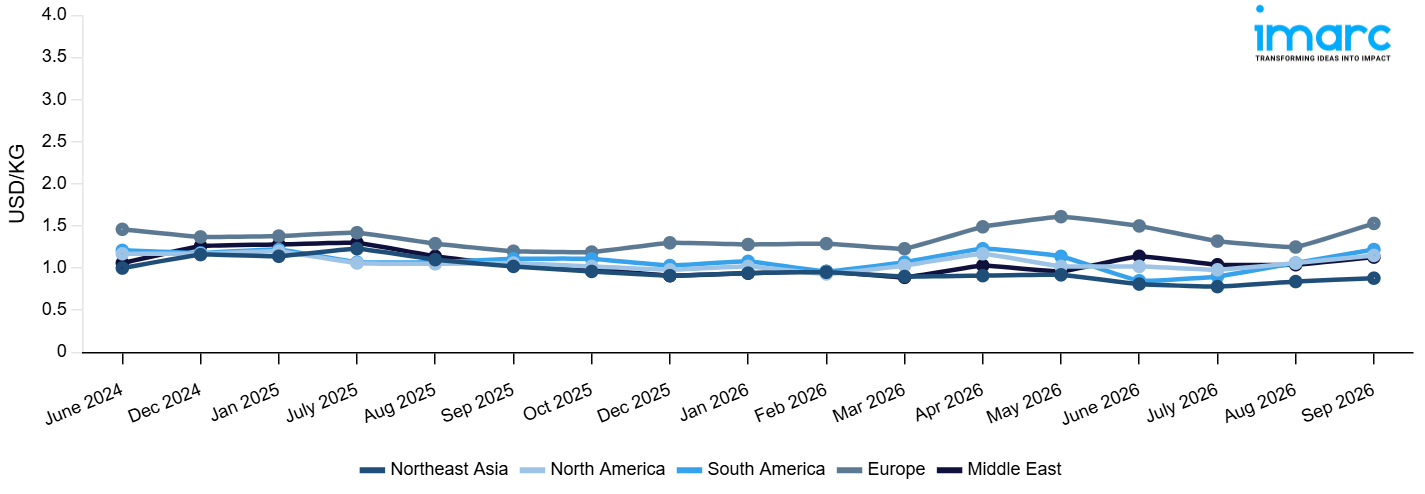
Diethanolamine (DEA) Price Index (USD/KG):
The chart below highlights monthly diethanolamine (DEA) prices across different regions.
Get Access to Monthly/Quarterly/Yearly Prices, Request Sample
Market Overview Q1 Ending March 2026
Northeast Asia: The diethanolamine (DEA) prices in Northeast Asia reached 0.90 USD/KG in March 2026. The downward pricing movement registered between December and March 2026 was 1.1%. Marginally softening demand from the surfactant, agrochemical, and gas treatment sectors tempered procurement activity and contributed to mild bearish conditions across Northeast Asian markets throughout the review period. Adequate domestic production output from regional ethylene oxide and ammonia based manufacturing facilities maintained sufficient supply conditions and placed modest downward pressure on prevailing DEA market rates during the quarter. Slightly declining upstream ethylene oxide feedstock costs at key producing facilities reduced manufacturing expenses and weakened the cost support for existing price levels.
Europe: The diethanolamine (DEA) prices in Europe reached 1.23 USD/KG in March 2026. The downward pricing movement registered between December and March 2026 was 5.4%. Weakened demand from the surfactant, personal care, and gas treatment manufacturing sectors reduced procurement activity and contributed to bearish DEA market conditions across European markets throughout the review period. Competitive import cargo availability from Asian and Middle Eastern supplying nations exerted consistent downward pressure on prevailing European market rates, limiting regional producers' ability to sustain existing price levels during the quarter. Declining upstream ethylene oxide and ammonia feedstock costs at regional production facilities reduced manufacturing expenses and eroded the cost floor supporting prevailing regional DEA price levels.
South America: The diethanolamine (DEA) prices in South America reached 1.07 USD/KG in March 2026. The upward pricing movement registered between December and March 2026 was 3.9%. The slightly increased purchase requirements from the agrochemical, surfactant, and gas treatment industries offered some procurement assistance and led to moderately favorable pricing dynamics within the South American markets during the evaluation period. The small increase in the feedstock prices for ethylene oxide and ammonia in the local production plants and the importing countries raised some additional costs for DEA production and reinforced the current marginal increase in pricing trends during the period under review.
Middle East: The diethanolamine (DEA) prices in the Middle East reached 0.89 USD/KG in March 2026. The downward pricing movement registered between December and March 2026 was 2.2%. Marginally softening export demand from Asian and European importing regions reduced DEA offtake volumes and contributed to mild bearish pricing conditions across Middle Eastern markets throughout the review period. Adequate regional production output from ethylene oxide based manufacturing facilities maintained sufficient supply conditions and placed modest downward pressure on prevailing market rates during the quarter. Slightly declining upstream ethylene oxide and ammonia feedstock costs at regional production facilities lowered manufacturing expenses and reduced the cost floor supporting existing DEA price levels.
North America: The diethanolamine (DEA) prices in North America reached 1.03 USD/KG in March 2026. The upward pricing movement registered between December and March 2026 was 5.1%. During the review period, active DEA procurement and strong pricing conditions across North American markets were driven by strong demand from the surfactant, gas treatment, and agrochemical manufacturing sectors. During the quarter, the cost of raw materials such as ethylene oxide and ammonia at domestic production facilities increased. This raised manufacturing costs and kept regional market rates going up. Tightening the availability of domestic DEA production due to seasonal changes in operations at key manufacturing facilities, limited supply and increased demand from downstream chemical and agricultural buyers.
Market Overview Q4 Ending December 2025
Northeast Asia: The diethanolamine (DEA) prices in Northeast Asia reached 0.91 USD/KG in December 2025. The downward pricing movement registered between September and December 2025 was 11.0%. The significant price decline was primarily driven by weakened downstream demand from the personal care surfactant, gas sweetening, and herbicide formulation sectors, which moderated procurement volumes amid subdued industrial activity across the region. Declining upstream ethylene oxide and ammonia feedstock costs further eroded production cost support for regional manufacturers. Elevated inventory levels among major producers intensified competitive discounting strategies to accelerate stock clearance, while surplus production capacity from expanded ethanolamine facilities amplified supply-side pressure.
Europe: The diethanolamine (DEA) prices in Europe reached 1.30 USD/KG in December 2025. The upward pricing movement registered between September and December 2025 was 8.3%. Growing upstream ethylene oxide feedstock costs were the main cause of the notable price increase, which raised production costs for local firms throughout the quarter. Regional availability was further limited by tighter supply conditions resulting from planned maintenance turnarounds at key ethanolamine production facilities. In the face of steady downstream consumption trends, strong procurement activity was sustained by demand from the gas treatment, personal care formulation, and agrochemical industries. Furthermore, higher energy costs associated with amination processes reinforced upward cost pressures across the supply chain, and buyers' sourcing flexibility was constrained by limited import options due to firm international pricing and freight costs, sustaining bullish pricing momentum throughout the quarter.
South America: The diethanolamine (DEA) prices in South America reached 1.03 USD/KG in December 2025. The downward pricing movement registered between September and December 2025 was 7.1%. The notable price decline was attributed to subdued demand from the personal care, detergent, and gas treatment chemical sectors amid broader economic slowdown and reduced industrial manufacturing activity across the region. Softening upstream ethylene oxide and ammonia feedstock costs reduced import cost assessments, enabling downward pricing adjustments. Increased import availability from competitively priced cargoes exerted additional downward pressure on prevailing market rates, while elevated stockpile positions among key distributors dampened restocking urgency.
Middle East: The diethanolamine (DEA) prices in the Middle East reached 0.91 USD/KG in December 2025. The downward pricing movement registered between September and December 2025 was 11.6%. Due to conservative industrial expenditure habits and decreased natural gas processing activity across the region, muted demand in the gas sweetening, oilfield chemical, and surfactant production sectors contributed to the notable price decline. Regional manufacturers' production cost benchmarks were further reduced by the softening of upstream ethylene oxide and ammonia feedstock costs. Elevated inventory levels among major distributors led to competitive pricing reductions to stimulate buyer interest, while ample supply from established suppliers increased downward pricing pressure on prevailing market rates.
North America: The diethanolamine (DEA) prices in North America reached 0.98 USD/KG in December 2025. The downward pricing movement registered between September and December 2025 was 7.2%. The notable price decline was driven by weakened demand from the gas treatment, personal care surfactant, and herbicide formulation sectors amid softening end-market conditions and restrained industrial activity across the region. Declining upstream ethylene oxide and ammonia feedstock costs substantially diminished production cost support for domestic manufacturers, facilitating downward pricing adjustments. Adequate domestic production capacity maintained comfortable supply availability, while increased import competition from competitively priced cargoes further dampened prevailing market rates.
Market Overview Q3 Ending September 2025
Northeast Asia: In Northeast Asia, diethanolamine prices declined due to subdued demand from the surfactants and herbicides industries. Abundant feedstock availability from ethylene oxide supported steady production rates, creating excess supply conditions. The diethanolamine price index reflected cautious procurement activity as downstream demand in detergents and agrochemicals remained muted, keeping prices under sustained downward pressure.
Europe: In Europe, diethanolamine prices weakened amid sluggish consumption from the personal care and gas treatment industries. Ample supply levels combined with competitive imports from Asia contributed to the bearish trend. The diethanolamine price index highlighted limited procurement momentum, while easing production costs reinforced the decline in regional pricing this quarter.
South America: In South America, diethanolamine prices increased as healthy demand from the agrochemicals and detergents sectors drove procurement activity. The diethanolamine price index captured strong regional consumption, supported by seasonal requirements in agriculture. Limited supply disruptions in distribution networks added marginal upward pressure, resulting in a positive pricing trajectory despite global bearish sentiment.
Middle East: In the Middle East, diethanolamine prices dropped sharply as feedstock supply remained steady while demand from gas treatment and surfactant industries softened. The diethanolamine price index reflected excess availability and weak export activity, with cautious buying patterns from downstream consumers reinforcing the downward pressure on prices across the region.
North America: In North America, diethanolamine prices showed slight gains as stable demand from detergents and gas sweetening applications supported market activity. The diethanolamine price index indicated balanced supply-demand fundamentals, with consistent ethylene oxide feedstock availability helping to stabilize production costs. Overall, prices trended marginally upward, reflecting steady industrial consumption.
Diethanolamine (DEA) Price Trend, Market Analysis, and News
IMARC's latest publication, “Diethanolamine (DEA) Prices, Trend, Chart, Demand, Market Analysis, News, Historical and Forecast Data Report 2026 Edition,” presents a detailed examination of the diethanolamine (DEA) market, providing insights into both global and regional trends that are shaping prices. This report delves into the spot price of diethanolamine (DEA) at major ports and analyzes the composition of prices, including FOB and CIF terms. It also presents detailed diethanolamine (DEA) prices trend analysis by region, covering North America, Europe, Asia Pacific, Latin America, and Middle East and Africa. The factors affecting diethanolamine (DEA) pricing, such as the dynamics of supply and demand, geopolitical influences, and sector-specific developments, are thoroughly explored. This comprehensive report helps stakeholders stay informed with the latest market news, regulatory updates, and technological progress, facilitating informed strategic decision-making and forecasting.
Diethanolamine (DEA) Industry Analysis
The global diethanolamine (DEA) industry size reached 564.5 Thousand Tons in 2025. By 2034, IMARC Group expects the market to reach 755.5 Thousand Tons, at a projected CAGR of 3.19% during 2026-2034. Growth is driven by rising demand for diethanolamine in the production of surfactants, detergents, agrochemicals, and gas treatment applications, supported by its versatility as an intermediate in chemical formulations.
Latest developments in the Diethanolamine (DEA) Industry:
- July 2025: Godrej Consumer Products Ltd. announced plans to more than double the scale of its liquid detergent brand Godrej Fab to achieve INR 500 crore in revenue by FY26. Since diethanolamine is widely used in the production of detergents, this expansion highlights increasing demand for such chemical inputs. The company also aims to expand rural outreach and enhance global market penetration.
- February 2023: Chemanol signed a joint venture agreement with Global Company for Downstream Industries (GDI) to form a national company producing several specialized chemicals, including diethanolamine.
- February 2023: Nippon Shokubai Co., Ltd. obtained ISCC PLUS certification for 19 products, among them diethanolamine, enabling production and marketing of certified low-impact products using biomass-derived raw materials under mass balance.
Product Description
Diethanolamine (DEA) is a colorless, viscous liquid organic compound with the chemical formula HN(C₂H₄OH)₂. It is produced through the reaction of ethylene oxide with ammonia and is classified as both a secondary amine and a diol, giving it amphiphilic properties. DEA is widely used in the manufacture of surfactants, emulsifiers, and corrosion inhibitors. It plays a critical role in detergents, shampoos, and other personal care products, while also being employed in gas treatment processes to remove hydrogen sulfide and carbon dioxide. In agriculture, diethanolamine is utilized in herbicide formulations and other agrochemical intermediates. Its chemical versatility and broad industrial applications underscore its importance in global chemical supply chains.
Report Coverage
| Key Attributes | Details |
|---|---|
| Product Name | Diethanolamine (DEA) |
| Report Features | Exploration of Historical Trends and Market Outlook, Industry Demand, Industry Supply, Gap Analysis, Challenges, Diethanolamine (DEA) Price Analysis, and Segment-Wise Assessment. |
| Currency/Units | US$ (Data can also be provided in local currency) or Metric Tons |
| Region/Countries Covered | The current coverage includes analysis at the global and regional levels only. Based on your requirements, we can also customize the report and provide specific information for the following countries: Asia Pacific: China, India, Indonesia, Pakistan, Bangladesh, Japan, Philippines, Vietnam, Thailand, South Korea, Malaysia, Nepal, Taiwan, Sri Lanka, Hongkong, Singapore, Australia, and New Zealand Europe: Germany, France, United Kingdom, Italy, Spain, Russia, Turkey, Netherlands, Poland, Sweden, Belgium, Austria, Ireland, Switzerland, Norway, Denmark, Romania, Finland, Czech Republic, Portugal and Greece North America: United States and Canada Latin America: Brazil, Mexico, Argentina, Columbia, Chile, Ecuador, and Peru Middle East & Africa: Saudi Arabia, UAE, Israel, Iran, South Africa, Nigeria, Oman, Kuwait, Qatar, Iraq, Egypt, Algeria, and Morocco The list of countries presented is not exhaustive. Information on additional countries can be provided if required by the client. |
| Information Covered for Key Suppliers |
|
| Customization Scope | The report can be customized as per the requirements of the customer |
| Report Price and Purchase Option |
Plan A: Monthly Updates - Annual Subscription
Plan B: Quarterly Updates - Annual Subscription
Plan C: Biannually Updates - Annual Subscription
|
| Post-Sale Analyst Support | 360-degree analyst support after report delivery |
| Delivery Format | PDF and Excel through email (We can also provide the editable version of the report in PPT/Word format on special request) |
Key Benefits for Stakeholders:
- IMARC’s report presents a detailed analysis of diethanolamine (DEA) pricing, covering global and regional trends, spot prices at key ports, and a breakdown of Ex Works, FOB, and CIF prices.
- The study examines factors affecting diethanolamine (DEA) price trend, including raw material costs, supply-demand shifts, geopolitical impacts, and industry developments, offering insights for informed decision-making.
- The competitive landscape review equips stakeholders with crucial insights into the latest market news, regulatory changes, and technological advancements, ensuring a well-rounded, strategic overview for forecasting and planning.
- IMARC offers various subscription options, including monthly, quarterly, and biannual updates, allowing clients to stay informed with the latest market trends, ongoing developments, and comprehensive market insights, ensuring they remain at the forefront of the diethanolamine (DEA) industry.
Frequently Asked Questions About the Diethanolamine (DEA) Price Trend Report
The diethanolamine prices in September 2026 were 0.88 USD/Kg in Northeast Asia, 1.53 USD/Kg in Europe, 1.22 USD/Kg in South America, 1.13 USD/Kg in Middle East, and 1.15 USD/Kg in North America.
The diethanolamine (DEA) pricing data is updated on a monthly basis.
We provide the pricing data primarily in the form of an Excel sheet and a PDF.
Yes, our report includes a forecast for diethanolamine (DEA) prices.
The regions covered include North America, Europe, Asia Pacific, Middle East, and Latin America. Countries can be customized based on the request (additional charges may be applicable).
Yes, we provide both FOB and CIF prices in our report.
Need more help?
- Speak to our experienced analysts for insights on the current market scenarios.
- Include additional segments and countries to customize the report as per your requirement.
- Gain an unparalleled competitive advantage in your domain by understanding how to utilize the report and positively impacting your operations and revenue.
- For further assistance, please connect with our analysts.
 Request Customization
 Inquire Before Buying
 Speak to an Analyst
 Request Brochure
Benefits of Customization
- Personalize this research
- Triangulate with your data
- Get data as per your format and definition
- Gain a deeper dive into a specific application, geography, customer, or competitor
- Any level of personalization
Get in Touch With Us
UNITED STATES
Phone: +1-201-971-6302
INDIA
Phone: +91-120-433-0800
UNITED KINGDOM
Phone: +44-753-714-6104
Email: [email protected]
Client Testimonials




.webp)




.webp)













Related Reports

Why Choose Us
IMARC offers trustworthy, data-centric insights into commodity pricing and evolving market trends, enabling businesses to make well-informed decisions in areas such as procurement, strategic planning, and investments. With in-depth knowledge spanning more than 1000 commodities and a vast global presence in over 150 countries, we provide tailored, actionable intelligence designed to meet the specific needs of diverse industries and markets.
1000
+Commodities
150
+Countries Covered
3000
+Clients
20
+Industry

Robust Methodologies & Extensive Resources
IMARC delivers precise commodity pricing insights using proven methodologies and a wealth of data to support strategic decision-making.

Subscription-Based Databases
Our extensive databases provide detailed commodity pricing, import-export trade statistics, and shipment-level tracking for comprehensive market analysis.

Primary Research-Driven Insights
Through direct supplier surveys and expert interviews, we gather real-time market data to enhance pricing accuracy and trend forecasting.

Extensive Secondary Research
We analyze industry reports, trade publications, and market studies to offer tailored intelligence and actionable commodity market insights.
Trusted by 3000+ industry leaders worldwide to drive data-backed decisions. From global manufacturers to government agencies, our clients rely on us for accurate pricing, deep market intelligence, and forward-looking insights.