
Digital Manufacturing Market Size, Share, Trends and Forecast by Component, Process Type, Application, and Region, 2026-2034
Digital Manufacturing Market Size and Share:
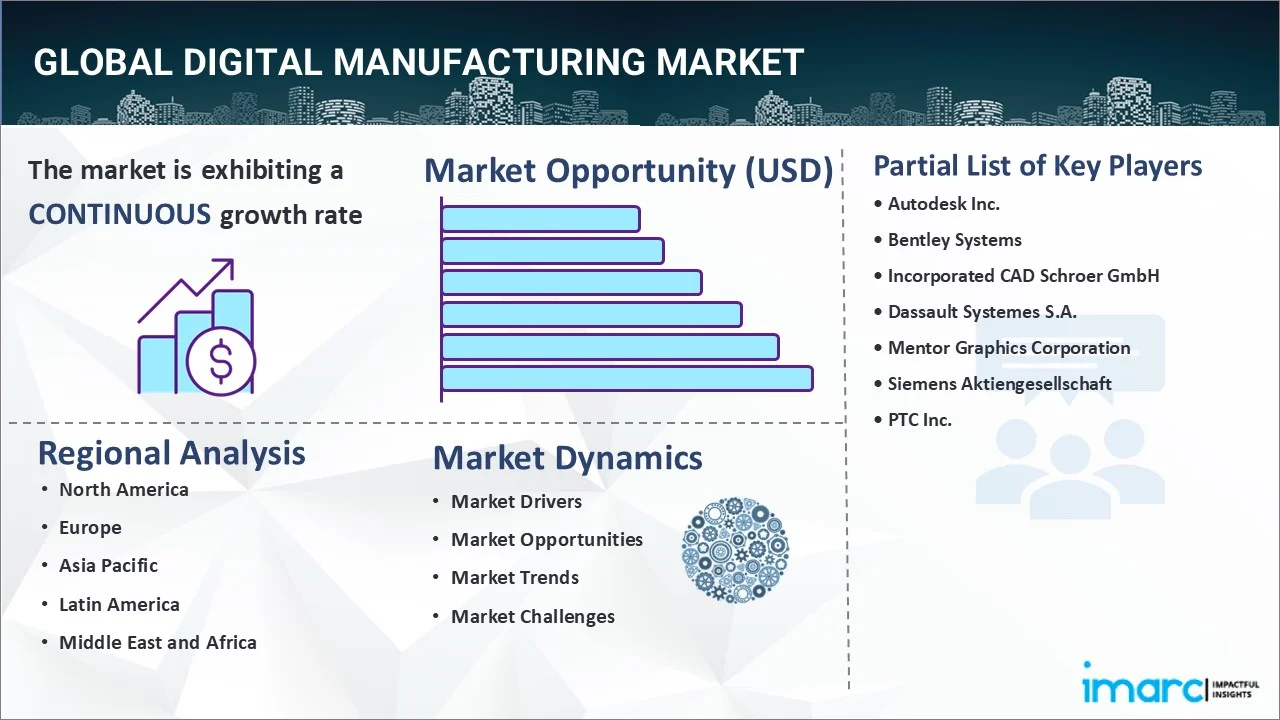
The global digital manufacturing market size was valued at USD 649.34 Billion in 2025. Looking forward, IMARC Group estimates the market to reach USD 2,215.22 Billion by 2034, exhibiting a CAGR of 12.67% from 2026-2034. North America currently dominates the market, holding a market share of 36.5% in 2025. The region benefits from substantial investments in advanced manufacturing technologies, the presence of leading industrial software providers, widespread adoption of automation and cloud-based production platforms, and strong government initiatives supporting reshoring and smart factory development, all contributing to the digital manufacturing market share.
The increasing integration of Industry 4.0 technologies across manufacturing operations worldwide is a primary driver influencing the market. Manufacturers are rapidly adopting digital tools, such as industrial Internet of Things (IoT) sensors, artificial intelligence (AI), advanced analytics, and cloud-based production management systems to enhance operational efficiency and reduce downtime. The growing need for real-time data visibility across production floors and supply chains is accelerating investments in connected factory solutions. Additionally, the rising demand for product customization and shorter time-to-market cycles is encouraging manufacturers to embrace simulation-driven design and digital twin technologies. Sustainability mandates and energy efficiency regulations are further encouraging organizations to deploy digitalized processes that optimize resource consumption and minimize waste.
The United States is strengthening its position as a major region in the digital manufacturing market due to its advanced technological infrastructure, strong research ecosystem, and continuous investment in next-generation manufacturing capabilities. The country benefits from close collaboration between universities, technology companies, and industrial manufacturers, which accelerates the development and adoption of emerging digital technologies. Government support for research initiatives further encourages innovation in areas such as digital twins, industrial automation, and data-driven production systems. Reflecting this momentum, in 2025, Arizona State University and the University of Michigan jointly launched the Center for Digital Twins in Manufacturing with support from the U.S. National Science Foundation. The center focused on developing advanced digital twin technologies to improve monitoring, simulation, and optimization of manufacturing operations. It also planned to establish smart manufacturing testbeds and train future engineers in robotics, digital manufacturing systems, and industrial IoT applications, strengthening the nation’s leadership in advanced manufacturing innovation.
To get more information on this market Request Sample
Digital Manufacturing Market Trends:
Growth of Integrated Digital Platforms for Rapid Manufacturing Workflows
The rise of integrated digital platforms that connect design, quoting, and manufacturing processes is transforming how engineers and manufacturers manage production workflows. These systems enable seamless collaboration between product design teams and manufacturing service providers, significantly reducing the time required to move from concept to production. Digital platforms capable of automatically analyzing CAD files, estimating costs, and generating production schedules allow manufacturers to accelerate prototyping and streamline low-volume production. By combining design validation, material selection, and process planning within a single environment, these tools improve transparency and decision-making throughout the manufacturing lifecycle. Reflecting this shift, in 2025, ProtoSoon introduced an online instant-quote platform that allows engineers to upload CAD models, select manufacturing processes and materials, and receive immediate pricing and lead-time estimates. Such platforms simplify production planning and enable faster transition from prototype development to scaled manufacturing, strengthening efficiency in modern digital manufacturing ecosystems.
Integration of Model-Based Metrology for Enhanced Quality Control
The growing adoption of model-based metrology systems that integrate quality inspection directly into digital production environments is offering a favorable digital manufacturing market outlook. Manufacturers are moving toward data-driven quality assurance processes that connect product design, measurement, and production verification through a unified digital workflow. This approach allows manufacturers to detect deviations early, improve part accuracy, and ensure consistent compliance with engineering specifications. Advanced metrology platforms also enable automated inspection routines and real-time feedback loops that help maintain repeatable process control across manufacturing operations. Reflecting this trend, in 2025, Verisurf Software released Verisurf 2026, an upgraded model-based metrology platform designed to strengthen inspection, measurement, and analysis within digital manufacturing environments. The system integrates design data with production workflows to support accurate part verification and continuous quality monitoring. With improved interoperability and automation capabilities, such solutions help manufacturers reduce operational costs, enhance productivity, and maintain consistent product quality across increasingly complex manufacturing processes.
Expansion of Collaborative Industry 4.0 Innovation Centers
The establishment of dedicated innovation labs and collaborative research centers is emerging as a major trend impelling the digital manufacturing market growth. Technology companies and engineering service providers are creating specialized facilities where advanced technologies can be tested, demonstrated, and implemented in real industrial environments. These centers bring together expertise in AI, digital engineering, IoT, and advanced manufacturing systems to develop integrated solutions for modern production challenges. Such initiatives support rapid prototyping, experimentation, and industry collaboration, enabling companies to evaluate new digital tools before large-scale implementation. In 2024, Tata Consultancy Services launched the Bringing Life to Things IoT Engineering Lab in Cincinnati, Ohio, designed to accelerate development of AI, generative AI, and IoT-driven industrial solutions. The facility included the TCS Digital Manufacturing Platform along with connected manufacturing tools and engineering technologies for sectors, such as manufacturing, energy, and life sciences. These innovation hubs help organizations accelerate digital transformation and strengthen Industry 4.0 adoption across global manufacturing networks.
Digital Manufacturing Industry Segmentation:
IMARC Group provides an analysis of the key trends in each segment of the global digital manufacturing market, along with forecast at the global, regional, and country levels from 2026-2034. The market has been categorized based on component, process type, and application.
Analysis by Component:
To get detailed segment analysis of this market Request Sample
- Software
- Services
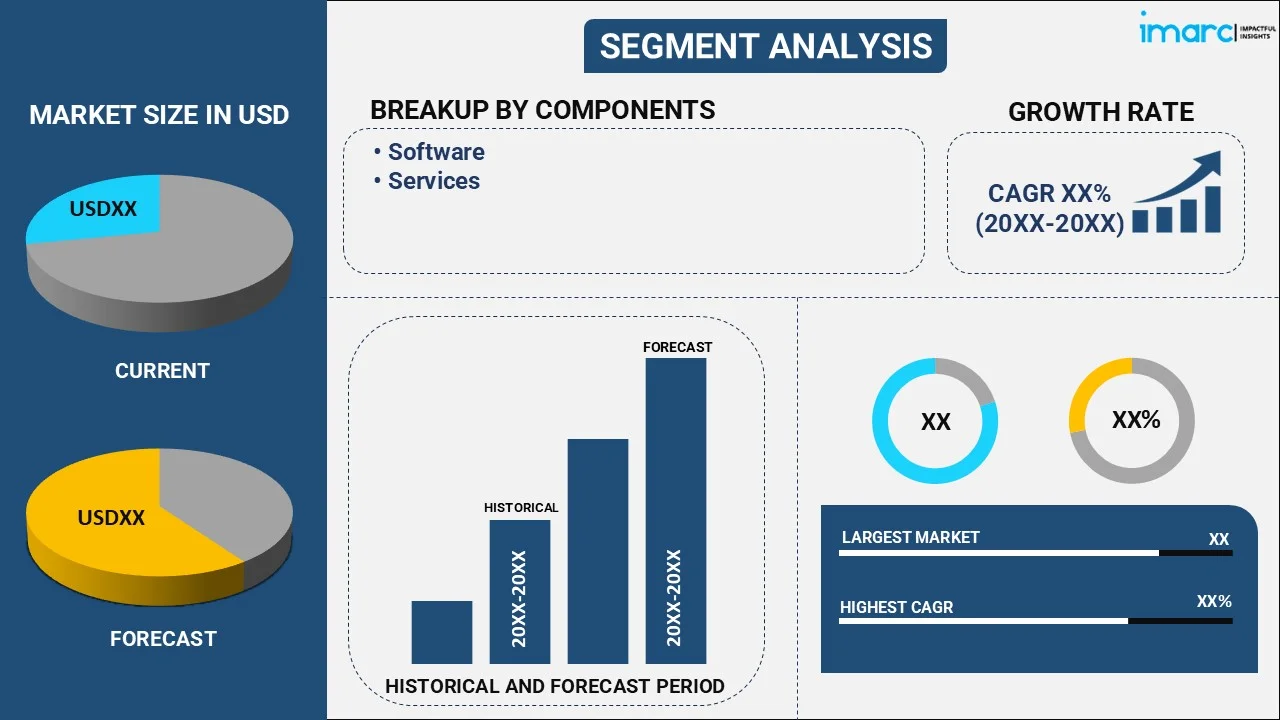
Software holds 62.5% of the market share. Software solutions in the digital manufacturing market encompass a broad range of tools, including computer-aided design, manufacturing execution systems, product lifecycle management platforms, and enterprise resource planning applications that enable end-to-end digitalization of production workflows. These platforms facilitate seamless data exchange between design, engineering, and manufacturing teams, enabling faster product development cycles and improved quality control. The increasing demand for cloud-based and subscription-based software models is expanding accessibility across organizations of all sizes, supporting broader industry adoption. For instance, in March 2025, Siemens completed the acquisition of Altair Engineering Inc. to strengthen its portfolio of AI-powered industrial and simulation software. The move supported advanced digital manufacturing and product development by enabling companies to design, test, and optimize complex industrial systems more efficiently. Digital manufacturing market forecast indicates continued expansion of software-driven manufacturing ecosystems as industries increasingly adopt integrated digital engineering and production management platforms.
Analysis by Process Type:
- Computer-Based Designing
- Computer-Based Simulation
- Computer 3D Visualization
- Analytics
- Others
Computer-based simulation holds a leading position in the market with a share of 30.0%, as manufacturers increasingly rely on virtual environments to design, analyze, and optimize industrial processes before physical deployment. These simulation tools enable engineers to create digital models of production systems, evaluate operational scenarios, and validate design modifications while minimizing development costs and shortening product development cycles. Applications such as structural analysis, thermal modeling, computational fluid dynamics, and electromagnetic simulation support precision engineering across multiple industries. Reflecting the expanding role of these technologies, Virtualware announced that it would present its industrial simulation and XR solutions at Hannover Messe 2025, including the Simumatik platform designed to simulate and test industrial systems in virtual environments prior to implementation. Integrated with the VIROO XR platform, the solution enables immersive interaction with digital twins and automation systems, helping manufacturers enhance training, improve system design, and increase operational efficiency through advanced digital manufacturing capabilities.
Analysis by Application:
- Automation and Transportation
- Aerospace and Defense
- Consumer Electronics
- Utilities and Processes
- Industrial Machinery
- Others
Industrial machinery dominates the market, accounting for a 38.0% share due to the sector’s increasing reliance on advanced production technologies to enhance operational efficiency and equipment reliability. The segment includes the use of digital tools in the design, production, and lifecycle management of heavy equipment, machine tools, and automated manufacturing systems used across diverse industries. Companies are adopting digital manufacturing processes to improve machining precision, streamline assembly operations, and shorten product development cycles. Integration of sensor networks, IoT connectivity, and data-driven analytics allows manufacturers to monitor machine performance in real time and detect potential faults before failure occurs. Predictive maintenance systems reduce unplanned downtime and extend equipment lifespan, while digital simulations enable optimized production planning and design validation. As industries continue to prioritize automation, quality control, and cost efficiency, digital manufacturing technologies are becoming central to the modernization of industrial machinery production and maintenance operations. These advancements reflect broader digital manufacturing market trends shaping industrial equipment modernization.
Regional Analysis:
To get more information on the regional analysis of this market Request Sample
- North America
- United States
- Canada
- Asia Pacific
- China
- Japan
- India
- South Korea
- Australia
- Indonesia
- Others
- Europe
- Germany
- France
- United Kingdom
- Italy
- Spain
- Russia
- Others
- Latin America
- Brazil
- Mexico
- Others
- Middle East and Africa
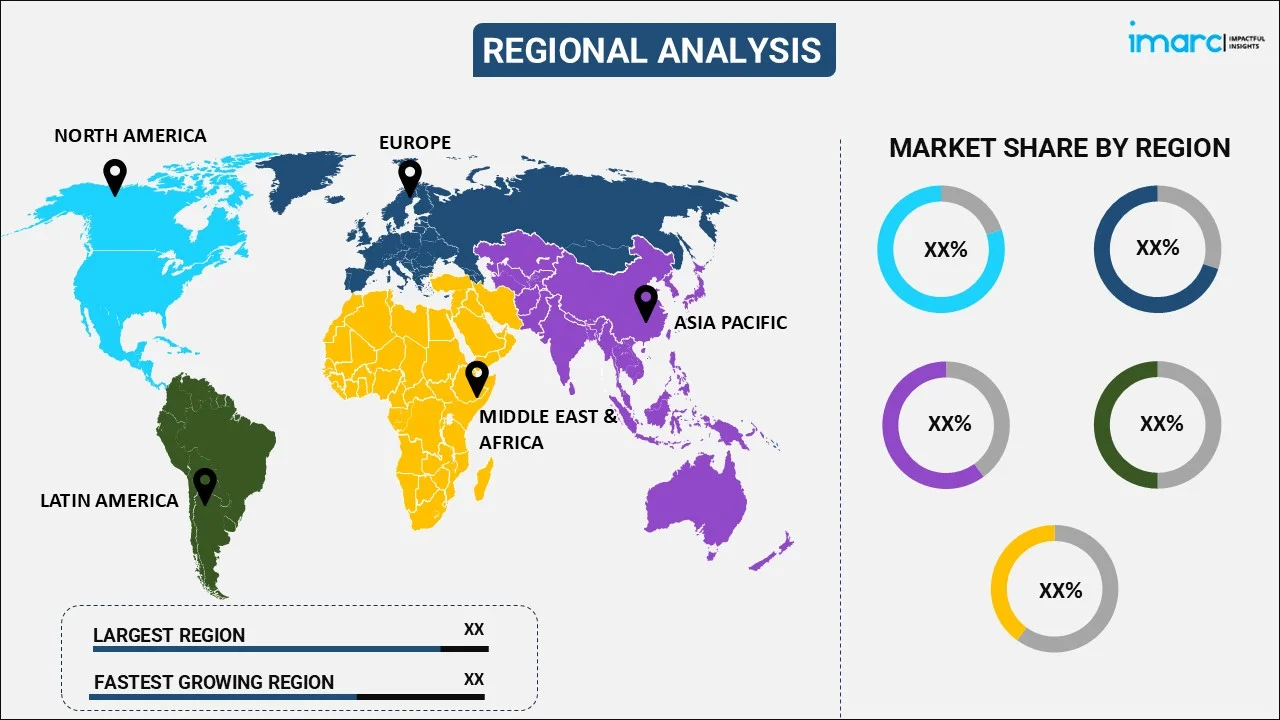
North America holds the leading position in the market, accounting for 36.5% of the total share, supported by its advanced technological infrastructure and strong ecosystem of industrial software developers and technology providers. The region benefits from widespread adoption of cloud computing, artificial intelligence, and Industry 4.0 solutions that enable manufacturers to improve production efficiency and operational visibility. Strong research capabilities, high investment in digital engineering, and close collaboration between technology firms and manufacturing enterprises further reinforce regional leadership. Reflecting this momentum, in 2025, L&T Technology Services established a new Engineering Design Center in Plano, Texas, dedicated to advancing artificial intelligence, cybersecurity, and digital manufacturing technologies. The facility focuses on developing Industry 4.0 solutions including smart factory platforms and digital engineering tools. Expected to create more than 350 high-skilled jobs, the center highlights growing investment in digital innovation and strengthens North America’s role as a major hub for advanced manufacturing technology development.
Key Regional Takeaways:
United States Digital Manufacturing Market Analysis
The United States represents a major contributor to the digital manufacturing market owing to strong investment in automation technologies, AI–enabled production systems, and advanced industrial software platforms. Manufacturers across sectors are adopting integrated digital tools to improve production visibility, enhance process control, and increase operational efficiency. The presence of leading technology developers, combined with large-scale industrial investment, supports rapid deployment of smart manufacturing solutions across the country. Reflecting this trend, in 2024, Panasonic Connect North America introduced the Syncora Digital Manufacturing Platform (SyncoraDMP) to support the expanding electric vehicle (EV) battery manufacturing industry in the United States. The platform integrated digital manufacturing capabilities, including real-time analytics, traceability systems, and quality management tools, that help manufacturers monitor production processes more effectively. Designed as a modular and scalable solution, SyncoraDMP enabled manufacturers to streamline operations, reduce production disruptions, and strengthen data-driven decision-making. As industries continue to adopt advanced digital systems to support complex manufacturing operations, such technological platforms are accelerating the transition toward fully connected and intelligent production environments across the United States.
Europe Digital Manufacturing Market Analysis
Europe represents a major contributor to the digital manufacturing market, supported by its strong industrial base, advanced engineering capabilities, and coordinated digital transformation initiatives across manufacturing sectors. The region has prioritized Industry 4.0 adoption through investments in automation, AI, and data-driven production technologies to enhance manufacturing efficiency and sustainability. Governments and industrial organizations are encouraging collaboration between technology providers, research institutes, and manufacturers to accelerate innovation in smart factory systems. Reflecting these efforts, in 2025, CNH completed the three-year Accelerator Project at its Zedelgem plant in Belgium in partnership with Flanders Make and other industry stakeholders. Backed by a €150 million investment in digital technologies, the initiative introduced advanced automation, AI-based quality inspection, and flexible production systems designed to improve operational performance. The project also strengthened the plant’s ability to support digitally connected manufacturing processes. Such initiatives highlight Europe’s continued focus on integrating advanced digital technologies within industrial operations, reinforcing the region’s leadership in smart manufacturing and Industry 4.0 development.
Asia-Pacific Digital Manufacturing Market Analysis
Asia-Pacific is emerging as a vital contributor to the digital manufacturing market, because of extensive industrialization, strong government initiatives promoting digital transformation, and a large manufacturing base across key economies. The region is witnessing increasing adoption of Industry 4.0 technologies as companies seek to enhance productivity, optimize production processes, and strengthen global competitiveness. Collaboration between technology providers and engineering service companies is accelerating the deployment of advanced digital manufacturing solutions. Reflecting this trend, in 2025, L&T Technology Services partnered with Autodesk to establish an AI-led Digital Manufacturing Center of Excellence in Vadodara, India. The facility integrated Autodesk’s cloud-based design platforms with LTTS’ AI models to support digital transformation across sectors, including automotive, pharmaceuticals, FMCG, and chemicals. By enabling digital twin deployment and improving asset performance monitoring, such initiatives help reduce project costs and implementation timelines, reinforcing Asia-Pacific’s role as a growing hub for advanced manufacturing innovation.
Latin America Digital Manufacturing Market Analysis
Latin America is witnessing increasing adoption of digital manufacturing technologies as regional industries pursue modernization and improved competitiveness through Industry 4.0 initiatives. Governments and industrial organizations are encouraging the use of automation, advanced analytics, and connected production systems to strengthen manufacturing efficiency and integrate regional industries into global supply chains. Reflecting this momentum, Expo Manufactura 2026, one of Mexico’s largest industrial trade events, will highlight smart manufacturing technologies including robotics, automation, additive manufacturing, and Industry 4.0 solutions. Scheduled for February 3–5 in Monterrey and spanning a 30,000 m² exhibition area, the event will bring together manufacturers, technology providers, and industry experts. Such initiatives promote collaboration and knowledge exchange, helping accelerate the adoption of digital manufacturing practices across Latin American industrial sectors.
Middle East and Africa Digital Manufacturing Market Analysis
The Middle East and Africa region is gradually adopting digital manufacturing technologies as governments and industrial companies pursue economic diversification and modernization of manufacturing operations. Increasing investment in Industry 4.0 solutions, including data analytics, AI, and cloud-based systems, is helping companies improve productivity, safety, and operational transparency. Reflecting this transition, in 2024, Emirates Global Aluminium launched a digital manufacturing platform developed with Microsoft to strengthen its Industry 4.0 strategy. Built on Microsoft Azure hybrid cloud infrastructure, the system integrates AI and data analytics across EGA’s facilities in Jebel Ali and Al Taweelah. By processing large volumes of real-time operational data, the platform supports improved production efficiency, quality management, and digital transformation across the company’s manufacturing processes.
Competitive Landscape:
The digital manufacturing market features a competitive landscape characterized by significant consolidation activity, strategic partnerships, and continuous investment in R&D by leading technology providers. Major players are focusing on expanding their portfolios through acquisitions that enhance AI, simulation, and digital twin capabilities to offer comprehensive industrial software suites. Companies are increasingly adopting platform-based business models that integrate design, engineering, manufacturing, and service management into unified digital ecosystems. The shift toward cloud-native and subscription-based software delivery models is reshaping competitive dynamics, enabling providers to reach broader user segments, including small and medium-sized enterprises (SMEs). Strategic collaborations between software providers, hardware manufacturers, and telecommunications companies are creating turnkey smart factory solutions that bundle connectivity, analytics, and automation capabilities. Investments in specialized AI models trained on engineering and manufacturing data are emerging as key differentiators among market leaders seeking to establish long-term competitive advantages.
The report provides a comprehensive analysis of the competitive landscape in the digital manufacturing market with detailed profiles of all major companies, including:
- Autodesk Inc.
- Bentley Systems
- Incorporated CAD Schroer GmbH
- Dassault Systemes S.A
- Mentor Graphics Corporation
- PTC Inc.
- Siemens Aktiengesellschaft
Latest News and Developments:
- In February 2026, GMH Gruppe launched ProMateria, a start-up focused on advanced metal powder production and additive manufacturing using high-nitrogen alloyed steel. The company combines in-house powder production, metal 3D printing, and finishing processes to manufacture high-performance components for industries, such as aerospace, medical technology, and energy. The initiative supports GMH Gruppe’s shift from traditional steelmaking toward digital and additive manufacturing technologies.
- In February 2026, Protolabs launched ProDesk, a digital manufacturing platform designed to support product development with AI-powered quoting and design-for-manufacturability analysis. The platform enables engineers and procurement teams to configure quotes, manage production-ready parts, and collaborate on prototyping and manufacturing projects. ProDesk also offers real-time order tracking, documentation access, and technical support to streamline product development and production workflows.
Digital Manufacturing Market Report Scope:
| Report Features | Details |
|---|---|
| Base Year of the Analysis | 2025 |
| Historical Period | 2020-2025 |
| Forecast Period | 2026-2034 |
| Units | Billion USD |
| Scope of the Report | Exploration of Historical Trends and Market Outlook, Industry Catalysts and Challenges, Segment-Wise Historical and Future Market Assessment:
|
| Components Covered | Software, Services |
| Process Types Covered | Computer-Based Designing, Computer-Based Simulation, Computer 3D Visualization, Analytics, Others |
| Applications Covered | Automation and Transportation, Aerospace and Defense, Consumer Electronics, Utilities and Processes, Industrial Machinery, Others |
| Regions Covered | North America, Asia Pacific, Europe, Latin America, Middle East and Africa |
| Countries Covered | United States, Canada, China, Japan, India, South Korea, Australia, Indonesia, Germany, France, United Kingdom, Italy, Spain, Russia, Brazil, Mexico |
| Companies Covered | Autodesk Inc., Bentley Systems, Incorporated CAD Schroer GmbH, Dassault Systemes S.A., Mentor Graphics Corporation, Siemens Aktiengesellschaft, PTC Inc., etc. |
| Customization Scope | 10% Free Customization |
| Post-Sale Analyst Support | 10-12 Weeks |
| Delivery Format | PDF and Excel through Email (We can also provide the editable version of the report in PPT/Word format on special request) |
Key Benefits for Stakeholders:
- IMARC's report offers a comprehensive quantitative analysis of various market segments, historical and current market trends, market forecasts, and dynamics of the digital manufacturing market from 2020-2034.
- The research study provides the latest information on the market drivers, challenges, and opportunities in the global digital manufacturing market.
- The study maps the leading, as well as the fastest-growing, regional markets. It further enables stakeholders to identify the key country-level markets within each region.
- Porter's Five Forces analysis assists stakeholders in assessing the impact of new entrants, competitive rivalry, supplier power, buyer power, and the threat of substitution. It helps stakeholders to analyze the level of competition within the digital manufacturing industry and its attractiveness.
- Competitive landscape allows stakeholders to understand their competitive environment and provides an insight into the current positions of key players in the market.
Frequently Asked Questions About the Digital Manufacturing Market Size Report Report
The digital manufacturing market was valued at USD 649.34 Billion in 2025.
The digital manufacturing market is projected to exhibit a CAGR of 12.67% during 2026-2034, reaching a value of USD 2,215.22 Billion by 2034.
The digital manufacturing market is driven by the rising adoption of model-based metrology for real-time quality verification, expansion of Industry 4.0 innovation centers fostering collaborative technology development, and growing deployment of integrated digital platforms that connect design, engineering, quoting, and production processes within unified manufacturing ecosystems.
North America currently dominates the digital manufacturing market, accounting for a share of 36.5%. The region benefits from a mature technology infrastructure, the presence of leading industrial software providers, substantial investments in advanced manufacturing capabilities, and strong government support for reshoring and smart factory development initiatives.
Some of the major players in the digital manufacturing market include Autodesk Inc., Bentley Systems, Incorporated CAD Schroer GmbH, Dassault Systemes S.A, Mentor Graphics Corporation, PTC Inc., Siemens Aktiengesellschaft, etc.
Need more help?
- Speak to our experienced analysts for insights on the current market scenarios.
- Include additional segments and countries to customize the report as per your requirement.
- Gain an unparalleled competitive advantage in your domain by understanding how to utilize the report and positively impacting your operations and revenue.
- For further assistance, please connect with our analysts.
 Request Customization
 Speak to an Analyst
 Request Brochure
 Inquire Before Buying
Benefits of Customization
- Personalize this research
- Triangulate with your data
- Get data as per your format and definition
- Gain a deeper dive into a specific application, geography, customer, or competitor
- Any level of personalization
Get in Touch With Us
UNITED STATES
Phone: +1-201-971-6302
INDIA
Phone: +91-120-433-0800
UNITED KINGDOM
Phone: +44-753-714-6104
Email: [email protected]
Client Testimonials




.webp)




.webp)













Related Reports

Choose your plan
*Please note that the prices mentioned below are starting prices for each bundle type. Kindly contact our team for further details.*
Single User License
- 1 User License, Access on 2 Devices
- PDF Report + Excel Dataset (Password Protected)
- Lifetime Access
- No Printing Rights
- 10% Free Report Customization
- 10–12 Weeks of Analyst Support
Five User License
- Access for 5 Users, 2 Devices per User
- PDF Report + Excel Dataset (Password Protected)
- Lifetime Access
- Dedicated Account Manager
- 12–14 Weeks of Analyst Support
- No Printing Rights
- 15% Free Report Customization
- 25% Discount on Your Next Purchase
Corporate User License
- Unlimited User Access (Within Your Organization)
- PDF Report + Excel Dataset
- Lifetime Access
- Dedicated Account Manager
- 14–20 Weeks of Analyst Support
- No Printing Rights
- 20% Free Report Customization
- 30% Discount on Your Next Purchase
Essential Insights
What's included:
3 reports
- Lifetime Access
- PDF Reports
- Excel Datasets
- 2 Weeks of Free Analyst Support
- 2 User Licenses
- Access on 2 Devices
- Printing Rights
- Complimentary PowerPoint (PPT) Version
- Complimentary License Upgrade
Professional Access
What's included:
5 reports
- Lifetime Access
- PDF Reports
- Excel Datasets
- 8 Weeks of Free Analyst Support
- 2 User Licenses
- Access on 2 Devices
- Printing Rights
- Complimentary PowerPoint (PPT) Version
- Complimentary License Upgrade
Business Advantage
What's included:
8 reports
- Lifetime Access
- PDF Reports
- Excel Datasets
- 14 Weeks of Free Analyst Support
- 2 User Licenses
- Access on 2 Devices
- Printing Rights
- Complimentary PowerPoint (PPT) Version
- Complimentary License Upgrade
Enterprise Intelligence
What's included:
10 reports
- Lifetime Access
- PDF Reports
- Excel Datasets
- 20 Weeks of Free Analyst Support
- 2 User Licenses
- Access on 2 Devices
- Printing Rights
- Complimentary PowerPoint (PPT) Version
- Complimentary License Upgrade