
Digital Music Content Market Size, Share, Trends and Forecast by Type, Age Group, Application, and Region, 2026-2034
Digital Music Content Market Size and Share:
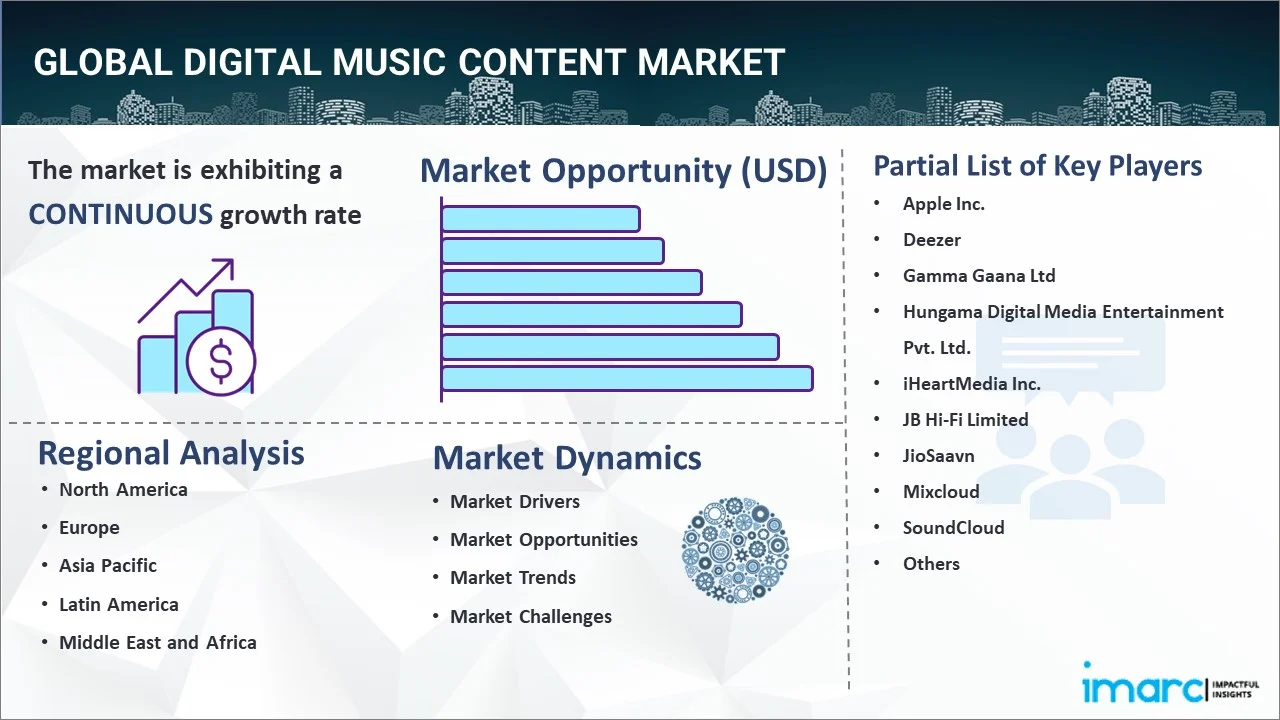
The global digital music content market size was valued at USD 25.56 Billion in 2025. Looking forward, IMARC Group estimates the market to reach USD 52.23 Billion by 2034, exhibiting a CAGR of 7.56% from 2026-2034. North America currently dominates the market, holding a market share of 34.6% in 2025. The region benefits from advanced digital infrastructure, high smartphone penetration, widespread broadband connectivity, and strong consumer preference for subscription-based streaming services, alongside the presence of leading global streaming platforms and robust music licensing frameworks that collectively drive the digital music content market share.
The global digital music content market is propelled by several converging factors that continue to reshape music consumption patterns worldwide. The rapid proliferation of smartphones and mobile internet connectivity has made on-demand music access ubiquitous across both developed and emerging economies. Shifting consumer preferences from physical media ownership to access-based digital streaming models have fundamentally altered how audiences engage with music content. The integration of artificial intelligence and machine learning algorithms into streaming platforms enables personalized music discovery and recommendation engines that enhance user engagement and retention. Furthermore, the expansion of high-speed internet infrastructure, including 5G networks, supports seamless high-fidelity audio streaming experiences. Strategic partnerships between telecommunications providers and music platforms through bundled subscription offerings are converting large user bases into paying subscribers. The growing popularity of podcasts and audiobooks on music platforms diversifies content offerings and extends daily listening time, creating additional digital music content market growth opportunities across multiple demographic segments.
The United States has emerged as a major region in the digital music content market owing to many factors. The country possesses a mature digital ecosystem characterized by high broadband penetration, advanced mobile infrastructure, and tech-savvy consumer demographics that favor digital music consumption. A strong culture of subscription-based services, supported by diverse pricing tiers and family plans, encourages widespread adoption across age groups. The presence of major music labels, independent distributors, and a vibrant artist community continuously enriches the available content catalog. Regulatory frameworks supporting intellectual property protection foster a stable environment for rights holders and platform operators. According to the RIAA, paid music streaming subscriptions in the United States surpassed 100 million accounts for the first time in H1 2025 and accounting for 84% of total recorded music revenue in the country.
To get more information on this market Request Sample
Digital Music Content Market Trends:
Rising Artificial Intelligence Integration
The integration of artificial intelligence into digital music content platforms is transforming how users discover, consume, and interact with music. AI-powered recommendation engines analyze listening patterns, contextual signals, and behavioral data to generate hyper-personalized playlists and daily mixes tailored to individual preferences. These sophisticated algorithms increase user engagement, extend session durations, and improve conversion rates from free to paid subscription tiers. Platforms are deploying natural language processing capabilities that allow users to create playlists through text-based prompts, further simplifying music discovery. AI tools are also being utilized for content moderation and fraud detection, identifying artificially generated or fraudulent uploads that undermine legitimate artists. Additionally, voice-activated assistants integrated within streaming applications enable hands-free music selection, enhancing accessibility for users during activities such as driving, exercising, and multitasking. The continuous refinement of machine learning models ensures that recommendations become increasingly accurate over time, fostering deeper listener loyalty and reducing churn rates across platforms. This technological evolution demonstrates the critical role AI plays in maintaining platform integrity while simultaneously enhancing personalized listening experiences.
Growing Spatial Audio Adoption
The adoption of spatial audio and immersive sound technologies is reshaping the digital music content landscape by delivering three-dimensional listening experiences that create a sense of presence and depth. Formats such as Dolby Atmos and spatial audio are becoming standard across major streaming platforms, with artists and producers increasingly releasing music in immersive formats to differentiate their content. Consumer electronics manufacturers are embedding spatial audio capabilities into headphones, earbuds, and smart speakers, making immersive listening accessible to mainstream audiences. Head-tracking technologies in compatible devices dynamically adjust sound positioning based on listener movement, creating a truly enveloping audio experience. The growing demand for higher-fidelity streaming has prompted platforms to introduce premium tiers featuring lossless and spatial audio options. Moreover, the integration of personalized head-related transfer function profiles allows devices to tailor spatial sound output based on individual ear anatomy, further enhancing audio realism. Music producers are also leveraging AI-assisted upmixing tools to convert legacy stereo recordings into spatial formats, expanding the catalog of immersive content available to listeners. These developments are accelerating digital music content market outlook improvements across the industry.
Expanding Subscription Model Innovation
Subscription model innovation is driving sustained growth in the digital music content market as platforms diversify their pricing structures and bundled offerings to capture broader audiences. The introduction of micro-subscriptions, weekly passes, and telecom-bundled plans is lowering entry barriers in price-sensitive emerging markets, converting previously ad-supported users into paying subscribers. Family and student plans provide cost-effective access for multiple users, while premium tiers offering high-fidelity audio and exclusive content command higher average revenue per user. Direct carrier billing solutions bypass traditional payment infrastructure limitations, expanding subscription accessibility in regions with low credit card penetration. Platforms are also experimenting with artist-centric payment models and superfan features that reward dedicated listeners with exclusive content and early releases. Additionally, the bundling of music streaming with complementary digital services such as video streaming, cloud storage, and gaming subscriptions is creating comprehensive entertainment ecosystems that increase perceived value and reduce subscriber churn. These evolving pricing strategies reflect the industry's focus on balancing affordability with revenue optimization across diverse global markets. This steady expansion fuels optimism for the digital music content market forecast trajectory.
Digital Music Content Industry Segmentation:
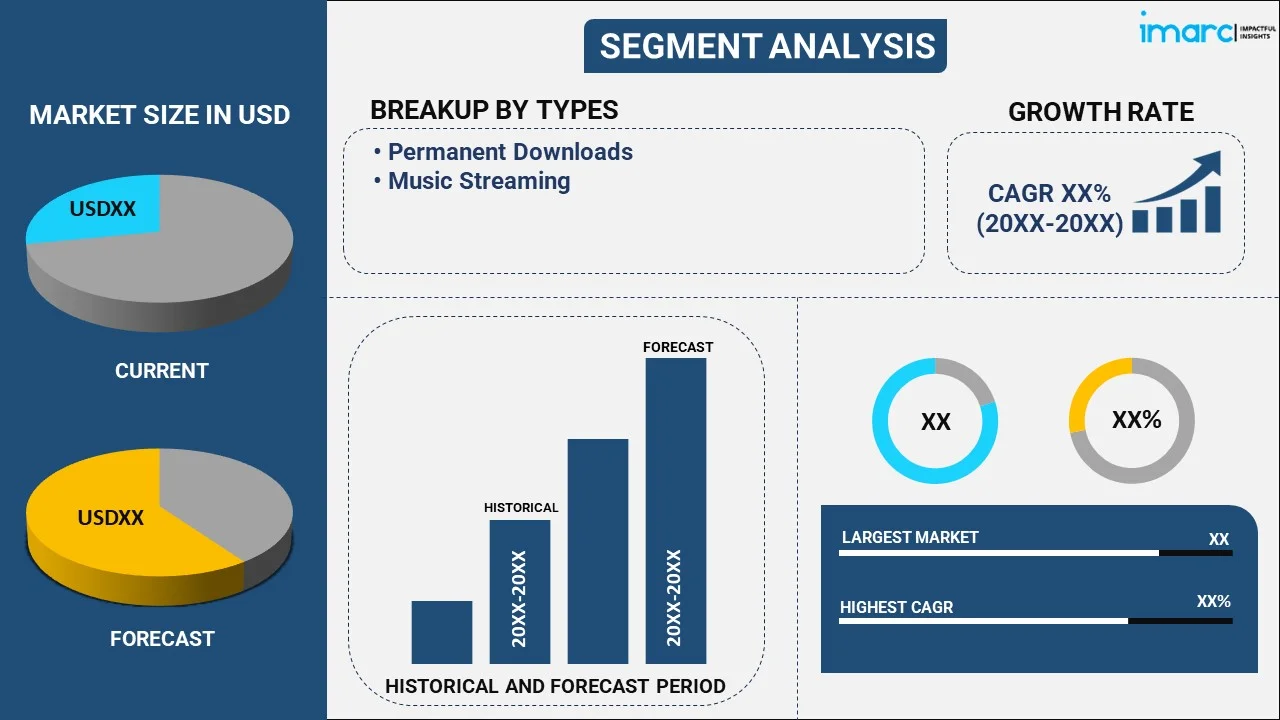
IMARC Group provides an analysis of the key trends in each segment of the global digital music content market, along with forecast at the global, regional, and country levels from 2026-2034. The market has been categorized based on type, age group, and application.
Analysis by Type:
To get detailed segment analysis of this market Request Sample
- Permanent Downloads
- Music Streaming
Music streaming holds 78.4% of the market share. Music streaming represents the dominant mode of digital music content consumption, encompassing subscription-based and ad-supported platforms that provide users with on-demand access to vast catalogs of songs, albums, and curated playlists. The segment benefits from the convenience of cloud-based access across multiple devices, offline caching features, and algorithmically driven music discovery that continuously enhances user engagement. Subscription models offering tiered pricing structures, including individual, family, and student plans, have broadened the addressable audience significantly. The shift from ownership-based consumption to access-based listening continues to accelerate as consumers prioritize convenience and variety over physical or downloaded media. The integration of podcasts, audiobooks, and video content within streaming platforms further extends daily listening time and strengthens subscriber retention. Moreover, the growing availability of high-fidelity and spatial audio options within streaming services is attracting quality-conscious listeners and encouraging upgrades to premium subscription tiers, reinforcing revenue growth across the segment.
Analysis by Age Group:
- Below 18 Years
- 18-40 Years
- 41-60 Years
- Above 60 Years
18-40 years leads the market with a share of 52.7%. The 18-40 years demographic segment represents the core audience for digital music content, driven by high digital literacy, strong smartphone adoption, and lifestyle preferences favoring on-demand entertainment. This age group is characterized by active engagement with personalized playlists, social sharing features, and curated discovery tools that streaming platforms prioritize in their product development. Young adults and millennials frequently integrate music streaming into daily routines, including commuting, exercise, work, and social activities, contributing to extended listening sessions and higher platform stickiness. Their willingness to pay for premium subscription tiers, particularly those offering ad-free experiences and high-fidelity audio, generates significant revenue for platforms. According to Luminate's 2025 year-end report, global on-demand audio song streams exceeded 5.1 trillion in 2025, marking a 9.6% year-on-year increase, with young adult demographics driving the majority of this digital music content market trends consumption.

Analysis by Application:
- Commercial Use
- Household Use
Commercial use dominates the market, with a share of 55.8%. The commercial use segment encompasses the deployment of digital music content across business environments, including retail stores, restaurants, hotels, fitness centers, corporate offices, and entertainment venues. Licensed music streaming services provide businesses with curated background music solutions that enhance customer experiences, influence purchasing behavior, and reinforce brand identity. The segment benefits from the growing recognition among businesses that carefully selected music can positively impact consumer perceptions and dwell time. Commercial licensing models offer businesses compliant access to extensive music catalogs while ensuring fair artist compensation. The integration of music into advertising, content creation, and media production further expands commercial demand. Additionally, the rising adoption of cloud-based commercial music platforms enables centralized management of audio branding across multiple locations, allowing businesses to maintain consistent sonic identities while tailoring playlists to regional preferences and peak trading hours.
Regional Analysis:
To get more information on the regional analysis of this market Request Sample
- North America
- United States
- Canada
- Asia-Pacific
- China
- Japan
- India
- South Korea
- Australia
- Indonesia
- Others
- Europe
- Germany
- France
- United Kingdom
- Italy
- Spain
- Russia
- Others
- Latin America
- Brazil
- Mexico
- Others
- Middle East and Africa
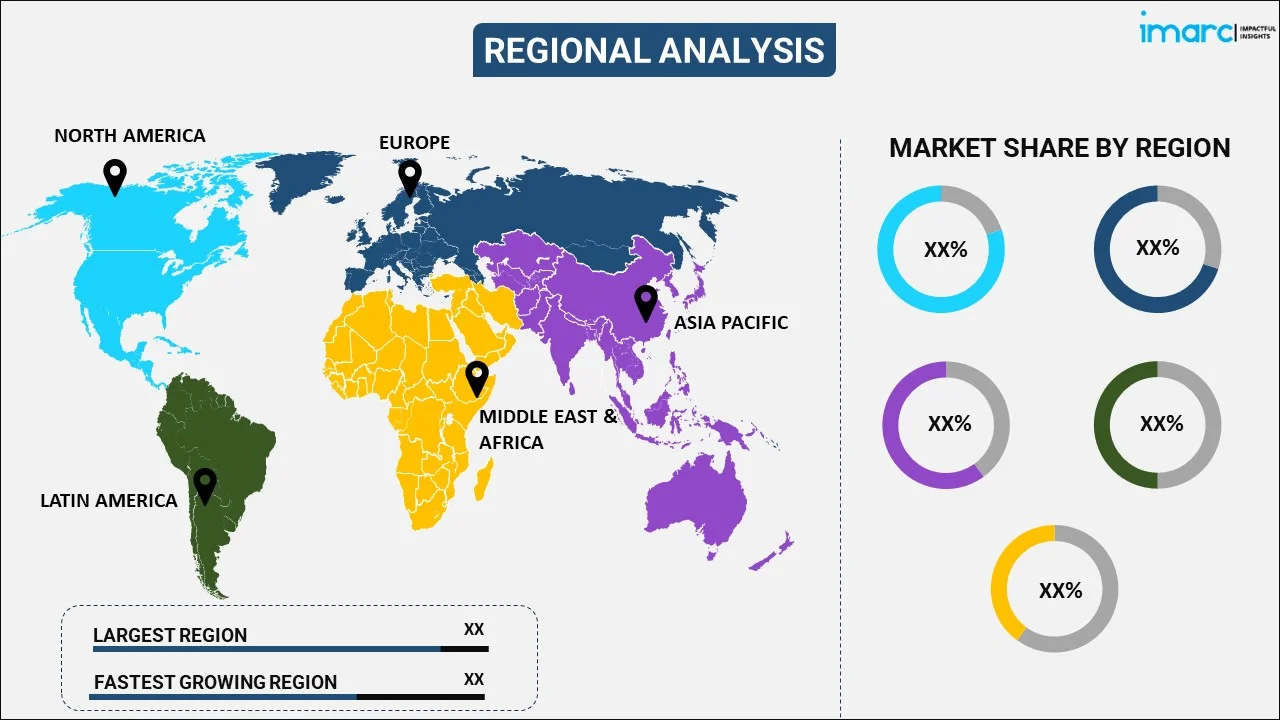
North America, accounting for 34.6% of the share, enjoys the leading position in the market. The region benefits from a well-established digital infrastructure, widespread high-speed internet access, and a mature ecosystem of streaming platforms that have achieved deep market penetration. Consumer willingness to pay for premium subscription services, supported by high disposable incomes and established digital payment systems, generates significant per-capita revenue for platform operators. The presence of major global music labels and a vibrant independent artist community ensures a continuously expanding and diverse content catalog. Regulatory frameworks supporting intellectual property protection and fair licensing practices create a stable operating environment. Advanced integration of music streaming with smart home devices, connected vehicles, and wearable technology further extends listening occasions and strengthens market leadership. Furthermore, the growing emphasis on immersive audio formats and personalized content curation across leading platforms continues to elevate user experiences and sustain subscriber growth throughout the region.
Key Regional Takeaways:
United States Digital Music Content Market Analysis
The United States remains the single largest national market for digital music content globally, driven by a combination of advanced digital infrastructure, high consumer spending power, and deeply ingrained digital entertainment habits. The country's streaming landscape is characterized by intense competition among major platforms, which drives continuous innovation in personalization algorithms, content diversification, and pricing strategies. High broadband and mobile internet penetration ensures seamless streaming experiences across urban and rural areas. The growing integration of music streaming with smart speakers, connected vehicles, and wearable devices extends listening opportunities throughout consumers' daily routines. The proliferation of family and student subscription plans has broadened the subscriber base beyond individual early adopters. Additionally, the increasing popularity of podcasts and audiobooks within music platforms contributes to extended engagement and higher retention rates. The expansion of high-fidelity and spatial audio offerings on major platforms is attracting audiophile segments and driving premium tier upgrades. Furthermore, the maturation of artist-centric payment models and direct-to-fan monetization tools is fostering a more equitable digital ecosystem that encourages independent content creation and diversifies the available music catalog.
Europe Digital Music Content Market Analysis
Europe represents a significant and steadily growing market for digital music content, underpinned by high internet penetration, diverse musical traditions, and strong consumer appetite for subscription-based streaming services. The region benefits from a robust regulatory environment, including the European Union's copyright directives that ensure fair compensation for rights holders while promoting legal content distribution. European consumers demonstrate a growing preference for localized content, with domestic artists achieving strong commercial success on national charts alongside international offerings. The expansion of premium subscription tiers featuring lossless audio and spatial sound formats is gaining traction among quality-conscious European listeners. Strategic partnerships between streaming platforms and telecommunications providers through bundled subscription offerings are accelerating subscriber growth across the region. The increasing emphasis on AI-driven content curation tailored to diverse linguistic and cultural preferences across European markets further strengthens user engagement and platform loyalty. Additionally, the growing adoption of immersive concert streaming and virtual live events is creating new revenue channels and expanding audience reach beyond traditional geographic boundaries.
Asia-Pacific Digital Music Content Market Analysis
The Asia-Pacific region is emerging as one of the fastest-growing markets for digital music content, propelled by rapid smartphone adoption, expanding mobile internet infrastructure, and a large young population embracing digital entertainment. Markets such as China, Japan, South Korea, and India each present unique dynamics, from K-pop's global cultural influence to India's demand for vernacular language content across multiple regional languages. Affordable data plans and micro-subscription models are democratizing access in price-sensitive economies, while telecom-bundled offerings convert large prepaid user bases into streaming subscribers. The growing integration of social features, short-form video tie-ins, and interactive livestreaming within music platforms enhances engagement and fosters community-driven content discovery across the region.
Latin America Digital Music Content Market Analysis
Latin America represents a rapidly expanding market for digital music content, driven by a youthful population, increasing smartphone penetration, and growing internet connectivity across the region. The global popularity of Latin music genres, including reggaeton, samba, and regional Mexican music, is fueling both domestic and international streaming volumes. Mobile-first consumption patterns dominate the region, with affordable data plans and carrier billing solutions enabling widespread adoption. The rising influence of social media platforms in music discovery and viral content promotion further accelerates streaming growth across diverse demographic segments.
Middle East and Africa Digital Music Content Market Analysis
The Middle East and Africa region is witnessing accelerating growth in digital music content consumption, supported by expanding mobile internet access, youthful demographics, and increasing smartphone affordability. Regional streaming platforms offering Arabic and local language catalogs are gaining traction alongside global services. Telecom-bundled weekly music passes are reducing entry barriers for youth segments, while direct carrier billing bypasses low credit card penetration. The increasing investment in localized content libraries and culturally relevant editorial curation is strengthening platform relevance and driving sustained subscriber acquisition across the region.
Competitive Landscape:
The digital music content market is characterized by intense competition among a mix of global streaming platforms, regional service providers, and technology companies seeking to capture diverse listener segments. Leading players are investing heavily in AI-driven personalization, spatial audio capabilities, exclusive content partnerships, and podcast integration to differentiate their offerings and enhance user engagement. Strategic pricing innovations, including tiered subscription models, family plans, and telecom-bundled packages, are central to subscriber acquisition and retention strategies. Companies are expanding into emerging markets through localized content libraries, vernacular language support, and culturally relevant playlists to capture untapped listener bases. Mergers, acquisitions, and strategic partnerships with record labels, independent artists, and content distributors continue to reshape the competitive landscape. The growing challenge of AI-generated content has prompted platforms to deploy detection and moderation tools, while industry-wide discussions on fair royalty distribution and artist-centric payment models are influencing long-term competitive strategies.
The report provides a comprehensive analysis of the competitive landscape in the Digital Music Content market with detailed profiles of all major companies, including:
- Apple Inc.
- Deezer
- Gamma Gaana Ltd
- Hungama Digital Media Entertainment Pvt. Ltd.
- iHeartMedia Inc.
- JB Hi-Fi Limited
- JioSaavn
- Mixcloud
- SoundCloud
- Spotify AB
Digital Music Content Market Report Scope:
| Report Features | Details |
|---|---|
| Base Year of the Analysis | 2025 |
| Historical Period | 2020-2025 |
| Forecast Period | 2026-2034 |
| Units | Billion USD |
| Scope of the Report |
Exploration of Historical Trends and Market Outlook, Industry Catalysts and Challenges, Segment-Wise Historical and Future Market Assessment:
|
| Types Covered | Permanent Downloads, Music Streaming |
| Age Groups Covered | Below 18 Years, 18-40 Years, 41-60 Years, Above 60 Years |
| Applications Covered | Commercial Use, Household Use |
| Regions Covered | North America, Asia-Pacific, Europe, Latin America, Middle East and Africa |
| Countries Covered | United States, Canada, China, Japan, India, South Korea, Australia, Indonesia, Germany, France, United Kingdom, Italy, Spain, Russia, Brazil, Mexico |
| Companies Covered | Apple Inc., Deezer, Gamma Gaana Ltd, Hungama Digital Media Entertainment Pvt. Ltd., iHeartMedia Inc., JB Hi-Fi Limited, JioSaavn, Mixcloud, SoundCloud, Spotify AB, etc. |
| Customization Scope | 10% Free Customization |
| Post-Sale Analyst Support | 10-12 Weeks |
| Delivery Format | PDF and Excel through Email (We can also provide the editable version of the report in PPT/Word format on special request) |
Key Benefits for Stakeholders:
- IMARC's report offers a comprehensive quantitative analysis of various market segments, historical and current market trends, market forecasts, and dynamics of the digital music content market from 2020-2034.
- The research study provides the latest information on the market drivers, challenges, and opportunities in the global digital music content market.
- The study maps the leading, as well as the fastest-growing, regional markets. It further enables stakeholders to identify the key country-level markets within each region.
- Porter's Five Forces analysis assists stakeholders in assessing the impact of new entrants, competitive rivalry, supplier power, buyer power, and the threat of substitution. It helps stakeholders to analyze the level of competition within the digital music content industry and its attractiveness.
- Competitive landscape allows stakeholders to understand their competitive environment and provides an insight into the current positions of key players in the market.
Frequently Asked Questions About the Digital Music Content Market Report
The digital music content market was valued at USD 25.56 Billion in 2025.
The digital music content market is projected to exhibit a CAGR of 7.56% during 2026-2034, reaching a value of USD 52.23 Billion by 2034.
The digital music content market is driven by the rapid proliferation of smartphones and high-speed internet connectivity, the shift from physical media to subscription-based streaming models, growing integration of artificial intelligence for personalized music discovery, expanding spatial audio and immersive listening technologies, and increasing consumer demand for diverse on-demand content across multiple devices and platforms.
North America currently dominates the digital music content market, accounting for a share of 34.6%. The region benefits from advanced digital infrastructure, high broadband penetration, mature subscription ecosystems, and the presence of leading global streaming platforms that drive sustained revenue generation.
Some of the major players in the digital music content market include Apple Inc., Deezer, Gamma Gaana Ltd, Hungama Digital Media Entertainment Pvt. Ltd., iHeartMedia Inc., JB Hi-Fi Limited, JioSaavn, Mixcloud, SoundCloud, Spotify AB, etc.
Need more help?
- Speak to our experienced analysts for insights on the current market scenarios.
- Include additional segments and countries to customize the report as per your requirement.
- Gain an unparalleled competitive advantage in your domain by understanding how to utilize the report and positively impacting your operations and revenue.
- For further assistance, please connect with our analysts.
 Request Customization
 Speak to an Analyst
 Request Brochure
 Inquire Before Buying
Benefits of Customization
- Personalize this research
- Triangulate with your data
- Get data as per your format and definition
- Gain a deeper dive into a specific application, geography, customer, or competitor
- Any level of personalization
Get in Touch With Us
UNITED STATES
Phone: +1-201-971-6302
INDIA
Phone: +91-120-433-0800
UNITED KINGDOM
Phone: +44-753-714-6104
Email: [email protected]
Client Testimonials




.webp)




.webp)













Related Reports

Choose your plan
*Please note that the prices mentioned below are starting prices for each bundle type. Kindly contact our team for further details.*
Single User License
- 1 User License, Access on 2 Devices
- PDF Report + Excel Dataset (Password Protected)
- Lifetime Access
- No Printing Rights
- 10% Free Report Customization
- 10–12 Weeks of Analyst Support
Five User License
- Access for 5 Users, 2 Devices per User
- PDF Report + Excel Dataset (Password Protected)
- Lifetime Access
- Dedicated Account Manager
- 12–14 Weeks of Analyst Support
- No Printing Rights
- 15% Free Report Customization
- 25% Discount on Your Next Purchase
Corporate User License
- Unlimited User Access (Within Your Organization)
- PDF Report + Excel Dataset
- Lifetime Access
- Dedicated Account Manager
- 14–20 Weeks of Analyst Support
- No Printing Rights
- 20% Free Report Customization
- 30% Discount on Your Next Purchase
Essential Insights
What's included:
3 reports
- Lifetime Access
- PDF Reports
- Excel Datasets
- 2 Weeks of Free Analyst Support
- 2 User Licenses
- Access on 2 Devices
- Printing Rights
- Complimentary PowerPoint (PPT) Version
- Complimentary License Upgrade
Professional Access
What's included:
5 reports
- Lifetime Access
- PDF Reports
- Excel Datasets
- 8 Weeks of Free Analyst Support
- 2 User Licenses
- Access on 2 Devices
- Printing Rights
- Complimentary PowerPoint (PPT) Version
- Complimentary License Upgrade
Business Advantage
What's included:
8 reports
- Lifetime Access
- PDF Reports
- Excel Datasets
- 14 Weeks of Free Analyst Support
- 2 User Licenses
- Access on 2 Devices
- Printing Rights
- Complimentary PowerPoint (PPT) Version
- Complimentary License Upgrade
Enterprise Intelligence
What's included:
10 reports
- Lifetime Access
- PDF Reports
- Excel Datasets
- 20 Weeks of Free Analyst Support
- 2 User Licenses
- Access on 2 Devices
- Printing Rights
- Complimentary PowerPoint (PPT) Version
- Complimentary License Upgrade