
Digital Printing Packaging Market Size, Share, Trends and Forecast by Printing Inks, Packaging Type, Format, Printing Technology, End User, and Region, 2026-2034
Digital Printing Packaging Market Size and Share:
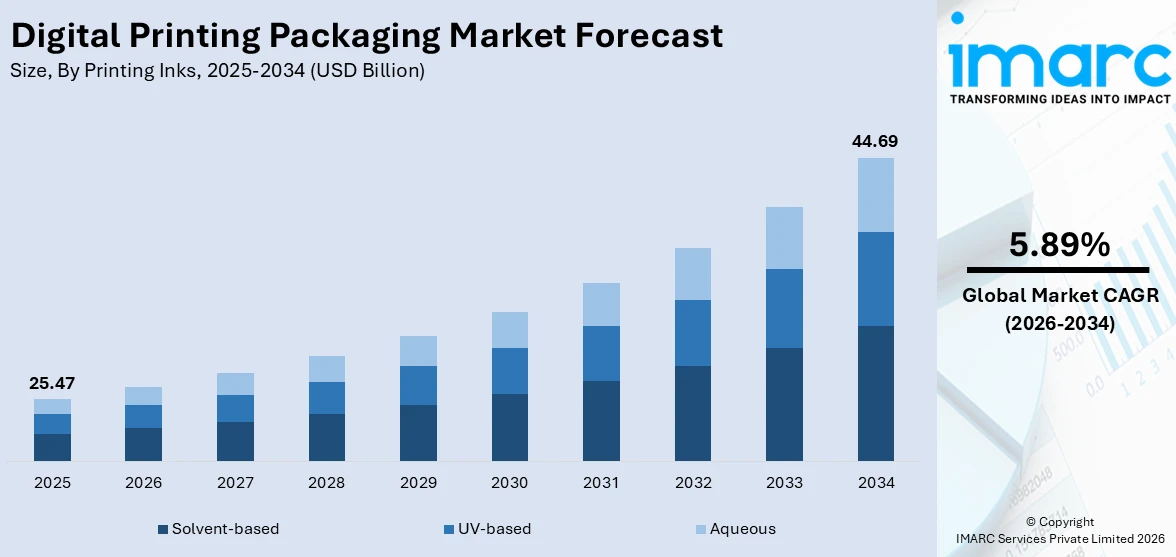
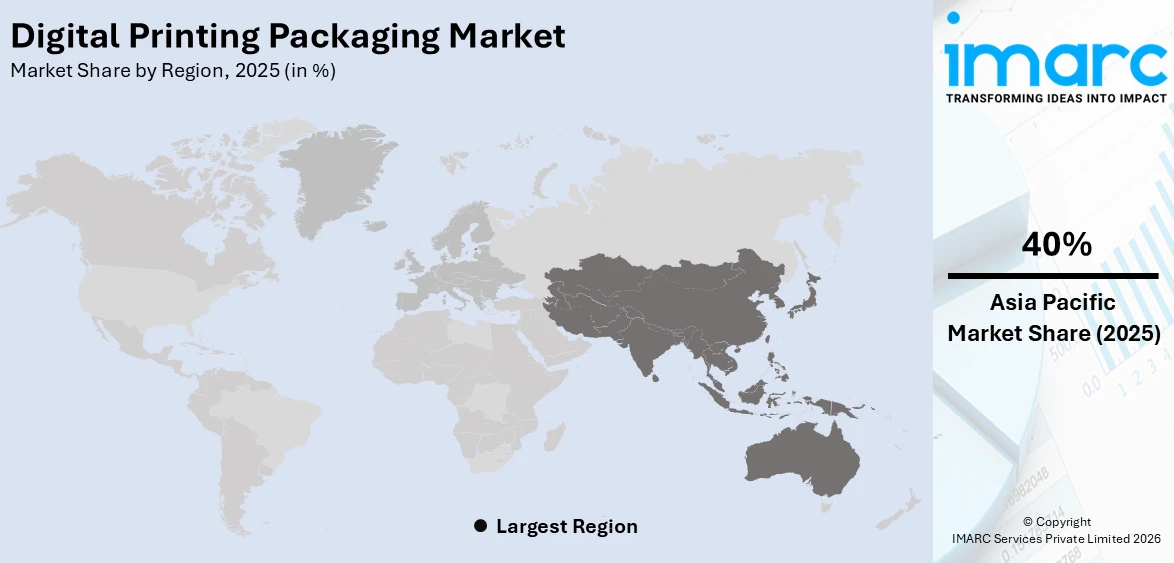
The global digital printing packaging market size was valued at USD 25.47 Billion in 2025. Looking forward, IMARC Group estimates the market to reach USD 44.69 Billion by 2034, exhibiting a CAGR of 5.89% from 2026-2034. Asia-Pacific currently dominates the market, holding a market share of 40% in 2025. The region benefits from a robust manufacturing base, extensive consumer goods industries, and rapid adoption of advanced printing technologies across China, Japan, India, and other emerging economies, all contributing to the expanding digital printing packaging market share.
The rising demand for personalized and customized packaging solutions across multiple industries is propelling the market growth in India. Brands are increasingly leveraging digital printing capabilities to execute short-run, variable-data packaging that supports seasonal promotions, regional marketing campaigns, and limited-edition product launches. The expansion of e-commerce platforms globally is generating strong demand for visually appealing and differentiated packaging that enhances unboxing experiences and strengthens brand recall. Additionally, the growing emphasis on sustainability is encouraging converters to adopt plate-less digital workflows that reduce material waste, eliminate chemical plate production, and minimize setup times compared to conventional printing methods. Moreover, the shift toward lightweight and flexible packaging formats supports efficient logistics and reduced environmental impact across the supply chain.
The United States is emerging as a key regional market in the digital printing packaging industry, supported by its mature e-commerce ecosystem and strong demand for customized, fast-turnaround packaging solutions for direct-to-consumer (DTC) fulfillment. Heightened regulatory oversight in food labeling and traceability requirements further drives adoption of high-precision digital printing technologies that allow rapid artwork revisions and compliance updates without disrupting production schedules. Industry investments reflect this momentum. In 2025, American Packaging Corporation launched a dedicated Digital Cell at its Columbus, Wisconsin Center of Excellence, equipped with two HP Indigo 200K digital presses and integrated laminating, coating, and pouching capabilities. This installation enhances agile flexible packaging production and supports short-run, on-demand manufacturing models. Such capital deployment underscores the country’s transition toward hybrid production strategies that combine digital, flexographic, and rotogravure technologies to improve responsiveness, operational efficiency, and customization capacity.
To get more information on this market Request Sample
Digital Printing Packaging Market Trends:
Growing Regulatory and Accessibility Requirements
The increasing regulatory emphasis on accessibility, product safety, and premium differentiation is driving the demand for advanced digital printing capabilities. Pharmaceutical, healthcare, and consumer goods manufacturers are required to incorporate compliant braille and tactile markings to ensure accessibility for visually impaired consumers, while also maintaining high production efficiency and print precision. Digital inkjet technologies capable of producing high-build varnish and textured effects are gaining traction as they allow converters to integrate functional features without additional offline processes. This trend is illustrated by Xaar’s 2026 launch of a white paper on braille inkjet printing at Labelexpo Asia and the Digital Print for Packaging Conference in Berlin, where the company highlighted its Versatex Printbar technology designed for compliant braille printing, tactile embellishments, and premium label finishes. Engineered for speed and accuracy, the solution supports ISO and pharmaceutical standards, reinforcing the role of functional and accessible printing innovations in advancing digital packaging adoption.
Rising Demand for Rapid Turnaround and Customized Flexible Packaging
The growing demand for shorter lead times, customized designs, and sustainable materials is influencing the digital printing packaging market, particularly within the flexible packaging segment. Brand owners across food, personal care, and nutraceutical categories require agile production models that can respond quickly to new product launches, limited editions, and shifting user preferences without maintaining large inventories. Digital printing, combined with automation, enables efficient short-run production while reducing setup time and material waste. This trend is reflected in All4Labels’ 2025 launch of All4Flexibles, a dedicated B2B division focused on the expanding flexible packaging market. The platform integrated digital printing technology, automated workflows, and sustainable substrate options to deliver customized packaging solutions with a 10-day lead time. Such initiatives demonstrate how converters are restructuring operations to prioritize speed, flexibility, and environmental performance, reinforcing the broader transition toward digitally enabled, demand-driven packaging production models across global markets.
Advancements in High-Speed and Specialty Toner Capabilities
Brand owners increasingly demand premium visual effects, short-run flexibility, and the ability to print on diverse substrates, including colored and transparent media, to enhance shelf appeal and product differentiation. Equipment manufacturers are responding by introducing presses that combine productivity with expanded color capabilities. In 2025, Konica Minolta announced the launch of the AccurioPress 14010S at PrintPack 2025, featuring a new white toner capability designed for printing on colored and transparent media, while delivering speeds of up to 140 A4 pages per minute for high-volume applications. Such innovations enable converters to produce high-impact packaging elements, labels, and promotional materials with improved opacity and design contrast. The integration of specialty toners with high-speed output supports premium packaging formats, reduces reliance on complex pre-press processes, and strengthens digital printing adoption across commercial and packaging segments.
Digital Printing Packaging Industry Segmentation:
IMARC Group provides an analysis of the key trends in each segment of the global digital printing packaging market, along with forecast at the global, regional, and country levels from 2026-2034. The market has been categorized based on printing inks, packaging type, format, printing technology, and end user.
Analysis by Printing Inks:
- Solvent-based
- UV-based
- Aqueous
Solvent-based holds 38% of the market share, reflecting its strong adoption across flexible and rigid packaging applications. Its widespread use is attributed to excellent adhesion, high color vibrancy, and compatibility with diverse substrates, including flexible films, metallic foils, laminates, and coated paperboard. This ink provides durability against moisture, chemicals, and abrasion, supporting packaging formats that require extended shelf life and consistent print performance during transportation and storage. Demand remains steady in high-volume production environments where cost efficiency and fast curing times are essential. At the same time, competitive innovation is evident, as highlighted in 2025 when DuPont™ Artistri® Digital Inks presented its full portfolio at FESPA Global Print Expo in Berlin, emphasizing compliant water-based ink solutions for packaging applications. Such developments indicate parallel advancements in alternative ink chemistries, while manufacturers continue refining lower-VOC solvent-based formulations to align with evolving environmental regulations without compromising performance standards.

Analysis by Packaging Type:
- Corrugated Packaging
- Folding Cartons
- Flexible Packaging
- Labels
- Others
Labels account for 36% of the digital printing packaging market, reflecting their extensive use across food and beverage, pharmaceutical, personal care, and consumer goods industries. Their leadership position is reinforced by the growing requirement for high-variation production, where brands rely on variable data printing, regional language customization, and serialized coding to meet compliance standards and enhance product authentication. Digital technologies enable short-run flexibility and rapid artwork changes without increasing setup time, making them suitable for promotional campaigns and product line extensions. The increasing demand for self-adhesive pressure-sensitive labels with high-resolution graphics, tactile finishes, and multi-layer information panels is further encouraging converters to invest in advanced digital label presses. These systems offer improved speed, color consistency, and substrate compatibility while reducing material waste and inventory costs. As product portfolios expand and regulatory disclosures become more detailed, digital label printing continues to gain traction across diverse packaging applications.
Analysis by Format:
- Full Color Printing
- Variable Data Printing
- Large Format Printing
- Others
Variable data printing dominates the market with a share of 44%, as it enables brands to print unique text, graphics, QR codes, barcodes, and serialized identifiers on each package without disrupting production speed, ensuring efficiency alongside customization. This capability supports personalized marketing initiatives, strengthens anti-counterfeiting measures, and fulfills regulatory traceability requirements across food, pharmaceuticals, cosmetics, and consumer goods. By allowing seamless incorporation of region-specific messaging, limited-edition designs, and targeted promotional content, variable data printing enhances brand engagement and influences purchasing decisions at the point of sale. The rapid expansion of e-commerce further accelerates adoption, as companies rely on the format to generate customized shipping labels, transactional inserts, and branded outer packaging that elevate the unboxing experience. Furthermore, automated data integration and digital workflows help maintain accuracy, reduce waste, and improve supply chain responsiveness across high-volume packaging operations. These capabilities collectively accelerate digital printing packaging market growth by increasing demand for personalized, compliant, and data-enabled packaging solutions.
Analysis by Printing Technology:
- Inkjet Printing
- Electrophotography Printing
- Others
Inkjet printing represents the leading segment, with a market share of 54%, owing to its exceptional versatility, high-speed production capabilities, and ability to deliver photographic-quality output across diverse substrates. The technology operates by depositing precise droplets of ink directly onto packaging materials, enabling detailed graphics, smooth gradients, and accurate color reproduction without the need for printing plates or cylinders. The continuous advancement in printhead technology, including piezoelectric and thermal inkjet innovations, is enabling faster production speeds and broader substrate compatibility, strengthening the position of inkjet as the preferred technology across the packaging value chain. In 2025, Canon launched the corrPRESS iB17, an industrial inkjet digital press for high-volume corrugated packaging production, at the FEFCO Technical Seminar in Rome. The press delivered speeds up to 8,000m² per hour, producing offset-quality prints directly on corrugated boards using water-based inks suitable for indirect food contact. Designed for short-to-medium runs, it featured automated cleaning, quality control, and print-on-demand capabilities to improve efficiency and reduce waste.
Analysis by End User:
Access the comprehensive market breakdown Request Sample
- Food and Beverages
- Pharmaceuticals
- Electronics
- Personal Care and Cosmetics
- Others
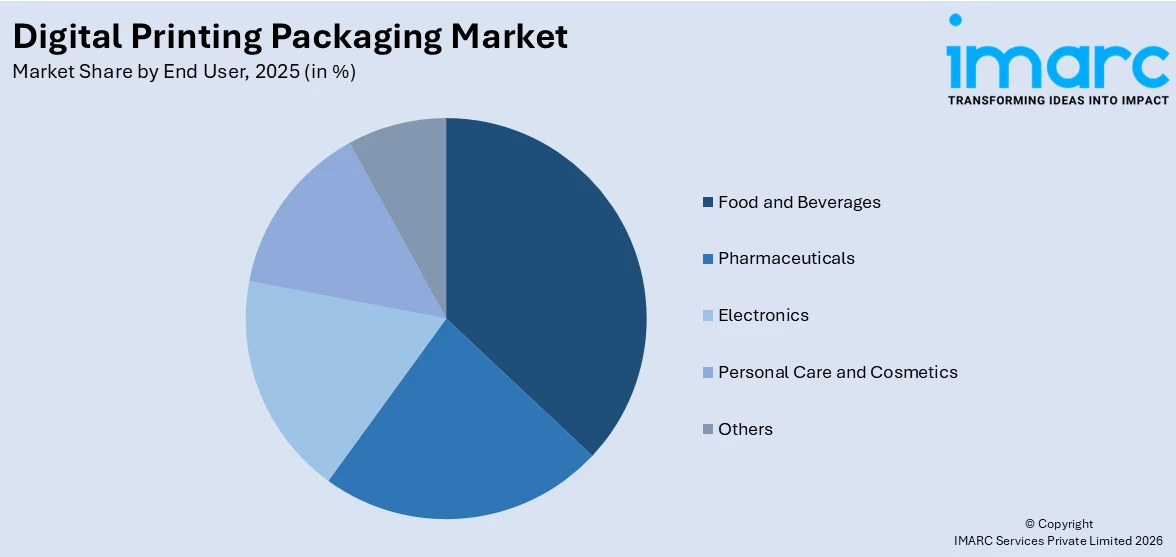
Food and beverages account for 30% of the market share, making it the largest end-user segment within the industry. The sector’s dominance is supported by strict labeling regulations, strong emphasis on product differentiation, and frequent packaging revisions aligned with seasonal launches and regional marketing programs. Digital printing enables manufacturers to produce high-quality graphics alongside precise nutritional information, allergen declarations, barcodes, and batch-level traceability codes required for compliance across multiple markets. The expansion of convenience foods, ready-to-eat (RTE) meals, and single-serve products continues to diversify packaging requirements, increasing demand for short production runs and rapid design modifications. Flexible pouches, stand-up bags, folding cartons, and wrap-around labels particularly benefit from digital printing technologies, as they allow faster turnaround times, reduced inventory waste, and improved customization while maintaining consistent print accuracy and visual appeal. The digital printing packaging market forecast remains positive for the food and beverages segment due to sustained regulatory compliance needs, rising packaged food consumption, and growing preference for short-run, customized packaging solutions.
Regional Analysis:
To get more information on the regional analysis of this market Request Sample
- North America
- United States
- Canada
- Asia-Pacific
- China
- Japan
- India
- South Korea
- Australia
- Indonesia
- Others
- Europe
- Germany
- France
- United Kingdom
- Italy
- Spain
- Russia
- Others
- Latin America
- Brazil
- Mexico
- Others
- Middle East and Africa
Asia-Pacific, accounting for 40% of the share, enjoys the leading position in the market. The region's dominance is underpinned by a massive manufacturing base, rapid urbanization, and expanding consumer goods industries across China, Japan, India, South Korea, and Southeast Asian nations. The proliferation of e-commerce platforms and increasing individual demand for premium packaging with customized designs and brand storytelling elements are driving significant investment in digital printing infrastructure. Governments across the region are implementing policies that support manufacturing digitization and sustainable production practices, further accelerating the transition from conventional to digital packaging workflows. For instance, in 2025, China's Beijing Institute of Graphic Communication and India's All-India Federation of Printers and Packagers signed a cooperation agreement to promote global collaboration in printing, packaging, and publishing education and industry connections. Rising disposable incomes, shifting dietary preferences toward packaged and processed foods, and growing pharmaceutical production are creating sustained demand for high-quality digitally printed packaging.
Key Regional Takeaways:
North America Digital Printing Packaging Market Analysis
North America represents a significant and technologically advanced market for digital printing packaging, supported by well-established e-commerce networks, sophisticated brand marketing practices, and strict regulatory requirements across food, pharmaceutical, and consumer goods sectors. Demand for short production runs, rapid design changes, and enhanced traceability continues to accelerate digital press adoption across flexible and rigid packaging formats. This market strength is reflected in the 2026 agreement between HP Indigo and ePac, valued at USD 50 Million over three years, to expand digital printing capabilities for flexible packaging across equipment, consumables, and services. Under the arrangement, ePac will install 10 HP Indigo 200K digital presses across North America and Europe, increasing production speed, throughput, and AI-enabled quality control standards. The expansion reinforces their long-standing partnership and supports faster, on-demand manufacturing models, further strengthening North America’s role in high-performance and sustainable digital packaging production. These developments underscore the sustained growth and technological advancement shaping digital printing packaging market trends, as they reflect rising automation, expanded digital press installations, strategic investments, and increasing demand for on-demand and sustainable packaging solutions across North America.
United States Digital Printing Packaging Market Analysis
The United States remains a vital market for digital printing packaging, supported by high rates of technology adoption, sustained capital investment in advanced press systems, and a diversified industrial base spanning food and beverages, pharmaceuticals, personal care, and e-commerce. Strong demand for short-run production, customization, and faster turnaround times continues to accelerate the shift toward digital platforms across packaging formats. This strategic direction is reflected in Sonoco’s 2025 announcement outlining a broad optimization program targeting USD 65 Million in productivity savings during the year, supported by investments in automation, robotics, and expanded digital printing capabilities. The company is deploying autonomous forklifts, robotic assemblers, and upgraded digital press systems to enhance operational efficiency and throughput across its packaging facilities. Such initiatives, combined with portfolio rationalization and focused capital allocation, reinforce the United States’ position as a technologically advanced and innovation-driven market for digital printing packaging solutions.
Europe Digital Printing Packaging Market Analysis
Europe represents a substantial share of the digital printing packaging market, supported by strict environmental regulations, established printing technology infrastructure, and rising consumer preference for sustainable and transparent packaging formats. Regulatory mandates promoting recyclability and reduced carbon emissions are encouraging brand owners to adopt advanced digital solutions that improve material efficiency and traceability. This direction is reflected in industry investments, such as HEIDELBERG’s 175th anniversary milestone in 2025, marked by the opening of the redesigned 9,000 m² Print Media Center, branded as the “Home of Print,” at its Wiesloch-Walldorf site in Germany. The facility showcased end-to-end solutions for packaging, label, and commercial printing, highlighting HEIDELBERG’s role as a systems integrator with its Prinect ecosystem and partner technologies. These regulatory mandates, infrastructure investments, and technology upgrades collectively define the digital printing packaging market outlook in Europe, as they demonstrate sustained demand for sustainable materials, integrated digital workflows, and high-efficiency production systems across the region.
Asia-Pacific Digital Printing Packaging Market Analysis
Asia-Pacific holds a leading position in the global digital printing packaging market, supported by rapid industrialization, expanding consumer goods production, and government-backed manufacturing digitization initiatives across major economies. Ongoing technology upgrades by equipment manufacturers continue to strengthen regional capabilities. For instance, in 2025, FUJIFILM India introduced its next-generation Revoria Press™ production printers and Apeos 4620 multifunction devices at Printpack India 2025, with the Revoria EC2100S offering speeds of up to 100 ppm with five-color printing and the SC285 series delivering 85 ppm for commercial and short-run applications. The new systems enhanced productivity, color accuracy, and substrate flexibility, including support for envelopes, water-resistant paper, and cardboard for packaging, reinforcing the region’s strong adoption of advanced digital printing solutions.
Latin America Digital Printing Packaging Market Analysis
Latin America is witnessing growth in the digital printing packaging market, supported by the increasing food and beverage production, rising e-commerce penetration, and heightened brand differentiation efforts across consumer goods industries. The region’s technological progress is illustrated by Hybrid Software’s participation at Labelexpo Mexico 2025, where the company presented its Hybrid BrandZ unit, including the Artflow SaaS artwork management platform and iC3D software for 3D packaging visualization and prototyping, alongside workflow automation, variable data printing, spot color simulation, and digital press optimization solutions. Such advancements are strengthening operational efficiency and print quality standards among converters and brand owners across the region.
Middle East and Africa Digital Printing Packaging Market Analysis
The Middle East and Africa region is recording steady growth in the digital printing packaging market, supported by expanding food processing activities, accelerating urbanization, and sustained investments in organized retail infrastructure. Countries within the Gulf Cooperation Council are at the forefront of adoption, reflecting broader economic diversification efforts that emphasize non-oil industrial development, including packaging and consumer goods manufacturing. This momentum is reflected in industry platforms such as Gulf Print & Pack 2026, which announced a dedicated focus on digital printing expansion, smart packaging applications including QR and NFC integration, and sustainability-driven innovations, with exhibitors presenting high-speed inkjet systems, wide-format technologies, and environmentally responsible materials.
Competitive Landscape:
The competitive landscape of the digital printing packaging market is defined by sustained technological advancement, strategic collaborations, and ongoing capacity expansion among established and emerging participants. Leading companies are directing substantial investments toward next-generation inkjet and electrophotography systems that deliver higher print speeds, improved color accuracy, and compatibility with diverse substrates. Emphasis is also placed on developing sustainable ink formulations, including water-based and low-migration solutions, to meet regulatory requirements and brand owner sustainability commitments. In addition, firms are integrating end-to-end workflow automation, incorporating cloud-based management tools, data analytics, and real-time quality monitoring to enhance operational efficiency and reduce turnaround times. Partnerships with packaging converters, material suppliers, and brand owners are strengthening market reach and application development capabilities. Capacity expansions across key manufacturing hubs are enabling faster order fulfillment and localized production, supporting shorter print runs and customized packaging demands in a competitive environment.
The report provides a comprehensive analysis of the competitive landscape in the digital printing packaging market with detailed profiles of all major companies, including:
- DS Smith plc
- Eastman Kodak Company
- EC Labels Ltd.
- Edwards Label
- Hewlett-Packard Development Company L.P.
- INX International Ink Co. (Sakata Inx Corporation)
- Mondi plc
- Quad
- Thimm Holding Gmbh & Co. Kg
- Traco Manufacturing Inc.
- Xeikon B.V. (Flint Group)
- Xerox Holdings Corporation
Latest News and Developments:
- In September 2025, Mondi expanded its six-color digital printing range for corrugated packaging to include white ink, enabling high-contrast designs on brown board. The innovation supported vibrant branding, halftone effects, and direct printing of barcodes and QR codes without labels. Using water-based inks and plate-free data-to-print technology, the solution enhanced flexibility, reduced waste, and strengthened sustainable packaging options across food and FMCG sectors.
- In May 2025, FUJIFILM India expanded its Print-on-Demand business into Sri Lanka by launching a new Digital Business Centre in Colombo with Advanced Digital Graphics Pvt. Ltd. The center showcases Fujifilm’s Revoria PC 1120S and other advanced digital printing systems to strengthen regional print capabilities. Through this partnership, Fujifilm aimed to deliver high-quality, high-speed digital printing solutions across commercial printing, packaging, and photo segments in Sri Lanka.
Digital Printing Packaging Market Report Scope:
| Report Features | Details |
|---|---|
| Base Year of the Analysis | 2025 |
| Historical Period | 2020-2025 |
| Forecast Period | 2026-2034 |
| Units | Billion USD |
| Scope of the Report |
Exploration of Historical Trends and Market Outlook, Industry Catalysts and Challenges, Segment-Wise Historical and Future Market Assessment:
|
| Printing Inks Covered | Solvent-based, UV-based, Aqueous |
| Packaging Types Covered | Corrugated Packaging, Folding Cartons, Flexible Packaging, Labels, Others |
| Formats Covered | Full Color Printing, Variable Data Printing, Large Format Printing, Others |
| Printing Technologies Covered | Inkjet Printing, Electrophotography Printing, Others |
| End Users Covered | Food and Beverages, Pharmaceuticals, Electronics, Personal Care and Cosmetics, Others |
| Region Covered | North America, Asia-Pacific, Europe, Latin America, Middle East and Africa |
| Countries Covered | United States, Canada, China, Japan, India, South Korea, Australia, Indonesia, Germany, France, United Kingdom, Italy, Spain, Russia, Brazil, Mexico |
| Companies Covered | DS Smith plc, Eastman Kodak Company, EC Labels Ltd., Edwards Label, Hewlett-Packard Development Company L.P., INX International Ink Co. (Sakata Inx Corporation), Mondi plc, Quad, Thimm Holding Gmbh & Co. Kg, Traco Manufacturing Inc., Xeikon B.V. (Flint Group), Xerox Holdings Corporation, etc. |
| Customization Scope | 10% Free Customization |
| Post-Sale Analyst Support | 10-12 Weeks |
| Delivery Format | PDF and Excel through Email (We can also provide the editable version of the report in PPT/Word format on special request) |
Key Benefits for Stakeholders:
- IMARC's report offers a comprehensive quantitative analysis of various market segments, historical and current market trends, market forecasts, and dynamics of the digital printing packaging market from 2020-2034.
- The research study provides the latest information on the market drivers, challenges, and opportunities in the global digital printing packaging market.
- The study maps the leading, as well as the fastest-growing, regional markets. It further enables stakeholders to identify the key country-level markets within each region.
- Porter's Five Forces analysis assists stakeholders in assessing the impact of new entrants, competitive rivalry, supplier power, buyer power, and the threat of substitution. It helps stakeholders to analyze the level of competition within the digital printing packaging industry and its attractiveness.
- Competitive landscape allows stakeholders to understand their competitive environment and provides an insight into the current positions of key players in the market.
Frequently Asked Questions About the Digital Printing Packaging Market Report
The digital printing packaging market was valued at USD 25.47 Billion in 2025.
The digital printing packaging market is projected to exhibit a CAGR of 5.89% during 2026-2034, reaching a value of USD 44.69 Billion by 2034.
The digital printing packaging market is driven by the growing regulatory requirements for accessible packaging with compliant braille and tactile features, increasing demand for rapid turnaround in customized flexible packaging, and technological advancements in high-speed presses with specialty toner capabilities that enhance premium design, efficiency, and substrate versatility.
Asia-Pacific currently dominates the digital printing packaging market, accounting for a share of 40%. The region benefits from a massive manufacturing base, rapid urbanization, expanding consumer goods industries, and significant investments in digital printing infrastructure across China, Japan, India, and other developing economies.
Some of the major players in the digital printing packaging market include DS Smith plc, Eastman Kodak Company, EC Labels Ltd., Edwards Label, Hewlett-Packard Development Company L.P., INX International Ink Co. (Sakata Inx Corporation), Mondi plc, Quad, Thimm Holding Gmbh & Co. Kg, Traco Manufacturing Inc., Xeikon B.V. (Flint Group), Xerox Holdings Corporation, etc.
Need more help?
- Speak to our experienced analysts for insights on the current market scenarios.
- Include additional segments and countries to customize the report as per your requirement.
- Gain an unparalleled competitive advantage in your domain by understanding how to utilize the report and positively impacting your operations and revenue.
- For further assistance, please connect with our analysts.
 Request Customization
 Speak to an Analyst
 Request Brochure
 Inquire Before Buying
Benefits of Customization
- Personalize this research
- Triangulate with your data
- Get data as per your format and definition
- Gain a deeper dive into a specific application, geography, customer, or competitor
- Any level of personalization
Get in Touch With Us
UNITED STATES
Phone: +1-201-971-6302
INDIA
Phone: +91-120-433-0800
UNITED KINGDOM
Phone: +44-753-714-6104
Email: [email protected]
Client Testimonials




.webp)




.webp)













Related Reports

Choose your plan
*Please note that the prices mentioned below are starting prices for each bundle type. Kindly contact our team for further details.*
Single User License
- 1 User License, Access on 2 Devices
- PDF Report + Excel Dataset (Password Protected)
- Lifetime Access
- No Printing Rights
- 10% Free Report Customization
- 10–12 Weeks of Analyst Support
Five User License
- Access for 5 Users, 2 Devices per User
- PDF Report + Excel Dataset (Password Protected)
- Lifetime Access
- Dedicated Account Manager
- 12–14 Weeks of Analyst Support
- No Printing Rights
- 15% Free Report Customization
- 25% Discount on Your Next Purchase
Corporate User License
- Unlimited User Access (Within Your Organization)
- PDF Report + Excel Dataset
- Lifetime Access
- Dedicated Account Manager
- 14–20 Weeks of Analyst Support
- No Printing Rights
- 20% Free Report Customization
- 30% Discount on Your Next Purchase
Essential Insights
What's included:
3 reports
- Lifetime Access
- PDF Reports
- Excel Datasets
- 2 Weeks of Free Analyst Support
- 2 User Licenses
- Access on 2 Devices
- Printing Rights
- Complimentary PowerPoint (PPT) Version
- Complimentary License Upgrade
Professional Access
What's included:
5 reports
- Lifetime Access
- PDF Reports
- Excel Datasets
- 8 Weeks of Free Analyst Support
- 2 User Licenses
- Access on 2 Devices
- Printing Rights
- Complimentary PowerPoint (PPT) Version
- Complimentary License Upgrade
Business Advantage
What's included:
8 reports
- Lifetime Access
- PDF Reports
- Excel Datasets
- 14 Weeks of Free Analyst Support
- 2 User Licenses
- Access on 2 Devices
- Printing Rights
- Complimentary PowerPoint (PPT) Version
- Complimentary License Upgrade
Enterprise Intelligence
What's included:
10 reports
- Lifetime Access
- PDF Reports
- Excel Datasets
- 20 Weeks of Free Analyst Support
- 2 User Licenses
- Access on 2 Devices
- Printing Rights
- Complimentary PowerPoint (PPT) Version
- Complimentary License Upgrade