
Egypt Automotive Wiring Harness Market Size, Share, Trends and Forecast by Application, Material Type, Transmission Type, Vehicle Type, Category, Component, and Region, 2026-2034
Egypt Automotive Wiring Harness Market Summary:
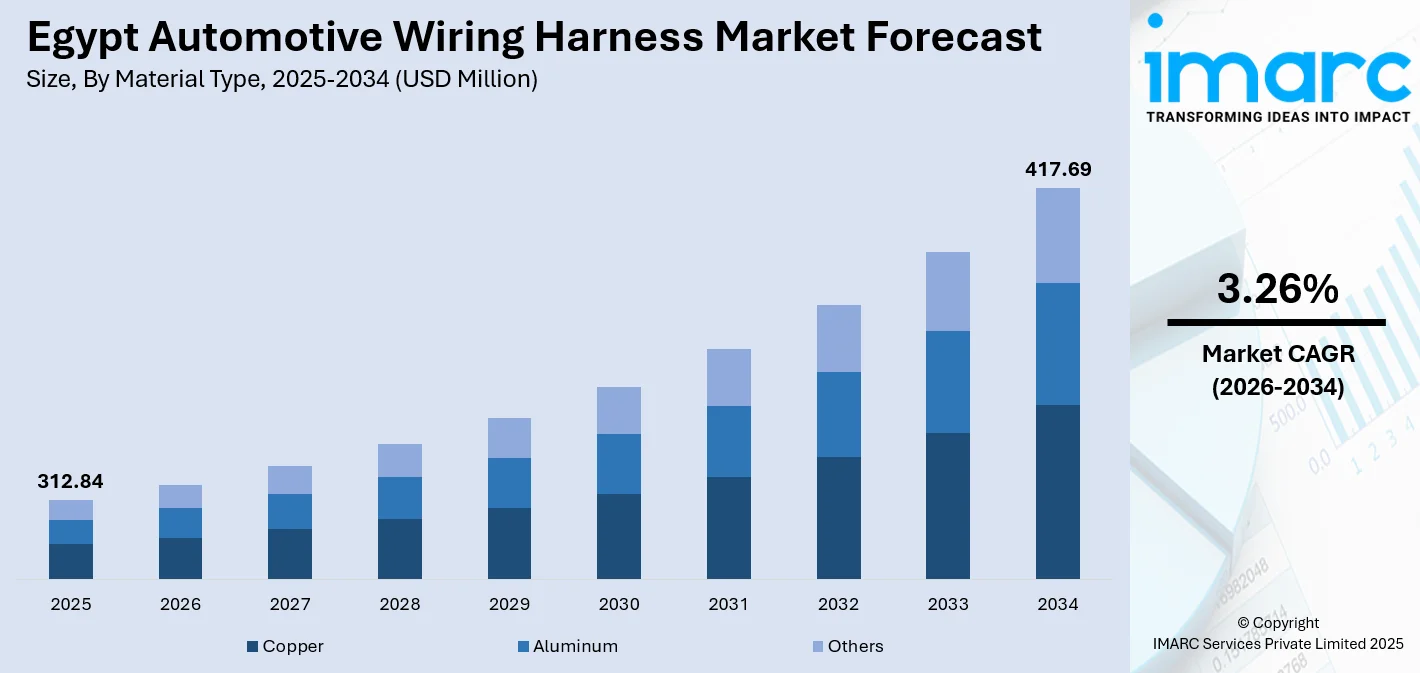
The Egypt automotive wiring harness market size was valued at USD 312.84 Million in 2025 and is projected to reach USD 417.69 Million by 2034, growing at a compound annual growth rate of 3.26% from 2026-2034.
The Egypt automotive wiring harness market is expanding steadily, driven by the country’s growing automotive manufacturing ecosystem and increasing vehicle electrification. Government-led industrial development strategies, rising demand for advanced in-vehicle electronic systems, and expanding local assembly operations are strengthening the need for sophisticated wiring harness solutions. The adoption of modern safety and connectivity technologies across passenger and commercial vehicles continues to support market growth and long-term Egypt automotive wiring harness market share.
Key Takeaways and Insights:
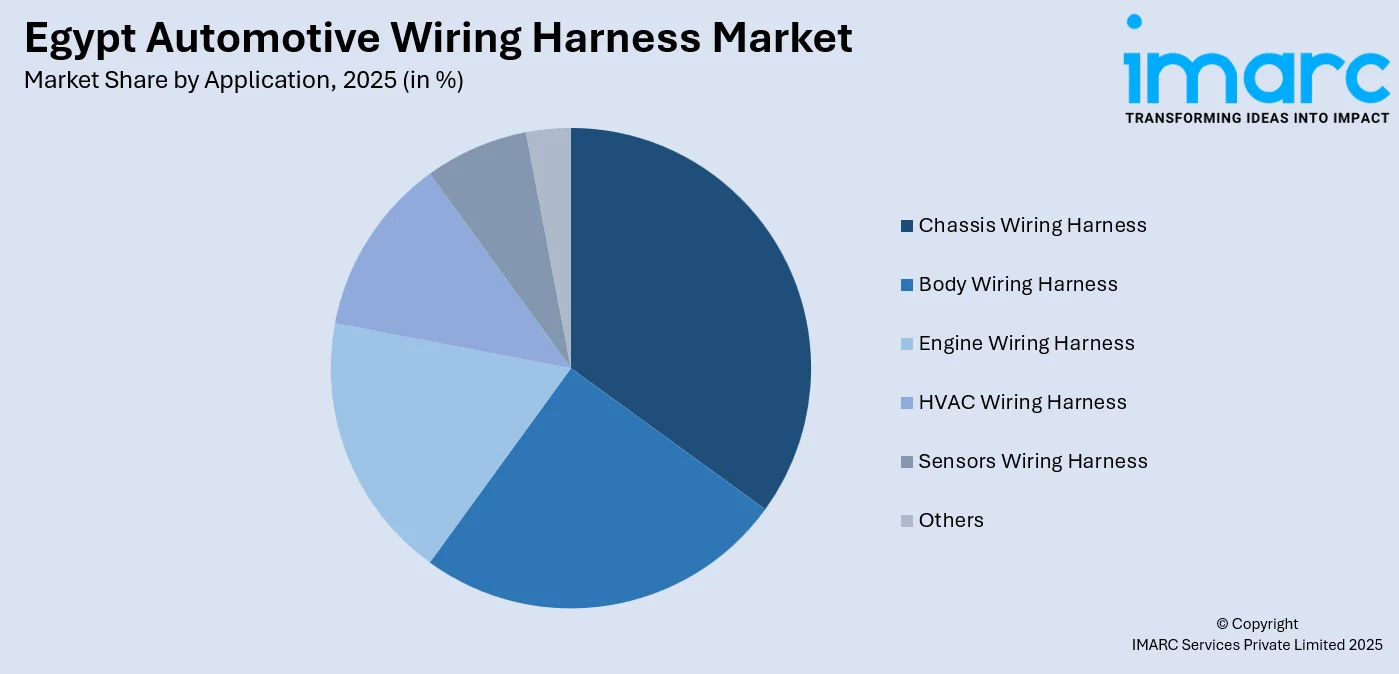
- By Application: Chassis wiring harness dominates the market with a share of 34.9% in 2025, due to the growing incorporation of cutting-edge steering, suspension, and braking systems in contemporary passenger cars built and assembled in Egypt.
- By Material Type: Copper leads the market with a share of 86.22% in 2025, fueled by its exceptional thermal resistance, electrical conductivity, and dependability in supplying vital automotive systems for both conventional and electric vehicle platforms.
- By Transmission Type: Electrical wiring dominates the market with a share of 81.51% in 2025, reflecting its essential role as the backbone for power distribution, lighting, infotainment, and advanced driver-assistance system integration across vehicle architectures.
- By Vehicle Type: Passenger cars lead the market with a share of 52.22% in 2025, fueled by rising consumer demand, expanding local assembly operations, and the growing incorporation of electronic features in sedan and crossover models.
- By Category: General wires hold the largest share with 40.05% in 2025, supported by their versatile application across standard lighting, ignition, and power distribution systems in conventionally powered and hybrid vehicles.
- By Component: Wires represent the leading segment with a share of 42.21% in 2025, underpinned by the fundamental role of copper and aluminum conductors in enabling power transmission and signal connectivity throughout vehicle electrical networks.
- Key Players: Key players are strengthening the Egypt automotive wiring harness market through expanded manufacturing footprints, workforce development, component localization, and investments in export-oriented production capacities, positioning the country as a globally competitive hub for wiring harness supply.
To get more information on this market Request Sample
The Egypt automotive wiring harness market is advancing rapidly as the country accelerates its transformation into a regional automotive manufacturing powerhouse. A combination of government-backed industrial initiatives, growing vehicle assembly activities, and rising integration of advanced electronic systems is fueling sustained demand for high-quality wiring harness solutions. The increasing complexity of modern vehicles, incorporating features such as advanced driver-assistance systems, infotainment modules, and electronic stability controls, requires more sophisticated wiring architectures to ensure reliable power distribution and signal connectivity throughout every vehicle platform. Policy support, expanding local content requirements, and growing partnerships with global automakers are further reinforcing the market’s positive trajectory. The rising emphasis on vehicle safety, connectivity, and energy-efficient design continues to expand meaningful opportunities across the entire Egypt automotive wiring harness value chain, encouraging further capacity investments and technology upgrades.
Egypt Automotive Wiring Harness Market Trends:
Expansion of EV-Ready Wiring Infrastructure
Egypt is witnessing a growing shift toward electric vehicle readiness, which is driving demand for high-voltage wiring harnesses capable of supporting battery management systems and electric powertrains. Manufacturers are increasingly adapting production lines to accommodate EV-specific harness configurations alongside traditional low-voltage assemblies. The development of specialized charging harnesses and power distribution cables for next-generation electric vehicle platforms is gaining momentum across the country's manufacturing base. This shift toward electrification-ready infrastructure is reinforcing Egypt automotive wiring harness market growth.
Localization of Wiring Harness Component Manufacturing
Egyptian wiring harness manufacturers are accelerating efforts to localize the production of critical components, including connectors, terminals, and insulation materials. This trend reduces reliance on imported parts, shortens supply chains, and enhances cost competitiveness. Dedicated in-house engineering teams are being established to innovate and produce locally made components that meet or exceed international quality benchmarks. The localization drive is attracting additional investment from global suppliers, creating new opportunities for domestic feeder industries, and strengthening the country's position within the broader automotive component ecosystem.
Integration of Advanced Electronic Systems in Vehicles
Modern vehicles assembled in Egypt are increasingly incorporating advanced electronic features, including adaptive cruise control, lane departure warning systems, and smart infotainment modules. These technologies require complex wiring harnesses to support high-speed data transfer and reliable power distribution. The rising number of individual connection points within modern vehicle electrical architectures reflects the escalating complexity of automotive wiring systems, demanding more sophisticated harness designs and higher-quality conductors. This trend is broadening the scope and value of wiring harness installations across diverse vehicle platforms.
Market Outlook 2026-2034:
The Egypt automotive wiring harness market is positioned for steady expansion, underpinned by the country’s ambitious automotive industrialization strategy, rising vehicle production capacity, and increasing foreign direct investment in component manufacturing. The expansion of free zone manufacturing operations by leading global wiring harness producers is strengthening Egypt’s position as a competitive export hub serving European and Middle Eastern automakers. The market generated a revenue of USD 312.84 Million in 2025 and is projected to reach a revenue of USD 417.69 Million by 2034, growing at a compound annual growth rate of 3.26% from 2026-2034. The ongoing integration of advanced driver-assistance systems, infotainment modules, and electrified powertrain components in locally assembled vehicles is creating sustained demand for increasingly sophisticated wiring harness solutions. Furthermore, the government’s allocation of EGP 1.5 Billion in its 2024/2025 budget to advance automotive localization reflects a strong institutional commitment to sector development, reinforcing investor confidence and signaling continued growth opportunities across the wiring harness value chain.
Egypt Automotive Wiring Harness Market Report Segmentation:
|
Segment Category |
Leading Segment |
Market Share |
|
Application |
Chassis Wiring Harness |
34.9% |
|
Material Type |
Copper |
86.22% |
|
Transmission Type |
Electrical Wiring |
81.51% |
|
Vehicle Type |
Passenger Cars |
52.22% |
|
Category |
General Wires |
40.05% |
|
Component |
Wires |
42.21% |
Application Insights:
Access the comprehensive market breakdown Request Sample
- Body Wiring Harness
- Engine Wiring Harness
- Chassis Wiring Harness
- HVAC Wiring Harness
- Sensors Wiring Harness
- Others
Chassis wiring harness dominates with a market share of 34.9% of the total Egypt automotive wiring harness market in 2025.
The chassis wiring harness segment holds the leading position in Egypt’s automotive wiring harness market, serving as a critical component for efficient power distribution and signal transmission across essential vehicle systems. This segment supports integral functions including anti-lock braking systems, electronic stability control, suspension management, fuel delivery, and steering mechanisms. The rising complexity of modern vehicles manufactured and assembled in Egypt, particularly those equipped with advanced safety electronics, continues to amplify demand for sophisticated chassis wiring harnesses. For instance, in 2024, automotive sales in Egypt surged by 13.16% year-on-year to reach 102,200 units, directly increasing the downstream requirement for chassis wiring harness installations.
Egyptian automotive assemblers are progressively incorporating electronic braking, traction control, and power steering systems that rely heavily on robust chassis wiring networks. The increasing localization of vehicle assembly operations, coupled with the growing presence of global automotive brands establishing production lines within Egypt's industrial zones, is creating sustained demand for high-quality chassis harness solutions. The expanding number of manufacturers actively assembling vehicles locally, combined with rising domestic content requirements, is strengthening the need for locally sourced chassis wiring components. These dynamics, supported by favorable industrial policies and workforce development initiatives, ensure the chassis segment's continued leadership in the market.
Material Type Insights:
- Copper
- Aluminum
- Others
Copper leads the market with a share of 86.22% of the total Egypt automotive wiring harness market in 2025.
Copper's commanding position in the Egypt automotive wiring harness market is attributable to its superior electrical conductivity, thermal performance, and mechanical reliability. These properties make copper indispensable for powering critical vehicle systems, including engine controls, advanced safety features, infotainment platforms, and lighting networks. The material's ability to transmit electrical signals with minimal resistance ensures consistent performance across demanding automotive environments. The growing transition toward electric vehicles, which require substantially more copper wiring than conventional internal combustion engine models, is further highlighting copper's increasing importance in the evolving automotive landscape.
The rising adoption of electric and hybrid vehicles within Egypt's automotive landscape is further reinforcing copper's dominance, as high-voltage wiring systems demand materials with exceptional conductivity and durability. Additionally, copper's recyclability aligns with growing sustainability goals and environmental standards being adopted across the automotive manufacturing sector. Government-led initiatives to advance automotive localization are supporting investments in component manufacturing that increasingly relies on copper-based wiring solutions. The combination of performance superiority, versatility across conventional and electrified platforms, and strong sustainability credentials positions copper as the preferred material for automotive wiring harness applications.
Transmission Type Insights:
- Data Transmission
- Electrical Wiring
Electrical wiring is the largest segment, accounting for 81.51% of the total Egypt automotive wiring harness market in 2025.
Electrical wiring serves as the fundamental backbone of automotive wiring harness systems, enabling power distribution and signal connectivity across all major vehicle subsystems. This segment supports essential functions including lighting, engine management, climate control, infotainment, and advanced driver-assistance systems. The growing electronic content in modern vehicles manufactured in Egypt continues to expand the scope and complexity of electrical wiring requirements. Leading wiring harness producers operating large-scale facilities across the country predominantly manufacture electrical wiring configurations, supplying major global automakers and reinforcing Egypt's role as a critical node in international automotive supply chains.
The increasing incorporation of safety features such as electronic stability control, automatic emergency braking, and adaptive cruise control in vehicles assembled in Egypt is intensifying demand for advanced electrical wiring solutions. These systems require reliable, high-quality wiring networks capable of handling multiple signal types simultaneously while maintaining electromagnetic compatibility. Major manufacturing facilities across multiple industrial zones continue to scale production capacity, with electrical wiring configurations representing the dominant share of total output. The steady expansion of vehicle assembly operations, rising complexity of in-vehicle electronics, and deepening partnerships between global manufacturers and local production bases ensure sustained growth for electrical wiring solutions.
Vehicle Type Insights:
- Two Wheelers
- Passenger Cars
- Commercial Vehicles
Passenger cars hold the largest share at 52.22% of the total Egypt automotive wiring harness market in 2025.
Passenger cars represent the dominant vehicle type driving wiring harness demand in Egypt, supported by rising consumer purchasing power, expanding urban mobility needs, and the growing availability of locally assembled models. The increasing penetration of electronic features in sedan, crossover, and hatchback models is intensifying the complexity and value of wiring harness installations per vehicle. For instance, passenger car sales in Egypt rose by 18 percent during the first 10 months of 2024, totaling 62,300 units compared to 52,800 in the corresponding period of the previous year, directly boosting wiring harness demand across assembly operations.
The expanding presence of international brands establishing local assembly lines in Egypt’s designated industrial zones is further strengthening passenger car wiring harness demand. Chinese brands such as Chery, Geely, and MG are rapidly gaining market share with technology-equipped, affordable vehicles that require comprehensive wiring networks. Government incentives under the Automotive Industry Development Program are encouraging higher local content ratios, further driving the integration of locally produced wiring harnesses into passenger car platforms.
Category Insights:
- General Wires
- Heat Resistant Wires
- Shielded Wires
- Tubed Wires
General wires represent the leading category with 40.05% share of the total Egypt automotive wiring harness market in 2025.
General wires maintain their leadership position owing to their versatile application across standard automotive functions including lighting circuits, ignition systems, power distribution networks, and basic electronic modules. Their cost-effectiveness and compatibility with a wide range of vehicle platforms make them the preferred choice for conventional wiring requirements in both domestically assembled and imported vehicles. The substantial volume of vehicles produced and assembled across Egypt's industrial zones relies predominantly on general wire configurations for standard electrical system architectures, ensuring consistent and growing demand for this category within the broader wiring harness ecosystem.
Advances in insulation materials and conductor technologies are enhancing the durability and performance characteristics of general wires, enabling them to meet increasingly stringent automotive quality standards. The expansion of vehicle assembly operations across Egypt's industrial zones is creating sustained demand for high-volume general wire supplies. The domestic vehicle market's strong recovery trajectory is directly supporting increased general wire consumption across both original equipment manufacturing and aftermarket channels. Additionally, the growing number of international brands establishing local assembly lines is broadening the range of vehicle platforms requiring standardized general wire configurations. These growth dynamics reinforce general wires' dominant position within the market.
Component Insights:
- Connectors
- Wires
- Terminals
- Others
Wires account for the highest revenue share of 42.21% of the total Egypt automotive wiring harness market in 2025.
Wires constitute the foundational element of every automotive wiring harness, serving as the primary medium for electrical power transmission and signal connectivity throughout vehicle architectures. The segment's dominance is driven by the sheer volume of copper and aluminum conductors required per vehicle, with modern automobiles incorporating increasingly complex wiring networks to support expanding electronic systems. The escalating number of individual conductors within contemporary vehicle electrical architectures reflects the growing material requirements driven by electrification and advanced feature integration across passenger and commercial vehicle platforms, positioning wires as the most material-intensive component category in the market.
The growing emphasis on lightweight yet durable conductor materials is driving innovation within the wires segment, as manufacturers explore advanced copper alloys and aluminum alternatives to reduce harness weight without compromising electrical performance. Egyptian manufacturing facilities are increasingly producing wires that meet rigorous international quality standards demanded by European and Japanese automakers. Leading production plants across the country house extensive wire cutting and preparation infrastructure, operating at peak capacity to fulfill growing global demand for automotive-grade wire products. The continuous scaling of manufacturing capabilities and the rising complexity of vehicle electrical systems ensure that wires remain the highest-revenue component within the Egypt automotive wiring harness market.
Regional Insights:
- Greater Cairo
- Alexandria
- Suez Canal
- Delta
- Others
Greater Cairo serves as the primary hub for Egypt’s automotive wiring harness market, hosting major manufacturing facilities and assembly operations within its industrial zones. The 6th of October City and 10th of Ramadan City house leading wiring harness producers, including Sumitomo and LEONI, which operate large-scale export-oriented plants. The region benefits from a concentrated skilled workforce, well-established logistics networks, and proximity to key automotive assembly lines, making it the dominant contributor to national wiring harness output.
Alexandria contributes meaningfully to the Egypt automotive wiring harness market through its established industrial infrastructure and strategic port access. The city’s free zone operations facilitate efficient import of raw materials and export of finished wiring harness products to European and Middle Eastern markets. Automotive component manufacturers in the region benefit from competitive labor availability and government-backed industrial incentives. The expansion of feeder industries supporting wiring harness production is enhancing Alexandria’s role within the broader automotive supply chain.
The Suez Canal region is emerging as a strategic zone for automotive component manufacturing, supported by the Suez Canal Economic Zone’s favorable investment climate and dedicated industrial parks. The region’s proximity to international shipping lanes enables efficient export logistics, attracting wiring harness manufacturers seeking to serve global supply chains. Government plans to establish specialized automotive hubs within the zone are expected to further strengthen the region’s contribution to Egypt’s wiring harness production capacity in the coming years.
The Delta region supports the Egypt automotive wiring harness market through its growing manufacturing base and availability of cost-competitive labor. Industrial activities in cities across the Delta are expanding to meet rising demand from automotive assembly operations concentrated in Greater Cairo and other urban centers. The region’s established textile and manufacturing heritage provides transferable skills relevant to the labor-intensive wiring harness assembly process, positioning it as an increasingly important contributor to domestic production capabilities.
Market Dynamics:
Growth Drivers:
Why is the Egypt Automotive Wiring Harness Market Growing?
Government-Led Automotive Industrialization Strategy
Egypt’s government has positioned automotive manufacturing as a strategic priority, implementing comprehensive industrial development programs that directly stimulate demand for wiring harness components. The Automotive Industry Development Program offers fiscal incentives, tax benefits, and regulatory support to encourage local content production and attract foreign investment into the automotive supply chain. These initiatives are creating a favorable ecosystem for wiring harness manufacturers to expand operations and increase production capacity. The establishment of the Supreme Council for the Automotive Industry and the Eco-Friendly Automotive Industry Financing Fund reflects institutional commitment to sector development
Rising Vehicle Sales and Expanding Assembly Operations
The recovery and growth of Egypt's domestic vehicle market is creating increasing demand for wiring harness installations across both original equipment manufacturing and aftermarket channels. Rising consumer purchasing power, easing inflation, and improved vehicle availability are contributing to a positive sales trajectory that directly benefits wiring harness suppliers. The expansion of local assembly operations by international brands is further amplifying demand for domestically manufactured components. Egypt's vehicle market has shown strong recovery momentum, with automotive sales demonstrating significant year-on-year improvement. Multiple global automakers have committed to establishing or expanding assembly facilities within the country's designated industrial zones, reflecting growing confidence in Egypt's automotive manufacturing potential. These investments are creating sustained downstream demand for wiring harnesses and positioning Egypt as a regional automotive manufacturing hub.
Emergence as a Global Wiring Harness Manufacturing Hub
Egypt has emerged as a globally significant center for automotive wiring harness manufacturing, attracting substantial investment from leading international producers. The country's competitive labor costs, strategic geographic position between Europe and the Middle East, and supportive free zone policies make it an attractive production base for export-oriented wiring harness operations. These factors are driving continuous capacity expansion and technology transfer to local manufacturing facilities. Major global wiring harness manufacturers have established extensive operations within Egypt, creating a robust manufacturing ecosystem. Leading producers operate multiple factories across the country, employing thousands of skilled workers and generating substantial export revenues that underscore the sector's international competitiveness. The concentration of leading manufacturers is fostering knowledge spillovers, workforce skill development, and supply chain localization that collectively strengthen the market's competitive position and growth trajectory.
Market Restraints:
What Challenges the Egypt Automotive Wiring Harness Market is Facing?
Currency Volatility and Import Dependency
The Egyptian pound’s ongoing depreciation and currency volatility present significant challenges for wiring harness manufacturers that depend on imported raw materials, specialized components, and production equipment. Fluctuating exchange rates increase input costs and create pricing uncertainty, complicating long-term business planning. Although localization efforts are advancing, a considerable proportion of high-specification connectors, terminals, and insulation materials continues to be sourced from international suppliers, exposing manufacturers to foreign exchange risks that can compress profit margins and delay investment decisions.
Raw Material Price Fluctuations
Volatile copper prices significantly impact the cost structure of wiring harness manufacturing, given that copper-based conductors dominate the market. Global copper price fluctuations, driven by supply chain disruptions, geopolitical tensions, and speculative trading, directly affect production costs for Egyptian manufacturers. The labor-intensive nature of wiring harness assembly means that material cost increases cannot be easily offset through automation, creating persistent margin pressure that challenges profitability, particularly for manufacturers serving price-sensitive domestic and regional vehicle markets.
Technical Skill Gaps in Advanced Harness Systems
While Egypt offers a competitive labor force for conventional wiring harness assembly, the transition toward high-voltage EV harnesses and complex data transmission systems demands specialized technical expertise that remains in limited supply. Manufacturing high-voltage wiring solutions requires advanced knowledge of electromagnetic compatibility, thermal management, and stringent safety protocols that differ substantially from traditional harness production. Bridging this skill gap requires sustained investment in workforce training programs and technology transfer partnerships, which takes time and resources to implement at scale across the manufacturing base.
Competitive Landscape:
The Egypt automotive wiring harness market features a competitive landscape characterized by the presence of leading global manufacturers operating large-scale, export-oriented production facilities within designated industrial and free zones. Competition is primarily driven by manufacturing capacity expansion, product quality standards, workforce development, and the ability to serve exacting specifications of European and Japanese automakers. Manufacturers are differentiating through component localization initiatives, investments in EV-ready production capabilities, and vertical integration of supply chains. Strategic partnerships between international producers and local industrial authorities are fostering innovation, technology transfer, and capacity scaling. The competitive environment is further shaped by proximity to major vehicle assembly operations, cost-efficient labor availability, and evolving government incentive structures that attract continued foreign direct investment into the sector.
Egypt Automotive Wiring Harness Market Report Coverage:
| Report Features | Details |
|---|---|
| Base Year of the Analysis | 2025 |
| Historical Period | 2020-2025 |
| Forecast Period | 2026-2034 |
| Units | Million USD |
| Scope of the Report |
Exploration of Historical Trends and Market Outlook, Industry Catalysts and Challenges, Segment-Wise Historical and Future Market Assessment:
|
| Applications Covered | Body Wiring Harness, Engine Wiring Harness, Chassis Wiring Harness, HVAC Wiring Harness, Sensors Wiring Harness, Others |
| Material Types Covered | Copper, Aluminum, Others |
| Transmission Types Covered | Data Transmission, Electrical Wiring |
| Vehicle Types Covered | Two Wheelers, Passenger Cars, Commercial Vehicles |
| Categories Covered | General Wires, Heat Resistant Wires, Shielded Wires, Tubed Wires |
| Components Covered | Connectors, Wires, Terminals, Others |
| Regions Covered | Greater Cairo, Alexandria, Suez Canal, Delta, Others |
| Customization Scope | 10% Free Customization |
| Post-Sale Analyst Support | 10-12 Weeks |
| Delivery Format | PDF and Excel through Email (We can also provide the editable version of the report in PPT/Word format on special request) |
Frequently Asked Questions About the Egypt Automotive Wiring Harness Market Report
The Egypt automotive wiring harness market size was valued at USD 312.84 Million in 2025.
The Egypt automotive wiring harness market is expected to grow at a compound annual growth rate of 3.26% from 2026-2034 to reach USD 417.69 Million by 2034.
Chassis wiring harness dominated the market with a share of 34.9%, driven by the increasing integration of advanced braking, suspension, steering electronics, and electronic stability control systems across vehicles manufactured and assembled in Egypt.
Key factors driving the Egypt automotive wiring harness market include government-led automotive industrialization policies, rising vehicle production and sales, expanding global manufacturer presence, increasing electronic content in vehicles, and growing local content requirements.
Major challenges include currency volatility affecting import-dependent supply chains, fluctuating copper prices impacting production costs, technical skill gaps in advanced EV harness manufacturing, and infrastructure limitations in emerging industrial zones.
Need more help?
- Speak to our experienced analysts for insights on the current market scenarios.
- Include additional segments and countries to customize the report as per your requirement.
- Gain an unparalleled competitive advantage in your domain by understanding how to utilize the report and positively impacting your operations and revenue.
- For further assistance, please connect with our analysts.
 Request Customization
 Speak to an Analyst
 Request Brochure
 Inquire Before Buying
Benefits of Customization
- Personalize this research
- Triangulate with your data
- Get data as per your format and definition
- Gain a deeper dive into a specific application, geography, customer, or competitor
- Any level of personalization
Get in Touch With Us
UNITED STATES
Phone: +1-201-971-6302
INDIA
Phone: +91-120-433-0800
UNITED KINGDOM
Phone: +44-753-714-6104
Email: [email protected]
Client Testimonials




.webp)




.webp)













Related Reports

Choose your plan
*Please note that the prices mentioned below are starting prices for each bundle type. Kindly contact our team for further details.*
Single User License
- 1 User License, Access on 2 Devices
- PDF Report + Excel Dataset (Password Protected)
- Lifetime Access
- No Printing Rights
- 10% Free Report Customization
- 10–12 Weeks of Analyst Support
Five User License
- Access for 5 Users, 2 Devices per User
- PDF Report + Excel Dataset (Password Protected)
- Lifetime Access
- Dedicated Account Manager
- 12–14 Weeks of Analyst Support
- No Printing Rights
- 15% Free Report Customization
- 25% Discount on Your Next Purchase
Corporate User License
- Unlimited User Access (Within Your Organization)
- PDF Report + Excel Dataset
- Lifetime Access
- Dedicated Account Manager
- 14–20 Weeks of Analyst Support
- No Printing Rights
- 20% Free Report Customization
- 30% Discount on Your Next Purchase
Essential Insights
What's included:
3 reports
- Lifetime Access
- PDF Reports
- Excel Datasets
- 2 Weeks of Free Analyst Support
- 2 User Licenses
- Access on 2 Devices
- Printing Rights
- Complimentary PowerPoint (PPT) Version
- Complimentary License Upgrade
Professional Access
What's included:
5 reports
- Lifetime Access
- PDF Reports
- Excel Datasets
- 8 Weeks of Free Analyst Support
- 2 User Licenses
- Access on 2 Devices
- Printing Rights
- Complimentary PowerPoint (PPT) Version
- Complimentary License Upgrade
Business Advantage
What's included:
8 reports
- Lifetime Access
- PDF Reports
- Excel Datasets
- 14 Weeks of Free Analyst Support
- 2 User Licenses
- Access on 2 Devices
- Printing Rights
- Complimentary PowerPoint (PPT) Version
- Complimentary License Upgrade
Enterprise Intelligence
What's included:
10 reports
- Lifetime Access
- PDF Reports
- Excel Datasets
- 20 Weeks of Free Analyst Support
- 2 User Licenses
- Access on 2 Devices
- Printing Rights
- Complimentary PowerPoint (PPT) Version
- Complimentary License Upgrade