
Ethiopia Cyber Threat Intelligence Market Size, Share, Trends and Forecast by Component, Deployment Mode, Organization Size, Application, Threat Type, and Region, 2026-2034
Ethiopia Cyber Threat Intelligence Market Summary:
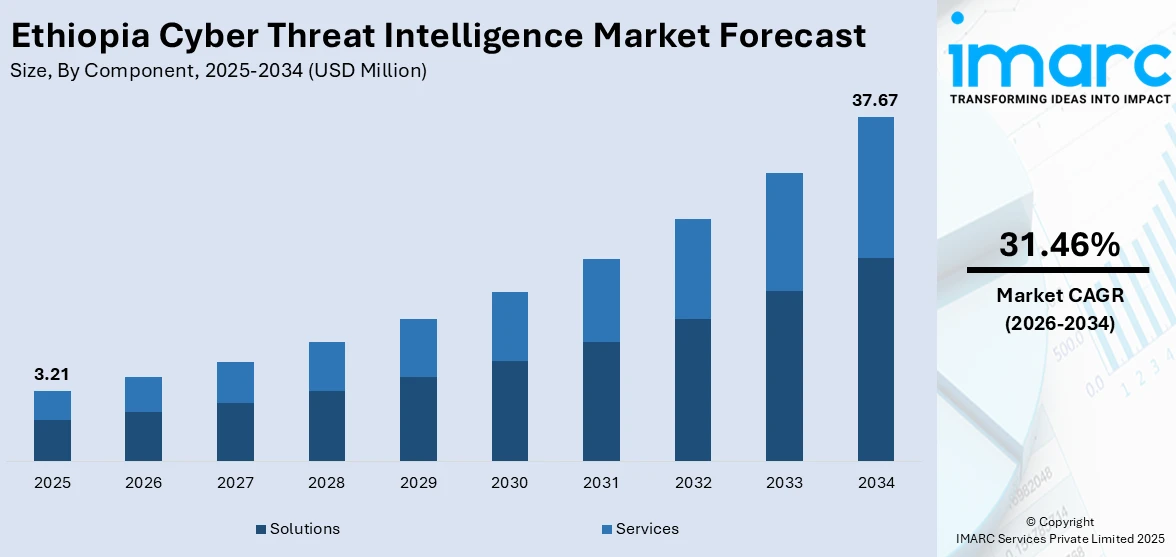
The Ethiopia cyber threat intelligence market size was valued at USD 3.21 Million in 2025 and is projected to reach USD 37.67 Million by 2034, growing at a compound annual growth rate of 31.46% from 2026-2034.
The market is driven by rapid digital transformation across Ethiopia and the growing frequency of cyberattacks targeting critical infrastructure. Government preparedness initiatives, increased funding for monitoring solutions, and wider deployment of intelligence platforms support expansion. Rising adoption of digital financial services, stronger regulatory frameworks, and the integration of artificial intelligence into cybersecurity practices are further accelerating demand and contributing to the overall development of the country’s cyber threat intelligence ecosystem.
Key Takeaways and Insights:
- By Component: Solutions dominate the market with a share of 56.2% in 2025, driven by the growing demand for integrated threat analytics platforms and automated detection systems.
- By Deployment Mode: Cloud-based leads the market with a share of 61.8% in 2025, owing to the scalability, cost efficiency, and rapid deployment advantages of cloud infrastructure.
- By Organization Size: Large enterprises represent the largest segment with a market share of 64.1% in 2025, driven by their higher cybersecurity budgets and complex digital infrastructure requiring advanced threat intelligence.
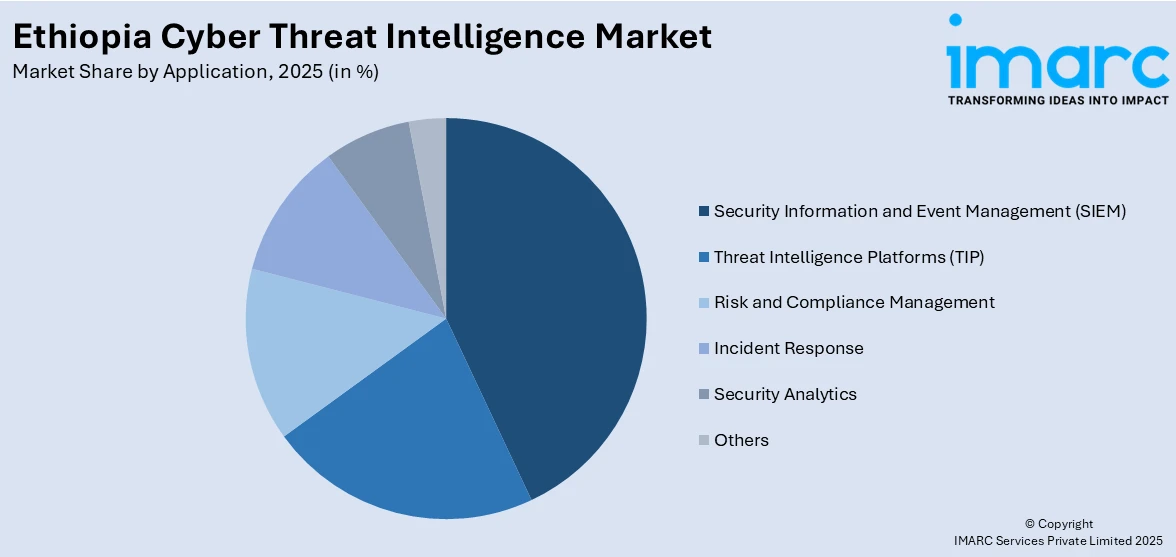
- By Application: Security information and event management (SIEM) dominates the market with a share of 42.5% in 2025, owing to its ability to aggregate and analyze security data from multiple sources in real time.
- Key Players: The Ethiopia cyber threat intelligence market is moderately competitive, with leading cybersecurity firms expanding threat detection capabilities, investing in AI-powered analytics, and forming strategic partnerships to strengthen market presence across financial services, telecommunications, and government sectors.
To get more information on this market Request Sample
The Ethiopia cyber threat intelligence market is looking to gain significant traction as the country continues to deal with the ever-evolving digital space that is characterized by emerging cyber threats. As the country moves towards the digital economy, based on the digital Ethiopia strategy, it continues to roll out digital government services, financial mechanisms, and connectivity options, thus making the cyber space more dynamic and ever-evolving. As the digital space in Ethiopia continues to grow and the number of attacks targeting the government and even financial institutions increases, including denial of service attacks, phishing, and malware, the country moves to meet the strategic needs of protecting the digital space against developing threats. According to reports in September 2025, Ethiopia was identified as the most targeted country worldwide for cyberattacks in 2024, particularly in malware detections, underscoring the urgency for strengthened cyber defenses amid rapid digital growth.
Ethiopia Cyber Threat Intelligence Market Trends:
Integration of Artificial Intelligence into Threat Detection and Response
Ethiopian organizational entities are becoming more inclined to harness artificial intelligence (AI) and machine learning (ML) techniques for further increasing both speed and accuracy in threat detection, classification, and response. There is a growing sense of priority for intelligence solutions that harness AI technology for threat detection as more polymorphic threats are emerging, which are difficult to track using conventional signature-based detection techniques. Reflecting this trend, Planet AI Technologies PLC announced in 2025 that it is delivering AI‑enhanced cybersecurity solutions, including AI‑powered anomaly detection and analytics, to Ethiopian banks, government services, and other sectors to strengthen digital defenses as artificial intelligence becomes central to national innovation efforts.
Growing Demand for Sector-Specific Threat Intelligence in Financial Services
Ethiopia’s rapidly expanding digital payments ecosystem and financial services sector are generating heightened demand for tailored cyber threat intelligence solutions. As mobile money transactions, interbank digital transfers, and electronic payment volumes surge, financial institutions face targeted fraud, phishing, and ransomware campaigns that require sector-specific threat analytics. Recognizing these risks, the National Digital Payments Strategy (2026–2030) proposes establishing a shared national cybersecurity and threat intelligence system within the National Bank of Ethiopia (NBE) to enable centralized, real‑time intelligence exchange across the financial ecosystem, shifting the sector from reactive to proactive defenses. The increasing recognition that siloed incident data leaves the broader financial ecosystem vulnerable is also driving demand.
Expansion of National Cybersecurity Infrastructure and Incident Response Capabilities
Ethiopia is witnessing a strategic buildup of national cybersecurity infrastructure, including centralized threat monitoring operations, digital forensics capabilities, and emergency response frameworks. The establishment and operationalization of national-level security operations centers and computer emergency response teams are creating institutional demand for scalable threat intelligence feeds and analytics platforms. In December 2025, the Information Network Security Administration (INSA) marked the 6th National Cybersecurity Month under the theme “Cybersecurity – The Foundation of Digital Ethiopia,” highlighting government efforts to elevate institutional capacity, public awareness, and cross‑sector collaboration on cyber defense. This infrastructure expansion, aligned with the country’s long-term digital strategy objectives, is enabling a shift from reactive to proactive cyber defense and fostering greater collaboration between public agencies and private sector stakeholders.
Market Outlook 2026-2034:
The Ethiopia cyber threat intelligence market is poised for sustained expansion as the country deepens its digital transformation across government, financial services, telecommunications, and critical infrastructure sectors. Increasing regulatory attention to data protection, rising investments in cloud-native security platforms, and the growing integration of AI-powered analytics into security operations are expected to drive continued adoption. The evolving cyber threat landscape, coupled with expanding public-private collaboration on intelligence sharing and incident response, will further necessitate advanced threat intelligence capabilities across the ecosystem. The market generated a revenue of USD 3.21 Million in 2025 and is projected to reach a revenue of USD 37.67 Million by 2034, growing at a compound annual growth rate of 31.46% from 2026-2034.
Ethiopia Cyber Threat Intelligence Market Report Segmentation:
|
Segment Category |
Leading Segment |
Market Share |
|
Component |
Solutions |
56.2% |
|
Deployment Mode |
Cloud-based |
61.8% |
|
Organization Size |
Large Enterprises |
64.1% |
|
Application |
Security Information and Event Management (SIEM) |
42.5% |
Component Insights:
- Solutions
- Services
- Professional Services
- Managed Services
Solutions dominate with a market share of 56.2% of the total Ethiopia cyber threat intelligence market in 2025.
The solutions are currently leading the market for cyber threat intelligence in Ethiopia, attributed to an increase in demand for integrated threat detection, analytics, and response systems within key sectors of the economy such as enterprises and governments. There has been a growing demand for packaged threat intelligence solutions, mainly because of their ability to provide platforms with features such as automated threat feeds, vulnerability, and incident correlation. Moreover, there has been rapid digitalization of service delivery and financial systems, resulting in an increased need for continuous monitoring and evaluation with features that provide security teams with intelligence in an ever-expanding digital landscape.
As the cyber attacks or intrusions against various organizations grow even more sophisticated, the trend towards comprehensive, platform-based intelligence solutions continues to gain scope. This is because such solutions offer the advantage of enabling the entire distributed network environments to be viewed, making it easier to quickly identify emerging attack vectors. The overall trend towards more proactive, intelligent security solutions is also making the case strong for those solutions that can provide Ethiopian businesses with the advantage of aggregating real-time threat information, as well as featuring more advanced behavioral analysis.
Deployment Mode Insights:
- Cloud-based
- On-premise
Cloud-based leads with a share of 61.8% of the total Ethiopia cyber threat intelligence market in 2025.
Cloud-based currently holds the majority of the Ethiopia cyber threat intelligence market. This can be attributed to the increased adoption of trend-based security systems, which favor cloud-based computing systems. Organizations and institutions, both in the public and private sectors, have started adopting cloud-based threat intelligence systems to reduce their reliance on more complex systems while still benefiting from the dynamic nature of such solutions. Strategic government initiatives are also reinforcing this trend, under the Digital Ethiopia 2030 Strategy, Ethiopia has been building its own national cloud infrastructure to bolster digital services and enhance trust in cloud‑hosted applications, with cloud platforms now integral to government service delivery and data management.
The flexibility that cloud-based deployments offer has been estimated to prove particularly advantageous for organizations operating within the context of the nation of Ethiopia. This advantage arises due to the ease of integration with the existing ecosystems of security that the platforms are capable of providing. There exists the capability to scale intelligence to the increasing digital footprint seamlessly as well, which has been estimated to prove particularly appealing for organizations that wish to keep pace with the threats that are constantly proving increasingly advanced while avoiding the complexity of traditional infrastructure costs that they often entail.
Organization Size Insights:
- Large Enterprises
- Small and Medium-Sized Enterprises (SMEs)
Large enterprises exhibit a clear dominance with a 64.1% share of the total Ethiopia cyber threat intelligence market in 2025.
Large enterprises hold the dominant position in the Ethiopia cyber threat intelligence market, owing to their extensive digital footprints, high-value data assets, and elevated exposure to sophisticated cyberattacks. Major financial institutions, telecommunications providers, and government agencies maintain dedicated security operations teams and invest significantly in comprehensive threat intelligence platforms. These organizations require continuous monitoring, advanced analytics, and multi-source threat feed integration to protect complex network environments and ensure the resilience of mission-critical systems supporting national digital infrastructure.
The growing interconnectedness of enterprise systems and the increasing sophistication of targeted attack campaigns are compelling large organizations to adopt layered, intelligence-driven security architectures. These enterprises prioritize platforms that deliver contextual threat insights, enabling informed decision-making and coordinated incident response across multiple departments and operational units. Their capacity to allocate substantial cybersecurity budgets and recruit specialized talent positions large enterprises as the primary drivers of market demand, setting adoption benchmarks that influence broader ecosystem maturity.
Application Insights:
Access the comprehensive market breakdown Request Sample
- Security Information and Event Management (SIEM)
- Threat Intelligence Platforms (TIP)
- Risk and Compliance Management
- Incident Response
- Security Analytics
- Others
Security information and event management (SIEM) leads with a market share of 42.5% of the total Ethiopia cyber threat intelligence market in 2025.
Security information and event management (SIEM) dominates the Ethiopia cyber threat intelligence market, underscoring the critical need for centralized log management, real-time threat monitoring, and incident correlation across expanding digital ecosystems. SIEM platforms enable organizations to aggregate security data from diverse endpoints, networks, and cloud environments into unified dashboards that facilitate rapid anomaly detection and threat prioritization. As Ethiopian institutions manage increasingly complex and interconnected IT environments, SIEM solutions serve as the foundational layer for operationalizing threat intelligence and strengthening overall cybersecurity posture.
The growing volume and velocity of security events generated across Ethiopia's digital infrastructure are reinforcing the importance of SIEM applications in enabling efficient threat triage and response. These platforms support compliance with emerging data protection regulations by providing audit-ready reporting and continuous monitoring capabilities. The integration of advanced analytics and machine learning into modern SIEM architectures is further enhancing their value proposition, enabling predictive threat identification and automated response workflows that reduce the burden on security teams while improving detection accuracy.
Threat Type Insights:
- Advanced Persistent Threats (APT)
- Zero-day Exploits
- Insider Threats
- Distributed Denial of Service (DDoS)
- Malware
- Phishing
- Others
Advanced persistent threats (APT) represent prolonged, targeted cyberattacks where adversaries infiltrate networks to steal sensitive data or conduct espionage over extended periods. Ethiopian government agencies and critical infrastructure operators face growing APT risks as digital transformation expands attack surfaces. These sophisticated intrusions require continuous threat intelligence monitoring and advanced behavioral analytics to detect stealthy lateral movements within compromised networks.
Zero-day exploits target previously unknown software vulnerabilities before developers release patches, making them extremely difficult to detect using conventional security measures. As Ethiopian organizations increasingly adopt diverse software ecosystems across government services, banking, and telecommunications, exposure to zero-day threats intensifies. Effective threat intelligence platforms that leverage global vulnerability databases and predictive analytics are essential for identifying and mitigating these emerging risks.
Insider threats originate from individuals within organizations who misuse authorized access to compromise data, systems, or operations, whether intentionally or through negligence. Ethiopian enterprises, particularly in the financial and government sectors, face growing insider risks as digital access expands across employees and third-party contractors. Threat intelligence solutions incorporating user behavior analytics and access monitoring are critical for detecting anomalous internal activities and preventing data breaches.
Distributed Denial of Service (DDoS) attacks overwhelm networks and servers with massive traffic volumes, disrupting essential services and causing significant operational downtime. Ethiopian telecommunications providers and financial institutions face persistent DDoS campaigns employing techniques such as DNS amplification and UDP-based floods. Threat intelligence platforms that provide real-time attack detection, traffic analysis, and automated mitigation capabilities are vital for maintaining service continuity across critical digital infrastructure.
Malware encompasses malicious software including ransomware, trojans, and spyware designed to infiltrate, damage, or exfiltrate data from targeted systems. Ethiopia faces an escalating malware threat landscape as digital adoption accelerates across public and private sectors. Comprehensive threat intelligence solutions that deliver real-time malware signature updates, behavioral detection, and automated containment capabilities are essential for protecting organizational assets against evolving malicious software campaigns.
Phishing attacks employ deceptive communications to trick individuals into revealing sensitive credentials, financial information, or installing malicious payloads. Ethiopian organizations, particularly in banking and government services, face increasing phishing campaigns exploiting low cybersecurity awareness among users. Threat intelligence platforms that provide phishing URL detection, email threat analysis, and employee awareness integration are crucial for reducing susceptibility and strengthening organizational defenses against social engineering tactics.
Others encompasses emerging and hybrid cyber threats including supply chain attacks, cryptojacking, man-in-the-middle interceptions, and SQL injection exploits targeting Ethiopian organizations. As the digital ecosystem diversifies and new technologies are adopted, previously uncommon attack vectors gain relevance. Threat intelligence solutions offering broad-spectrum threat coverage and adaptive detection capabilities are essential for addressing this evolving and unpredictable threat landscape.
Regional Insights:
- Addis Ababa
- Oromia Region
- Amhara Region
- SNNPR Region
- Tigray Region
- Others
Addis Ababa dominates the Ethiopia cyber threat intelligence market as the nation's capital, primary commercial hub, and seat of government institutions, financial headquarters, and telecommunications infrastructure. The concentration of large enterprises, banking operations, technology firms, and diplomatic missions creates substantial demand for advanced threat intelligence solutions to protect critical digital assets and sensitive information networks.
Oromia Region represents a growing market for cyber threat intelligence solutions, driven by expanding industrial activities, agricultural modernization initiatives, and increasing digital connectivity across urban centers. The region's developing telecommunications infrastructure and rising adoption of digital services among businesses and public institutions are generating demand for security solutions that safeguard emerging digital operations and support regional economic transformation efforts.
Amhara Region is witnessing gradual adoption of cyber threat intelligence capabilities as digital services expand across government offices, educational institutions, and financial service providers. The region's increasing internet penetration and growing reliance on digital platforms for public service delivery are creating awareness about cybersecurity risks, driving demand for foundational threat monitoring and intelligence solutions tailored to emerging digital environments.
SNNPR Region is experiencing rising demand for cybersecurity solutions as digital inclusion initiatives expand connectivity and government service digitization reaches broader populations. The region's growing engagement with mobile financial services and e-government platforms is elevating cybersecurity awareness among institutions, creating nascent demand for threat intelligence capabilities that protect expanding digital touchpoints and regional infrastructure.
Tigray Region represents an emerging market for cyber threat intelligence as post-conflict reconstruction efforts prioritize the restoration and modernization of digital infrastructure and communications networks. The rebuilding of institutional systems, telecommunications connectivity, and financial service platforms is creating foundational requirements for cybersecurity solutions that ensure the integrity and resilience of newly deployed digital systems across the region.
Other regions across Ethiopia, including Somali, Afar, Benishangul-Gumuz, Gambela, Harari, Dire Dawa, and Sidama, collectively represent an emerging market for threat intelligence solutions. As national digital transformation initiatives extend connectivity and digital services to underserved areas, these regions are gradually developing cybersecurity awareness and generating early-stage demand for basic threat monitoring and protection capabilities.
Market Dynamics:
Growth Drivers:
Why is the Ethiopia Cyber Threat Intelligence Market Growing?
Accelerating Digital Transformation and Expansion of Critical Digital Infrastructure
Ethiopia's ambitious digital transformation agenda is fundamentally expanding the digital attack surface, creating a pressing need for advanced cyber threat intelligence capabilities. The government's strategic focus on digitizing public services, expanding mobile connectivity, and building national cloud infrastructure has resulted in a rapidly growing digital ecosystem encompassing e-government portals, digital identity systems, and electronic payment platforms. In January 2026, Ethiopia hosted a high‑level cyber security workshop with experts from Israel and local stakeholders to highlight emerging AI‑powered threats and reinforce the country’s commitment to strengthening digital defenses. As these systems become more interconnected and accessible, they present attractive targets for cybercriminals, necessitating intelligence-driven security approaches that can anticipate and mitigate threats before they materialize.
Escalating Cyber Threat Landscape and Increasing Attack Sophistication
The rapidly intensifying cyber threat environment facing Ethiopia is a critical driver of demand for threat intelligence solutions. The country has experienced a dramatic escalation in cyberattack attempts targeting public institutions, telecommunications infrastructure, financial organizations, and essential service systems. Recent reports indicate that Ethiopia currently ranks as the most targeted nation worldwide for malware and AI‑driven attacks, with critical infrastructure, including major dams and telecom networks, facing frequent sophisticated assault attempts, highlighting how acute these threats have become. The evolving nature of these threats, which now include advanced persistent threats, polymorphic malware, and multi-vector campaigns, demands sophisticated intelligence capabilities that go beyond traditional perimeter defenses, compelling organizations to invest in platforms providing contextual, actionable insights for proactive defense strategies.
Government-Led Cybersecurity Initiatives and Strengthening Regulatory Frameworks
Proactive government efforts to build a resilient national cybersecurity ecosystem are significantly propelling the adoption of threat intelligence solutions in Ethiopia. The establishment and strengthening of national cybersecurity agencies, the operationalization of computer emergency response teams, and the development of mandatory cybersecurity standards for critical sectors are creating institutional demand for intelligence platforms. Under Ethiopia’s Personal Data Protection Proclamation No. 1321/2024, effective 24 July 2024, public and private entities must implement stronger cyber defenses, breach documentation, and technical safeguards to comply with legal data security obligations. The enactment of comprehensive data protection legislation is also compelling organizations to adopt more rigorous security postures, driving sustained investment in threat intelligence capabilities across public and private sectors.
Market Restraints:
What Challenges the Ethiopia Cyber Threat Intelligence Market is Facing?
Acute Shortage of Skilled Cybersecurity Professionals
Ethiopia faces a significant deficit in qualified cybersecurity professionals capable of deploying, managing, and interpreting outputs from advanced threat intelligence platforms. The limited talent pool restricts organizations' ability to fully leverage sophisticated tools, reduces operational readiness, and slows the adoption of intelligence-driven security strategies across both public and private sectors, hindering overall market expansion.
Fragmented Threat Information Sharing and Low Reporting Culture
The absence of a unified, sector-wide framework for sharing cyber incident information creates significant blind spots in Ethiopia's collective cyber defense posture. Many organizations remain reluctant to disclose cyberattack incidents due to reputational concerns, leaving the broader ecosystem vulnerable to repeated exploitation of known vulnerabilities and undermining the effectiveness of collaborative threat intelligence coordination efforts.
Infrastructure and Connectivity Limitations
Persistent challenges related to power supply reliability, internet connectivity gaps, and limited IT infrastructure in rural and semi-urban areas constrain the deployment and effectiveness of threat intelligence solutions. Unstable network environments and insufficient computing resources hinder the ability to implement real-time threat monitoring and cloud-based intelligence platforms that require consistent and robust digital connectivity infrastructure.
Competitive Landscape:
The Ethiopia cyber threat intelligence market is characterized by a dynamic competitive environment where international cybersecurity vendors and emerging regional solution providers are vying for market presence. Competition is driven by the ability to deliver contextually relevant threat intelligence tailored to Ethiopia’s unique risk landscape, including localized threat feeds and regionally adapted analytics. Market participants are differentiating through partnerships with government institutions, investments in local capacity building, and the development of cloud-native, scalable platforms that accommodate varying organizational maturity levels. Strategic alliances between technology providers and national cybersecurity bodies are shaping the competitive dynamics, while growing demand for managed security services is opening new avenues for service-oriented competitors to gain foothold in the market.
Recent Developments:
-
In December 2025, Ethiopia launched Digital Ethiopia 2030, a five-year national technology and digital transformation strategy focusing on cybersecurity, AI, digital infrastructure, and trusted digital services. The plan strengthens cybersecurity coordination, incident response, and public-private collaboration to address rising digital threats.
Ethiopia Cyber Threat Intelligence Market Report Coverage:
|
Report Features |
Details |
|
Base Year of the Analysis |
2025 |
|
Historical Period |
2020-2025 |
|
Forecast Period |
2026-2034 |
|
Units |
Million USD |
|
Scope of the Report |
Exploration of Historical Trends and Market Outlook, Industry Catalysts and Challenges, Segment-Wise Historical and Future Market Assessment:
|
|
Components Covered |
|
|
Deployment Modes Covered |
Cloud-based, On-premise |
|
Organization Sizes Covered |
Large Enterprises, Small and Medium-Sized Enterprises (SMEs) |
|
Applications Covered |
Security Information and Event Management (SIEM), Threat Intelligence Platforms (TIP), Risk and Compliance Management, Incident Response, Security Analytics, Others |
|
Threat Types Covered |
Advanced Persistent Threats (APT), Zero-day Exploits, Insider Threats, Distributed Denial of Service (DDoS), Malware, Phishing, Others |
|
Regions Covered |
Addis Ababa, Oromia Region, Amhara Region, SNNPR Region, Tigray Region, Others |
|
Customization Scope |
10% Free Customization |
|
Post-Sale Analyst Support |
10-12 Weeks |
|
Delivery Format |
PDF and Excel through Email (We can also provide the editable version of the report in PPT/Word format on special request) |
Frequently Asked Questions About the Ethiopia Cyber Threat Intelligence Market Report
The Ethiopia cyber threat intelligence market size was valued at USD 3.21 Million in 2025.
The Ethiopia cyber threat intelligence market is expected to grow at a compound annual growth rate of 31.46% from 2026-2034 to reach USD 37.67 Million by 2034.
Solutions held the largest Ethiopia cyber threat intelligence market share, driven by rising demand for integrated threat analytics platforms, automated detection engines, and real-time intelligence feeds across enterprise and government sectors.
Key factors driving the Ethiopia cyber threat intelligence market include escalating cyberattacks targeting critical infrastructure, government-led digital transformation initiatives, rapid financial sector digitalization, regulatory mandates for cybersecurity compliance, and growing adoption of AI-powered threat detection solutions.
Major challenges include a severe shortage of qualified cybersecurity professionals, limited cybersecurity budgets across public and private sectors, fragmented regulatory frameworks, infrastructure constraints, and the rapidly evolving sophistication of cyber threats outpacing defensive capabilities.
Need more help?
- Speak to our experienced analysts for insights on the current market scenarios.
- Include additional segments and countries to customize the report as per your requirement.
- Gain an unparalleled competitive advantage in your domain by understanding how to utilize the report and positively impacting your operations and revenue.
- For further assistance, please connect with our analysts.
 Request Customization
 Speak to an Analyst
 Request Brochure
 Inquire Before Buying
Benefits of Customization
- Personalize this research
- Triangulate with your data
- Get data as per your format and definition
- Gain a deeper dive into a specific application, geography, customer, or competitor
- Any level of personalization
Get in Touch With Us
UNITED STATES
Phone: +1-201-971-6302
INDIA
Phone: +91-120-433-0800
UNITED KINGDOM
Phone: +44-753-714-6104
Email: [email protected]
Client Testimonials




.webp)




.webp)













Related Reports

Choose your plan
*Please note that the prices mentioned below are starting prices for each bundle type. Kindly contact our team for further details.*
Single User License
- 1 User License, Access on 2 Devices
- PDF Report + Excel Dataset (Password Protected)
- Lifetime Access
- No Printing Rights
- 10% Free Report Customization
- 10–12 Weeks of Analyst Support
Five User License
- Access for 5 Users, 2 Devices per User
- PDF Report + Excel Dataset (Password Protected)
- Lifetime Access
- Dedicated Account Manager
- 12–14 Weeks of Analyst Support
- No Printing Rights
- 15% Free Report Customization
- 25% Discount on Your Next Purchase
Corporate User License
- Unlimited User Access (Within Your Organization)
- PDF Report + Excel Dataset
- Lifetime Access
- Dedicated Account Manager
- 14–20 Weeks of Analyst Support
- No Printing Rights
- 20% Free Report Customization
- 30% Discount on Your Next Purchase
Essential Insights
What's included:
3 reports
- Lifetime Access
- PDF Reports
- Excel Datasets
- 2 Weeks of Free Analyst Support
- 2 User Licenses
- Access on 2 Devices
- Printing Rights
- Complimentary PowerPoint (PPT) Version
- Complimentary License Upgrade
Professional Access
What's included:
5 reports
- Lifetime Access
- PDF Reports
- Excel Datasets
- 8 Weeks of Free Analyst Support
- 2 User Licenses
- Access on 2 Devices
- Printing Rights
- Complimentary PowerPoint (PPT) Version
- Complimentary License Upgrade
Business Advantage
What's included:
8 reports
- Lifetime Access
- PDF Reports
- Excel Datasets
- 14 Weeks of Free Analyst Support
- 2 User Licenses
- Access on 2 Devices
- Printing Rights
- Complimentary PowerPoint (PPT) Version
- Complimentary License Upgrade
Enterprise Intelligence
What's included:
10 reports
- Lifetime Access
- PDF Reports
- Excel Datasets
- 20 Weeks of Free Analyst Support
- 2 User Licenses
- Access on 2 Devices
- Printing Rights
- Complimentary PowerPoint (PPT) Version
- Complimentary License Upgrade