
Ethiopia Precision Farming Market Size, Share, Trends and Forecast by Offering, Application, and Region, 2026-2034
Ethiopia Precision Farming Market Summary:
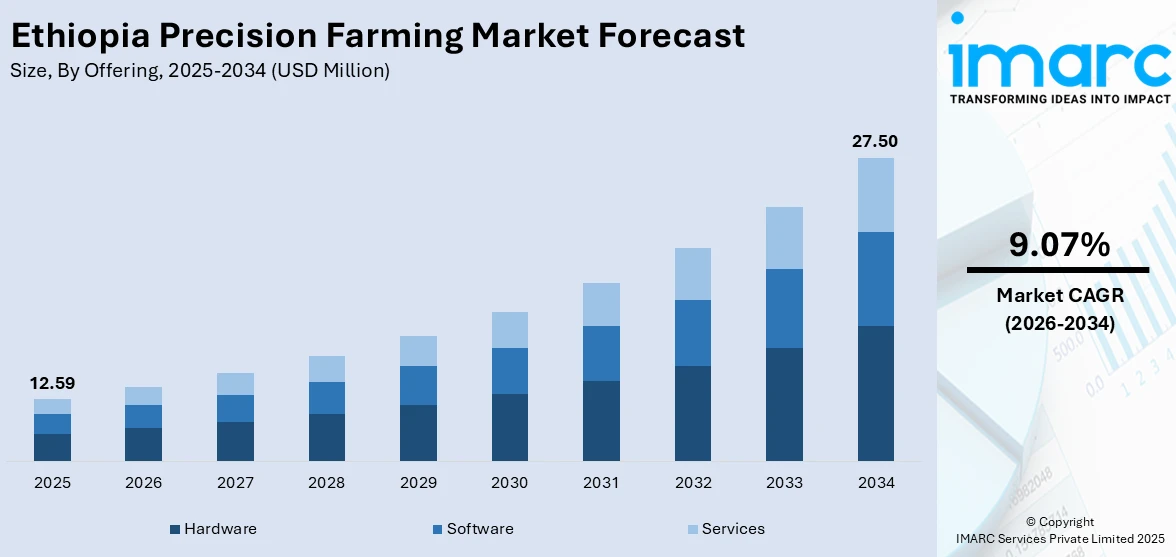
The Ethiopia precision farming market size was valued at USD 12.59 Million in 2025 and is projected to reach USD 27.50 Million by 2034, growing at a compound annual growth rate of 9.07% from 2026-2034.
Precision farming market in Ethiopia: The precision farming market in Ethiopia is gaining momentum as the nation pushes forward its modernization drive for the agriculture sector through government-backed digital transformation programs in Ethiopia. Public attention to increased investment in irrigation infrastructure and food security goals also boosts the precision farming business segment positively. Satellite monitoring technology, mobile-based advisory systems, and IoT-based farming systems are changing the face of conventional farming practices, and precision farming is now emerging as a new industry platform in Ethiopia, taking the precision farming share forward exclusively.
Key Takeaways and Insights:
- By Offering: Hardware dominated the market with a share of 45.8% in 2025, driven by the expanding deployment of IoT sensors, GPS-guided equipment, and drone-based monitoring systems across Ethiopia’s agricultural landscape.
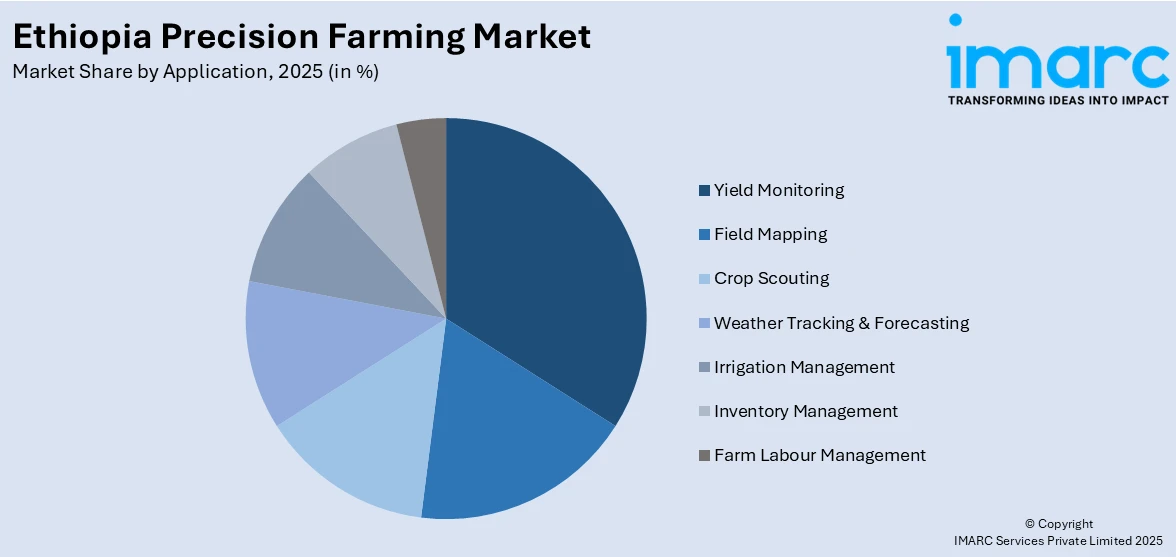
- By Application: Yield monitoring leads the market with a share of 28.6% in 2025, owing to the growing reliance on satellite imagery and sensor-based crop performance tracking to optimize harvest outcomes across diverse farming regions.
- By Region: Oromia Region accounted for the largest share of 39.2% in 2025. This dominance is driven by the region’s vast cultivable land area, diverse agro-climatic conditions, and significant government investment in mechanized and commercial farming operations.
- Key Players: The Ethiopia precision farming market exhibits a moderately competitive landscape, with international technology providers and emerging local agritech enterprises collaborating to expand precision agriculture solutions across the country.
To get more information on this market Request Sample
The Ethiopian precision farming market is currently at a crucial stage, witnessing tremendous growth with more innovative farming technologies being incorporated within Ethiopian farmers, particularly to address issues such as food security. In 2025, the Ethiopian Ministry of Agriculture signed a Memorandum of Understanding with Precision Development (PxD), backed by a USD 3 million funding grant from the Bill & Melinda Gates Foundation, to establish a Project Management Unit for the implementation of the country’s Digital Agriculture Roadmap, a key step toward scaling digital agriculture solutions nationwide, including digital advisory and precision tools for smallholder farmers. The government has established various digital agriculture transformation strategies, modernization strategies, and other significant government initiatives that have created a strong foundation for precision farming, incorporating technology such as mobile advisory services, satellite farming systems, IoT farming, and other forms of precision farming technologies.
Ethiopia Precision Farming Market Trends:
Growing Integration of Satellite and Drone-Based Crop Monitoring
Ethiopia is witnessing accelerating adoption of satellite imagery and unmanned aerial vehicles for crop health assessment and agricultural planning. In October 2025, the Government of Ethiopia’s Ministry of Irrigation and Lowlands received advanced surveying drones equipped with high‑resolution sensors through a UNOPS programme to boost agricultural productivity, monitor crop health, and create detailed vegetation maps for better land use decisions, tools that are now being used across key farming regions. These remote sensing technologies are enabling farmers and government agencies to monitor vegetation health, detect pest outbreaks, and map agricultural land use patterns with increasing accuracy. The integration of multispectral sensors and AI-powered analytics is enhancing early warning capabilities and supporting more informed decision-making across the country’s diverse agro-ecological zones, thereby contributing to Ethiopia precision farming market growth.
Expansion of Mobile-Based Digital Advisory Services
Digital agricultural extension services delivered through mobile platforms are rapidly transforming how farmers access agronomic advice, weather forecasts, and market information. In 2024–2025, Ethiopia’s Digital Agriculture Advisory Services (DAAS) programme, led by Precision Development (PxD) in partnership with the Ethiopian Agricultural Transformation Institute and the Ministry of Agriculture, upgraded the country’s 8028 Farmer’s Hotline and voice‑based mobile advisory systems, expanding targeted push‑call advisory support to nearly 1 million crop and livestock farmers nationwide. Voice-based advisory systems and interactive mobile applications are bridging the knowledge gap for smallholder farmers in remote regions. These platforms leverage data analytics to deliver personalized recommendations on planting schedules, fertilizer application, and pest management, making precision agriculture tools accessible to a broader farming population across Ethiopia.
Rising Adoption of IoT-Enabled Smart Farming Solutions
The deployment of Internet of Things sensors and connected devices is gaining momentum across Ethiopia’s agricultural landscape. According to reports, Ethio Telecom partnered with the Oromia Agriculture Bureau to launch a big‑data digital agriculture platform that integrates data from IoT devices, satellite imagery, and field sensors to enable real‑time crop and soil monitoring and support predictive analytics for farmers and regional planners. IoT-based monitoring systems are enabling real-time tracking of soil moisture levels, ambient temperature, and crop growth conditions, allowing farmers to optimize irrigation schedules and reduce resource wastage. The convergence of IoT with cloud computing platforms is facilitating centralized data management and predictive analytics, supporting improved farm management outcomes and more efficient resource allocation.
Market Outlook 2026-2034:
The Ethiopia precision farming market is positioned for sustained growth over the forecast period, supported by the country’s ongoing agricultural transformation agenda, rising investments in digital infrastructure, and expanding international partnerships focused on smart agriculture solutions. Increasing government expenditure on agricultural modernization, coupled with the growing availability of affordable precision farming hardware and expanding rural connectivity, is expected to broaden technology adoption across diverse farming regions and strengthen the country’s food security framework. The market generated a revenue of USD 12.59 Million in 2025 and is projected to reach a revenue of USD 27.50 Million by 2034, growing at a compound annual growth rate of 9.07% from 2026-2034.
Ethiopia Precision Farming Market Report Segmentation:
|
Segment Category |
Leading Segment |
Market Share |
|
Offering |
Hardware |
45.8% |
|
Application |
Yield Monitoring |
28.6% |
|
Region |
Oromia Region |
39.2% |
Offering Insights:
- Hardware
- Software
- Services
The hardware dominates with a market share of 45.8% of the total Ethiopia precision farming market in 2025.
The dominance of hardware segment can be related to increased offerings of physical devices and equipment that are essential to the development of precision agriculture in Ethiopia. There is increased interest in precision agriculture, which covers the use of GPS-guided tractors, IoT devices, and various monitoring systems, particularly with regards to government efforts aimed at encouraging the use of machines in agriculture. The emphasis on ensuring that agriculture is undertaken with advanced devices is also contributing to the dominance of hardware segment.
In addition, the increasing affordability of sensor technologies and connected devices is further contributing to hardware proliferation among smallholder farmers in the country. There is a growing utilization of remote sensor technologies, weather stations, as well as soil moisture sensors in farming, particularly for data collection purposes. The government initiative that supports mechanization, particularly in facilitating the importation of machinery, is actively contributing to the proliferation of hardware utilization in precision farming, considering different agro-ecological zones in Ethiopia.
Application Insights:
Access the comprehensive market breakdown Request Sample
- Yield Monitoring
- Field Mapping
- Crop Scouting
- Weather Tracking & Forecasting
- Irrigation Management
- Inventory Management
- Farm Labour Management
The yield monitoring leads with a share of 28.6% of the total Ethiopia precision farming market in 2025.
The yield monitoring segment’s leading position reflects the critical importance of accurate harvest prediction and crop performance assessment in Ethiopia’s agricultural landscape, where food security remains a national priority. In March 2025, the Food and Agriculture Organization (FAO) supported a national initiative with the Ethiopian Statistics Service (ESS) to integrate Earth Observation (EO) data and process‑based crop models for enhanced yield estimation, a programme that trained national experts to use satellite‑derived data for more precise crop yield predictions and decision‑making across major farming regions. The adoption of satellite-based vegetation indices, drone-mounted multispectral sensors, and ground-based monitoring stations is enabling farmers and agricultural agencies to track crop health throughout the growing season. These technologies are helping optimize planting decisions and harvest timing, directly contributing to improved productivity outcomes across the country.
Yield monitoring technologies are increasingly being integrated with machine learning algorithms and predictive analytics platforms to enhance the accuracy of production forecasts. Research institutions and government bodies are leveraging historical satellite data combined with real-time field observations to develop crop yield prediction models tailored to Ethiopia’s diverse agro-ecological conditions. These data-driven approaches are improving harvest planning, reducing post-harvest losses, and supporting evidence-based agricultural policy decisions that aim to strengthen food self-sufficiency.
Regional Insights:
- Addis Ababa
- Oromia Region
- Amhara Region
- SNNPR Region
- Tigray Region
- Others
Oromia Region exhibits a clear dominance with a 39.2% share of the total Ethiopia precision farming market in 2025.
The leading market position of the Oromia Region is facilitated by the fact that this region is the agricultural heartland of Ethiopia, having the most extensive area of cultivable land, a wide range of agro-climatic zones, and heavy investment by the government in modern farming infrastructure. Cluster mechanized farming is practiced in this region, supported by enhanced seed distribution, fertilizer supply, and an expanded irrigation system. Precision farming technologies optimizing resource use and improving productivity are applied to coffee, cereals, oilseeds, and horticultural crops grown in various landscapes of Oromia.
The growing deployment of digital agriculture solutions in Oromia is further reinforcing the region's market leadership. Agricultural financing institutions operating within the region have emerged as prominent supporters of modern farming adoption, enabling producers and agribusinesses to invest in advanced equipment and technologies. Additionally, the expansion of industrial park infrastructure in key urban centers, together with favorable investment policies and proximity to the national capital, is attracting agritech enterprises and technology providers to the region.
Market Dynamics:
Growth Drivers:
Why is the Ethiopia Precision Farming Market Growing?
Government-Led Agricultural Digitalization and Transformation Programs
The Ethiopian government has positioned agricultural modernization as a central pillar of its national development strategy, driving significant investment in digital agriculture infrastructure and precision farming technologies. National strategies focused on digital transformation have catalyzed systematic technological adoption across rural communities, with mobile internet connectivity expanding and network coverage reaching previously underserved farming regions. Comprehensive digital agriculture roadmaps have been established, charting multi-year investment frameworks that prioritize digital extension services, farmer profiling systems, pest and disease outbreak response mechanisms, and access to agricultural credit and insurance through technology-enabled platforms. The government’s commitment to organizing smallholder farmers into production clusters further enhances economies of scale and improves access to modern agricultural inputs and digital services, helping farmers transition from subsistence agriculture to competitive commercial endeavors.
Expanding Irrigation Infrastructure and Climate-Resilient Agriculture Initiatives
Ethiopia’s rapidly expanding irrigation infrastructure is creating a favorable environment for precision farming adoption by enabling year-round cultivation and reducing dependence on rain-fed agriculture. In September 2025, the Ministry of Irrigation and Lowlands announced a major scale‑up of national irrigation capacity with ten new large‑scale irrigation projects underway across the country, backed by a special irrigation development fund and technical support from partners such as the FAO, aimed at ensuring continuous production cycles and strengthening food security. Large-scale irrigation projects are transforming previously marginal lands into productive agricultural zones, covering vast hectares for the cultivation of key crops including wheat, sesame, and corn. These expanded irrigation systems necessitate precision water management technologies, IoT-based soil moisture monitoring, and automated scheduling solutions that optimize water distribution and enhance crop productivity.
Rising Agricultural Financing and Mechanization Investment
The substantial increase in agricultural financing is accelerating the adoption of precision farming equipment and technologies across Ethiopia. In March 2025, the International Finance Corporation (IFC) partnered with Ethiopian fintech provider Kifiya to improve access to digital financial services for farmers, aiming to digitally map and profile 1 million smallholder farmers and extend financial services, including potential credit access, to remote rural areas as part of broader efforts to strengthen agricultural finance and productivity. Government budget allocations directed toward agricultural inputs, research, and infrastructure development have risen significantly, reflecting the country’s commitment to transforming its farming sector. Historic budget approvals for agriculture represent marked increases in expenditure aimed at enhancing productivity, supporting vulnerable communities, and promoting sustainable growth. Government policies facilitating duty-free importation of farm machinery are reducing cost barriers for farmers seeking to adopt GPS-guided equipment, automated planting systems, and precision monitoring devices. Additionally, financial institutions are increasingly offering specialized agricultural loans and flexible leasing services for mechanization equipment, enabling smallholder farmers and agribusinesses to modernize their operations and integrate precision farming technologies.
Market Restraints:
What Challenges the Ethiopia Precision Farming Market is Facing?
Limited Digital Infrastructure and Connectivity in Rural Areas
Nevertheless, rural farming communities across Ethiopia, even with mobile network and internet connectivity services, have not experienced sufficient connectivity. Insufficient network connectivity in rural agricultural areas makes it difficult to use IoT devices, cloud analytics, and other technologies, which are essential for precision farming. This demonstrates that insufficient network connectivity in rural areas is affecting market penetration in Ethiopia.
High Initial Cost of Precision Farming Technologies
At the moment, most of the hardware for precision farming is so expensive that simple drones, GPS-guided equipment, and sensor networks remain out of reach for the majority of smallholder farmers in Ethiopia. Greater access to affordable financing, with large-scale and affordable leasing models of advanced agricultural equipment, remains limited, thus constraining technology adoption among resource-limited farming communities, slowing market expansion, and limiting the benefits of precision agriculture to larger commercial operations.
Low Digital Literacy and Technical Skill Gaps Among Farmers
The effective usage of precision farming technologies demands a certain minimum level of digital literacy skills, which is beyond the capacity of most Ethiopian farmers. There is a lack of proper training programs and extension services aimed at developing precision farming, which is a barrier to the implementation of data-driven farming practices. The effectiveness of a wide range of precision farming technologies depends on whether proper capacity-building programs and training support are provided.
Competitive Landscape:
The Ethiopia precision farming industry has an evolving competitive profile, primarily dictated by the dynamics among global technology providers, multilateral development agencies, and homegrown tech startups. To this end, players are taking conscious efforts to innovate cutting-edge technology targeting precision farming, whose needs and dynamics pertain uniquely to Ethiopian agriculture. Currently, competition is dictated by technology innovations, particularly in digital extension services, monitoring technologies, and data services that help improve crop management practices. Strategic partnerships among human institutions and eventually for-profit players have ensured an accelerated pace of technology adoption, such that there is an enhanced availability of precision farming services across all agro-ecological zones. Additionally, the industry and players have benefited greatly from various positive influences from global agencies, as dictated by plans aimed at enforcing innovations and expansions pertaining to agricultural technology, whose overall effect has enhanced the general competitiveness of precision farming providers.
Recent Developments:
-
In February 2025, Ethiopia launches national Digital Agriculture Roadmap (DAR) 2025–2032, a government‑led blueprint developed by the Ministry of Agriculture with Precision Development (PxD), the Ethiopian Agricultural Transformation Institute (ATI), Gates Foundation and BCG to modernize precision farming services including digital advisory, weather/pest alerts, market access, unique farmer IDs, and more.
Ethiopia Precision Farming Market Report Coverage:
|
Report Features |
Details |
|
Base Year of the Analysis |
2025 |
|
Historical Period |
2020-2025 |
|
Forecast Period |
2026-2034 |
|
Units |
Million USD |
|
Scope of the Report |
Exploration of Historical Trends and Market Outlook, Industry Catalysts and Challenges, Segment-Wise Historical and Future Market Assessment:
|
|
Offerings Covered |
Hardware, Software, Services |
|
Applications Covered |
Yield Monitoring, Field Mapping, Crop Scouting, Weather Tracking & Forecasting, Irrigation Management, Inventory Management, Farm Labour Management |
|
Regions Covered |
Addis Ababa, Oromia Region, Amhara Region, SNNPR Region, Tigray Region, Others |
|
Customization Scope |
10% Free Customization |
|
Post-Sale Analyst Support |
10-12 Weeks |
|
Delivery Format |
PDF and Excel through Email (We can also provide the editable version of the report in PPT/Word format on special request) |
Frequently Asked Questions About the Ethiopia Precision Farming Market Report
The Ethiopia precision farming market size was valued at USD 12.59 Million in 2025.
The Ethiopia precision farming market is expected to grow at a compound annual growth rate of 9.07% from 2026-2034 to reach USD 27.50 Million by 2034.
Hardware, holding the largest share of 45.8%, remains the leading offering segment driven by expanding deployment of IoT sensors, GPS-guided equipment, and agricultural drones across farming operations nationwide.
Key factors driving the Ethiopia precision farming market include government-led digital agriculture transformation programs, expanding irrigation infrastructure, rising agricultural financing, growing adoption of IoT and satellite monitoring technologies, and increasing demand for food security solutions.
Major challenges include limited digital infrastructure and connectivity in rural areas, high initial costs of precision farming technologies, low digital literacy among smallholder farmers, supply chain constraints for imported equipment, and insufficient technical training and extension support.
Need more help?
- Speak to our experienced analysts for insights on the current market scenarios.
- Include additional segments and countries to customize the report as per your requirement.
- Gain an unparalleled competitive advantage in your domain by understanding how to utilize the report and positively impacting your operations and revenue.
- For further assistance, please connect with our analysts.
 Request Customization
 Speak to an Analyst
 Request Brochure
 Inquire Before Buying
Benefits of Customization
- Personalize this research
- Triangulate with your data
- Get data as per your format and definition
- Gain a deeper dive into a specific application, geography, customer, or competitor
- Any level of personalization
Get in Touch With Us
UNITED STATES
Phone: +1-201-971-6302
INDIA
Phone: +91-120-433-0800
UNITED KINGDOM
Phone: +44-753-714-6104
Email: [email protected]
Client Testimonials




.webp)




.webp)













Related Reports

Choose your plan
*Please note that the prices mentioned below are starting prices for each bundle type. Kindly contact our team for further details.*
Single User License
- 1 User License, Access on 2 Devices
- PDF Report + Excel Dataset (Password Protected)
- Lifetime Access
- No Printing Rights
- 10% Free Report Customization
- 10–12 Weeks of Analyst Support
Five User License
- Access for 5 Users, 2 Devices per User
- PDF Report + Excel Dataset (Password Protected)
- Lifetime Access
- Dedicated Account Manager
- 12–14 Weeks of Analyst Support
- No Printing Rights
- 15% Free Report Customization
- 25% Discount on Your Next Purchase
Corporate User License
- Unlimited User Access (Within Your Organization)
- PDF Report + Excel Dataset
- Lifetime Access
- Dedicated Account Manager
- 14–20 Weeks of Analyst Support
- No Printing Rights
- 20% Free Report Customization
- 30% Discount on Your Next Purchase
Essential Insights
What's included:
3 reports
- Lifetime Access
- PDF Reports
- Excel Datasets
- 2 Weeks of Free Analyst Support
- 2 User Licenses
- Access on 2 Devices
- Printing Rights
- Complimentary PowerPoint (PPT) Version
- Complimentary License Upgrade
Professional Access
What's included:
5 reports
- Lifetime Access
- PDF Reports
- Excel Datasets
- 8 Weeks of Free Analyst Support
- 2 User Licenses
- Access on 2 Devices
- Printing Rights
- Complimentary PowerPoint (PPT) Version
- Complimentary License Upgrade
Business Advantage
What's included:
8 reports
- Lifetime Access
- PDF Reports
- Excel Datasets
- 14 Weeks of Free Analyst Support
- 2 User Licenses
- Access on 2 Devices
- Printing Rights
- Complimentary PowerPoint (PPT) Version
- Complimentary License Upgrade
Enterprise Intelligence
What's included:
10 reports
- Lifetime Access
- PDF Reports
- Excel Datasets
- 20 Weeks of Free Analyst Support
- 2 User Licenses
- Access on 2 Devices
- Printing Rights
- Complimentary PowerPoint (PPT) Version
- Complimentary License Upgrade