
Europe Building Automation Systems Market Size, Share, Trends and Forecast by Offering, Communication Technology, Application, and Country, 2026-2034
Europe Building Automation Systems Market Summary:
The Europe building automation systems market size was valued at USD 27.6 Billion in 2025 and is projected to reach USD 55.4 Billion by 2034, growing at a compound annual growth rate of 8.08% from 2026-2034.
The Europe building automation systems market is experiencing robust expansion as countries across the region intensify their focus on energy efficiency, smart building infrastructure, and carbon neutrality. Stringent regulatory frameworks, particularly the revised Energy Performance of Buildings Directive, are compelling property owners and facility managers to adopt advanced automation solutions for HVAC, lighting, security, and energy management. The convergence of Internet of Things technologies, artificial intelligence, and cloud-based analytics is transforming building operations, enabling predictive maintenance, real-time monitoring, and occupant comfort optimization. Increasing urbanization, rising electricity costs, and corporate sustainability commitments are further accelerating the integration of building automation systems across commercial, residential, and industrial facilities, strengthening the Europe building automation systems market share.
Key Takeaways and Insights:
- By Offering: Facility management systems dominate the market with a share of 22% in 2025, owing to increasing demand for integrated building management platforms that optimize energy consumption, streamline maintenance workflows, and enhance operational efficiency across commercial and institutional facilities.
- By Communication Technology: Wireless leads the market with a share of 60% in 2025, driven by the growing adoption of IoT-enabled wireless sensor networks that offer cost-effective retrofitting solutions, scalable deployment, and seamless integration with cloud-based building analytics platforms.
- By Application: Commercial represents the largest segment with a market share of 48% in 2025, reflecting the concentration of automation investments in office buildings, retail spaces, hospitals, and hospitality establishments where energy optimization, occupant comfort, and regulatory compliance are critical priorities.
- Key Players: Leading manufacturers are strengthening their market presence through advanced IoT platforms, AI-powered analytics, strategic acquisitions, and partnerships with system integrators to deliver comprehensive building automation solutions and expand geographic reach across the European region.
The Europe building automation systems market is advancing as regulatory mandates, technological innovation, and sustainability priorities converge to reshape how buildings are designed, operated, and managed. The revised Energy Performance of Buildings Directive is compelling building owners across Germany, France, the United Kingdom, and other major economies to invest in intelligent automation infrastructure by mandating building automation and control systems for non-residential buildings. Stricter energy performance benchmarks and decarbonization targets are accelerating the transition from legacy systems to smart, interoperable platforms that optimize energy consumption and occupant comfort. For instance, in December 2024, ABB's Smart Buildings Division announced a collaboration with the World Green Building Council's European Regional Network to advance energy-efficient and sustainable building practices across the continent. The integration of wireless IoT sensors, AI-driven fault detection, and cloud-based energy management platforms is enabling predictive maintenance and real-time optimization, while declining sensor costs and improving interoperability standards are broadening accessibility across diverse property portfolios and building categories.
Europe Building Automation Systems Market Trends:
Accelerating adoption of AI-driven building analytics
Artificial intelligence is rapidly transforming building automation from reactive control systems to predictive, self-optimizing platforms across Europe. AI-enabled fault detection algorithms identify equipment failures before they occur, while machine learning models analyze occupancy patterns, weather data, and historical energy consumption to dynamically optimize HVAC and lighting operations. For instance, in March 2024, BrainBox AI launched Artificial Responsive Intelligent Assistant (ARIA), a generative AI assistant capable of reducing HVAC energy consumption by up to 25%. These advancements are enabling facility managers to achieve significant cost savings while improving occupant comfort, supporting Europe building automation systems market growth.
Rapid expansion of wireless IoT sensor networks
Wireless sensor technologies are gaining significant traction across the European building automation landscape, particularly for retrofit projects in older building stock. Declining costs of multi-technology occupancy, temperature, and light sensors are making wireless deployments increasingly affordable, driven by advancements in wafer production and system-on-chip architectures. Nordic property owners have been early adopters, deploying battery-powered sensors to monitor energy-intensive facilities during prolonged heating seasons. Reduced wiring and installation costs are shortening payback periods, broadening the customer base beyond premium office towers to mid-sized commercial and residential properties.
Growing integration of renewable energy with building management systems
Building automation systems are increasingly being integrated with renewable energy sources, particularly solar and wind, to optimize on-site generation, storage, and consumption across European facilities. Smart energy management platforms enable real-time balancing of grid and renewable power, supporting demand-response programs and reducing carbon footprints. For instance, a residential development in Brobyholm, Sweden, is utilizing ABB's building automation and smart home systems to enable energy generation, sharing, and optimization among residents. This trend aligns with the European Union's broader decarbonization objectives and zero-emission building mandates.
Europe Building Automation Systems Market Outlook 2026-2034:
The Europe building automation systems market is positioned for sustained expansion as regulatory enforcement accelerates, energy costs remain elevated, and corporate net-zero commitments intensify. The enforcement of EPBD mandates requiring building automation in non-residential buildings, combined with advancing wireless sensor technologies and AI-powered optimization platforms, is expected to broaden market penetration across commercial, residential, and industrial verticals. Increasing investments in smart city initiatives, cloud-based facility management, and interoperable open-protocol architectures will further strengthen automation adoption. The market generated a revenue of USD 27.6 Billion in 2025 and is projected to reach a revenue of USD 55.4 Billion by 2034, growing at a compound annual growth rate of 8.08% from 2026-2034.
.webp)
Europe Building Automation Systems Market Report Segmentation:
|
Segment Category |
Leading Segment |
Market Share |
|
Offering |
Facility Management Systems |
22% |
|
Communication Technology |
Wireless |
60% |
|
Application |
Commercial |
48% |
Offering Insights:
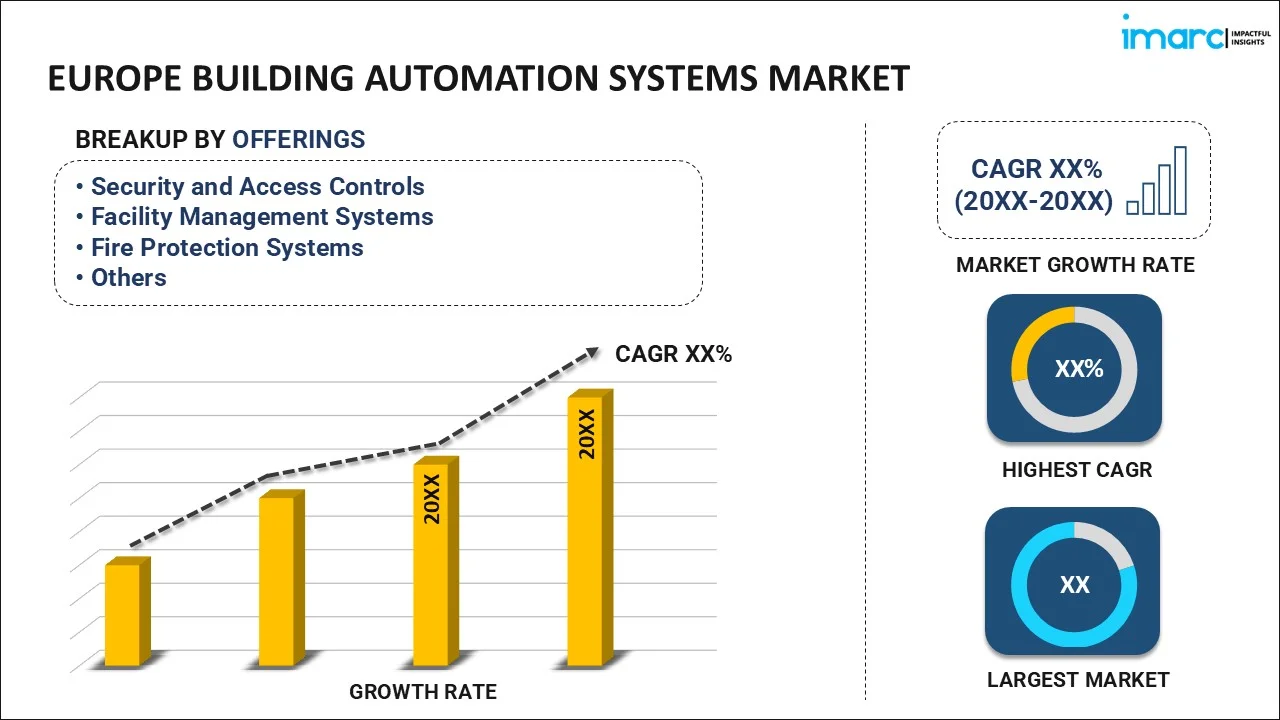
To get detailed segment analysis of this market Request Sample
- Security and Access Controls
- Facility Management Systems
- Fire Protection Systems
- Building Energy Management Software
- Building Automation System Services
- Others
Facility management systems dominate with a market share of 22% of the total Europe building automation systems market in 2025.
Facility management systems have established themselves as the cornerstone of modern building operations across Europe, enabling centralized monitoring and control of HVAC, lighting, security, and energy systems through unified platforms. The increasing complexity of multi-building portfolios and the demand for real-time operational visibility are driving property managers to adopt integrated facility management solutions. These systems leverage data analytics and automation to optimize maintenance schedules, reduce energy waste, and ensure regulatory compliance across diverse commercial and institutional environments.
The evolution of cloud-based facility management platforms is further accelerating adoption, allowing remote monitoring and management of building systems across geographically dispersed portfolios. These platforms unify energy, power, and building operations into single operational interfaces, significantly streamlining engineering workflows and enabling centralized oversight of multi-site assets. This shift toward software-driven facility management is empowering building operators with predictive maintenance capabilities, automated fault detection, and data-driven decision-making that enhance both operational efficiency and occupant satisfaction across diverse commercial environments.
Communication Technology Insights:
- Wireless
- Wired
Wireless leads with a share of 60% of the total Europe building automation systems market in 2025.
Wireless communication technologies have become the preferred choice for building automation deployments across Europe, driven by their flexibility, lower installation costs, and suitability for retrofit applications in older buildings where traditional wiring is impractical. The proliferation of protocols such as Zigbee, BLE, Wi-Fi 6, and Thread is enabling seamless connectivity between sensors, controllers, and cloud platforms. Battery-powered wireless sensors are particularly gaining traction in heritage and pre-1990 buildings, where minimizing structural disruption during automation upgrades is a critical consideration for property owners and facility managers.
The advancement of multi-protocol wireless modules is enhancing interoperability and simplifying system integration across diverse building environments. These modules increasingly support multiple communication protocols simultaneously, enabling seamless connectivity between sensors, controllers, and cloud platforms from different manufacturers. This technological convergence is enabling building automation vendors to offer unified wireless solutions that reduce deployment complexity while supporting open-standard architectures favored by European regulatory frameworks and grant programs, fostering broader adoption across commercial, residential, and industrial applications throughout the region.
Application Insights:
- Commercial
- Residential
- Industrial
The commercial exhibits a clear dominance with a 48% share of the total Europe building automation systems market in 2025.
Commercial buildings represent the primary revenue driver for building automation systems in Europe, encompassing offices, retail spaces, hospitals, hotels, and educational institutions. Mandatory energy audits, rising tenant expectations for thermal comfort, and indoor air quality requirements are compelling commercial property owners to invest in advanced automation platforms. Facility managers are deploying AI-based optimization tools for HVAC, lighting, and security systems to reduce operating costs, enhance occupant well-being, and meet increasingly stringent energy performance benchmarks mandated by national and European-level regulations.
The competitive commercial real estate landscape is further driving automation investments as property owners seek to differentiate their assets through sustainability credentials and smart building features. Germany, the United Kingdom, and France represent the largest commercial real estate markets in Europe, concentrating significant property value in economies with stringent energy performance requirements. This competitive environment compels landlords and facility operators to deploy advanced building automation systems that deliver measurable energy savings, enhanced tenant experiences, and regulatory compliance, reinforcing demand across office, retail, healthcare, and hospitality sectors.
Country Insights:
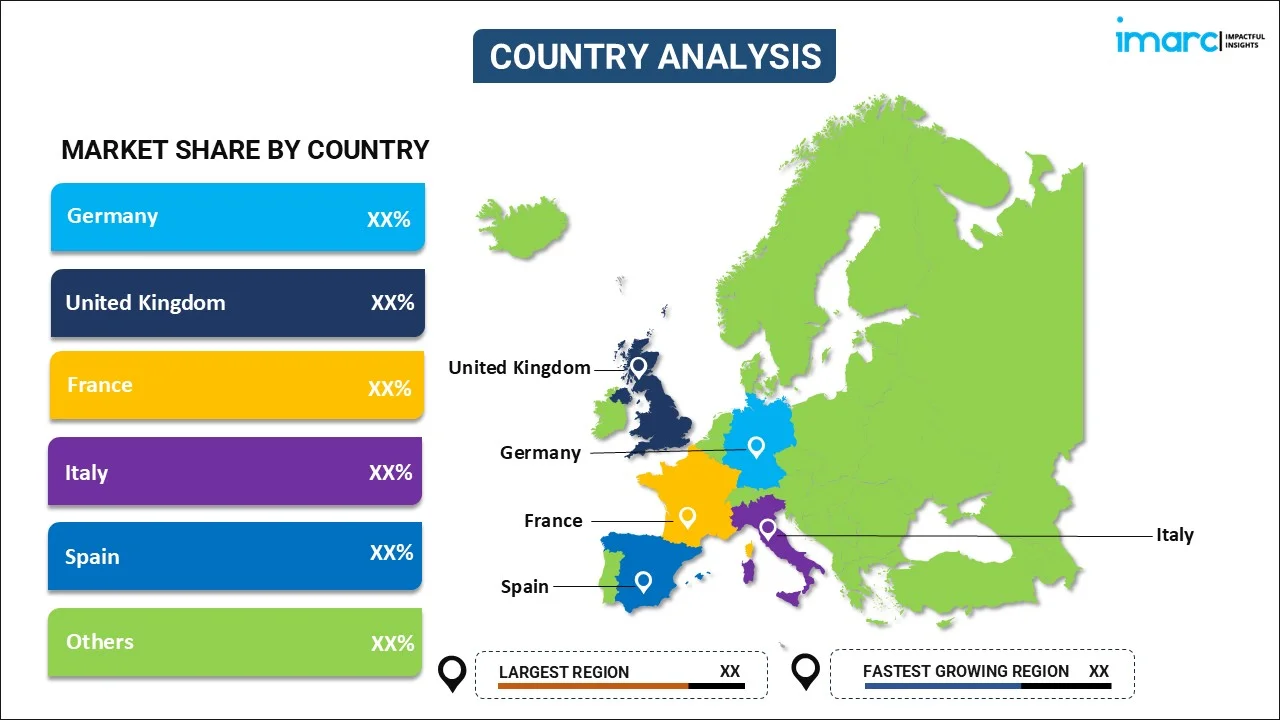
To get detailed regional analysis of this market Request Sample
- Germany
- France
- United Kingdom
- Italy
- Spain
- Others
Germany dominates the European building automation systems market, driven by proactive government initiatives, a strong industrial base, and substantial investments in construction and smart building infrastructure. Such commitment to energy transition by the federal government and substantial public investment flows into the construction industry are driving robust demand for automation solutions across commercial and residential sectors.
The France building automation systems are witnessing growing adoption, inspired by national sustainability policies and initiatives taken by the French Ministry of Ecological Transition to incentivize smart technology integration in building management. Correspondingly, France is in a good place to become one of the strong contributors to regional market growth due to its regulatory framework aligned with EU energy directives and rapid consumer preference for connected building solutions.
The United Kingdom advances its building automation market through strict regulatory mandates, sustainability initiatives, and rapid technological adoption. The UK government's Future Homes Standard, requiring all new homes to produce significantly lower carbon emissions, accelerates the integration of smart HVAC, lighting, and energy management solutions throughout major metropolitan hubs such as London, Manchester, and Birmingham.
Italy continues to increase its building automation, with mandatory BIM requirements for public works and increasing investment in smart building technologies. Favorable conditions are being created for the deployment of automation systems by a focus on sustainable construction practices and the improvement of energy efficiency in commercial and public buildings.
Spain is turning out to be a growing market for building automation systems-promoting energy-efficient construction and integration of renewable energy with building management platforms, backed by supportive government policies. Urban development projects and increasing awareness of sustainability benefits encourage adoption across commercial and residential properties.
Market Dynamics:
Growth Drivers:
Why is the Europe Building Automation Systems Market Growing?
Stringent EU energy efficiency regulations and building decarbonization mandates
The European Union's regulatory framework represents a primary catalyst for building automation adoption across the region. The revised Energy Performance of Buildings Directive establishes mandatory requirements for building automation and control systems in non-residential buildings, with compliance thresholds set to tighten progressively over the coming years. These mandates are compelling building owners to upgrade legacy systems and deploy interoperable automation solutions to meet energy performance benchmarks. Germany and France have adopted even stricter national thresholds, accelerating tender activity across public offices, schools, and healthcare facilities. The directive's requirement for zero-emission buildings for all new constructions, coupled with minimum energy performance standards targeting the renovation of the worst-performing building stock, is generating sustained demand for integrated building management platforms. Open-protocol solutions, particularly BACnet and KNX, are receiving preferential treatment in government grant programs, prompting property owners to replace proprietary networks during planned renovations. This regulatory momentum is locking market growth into compliance timetables that extend through the current decade.
Accelerating digital transformation and IoT integration in commercial buildings
The rapid proliferation of Internet of Things technologies is fundamentally reshaping how commercial buildings are monitored, controlled, and optimized across Europe. Connected sensors, smart controllers, and cloud-based analytics platforms are enabling real-time data collection from HVAC, lighting, fire safety, and access control systems, creating unified digital ecosystems that enhance operational efficiency. European building owners are increasingly leveraging digital twins, edge computing, and AI-powered optimization to achieve measurable energy savings and improved occupant comfort. The integration of smart sensors with occupancy detection, environmental monitoring, and predictive maintenance capabilities is transforming buildings from static structures into responsive, intelligent environments. This digital transformation is being further supported by ESG reporting requirements, carbon reduction mandates, and workplace utilization pattern changes that demand data-driven approaches to facility management.
Rising emphasis on corporate sustainability and net-zero building commitments
Corporate sustainability strategies and net-zero commitments are emerging as significant demand drivers for building automation systems across Europe. Real-time energy dashboards, automated fault detection modules, and carbon accounting tools are becoming integral to corporate ESG reporting frameworks, driving multi-site rollouts of standardized building automation architectures. Green financing mechanisms are further incentivizing automation investments, with lenders embedding step-down interest rates in green loans when energy-use-intensity targets are met. The convergence of regulatory compliance, financial incentives, and corporate responsibility objectives is creating a compelling business case for building automation adoption that extends beyond traditional cost-savings calculations.
Market Restraints:
What Challenges the Europe Building Automation Systems Market is Facing?
High initial investment and complex retrofit costs
The significant upfront capital required for implementing advanced building automation systems remains a substantial barrier, particularly for small and medium-sized property owners across Europe. Retrofit projects in older buildings often involve extensive rewiring, structural modifications, and integration challenges with legacy systems that escalate costs beyond initial projections. While long-term operational savings and energy cost reductions justify automation investments, many stakeholders face budgetary constraints that delay adoption decisions and limit the pace of market penetration across diverse property portfolios.
Cybersecurity vulnerabilities and data privacy concerns
The increasing connectivity of building automation systems through IoT networks and cloud platforms introduces cybersecurity risks that concern building owners and facility managers. Networked sensors, controllers, and management platforms create potential attack surfaces for malicious actors seeking to disrupt building operations or access sensitive data. European data privacy regulations, particularly GDPR, impose additional compliance requirements on building automation deployments that collect and process occupant data, creating complexity and hesitation among stakeholders regarding the scope and implementation of connected building solutions.
Skilled workforce shortages and interoperability challenges
The building automation industry faces persistent labor shortages of qualified technicians and system integrators capable of deploying and maintaining complex automation platforms across European markets. The convergence of traditional building services with IT and data analytics requires specialized skills that remain scarce, creating bottlenecks in project delivery timelines. Additionally, interoperability challenges between disparate vendor platforms and communication protocols continue to impede seamless system integration, increasing complexity and costs while limiting the potential for standardized, multi-vendor building automation deployments.
Competitive Landscape:
The Europe building automation systems market has a moderately consolidated competition profile with the top five vendors contributing toward the overall market revenue. Currently, vendors are more focused towards diversifying their product portfolios through strategic acquisitions, advancing their AI software optimization solutions, and forging regional system integrator partnerships. For instance, vendors compete with one another through their focus toward developing cloud-based solutions, wireless sensor systems, as well as open protocol solutions that facilitate interoperability among other system solutions so that customer lock-in does not occur. Actually, the retrofit sector remains highly lucrative in the Europe building automation systems market due to the existing age-damaged buildings, with wireless solutions becoming highly imperative in the market space towards ensuring minimal disruption as well as ensuring shorter payback periods. Software as a Service solution has become prominent as vendors attempt to establish recurring revenue streams with the ability of building owners to access predictive maintenance solutions as well as real-time energy analytics solutions.
Recent Developments:
- In January 2025, Johnson Controls acquired Webeasy, a provider of building automation and control systems, to expand its presence and strengthen its position within the European building automation ecosystem, enhancing its portfolio of integrated facility management solutions.
- In September 2024, Johnson Controls launched Metasys 14.0, an upgraded version of its building automation system designed to enhance energy management, network efficiency, and security, featuring 802.1x compliance and single sign-on capabilities supporting up to 800 IP devices.
Europe Building Automation Systems Market Report Coverage:
| Report Features | Details |
|---|---|
| Base Year of the Analysis | 2025 |
| Historical Period | 2020-2025 |
| Forecast Period | 2026-2034 |
| Units | Billion USD |
| Scope of the Report | Exploration of Historical Trends and Market Outlook, Industry Catalysts and Challenges, Segment-Wise Historical and Future Market Assessment:
|
| Offerings Covered | Security and Access Controls, Facility Management Systems, Fire Protection Systems, Building Energy Management Software, Building Automation System Services, Others |
| Communication Technologies Covered | Wireless, Wired |
| Applications Covered | Commercial, Residential, Industrial |
| Countries Covered | Germany, France, United Kingdom, Italy, Spain |
| Customization Scope | 10% Free Customization |
| Post-Sale Analyst Support | 10-12 Weeks |
| Delivery Format | PDF and Excel through Email (We can also provide the editable version of the report in PPT/Word format on special request) |
Frequently Asked Questions About the Europe Building Automation Systems Market Report
The Europe building automation systems market size was valued at USD 27.6 Billion in 2025.
The Europe building automation systems market is expected to grow at a compound annual growth rate of 8.08% from 2026-2034 to reach USD 55.4 Billion by 2034.
Facility management systems dominated the market with a share of 22%, driven by the increasing demand for centralized building operations platforms that integrate HVAC, lighting, and security management while enabling predictive maintenance and energy optimization.
Key factors driving the Europe building automation systems market include stringent EU energy efficiency regulations, accelerating IoT and AI integration in commercial buildings, rising corporate sustainability commitments, expanding wireless sensor deployments, and growing retrofit demand across Europe's aging building stock.
Major challenges include high initial investment costs for automation deployments, cybersecurity vulnerabilities in connected building systems, interoperability issues between vendor platforms, skilled workforce shortages, and complex retrofit requirements in older European building stock.
Need more help?
- Speak to our experienced analysts for insights on the current market scenarios.
- Include additional segments and countries to customize the report as per your requirement.
- Gain an unparalleled competitive advantage in your domain by understanding how to utilize the report and positively impacting your operations and revenue.
- For further assistance, please connect with our analysts.
 Request Customization
 Speak to an Analyst
 Request Brochure
 Inquire Before Buying
Benefits of Customization
- Personalize this research
- Triangulate with your data
- Get data as per your format and definition
- Gain a deeper dive into a specific application, geography, customer, or competitor
- Any level of personalization
Get in Touch With Us
UNITED STATES
Phone: +1-201-971-6302
INDIA
Phone: +91-120-433-0800
UNITED KINGDOM
Phone: +44-753-714-6104
Email: [email protected]
Client Testimonials




.webp)




.webp)













