
Europe Digital Transformation Market Size, Share, Trends and Forecast by Type, Deployment Mode, Enterprise Size, End Use Industry, and Country, 2026-2034
Europe Digital Transformation Market Summary:
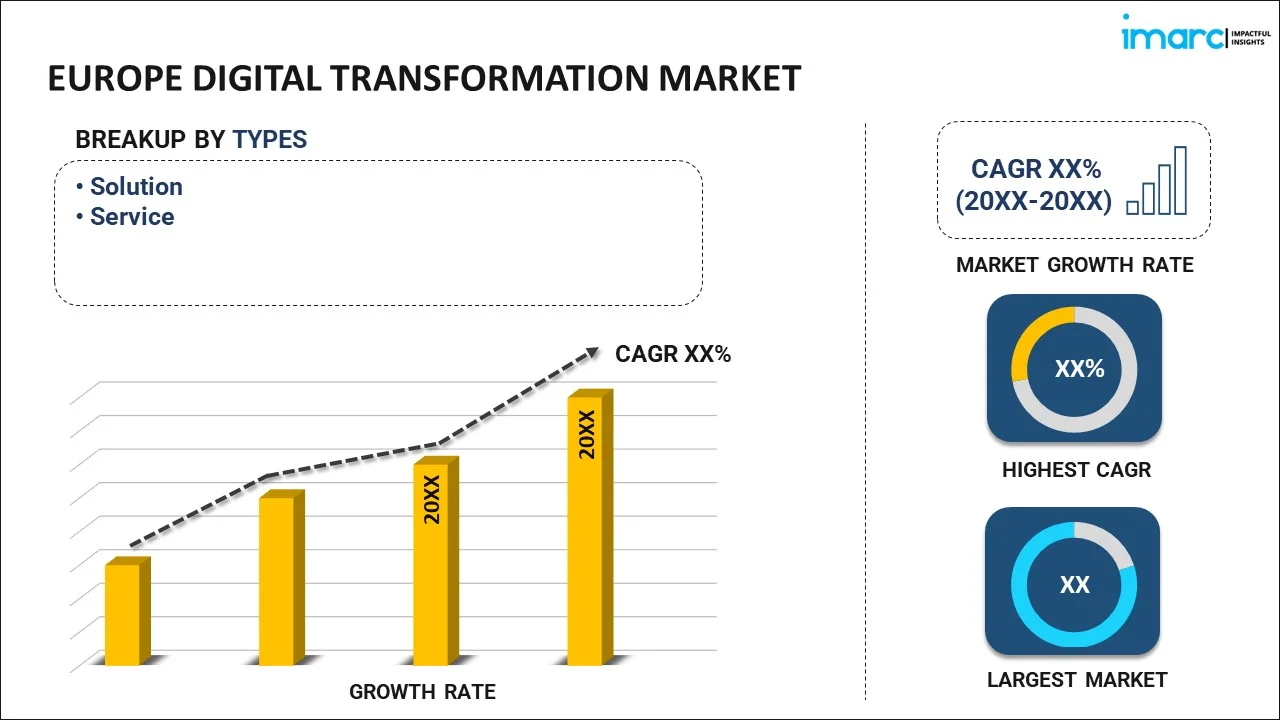
The Europe digital transformation market size was valued at USD 249.15 Billion in 2025 and is projected to reach USD 1,416.70 Billion by 2034, growing at a compound annual growth rate of 21.30% from 2026-2034.
The Europe digital transformation market is experiencing unprecedented growth driven by accelerated enterprise adoption of cloud computing, artificial intelligence (AI), and data analytics solutions. Organizations across diverse industries are prioritizing digital modernization initiatives to enhance operational efficiency, improve customer experiences, and maintain competitive positioning. Government-backed digitalization programs are channeling substantial investments into technology infrastructure and digital skills development. The proliferation of Industry 4.0 practices across the manufacturing sector and the increasing demand for integrated enterprise solutions are further propelling the Europe digital transformation market share.
Key Takeaways and Insights:
-
By Type: Solution dominates the market with a share of 58% in 2025, driven by the increasing enterprise demand for integrated analytics platforms, cloud computing infrastructure, and mobility solutions that enable comprehensive business process optimization and data-driven decision-making across European organizations.
-
By Deployment Mode: On-premises lead the market with a share of 51.82% in 2025, reflecting stringent data sovereignty requirements, regulatory compliance mandates under General Data Protection Regulation (GDPR), and organizational preferences for maintaining direct control over sensitive enterprise data and critical infrastructure.
-
By Enterprise Size: Large enterprises prevail the market with a share of 58.87% in 2025, owing to their substantial technology budgets, dedicated information technology (IT) departments, and strategic digital transformation roadmaps that facilitate comprehensive platform standardization and multi-cloud adoption strategies.
-
By End Use Industry: BFSI comprises the largest segment with a market share of 29.83% in 2025, fueled by digital banking transformation initiatives, fintech integration requirements, and the imperative to deliver personalized customer experiences through AI-powered services and real-time payment platforms.
-
By Country: Germany represents the largest country with 26% share in 2025, underpinned by its robust manufacturing sector embracing Industry 4.0, substantial government investments in digital infrastructure, and the concentration of technology innovation hubs in Berlin, Munich, and Stuttgart.
-
Key Players: Leading technology companies are driving the market expansion through strategic partnerships, sovereign cloud deployments, and AI infrastructure investments. These players are strengthening their European presence by establishing local data centers, developing GDPR-compliant solutions, and collaborating with regional enterprises to accelerate digital adoption.
The Europe digital transformation landscape is characterized by robust governmental support through comprehensive policy frameworks. The European Commission's commitment to achieving digital sovereignty is driving investments in sovereign cloud infrastructure, AI capabilities, and cybersecurity frameworks. Enterprise adoption of advanced technologies, including generative AI, predictive analytics, and Internet of Things (IoT), solutions is accelerating, as organizations are recognizing the competitive advantages of data-driven operations. According to Eurostat, 74% of all European Union businesses achieved a basic level of digital intensity by 2024, demonstrating the widespread embrace of digital tools across the commercial landscape. The convergence of regulatory mandates, technological innovations, and competitive pressures is creating unprecedented opportunities for market expansion. This momentum is further reinforced by rising digital skills initiatives and increased public–private collaboration across Europe.
Europe Digital Transformation Market Trends:
Accelerated Enterprise AI Adoption and Generative AI Integration
European enterprises are rapidly integrating AI capabilities into core business operations, transforming decision-making processes and operational workflows. As per IMARC Group, the Europe AI market size reached USD 28.6 Billion in 2024. The adoption of generative AI technologies is enabling organizations to automate content creation, enhance customer service interactions, and accelerate product development cycles. Financial services institutions are leveraging AI-powered analytics for risk assessment and fraud detection, while manufacturing firms are implementing machine learning (ML) algorithms for predictive maintenance and quality control optimization. The European Commission's AI innovation package is supporting startups and small and medium enterprises (SMEs) in developing trustworthy AI solutions aligned with regional values and regulatory frameworks.
Sovereign Cloud and Digital Infrastructure Expansion
Sovereign cloud and digital infrastructure expansion are driving the market expansion by strengthening data security, regulatory compliance, and digital resilience. Governments and enterprises are investing in localized cloud platforms, data centers, and high-speed connectivity to retain data control and meet sovereignty requirements. In June 2025, Microsoft, in collaboration with State Secretary Alexander Pröll, revealed plans to launch a data center region in Austria. Beginning in August 2025, the local cloud region would feature three data centers near Vienna, granting companies and public administration access to cutting-edge cloud and AI technologies while ensuring secure, compliant data storage within Austria. Improved infrastructure supports scalable cloud adoption, advanced analytics, and AI deployment, accelerating digital modernization across industries.
Digital Skills Development and Workforce Transformation
Digital skills development and workforce transformation are propelling the market growth in Europe by enabling organizations to effectively adopt and scale advanced technologies. Investments in upskilling and reskilling programs are improving employee readiness for cloud computing, data analytics, AI, and cybersecurity solutions. A digitally capable workforce reduces implementation risks, accelerates innovation, and improves productivity. Collaborations between governments, educational institutions, and enterprises are strengthening talent pipelines, supporting long-term digital adoption.
Market Outlook 2026-2034:
The Europe digital transformation market is positioned for sustained expansion, as enterprises across all sectors accelerate technology modernization initiatives to maintain competitive positioning in increasingly digital economies. Government policy frameworks continue to provide strategic direction and funding support for digital infrastructure development, AI adoption, and cybersecurity enhancement. The market generated a revenue of USD 249.15 Billion in 2025 and is projected to reach a revenue of USD 1,416.70 Billion by 2034, growing at a compound annual growth rate of 21.30% from 2026-2034. The proliferation of cloud-native applications, expanding IoT deployments, and increasing integration of AI capabilities across business operations will drive continued market growth.
.webp)
Europe Digital Transformation Market Report Segmentation:
| Segment Category | Leading Segment | Market Share |
|---|---|---|
| Type | Solution | 58% |
| Deployment Mode | On-premises | 51.82% |
| Enterprise Size | Large Enterprises | 58.87% |
| End Use Industry | BFSI | 29.83% |
| Country | Germany | 26% |
Type Insights:
To get more information on this market, Request Sample
- Solution
- Analytics
- Cloud Computing
- Mobility
- Social Media
- Others
- Service
- Professional Services
- Integration and Implementation
Solution dominates with a market share of 58% of the total Europe digital transformation market in 2025.
The solution segment encompasses comprehensive technology platforms, including analytics, cloud computing, mobility, and social media applications that enable enterprises to modernize operations and enhance customer engagement. Organizations are increasingly investing in integrated solution suites that provide end-to-end digital capabilities spanning data management, process automation, and business intelligence. The growing complexity of enterprise technology ecosystems is driving the demand for unified platforms that simplify management while delivering scalable performance across diverse operational requirements.
Cloud computing solutions are experiencing particularly robust adoption, as enterprises transition from legacy infrastructure to flexible, consumption-based models that reduce capital expenditure while enabling rapid scalability. According to the European Commission, edge node deployment in Europe grew from 498 in 2022 to around 1,836 in 2024, demonstrating the expanding infrastructure foundation supporting solution adoption. Analytics and AI-powered solutions are gaining prominence as organizations recognize the competitive advantages of data-driven decision-making and predictive capabilities.
Deployment Mode Insights:
- Cloud-based
- On-premises
On-premises lead with a share of 51.82% of the total Europe digital transformation market in 2025.
The on-premises deployment segment maintains market leadership, driven by stringent regulatory requirements, data sovereignty mandates, and organizational preferences for maintaining direct infrastructure control. Defense establishments, government agencies, and critical infrastructure operators prioritize on-premises deployments to ensure compliance with security protocols and data residency regulations. Financial institutions and healthcare organizations also favor on-premises solutions to meet sector-specific compliance requirements while maintaining operational independence.
The emphasis on digital sovereignty across European markets reinforces on-premises adoption as organizations seek alternatives to foreign-controlled cloud infrastructure. German manufacturers investing in Industry 4.0 technologies frequently implement on-premises edge computing solutions to maintain real-time processing capabilities while protecting proprietary operational data. According to Germany’s digital industry association Bitkom, German enterprises allocated EUR 11.1 Billion to IT security investments in 2024, reflecting the priority placed on secure, controlled infrastructure environments that on-premises deployments provide.
Enterprise Size Insights:
- Large Enterprises
- Small and Medium-sized Enterprises
Large enterprises exhibit a clear dominance with a 58.87% share of the total Europe digital transformation market in 2025.
Large enterprises command the dominant market position owing to their substantial technology investment capabilities, dedicated digital transformation teams, and comprehensive modernization strategies spanning global operations. These organizations leverage extensive resources to implement enterprise-wide platforms, negotiate favorable vendor agreements, and maintain multi-cloud architectures that optimize performance and cost efficiency. The strategic priorities of large enterprises extend beyond operational efficiency to encompass sustainability objectives, ethical AI deployment, and competitive differentiation.
According to Eurostat, in 2025, 55.03% of large EU companies employed AI technologies. Large enterprises are increasingly forming strategic partnerships with hyperscale cloud providers to accelerate AI implementation and ensure access to cutting-edge computational resources. Their influence on market development extends to shaping vendor roadmaps and driving innovation in enterprise technology solutions.
End Use Industry Insights:
- BFSI
- Manufacturing and Retail
- Government
- Healthcare
- IT and Telecom
- Others
BFSI represents the leading segment with a 29.83% share of the total Europe digital transformation market in 2025.
The banking, financial services, and insurance sector leads market adoption, driven by the imperative to deliver seamless digital experiences, combat evolving cybersecurity threats, and integrate fintech innovations into traditional service models. Financial institutions are implementing AI-powered solutions for fraud detection, risk assessment, and personalized customer engagement while modernizing legacy systems to enable real-time transaction processing. Open banking regulations are encouraging established banks to develop application programming interface (API)-enabled platforms that facilitate third-party integrations and innovative service delivery.
Europe's digital banking market is expanding rapidly, with the market share of digital banks increasing from 3.1% of total assets in 2019 to 3.9% in 2024, according to the European Central Bank's Financial Stability Review. The sector is embracing hyper-automation technologies that integrate robotic process automation, AI, and ML to streamline complex workflows, including loan processing and compliance verification. Mobile wallet adoption, contactless payment expansion, and instant payment platform deployment are transforming customer transaction experiences across European markets.
Country Insights:
- Germany
- France
- United Kingdom
- Italy
- Spain
- Others
Germany holds the largest country share with 26% of the total Europe digital transformation market in 2025.
Germany leads the Europe digital transformation market due to its strong industrial base, advanced manufacturing ecosystem, and early adoption of Industry 4.0 technologies. The country’s large automotive, engineering, and industrial sectors are rapidly integrating automation, AI, cloud platforms, and IoT solutions to enhance efficiency and global competitiveness. Strong government support for digitalization, combined with high enterprise technology spending and a robust startup ecosystem, further accelerates market leadership across multiple industries.
The expansion of data center infrastructure across Germany is strengthening cloud adoption, data security, and high-performance computing capabilities. In February 2024, Microsoft announced investment of EUR 3.2 Billion to double its AI infrastructure and cloud computing capacity of its data centers in Germany. It was set to meet growing enterprise demand for AI-enabled services across the region. Growing investments in hyperscale and colocation data centers support rising demand for sovereign cloud services, AI workloads, and real-time analytics. Additionally, Germany’s skilled workforce, strong cybersecurity focus, and emphasis on digital standards enable scalable and secure digital transformation initiatives nationwide.
Market Dynamics:
Growth Drivers:
Why is the Europe Digital Transformation Market Growing?
Strong Government Digital Policies and Strategic Initiatives
European governments are playing a central role in driving the digital transformation market through long-term policy frameworks, national digital strategies, and coordinated EU-level programs. Public authorities are prioritizing digital public services, e-government platforms, and smart governance to improve efficiency, transparency, and citizen engagement. These initiatives encourage widespread adoption of cloud computing, data analytics, AI, and cybersecurity solutions across both public and private sectors. Regulatory alignment around data protection, digital identity, and cross-border digital services is creating a more predictable environment for technology investments. Governments are also acting as anchor customers, stimulating demand for advanced digital solutions and setting benchmarks for private enterprises. In addition, public–private partnerships and innovation hubs are supporting pilot projects and large-scale digital deployments. Together, these policy-driven efforts reduce adoption risks, stimulate technology spending, and establish a strong foundation for sustained digital transformation growth across Europe.
Rising Adoption of Cloud Computing and Advanced Data Technologies
The rapid adoption of cloud computing, big data analytics, and AI-driven platforms is a major driver of the market expansion. Enterprises are increasingly migrating from legacy IT systems to flexible cloud-based environments to improve scalability, agility, and cost efficiency. Cloud platforms enable real-time data processing, predictive analytics, and automation, helping organizations make faster, data-driven decisions. Growing demand for hybrid and multi-cloud architectures reflects the need to balance performance, security, and regulatory compliance. Data-centric technologies are also supporting digital innovations in areas, such as personalized customer experiences, supply chain optimization, and intelligent manufacturing. As data volumes continue to grow, organizations are investing heavily in analytics, ML, and visualization tools to extract actionable insights. This shift towards cloud-first and data-driven operating models is accelerating digital maturity across industries, reinforcing market expansion.
Increasing Focus on Cybersecurity and Data Protection
Heightened focus on cybersecurity and data protection is significantly driving digital transformation investments across Europe. According to IMARC Group, the Europe cybersecurity market size was valued at USD 75.4 Billion in 2024. As organizations digitize operations and adopt cloud-based platforms, protecting sensitive data and digital assets has become a strategic priority. Enterprises are investing in advanced cybersecurity solutions, identity management systems, and secure architectures to mitigate risks associated with cyber threats and data breaches. Strong regulatory emphasis on data protection has further encouraged adoption of secure digital frameworks and compliance-focused technologies. Cyber resilience is being viewed as an enabler rather than a barrier to digital transformation, allowing organizations to innovate with confidence. This focus is particularly important for sectors, such as finance, healthcare, manufacturing, and government services. As digital ecosystems expand, sustained cybersecurity spending continues to support the growth and stability of the Europe digital transformation market.
Market Restraints:
What Challenges the Europe Digital Transformation Market is Facing?
Persistent Digital Skills Shortage and Information and Communication Technology (ICT) Talent Gap
European enterprises face significant challenges in acquiring and retaining qualified technology professionals, constraining digital transformation implementation across sectors. The availability of ICT specialists with advanced skills in cybersecurity, AI development, and data analytics remains critically low, with persistent gender disparities further limiting the talent pool. Educational systems are struggling to produce graduates with competencies aligned to rapidly evolving industry requirements.
Complex Multi-Jurisdictional Regulatory Compliance Requirements
Complex multi-jurisdictional regulatory compliance requirements are restraining the growth of the Europe digital transformation market by increasing implementation costs and operational complexity. Organizations operating across multiple countries must navigate varying data protection, cybersecurity, and digital governance rules, slowing decision-making and technology deployment. Compliance burdens often delay cloud adoption and cross-border data integration. As a result, digital initiatives face longer timelines, higher risk exposure, and cautious investment strategies.
Infrastructure Constraints and Cybersecurity Vulnerabilities
Uneven digital infrastructure development creates disparities in transformation capabilities between major urban centers and underserved regions. Grid capacity constraints are emerging as barriers to data center expansion as energy demands from AI applications outpace renewable energy development. Escalating cybersecurity threats targeting financial services, public administration, and critical infrastructure require substantial ongoing investment in protective measures.
Competitive Landscape:
The Europe digital transformation market exhibits a fragmented competitive structure with established global technology providers competing alongside specialized regional firms and emerging innovative startups. Major international vendors are strengthening their European presence through strategic infrastructure investments, localized service development, and partnerships with regional systems integrators. Market participants are differentiating through sovereign cloud offerings that address data residency requirements, vertical-specific solutions tailored to regulatory environments, and comprehensive managed service capabilities. Strategic alliances between technology providers, telecommunications operators, and industry associations are fostering collaborative innovation ecosystems. The competitive dynamics are further shaped by government procurement preferences, GDPR compliance capabilities, and demonstrated commitment to European technology sovereignty.
Recent Developments:
-
In November 2025, Deutsche Telekom and NVIDIA launched the Industrial AI Cloud in Germany as part of the 'Made for Germany' initiative, combining Deutsche Telekom's trusted infrastructure with NVIDIA AI and Omniverse digital twin platforms to accelerate sovereign AI development and deployment for enterprises across European industries.
-
In November 2025, Capgemini revealed that it enhanced its collaboration with SAP to speed up agentic AI-powered enterprise transformation solutions for all European industries, especially in the public sector, defense agencies, and highly regulated industries. The firms would initiate a Sovereign Technology Partnership aimed at allowing European entities to innovate safely and autonomously. It would be intentionally crafted to strengthen Europe’s digital independence and ensure the necessary control to safeguard sensitive information and vital activities.
Europe Digital Transformation Market Report Coverage:
| Report Features | Details |
|---|---|
| Base Year of the Analysis | 2025 |
| Historical Period | 2020-2025 |
| Forecast Period | 2026-2034 |
| Units | Billion USD |
| Scope of the Report | Exploration of Historical and Forecast Trends, Industry Catalysts and Challenges, Segment-Wise Historical and Predictive Market Assessment:
|
| Types Covered |
|
| Deployment Modes Covered | Cloud-based, On-premises |
| Enterprise Sizes Covered | Large Enterprises, Small and Medium-sized Enterprises |
| End Use Industry | BFSI, Manufacturing and Retail, Government, Healthcare, IT and Telecom, Others |
| Countries Covered | Germany, France, United Kingdom, Italy, Spain, Others |
| Customization Scope | 10% Free Customization |
| Post-Sale Analyst Support | 10-12 Weeks |
| Delivery Format | PDF and Excel through Email (We can also provide the editable version of the report in PPT/Word format on special request) |
Frequently Asked Questions About the Europe Digital Transformation Market Report
The Europe digital transformation market size was valued at USD 249.15 Billion in 2025.
The Europe digital transformation market is expected to grow at a compound annual growth rate of 21.30% from 2026-2034 to reach USD 1,416.70 Billion by 2034.
Solution dominated the market with a share of 58%, driven by increasing enterprise demand for integrated analytics platforms, cloud computing infrastructure, and comprehensive technology suites enabling business process optimization.
Key factors driving the Europe digital transformation market include comprehensive government policy frameworks and investment programs, Industry 4.0 advancement in manufacturing sectors, financial services digital modernization, accelerating enterprise AI adoption, and expanding cloud infrastructure across the region.
Major challenges include persistent digital skills shortages and ICT talent gaps, complex multi-jurisdictional regulatory compliance requirements, uneven infrastructure development across regions, cybersecurity vulnerabilities, and high implementation costs for comprehensive transformation initiatives.
Need more help?
- Speak to our experienced analysts for insights on the current market scenarios.
- Include additional segments and countries to customize the report as per your requirement.
- Gain an unparalleled competitive advantage in your domain by understanding how to utilize the report and positively impacting your operations and revenue.
- For further assistance, please connect with our analysts.
 Request Customization
 Speak to an Analyst
 Request Brochure
 Inquire Before Buying
Benefits of Customization
- Personalize this research
- Triangulate with your data
- Get data as per your format and definition
- Gain a deeper dive into a specific application, geography, customer, or competitor
- Any level of personalization
Get in Touch With Us
UNITED STATES
Phone: +1-201-971-6302
INDIA
Phone: +91-120-433-0800
UNITED KINGDOM
Phone: +44-753-714-6104
Email: [email protected]
Client Testimonials




.webp)




.webp)













Related Reports

Choose your plan
*Please note that the prices mentioned below are starting prices for each bundle type. Kindly contact our team for further details.*
Single User License
- 1 User License, Access on 2 Devices
- PDF Report + Excel Dataset (Password Protected)
- Lifetime Access
- No Printing Rights
- 10% Free Report Customization
- 10–12 Weeks of Analyst Support
Five User License
- Access for 5 Users, 2 Devices per User
- PDF Report + Excel Dataset (Password Protected)
- Lifetime Access
- Dedicated Account Manager
- 12–14 Weeks of Analyst Support
- No Printing Rights
- 15% Free Report Customization
- 25% Discount on Your Next Purchase
Corporate User License
- Unlimited User Access (Within Your Organization)
- PDF Report + Excel Dataset
- Lifetime Access
- Dedicated Account Manager
- 14–20 Weeks of Analyst Support
- No Printing Rights
- 20% Free Report Customization
- 30% Discount on Your Next Purchase
Essential Insights
What's included:
3 reports
- Lifetime Access
- PDF Reports
- Excel Datasets
- 2 Weeks of Free Analyst Support
- 2 User Licenses
- Access on 2 Devices
- Printing Rights
- Complimentary PowerPoint (PPT) Version
- Complimentary License Upgrade
Professional Access
What's included:
5 reports
- Lifetime Access
- PDF Reports
- Excel Datasets
- 8 Weeks of Free Analyst Support
- 2 User Licenses
- Access on 2 Devices
- Printing Rights
- Complimentary PowerPoint (PPT) Version
- Complimentary License Upgrade
Business Advantage
What's included:
8 reports
- Lifetime Access
- PDF Reports
- Excel Datasets
- 14 Weeks of Free Analyst Support
- 2 User Licenses
- Access on 2 Devices
- Printing Rights
- Complimentary PowerPoint (PPT) Version
- Complimentary License Upgrade
Enterprise Intelligence
What's included:
10 reports
- Lifetime Access
- PDF Reports
- Excel Datasets
- 20 Weeks of Free Analyst Support
- 2 User Licenses
- Access on 2 Devices
- Printing Rights
- Complimentary PowerPoint (PPT) Version
- Complimentary License Upgrade