
Europe Green Cement Market Size, Share, Trends and Forecast by Product Type, End Use Industry, and Country, 2026-2034
Europe Green Cement Market Summary:
The Europe green cement market size was valued at USD 11.13 Billion in 2025 and is projected to reach USD 23.86 Billion by 2034, growing at a compound annual growth rate of 8.8% from 2026-2034.
The Europe green cement market is experiencing robust expansion driven by stringent environmental regulations and the region's commitment to achieving carbon neutrality by mid-century. Increasing adoption of sustainable construction practices, coupled with growing awareness among developers and consumers about eco-friendly building materials, is accelerating demand. Technological advancements in supplementary cementitious materials and carbon capture technologies are enabling manufacturers to deliver low-carbon alternatives. Government incentives promoting green building certifications and infrastructure modernization projects are further strengthening the Europe green cement market share.
Key Takeaways and Insights:
-
By Product Type: Fly ash-based dominates the market with a share of 41.34% in 2025, owing to its superior pozzolanic properties, cost-effectiveness, and ability to significantly reduce carbon emissions while enhancing concrete durability and strength in construction applications.
-
By End Use Industry: Residential leads the market with a share of 43.25% in 2025, driven by increasing investments in sustainable housing developments, renovation projects targeting energy efficiency, and consumer preference for eco-friendly construction materials.
-
By Country: Germany is the largest country with 27% share in 2025, supported by the nation's ambitious climate targets, robust manufacturing capabilities, and leadership in adopting low-carbon cement technologies across construction sectors.
-
Key Players: Key players drive the Europe green cement market by investing in carbon capture technologies, expanding low-carbon product portfolios, forming strategic partnerships, and strengthening distribution networks to accelerate sustainable construction material adoption across the region.
The Europe green cement market is advancing rapidly as the construction industry embraces decarbonization imperatives and regulatory frameworks tighten environmental standards. The European Union's Fit for 55 package and Energy Performance of Buildings Directive are creating strong incentives for adopting sustainable construction materials throughout the building lifecycle. Manufacturers are scaling up production capacities for blended cements incorporating fly ash, slag, and calcined clay to meet surging demand. In May 2025, Holcim initiated work on the OLYMPUS project at its Milaki plant in Greece, representing a EUR 400 Million investment to produce 2 Million Tons of near-zero cement annually by 2029, with support from the EU Innovation Fund. This expansion reflects the Europe green cement market growth trajectory as industry leaders commit substantial capital toward transforming cement production and achieving net-zero emissions targets across the value chain.
Europe Green Cement Market Trends:
Accelerating Carbon Capture and Storage Deployment
Carbon capture utilization and storage technologies are rapidly transforming cement production across Europe as manufacturers seek pathways to achieve net-zero emissions. Industry leaders are investing substantially in pilot projects and commercial-scale facilities to capture process emissions directly from kiln operations. Heidelberg Materials launched the world's first carbon-captured net-zero cement under its evoZero brand in November 2023 at its Brevik facility in Norway, demonstrating commercial viability of carbon capture technology without relying on external carbon credits. These advancements are positioning European producers at the forefront of global decarbonization efforts.
Rising Integration of Supplementary Cementitious Materials
The utilization of supplementary cementitious materials including fly ash, ground granulated blast furnace slag, and calcined clays is expanding significantly as manufacturers develop lower-clinker cement formulations. These materials enable substantial reductions in embodied carbon while maintaining or enhancing performance characteristics required for diverse construction applications. Strategic partnerships between cement producers and industrial suppliers are strengthening raw material availability across the region. This approach supports compliance with evolving European standards while offering cost advantages and improved technical properties.
Expansion of Green Building Certification Requirements
Green building certifications including BREEAM and LEED are driving increased specification of sustainable construction materials throughout the European construction sector. Developers and architects are prioritizing low-carbon cement products to achieve certification targets and enhance project sustainability profiles. The European Commission's framework for calculating life-cycle global warming potential of new buildings mandates disclosure requirements for large buildings initially and subsequently for all new constructions. This regulatory evolution is creating sustained demand for green cement solutions across residential, commercial, and infrastructure segments.
.webp)
Market Outlook 2026-2034:
The Europe green cement market outlook remains positive as decarbonization imperatives accelerate industry transformation and investment flows toward sustainable production technologies. Regulatory frameworks including the EU Emissions Trading System and Carbon Border Adjustment Mechanism are strengthening economic incentives for low-carbon cement adoption. Manufacturers are scaling production capacities and advancing carbon capture technologies to meet growing demand for sustainable construction materials. The market generated a revenue of USD 11.13 Billion in 2025 and is projected to reach a revenue of USD 23.86 Billion by 2034, growing at a compound annual growth rate of 8.8% from 2026-2034. Infrastructure modernization programs, sustainable housing initiatives, and renovation projects targeting energy efficiency improvements will sustain demand throughout the forecast period. Strategic partnerships between cement producers, technology providers, and construction companies are further accelerating market development and innovation.
Europe Green Cement Market Report Segmentation:
|
Segment Category |
Leading Segment |
Market Share |
|
Product Type |
Fly Ash-Based |
41.34% |
|
End Use Industry |
Residential |
43.25% |
|
Country |
Germany |
27% |
Product Type Insights:
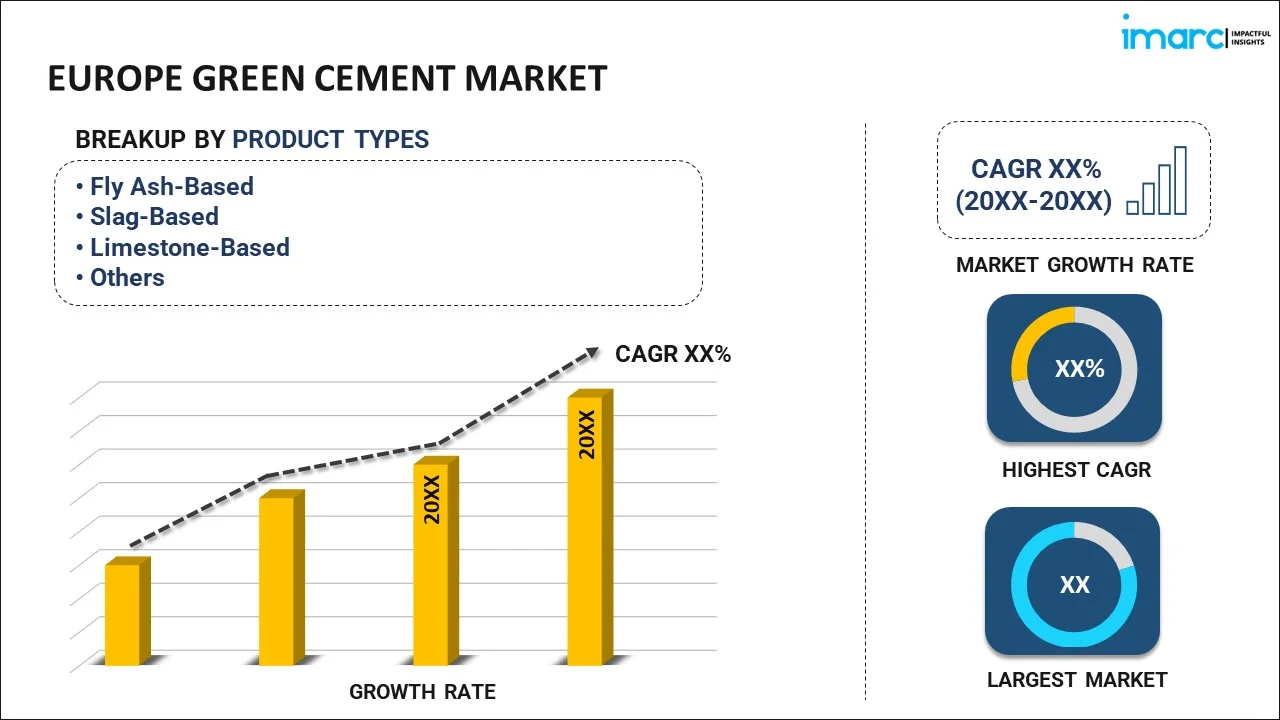
To get more information on this market, Request Sample
- Fly Ash-Based
- Slag-Based
- Limestone-Based
- Silica Fume-Based
- Others
Fly ash-based dominates with a market share of 41.34% of the total Europe green cement market in 2025.
Fly ash-based green cement maintains market leadership due to its exceptional pozzolanic properties that enhance concrete durability, workability, and long-term strength characteristics. The material represents a sustainable solution by utilizing industrial by-products from coal combustion while significantly reducing the carbon footprint associated with traditional cement production. European manufacturers are expanding fly ash sourcing networks and investing in beneficiation technologies to ensure consistent quality supply. Strategic partnerships between cement producers and power generation facilities are strengthening raw material availability across the region. The growing emphasis on circular economy practices continues driving adoption as construction stakeholders seek environmentally responsible alternatives to conventional cement formulations.
The widespread adoption of fly ash-based cement across residential, commercial, and infrastructure applications reflects its versatility and proven performance in diverse construction environments. Regulatory frameworks promoting industrial waste utilization and embodied carbon reduction are strengthening demand dynamics. Technical standards including EN 197-5 provide clear specifications for blended cement compositions, enabling architects and engineers to confidently specify fly ash products for demanding structural applications throughout Europe. Enhanced workability characteristics and superior resistance to chemical attack further reinforce preference among construction professionals.
End Use Industry Insights:
- Residential
- Non-Residential
- Infrastructure
Residential leads with a share of 43.25% of the total Europe green cement market in 2025.
The residential sector commands the largest market share driven by sustained investments in sustainable housing developments, energy-efficient renovations, and consumer demand for environmentally responsible construction materials. European governments are implementing ambitious housing programs prioritizing carbon-neutral building practices throughout the construction lifecycle. The EU's Renovation Wave Strategy targeting retrofit of 35 Million buildings by 2030 is creating substantial demand for low-carbon cement in modernization projects. Green building certifications for residential properties are increasingly requiring specification of sustainable materials.
Rising environmental consciousness among homebuyers and property developers is accelerating preference for green cement in residential construction across urban and suburban markets. Mortgage incentives linked to energy performance ratings and sustainable construction standards are further strengthening demand dynamics. Financial institutions increasingly offer favorable lending terms for properties incorporating sustainable building materials. The thermal mass benefits of concrete construction using green cement support passive heating and cooling strategies, reducing operational energy consumption and aligning with energy efficiency objectives outlined in national building regulations throughout European member states.
Country Insights:
- Germany
- France
- United Kingdom
- Italy
- Spain
- Others
Germany exhibits a clear dominance with 27% share of the total Europe green cement market in 2025.
Germany leads the European green cement market supported by the nation's stringent environmental regulations, advanced manufacturing infrastructure, and ambitious climate neutrality targets. The German government's EUR 212 Billion Climate and Transformation Fund provides substantial support for green industrial innovation including low-carbon cement production and carbon capture technologies. Leading manufacturers including Heidelberg Materials are headquartered in Germany and driving technological advancement across carbon capture, supplementary cementitious materials, and sustainable production processes. Research institutions and industry associations collaborate extensively to develop next-generation sustainable cement formulations meeting evolving performance requirements.
The robust construction sector in Germany continues generating sustained demand for green cement across residential, commercial, and infrastructure applications. Public procurement standards increasingly incorporate life-cycle carbon benchmarks, providing competitive advantages for low-emission cement products in government-funded projects. Federal and state-level sustainability initiatives prioritize environmentally responsible construction materials throughout public infrastructure development. Energy infrastructure development supporting renewable energy transition, including wind turbine foundations and grid corridor construction, creates additional demand opportunities for high-performance sustainable cement solutions throughout the German market.
Market Dynamics:
Growth Drivers:
Why is the Europe Green Cement Market Growing?
Stringent Environmental Regulations and Carbon Pricing Mechanisms
The European Union's comprehensive regulatory framework targeting industrial decarbonization is creating powerful incentives for green cement adoption throughout the construction value chain. The EU Emissions Trading System imposes escalating costs on carbon emissions, making conventional cement production increasingly expensive relative to low-carbon alternatives. The Carbon Border Adjustment Mechanism scheduled for full implementation ensures imported cement faces equivalent carbon pricing, protecting European green cement producers from international competition while driving industry transformation. These regulatory mechanisms are fundamentally reshaping economic calculations across the construction sector and accelerating sustainable material adoption. The delegated regulation establishing a common framework for calculating life-cycle global warming potential of buildings will mandate disclosure requirements for large new buildings initially and subsequently extend to all new constructions, creating sustained demand for low-carbon construction materials across residential, commercial, and infrastructure segments throughout the region.
Growing Demand for Sustainable Construction Practices
Rising environmental awareness among developers, architects, and consumers is accelerating preference for sustainable building materials across European construction markets. Green building certification programs including BREEAM and LEED require documentation of material environmental impacts, driving specification of low-carbon cement products. Corporate sustainability commitments and environmental, social, and governance reporting requirements are compelling construction companies to prioritize sustainable supply chains. The construction sector's significant contribution to total greenhouse gas emissions places increasing scrutiny on material selection decisions throughout project planning and execution phases. Consumer preference for sustainable living spaces and commercial tenants seeking environmentally responsible premises are further strengthening demand dynamics throughout the market. Property valuations increasingly reflect sustainability credentials, motivating developers to incorporate green cement in construction projects targeting premium market segments.
Substantial Infrastructure Investment and Renovation Programs
Major public sector investment programs across Europe are generating sustained demand for construction materials including green cement throughout the forecast period. The EU Recovery and Resilience Facility is mobilizing substantial resources toward transport corridors, renewable energy installations, and building renovation programs requiring cement-intensive construction. National housing programs targeting sustainable residential development are creating additional demand opportunities across member states. The EU's Renovation Wave Strategy emphasizes sustainable material utilization to reduce embodied carbon in modernization projects targeting energy-efficient building upgrades. Energy infrastructure development supporting renewable energy transition, including wind turbine foundations, grid infrastructure, and hydrogen-ready facilities, requires high-performance cement solutions capable of meeting demanding technical specifications while delivering sustainability benefits. Cross-border transportation networks and urban development initiatives further contribute to sustained market expansion.
Market Restraints:
What Challenges the Europe Green Cement Market is Facing?
Higher Production Costs Compared to Conventional Cement
Green cement production typically involves higher costs associated with carbon capture technologies, alternative raw material sourcing, and process modifications required to achieve reduced emissions profiles. These cost premiums present challenges for market penetration, particularly in price-sensitive construction segments where conventional cement remains economically attractive despite environmental considerations. Smaller construction firms often struggle to absorb additional material expenses without compromising project profitability.
Limited Availability of Supplementary Cementitious Materials
The supply of supplementary cementitious materials including fly ash and blast furnace slag faces constraints as coal-fired power generation declines across Europe and steel production fluctuates. Securing consistent, high-quality raw material supplies requires strategic partnerships and investment in beneficiation technologies, creating operational complexities for manufacturers scaling green cement production. Geographic disparities in material availability further complicate regional supply chain management.
Technical Standardization and Performance Verification Challenges
Evolving technical standards and performance verification requirements create complexity for green cement manufacturers navigating diverse national regulations across European markets. Establishing consistent product specifications and demonstrating long-term durability performance requires substantial testing and certification investments, potentially slowing market introduction of innovative sustainable cement formulations. Harmonizing standards across member states remains an ongoing challenge for industry stakeholders.
Competitive Landscape:
The Europe green cement market exhibits moderate consolidation with established multinational manufacturers commanding significant market positions while innovative startups introduce disruptive technologies. Leading companies are differentiating through investments in carbon capture facilities, expansion of low-carbon product portfolios, and strategic acquisitions targeting sustainable construction materials. Competition increasingly centers on technological capabilities, sustainability credentials, and ability to deliver comprehensive solutions meeting evolving customer requirements. Strategic partnerships between cement producers, technology providers, and construction companies are accelerating innovation and market development. Manufacturers are expanding distribution networks and strengthening customer relationships to secure long-term supply agreements as green cement transitions from specialty product to mainstream construction material.
Europe Green Cement Market Report Scope:
| Report Features | Details |
|---|---|
| Base Year of the Analysis | 2025 |
| Historical Period | 2020-2025 |
| Forecast Period | 2026-2034 |
| Units | Billion USD |
| Scope of the Report | Exploration of Historical Trends and Market Outlook, Industry Catalysts and Challenges, Segment-Wise Historical and Future Market Assessment:
|
| Product Types Covered | Fly Ash-Based, Slag-Based, Limestone-Based, Silica Fume-Based, Others |
| End Use Industries Covered | Residential, Non-Residential, Infrastructure |
| Countries Covered | Germany, France, United Kingdom, Italy, Spain, Others |
| Customization Scope | 10% Free Customization |
| Post-Sale Analyst Support | 10-12 Weeks |
| Delivery Format | PDF and Excel through Email (We can also provide the editable version of the report in PPT/Word format on special request) |
Frequently Asked Questions About the Europe Green Cement Market Report
The Europe green cement market size was valued at USD 11.13 Billion in 2025.
The Europe green cement market is expected to grow at a compound annual growth rate of 8.8% from 2026-2034 to reach USD 23.86 Billion by 2034.
Fly ash-based dominates the market with a share of 41.34%, owing to its superior pozzolanic properties, cost-effectiveness, and ability to significantly reduce carbon emissions while enhancing concrete durability in construction applications.
Key factors driving the Europe green cement market include stringent environmental regulations and carbon pricing mechanisms, growing demand for sustainable construction practices, rising investments in green building certifications, substantial infrastructure investment programs, and technological advancements in low-carbon cement production.
Major challenges include higher production costs compared to conventional cement, limited availability of supplementary cementitious materials due to declining coal power generation, technical standardization complexities across diverse national regulations, and infrastructure requirements for scaling carbon capture technologies.
Need more help?
- Speak to our experienced analysts for insights on the current market scenarios.
- Include additional segments and countries to customize the report as per your requirement.
- Gain an unparalleled competitive advantage in your domain by understanding how to utilize the report and positively impacting your operations and revenue.
- For further assistance, please connect with our analysts.
 Request Customization
 Speak to an Analyst
 Request Brochure
 Inquire Before Buying
Benefits of Customization
- Personalize this research
- Triangulate with your data
- Get data as per your format and definition
- Gain a deeper dive into a specific application, geography, customer, or competitor
- Any level of personalization
Get in Touch With Us
UNITED STATES
Phone: +1-201-971-6302
INDIA
Phone: +91-120-433-0800
UNITED KINGDOM
Phone: +44-753-714-6104
Email: [email protected]
Client Testimonials




.webp)




.webp)













Related Reports

Choose your plan
*Please note that the prices mentioned below are starting prices for each bundle type. Kindly contact our team for further details.*
Single User License
- 1 User License, Access on 2 Devices
- PDF Report + Excel Dataset (Password Protected)
- Lifetime Access
- No Printing Rights
- 10% Free Report Customization
- 10–12 Weeks of Analyst Support
Five User License
- Access for 5 Users, 2 Devices per User
- PDF Report + Excel Dataset (Password Protected)
- Lifetime Access
- Dedicated Account Manager
- 12–14 Weeks of Analyst Support
- No Printing Rights
- 15% Free Report Customization
- 25% Discount on Your Next Purchase
Corporate User License
- Unlimited User Access (Within Your Organization)
- PDF Report + Excel Dataset
- Lifetime Access
- Dedicated Account Manager
- 14–20 Weeks of Analyst Support
- No Printing Rights
- 20% Free Report Customization
- 30% Discount on Your Next Purchase
Essential Insights
What's included:
3 reports
- Lifetime Access
- PDF Reports
- Excel Datasets
- 2 Weeks of Free Analyst Support
- 2 User Licenses
- Access on 2 Devices
- Printing Rights
- Complimentary PowerPoint (PPT) Version
- Complimentary License Upgrade
Professional Access
What's included:
5 reports
- Lifetime Access
- PDF Reports
- Excel Datasets
- 8 Weeks of Free Analyst Support
- 2 User Licenses
- Access on 2 Devices
- Printing Rights
- Complimentary PowerPoint (PPT) Version
- Complimentary License Upgrade
Business Advantage
What's included:
8 reports
- Lifetime Access
- PDF Reports
- Excel Datasets
- 14 Weeks of Free Analyst Support
- 2 User Licenses
- Access on 2 Devices
- Printing Rights
- Complimentary PowerPoint (PPT) Version
- Complimentary License Upgrade
Enterprise Intelligence
What's included:
10 reports
- Lifetime Access
- PDF Reports
- Excel Datasets
- 20 Weeks of Free Analyst Support
- 2 User Licenses
- Access on 2 Devices
- Printing Rights
- Complimentary PowerPoint (PPT) Version
- Complimentary License Upgrade