
Europe Lawful Interception Market Size, Share, Trends and Forecast by Network Technology, Device, Communication Content, Service, End User, and Country, 2026-2034
Europe Lawful Interception Market Size, Share, Trends & Forecast (2026-2034)
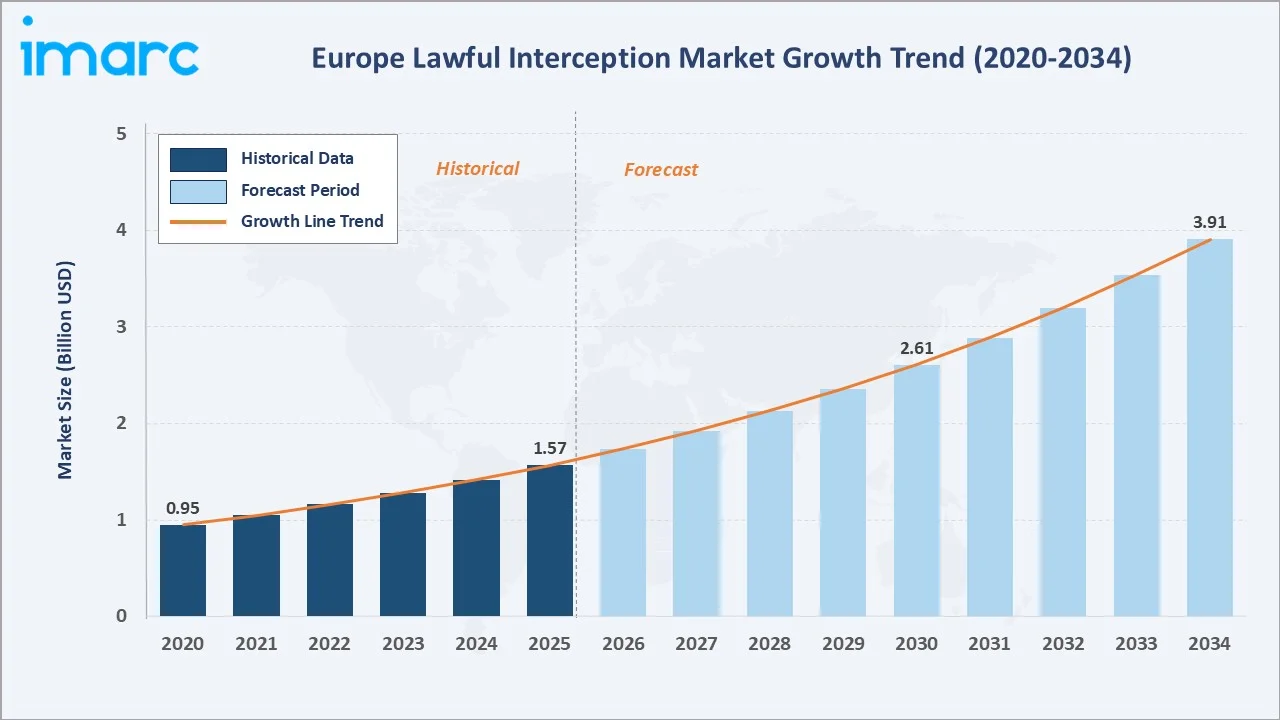
The Europe lawful interception market grew from USD 1.57 Billion in 2025 to USD 1.74 Billion in 2026 and is projected to reach USD 3.91 Billion by 2034, growing at a CAGR of 10.67% during 2026-2034. The market is driven by rising cybersecurity threats, organized crime, terrorism risks, and the increasing use of encrypted digital communication channels. Stringent regulatory requirements for telecom operators, expanding 5G networks, and growing adoption of cloud-based communication services are further increasing demand for advanced, secure, and compliant lawful interception solutions. VoIP leads network technology at 25.0%, management servers dominate device type at 20.0%, and Germany commands the largest country share at 24.6%.
Market Snapshot
|
Metric |
Value |
|
Base Year Market Size (2025) |
USD 1.57 Billion |
|
Market Size (2026) |
USD 1.74 Billion |
|
Forecast Market Size (2034) |
USD 3.91 Billion |
|
CAGR (2026-2034) |
10.67% |
|
Base Year |
2025 |
|
Historical Period |
2020-2025 |
|
Forecast Period |
2026-2034 |
|
Dominant Network Technology |
VoIP (25.0%, 2025) |
|
Dominant Device |
Management Servers (20.0%, 2025) |
|
Leading Country |
Germany (24.6%, 2025) |
The Europe lawful interception market grew from USD 0.95 Billion in 2020 to USD 1.57 Billion by 2025 and is estimated to reach USD 1.74 Billion in 2026. The market is projected to reach USD 2.61 Billion by 2030 and USD 3.91 Billion by 2034.
To get more information on this market, Request Sample
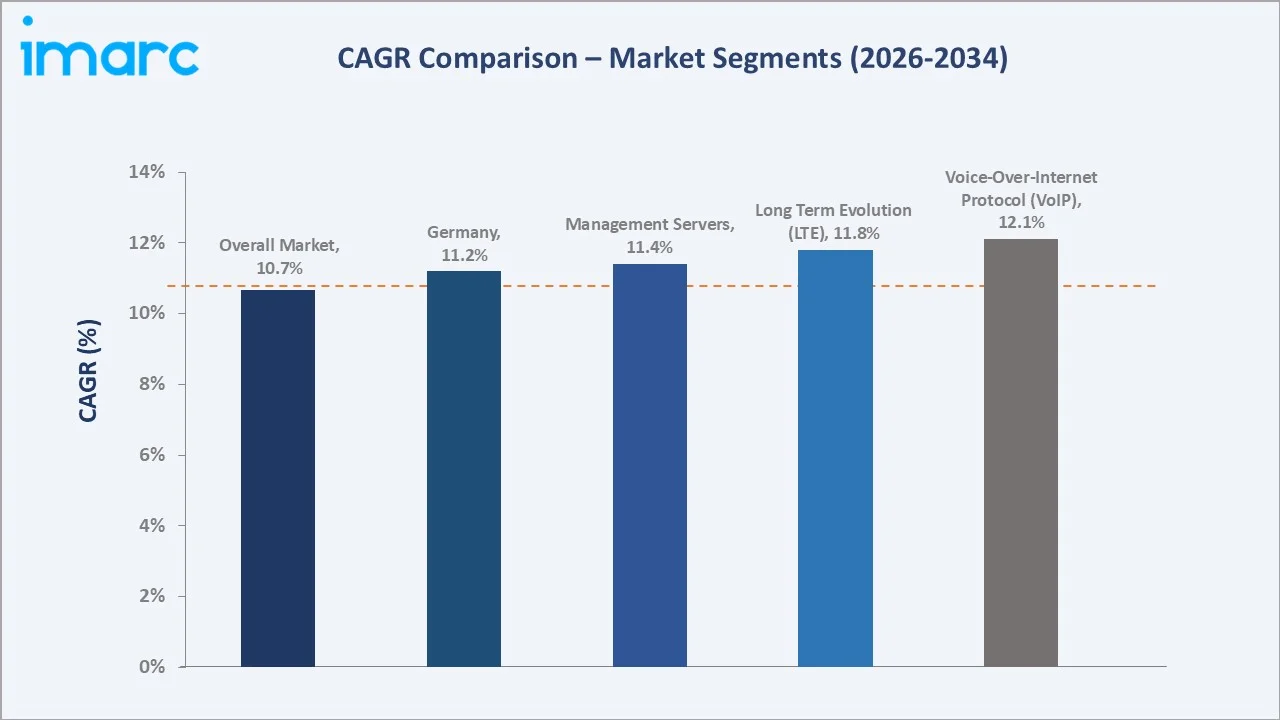
VoIP lawful interception grows at ~12.1% CAGR as the fastest-growing network technology segment through encrypted communication proliferation mandating new intercept capabilities. LTE grows at ~11.8% CAGR through the 4G/5G transition requiring upgraded LI systems. Management servers expand at ~11.4% CAGR through centralized LI command-and-control infrastructure investment.
Executive Summary
The Europe lawful interception market is experiencing robust double-digit growth anchored by mandatory regulatory compliance obligations across all EU member states, accelerating 5G network deployments requiring new-generation LI infrastructure, and escalating law enforcement demand driven by cybercrime proliferation and counterterrorism requirements. The market is driven by LI standard evolution for 5G networks, AI-powered real-time intercept analytics investment, and European intelligence agencies' enhanced capability requirements following geopolitical escalation. VoIP leads network technology at 25.0% through the dominance of IP-based communication. Management servers command 20.0% device share as the central LI orchestration layer. Germany leads national markets at 24.6% through Europe's most comprehensive LI regulatory enforcement.
Key Market Insights
|
Insight |
Data |
|
Dominant Network Technology |
Voice-Over-Internet Protocol (VoIP) - 25.0% share (2025) |
|
Dominant Device |
Management Servers - 20.0% share (2025) |
|
Leading Country |
Germany - 24.6% (2025) |
|
Key Market Opportunity |
The mandatory 5G lawful interception compliance requirement across all EU member states represents an incremental infrastructure investment opportunity by 2030 as telecom operators upgrade existing LI systems for 5G standalone network architecture. |
Key Analytical Observations Explaining the Dominant Segments and Leading Country:
- Voice-Over-Internet Protocol (VoIP) at 25.0%: VoIP commands the largest network technology share because it has become the primary communication medium across enterprise, consumer, and government organizations throughout Europe, replacing traditional circuit-switched telephony and generating the highest volume of lawful interception orders from law enforcement agencies.
- Management Servers at 20.0%: Management servers represent the central command-and-control layer of any lawful interception system, housing the lawful interception management function (LIMF) that orchestrates, authorizes, and audits all interception activities across an operator's network. Each telecom operator requires at least one management server deployment, and major operators maintain geographically distributed management server infrastructure for redundancy and regulatory compliance.
- Germany at 24.6%: Germany leads through the combination of Europe's largest telecommunications market by operator count, which imposes some of Europe's most stringent and technically detailed LI compliance obligations on communications service providers. Germany's federal structure creates a uniquely distributed and high-volume LI procurement environment that generates 24.6% of European market revenue.
Europe Lawful Interception Market Overview
The Europe lawful interception market encompasses the technology systems, software platforms, and professional services that enable communications service providers (CSPs) to lawfully intercept communications and associated metadata under court order or equivalent legal authorization and deliver the intercepted content to authorized law enforcement agencies (LEAs), intelligence services, and government security bodies. Lawful interception systems must comply with Lawful Interception standards, which define the technical interfaces between CSP internal LI infrastructure and LEA collection platforms.
Market Dynamics
To evaluate market opportunities, Request Sample
Market Drivers
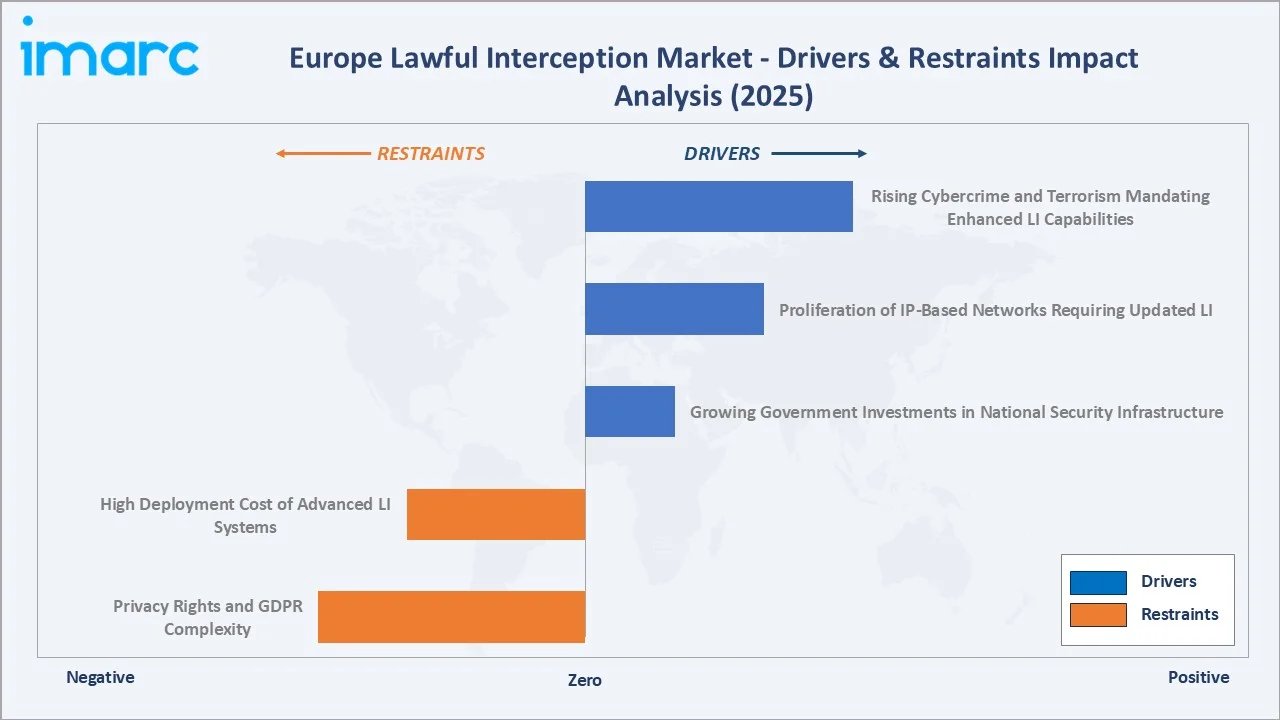
- Rising Cybercrime and Terrorism Mandating Enhanced LI Capabilities: The findings from DLA Piper’s seventh GDPR Fines and Data Breach Survey indicate that European data protection authorities imposed approximately €1.2 billion in GDPR fines during 2024, taking cumulative penalties since May 2018 to around €5.88 billion. As cyber threats and sophisticated digital crimes expand, authorities require advanced LI systems that can enable legally authorized monitoring and evidence collection while maintaining strict GDPR-compliant data handling, security, and privacy safeguards.
- Proliferation of IP-Based Networks Requiring Updated LI: By the end of 2025, 5G networks covered approximately 94.9% of the population, representing a notable increase from 87% in 2024. This includes 5G standalone (SA) core network architecture with fundamentally different LI technical interfaces requiring compliance with updated standards. Every 5G SA network element requires separate LI function implementation, driving significant infrastructure investment from all European MNOs for 5G core network LI compliance.
- Growing Government Investments in National Security Infrastructure: European NATO members allocated approximately 36.2% of their defense budgets to investment in 2026, representing a substantial increase from 24.8% in 2020. European defense spending increases include substantial allocations for national intelligence and law enforcement LI capabilities. EU member state governments collectively invest heavily in national security technology, including LI infrastructure, with additional EU-level funding supporting common LI interoperability development.
Market Restraints
- Privacy Rights and GDPR Complexity: Stringent GDPR requirements and strong privacy protections across Europe are limiting the deployment of lawful interception solutions by imposing strict conditions on data collection, processing, storage, and access. Compliance with varying national surveillance laws further increases operational and technical complexity for solution providers. Moreover, concerns regarding excessive surveillance and unauthorized data access can delay implementation and increase compliance costs.
- High Deployment Cost of Advanced LI Systems: The high cost of deploying advanced lawful interception (LI) systems is constraining market growth, particularly for smaller telecom operators and service providers. Significant investments are required for specialized hardware, software, secure data storage, system integration, and continuous upgrades. Moreover, the transition toward 5G, cloud, and encrypted communications increases infrastructure complexity, further raising implementation and maintenance costs.
Market Opportunities
- Encrypted Communication LI Technology Development: The proliferation of end-to-end encrypted communications used by EU residents creates a critical legal intercept challenge where network-level LI captures only metadata rather than communication content. Investment in lawful hacking technology, device-side interception solutions compliant with regulatory frameworks, and encrypted traffic analysis systems represents a high-value emerging capability development opportunity.
- AI-Powered Real-Time LI Analytics: Law enforcement agencies are increasingly requiring not merely intercepting content delivery but real-time analytics, automatic speech recognition, multilingual translation, entity extraction, and communication network analysis that transform raw LI data into actionable intelligence. AI-powered LI analytics platforms addressing this requirement command significant premium pricing above basic LI infrastructure, generating high-margin software revenue for vendors with advanced natural language processing and behavioral analytics capabilities.
Market Challenges
- Jurisdiction Complexity in Cross-Border LI Operations: Modern digital communications are borderless, creating complex multi-jurisdiction legal authorization requirements that delay intercept execution and reduce the tactical effectiveness of time-sensitive LI operations. The EU's regulatory framework is addressing cross-border legal cooperation, but implementation delays and member state legislative transposition variations continue to create operational friction.
- Lawful Interception Expertise Shortage in Law Enforcement: The technical complexity of modern IP, VoIP, and 5G lawful interception systems requires highly specialized engineering knowledge in both telecommunications network architecture and legal/regulatory compliance frameworks. A significant talent gap exists across European LEAs in personnel capable of operating advanced LI systems, managing ETSI interface configurations, and ensuring legal compliance with data handling requirements, creating training investment requirements and operational bottlenecks that reduce LI system utilization rates.
Emerging Market Trends
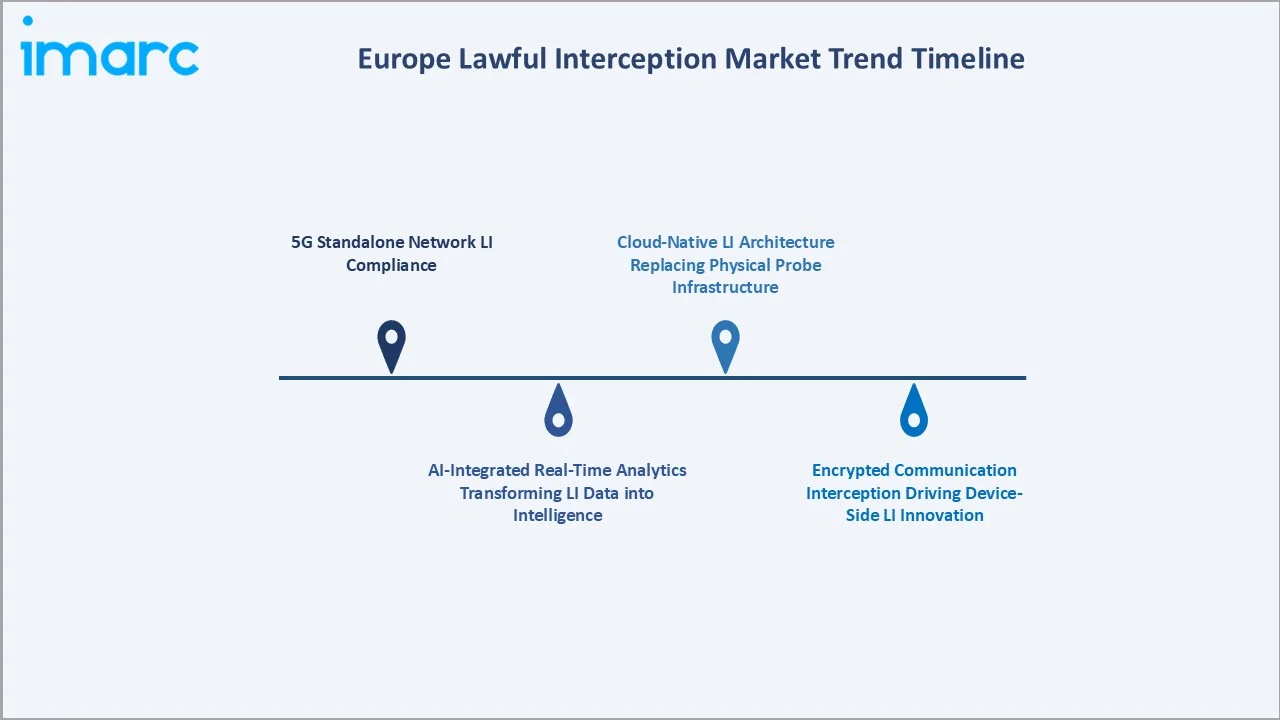
1. 5G Standalone Network LI Compliance
In Europe, ten out of eleven operators achieved lower latency with 5G standalone (SA) networks, recording improvements ranging from 5% to 32% compared with non-standalone (NSA) networks. The transition from 4G LTE to 5G Standalone (SA) architecture represents the most significant LI infrastructure replacement cycle in a decade, as 5G SA's service-based architecture (SBA) fundamentally changes the network elements requiring LI function implementation. Major European MNOs are investing in 5G core LI compliance programs that represent the primary revenue growth driver for LI system vendors through 2027.
2. AI-Integrated Real-Time Analytics Transforming LI Data into Intelligence
European intelligence agencies and law enforcement bodies are requiring vendors to move beyond passive intercept delivery toward active intelligence generation from intercepted communications. Automatic speech-to-text for European languages, entity recognition across multilingual communications, and predictive behavioral analytics are becoming standard requirements in LEA LI platform procurement specifications.
3. Cloud-Native LI Architecture Replacing Physical Probe Infrastructure
The industry's transition from physical LI probe hardware to cloud-native virtual LI functions is accelerating as operators deploy cloud-native 5G core networks. This architectural shift reduces LI hardware capex while enabling rapid capability scaling and feature updates through software releases, creating a recurring software subscription revenue model that benefits LI vendors with strong software development capabilities.
4. Encrypted Communication Interception Driving Device-Side LI Innovation
The entrenchment of end-to-end encryption in mainstream European communications has prompted law enforcement advocacy for device-side interception capabilities, installing LI software on target devices through lawful hacking frameworks authorized under national criminal procedure codes. The regulatory frameworks authorize device-side interception under judicial oversight, creating a market for specialized endpoint exploitation technology and legally compliant software delivery infrastructure that supplements traditional network-level LI capabilities.
Industry Value Chain Analysis
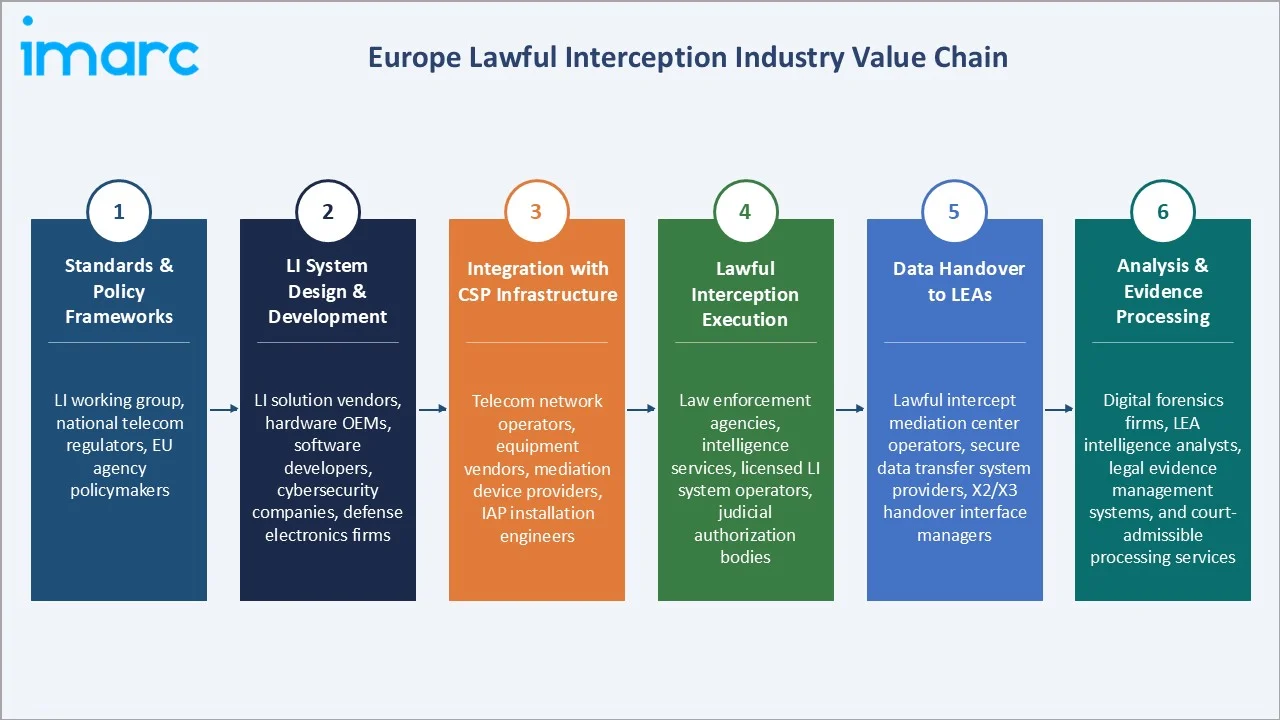
The Europe lawful interception value chain encompasses regulatory standards and policy frameworks, LI system design and development, integration with communications service provider infrastructure, lawful interception execution, data handover to law enforcement agencies, and digital analysis and evidence processing.
|
Stage |
Key Players |
|
Standards & Policy Frameworks |
LI working group, national telecom regulators, EU agency policymakers. |
|
LI System Design & Development |
LI solution vendors, hardware OEMs, software developers, cybersecurity companies, defense electronics firms. |
|
Integration with CSP Infrastructure |
Telecom network operators, equipment vendors, mediation device providers, IAP installation engineers. |
|
Lawful Interception Execution |
Law enforcement agencies, intelligence services, licensed LI system operators, judicial authorization bodies. |
|
Data Handover to LEAs |
Lawful intercept mediation center operators, secure data transfer system providers, X2/X3 handover interface managers. |
|
Analysis & Evidence Processing |
Digital forensics firms, LEA intelligence analysts, legal evidence management systems, and court-admissible processing services. |
Integration with communications service provider infrastructure represents the highest technical complexity and value-creation stage, where LI solution vendors must adapt their platforms to each operator's unique network architecture while maintaining regulatory standards compliance and operational transparency to regulatory authorities.
Technology Landscape in the Europe Lawful Interception Industry
5G Lawful Interception Technology
The expansion of 5G standalone (SA) networks is transforming lawful interception architectures across Europe. LI solutions are increasingly designed to operate across virtualized and service-based 5G core networks while supporting high-speed data collection. Integration with network functions and standardized interfaces enables authorized agencies to intercept communications and related metadata under applicable legal frameworks.
Artificial Intelligence (AI) and Machine Learning (ML)
AI and ML technologies support the analysis of large volumes of lawfully obtained communications data by identifying patterns, relationships, and anomalies. These technologies can improve data classification and prioritization, helping authorized agencies process complex datasets more efficiently. Their adoption also increases the importance of governance, transparency, and regulatory compliance.
Virtualized Network Functions (VNF) and Network Function Virtualization (NFV)
NFV allows lawful interception capabilities to operate as software-based network functions rather than relying exclusively on dedicated physical appliances. This supports faster deployment, scalability, and integration with virtualized telecom networks. The technology is particularly relevant to 5G infrastructure, where network functions are increasingly software-defined.
Market Segmentation Analysis
The report covers the following segments:
|
Segment Category |
Leading Segment |
Market Share |
Year |
|
Network Technology |
Voice-Over-Internet Protocol (VoIP) |
25.0% |
2025 |
|
Device |
Management Servers |
20.0% |
2025 |
|
Communication Content |
Voice Communication |
31.0% |
2025 |
|
Service |
Professional Services |
39.0% |
2025 |
|
End User |
Law Enforcement Agencies |
45.0% |
2025 |
|
Country |
North America |
24.6% |
2025 |

By Network Technology
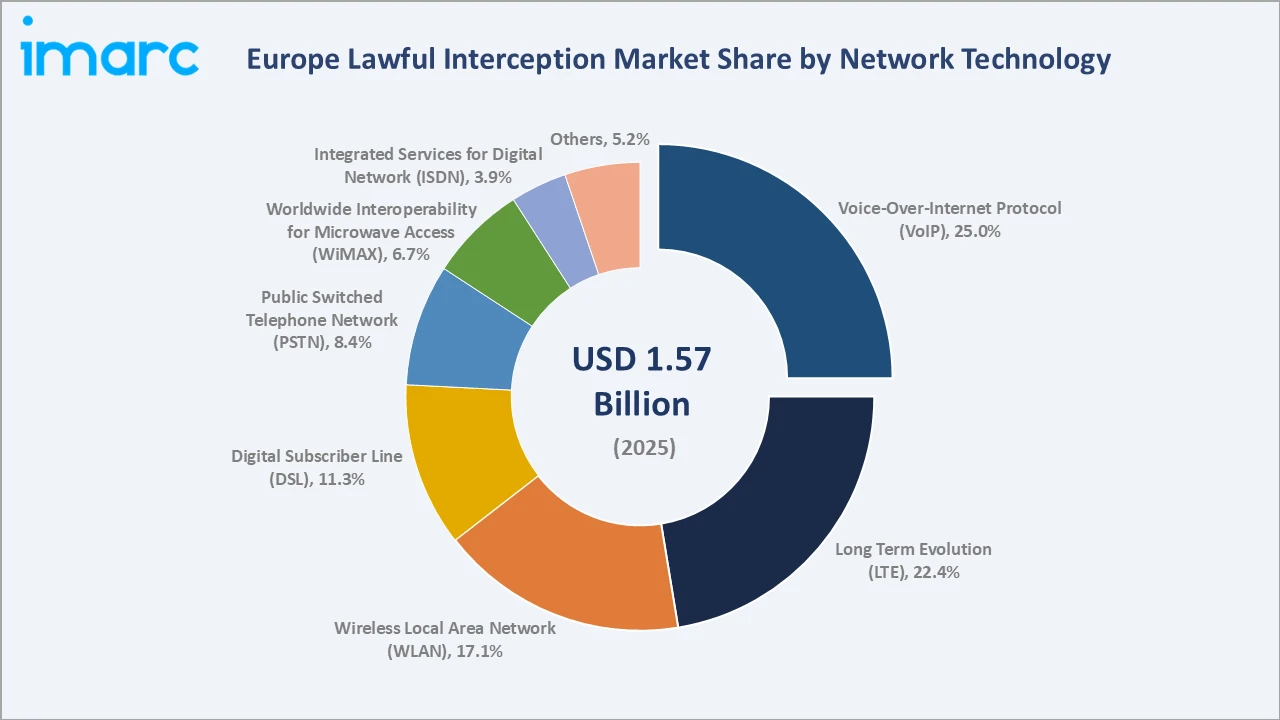
Voice-over-internet protocol (VoIP) commands 25.0% in 2025, reflecting VoIP's displacement of traditional circuit-switched telephony as the primary enterprise and consumer communication medium across Europe.
To access detailed market analysis, Request Sample
Long term evolution (LTE) at 22.4% reflects the dominant mobile LI technology, with 4G LTE's IMS architecture requiring specialized LI function implementation across core elements. Wireless local area network (WLAN) at 17.1% is growing through public Wi-Fi LI obligations in hospitality, transport, and public access networks under EU member state transpositions. Digital subscriber line (DSL) at 11.3%, public switched telephone network (PSTN) at 8.4%, worldwide interoperability for microwave access (WiMAX) at 6.7%, and integrated services for digital network (ISDN) at 3.9% represent declining legacy technologies with stable compliance maintenance requirements.
By Device
Management servers dominate at 20.0%, representing the centralized Lawful Interception Management System (LIMS) that orchestrates all LI activities across an operator's network.
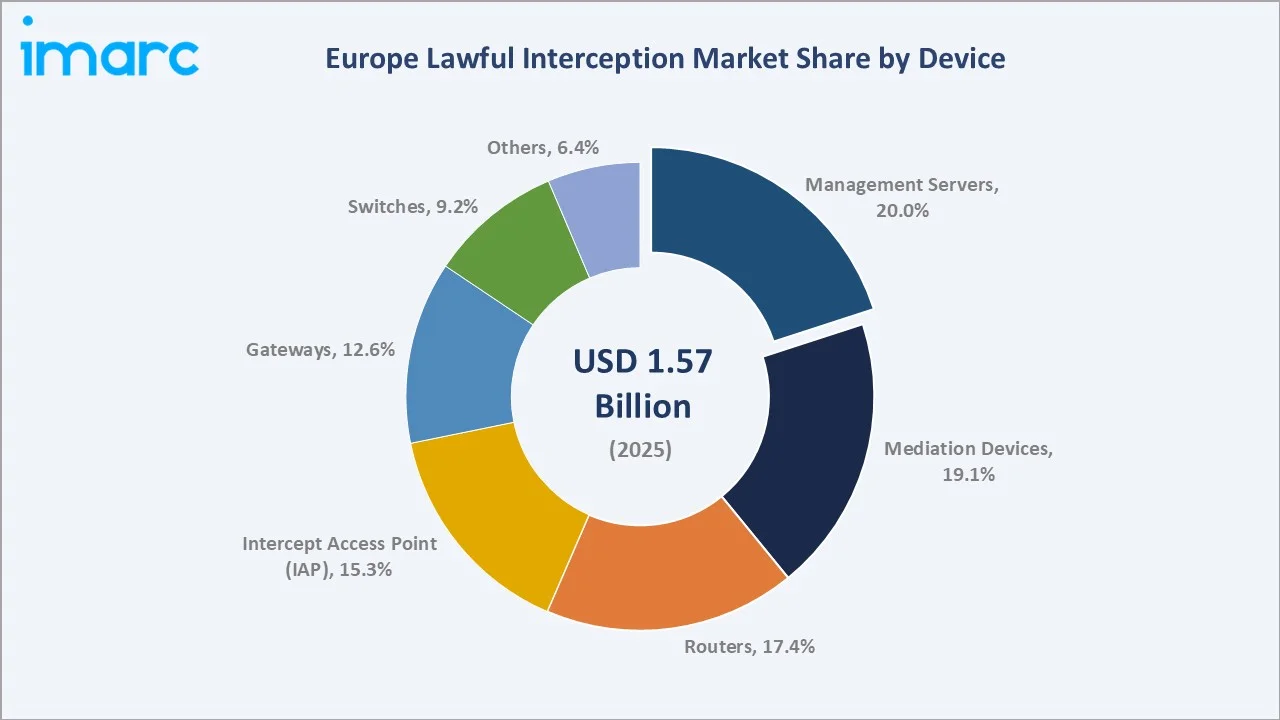
Mediation devices at 19.1% serve as the technical translation layer between operator network LI functions and LEA-facing X2/X3 handover interfaces, handling format conversion, encryption, and delivery confirmation. Routers at 17.4% with LI capability embed intercept access functions directly in network infrastructure. IAPs (intercept access points) at 15.3% provide dedicated hardware probes at strategic traffic aggregation points. Gateways at 12.6% and switches at 9.2% complete the distributed LI hardware infrastructure.
Regional Market Insights
|
Country |
Share (2025) |
Key Europe Lawful Interception Market Drivers & Characteristics |
|
Germany |
24.6% |
Reflecting Europe's largest economy with the most sophisticated LI regulatory framework, cybersecurity mandates, and intelligence agencies driving continuous LI infrastructure investment. |
|
United Kingdom |
20.8% |
Reflecting the advanced signals intelligence capabilities and domestic and foreign LI requirements. |
|
France |
18.5% |
Reflecting comprehensive equivalent obligations, intelligence agency LI requirements, and cybersecurity mandates. |
|
Italy |
13.9% |
Reflecting extensive use of judicial interception orders, among the highest per capita in Europe, driven by organized crime surveillance and counterterrorism operations requiring comprehensive LI coverage across mobile, internet, and VoIP networks. |
|
Spain |
10.7% |
Reflecting the criminal framework for judicial interception authorization, intelligence service LI requirements, and law enforcement surveillance operations targeting domestic terrorism and organized crime networks. |
|
Others |
11.5% |
Reflecting other EU member states with legally mandated LI compliance obligations and national transpositions, creating distributed infrastructure investment across smaller European markets with growing LI technology adoption. |
Germany's 24.6% country share reflects its triple competitive position as Europe's largest telecommunications market by licensed operator count, its federal intelligence and law enforcement LI procurement structure generating the highest per-country LI investment volume, and its hosting of key European LI technology vendors, creating a vertically integrated ecosystem of LI system vendors, operators, and government customers that sustains above-average market investment.
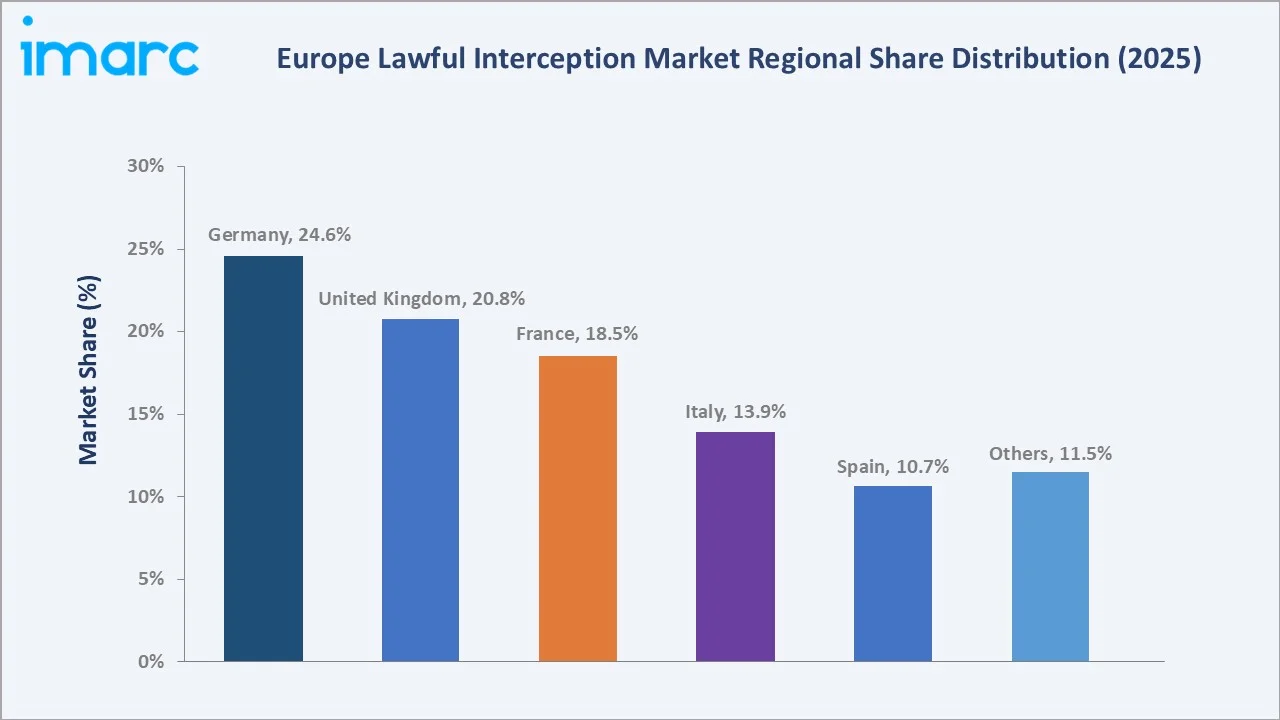
The United Kingdom's 20.8% reflects both its advanced LI regulatory sophistication and its significant intelligence community LI investment through a national signals intelligence mandate that drives technology procurement well above what criminal law enforcement alone would generate. France's 18.5% reflects counterterrorism LI investment sustained through the regulatory framework. Italy's 13.9% captures the highest per-capita judicial interception order volume in Europe driven by organized crime surveillance. Spain at 10.7% and Others at 11.5% complete the European distribution, with the others category growing as Eastern European member states accelerate national LI modernization under EU security cooperation frameworks.
Competitive Landscape
The Europe lawful interception market features a competitive landscape combining global telecom equipment leaders, defense and intelligence technology specialists, networking infrastructure majors, dedicated LI software vendors, and regional European specialists. Market leadership is determined by regulatory standard compliance breadth, 5G/IP interception capability, government security clearance and sovereign trust credentials, and ability to integrate with diverse European operator network architectures.
|
Company |
Key Offerings |
Market Position |
Core Strength |
|
Telefonaktiebolaget LM Ericsson |
Ericsson LI-IMS and LMISF |
Market Leader |
Telefonaktiebolaget LM Ericsson plays a critical operational role in Europe’s lawful interception landscape by acting as a primary technology enabler for Communications Service Providers. |
|
Nokia |
Nokia Cloud Mobility Manager (CMM), Nokia NetGuard |
Market Leader |
Nokia provides passive network infrastructure and technical capabilities that allow authorized law enforcement agencies to perform lawful interception (LI) on telecommunications networks in compliance with European regulations. |
|
BAE Systems |
BAE Systems DataBridge, BAE Systems DataRetain |
Market Leader |
BAE Systems provides software and technology solutions that help communications service providers and governments handle lawful interception. |
|
Cisco Systems, Inc. |
Cisco Catalyst SD-WAN, Cisco SD-WAN Manager |
Established Player |
Cisco Systems provides native hardware and software capabilities that function as Intercept Access Points (IAPs) within telecom and data networks to support legally authorized electronic surveillance |
|
NETSCOUT |
InfiniStreamNG Appliance, TrueCall |
Established Player |
Providing deep packet inspection and scalable network visibility infrastructure, NETSCOUT supports the operational intelligence and monitoring architectures that telecommunications operators use to comply with local and European lawful interception (LI) frameworks. |
Competitive dynamics are evolving as the 5G transition creates a platform replacement cycle benefiting vendors with 5G-native LI capabilities over legacy vendors with outdated probe-based architectures. The convergence of LI data delivery with AI-powered intelligence analytics is creating integration partnerships between traditional LI infrastructure vendors and analytics platform providers.
Key Company Profiles
Telefonaktiebolaget LM Ericsson
Telefonaktiebolaget LM Ericsson is a major telecommunications technology provider with an established presence across Europe, offering network infrastructure, software, and communication solutions. In the lawful interception market, the company provides technologies designed to support legally authorized interception and regulatory compliance across telecommunications networks. Its expertise in 4G, 5G, cloud-native networks, and network virtualization supports the integration of lawful interception capabilities into evolving digital network environments.
- Key Offerings: Ericsson LI-IMS and LMISF.
- Strategic Focus: Focuses on integrating secure and standards-based lawful interception capabilities into advanced 4G, 5G, and cloud-native network environments across Europe. The company emphasizes regulatory compliance, network modernization, scalability, and interoperability to address evolving requirements from telecom operators and authorized government agencies.
Nokia
Nokia is a major telecommunications technology provider with a strong presence across Europe, offering mobile, fixed, IP, and cloud network solutions. In the lawful interception market, the company supports telecom operators in implementing regulatory and legally mandated interception capabilities across evolving network environments. Its expertise in 5G, cloud-native architectures, network virtualization, and security strengthens its position in supporting compliant and scalable lawful interception infrastructure.
- Key Offerings: Nokia Cloud Mobility Manager (CMM)[PM8.1], Nokia NetGuard.
- Strategic Focus: Integrating secure, scalable, and standards-compliant lawful interception capabilities across advanced 5G, cloud-native, and virtualized telecommunications networks in Europe. The company emphasizes network modernization, interoperability, regulatory compliance, and automation to support evolving interception requirements of telecom operators and authorized agencies.
Market Concentration Analysis
The Europe lawful interception market is moderately concentrated, with deep operator network integration, government security clearances, and multi-year managed service contracts. Market consolidation is occurring at the solution stack level, where LI infrastructure vendors are acquiring or partnering with analytics software companies to provide integrated platforms, while remaining fragmented at the national specialty level, where certified, qualified, and approved vendors maintain protected positions in sovereign government procurement. The 5G compliance replacement cycle is expected to benefit scale vendors with complete 5G network function portfolios over specialists with partial technology coverage.
Investment & Growth Opportunities
Highest Growth Segments
VoIP lawful interception technology (~12.1% CAGR), LTE/5G network LI compliance (~11.8% CAGR), AI-powered LI analytics platforms, cloud-native LI-as-a-Service for mid-size operators, OTT provider LI compliance programs, encrypted communication analysis technology, and Eastern European member state LI modernization represent the highest-return investment vectors in the European lawful interception market through 2034.
Investment Themes
- 5G Standalone Core LI Compliance Infrastructure: Every European MNO transitioning to 5G SA architecture requires new LI function implementation across various network elements versus 4G LTE. Vendors with complete 5G core function LI portfolios certified are positioned to capture disproportionate share of this replacement opportunity.
- AI Analytics Layer above LI Data Streams: Building AI-powered intelligence analytics platforms that process and analyze lawfully intercepted data, providing automatic transcription, translation, entity extraction, and behavioral scoring, generates premium software revenue of 3-5x the underlying LI infrastructure cost. LEA budget allocations are increasingly separated between LI compliance infrastructure (operator-funded) and intelligence analytics capabilities (LEA-funded), with analytics spending growing faster than infrastructure as agencies prioritize analyst productivity enhancement.
Future Market Outlook (2026-2034)
The Europe lawful interception market is projected to grow from USD 1.57 Billion in 2025 to USD 1.74 Billion in 2026, reaching USD 3.91 Billion by 2034, exhibiting a CAGR of 10.67% during 2026-2034. The market is projected to reach an anchor value of USD 2.61 Billion by 2030, representing the mid-period milestone at which 5G SA core network LI compliance achieves broad European MNO deployment, OTT provider LI compliance programs generate significant new market revenue, and AI-powered LI analytics platforms achieve mainstream LEA adoption across major European law enforcement agencies.
Three structural forces will define the Europe lawful interception market through 2034. First, the 5G compliance replacement cycle generates the largest single wave of LI infrastructure investment in a decade, benefiting vendors with certified 5G core LI capabilities and managed service delivery models that reduce operator compliance complexity. Second, the regulatory expansion of LI obligations to previously exempt categories significantly expands the addressable LI compliance market beyond traditional telecom operators. Third, the integration of artificial intelligence and machine learning into LI analytics pipelines is transforming the market's value architecture.
Research Methodology
Primary Research
Primary research comprised in-depth interviews with European telecom operator LI compliance officers, law enforcement agency digital evidence managers, national security agency technology procurement officers, LI system vendor product managers, LI working group participants, and European telecommunications regulatory consultants. These discussions validated market size estimates, network technology and device segment demand dynamics, country market characteristics, and technology adoption trajectories for the 2026-2034 forecast period.
Secondary Research
Secondary research encompassed LI technical standards publications, telecommunications policy documents, European Union Agency for Cybersecurity reports, national telecommunications regulatory authority annual reports, IMARC Group proprietary telecommunications security databases, annual reports of key market participants, and academic publications on lawful interception technology and policy through 2025.
Forecasting Models
Forecasting models incorporated historical LI market revenue correlations with European 5G rollout milestones, law enforcement LI warrant volume growth trends, operator capex and LI compliance investment allocation data, standard publication timelines and compliance implementation lead times, and macroeconomic indicators including European defense and security spending growth. Both bottom-up network technology and device segment revenue modeling and top-down country-level compliance investment approaches were cross-validated for forecast consistency.
Report Coverage:
| Report Features | Details |
|---|---|
| Base Year of the Analysis | 2025 |
| Historical Period | 2020-2025 |
| Forecast Period | 2026-2034 |
| Units | Billion USD |
| Scope of the Report | Exploration of Historical Trends and Market Outlook, Industry Catalysts and Challenges, Segment-Wise Historical and Future Market Assessment:
|
| Network Technologies Covered | Voice-Over-Internet Protocol (VoIP), Long Term Evolution (LTE), Wireless Local Area Network (WLAN), Worldwide Interoperability for Microwave Access (WiMAX), Digital Subscriber Line (DSL), Public Switched Telephone Network (PSTN), Integrated Services for Digital Network (ISDN), Others |
| Devices Covered | Mediation Devices, Routers, Intercept Access Point (IAP), Gateways, Switches, Management Servers, Others |
| Communication Contents Covered | Voice Communication, Video, Text Messaging, Facsimile, Digital Pictures, File Transfer, Others |
| Services Covered | Professional Services, Managed Services, System Integrators |
| End Users Covered | Government & Public Affairs, Law Enforcement Agencies, Small & Medium Enterprises |
| Countries Covered | Germany, France, United Kingdom, Italy, Spain, Others |
| Companies Covered | Telefonaktiebolaget LM Ericsson, Nokia, BAE Systems, Cisco Systems, Inc., NETSCOUT, etc. |
| Customization Scope | 10% Free Customization |
| Post-Sale Analyst Support | 10-12 Weeks |
| Delivery Format | PDF and Excel through Email (We can also provide the editable version of the report in PPT/Word format on special request) |
Frequently Asked Questions About the Europe Lawful Interception Market Report
The Europe lawful interception market reached to USD 1.74 Billion in 2026, driven by 5G core network LI compliance investment, VoIP intercept infrastructure expansion, extension of LI obligations to OTT providers, and increased law enforcement LI system procurement across major European economies.
The Europe lawful interception market is projected to grow at a CAGR of 10.67% during 2026-2034, driven by 5G SA compliance infrastructure replacement, AI-powered LI analytics adoption, OTT provider compliance market emergence, cloud-native LI platform migration, and increasing European government security spending.
The market is projected to reach USD 2.61 Billion by 2030, the mid-period milestone at which 5G SA LI compliance achieves broad European MNO deployment, OTT provider programs generate significant new revenue, and AI-powered LEA analytics platforms achieve mainstream adoption across major European law enforcement agencies.
VoIP leads with a 25.0% share in 2025, reflecting VoIP's complete displacement of PSTN as the primary European enterprise and consumer communication medium, generating the highest volume of lawful interception orders and requiring the most technically complex and costly intercept infrastructure among all network technology segments.
Management servers lead with a 20.0% share in 2025, as the mandatory regulatory-compliant lawful interception management system (LIMS) that every operator must deploy to orchestrate, audit, and manage all LI activities, comply with warrant lifecycle management requirements, and maintain regulatory accountability for intercept operations.
Germany leads with a 24.6% share in 2025, reflecting Europe's largest telecom operator market, Germany's mandated stringent LI compliance requirements, intelligence agency LI procurement, and Germany's federal-state structure generating independent LI deployment authorities, creating the highest per-country LI investment volume in Europe.
Key players include Telefonaktiebolaget LM Ericsson, Nokia, BAE Systems, Cisco Systems, Inc., and NETSCOUT, among others.
The market is projected to reach USD 3.91 Billion by 2034, driven by complete 5G SA LI deployment across all European MNOs, OTT provider compliance market maturation, quantum-resistant LI cryptography investment for 6G preparation, and AI analytics platform dominance in law enforcement intelligence production workflows.
Key opportunities include 5G SA core network LI infrastructure replacement, OTT provider compliance technology, AI-powered LEA analytics platforms generating 3-5x LI infrastructure revenue, cloud-native LI-as-a-Service for mid-size operators, and Eastern European member state LI modernization programs under EU security cooperation frameworks.
Need more help?
- Speak to our experienced analysts for insights on the current market scenarios.
- Include additional segments and countries to customize the report as per your requirement.
- Gain an unparalleled competitive advantage in your domain by understanding how to utilize the report and positively impacting your operations and revenue.
- For further assistance, please connect with our analysts.
 Request Customization
 Speak to an Analyst
 Request Brochure
 Inquire Before Buying
Benefits of Customization
- Personalize this research
- Triangulate with your data
- Get data as per your format and definition
- Gain a deeper dive into a specific application, geography, customer, or competitor
- Any level of personalization
Get in Touch With Us
UNITED STATES
Phone: +1-201-971-6302
INDIA
Phone: +91-120-433-0800
UNITED KINGDOM
Phone: +44-753-714-6104
Email: [email protected]
Client Testimonials

.webp)



.webp)









Related Reports

Choose your plan
*Please note that the prices mentioned below are starting prices for each bundle type. Kindly contact our team for further details.*
Single User License
- 1 User License, Access on 2 Devices
- PDF Report + Excel Dataset (Password Protected)
- Lifetime Access
- No Printing Rights
- 10% Free Report Customization
- 10–12 Weeks of Analyst Support
Five User License
- Access for 5 Users, 2 Devices per User
- PDF Report + Excel Dataset (Password Protected)
- Lifetime Access
- Dedicated Account Manager
- 12–14 Weeks of Analyst Support
- No Printing Rights
- 15% Free Report Customization
- 25% Discount on Your Next Purchase
Corporate User License
- Unlimited User Access (Within Your Organization)
- PDF Report + Excel Dataset
- Lifetime Access
- Dedicated Account Manager
- 14–20 Weeks of Analyst Support
- No Printing Rights
- 20% Free Report Customization
- 30% Discount on Your Next Purchase
Essential Insights
What's included:
3 reports
- Lifetime Access
- PDF Reports
- Excel Datasets
- 2 Weeks of Free Analyst Support
- 2 User Licenses
- Access on 2 Devices
- Printing Rights
- Complimentary PowerPoint (PPT) Version
- Complimentary License Upgrade
Professional Access
What's included:
5 reports
- Lifetime Access
- PDF Reports
- Excel Datasets
- 8 Weeks of Free Analyst Support
- 2 User Licenses
- Access on 2 Devices
- Printing Rights
- Complimentary PowerPoint (PPT) Version
- Complimentary License Upgrade
Business Advantage
What's included:
8 reports
- Lifetime Access
- PDF Reports
- Excel Datasets
- 14 Weeks of Free Analyst Support
- 2 User Licenses
- Access on 2 Devices
- Printing Rights
- Complimentary PowerPoint (PPT) Version
- Complimentary License Upgrade
Enterprise Intelligence
What's included:
10 reports
- Lifetime Access
- PDF Reports
- Excel Datasets
- 20 Weeks of Free Analyst Support
- 2 User Licenses
- Access on 2 Devices
- Printing Rights
- Complimentary PowerPoint (PPT) Version
- Complimentary License Upgrade