
Europe Marketing Automation Software Market Size, Share, Trends and Forecast by Deployment, Application, End-User Verticals, and Country, 2026-2034
Europe Marketing Automation Software Market Summary:
The Europe marketing automation software market size was valued at USD 2.4 Billion in 2025 and is projected to reach USD 8.1 Billion by 2034, growing at a compound annual growth rate of 14.45% from 2026-2034.
The Europe marketing automation software market is advancing strongly as enterprises across industries accelerate digital transformation and adopt cloud-native engagement platforms. Rising demand for AI-driven personalization, expanding e-commerce ecosystems, and the growing need for GDPR-compliant customer data strategies are fueling adoption. Omnichannel marketing orchestration, deeper CRM integration, and predictive analytics capabilities are reshaping how organizations engage audiences, optimize campaign performance, and drive measurable returns on marketing investment. Advancements in consent management technologies and first-party data frameworks are further supporting the Europe marketing automation software market share.
Key Takeaways and Insights:
- By Deployment: Cloud-based dominates the market with a share of 65% in 2025, owing to its scalable infrastructure, seamless AI integration capabilities, and built-in GDPR compliance features that reduce regulatory risk for enterprises across the region.
- By Application: Campaign management leads the market with a share of 23% in 2025, driven by growing enterprise demand for integrated, multi-channel campaign orchestration tools that deliver measurable returns and align marketing efforts with business outcomes.
- By End-User Verticals: Financial services represent the largest segment with a market share of 18% in 2025, reflecting the sector's increasing investment in automated customer engagement, personalized outreach, and regulatory-compliant digital communication platforms.
- Key Players: Key players drive the Europe marketing automation software market by investing in AI-powered personalization, expanding cloud-based platform capabilities, strengthening CRM integrations, and forging strategic partnerships to improve omnichannel engagement and maintain competitive positioning across diverse industry verticals.
The Europe marketing automation software market is experiencing robust expansion as businesses increasingly prioritize data-driven customer engagement and AI-enabled campaign optimization. The region's mature digital infrastructure, high internet penetration, and advanced cloud adoption rates provide a strong foundation for marketing automation platforms. Enterprises are shifting from siloed campaign tools to integrated orchestration suites that unify email, social media, mobile, and inbound marketing data into cohesive customer journeys. Regulatory frameworks such as GDPR and the EU AI Act are encouraging organizations to adopt privacy-compliant automation solutions that embed consent management and transparent data governance. For instance, according to a survey by IAB Europe published in September 2025, around 85% of European companies already utilize AI-based tools for marketing, with three-quarters having at least one campaign function powered by AI. This momentum underscores the region's readiness for next-generation marketing automation technologies.
Europe Marketing Automation Software Market Trends:
Rising Integration of Generative AI in Marketing Workflows
European enterprises are increasingly embedding generative AI into their marketing automation platforms to streamline content creation, personalize messaging, and optimize campaign delivery across various channels. These advanced tools enable automated copy generation, behavioral trigger alignment, and real-time audience segmentation. As organizations prioritize greater efficiency in production, generative AI is becoming a central component of the regional marketing software landscape. This integration facilitates improved orchestration and significant cost reduction, fostering a more responsive and agile approach to digital engagement.
Expansion of Omnichannel Marketing Orchestration
European enterprises are transitioning from single-channel management to unified omnichannel orchestration platforms that integrate various digital and mobile interactions into a central decision hub. This shift ensures consistent brand messaging, improved customer journey mapping, and enhanced attribution analytics. The convergence of offline and digital channels encourages businesses to invest in comprehensive automation solutions. By leveraging integrated data, organizations can achieve higher engagement and better conversion outcomes, making unified platforms essential for modern marketing strategies across the region.
Growing Emphasis on Privacy-Compliant First-Party Data Strategies
The deprecation of third-party cookies and the tightening of data privacy regulations are driving European organizations toward first-party data collection and consent-based marketing strategies. Marketing automation platforms are increasingly integrating robust consent management tools, customer data platforms, and privacy-by-design frameworks to ensure compliance with GDPR and the EU AI Act. For instance, the EU AI Act entered into force in August 2024, with phased applicability from 2025, requiring companies using AI-based marketing tools to implement transparency, documentation, and human oversight mechanisms. This regulatory evolution is accelerating demand for compliant automation solutions.
.webp)
Market Outlook 2026-2034:
The Europe marketing automation software market is poised for sustained expansion, underpinned by accelerating digital transformation initiatives, growing AI adoption, and rising demand for personalized customer engagement across verticals. The convergence of cloud-native platforms, regulatory compliance technologies, and advanced analytics capabilities is creating a favorable environment for next-generation marketing automation solutions. The market generated a revenue of USD 2.4 Billion in 2025 and is projected to reach a revenue of USD 8.1 Billion by 2034, growing at a compound annual growth rate of 14.45% from 2026-2034. Increasing investments in AI-powered content creation, real-time journey orchestration, and privacy-first data architectures are expected to drive higher adoption rates and foster a more competitive, innovation-led market landscape across the region.
Europe Marketing Automation Software Market Report Segmentation:
|
Segment Category |
Leading Segment |
Market Share |
|
Deployment |
Cloud-based |
65% |
|
Application |
Campaign Management |
23% |
|
End-User Verticals |
Financial Services |
18% |
Deployment Insights:
.webp)
To get detailed segment analysis of this market Request Sample
- Cloud Based
- On-premise
Cloud-based dominates with a market share of 65% of the total Europe marketing automation software market in 2025.
Cloud-based deployment has become the primary model for European enterprises prioritizing scalable and regulation-ready marketing automation infrastructure. The inherent flexibility of these platforms allows organizations to integrate advanced features, coordinate multi-channel campaigns, and manage expanding data volumes without requiring extensive capital investment. These solutions often include centralized tools that streamline compliance by automating essential data governance, notification, and security protocols. Regional initiatives further encourage this transition by subsidizing software adoption, effectively lowering entry barriers and accelerating the shift toward cloud migration.
The continuous innovation cycles and scalability inherent in cloud platforms drive broad adoption across various business sectors. This deployment model facilitates real-time data processing, provides the necessary computing power for sophisticated model deployment, and ensures seamless integration with core organizational systems to improve operational efficiency. Furthermore, specialized sovereign cloud offerings are gaining momentum as sectors with strict data requirements prioritize residency and specific jurisdictional routing. Dedicated ecosystem programs continue to foster regional technology innovation, supporting the sustained growth of cloud-based platform adoption throughout the territory.
Application Insights:
- Campaign Management
- E-mail Marketing
- In-bound Marketing
- Mobile Marketing
- Social Media Marketing
- Other Applications
Campaign management leads with a share of 23% of the total Europe marketing automation software market in 2025.
Campaign management represents the dominant application within the European market as enterprises seek sophisticated tools to coordinate and evaluate multi-channel initiatives from a unified interface. The increasing complexity of modern customer journeys requires integrated orchestration to align messaging and timing with behavioral insights across diverse touchpoints. Organizations are prioritizing solutions that merge advanced audience segmentation with automated testing and live performance monitoring. Recent technological advancements in autonomous systems further enhance these capabilities by optimizing campaign paths with minimal oversight, allowing for more agile and responsive decision-making processes.
A growing emphasis on accountability and performance measurement continues to bolster the demand for these management capabilities. Businesses require tools that offer detailed attribution analytics to link marketing activities directly to revenue outcomes across various segments and personas. The inclusion of predictive analytics allows for anticipated customer responses and more efficient budget allocation. This shift toward lifecycle-oriented strategies is accelerating the adoption of comprehensive modules that seamlessly deliver and coordinate content across digital, social, and mobile channels to ensure a cohesive brand experience.
End-User Verticals Insights:
- Entertainment and Media
- Financial Services
- Government
- Healthcare
- Manufacturing
- Retail
- Other End-User Verticals
The financial services segment exhibits a clear dominance with 18% share of the total Europe marketing automation software market in 2025.
Financial services firms across Europe are rapidly adopting marketing automation platforms to deliver personalized customer communications, enhance digital onboarding journeys, and comply with stringent regulatory requirements. Banks and insurance companies are leveraging automated workflows to manage lifecycle marketing, cross-selling initiatives, and retention campaigns while ensuring adherence to open-banking regulations and data protection mandates. The integration of AI-powered chatbots, predictive lead scoring, and automated compliance checks is transforming customer engagement practices.
The financial services sector is also investing heavily in digital transformation projects that incorporate marketing automation as a core component of customer experience strategies. European banks are prioritizing hyper-personalization capabilities powered by behavioral data analytics, enabling tailored product recommendations and proactive financial insights delivered through automated channels. Open-banking APIs are facilitating real-time, consent-based data sharing that supports more targeted and relevant customer outreach. In 2024, a total of 572 digitalization projects accounting for EUR 4.1 Billion in investment were recorded among banks under ECB supervision, with retail banking representing 35.8% of these initiatives.
Country Insights:
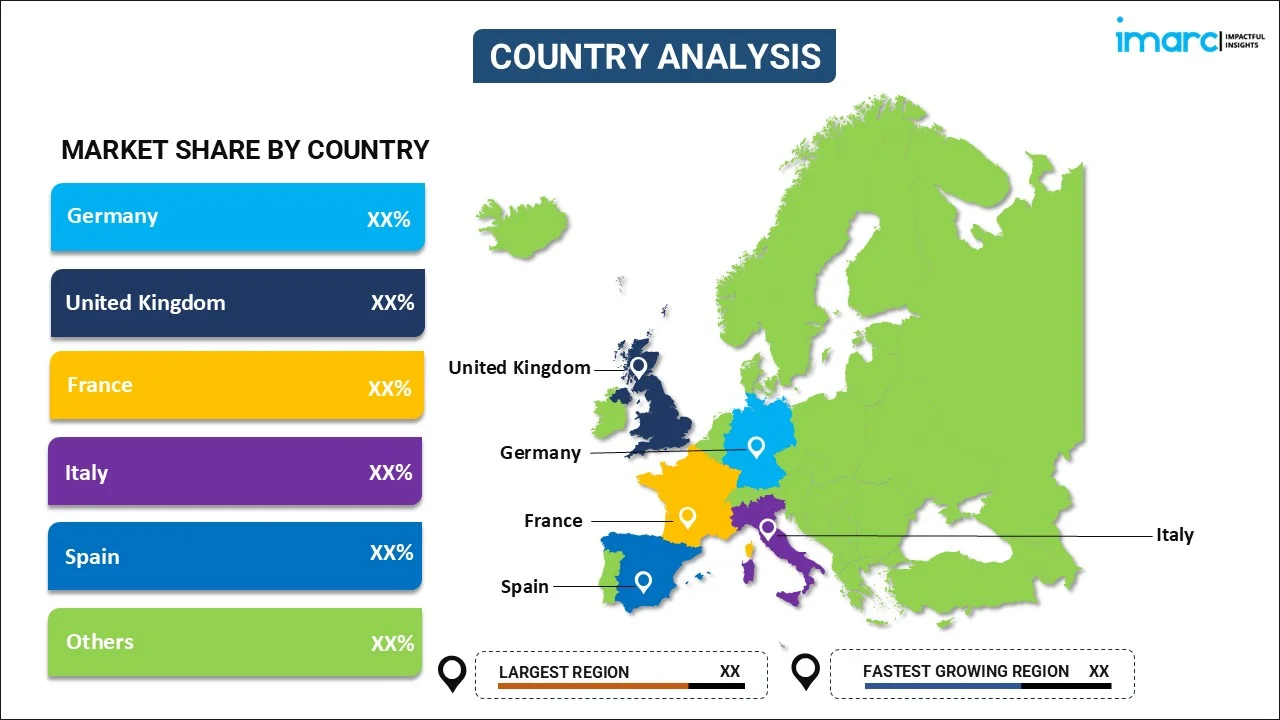
To get detailed regional analysis of this market Request Sample
- Germany
- France
- United Kingdom
- Italy
- Spain
- Others
Germany is accelerating marketing automation adoption through Industry 4.0 integration, AI personalization pilots across the DACH region, and growing enterprise investment in cloud-based customer engagement platforms. Manufacturing firms are incorporating marketing data streams into existing ERP and PLM systems, while retailers are deploying AI-driven recommendation engines to enhance conversion rates and customer loyalty across digital and physical channels.
France is emerging as a dynamic hub for marketing automation innovation, supported by a thriving startup ecosystem and growing enterprise demand for AI-powered engagement tools. The country is home to several prominent marketing technology companies that are expanding platform capabilities, integrating CRM functionalities, and investing in AI-driven features to compete with global players and serve the evolving needs of mid-market and enterprise clients.
The United Kingdom remains the largest market for marketing automation software in Europe, benefiting from its strong fintech ecosystem, advanced digital marketing maturity, and long-standing cloud adoption culture. Post-Brexit regulatory divergence has prompted dual compliance architectures managing both UK GDPR and EU GDPR, incentivizing multi-tenant platform instances with jurisdiction-aware data routing capabilities.
Italy is gradually expanding its marketing automation footprint as businesses invest in cloud-based platforms to modernize customer engagement practices. The growing e-commerce sector and rising consumer preference for online purchasing channels are driving demand for automated marketing solutions that manage social media, email, and mobile campaigns across diverse consumer segments.
Spain is witnessing growing adoption of marketing automation tools among SMEs and mid-market enterprises, supported by government digitalization initiatives and rising demand for multi-language, localized campaign management solutions. Agencies and technology startups are leveraging automation platforms to deliver targeted B2B and B2C campaigns across the Iberian market.
Market Dynamics:
Growth Drivers:
Why is the Europe Marketing Automation Software Market Growing?
Accelerating Digital Transformation Across Industries
The massive digital transformation that European companies are going through is radically altering their operating procedures and marketing plans. Businesses in the industrial, retail, healthcare, and financial services sectors are switching from manual, outdated marketing procedures to data-driven, automated engagement methods. Businesses are being compelled to use advanced automation systems by the growth of digital channels, growing consumer expectations for tailored interactions, and the need to maximize marketing budgets. Businesses of all sizes may now access enterprise-grade marketing capabilities without having to make a sizable upfront infrastructure investment thanks to cloud-based solutions. Additional encouragement for digital adoption is coming from the European Commission's Digital Single Market policy and related financing initiatives, especially for small and medium-sized businesses who have historically trailed behind in implementing technology. As more organizations recognize the competitive advantages of automated customer engagement, predictive analytics, and AI-powered content optimization, the pace of digital transformation is expected to accelerate further across the region.
Rising Adoption of AI-Powered Personalization
Marketing automation is evolving from a tool for campaign execution to an intelligent platform for consumer interaction due to the increasing sophistication of AI and machine learning technology. AI-driven personalization engines that evaluate behavioral data, forecast consumer preferences, and provide hyper-targeted content across several touchpoints are being used by European businesses. With the help of these skills, businesses may transition from basic batch communications to customized encounters that boost long-term loyalty, customer satisfaction, and conversion rates. Enterprise buyers are increasingly expecting AI-powered capabilities like dynamic audience segmentation, automated content creation, predictive lead scoring, and real-time trip optimization. AI-driven personalization's quantifiable return on investment is promoting wider use; companies are reporting increased engagement metrics, more effective campaigns, and less manual labor for marketing teams.
Expanding E-Commerce Ecosystem and Omnichannel Demand
The rapid growth of e-commerce in Europe has created a great need for marketing automation solutions that can manage complex, multi-channel customer journeys at scale. As consumers interact with brands via websites, mobile applications, social media platforms, and physical shops, businesses want integrated systems that offer consistent messaging and track interactions across all touchpoints. Using omnichannel marketing automation solutions, businesses can optimize the channel mix, monitor attribution across the customer lifecycle, and plan the delivery of campaigns. Marketing automation providers have a large and growing potential market since the European e-commerce industry is still growing quickly. As more consumers make purchases through digital channels and need seamless cross-platform interactions, the need for sophisticated automation solutions that bridge online and offline engagement will only increase.
Market Restraints:
What Challenges the Europe Marketing Automation Software Market is Facing?
Complex and Evolving Regulatory Landscape
For marketing automation providers and their business clients, the regulatory landscape in Europe poses serious compliance issues. Constant platform changes, legal knowledge, and operational modifications are necessary to comply with GDPR, the EU AI Act, and new national data protection regulations. Organizations need to put in place automated data governance, transparent consent management, and documentation frameworks that meet the requirements of several regulatory agencies in various countries. Particularly for cross-border marketing activities, the difficulty of preserving compliance across disparate regulatory environments lengthens deployment schedules and raises implementation costs.
Shortage of Specialized Marketing Automation Talent
Professionals with extensive understanding of data protection laws, AI deployment, analytics, and marketing automation are becoming increasingly rare. Organizations are unable to fully utilize sophisticated capabilities due to this skill gap, which also hinders platform implementation and increases reliance on managed services and outside consultants. According to reports, organizations lack the architects, data engineers, and workflow specialists necessary to fully utilize complex platform features, which results in almost half of automation investments underperforming. This ongoing barrier prevents companies from reaping the benefits of marketing automation systems.
Integration Challenges with Legacy Systems
Many European businesses still use outdated IT infrastructure that is challenging to connect with contemporary marketing automation solutions, especially those in the industrial, government, and traditional financial services sectors. It takes a lot of customization, middleware development, and continuous maintenance to integrate automation solutions with outdated CRM, ERP, and data management systems, which raises costs and slows time-to-value. When compared to greenfield installations, integration initiatives can significantly raise prices, which deters adoption among budget-conscious businesses and restricts established companies' access to sophisticated marketing automation features.
Competitive Landscape:
Moderate consolidation characterizes the marketing automation software industry in Europe, where localized experts and up-and-coming AI-native companies compete with global platform suppliers. By investing in GDPR-compliant infrastructure, multilingual orchestration capabilities, and AI-powered feature enhancements, major businesses are bolstering their position in Europe. Low-code interfaces to CRM, ERP, and banking APIs, embedded compliance engines, and generative AI content tools designed for European languages are becoming the main areas of competition. As suppliers look to increase platform capabilities, regional reach, and vertical specialization to meet the rising demand from mid-market and corporate clients, strategic alliances and acquisitions are changing the competitive landscape.
Europe Marketing Automation Software Market Report Coverage:
| Report Features | Details |
|---|---|
| Base Year of the Analysis | 2025 |
| Historical Period | 2020-2025 |
| Forecast Period | 2026-2034 |
| Units | Billion USD |
| Scope of the Report |
Exploration of Historical Trends and Market Outlook, Industry Catalysts and Challenges, Segment-Wise Historical and Future Market Assessment:
|
| Deployments Covered | Cloud Based, On- premise |
| Applications Covered | Campaign Management, E-mail Marketing, In-bound Marketing, Mobile Marketing, Social Media Marketing and Other Applications |
| End-User Verticals Covered | Entertainment and Media, Financial Services, Government, Healthcare, Manufacturing, Retail, Other End-User Verticals |
| Countries Covered | Germany, France, United Kingdom, Italy, Spain, Others |
| Customization Scope | 10% Free Customization |
| Post-Sale Analyst Support | 10-12 Weeks |
| Delivery Format | PDF and Excel through Email (We can also provide the editable version of the report in PPT/Word format on special request) |
Frequently Asked Questions About the Europe Marketing Automation Software Market Report
The Europe marketing automation software market size was valued at USD 2.4 Billion in 2025.
The Europe marketing automation software market is expected to grow at a compound annual growth rate of 14.45% from 2026-2034 to reach USD 8.1 Billion by 2034.
Cloud-based deployment held the largest revenue share of 65%, driven by its scalable GDPR-compliant infrastructure, seamless AI integration capabilities, and cost-effective subscription models that lower adoption barriers for enterprises across Europe.
Key factors driving the Europe marketing automation software market include accelerating digital transformation, rising adoption of AI-powered personalization, expanding e-commerce ecosystems, growing demand for omnichannel engagement, and regulatory compliance needs.
Major challenges include a complex and evolving regulatory landscape across multiple jurisdictions, a shortage of specialized marketing automation talent, integration difficulties with legacy enterprise systems, and demonstrating clear return on investment.
Need more help?
- Speak to our experienced analysts for insights on the current market scenarios.
- Include additional segments and countries to customize the report as per your requirement.
- Gain an unparalleled competitive advantage in your domain by understanding how to utilize the report and positively impacting your operations and revenue.
- For further assistance, please connect with our analysts.
 Request Customization
 Speak to an Analyst
 Request Brochure
 Inquire Before Buying
Benefits of Customization
- Personalize this research
- Triangulate with your data
- Get data as per your format and definition
- Gain a deeper dive into a specific application, geography, customer, or competitor
- Any level of personalization
Get in Touch With Us
UNITED STATES
Phone: +1-201-971-6302
INDIA
Phone: +91-120-433-0800
UNITED KINGDOM
Phone: +44-753-714-6104
Email: [email protected]
Client Testimonials




.webp)




.webp)













Related Reports

Choose your plan
*Please note that the prices mentioned below are starting prices for each bundle type. Kindly contact our team for further details.*
Single User License
- 1 User License, Access on 2 Devices
- PDF Report + Excel Dataset (Password Protected)
- Lifetime Access
- No Printing Rights
- 10% Free Report Customization
- 10–12 Weeks of Analyst Support
Five User License
- Access for 5 Users, 2 Devices per User
- PDF Report + Excel Dataset (Password Protected)
- Lifetime Access
- Dedicated Account Manager
- 12–14 Weeks of Analyst Support
- No Printing Rights
- 15% Free Report Customization
- 25% Discount on Your Next Purchase
Corporate User License
- Unlimited User Access (Within Your Organization)
- PDF Report + Excel Dataset
- Lifetime Access
- Dedicated Account Manager
- 14–20 Weeks of Analyst Support
- No Printing Rights
- 20% Free Report Customization
- 30% Discount on Your Next Purchase
Essential Insights
What's included:
3 reports
- Lifetime Access
- PDF Reports
- Excel Datasets
- 2 Weeks of Free Analyst Support
- 2 User Licenses
- Access on 2 Devices
- Printing Rights
- Complimentary PowerPoint (PPT) Version
- Complimentary License Upgrade
Professional Access
What's included:
5 reports
- Lifetime Access
- PDF Reports
- Excel Datasets
- 8 Weeks of Free Analyst Support
- 2 User Licenses
- Access on 2 Devices
- Printing Rights
- Complimentary PowerPoint (PPT) Version
- Complimentary License Upgrade
Business Advantage
What's included:
8 reports
- Lifetime Access
- PDF Reports
- Excel Datasets
- 14 Weeks of Free Analyst Support
- 2 User Licenses
- Access on 2 Devices
- Printing Rights
- Complimentary PowerPoint (PPT) Version
- Complimentary License Upgrade
Enterprise Intelligence
What's included:
10 reports
- Lifetime Access
- PDF Reports
- Excel Datasets
- 20 Weeks of Free Analyst Support
- 2 User Licenses
- Access on 2 Devices
- Printing Rights
- Complimentary PowerPoint (PPT) Version
- Complimentary License Upgrade