
France Wellness Tourism Market Size, Share, Trends and Forecast by Travelers Type, Service Type, Location, and Region, 2026-2034
France Wellness Tourism Market Summary:
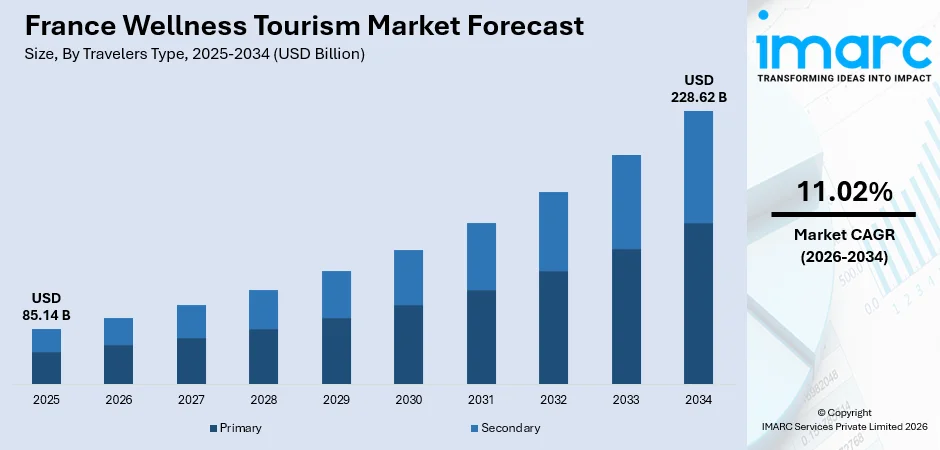
The France wellness tourism market size was valued at USD 85.14 Billion in 2025 and is projected to reach USD 228.62 Billion by 2034, growing at a compound annual growth rate of 11.02% from 2026-2034.
The France wellness tourism market is witnessing robust expansion, fueled by the country's centuries-old thermal spa heritage, increasing consumer preference for preventive health-focused travel, and a flourishing luxury hospitality ecosystem. Rising disposable incomes, growing awareness of holistic well-being, and the integration of innovative treatments such as thalassotherapy, vinotherapy, and personalized diagnostics into travel experiences are reinforcing demand. Expanding government support for sustainable tourism initiatives, coupled with strong international visitor inflows and a resilient domestic travel base, is further strengthening the France wellness tourism market share.
Key Takeaways and Insights:
- By Travelers Type: Primary dominates the market with a share of 61.4% in 2025, owing to increasing consumer preference for purpose-driven wellness vacations, rising demand for immersive spa retreats and holistic healing programs, and growing health consciousness among domestic and international travelers.
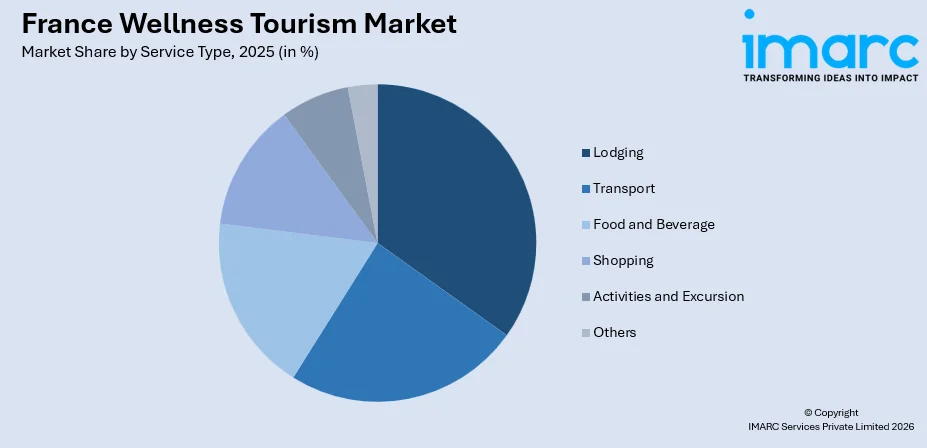
- By Service Type: Lodging leads the market with a share of 34.8% in 2025. This dominance is driven by the proliferation of luxury wellness-integrated hotels and resorts, expanding thalassotherapy and thermal spa accommodations along coastal and mountain regions, and rising traveler expectations for comprehensive in-house wellness amenities.
- By Location: Domestic represents the largest segment with a market share of 68.2% in 2025, reflecting strong preference among French residents for wellness-oriented staycations, supported by an extensive network of thermal spas, thalassotherapy centers, and wellness retreats accessible across diverse geographic regions throughout the country.
- By Region: Paris Region comprises the largest region with 32.6% share in 2025, driven by the concentration of luxury wellness hotels and world-class spas in the Île-de-France metropolitan area, robust international tourist inflows, and the capital's prominent position as a global hospitality and lifestyle destination.
- Key Players: The market is highly competitive, driven by luxury spa destinations, thermal springs, and holistic retreats. Domestic and international operators vie on service quality, unique experiences, and sustainability. Digital marketing, differentiated wellness packages, and regional branding are key to attracting health‑focused travelers.
To get more information on this market Request Sample
The France wellness tourism market is experiencing strong momentum as the country leverages its deep-rooted thermal heritage and world-renowned hospitality infrastructure to attract health-conscious travelers. A key factor underpinning this expansion is France's position as the world's most visited destination, which provides a vast pool of potential wellness tourists. In 2024, France welcomed over 100 million international visitors and generated a record EUR 71 Billion in international tourism revenue, representing a 12% increase over the preceding year, according to the French Ministry of Tourism. This unprecedented tourism inflow, combined with a robust domestic travel base, expanding luxury spa offerings, and growing consumer interest in preventive health and holistic rejuvenation, is creating a highly favorable environment for sustained wellness tourism growth.
France Wellness Tourism Market Trends:
Rising Integration of Personalized Wellness Diagnostics
France is witnessing a shift toward science-backed, personalized wellness programs that combine advanced diagnostics with traditional treatments. For instance, Cures Marines Hôtel and Spa Trouville, operating under the MGallery Collection, introduced programs that enrich thalassotherapy with advanced diagnostic tools to create individualized wellness plans incorporating care, sport, nutrition, and sleep. This approach reflects broader demand for evidence-based wellness experiences that deliver measurable health outcomes rather than generic relaxation, fueling France wellness tourism market growth.
Expansion of Urban Wellness Hospitality
Parisian and metropolitan wellness hospitality is expanding rapidly with new luxury spa hotels catering to wellness-focused urban travelers. For example, multiple new spa hotels opened in Paris in late 2024 and early 2025, including Hôtel Filigrane and Spa in the 2nd arrondissement and Maison Barrière Vendôme near Place Vendôme, both featuring dedicated wellness facilities with spas, saunas, and treatment rooms. This urban wellness boom is broadening access to premium wellness experiences beyond traditional coastal and mountain destinations.
Growing Appeal of Thalassotherapy and Vinotherapy Experiences
France's unique thalassotherapy and vinotherapy traditions continue to attract domestic and international wellness travelers seeking distinctive, region-specific treatments. The country operates more than 50 thalassotherapy centers along its Atlantic and Mediterranean coasts, welcoming visitors for seawater-based healing programs. Simultaneously, vinotherapy centers in Bordeaux and other wine regions offer innovative grape-based skincare treatments, combining wellness with cultural tourism and reinforcing France's differentiated position in the global wellness travel landscape.
Market Outlook 2026-2034:
The France wellness tourism market is poised for sustained expansion over the forecast period, driven by continuous investments in luxury wellness infrastructure, deepening integration of traditional thermal and thalassotherapy treatments with modern health technologies, and a growing base of health-conscious domestic and international travelers. As such, in September 2025, Six Senses launched a EUR 40 Million flagship resort in France’s Loire Valley, combining private residences with wellness innovation, luxury amenities, and immersive nature integration, reinforcing its European portfolio and expanding its global footprint in experiential, sustainable living. Similarly, the increasing preference for preventive health-oriented travel, the proliferation of boutique wellness retreats, and robust government emphasis on promoting sustainable tourism are expected to create new revenue streams. Additionally, expanding digital booking platforms, personalized wellness program offerings, and rising collaborations between hospitality brands and luxury health and beauty companies are anticipated to strengthen competitive positioning and accelerate market development. The market generated a revenue of USD 85.14 Billion in 2025 and is projected to reach a revenue of USD 228.62 Billion by 2034, growing at a compound annual growth rate of 11.02% from 2026-2034.
France Wellness Tourism Market Report Segmentation:
|
Segment Category |
Leading Segment |
Market Share |
|
Travelers Type |
Primary |
61.4% |
|
Service Type |
Lodging |
34.8% |
|
Location |
Domestic |
68.2% |
|
Region |
Paris Region |
32.6% |
Travelers Type Insights:
- Primary
- Secondary
Primary dominates with a market share of 61.4% of the total France wellness tourism market in 2025.
Primary wellness travelers, who undertake journeys specifically to pursue wellness activities as the main purpose of their trip, constitute the largest traveler segment in France. The country's deep-rooted heritage in thermal cures, thalassotherapy, and holistic healing attracts purpose-driven visitors seeking structured wellness programs. According to Atout France, the national tourism development agency, France ranks 3rd among the top wellness destinations globally owing to its longstanding tradition of water-based treatments, supporting robust demand from dedicated wellness seekers.
The growing preference among consumers for immersive, health-focused travel experiences over conventional leisure vacations is reinforcing the dominance of the primary traveler segment. France's network of spas, including doctor-prescribed thermal cures, coastal thalassotherapy retreats, and vineyard-based vinotherapy centers, provides a comprehensive ecosystem for primary wellness travelers. Rising awareness of preventive healthcare, mental well-being, and stress management is further encouraging travelers to choose France as a dedicated wellness destination, driving consistent growth in this segment.
Service Type Insights:
Access the comprehensive market breakdown Request Sample
- Transport
- Lodging
- Food and Beverage
- Shopping
- Activities and Excursion
- Others
Lodging leads with a share of 34.8% of the total France wellness tourism market in 2025.
Lodging represents the largest service segment in the France wellness tourism market, driven by the country's extensive portfolio of wellness-integrated accommodations ranging from luxury palace hotels and boutique spa resorts to thermal spa residences and coastal thalassotherapy hotels. The strong position of this segment is underpinned by the fact that accommodation-based wellness centers consistently achieve higher occupancy levels than conventional hotels.
The lodging segment continues to benefit from major investments by hospitality groups expanding wellness-focused accommodation offerings across France. In 2024, Accor, the largest hospitality company in Europe headquartered in France, expanded its global portfolio with the opening of 293 hotels and resorts, adding 50,000 rooms, with several properties featuring integrated wellness, spa, and thalassotherapy facilities. This aggressive expansion, combined with rising traveler expectations for comprehensive in-room and on-site wellness amenities, is reinforcing lodging as the cornerstone service category within the France wellness tourism ecosystem.
Location Insights:
- Domestic
- International
The domestic segment exhibits a clear dominance with a 68.2% share of the total France wellness tourism market in 2025.
Domestic wellness tourism forms the bedrock of the France wellness tourism market, reflecting the deeply ingrained French cultural tradition of seeking therapeutic and rejuvenation-focused travel within the country's own borders. French residents benefit from an extensive national infrastructure of thermal spas, thalassotherapy centers, and wellness retreats distributed across diverse geographic regions. From January to October 2024, domestic visitors accounted for 284.66 million overnight stays at tourist accommodation establishments in France, representing approximately 69.2% of the total nights spent, according to official tourism statistics.
The strong domestic preference for wellness-oriented staycations is further supported by France's national healthcare system, which partially covers prescribed three-week thermal cure programs at recognized thermal establishments. This unique integration of wellness tourism into the healthcare framework encourages millions of French residents to undertake therapeutic stays annually at destinations such as Vichy, Aix-les-Bains, and Évian-les-Bains. Rising awareness of mental health, stress management, and holistic well-being among younger demographics, combined with expanding short-stay wellness packages tailored for weekend retreats, is sustaining strong domestic demand.
Region Insights:
- Paris Region
- Auvergne-Rhône-Alpes
- Nouvelle-Aquitaine
- Hauts-de-France
- Occitanie
- Provence Alpes Côte d'Azur
- Grand Est
- Others
Paris Region represents the leading segment with a 32.6% share of the total France wellness tourism market in 2025.
The Paris Region dominates the France wellness tourism market, underpinned by its status as the world's most visited metropolitan area and its concentration of luxury wellness hotels, palace spas, and cutting-edge wellness facilities. The Île-de-France region welcomed over 47.5 million domestic and international tourists in 2023, with momentum accelerating further in 2024 due to the Olympic Games and the reopening of Notre-Dame. According to the French Ministry of Tourism, Paris hotel occupancy rates were expected to rise by seven points in January 2025, reflecting sustained post-event tourism demand.
The region's wellness tourism appeal is strengthened by a dense ecosystem of world-renowned luxury spa properties, including palace hotels along the Champs-Élysées and Place Vendôme featuring exclusive partnerships with premium beauty brands such as Dior, Sisley, and Valmont. The proliferation of new boutique wellness hotels in central Paris, offering dedicated spa facilities, swimming pools, hammams, and personalized treatment programs, is continuously expanding the region's wellness accommodation capacity and attracting both leisure and business travelers seeking rejuvenation in an urban setting.
Growth Drivers:
Why is the France Wellness Tourism Market Growing?
Record International Tourism Inflows Supporting Wellness Demand
France's position as the world's leading tourist destination is creating a substantial and growing base for wellness tourism. The country's ability to attract massive international visitor volumes provides a natural funnel for wellness-focused travel experiences. Industry report states that, France’s wellness tourism arrivals are dominated by European neighbors: the UK (13%), Germany (12%), and Belgium (10%). Other notable markets include the Netherlands (7%), Switzerland and Italy (6% each), Spain and the US (5%), with China (3%) and Japan (2%) contributing smaller shares. As international travelers increasingly seek purposeful travel experiences beyond traditional sightseeing, wellness-oriented offerings including spa treatments, thermal cures, and holistic retreat programs are capturing a growing share of tourism expenditure. The ongoing post-Olympic momentum and the global prestige of French hospitality are further reinforcing the country's attractiveness as a premier wellness destination.
Deep-Rooted Thermal and Thalassotherapy Heritage
France's unparalleled infrastructure of thermal spas and thalassotherapy centers provides a distinctive competitive advantage in the global wellness tourism landscape. The country's centuries-old tradition of water-based treatments, recognized by UNESCO through the inscription of Vichy among the Great Spa Towns of Europe, creates a strong foundation for both medical wellness and leisure wellness tourism. This extensive therapeutic infrastructure, combined with the French healthcare system's provision for partially reimbursed three-week thermal cure programs, ensures a consistent baseline of wellness travelers. The ongoing modernization of thermal establishments and the introduction of shorter, more flexible wellness packages are expanding the market beyond traditional medical cure patients to attract a broader, younger, and more lifestyle-oriented consumer demographic.
Expanding Luxury Wellness Hospitality Investment
Significant capital investment in luxury wellness-focused hospitality properties is strengthening France's wellness tourism infrastructure and elevating the quality of guest experiences. Major hospitality groups are actively integrating comprehensive wellness facilities into their properties, reflecting the growing importance of wellness amenities as a key differentiator in the premium accommodation segment. For example, in September 2024, Évian Resort's Hôtel Royal completed the transformation of its spa into the exclusive 1,700-square-meter evian SPA, the only one of its kind in Europe, designed by interior architect François Champsaur as a wellness sanctuary inspired by the life cycle of Évian mineral water. This investment trend extends across the country, with new wellness-integrated boutique hotels and luxury properties opening in Paris, the French Riviera, and Normandy. The growing emphasis on experiential wellness, combining treatments with gastronomy, cultural immersion, and outdoor activities, is attracting high-spending travelers and generating higher revenue per guest, thereby strengthening the economic contribution of wellness tourism.
Market Restraints:
What Challenges the France Wellness Tourism Market is Facing?
Pronounced Seasonal Demand Fluctuations
The France wellness tourism market faces significant seasonal demand variations, with coastal thalassotherapy centers and mountain thermal resorts experiencing peak occupancy during summer and winter holiday periods while remaining underutilized during shoulder seasons. This seasonality creates uneven cash flows, higher per-guest operational overheads, and challenges in retaining qualified wellness practitioners year-round. Although tourism boards are encouraging off-season events and wellness conferences, smoothing occupancy across all periods remains a persistent structural challenge.
Intense Competition from Neighboring European Destinations
France encounters growing competitive pressure from other European wellness tourism markets, particularly Spain, Italy, Germany, and Nordic countries, which are rapidly expanding their wellness offerings. Spain's sharp rise in international tourists, combined with competitive pricing and growing investment in wellness resort infrastructure along the Mediterranean coast, poses a direct challenge to France's market positioning. The emergence of specialized wellness destinations in Eastern Europe offering lower-cost alternatives further intensifies competitive dynamics across the continent.
Revenue Optimization Challenges Despite High Visitor Volumes
Despite attracting the highest number of international tourists globally, France faces difficulties in converting visitor volumes into proportionally high wellness tourism revenue. The average tourist expenditure in France remains lower compared to key competitors, partly attributed to shorter average stays and the country's frequent use as a transit destination within broader European itineraries. Improving the depth and duration of wellness-focused stays, enhancing the premium service experience, and developing targeted offerings for high-spending wellness travelers remain critical areas requiring strategic attention.
Competitive Landscape:
The France wellness tourism market is characterized by a diverse and intensely competitive landscape comprising international hospitality groups, specialized wellness resort operators, thermal spa establishments, and boutique retreat providers. Competition is driven by the quality of wellness offerings, integration of innovative treatment technologies, brand reputation, and the ability to deliver personalized guest experiences. Major hospitality chains are continuously expanding their wellness portfolios through acquisitions, brand partnerships with luxury beauty and health companies, and the development of signature spa concepts. Simultaneously, independent thermal establishments and thalassotherapy operators are differentiating through authentic heritage-based programs, regional specialization, and government-accredited therapeutic services, contributing to a highly dynamic competitive environment.
Recent Developments:
- In February 2026, Château De Fiac by The Pavilions Hotels & Resorts launched luxury wellness experiences in France’s Tarn region. Featuring REVĪVŌ Spa, yoga, meditation, and holistic treatments, the boutique hotel hosts immersive events for couples, families, and solo travelers, combining relaxation, cultural heritage, and rejuvenation in serene surroundings.
- In January 2026, Novotel launched “Longevity Everyday,” a global wellness initiative across 600+ hotels in 67 countries. Focusing on Quiet Wellbeing, it promotes sustainable, incremental health practices, mindful movement, nutritious meals, meditation, and better sleep, making longevity accessible to everyday travelers amid rising wellness tourism and lifestyle-focused demand.
France Wellness Tourism Market Report Coverage:
|
Report Features |
Details |
|
Base Year of the Analysis |
2025 |
|
Historical Period |
2020-2025 |
|
Forecast Period |
2026-2034 |
|
Units |
Billion USD |
|
Scope of the Report |
Exploration of Historical Trends and Market Outlook, Industry Catalysts and Challenges, Segment-Wise Historical and Future Market Assessment:
|
|
Travelers Types Covered |
Primary, Secondary |
|
Service Types Covered |
Transport, Lodging, Food and Beverage, Shopping, Activities and Excursion, Others |
|
Locations Covered |
Domestic, International |
|
Regions Covered |
Paris Region, Auvergne-Rhône-Alpes, Nouvelle-Aquitaine, Hauts-de-France, Occitanie, Provence Alpes Côte d'Azur, Grand Est, Others |
|
Customization Scope |
10% Free Customization |
|
Post-Sale Analyst Support |
10-12 Weeks |
|
Delivery Format |
PDF and Excel through Email (We can also provide the editable version of the report in PPT/Word format on special request) |
Frequently Asked Questions About the France Wellness Tourism Market Report
The France wellness tourism market size was valued at USD 85.14 Billion in 2025.
The France wellness tourism market is expected to grow at a compound annual growth rate of 11.02% from 2026-2034 to reach USD 228.62 Billion by 2034.
Primary dominated the market with a share of 61.4%, driven by increasing consumer preference for purpose-driven wellness vacations, rising demand for immersive spa and thermal cure programs, and growing health consciousness among domestic and international travelers.
Key factors driving the France wellness tourism market include record international tourism inflows, deep-rooted thermal and thalassotherapy heritage, expanding luxury wellness hospitality investments, and growing consumer preference for preventive and holistic health experiences.
Major challenges include pronounced seasonal demand fluctuations affecting coastal and mountain wellness facilities, intense competition from neighboring European wellness destinations, revenue optimization difficulties despite high visitor volumes, and infrastructure capacity constraints in peak tourism areas.
Need more help?
- Speak to our experienced analysts for insights on the current market scenarios.
- Include additional segments and countries to customize the report as per your requirement.
- Gain an unparalleled competitive advantage in your domain by understanding how to utilize the report and positively impacting your operations and revenue.
- For further assistance, please connect with our analysts.
 Request Customization
 Speak to an Analyst
 Request Brochure
 Inquire Before Buying
Benefits of Customization
- Personalize this research
- Triangulate with your data
- Get data as per your format and definition
- Gain a deeper dive into a specific application, geography, customer, or competitor
- Any level of personalization
Get in Touch With Us
UNITED STATES
Phone: +1-201-971-6302
INDIA
Phone: +91-120-433-0800
UNITED KINGDOM
Phone: +44-753-714-6104
Email: [email protected]
Client Testimonials




.webp)




.webp)













Related Reports

Choose your plan
*Please note that the prices mentioned below are starting prices for each bundle type. Kindly contact our team for further details.*
Single User License
- 1 User License, Access on 2 Devices
- PDF Report + Excel Dataset (Password Protected)
- Lifetime Access
- No Printing Rights
- 10% Free Report Customization
- 10–12 Weeks of Analyst Support
Five User License
- Access for 5 Users, 2 Devices per User
- PDF Report + Excel Dataset (Password Protected)
- Lifetime Access
- Dedicated Account Manager
- 12–14 Weeks of Analyst Support
- No Printing Rights
- 15% Free Report Customization
- 25% Discount on Your Next Purchase
Corporate User License
- Unlimited User Access (Within Your Organization)
- PDF Report + Excel Dataset
- Lifetime Access
- Dedicated Account Manager
- 14–20 Weeks of Analyst Support
- No Printing Rights
- 20% Free Report Customization
- 30% Discount on Your Next Purchase
Essential Insights
What's included:
3 reports
- Lifetime Access
- PDF Reports
- Excel Datasets
- 2 Weeks of Free Analyst Support
- 2 User Licenses
- Access on 2 Devices
- Printing Rights
- Complimentary PowerPoint (PPT) Version
- Complimentary License Upgrade
Professional Access
What's included:
5 reports
- Lifetime Access
- PDF Reports
- Excel Datasets
- 8 Weeks of Free Analyst Support
- 2 User Licenses
- Access on 2 Devices
- Printing Rights
- Complimentary PowerPoint (PPT) Version
- Complimentary License Upgrade
Business Advantage
What's included:
8 reports
- Lifetime Access
- PDF Reports
- Excel Datasets
- 14 Weeks of Free Analyst Support
- 2 User Licenses
- Access on 2 Devices
- Printing Rights
- Complimentary PowerPoint (PPT) Version
- Complimentary License Upgrade
Enterprise Intelligence
What's included:
10 reports
- Lifetime Access
- PDF Reports
- Excel Datasets
- 20 Weeks of Free Analyst Support
- 2 User Licenses
- Access on 2 Devices
- Printing Rights
- Complimentary PowerPoint (PPT) Version
- Complimentary License Upgrade