
GCC Fruit Juice Market Size, Share, Trends and Forecast by Product Type, Flavor, Packaging Type, Distribution Channel, and Country, 2026-2034
GCC Fruit Juice Market Size, Share, Trends & Forecast (2026-2034)
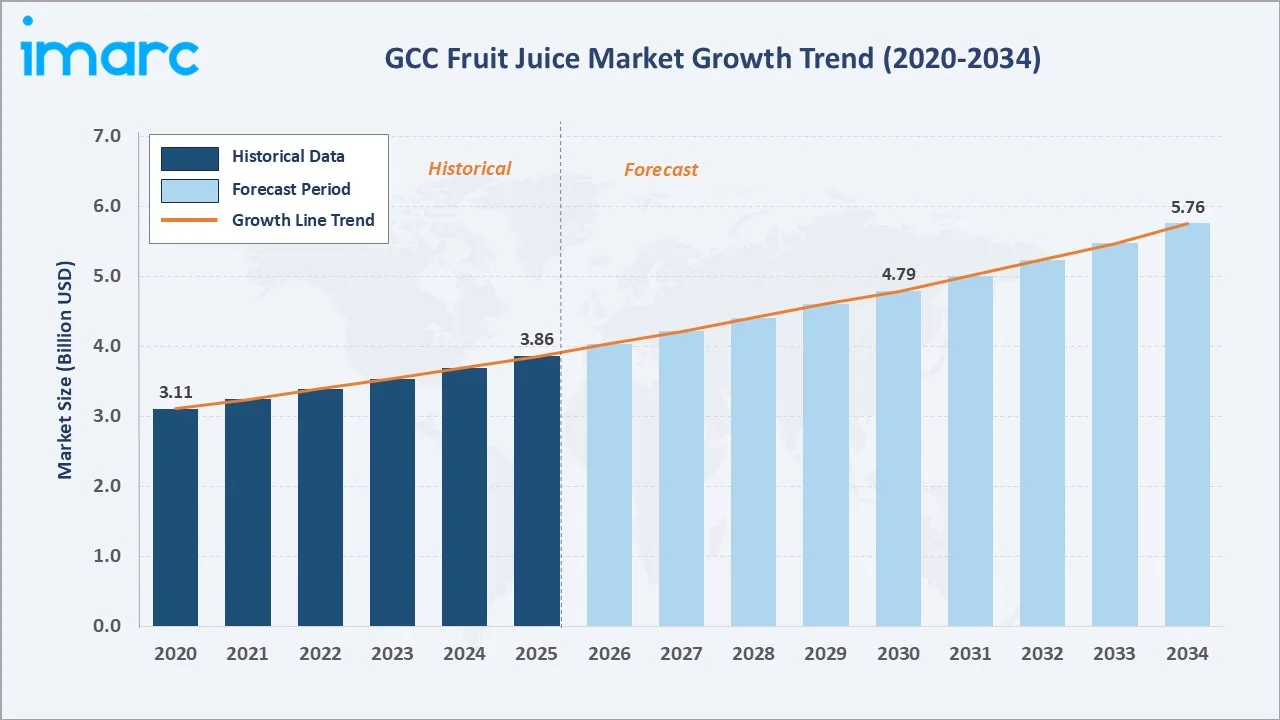
The GCC fruit juice market size increased from USD 3.86 Billion in 2025 to USD 4.07 Billion in 2026 and is projected to reach USD 5.76 Billion by 2034, growing at a CAGR of 4.42% during 2026-2034. Market growth is driven by rising health consciousness among GCC consumers, strong expatriate population demand, and proactive government food safety frameworks. Juice drinks lead product type with 34.8% share, while orange flavor dominates at 31.5%. Saudi Arabia commands 39.8% of the regional market, anchoring the GCC's largest consumer base.
Market Snapshot
|
Metric |
Value |
|
Base Year Market Size (2025) |
USD 3.86 Billion |
| Market Size (2026) | USD 4.07 Billion |
|
Forecast Market Size (2034) |
USD 5.76 Billion |
|
CAGR (2026-2034) |
4.42% |
|
Largest Country |
Saudi Arabia (39.8%, 2025) |
|
Largest Product Type |
Juice Drinks (34.8%, 2025) |
|
Leading Flavor |
Orange (31.5%, 2025) |
The market expanded from USD 3.11 Billion in 2020 to USD 3.86 Billion in 2025 and an estimated USD 4.07 Billion in 2026, anchored at USD 4.79 Billion in 2030, and forecast to reach USD 5.76 Billion by 2034. Sustained urbanization, a fast-growing young population across all six GCC nations, and deepening modern retail penetration created a compounding growth cycle. The shift toward healthier, low-sugar beverages is fundamentally reshaping product innovation across the region.
To get more information on this market, Request Sample
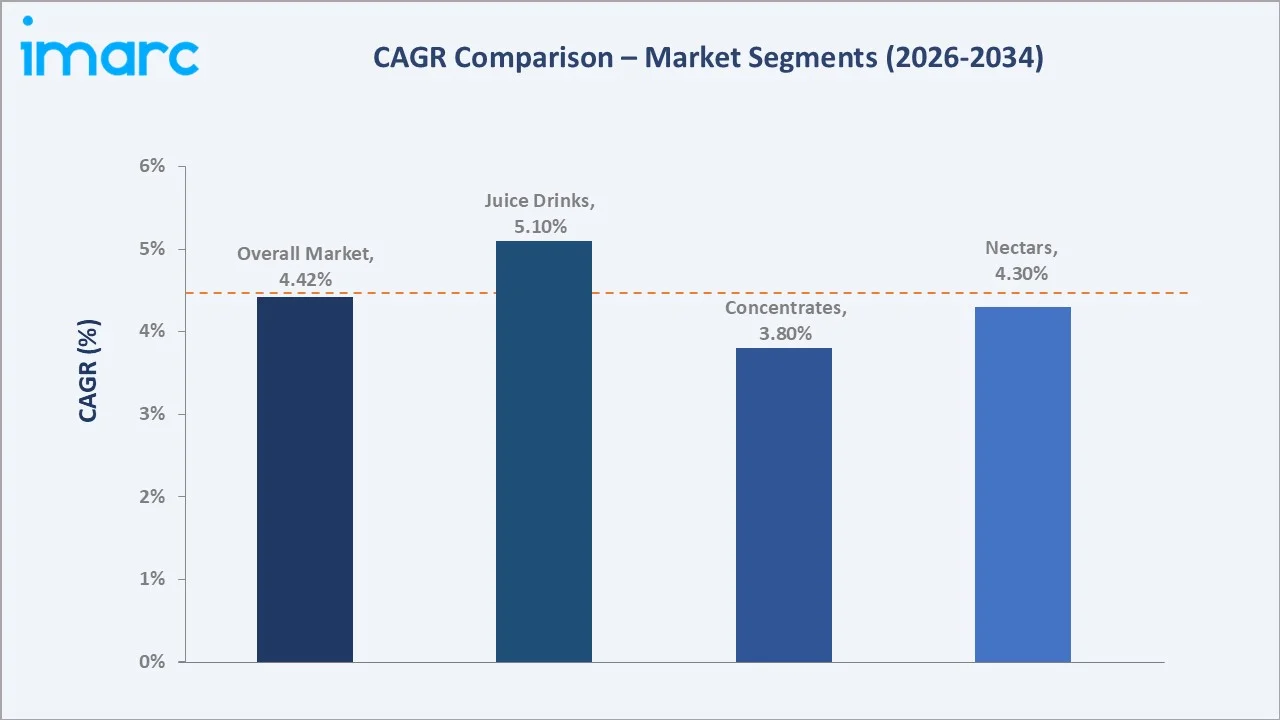
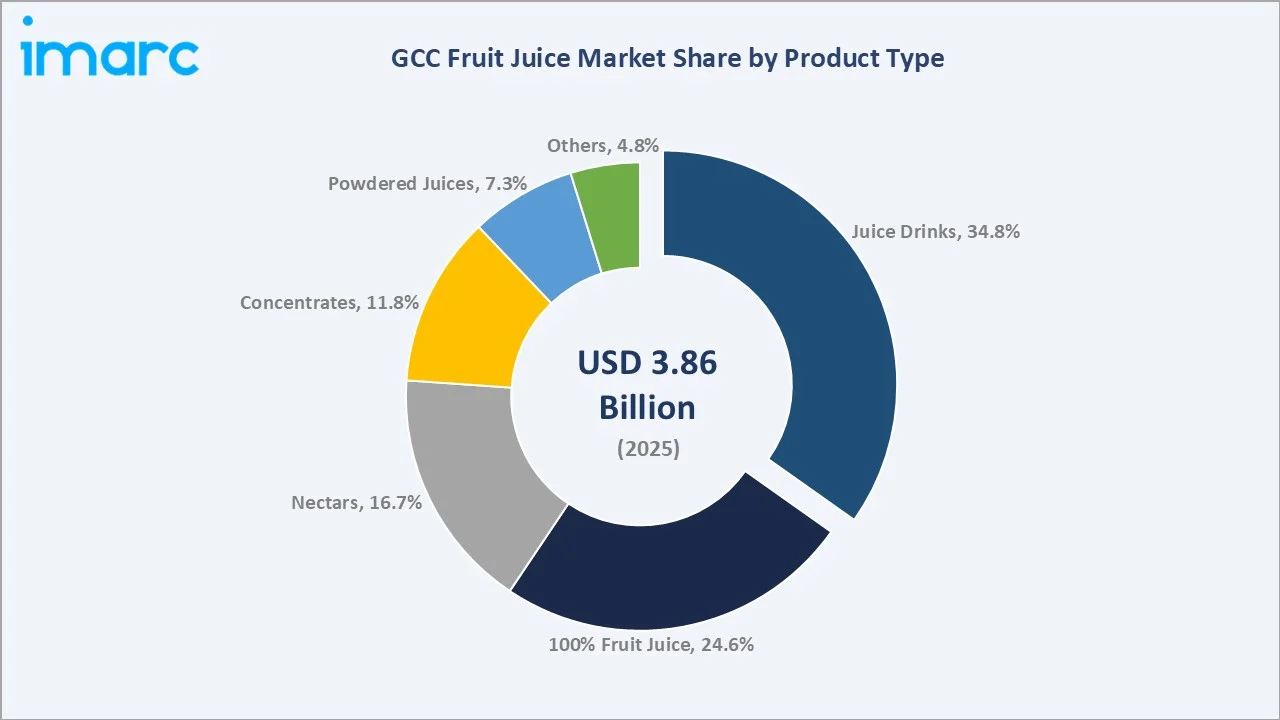
Juice drinks grow steadily, supported by affordability and wide availability. 100% Fruit Juice is gaining traction as consumers shift toward natural, preservative-free options. Nectars and Concentrates cater to foodservice and industrial channels, while Powdered Juice remains relevant in price-sensitive markets.
Executive Summary
The GCC fruit juice market, which increased from USD 3.86 Billion in 2025 to an estimated USD 4.07 Billion in 2026, representing one of the most dynamic beverage segments in the Middle East. All six GCC nations, Saudi Arabia, the UAE, Qatar, Oman, Kuwait, and Bahrain - are witnessing accelerating demand driven by urbanization, rising disposable incomes, and health-aware consumer lifestyles. Saudi Arabia's Vision 2030 has catalyzed broader food and beverage sector investments, indirectly supporting modern retail infrastructure that benefits fruit juice distribution.
Juice Drinks command 34.8% market share (2025), anchored by their competitive price points and high availability across hypermarkets and convenience stores. Orange leads at 31.5% by flavor, leveraging universal consumer preference across all age groups. Saudi Arabia retains 39.8% leadership by country, while the UAE at 28.4% serves as the GCC's premium beverage innovation hub.
The market is projected to reach USD 5.76 Billion by 2034 at a 4.42% CAGR, driven by product premiumization, clean-label launches, e-commerce channel growth, and rising demand for fortified and functional juice variants. The market's anchor value of USD 4.79 Billion in 2030 reflects successful penetration into smaller GCC markets and continued consumer upgrading.
Key Market Insights
|
Insight |
Data |
|
Largest Product Type |
Juice Drinks - 34.8% share (2025) |
|
Leading Flavor |
Orange - 31.5% share (2025) |
|
Dominant Country |
Saudi Arabia - 39.8% market share (2025) |
|
Market Opportunity |
Functional & fortified juice, e-commerce channel expansion |
|
Top Companies |
Almarai Company, Al Rabie Saudi Foods Co., and Dole plc. |
Key Analytical Observations Supporting The Above Data:
- Juice drinks at 34.8% (2025), driven by affordability and retail penetration: GCC hypermarkets and convenience stores stock an extensive range of juice drink SKUs. The category benefits from competitive price points compared to 100% juices, making it the go-to choice for everyday consumption across the region.
- Orange flavor leads at 31.5%: Orange juice remains the most universally consumed flavor across all GCC demographics. Its established association with breakfast nutrition and Vitamin C content positions it as a staple purchase. The Saudi Food and Drug Authority (SFDA) has actively promoted micronutrient-fortified beverages, further boosting orange juice consumption.
- Saudi Arabia at 39.8% driven by population scale and modern retail expansion: Saudi Arabia's General Authority for Statistics (GASTAT) reported the country's population exceeded 35 million in 2024, with a young median age driving strong per-capita beverage consumption.
- 100% Fruit Juice is the fastest-growing sub-segment: Consumer shift toward clean-label, no-added-sugar products is accelerating 100% juice demand. The UAE and Qatar lead adoption, with premium retail channels dedicating increasing shelf space to natural juice variants.
- E-commerce is an emerging growth channel: GCC e-commerce food and beverage sales have surged post-2020. Online grocery platforms such as Noon and Talabat Mart are expanding fruit juice assortments, enabling direct-to-consumer sales with subscription-based delivery models.
GCC Fruit Juice Market Overview
The GCC fruit juice market encompasses ready-to-drink (RTD) juices, nectars, juice drinks, concentrates, and powdered juice formats sold across Saudi Arabia, the UAE, Qatar, Oman, Kuwait, and Bahrain. Products serve both retail consumers and the foodservice sector, including hotels, restaurants, airlines, and institutional catering. Applications span breakfast beverage occasions, health and wellness consumption, and hospitality service.
The market operates under robust food safety regulatory frameworks administered by the Saudi Food and Drug Authority (SFDA), the UAE's Ministry of Climate Change and Environment (MOCCAE), and equivalent national bodies. Macroeconomic drivers include strong population growth, high smartphone penetration enabling e-commerce purchasing, sustained government investment in modern retail infrastructure under Vision 2030, and a large, beverage-consuming expatriate population across all six GCC states.
Market Dynamics
To evaluate market opportunities, Request Sample
Market Drivers
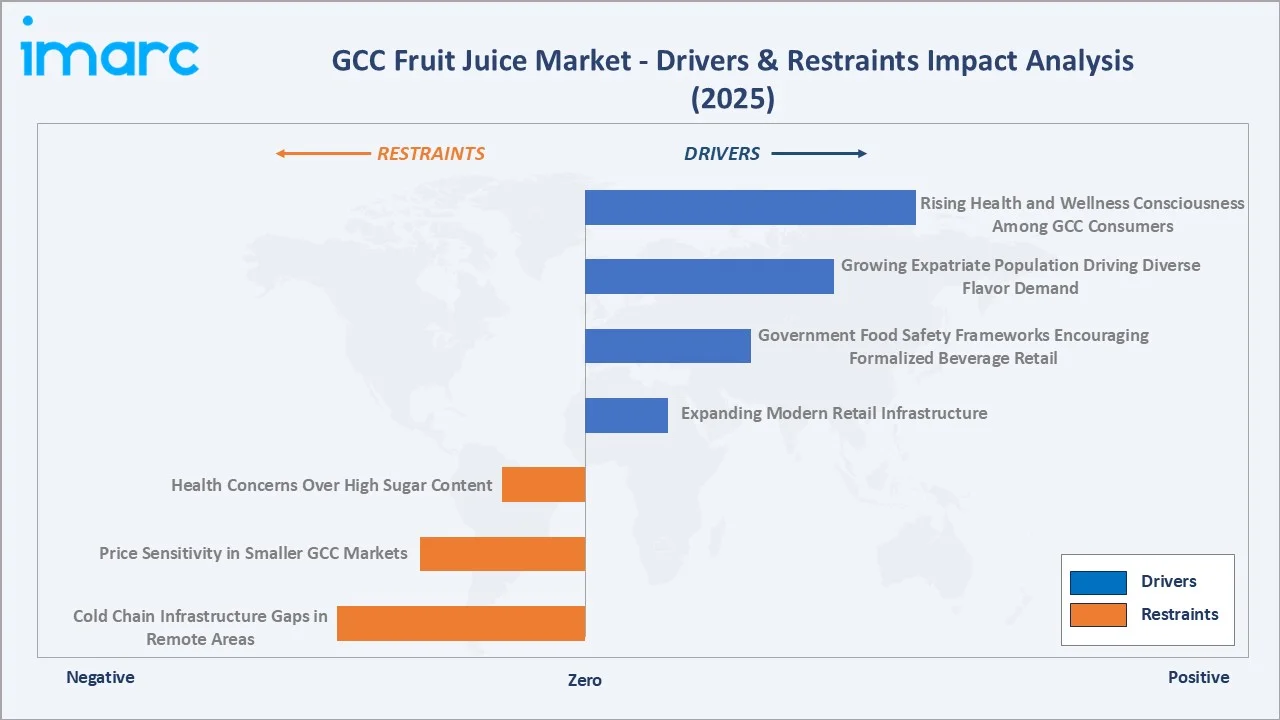
- Rising Health and Wellness Consciousness Among GCC Consumers: Health awareness is reshaping beverage choices across the GCC. The region's high prevalence of lifestyle diseases, diabetes affects approximately 23% of the adult population in Saudi Arabia according to the International Diabetes Federation, has propelled demand for natural, low-sugar, and fortified juice products.
- Growing Expatriate Population Driving Diverse Flavor Demand: The GCC hosts over 20 million expatriate workers, many from fruit-juice-consuming cultures in South Asia, Southeast Asia, and Europe. This demographic diversity sustains demand for mango, tropical, and citrus variants beyond the conventional orange flavor.
- Government Food Safety Frameworks Encouraging Formalized Beverage Retail: Regulatory initiatives by the SFDA and the UAE MOCCAE have promoted standardized, labeled, and certified fruit juice products, displacing informal market alternatives and channeling consumption toward established brands.
- Expanding Modern Retail Infrastructure: Saudi Arabia's Vision 2030 program has spurred investment in hypermarkets, supermarkets, and convenience store networks. The Kingdom's retail sector expansion provides fruit juice manufacturers with superior distribution reach and promotional shelf space.
Market Restraints
- Health Concerns Over High Sugar Content: Despite overall market growth, consumer concern over added sugar in juice drinks and nectars is constraining volume sales. GCC health ministries have introduced front-of-pack labeling requirements highlighting sugar content, increasing consumer price sensitivity in some sub-segments.
- Price Sensitivity in Smaller GCC Markets: Oman, Bahrain, and Kuwait demonstrate higher price sensitivity relative to Saudi Arabia and the UAE. Premium 100% juice variants face slower penetration in these markets, where juice drinks and powdered formats remain dominant.
- Cold Chain Infrastructure Gaps in Remote Areas: Fresh and chilled juice distribution requires robust cold chain logistics. Infrastructure gaps in certain remote regions of Saudi Arabia and Oman constrain the market for premium chilled juice products outside major urban centers.
Market Opportunities
- Functional and Fortified Juice Innovation: GCC consumers increasingly seek beverages with added health benefits beyond basic nutrition. Vitamin C, D, zinc, and probiotic-enriched juice variants represent a significant product innovation opportunity, particularly in the UAE and Qatar premium segments.
- E-Commerce and Direct-to-Consumer Channels: Online grocery and food delivery platforms are expanding fruit juice assortments rapidly. Subscription-based fresh juice delivery and online-exclusive bundle offers represent a high-growth channel with improving last-mile delivery infrastructure.
Market Challenges
- Intense Competition from Alternative Beverages: Energy drinks, flavored water, and plant-based drinks compete directly with fruit juices for health-conscious GCC consumer spending. The RTD tea and coconut water segments are growing rapidly, diverting consumption away from traditional fruit juices.
- Raw Material Price Volatility: Global fruit commodity price fluctuations, particularly for orange and mango concentrate impact production costs and manufacturer margins. Supply disruptions from major producing countries introduce cost uncertainty for GCC juice manufacturers relying on imported concentrates.
Emerging Market Trends
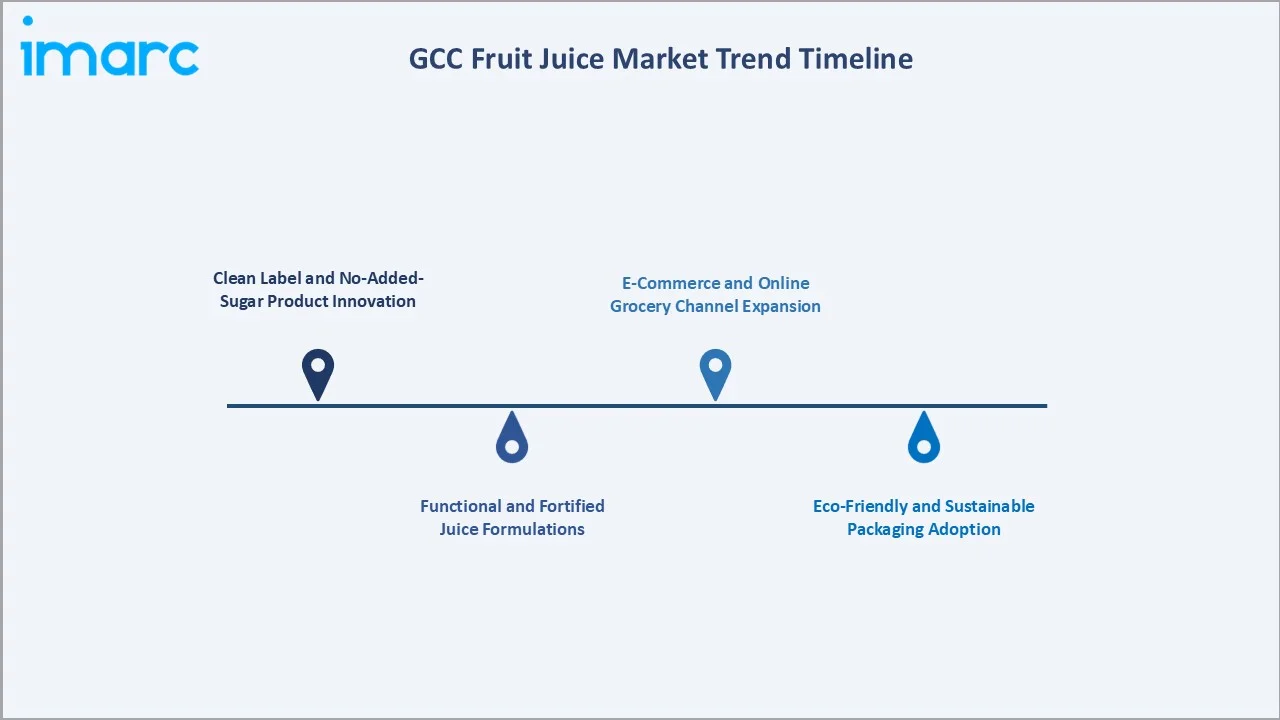
1. Clean Label and No-Added-Sugar Product Innovation
GCC consumers are increasingly reading ingredient labels, with awareness of artificial preservatives and added sugars rising significantly post-2022. Manufacturers are launching clean-label, 100% natural juice variants with no preservatives, artificial colors, or added sugars. The UAE's food retail sector saw a 24% increase in clean-label beverage SKUs between 2023 and 2025, reflecting strong market traction for this trend.
2. Functional and Fortified Juice Formulations
Fortified juices enriched with vitamins, minerals, and functional ingredients are gaining market share in premium GCC retail channels. The Saudi Food and Drug Authority has published fortification guidelines encouraging micronutrient enhancement in beverages, supporting manufacturer investment in this product tier. Probiotic juice blends and collagen-infused variants are emerging in the UAE specialty health food retailers.
3. E-Commerce and Online Grocery Channel Expansion
Online grocery platforms including Noon Grocery, Carrefour Online, and Talabat Mart have significantly expanded fruit juice assortments since 2021. Subscription delivery models, enabling weekly or monthly automated juice deliveries, are growing rapidly. E-commerce's share of GCC food and beverage retail is forecast to grow further through the 2026-2034 period, with fruit juice benefiting from bundled health basket purchasing behavior.
4. Eco-Friendly and Sustainable Packaging Adoption
GCC governments are progressively tightening plastic packaging regulations. Saudi Arabia's National Environmental Strategy is driving adoption of recyclable Tetra Pak cartons, biodegradable bottles, and refillable concentrate formats. Sustainable packaging is increasingly a purchasing criterion for the UAE and Qatar premium retail consumers.
5. Local Flavor and Regional Variety Innovation
Manufacturers are introducing GCC-specific and Middle Eastern flavor variants, including pomegranate, lemon-mint, and tamarind blends, that resonate with local cultural preferences and Ramadan season consumption occasions. Almarai Company and Al Rabie Saudi Foods have both expanded regionally-inspired SKUs, capturing incremental market share from international juice brands.
Industry Value Chain Analysis
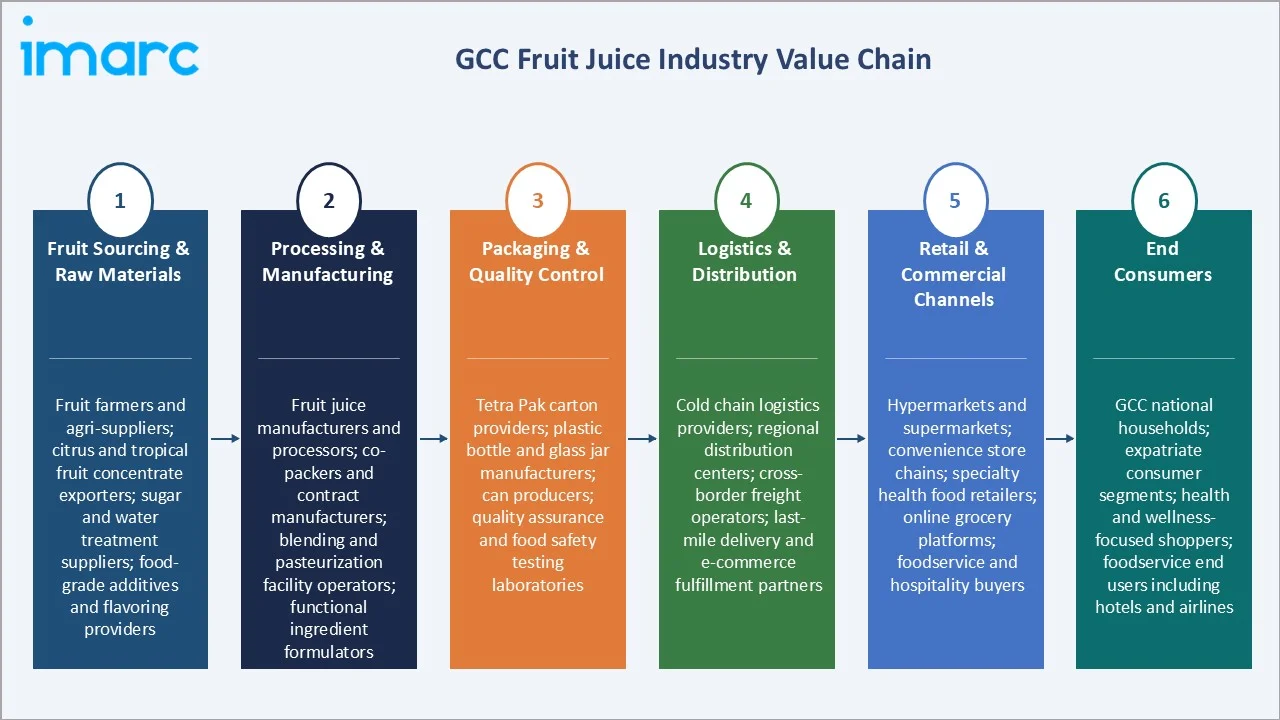
The GCC fruit juice value chain integrates global raw material sourcing through local manufacturing, quality assurance, and modern retail delivery to serve the region's diverse consumers. Each stage adds measurable value, with manufacturers capturing the highest margin layer through processing and brand premiumization.
|
Stage |
Key Participants |
|
Fruit Sourcing & Raw Materials |
Fruit farmers and agri-suppliers; citrus and tropical fruit concentrate exporters; sugar and water treatment suppliers; food-grade additives and flavoring providers |
|
Processing & Manufacturing |
Fruit juice manufacturers and processors; co-packers and contract manufacturers; blending and pasteurization facility operators; functional ingredient formulators |
|
Packaging & Quality Control |
Tetra Pak carton providers; plastic bottle and glass jar manufacturers; can producers; quality assurance and food safety testing laboratories |
|
Logistics & Distribution |
Cold chain logistics providers; regional distribution centers; cross-border freight operators; last-mile delivery and e-commerce fulfillment partners |
|
Retail & Commercial Channels |
Hypermarkets and supermarkets; convenience store chains; specialty health food retailers; online grocery platforms; foodservice and hospitality buyers |
|
End Consumers |
GCC national households; expatriate consumer segments; health and wellness-focused shoppers; foodservice end users including hotels and airlines |
Local manufacturers leverage imported fruit concentrates, primarily from Brazil (orange), Thailand (mango), and Turkey (mixed fruit), and blend, pasteurize, and package within GCC facilities to meet regional halal certification and SFDA standards. The retail layer is dominated by Saudi Arabia's large hypermarket chains, the UAE premium supermarkets, and GCC-wide convenience store networks, with e-commerce platforms emerging as a high-growth distribution complement.
Technology Landscape in the GCC Fruit Juice Industry
Advanced Cold-Press and HPP (High-Pressure Processing) Technology
High-Pressure Processing (HPP) technology is being adopted by premium GCC juice brands to extend shelf life without heat treatment, preserving natural nutrients and flavors. The UAE-based premium juice brands have introduced HPP-processed products in 2024-2025, commanding a 25-35% price premium over conventional pasteurized juices. HPP eliminates the need for preservatives, directly aligning with the clean-label trend.
Aseptic Packaging and Extended Shelf-Life (ESL) Technology
Tetra Pak's aseptic filling technology dominates GCC fruit juice packaging, enabling ambient storage without preservatives. Advanced aseptic lines allow production of ESL juices with 12-18 month shelf lives, supporting GCC retailers' supply chain requirements. Tetra Pak's GCC market presence spans all six countries, with major investments in customer partnership programs for local juice manufacturers.
Smart Packaging and Traceability Solutions
QR code-enabled packaging and blockchain-based supply chain traceability are emerging in GCC premium juice segments, particularly in the UAE and Qatar. Smart labels provide consumers with source verification, nutritional content details, and batch tracking. Saudi Arabia's SFDA has introduced digital traceability mandates for food products, accelerating manufacturer adoption of smart packaging technology across the broader GCC market.
Market Segmentation Analysis
The report covers the following segments:
|
Segment Category |
Leading Segment |
Market Share |
Year |
|
Product Type |
Juice Drinks |
34.8% |
2025 |
|
Flavor |
Orange |
31.5% |
2025 |
|
Packaging Type |
Tetra Pack |
🔒 |
2025 |
|
Distribution Channel |
Supermarkets and Hypermarkets |
🔒 |
2025 |
|
Country |
Saudi Arabia |
39.8% |
2025 |

By Product Type
Juice drinks lead at 34.8% market share (2025). GCC juice drink formulations combine fruit juice content with water, sweeteners, and flavorings, offering affordable price points that drive high volume sales through hypermarkets and convenience stores. The segment grows steadily, supported by broad consumer accessibility and the preference for sweetened, flavored beverages in the GCC cultural context.
To access detailed market analysis, Request Sample
100% fruit juice at 24.6% is the fastest-evolving premium sub-segment. Health-driven demand and clean-label consumer preference are driving manufacturers to expand natural, NFC (not-from-concentrate) product lines. Nectars at 16.7% serve consumers seeking fruit-forward beverages with some added sweetness, positioned between 100% juices and juice drinks. Concentrates at 11.8% serve foodservice and institutional buyers. Powdered juice at 7.3% remains popular in price-sensitive and remote market segments across Oman and Kuwait.
By Flavor
Orange leads at 31.5% flavor share (2025). Orange juice's universal appeal, association with morning nutrition, and established retail presence make it the foundational fruit juice flavor across all GCC markets. Almarai Company's orange juice range is among the best-selling beverage SKUs in Saudi Arabia's organized retail sector.
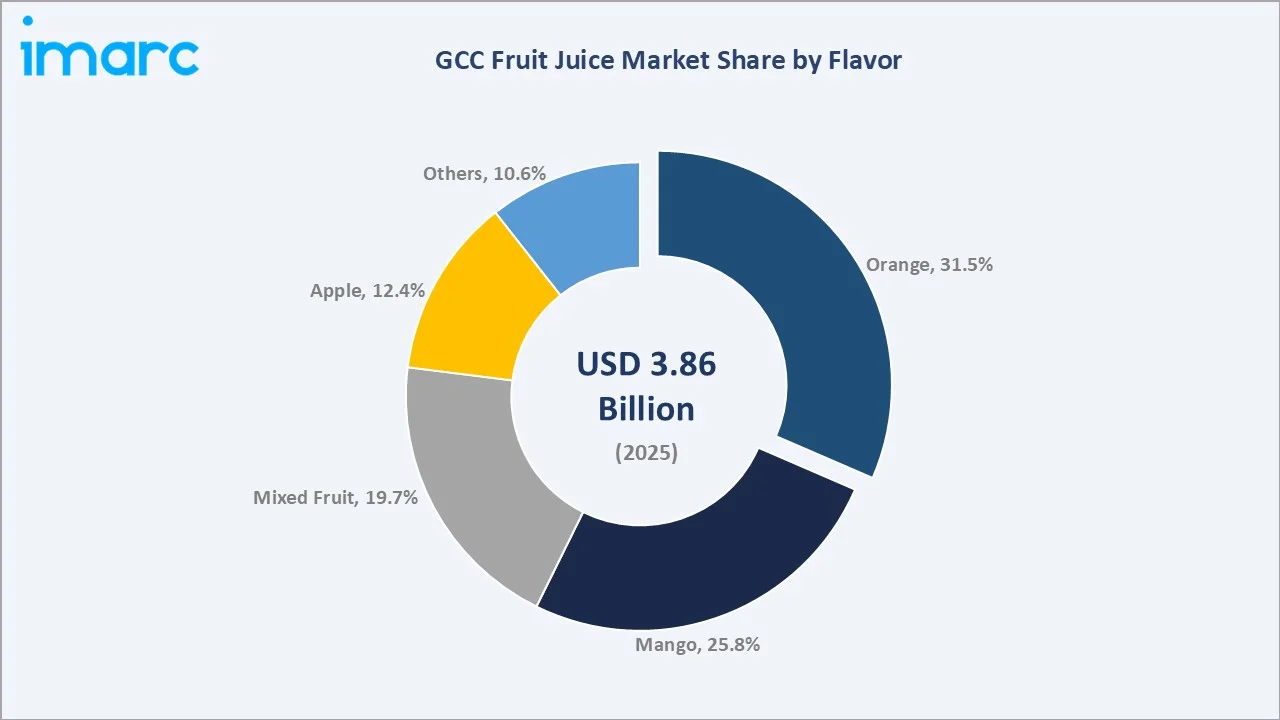
Mango at 25.8% reflects the strong South and Southeast Asian expatriate influence in GCC consumer preferences. The UAE and Qatar, with large expatriate populations from mango-consuming cultures, are the primary drivers of mango flavor demand. Mixed fruit at 19.7% appeals broadly to family purchase occasions. Apple at 12.4% serves health-conscious consumers seeking lower-calorie, mildly sweet juice options.
Regional Market Insights
|
Country |
Share (2025) |
Key Growth Drivers & Characteristics |
|
Saudi Arabia |
39.8% |
Largest GCC population, expansive modern retail network, rising health awareness, Vision 2030 food sector investment, and strong Almarai and Al Rabie brand presence |
|
UAE |
28.4% |
Premium beverage market leadership, high expatriate population diversity, robust e-commerce penetration, and the UAE's role as GCC's food innovation and import hub |
|
Kuwait |
9.7% |
High per-capita income, consumer preference for premium juice variants, and strong convenience store and hypermarket distribution networks |
|
Oman |
8.5% |
Growing modern retail expansion, rising health consciousness, and government investment in food sector infrastructure under Vision 2040 |
|
Qatar |
8.0% |
High household income levels, premium retail channel strength, World Cup 2022 legacy hospitality infrastructure, and diverse expatriate consumer base |
|
Bahrain |
5.6% |
Small but affluent consumer market, tourism-linked hospitality demand, and strong modern retail penetration relative to population size |
Saudi Arabia's 39.8% dominance reflects the combination of the GCC's largest population, highest food and beverage retail investment, and the market presence of regional juice champions including Almarai Company and Al Rabie Saudi Foods. GASTAT's 2024 household expenditure data confirmed that food and beverages represent the largest consumer spending category, reinforcing the structural demand base for fruit juices.
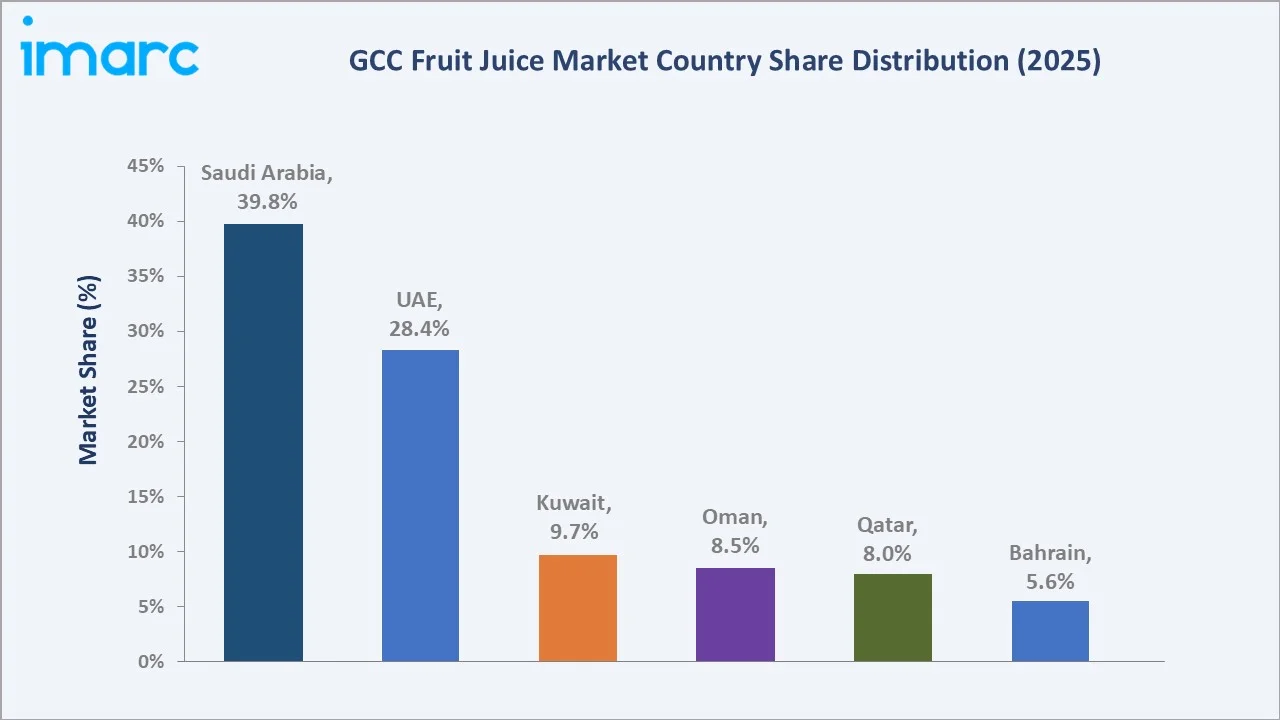
The UAE's 28.4% share is anchored by its role as the GCC's premium product testbed and import gateway. Dubai's cosmopolitan consumer base demands diverse flavors and premium formulations, driving earlier adoption of functional juices and HPP-processed variants. Kuwait's 9.7% reflects high per-capita consumption supported by affluent household income levels and strong retail infrastructure.
Competitive Landscape
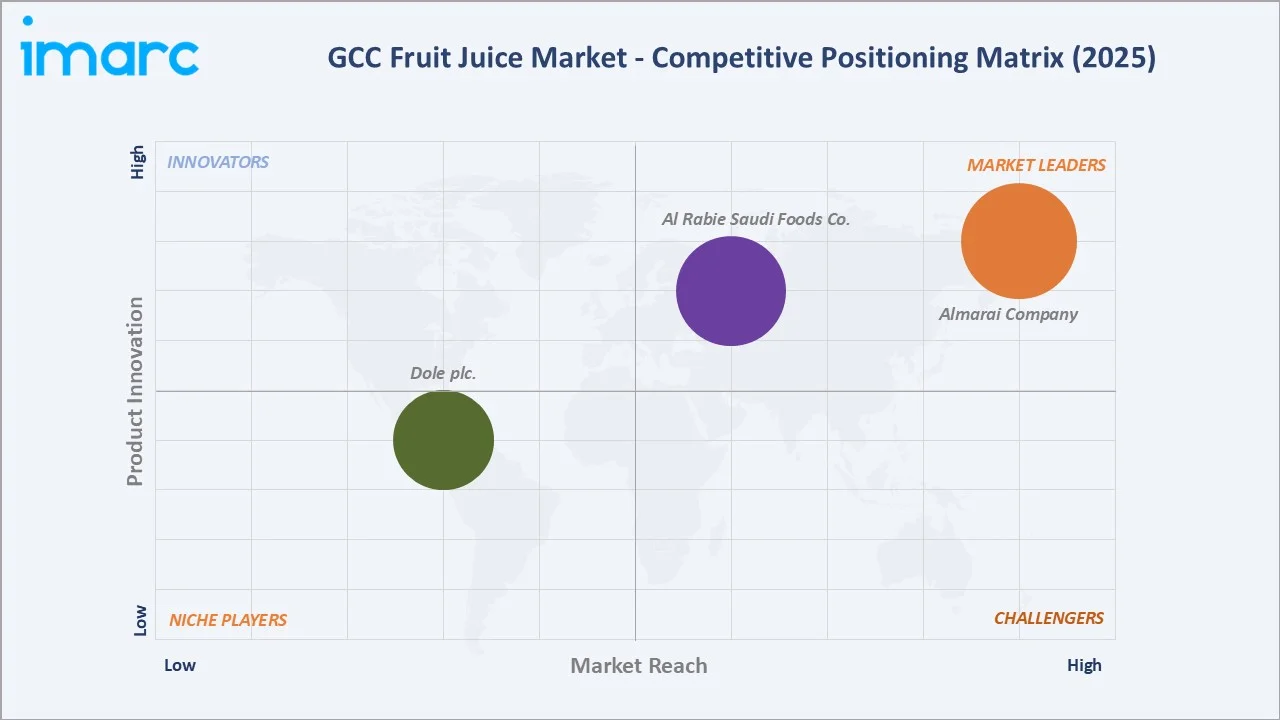
The GCC fruit juice market is moderately concentrated, with regional champions holding significant share in Saudi Arabia and the UAE, while global beverage multinationals compete in premium and specialty segments. Almarai Company, Al Rabie Saudi Foods Co., and Dole plc. collectively hold an estimated 40-48% of GCC branded fruit juice revenues (2025), driven by strong retail distribution and consumer brand loyalty.
|
Company Name |
Brand / Product Line |
Market Position |
Core Strength |
|
Almarai Company |
Almarai/Farm’s Select |
Market Leader |
Largest GCC dairy and juice company; wide distribution across Saudi Arabia and the UAE; strong brand equity with consumers |
|
Al Rabie Saudi Foods Co. |
Al Rabie |
Market Leader |
Leading juice-focused manufacturer in Saudi Arabia; wide range of juice drinks, nectars, and fruit beverages; strong national distribution |
|
Dole plc. |
DOLE |
Niche Player |
Brand recognition in 100% juice segment; premium positioning in the UAE and Qatar modern retail channels |
Competitive differentiation is driven by product formulation (natural vs. added sugar), packaging format (Tetra Pak, PET, glass), distribution reach (organized retail vs. traditional trade), and pricing strategy. Regional players benefit from halal certification alignment, Arabic labeling compliance, and established relationships with GCC retail buyers, creating barriers for new international entrants.
Key Company Profiles
Almarai Company
Almarai Company is Saudi Arabia's largest food and beverage manufacturer and one of the GCC's leading fruit juice producers. Headquartered in Riyadh, Almarai operates integrated production facilities across the Kingdom and distributes products across all GCC markets.
- Product Portfolio: Almarai Juice Range including orange, mango, mixed fruit, and tropical variants in Tetra Pak and PET formats
- Strategic Focus: Portfolio premiumization through healthier formulations; expanding e-commerce channel presence; strengthening distribution in smaller GCC markets
Al Rabie Saudi Foods Co.
Al Rabie Saudi Foods Co. is one of Saudi Arabia's pioneering fruit juice manufacturers, producing a comprehensive range of juice drinks, nectars, concentrates, and flavored beverages for GCC consumers.
- Product Portfolio: Al Rabie Juices spanning orange, apple, mango, mixed fruit, and pomegranate variants; available in Tetra Pak, PET, and can formats
- Strategic Focus: Expanding regional brand awareness beyond Saudi Arabia; investing in production efficiency and Tetra Pak technology upgrades; growing foodservice channel revenues
Market Concentration Analysis
The GCC fruit juice market exhibits moderate concentration at the branded retail level, with a small number of established regional and global players holding significant combined market share. Almarai Company and Al Rabie Saudi Foods collectively account for an estimated 28-33% of branded GCC retail fruit juice revenues (2025), supported by extensive distribution networks and strong consumer brand equity.
The top players - Almarai Company, Al Rabie Saudi Foods Co., and Dole plc. - hold a combined estimated 45-52% of organized retail revenues. However, significant fragmentation exists in the juice drink and powdered juice sub-segments, where local and regional brands compete aggressively on price in traditional trade channels.
Consolidation trends are moderate. The market has not experienced major M&A activity in recent years, though Almarai's continued organic expansion and Al Rabie's production investment signal intent to extend market leadership. The entry of international brands through the UAE distribution partnerships is introducing competitive pressure in premium segments, encouraging local manufacturers to accelerate premiumization strategies.
Investment & Growth Opportunities
Fastest Growing Segments
100% Fruit Juice (clean-label, NFC formats), functional and fortified juice variants (Vitamin C, probiotic-enriched), and premium Tetra Pak RTD formats represent the GCC's highest-growth investment vectors through 2034. E-commerce and direct-to-consumer juice subscription models are the fastest-growing distribution channel, with the UAE leading adoption.
Emerging Market Opportunities
Oman and Kuwait represent systematically underleveraged markets. Both countries are increasing modern retail infrastructure investment, with Oman's Vision 2040 allocating specific funding to food sector development. Bahrain's highly urbanized, relatively affluent population offers a high-density test market for premium and functional juice innovations before broader GCC scaling.
Investment Themes
- Functional beverage development: Investment in R&D for immunity-boosting, probiotic, and collagen-enriched juice variants positions manufacturers to capture the fast-growing GCC health and wellness consumer segment.
- E-commerce infrastructure partnerships: Partnerships with GCC online grocery platforms (Noon Grocery, Carrefour Online, Talabat Mart) and investment in cold-chain last-mile delivery capabilities offer significant incremental revenue from digital-native consumer cohorts.
- Sustainable packaging transition: Early investment in recyclable and eco-friendly packaging aligns with tightening GCC regulatory requirements and enhances brand perception among environmentally conscious premium consumers in the UAE and Qatar.
Future Market Outlook (2026-2034)
The GCC fruit juice market is projected to grow from USD 3.86 Billion in 2025 to USD 4.07 Billion in 2026, reaching USD 5.76 Billion by 2034, delivering a 4.42% CAGR. This trajectory reflects a favorable combination of population growth, rising disposable incomes, health-conscious consumption shifts, and expanding modern retail and e-commerce infrastructure across all six GCC member states. The market's anchor value of USD 4.79 Billion in 2030 represents the consolidation of clean-label, functional, and premium juice segments as mainstream retail categories.
Three structural forces define GCC fruit juice's growth trajectory with confidence: sustained population expansion - the GCC's population is projected to exceed 70 million by 2034 - creating a growing consumer base; product innovation toward health-aligned formulations expanding addressable premium segments; and government food sector investment and food safety framework development channeling consumption toward branded, certified products.
Flavor diversification toward exotic and regional variants, sustainable packaging adoption, and the rise of e-commerce-exclusive health juice subscriptions will be the defining commercial trends of the 2026-2034 forecast period. Saudi Arabia will retain market leadership while the UAE accelerates premiumization, and smaller GCC markets present incremental but meaningful volume growth opportunities for regional manufacturers.
Research Methodology
Primary Research
Primary research comprised structured interviews with 60+ industry stakeholders (2025), including senior supply chain managers from GCC food and beverage manufacturers; Saudi Food and Drug Authority (SFDA) and the UAE MOCCAE regulatory specialists; GCC regional sales directors from leading juice brands; hypermarket and supermarket category managers; and health food specialty retail buyers across Saudi Arabia and the UAE.
Secondary Research
Secondary research encompassed Saudi Arabia General Authority for Statistics (GASTAT) household expenditure reports 2024; the UAE Ministry of Economy trade statistics 2024; GCC food and beverage trade association publications; Tetra Pak GCC market reports; International Diabetes Federation GCC prevalence data 2023; FAO commodity price data for orange and mango concentrates; and company annual reports for all major profiled manufacturers. Over 120 secondary sources were reviewed.
Forecasting Models
Market revenue forecasts used bottom-up retail volume x price per unit models combined with per-capita fruit juice consumption x population growth x affordability index models for each GCC country. Key inputs include GCC population projections, GDP per capita growth forecasts, modern retail penetration trajectories, e-commerce growth rates, and historical fruit juice category CAGR from 2020-2025.
GCC Fruit Juice Market Report Coverage:
| Report Features | Details |
|---|---|
| Base Year of the Analysis | 2025 |
| Historical Period | 2020-2025 |
| Forecast Period | 2026-2034 |
| Units | Billion USD |
| Scope of the Report |
Exploration of Historical Trends and Market Outlook, Industry Catalysts and Challenges, Segment-Wise Historical and Future Market Assessment:
|
| Product Types Covered | Juice Drinks, 100% Fruit Juice, Concentrates, Nectars, Powdered Juice, and Others |
| Flavors Covered | Orange, Mango, Mixed Fruit, Apple, and Others |
| Packaging Types Covered | Tetra Pack, Bottles, Cans, and Others |
| Distribution Channels Covered | Supermarkets and Hypermarkets, Convenience Stores, Specialty Food Stores, Online Stores, and Others |
| Countries Covered | Saudi Arabia, United Arab Emirates, Qatar, Oman, Kuwait, Bahrain |
| Companies Covered | Almarai Company, Al Rabie Saudi Foods Co., Dole plc., etc. |
| Customization Scope | 10% Free Customization |
| Post-Sale Analyst Support | 10-12 Weeks |
| Delivery Format | PDF and Excel through Email (We can also provide the editable version of the report in PPT/Word format on special request) |
Frequently Asked Questions About the GCC Fruit Juice Market Report
The GCC fruit juice market size is estimated at USD 4.07 Billion in 2026, covering juice drinks, 100% juices, nectars, concentrates, and powdered formats across all six GCC member states.
The GCC fruit juice market is projected to grow at 4.42% CAGR during 2026-2034, reaching USD 5.76 Billion by 2034, driven by health trends, population growth, and retail expansion.
Juice drinks lead at 34.8% (2025), driven by affordable price points and wide availability across hypermarkets and convenience stores throughout the GCC.
Orange leads at 31.5% flavor share (2025), reflecting universal consumer preference and the established association of orange juice with daily nutritional consumption.
Saudi Arabia leads with 39.8% market share (2025), driven by its large population base, expansive modern retail infrastructure, and strong regional brand presence.
Leading companies include Almarai Company, Al Rabie Saudi Foods Co., and Dole plc., among others.
The GCC fruit juice market is projected to reach USD 4.79 Billion by 2030, with clean-label 100% juice and functional beverage segments achieving above-average growth rates.
Key drivers include rising health consciousness, growing expatriate population diversity, government food safety standards, and expanding modern retail and e-commerce distribution channels.
Key constraints include high sugar content concerns, raw material price volatility for concentrate imports, cold chain infrastructure gaps in remote regions, and intense competition from alternative beverages.
Functional and fortified juices, e-commerce channel expansion, HPP-processed premium juices, and sustainable eco-packaging innovations represent the highest-growth investment opportunities through 2034.
Need more help?
- Speak to our experienced analysts for insights on the current market scenarios.
- Include additional segments and countries to customize the report as per your requirement.
- Gain an unparalleled competitive advantage in your domain by understanding how to utilize the report and positively impacting your operations and revenue.
- For further assistance, please connect with our analysts.
 Request Customization
 Speak to an Analyst
 Request Brochure
 Inquire Before Buying
Benefits of Customization
- Personalize this research
- Triangulate with your data
- Get data as per your format and definition
- Gain a deeper dive into a specific application, geography, customer, or competitor
- Any level of personalization
Get in Touch With Us
UNITED STATES
Phone: +1-201-971-6302
INDIA
Phone: +91-120-433-0800
UNITED KINGDOM
Phone: +44-753-714-6104
Email: [email protected]
Client Testimonials




.webp)




.webp)













Related Reports

Choose your plan
*Please note that the prices mentioned below are starting prices for each bundle type. Kindly contact our team for further details.*
Single User License
- 1 User License, Access on 2 Devices
- PDF Report + Excel Dataset (Password Protected)
- Lifetime Access
- No Printing Rights
- 10% Free Report Customization
- 10–12 Weeks of Analyst Support
Five User License
- Access for 5 Users, 2 Devices per User
- PDF Report + Excel Dataset (Password Protected)
- Lifetime Access
- Dedicated Account Manager
- 12–14 Weeks of Analyst Support
- No Printing Rights
- 15% Free Report Customization
- 25% Discount on Your Next Purchase
Corporate User License
- Unlimited User Access (Within Your Organization)
- PDF Report + Excel Dataset
- Lifetime Access
- Dedicated Account Manager
- 14–20 Weeks of Analyst Support
- No Printing Rights
- 20% Free Report Customization
- 30% Discount on Your Next Purchase
Essential Insights
What's included:
3 reports
- Lifetime Access
- PDF Reports
- Excel Datasets
- 2 Weeks of Free Analyst Support
- 2 User Licenses
- Access on 2 Devices
- Printing Rights
- Complimentary PowerPoint (PPT) Version
- Complimentary License Upgrade
Professional Access
What's included:
5 reports
- Lifetime Access
- PDF Reports
- Excel Datasets
- 8 Weeks of Free Analyst Support
- 2 User Licenses
- Access on 2 Devices
- Printing Rights
- Complimentary PowerPoint (PPT) Version
- Complimentary License Upgrade
Business Advantage
What's included:
8 reports
- Lifetime Access
- PDF Reports
- Excel Datasets
- 14 Weeks of Free Analyst Support
- 2 User Licenses
- Access on 2 Devices
- Printing Rights
- Complimentary PowerPoint (PPT) Version
- Complimentary License Upgrade
Enterprise Intelligence
What's included:
10 reports
- Lifetime Access
- PDF Reports
- Excel Datasets
- 20 Weeks of Free Analyst Support
- 2 User Licenses
- Access on 2 Devices
- Printing Rights
- Complimentary PowerPoint (PPT) Version
- Complimentary License Upgrade