
Ginger Processing Market Size, Share, Trends and Forecast by Form, End-Use, Distribution Channel, and Region, 2026-2034
Ginger Processing Market Size, Share, Trends & Forecast (2026-2034)
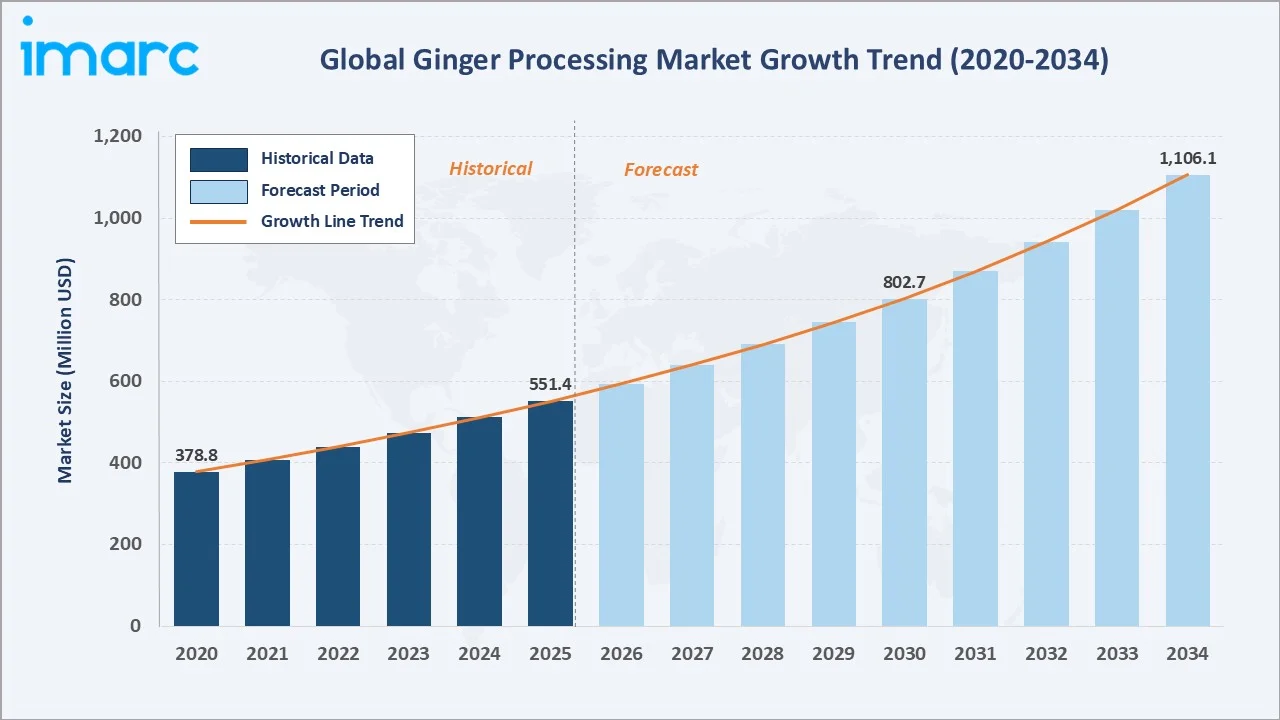
The global ginger processing market reached USD 551.4 Million in 2025, up from USD 378.8 Million in 2020, and is projected to reach USD 1,106.1 Million by 2034, growing at a CAGR of 7.80% during 2026-2034. Ginger powder leads the form segment at 71.6%, while the food industry dominates end-use at 48.3% in 2025.
Growth is driven by rising demand for natural condiments, expanding nutraceutical and cosmetic applications of gingerol-rich extracts, and increasing export-oriented processing capacity across leading producing countries. India leads regional demand at 31.4% share, supported by favorable cultivation conditions and strong export infrastructure.
Market Snapshot
|
Metric |
Value |
|
Market Size (2025) |
USD 551.4 Million |
|
Market Size (2034) |
USD 1,106.1 Million |
|
CAGR (2026-2034) |
7.80% |
|
Base Year |
2025 |
|
Historical Period |
2020-2025 |
|
Forecast Period |
2026-2034 |
|
Dominant Form |
Ginger Powder (71.6%, 2025) |
|
Dominant End-Use |
Food Industry (48.3%, 2025) |
|
Leading Region |
India (31.4%, 2025) |
The market is anchored at USD 378.8 Million in 2020 and expanded to USD 551.4 Million by 2025, more than doubling to USD 1,106.1 Million by 2034, with an intermediate waypoint of USD 802.7 Million in 2030. Growth accelerates through the forecast period as processed ginger penetrates deeper into functional food, pharmaceutical, and cosmetic value chains.
To get more information on this market, Request Sample
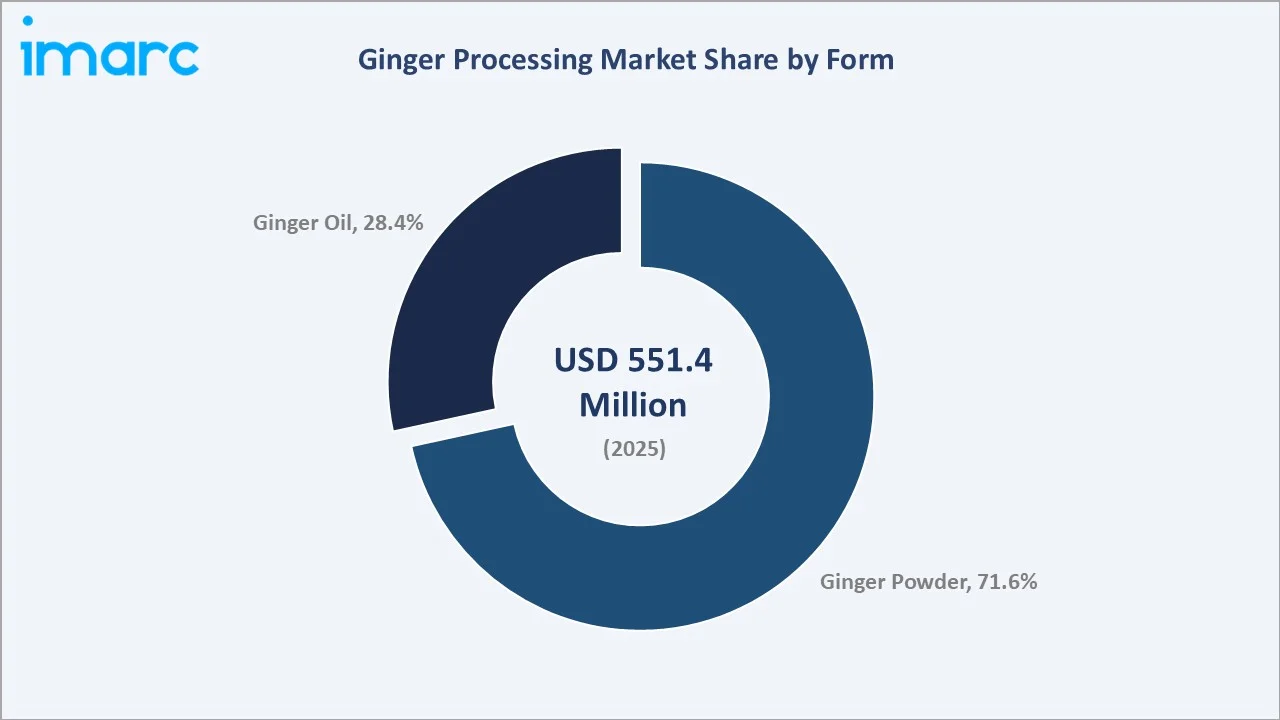
Ginger powder's dominance stems from its ease of storage, longer shelf life, and versatility as a flavoring agent in sauces, pickles, and bakery items. Ginger oil, while smaller at 28.4%, is gaining traction in aromatherapy, cosmetics, and beverage flavoring applications driven by rising demand for natural extracts.
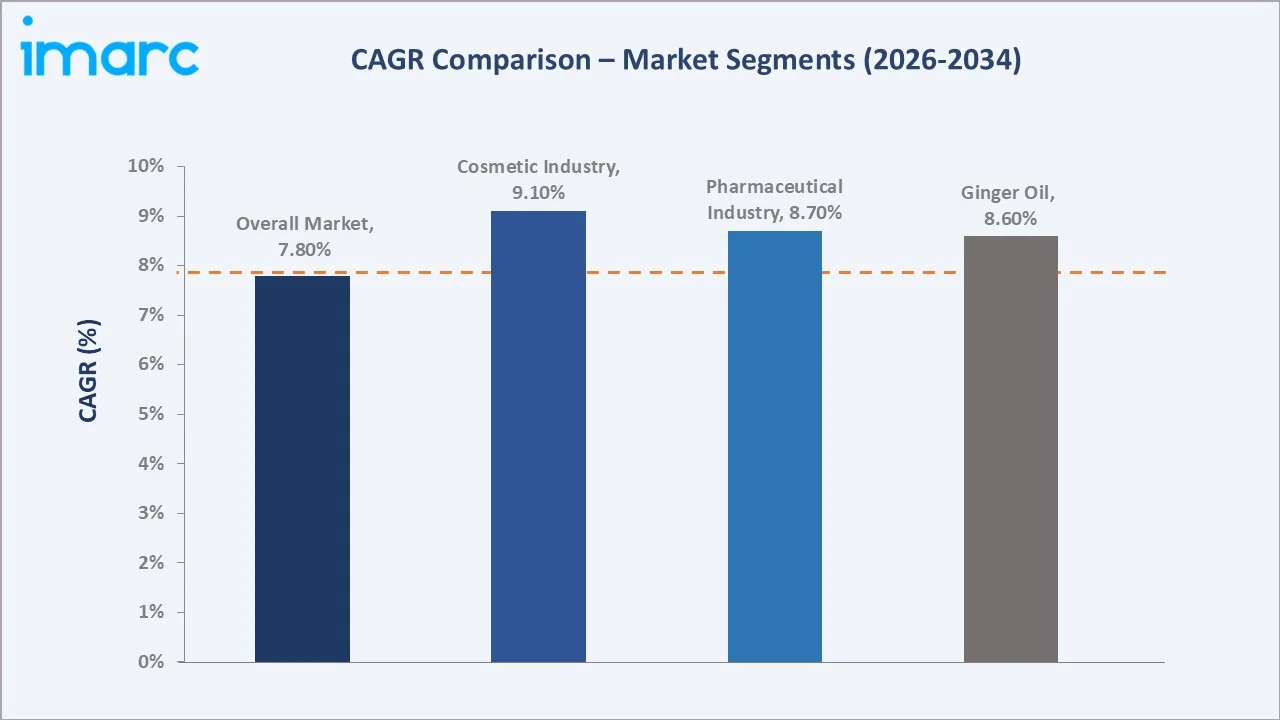
The cosmetic industry is projected to post the fastest growth at approximately 9.10% CAGR, followed by the pharmaceutical industry at 8.70%, as gingerol-standardized extracts gain traction in skincare and nutraceutical formulations. Ginger oil, at 8.60%, is expected to outpace ginger powder's 7.55% CAGR over the forecast period.
Executive Summary
The global ginger processing market reached USD 551.4 Million in 2025, up from USD 378.8 Million in 2020, reflecting steady demand for value-added ginger derivatives across food, pharmaceutical, and cosmetic industries. Processed ginger extends the shelf life of the aromatic rhizome through drying, grinding, and extraction into powder and oil formats.
Ginger powder commands 71.6% of the form segment owing to its mild flavor and multi-industry utility, while the food industry leads end-use applications at 48.3% share. India leads regional demand at 31.4%, benefiting from favorable climatic conditions and a well-established export infrastructure.
Key Market Insights
|
Insight |
Data |
|
Dominant Form |
Ginger Powder – 71.6% market share (2025) |
|
Dominant End-Use |
Food Industry – 48.3% market share (2025) |
|
Leading Region |
India – 31.4% market share (2025) |
|
Market Opportunity |
Organic and clean-label ginger extracts; functional beverages; cosmetic-grade ginger oil; pharmaceutical-grade standardized extracts |
Key Analytical Observations Supporting The Above Data:
- Ginger Powder at 71.6%: Ginger powder dominates the form segment as it lacks the sharp pungency of fresh ginger, making it suitable for imparting mild flavor across sauces, curries, bakery items, and beverages. Its longer shelf life and ease of storage reinforce its widespread adoption among food processors.
- Food Industry at 48.3%: The food industry leads end-use applications due to extensive use of processed ginger in bakery products, smoothies, curries, and sauces. Rising consumer preference for natural flavoring agents over synthetic alternatives continues to expand ginger powder and oil consumption across food categories.
- India at 31.4%: India dominates the regional market as the world's largest ginger producer and a leading exporter of processed ginger products. Favorable climatic conditions across key growing states, coupled with a developed spice processing and export infrastructure, sustain the country's leadership.
Ginger Processing Market Overview
The global ginger processing market encompasses the harvesting, washing, drying, grinding, and extraction of ginger rhizomes into value-added products, primarily ginger powder and ginger oil. These derivatives extend shelf life and enable standardized use of ginger's aromatic and bioactive gingerol compounds.
The industry ecosystem connects ginger farmers, collectors, and processors with distributors, exporters, and end-use manufacturers across food, pharmaceutical, and cosmetic sectors. Rising consumer preference for natural, plant-based ingredients continues to widen the addressable market for processed ginger derivatives globally.
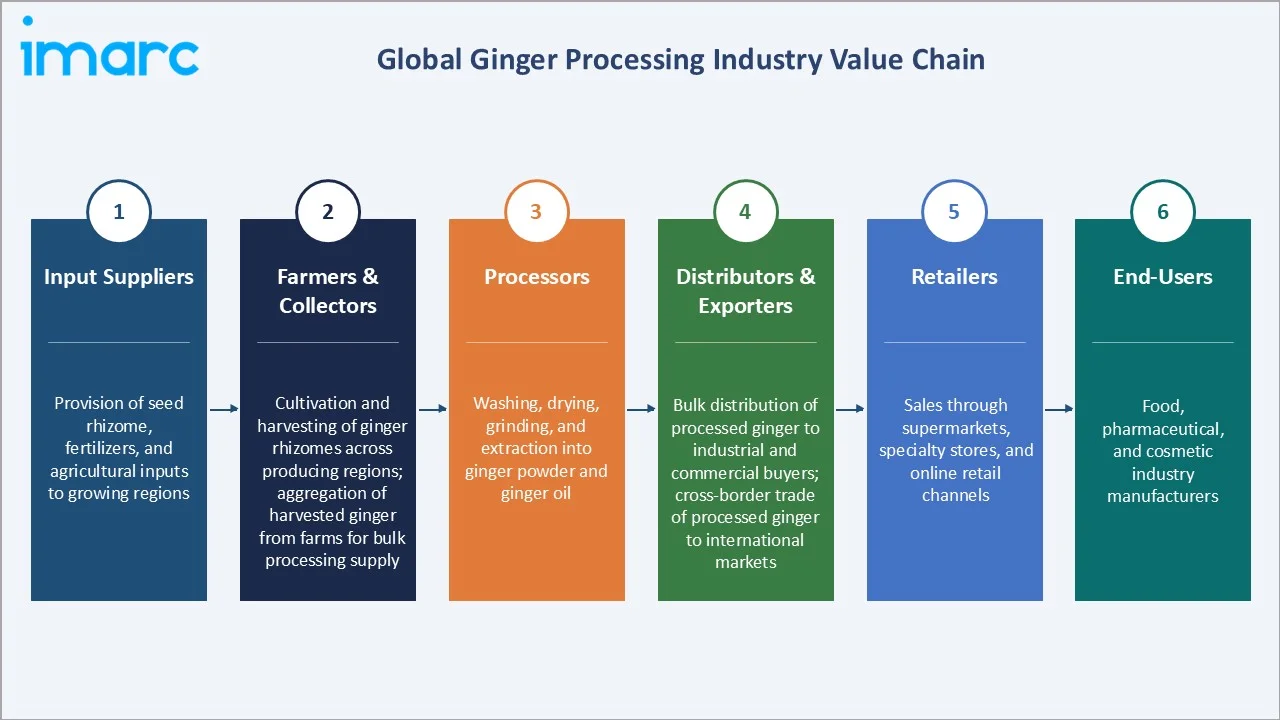
The ecosystem connects upstream farm input and seed suppliers with growers across leading producing countries, feeding into a central processing and value-addition hub that supplies spice ingredient manufacturers and, ultimately, food, pharmaceutical, and cosmetic end-users under applicable regulatory frameworks.
Market Dynamics
To evaluate market opportunities, Request Sample
Market Drivers
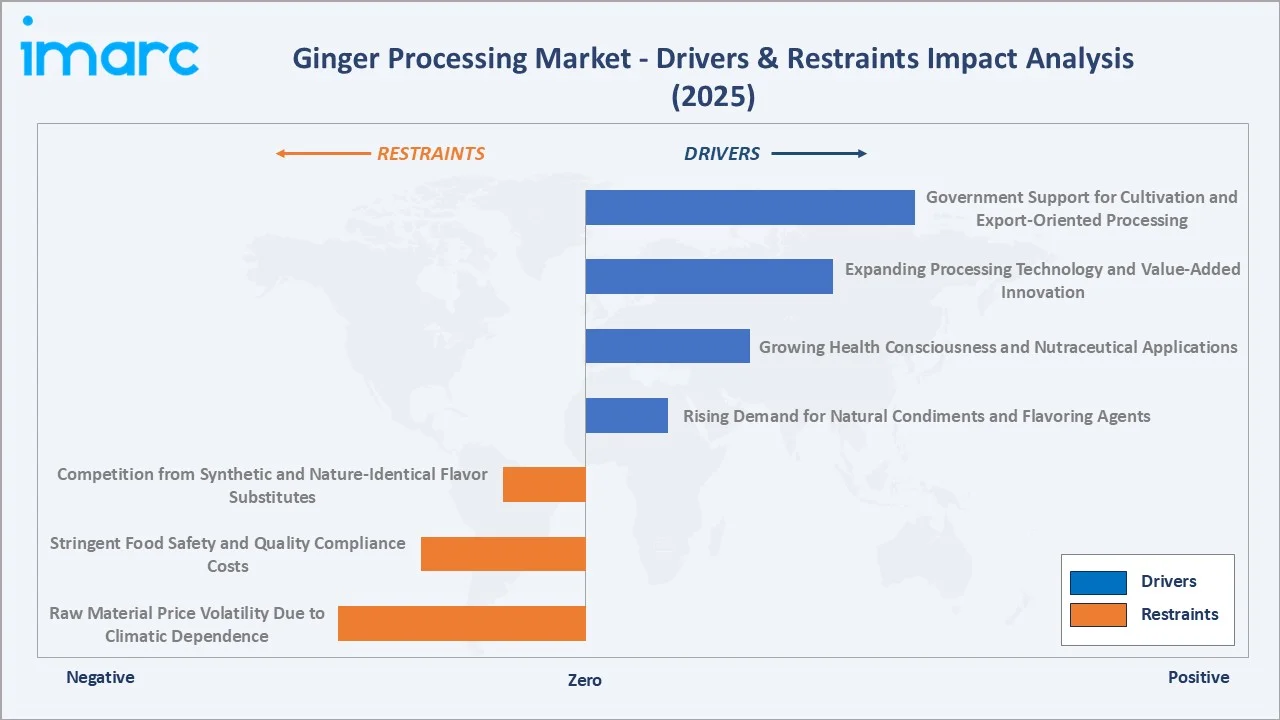
- Rising Demand for Natural Condiments and Flavoring Agents: Ginger powder is increasingly used as a condiment and flavoring agent in salad dressings, sauces, pickles, gravies, and meat products. Its mild taste and long shelf life make it a preferred natural alternative to synthetic flavorings.
- Growing Health Consciousness and Nutraceutical Applications: Increasing consumer awareness of ginger's anti-inflammatory, digestive, and antioxidant properties is boosting demand for standardized ginger extracts in dietary supplements. Rising nutraceutical sales, supported by preventive healthcare trends, are accelerating processed ginger consumption.
- Expanding Processing Technology and Value-Added Innovation: Advances in freeze-drying, steam distillation, and CO2 extraction are improving yield, potency, and shelf stability of ginger powder and oil. These technologies enable processors to meet rising demand for standardized, high-quality extracts.
- Government Support for Cultivation and Export-Oriented Processing: Producing countries, including India and Nigeria, are strengthening agricultural support programs and export infrastructure for spices. Harmonized food safety standards are improving market access to Europe and the Middle East.
Market Restraints
- Raw Material Price Volatility Due to Climatic Dependence: Ginger cultivation is highly sensitive to weather conditions, and yield fluctuations in key growing regions directly affect raw material availability and pricing. Limited hedging instruments expose processors to margin pressure during supply disruptions.
- Stringent Food Safety and Quality Compliance Costs: Tightening pesticide residue, aflatoxin, and contaminant testing requirements under frameworks such as FSSAI, USDA organic, and EU regulations raise compliance costs, particularly burdening smaller processing operations with limited testing infrastructure.
- Competition from Synthetic and Nature-Identical Flavor Substitutes: Cost-engineered nature-identical flavor compounds are increasingly displacing natural ginger extracts in confectionery and beverage applications, particularly among price-sensitive manufacturers, moderating volume growth for premium natural ginger products.
Market Opportunities
- Organic and Clean-Label Certification Expansion: Growing demand for certified organic ginger powder and oil in North America and Europe creates opportunities for processors to invest in traceability systems and premium certification, unlocking access to higher-margin retail and export channels.
- Pharmaceutical-Grade Standardized Extract Development: Rising nutraceutical and pharmaceutical demand for gingerol-standardized extracts creates opportunities for processors to invest in analytical testing and extraction technology, enabling entry into higher-value pharmaceutical and dietary supplement supply chains.
Market Challenges
- Fragmented Smallholder Supply Base Limiting Traceability: Ginger cultivation is dominated by smallholder farmers across producing countries, making consistent quality, volume, and traceability difficult to guarantee, complicating certification compliance for processors serving premium export markets.
- Post-Harvest Losses Reducing Effective Raw Material Yield: Inadequate storage and transport infrastructure in some producing regions leads to significant post-harvest spoilage, reducing effective raw ginger availability for processing and creating upward pressure on input costs.
Emerging Market Trends
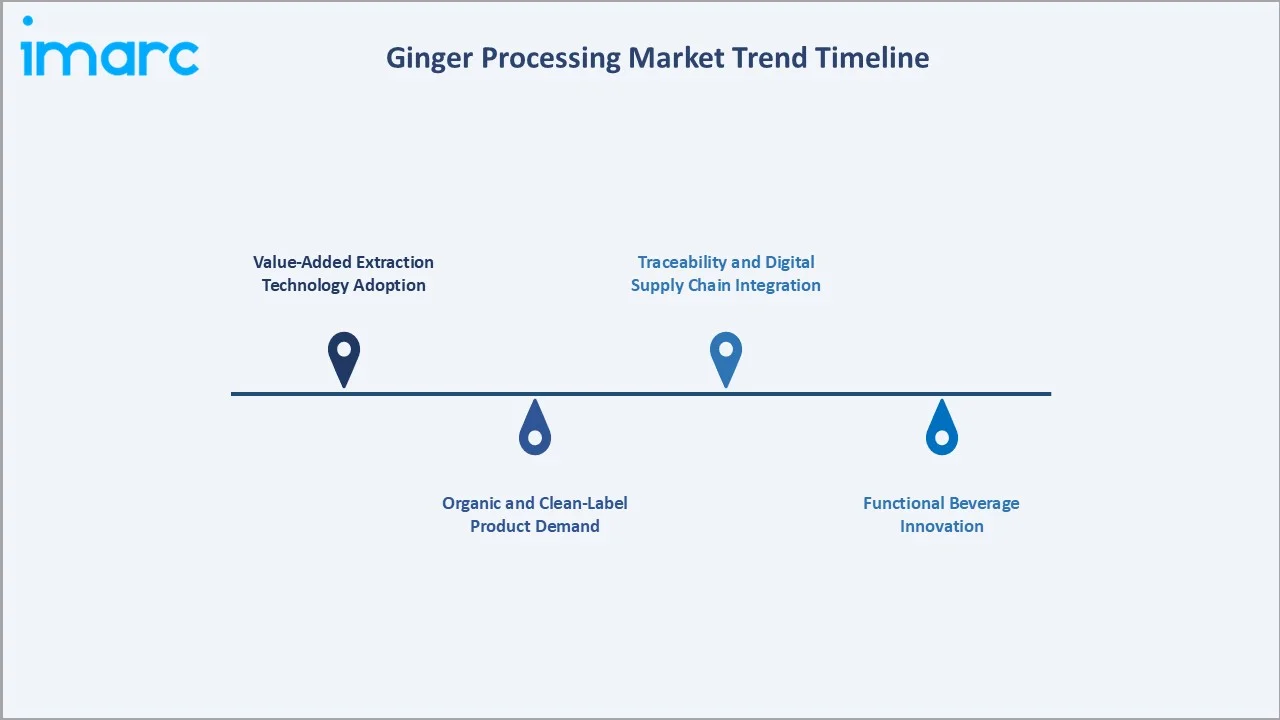
1. Value-Added Extraction Technology Adoption
Processors are increasingly adopting supercritical CO2 and ultrasonic extraction methods to improve gingerol yield and preserve volatile aromatic compounds. These technologies support standardized, high-potency ginger oil and extracts for pharmaceutical and nutraceutical applications.
2. Organic and Clean-Label Product Demand
Rising consumer preference for clean-label, minimally processed ingredients is driving demand for organically certified ginger powder and oil. Processors are expanding traceability systems and organic certification to access premium retail and export markets.
3. Functional Beverage Innovation
Ginger-based functional beverages, including kombucha, ready-to-drink teas, and low-sugar carbonated drinks, are emerging as a fast-growing application. Beverage manufacturers are increasingly formulating wellness-positioned products around ginger's digestive and immunity-supporting properties.
4. Traceability and Digital Supply Chain Integration
Processors are increasingly adopting blockchain and digital traceability platforms to verify origin, certification status, and quality parameters across the ginger supply chain, meeting tightening buyer and regulatory documentation requirements.
Industry Value Chain Analysis
The ginger processing value chain spans input suppliers, farmers, and collectors through processors, distributors, exporters, retailers, and end-users across food, pharmaceutical, and cosmetic industries. Processing is the value chain's most commercially critical stage, transforming raw rhizomes into standardized formats.
|
Stage |
Key Participants |
|
Input Suppliers |
Provision of seed rhizome, fertilizers, and agricultural inputs to growing regions |
|
Farmers & Collectors |
Cultivation and harvesting of ginger rhizomes across producing regions; aggregation of harvested ginger from farms for bulk processing supply |
|
Processors |
Washing, drying, grinding, and extraction into ginger powder and ginger oil |
|
Distributors & Exporters |
Bulk distribution of processed ginger to industrial and commercial buyers; cross-border trade of processed ginger to international markets |
|
Retailers |
Sales through supermarkets, specialty stores, and online retail channels |
|
End-Users |
Food, pharmaceutical, and cosmetic industry manufacturers |
Processing Technology Landscape
Steam Distillation & Solvent Extraction
Steam distillation and solvent extraction remain the primary methods for producing ginger oil and oleoresin, valued for their ability to preserve volatile aromatic compounds and deliver standardized gingerol content for food and pharmaceutical applications.
Freeze-Drying & Spray-Drying
Freeze-drying and spray-drying technologies are increasingly used to produce premium ginger powder with enhanced flavor retention, lower moisture content, and extended shelf life, supporting demand from nutraceutical and clean-label food manufacturers.
Supercritical CO2 Extraction
Supercritical CO2 extraction is gaining adoption for producing high-purity, solvent-free ginger extracts. Ultrasonic-assisted extraction has been shown to improve gingerol extraction efficiency by up to 20%, supporting higher-potency formulations for functional beverages and supplements.
Market Segmentation Analysis
The report covers the following segments:
|
Segment Category |
Leading Segment |
Market Share |
Year |
|
Form |
Ginger Powder |
71.6% |
2025 |
|
End-Use |
Food Industry |
48.3% |
2025 |
|
Distribution Channel |
🔒 |
🔒 |
2025 |
|
Region |
India |
31.4% |
2025 |

By Form
Ginger powder leads the form segment at 71.6% in 2025, reflecting its widespread use as a mild, easy-to-store flavoring agent across food processing applications. Ginger oil accounts for the remaining 28.4%, driven by growing demand in aromatherapy, cosmetics, and beverage flavoring.
To access detailed market analysis, Request Sample
Ginger powder's dominance is reinforced by its compatibility with bakery products, curry blends, and packaged sauces, where fresh ginger's strong pungency is undesirable. Ginger oil, though smaller, commands premium pricing in cosmetic and pharmaceutical-grade applications requiring standardized gingerol content.
By End-Use
The food industry leads end-use applications at 48.3% in 2025, driven by extensive use of processed ginger in bakery, beverage, and sauce manufacturing. The pharmaceutical industry follows at 24.7%, supported by rising nutraceutical demand for ginger's anti-inflammatory and digestive properties.
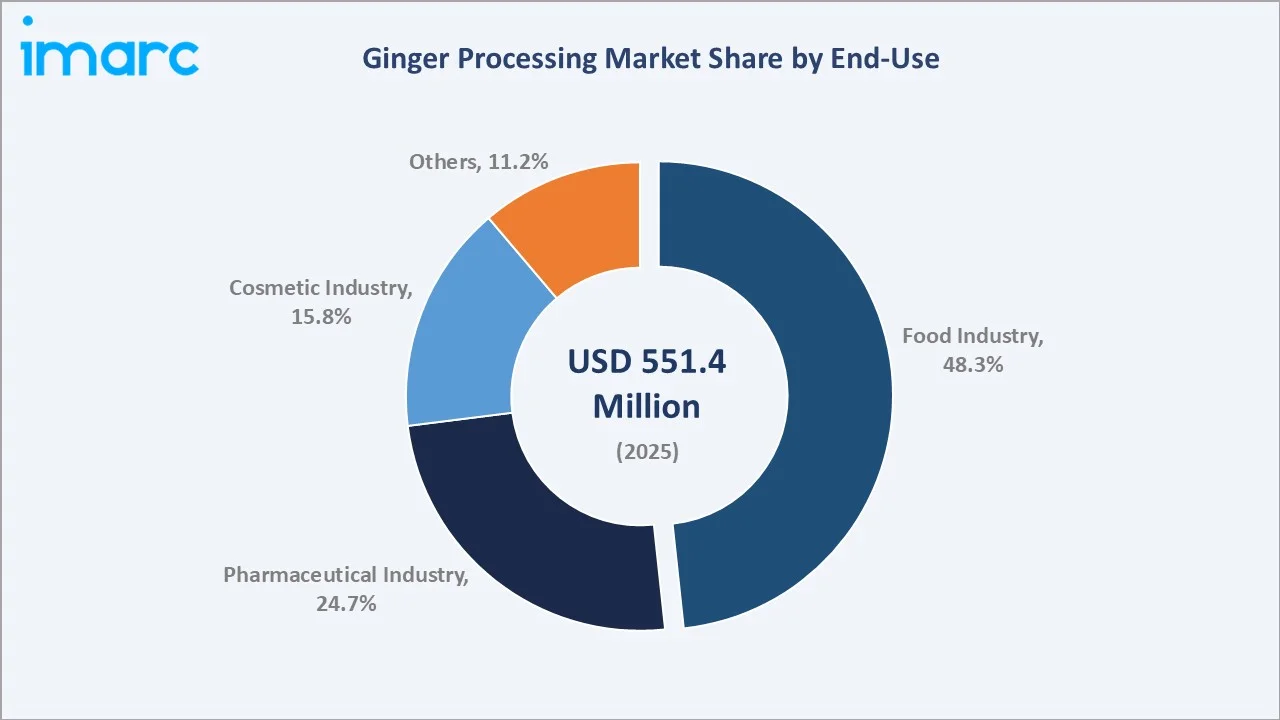
The cosmetic industry accounts for 15.8% of end-use demand, driven by ginger oil's use in skincare and haircare formulations, while other applications, including animal feed and industrial uses, represent the remaining 11.2% of end-use demand.
Regional Market Insights
|
Region |
Share (2025) |
Key Market Characteristics |
|
India |
31.4% |
Leading producer and exporter, supported by favorable cultivation conditions and established processing infrastructure |
|
China |
24.8% |
Large-scale cultivation and processing capacity, serving both domestic and export markets |
|
Nigeria |
12.7% |
Growing production base with expanding export-oriented processing capacity |
|
Indonesia |
10.6% |
Established regional processing hub with growing domestic demand |
|
Thailand |
8.9% |
Regional processing and export activity supporting Southeast Asian demand |
|
Nepal |
6.3% |
Traditional cultivation base with growing processed product exports |
|
Others |
5.3% |
Emerging processing activity across additional producing and consuming countries |
India leads the global ginger processing market at 31.4% share, underpinned by its position as the world's largest ginger producer and a major exporter of processed ginger products. Favorable climatic conditions across key growing states support consistent raw material supply.
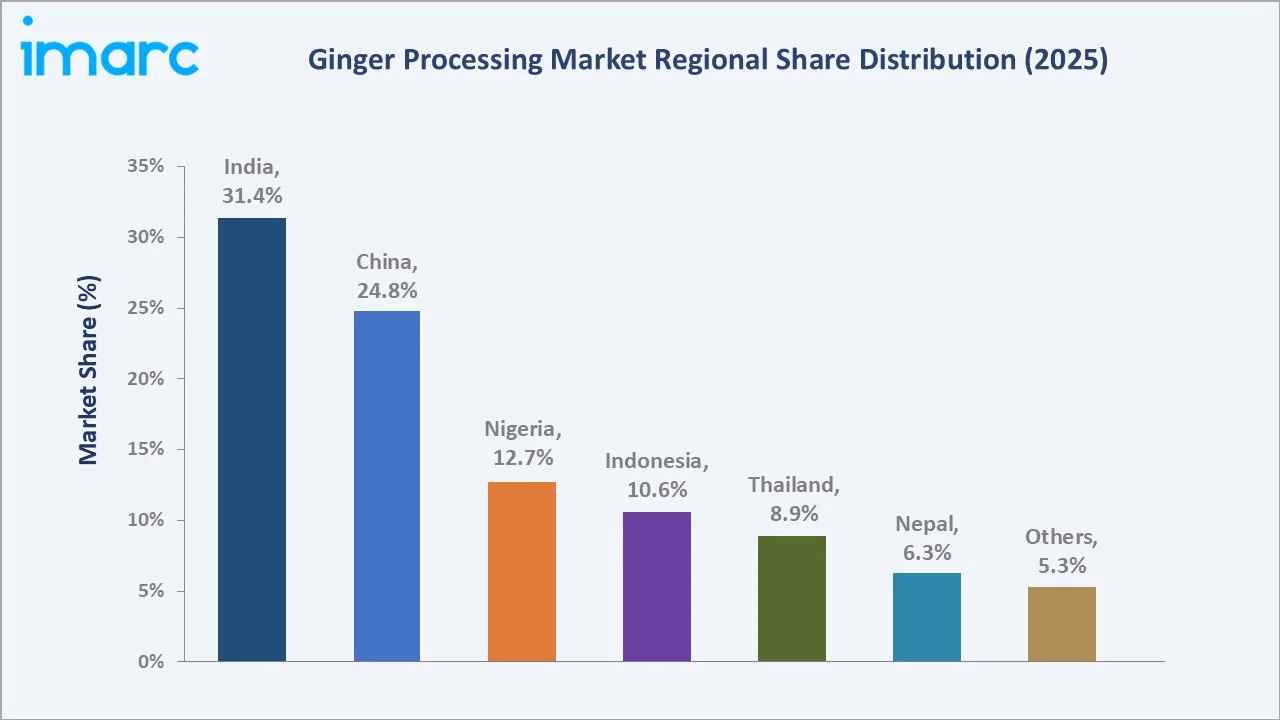
China follows at 24.8%, supported by large-scale cultivation and processing capacity serving both domestic and export markets. Nigeria, at 12.7%, has emerged as a fast-growing production base increasingly integrated into global spice ingredient supply chains.
Indonesia, Thailand, and Nepal collectively account for 25.8% of the market, reflecting established regional processing hubs and traditional cultivation bases. Remaining markets contribute 5.3% share, representing emerging processing activity worldwide.
Competitive Landscape
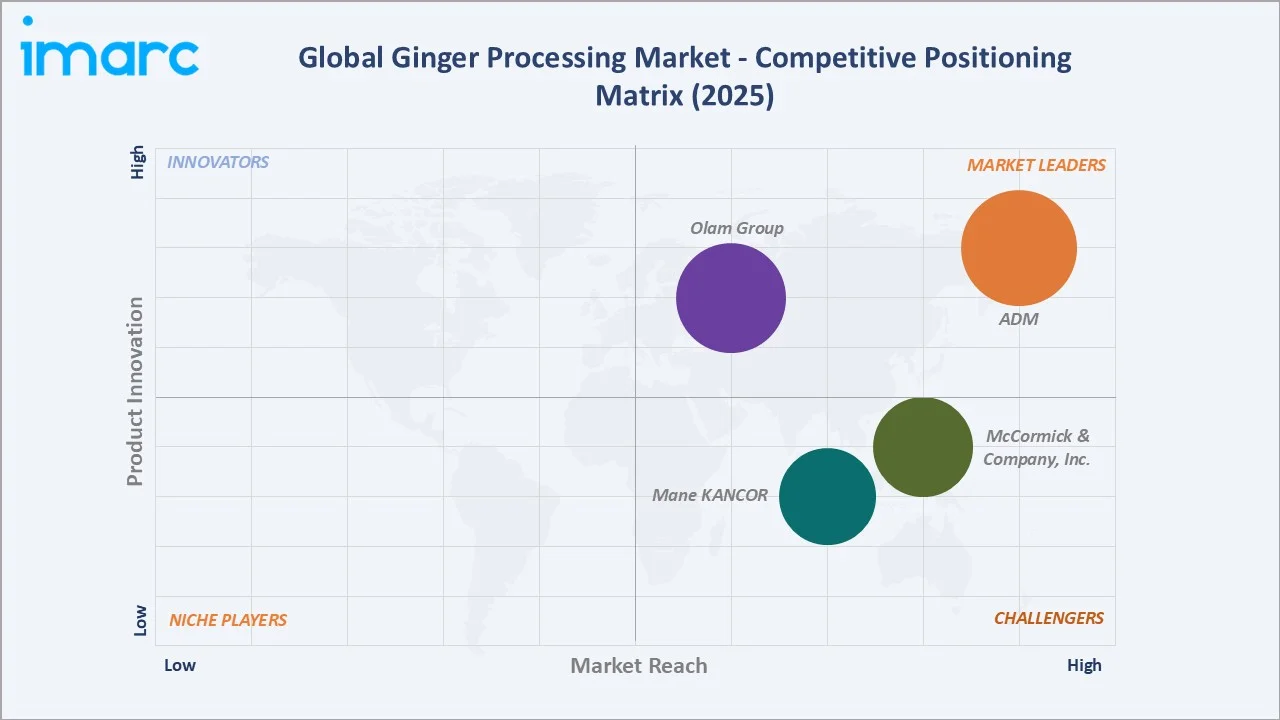
The global ginger processing market is fragmented, comprising diversified global agribusinesses, specialized spice extraction companies, and regional processors concentrated in leading producing countries. Competition is shaped by backward integration into farm-level sourcing and processing technology investment.
|
Company Name |
Key Products |
Market Position |
Core Strength |
|
ADM |
Natural Flavors, Spice Extracts, Ginger Ingredients |
Market Leader |
Global agribusiness with integrated sourcing, processing, and flavor ingredient manufacturing scale |
|
Olam Group |
Ginger Powder, Tropical Spice Ingredients |
Market Leader |
Vertically integrated sourcing from Nigeria with dedicated processing facilities across Asia |
|
McCormick & Company, Inc. |
Ginger Powder, Branded Spice Products |
Strong Challenger |
Global branded spice portfolio with extensive retail and foodservice distribution network |
|
Mane KANCOR |
Ginger Oleoresin, Ginger Essential Oil |
Strong Challenger |
India-based spice extraction specialist with global sourcing and certified processing facilities |
Key players include ADM, Olam Group, McCormick & Company, Inc., Mane KANCOR, and others.
Key Company Profiles
ADM
ADM is a US-based global agribusiness with a diversified natural ingredients and flavors portfolio serving the food, beverage, and nutrition industries worldwide.
- Key Products: Natural Flavors, Spice Extracts, Functional Ingredients.
- Strategic Focus: Expanding science-backed natural ingredient and functional food solutions, integrating sustainable sourcing across its global agricultural supply chain.
Mane KANCOR
Mane KANCOR is an India-based pioneer in spice extraction, specializing in oleoresins, essential oils, and natural ingredient solutions.
- Key Products: Ginger Oleoresin, Ginger Essential Oil, Natural Extracts.
- Strategic Focus: Backward integration with farmer sourcing networks and expansion of certified, standardized spice extraction capacity across India.
Market Concentration Analysis
The ginger processing market is moderately fragmented, with diversified global agribusinesses and flavor companies competing alongside specialized spice extraction firms and regional processors. No single player commands a dominant global share, as sourcing is concentrated in producing countries.
Competitive intensity is increasing as regional processors in India, China, and Nigeria expand export-oriented capacity, while global ingredient companies invest in backward integration and certification to secure reliable, traceable ginger supply for premium applications.
Investment & Growth Opportunities
Highest Growth Segments
Ginger oil, functional beverage applications, and pharmaceutical-grade standardized extracts represent the fastest-growing opportunities within the ginger processing market, supported by rising nutraceutical demand, cosmetic industry adoption, and premium pricing for standardized formulations.
Emerging Investment Opportunities
Pharmaceutical-grade ginger extract manufacturing represents the market's highest per-unit-value emerging opportunity, as standardized gingerol and shogaol formulations command significant price premiums over commodity-grade ginger powder, supported by expanding nutraceutical demand across North America and Europe.
Investment Themes
- Organic and Clean-Label Certification: Expanding organic certification and traceability systems enables processors to access premium retail and export channels in Europe and North America, where clean-label demand continues to accelerate.
- Export-Oriented Processing Capacity in Nigeria and Indonesia: Rising raw ginger production in emerging origins creates opportunities for processors to establish export-oriented processing facilities, capturing value currently lost to raw material export.
Future Market Outlook (2026-2034)
The global ginger processing market is projected to grow from USD 551.4 Million in 2025 to USD 802.7 Million by 2030 and USD 1,106.1 Million by 2034, delivering a 7.80% CAGR over the forecast period. Growth will be reinforced by expanding nutraceutical, cosmetic, and functional beverage applications.
Ginger oil and standardized extract formats are expected to gain share as pharmaceutical and cosmetic manufacturers increasingly demand gingerol-content consistency, while ginger powder retains its leadership through sustained food industry demand across bakery, sauce, and beverage applications.
Research Methodology
Primary Research
Primary research comprised structured interviews with industry stakeholders, including ginger processors, spice ingredient manufacturers, export intermediaries, and food and pharmaceutical industry procurement leads across major producing and consuming regions.
Secondary Research
Secondary research encompassed company reports, trade association data, government agricultural statistics, and industry publications covering ginger cultivation, processing technology, and end-use application trends.
Forecasting Models
Market revenue forecasts were developed using a bottom-up model incorporating ginger production volumes, processing conversion rates, and average revenue per unit across form, end-use, and regional segments, triangulated against secondary market estimates.
Report Coverage:
| Report Features | Details |
|---|---|
| Base Year of the Analysis | 2025 |
| Historical Period | 2020-2025 |
| Forecast Period | 2026-2034 |
| Units | Million USD |
| Scope of the Report | Exploration of Historical Trends and Market Outlook, Industry Catalysts and Challenges, Segment-Wise Historical and Future Market Assessment:
|
| Forms Covered | Ginger Powder, Ginger Oil |
| End-Uses Covered | Food Industry, Pharmaceutical Industry, Cosmetic Industry, Others |
| Distribution Channels Covered | Supermarkets and Hypermarkets, Convenience Stores, Specialty Food Stores, Online, Others |
| Countries Covered | China, India, Nepal, Thailand, Nigeria, Indonesia, Others |
| Companies Covered | ADM, Olam Group, McCormick & Company Inc., Mane KANCOR, etc. |
| Customization Scope | 10% Free Customization |
| Post-Sale Analyst Support | 10-12 Weeks |
| Delivery Format | PDF and Excel through Email (We can also provide the editable version of the report in PPT/Word format on special request) |
Frequently Asked Questions About the Ginger Processing Market Report
The global ginger processing market reached USD 551.4 Million in 2025, up from USD 378.8 Million in 2020, driven by ginger powder's dominance at 71.6% share and India's leadership at 31.4% regional share.
The market is projected to grow at a CAGR of 7.80% during 2026-2034, reaching USD 1,106.1 Million by 2034, supported by rising nutraceutical, cosmetic, and functional food applications of processed ginger.
The market is projected to reach approximately USD 802.7 Million by 2030, supported by continued expansion of nutraceutical, cosmetic, and functional beverage applications across major producing and consuming regions.
Ginger powder leads at 71.6% share in 2025, owing to its mild flavor, long shelf life, and versatility as a condiment across food processing applications.
The food industry leads at 48.3% share, driven by extensive use of processed ginger in bakery, beverage, sauce, and curry manufacturing.
India leads at 31.4% share, supported by its position as the world's largest ginger producer and exporter of processed ginger products.
Leading companies include ADM, Olam Group, McCormick & Company, Inc., Mane KANCOR, and others.
Key opportunities include organic and clean-label ginger extracts, functional beverage applications, and pharmaceutical-grade standardized ginger oil formulations.
Need more help?
- Speak to our experienced analysts for insights on the current market scenarios.
- Include additional segments and countries to customize the report as per your requirement.
- Gain an unparalleled competitive advantage in your domain by understanding how to utilize the report and positively impacting your operations and revenue.
- For further assistance, please connect with our analysts.
 Request Customization
 Speak to an Analyst
 Request Brochure
 Inquire Before Buying
Benefits of Customization
- Personalize this research
- Triangulate with your data
- Get data as per your format and definition
- Gain a deeper dive into a specific application, geography, customer, or competitor
- Any level of personalization
Get in Touch With Us
UNITED STATES
Phone: +1-201-971-6302
INDIA
Phone: +91-120-433-0800
UNITED KINGDOM
Phone: +44-753-714-6104
Email: [email protected]
Client Testimonials




.webp)




.webp)













Related Reports

Choose your plan
*Please note that the prices mentioned below are starting prices for each bundle type. Kindly contact our team for further details.*
Single User License
- 1 User License, Access on 2 Devices
- PDF Report + Excel Dataset (Password Protected)
- Lifetime Access
- No Printing Rights
- 10% Free Report Customization
- 10–12 Weeks of Analyst Support
Five User License
- Access for 5 Users, 2 Devices per User
- PDF Report + Excel Dataset (Password Protected)
- Lifetime Access
- Dedicated Account Manager
- 12–14 Weeks of Analyst Support
- No Printing Rights
- 15% Free Report Customization
- 25% Discount on Your Next Purchase
Corporate User License
- Unlimited User Access (Within Your Organization)
- PDF Report + Excel Dataset
- Lifetime Access
- Dedicated Account Manager
- 14–20 Weeks of Analyst Support
- No Printing Rights
- 20% Free Report Customization
- 30% Discount on Your Next Purchase
Essential Insights
What's included:
3 reports
- Lifetime Access
- PDF Reports
- Excel Datasets
- 2 Weeks of Free Analyst Support
- 2 User Licenses
- Access on 2 Devices
- Printing Rights
- Complimentary PowerPoint (PPT) Version
- Complimentary License Upgrade
Professional Access
What's included:
5 reports
- Lifetime Access
- PDF Reports
- Excel Datasets
- 8 Weeks of Free Analyst Support
- 2 User Licenses
- Access on 2 Devices
- Printing Rights
- Complimentary PowerPoint (PPT) Version
- Complimentary License Upgrade
Business Advantage
What's included:
8 reports
- Lifetime Access
- PDF Reports
- Excel Datasets
- 14 Weeks of Free Analyst Support
- 2 User Licenses
- Access on 2 Devices
- Printing Rights
- Complimentary PowerPoint (PPT) Version
- Complimentary License Upgrade
Enterprise Intelligence
What's included:
10 reports
- Lifetime Access
- PDF Reports
- Excel Datasets
- 20 Weeks of Free Analyst Support
- 2 User Licenses
- Access on 2 Devices
- Printing Rights
- Complimentary PowerPoint (PPT) Version
- Complimentary License Upgrade