
Hazardous Location LED Lighting Market Size, Share, Trends and Forecast by Class, Device Type, End-Use Industry, and Region, 2026-2034
Hazardous Location LED Lighting Market Size and Share:
The global hazardous location LED lighting market size was valued at USD 531.56 Million in 2025. Looking forward, IMARC Group estimates the market to reach USD 847.54 Million by 2034, exhibiting a CAGR of 4.88% during 2026-2034. Asia-Pacific currently dominates the market, holding a market share of 36.8% in 2025. The region benefits from expansive oil refining and petrochemical infrastructure, rapid growth in energy-related construction, and progressively stringent industrial safety standards across classified facilities, all of which sustain robust demand for certified explosion-proof luminaires and reinforce the hazardous location LED lighting market share.
The hazardous location LED lighting market growth is propelled by a convergence of regulatory, operational, and technological forces reshaping industrial safety globally. Industries such as oil and gas, petrochemicals, pharmaceuticals, and mining operate in environments where flammable gases, vapors, combustible dust, or ignitable fibers present persistent explosion risks. Regulatory frameworks including the National Electrical Code, ATEX directives in Europe, and IECEx international standards mandate the use of certified explosion-proof lighting, creating sustained compliance-driven demand. LED technology's inherent advantages, including superior energy efficiency, operational lifespans exceeding 100,000 hours, and significantly reduced heat generation, offer compelling total cost of ownership benefits compared to legacy high-intensity discharge and fluorescent systems. Furthermore, global efforts to modernize aging industrial infrastructure and reduce unplanned maintenance downtime are accelerating upgrades to smart, certified LED fixtures across high-risk industrial facilities worldwide.
United States is a notable country in the hazardous location LED lighting market due to a number of factors. It is home to the world's largest network of oil refineries, petrochemical facilities, pharmaceutical manufacturing facilities, and grain storage facilities, all of which have classified hazardous locations that require compliant certified lighting solutions. OSHA regulates electrical safety regulations for classified locations, which requires operators to maintain compliant lighting solutions. Failure to do so results in heavy financial penalties. The National Electrical Code regulates the domestic classification for hazardous locations. It is a code that is frequently amended, which results in lighting audits for facilities.
To get more information on this market Request Sample
Hazardous Location LED Lighting Market Trends:
Rising Regulatory Compliance Standards
Strengthening safety regulations governing industrial environments are playing a central role in driving adoption of certified hazardous location LED lighting globally. Regulatory bodies including OSHA in the United States, and international frameworks such as ATEX and IECEx, impose strict requirements on electrical equipment deployed in areas where flammable substances are present. The 2023 edition of the National Electrical Code introduced mandatory documentation requirements and enhanced professional oversight for hazardous area classifications, reinforcing the imperative for verified, compliant lighting solutions across industrial facilities. Non-compliance risks extend beyond financial penalties to include facility shutdowns, increased insurance premiums, and reputational damage, making regulatory adherence a strategic priority for operators across oil and gas, pharmaceutical, and mining sectors.
IoT-Enabled Smart Lighting Integration
The integration of Internet of Things connectivity into hazardous location LED lighting systems is reshaping the hazardous location LED lighting market outlook for industrial operators seeking enhanced safety and operational efficiency. Smart lighting platforms now enable real-time remote monitoring of fixture health, predictive maintenance scheduling, and automated dimming based on occupancy and ambient conditions, all without requiring personnel to enter high-risk classified zones. Wireless protocols including Zigbee, LoRaWAN, and DALI are increasingly being adopted in certified explosion-proof fixtures, enabling seamless integration with broader industrial automation platforms and safety management systems across refineries, offshore platforms, and pharmaceutical facilities worldwide.
Accelerated Replacement of Legacy Industrial Lighting
The systematic replacement of legacy high-intensity discharge and fluorescent lighting systems with advanced LED alternatives is a defining factor shaping the hazardous location LED lighting market forecast across industrial sectors globally. Traditional HID and fluorescent technologies present significant operational disadvantages in hazardous environments, including higher heat generation that increases explosion risk, frequent lamp replacements requiring personnel to enter classified zones, and substantially higher energy consumption throughout asset lifecycles. Rising energy costs globally, combined with growing sustainability mandates and corporate decarbonization commitments, are further accelerating facility-wide LED retrofit programs across refineries, mining operations, pharmaceutical plants, and grain-handling facilities seeking both safety compliance and measurable efficiency improvements.
Hazardous Location LED Lighting Industry Segmentation:
IMARC Group provides an analysis of the key trends in each segment of the global hazardous location LED lighting market, along with forecast at the global, regional, and country levels from 2026-2034. The market has been categorized based on class, device type, and end-use industry.
Analysis by Class:
To get detailed segment analysis of this market Request Sample
- Class I
- Class II
- Class III
Class I holds 48.6% of the market share. Class I locations are defined as areas where flammable gases, vapors, or liquids are present in sufficient concentrations to produce ignitable or explosive mixtures, making them the most prevalent hazardous classification across critical industries including petroleum refining, natural gas processing, chemical manufacturing, and offshore oil and gas operations. The compelling dominance of Class I in the market is attributable to the sheer scale of global oil and gas infrastructure, where virtually all upstream, midstream, and downstream facilities contain Class I designated areas requiring explosion-proof certified lighting. LED technology has demonstrated exceptional suitability for Class I environments, offering sealed enclosures, vibration-resistant construction, and temperature ratings that satisfy NEC Article 500 and equivalent international certification standards. Growing investments in LNG terminals, petrochemical complexes, and natural gas distribution networks worldwide are continuously expanding the installed base of Class I locations, sustaining long-term procurement demand for certified Class I LED luminaires across maintenance, new construction, and facility upgrade projects globally.
Analysis by Device Type:
- Zone 0
- Zone 20
- Zone 1
- Zone 21
- Zone 2
- Zone 22
Zone 1 leads the market with a share of 26.8%. Zone 1 environments are classified as locations where explosive atmospheres in the form of flammable gases or vapors are likely to occur periodically during normal operations, placing them among the most technically demanding and widely regulated hazardous area classifications in global industrial settings. Refineries, chemical processing units, loading bays, pump rooms, and compressor stations commonly contain Zone 1 designated areas, all requiring LED luminaires with appropriate IP ratings, temperature classifications, and certifications under ATEX, IECEx, or NEC standards. The elevated certification requirements for Zone 1 fixtures typically translate into higher unit values compared to Zone 2 products, contributing disproportionately to overall market revenue. As global investment in petrochemical and gas processing infrastructure intensifies, particularly across Asia-Pacific, the Middle East, and Latin America, the volume of Zone 1 classified areas within industrial facilities continues to expand, directly supporting sustained demand growth for premium-certified Zone 1 LED lighting solutions designed for challenging operational environments.

Analysis by End-Use Industry:
- Oil and Gas
- Petrochemical
- Industrial
- Power Generation
- Pharmaceutical
- Processing
- Others
Oil and gas dominates the market, with a share of 34.9%. The oil and gas sector encompasses upstream exploration and drilling, midstream transportation and storage, and downstream refining and petrochemical conversion operations, all of which inherently involve extensive exposure to flammable hydrocarbons that mandate the use of explosion-proof certified lighting across facility footprints. The sector's global scale, spanning hundreds of onshore refineries, thousands of offshore platforms, and extensive pipeline networks, creates a vast and recurring demand for hazardous location LED fixtures in maintenance, retrofit, and new construction applications. Stringent safety regulations imposed by OSHA, the UK Health and Safety Executive, and equivalent national regulators require continuous compliance monitoring, creating procurement cycles driven by certification requirements as much as by operational need. The transition toward liquefied natural gas infrastructure, with new LNG import and export terminals being commissioned across Asia, Europe, and the Americas, is generating significant incremental demand for Zone-rated and Class-rated LED luminaires across newly constructed and expanded processing and storage facilities worldwide.
Regional Analysis:
To get more information on the regional analysis of this market Request Sample
- North America
- United States
- Canada
- Asia-Pacific
- China
- Japan
- India
- South Korea
- Australia
- Indonesia
- Others
- Europe
- Germany
- France
- United Kingdom
- Italy
- Spain
- Russia
- Others
- Latin America
- Brazil
- Mexico
- Others
- Middle East and Africa
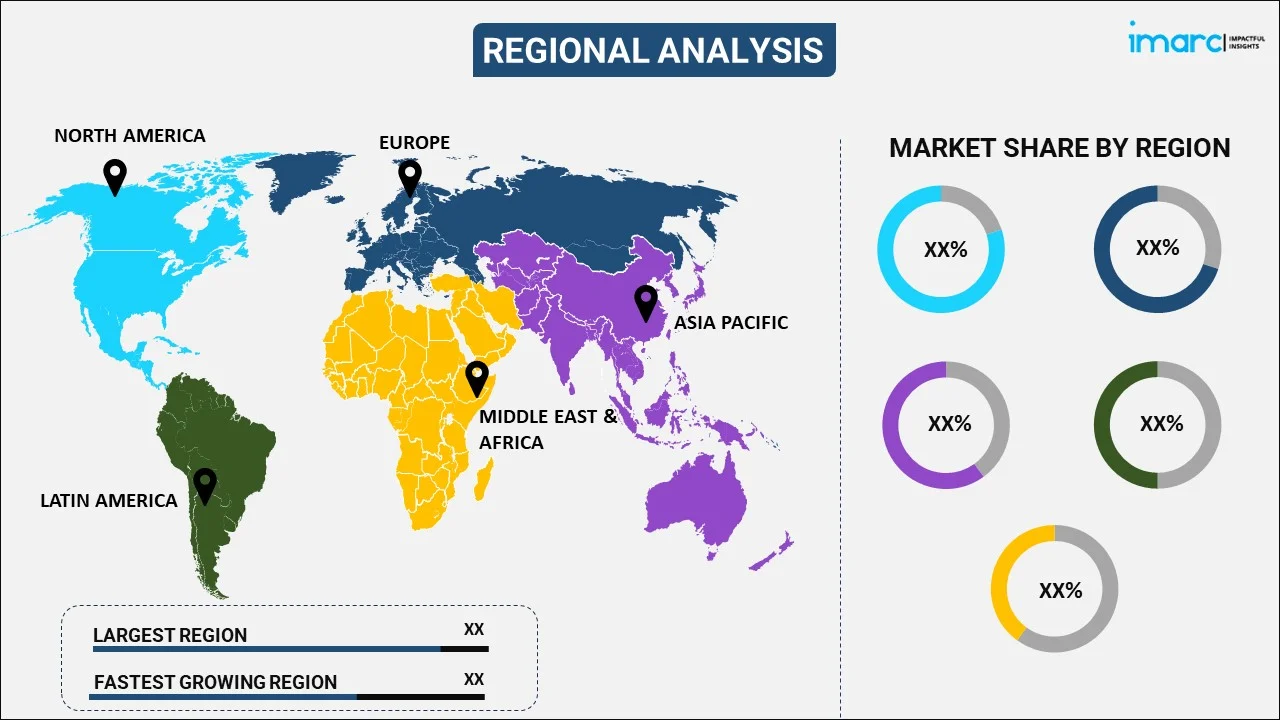
Asia-Pacific, accounting for 36.8% of the share, holds the leading position in the market. The region's industrial sector, with China's well-established petroleum refining and petrochemical industries, along with India's rapidly developing downstream energy sector, ensures that the region maintains high levels of explosion-proof certified lighting demand. Ongoing modernization in the region's regulatory environment is further increasing the importance of regulatory-driven procurement in Asia-Pacific nations, as governments continue to adopt international regulatory frameworks such as IECEx and evolving safety standards in classified hazardous environments. The hazardous location LED lighting market trends in the Asia-Pacific region indicate increasing rates of investment in LNG import terminals, coal-to-chemicals complexes, and pharmaceutical manufacturing clusters, all of which feature high levels of Class I/Zone-rated environments requiring certified lighting. Urbanization and industrialization in Southeast Asia nations such as Indonesia, Vietnam, and Malaysia ensure that new centers of demand for compliant hazardous location LED lighting fixtures are emerging in the region. South Korea's well-established shipbuilding and offshore platform manufacturing industries ensure that high levels of certified explosion-proof lighting procurement occur in the region to meet the lighting needs of newly manufactured vessels.
Key Regional Takeaways:
North America Hazardous Location LED Lighting Market Analysis
North America represents a large and technically advanced market for hazardous location LED lighting, underpinned by one of the world's most extensive networks of oil refineries, petrochemical complexes, pharmaceutical manufacturing facilities, and grain-handling operations. The United States and Canada collectively host thousands of facilities with classified hazardous areas governed by OSHA, the National Electrical Code, and Canadian Electrical Code requirements, creating sustained compliance-driven demand across diverse industrial sectors. The region's energy infrastructure is undergoing extensive modernization as operators transition from legacy high-intensity discharge and fluorescent systems to certified LED alternatives, driven by compelling lifecycle cost advantages and growing operational sustainability commitments. Continued investment in LNG export infrastructure along the US Gulf Coast and in British Columbia, combined with active pharmaceutical and chemical manufacturing clusters across the Northeast and Midwest, ensures that North America will remain a high-value market for certified hazardous location LED luminaires throughout the forecast period.
United States Hazardous Location LED Lighting Market Analysis
The United States represents the largest individual country market for hazardous location LED lighting within North America, supported by a vast and diverse industrial base that includes petroleum refineries, chemical processing plants, pharmaceutical manufacturers, and grain-handling facilities, all of which contain classified hazardous areas requiring compliant certified lighting solutions. OSHA's enforcement of stringent electrical safety standards for classified areas creates a continuously active compliance market, with facility operators facing significant financial penalties for non-compliant installations across industrial sectors. The National Electrical Code provides the domestic framework for hazardous area classification, and ongoing revisions to this standard regularly prompt facility-wide lighting audits and upgrade programs. The pharmaceutical sector's growing capital expenditure in domestic manufacturing capacity is also generating incremental demand for certified hazardous location lighting in production areas subject to volatile compound exposure, reinforcing the country's position as a high-value procurement market for advanced certified LED hazardous location solutions across multiple industrial sectors.
Europe Hazardous Location LED Lighting Market Analysis
Europe's hazardous location LED lighting market is shaped by a mature but actively modernizing industrial landscape governed by the ATEX directive, which establishes rigorous certification requirements for equipment deployed in explosive atmospheres across the region's petrochemical, pharmaceutical, and mining sectors. Germany, France, the United Kingdom, and the Netherlands collectively anchor regional demand through their concentrations of chemical processing, refining, and offshore energy assets. The North Sea oil and gas industry generates consistent procurement demand for marine-grade certified explosion-proof LED fixtures suitable for harsh offshore environments. Eastern European industrial modernization, particularly in Poland and the Czech Republic, is also contributing to regional market expansion as aging facilities replace legacy lighting systems to meet updated ATEX compliance requirements and improve energy performance across classified production areas.
Asia-Pacific Hazardous Location LED Lighting Market Analysis
Asia-Pacific leads the global hazardous location LED lighting market, driven by China's extensive petroleum refining capacity, India's rapidly expanding downstream energy infrastructure, and growing industrial safety regulation across the region. Regulatory bodies in multiple economies are progressively adopting international standards such as IECEx and national equivalents, compelling compliance-driven procurement across oil and gas, chemical, and mining facilities. Southeast Asian markets including Indonesia, Vietnam, and Malaysia are emerging as new demand centers as industrial investment accelerates and occupational safety frameworks mature, further supporting the region's dominant position throughout the forecast period.
Latin America Hazardous Location LED Lighting Market Analysis
Latin America's hazardous location LED lighting market is anchored by the region's significant upstream and offshore oil and gas industry, with Brazil and Mexico representing the largest demand centers. Brazil's extensive deepwater and pre-salt oil production operations encompass vast networks of offshore platforms, onshore processing facilities, and pipeline infrastructure, all of which require compliant certified explosion-proof lighting across classified hazardous areas. Mexico's energy sector, operating through an extensive refinery and distribution network, similarly sustains consistent demand for certified hazardous location fixtures. Growing interest in chemical manufacturing and pharmaceutical production across the region is gradually diversifying procurement demand beyond the dominant oil and gas sector, broadening the market's industrial base.
Middle East and Africa Hazardous Location LED Lighting Market Analysis
The Middle East and Africa market for hazardous location LED lighting is primarily driven by the region's vast hydrocarbon production infrastructure, encompassing onshore oil fields, offshore platforms, LNG export terminals, and petrochemical complexes concentrated in Saudi Arabia, the UAE, Qatar, and Kuwait. National oil companies are investing in both new facility construction and existing asset modernization, creating dual demand streams for certified LED luminaires. In 2023, China's ENN Natural Gas secured a 15-year LNG supply agreement with ADNOC, signaling continued energy infrastructure expansion in the region that will generate associated demand for certified hazardous location LED fixtures. African mining operations in South Africa, Ghana, and the Democratic Republic of Congo provide an additional demand base.
Competitive Landscape:
The hazardous location LED lighting industry is a moderately consolidated market with diversified electrical conglomerates and industrial lighting manufacturers competing with each other in terms of explosion-proof design innovation, thermal management technology, and multi-standard product certification strategies. The major competition factors in the industry include the simultaneous pursuit of NEC, ATEX, IECEx, and UL product certifications, expansion of operations in high-growth industrial regions, and acquisition-based enhancement of technical capabilities. R&D investments in the industry are mainly focused on the integration of IoT connectivity, wireless monitoring, and predictive diagnostics with explosion-proof product certifications while maintaining full compliance with hazardous area product ratings. Companies from the Asian region are increasingly competing with their cost-competitive product offerings for mining and chemical processing industries in emerging industrial regions, although challenges persist in penetrating the Western region due to international product certification hurdles. The competition in the industry is favorable for companies with high regulatory knowledge, product reliability in extreme environments, and established long-term relationships with oil and gas, petrochemical, and pharmaceutical industry operators worldwide. Companies are expanding their service offerings beyond product sales to include fixture design consultation, installation, and maintenance contracts.
The report provides a comprehensive analysis of the competitive landscape in the hazardous location LED lighting market with detailed profiles of all major companies, including:
- ABB Ltd.
- Dialight PLC
- Emerson Electric Co.
- Glamox AS
- Hilclare Lighting
- Hubbell Limited
- Larson Electronics LLC
- Nemalux Inc.
- Prolux International LLC
- R. Stahl Limited
- Raytec Limited
- Shenzhen CESP Co. Ltd
- Worksite Lighting LLC
Latest News and Developments:
- In January 2026, Dialight announced it will exhibit ATEX and IECEx-certified LED lighting solutions at Hazardex Live 2026, held on 25–26 February 2026 at the Harrogate Convention Centre in the United Kingdom. The event showcase was set to feature Dialight's ProSite LED Floodlight alongside a range of additional hazardous area lighting solutions designed for demanding industrial environments.
Hazardous Location LED Lighting Market Report Scope:
| Report Features | Details |
|---|---|
| Base Year of the Analysis | 2025 |
| Historical Period | 2020-2025 |
| Forecast Period | 2026-2034 |
| Units | Million USD |
| Scope of the Report |
Exploration of Historical Trends and Market Outlook, Industry Catalysts and Challenges, Segment-Wise Historical and Future Market Assessment:
|
| Classes Covered | Class I, Class II, Class III |
| Device Types Covered | Zone 0, Zone 20, Zone 1, Zone 21, Zone 2, Zone 22 |
| End Use Industries Covered | Oil & Gas, Petrochemical, Industrial, Power Generation, Pharmaceutical, Processing, Others |
| Regions Covered | North America, Asia-Pacific, Europe, Latin America, Middle East and Africa |
| Countries Covered | United States, Canada, China, Japan, India, South Korea, Australia, Indonesia, Germany, France, United Kingdom, Italy, Spain, Russia, Brazil, Mexico |
| Companies Covered | ABB Ltd., Dialight PLC, Emerson Electric Co., Glamox AS, Hilclare Lighting, Hubbell Limited, Larson Electronics LLC, Nemalux Inc., Prolux International LLC, R. Stahl Limited, Raytec Limited, Shenzhen CESP Co. Ltd, Worksite Lighting LLC, etc. |
| Customization Scope | 10% Free Customization |
| Post-Sale Analyst Support | 10-12 Weeks |
| Delivery Format | PDF and Excel through Email (We can also provide the editable version of the report in PPT/Word format on special request) |
Key Benefits for Stakeholders:
- IMARC’s report offers a comprehensive quantitative analysis of various market segments, historical and current market trends, market forecasts, and dynamics of the hazardous location LED lighting market from 2020-2034.
- The research study provides the latest information on the market drivers, challenges, and opportunities in the global hazardous location LED lighting market.
- The study maps the leading, as well as the fastest-growing, regional markets. It further enables stakeholders to identify the key country-level markets within each region.
- Porter’s Five Forces analysis assists stakeholders in assessing the impact of new entrants, competitive rivalry, supplier power, buyer power, and the threat of substitution. It helps stakeholders to analyze the level of competition within the hazardous location LED lighting industry and its attractiveness.
- Competitive landscape allows stakeholders to understand their competitive environment and provides an insight into the current positions of key players in the market.
Frequently Asked Questions About the Hazardous Location LED Lighting Market Report
The hazardous location LED lighting market was valued at USD 531.56 Million in 2025.
The hazardous location LED lighting market is projected to exhibit a CAGR of 4.88% during 2026-2034, reaching a value of USD 847.54 Million by 2034.
The hazardous location LED lighting market is primarily driven by stringent regulatory mandates including OSHA, ATEX, and IECEx standards requiring certified explosion-proof lighting in flammable environments. Growing investment in oil and gas, petrochemical, and pharmaceutical infrastructure globally, combined with the superior energy efficiency and extended lifespans of LED technology, are compelling widespread adoption across classified industrial facilities.
Asia-Pacific currently dominates the hazardous location LED lighting market, accounting for a share of 36.8%. The region benefits from extensive oil refining and petrochemical infrastructure in China and India, rapid industrial expansion across Southeast Asia, and tightening workplace safety regulations that compel certified explosion-proof LED adoption across newly constructed and existing classified industrial facilities.
Some of the major players in the hazardous location LED lighting market include ABB Ltd., Dialight PLC, Emerson Electric Co., Glamox AS, Hilclare Lighting, Hubbell Limited, Larson Electronics LLC, Nemalux Inc., Prolux International LLC, R. Stahl Limited, Raytec Limited, Shenzhen CESP Co. Ltd, Worksite Lighting LLC, etc.
Need more help?
- Speak to our experienced analysts for insights on the current market scenarios.
- Include additional segments and countries to customize the report as per your requirement.
- Gain an unparalleled competitive advantage in your domain by understanding how to utilize the report and positively impacting your operations and revenue.
- For further assistance, please connect with our analysts.
 Request Customization
 Speak to an Analyst
 Request Brochure
 Inquire Before Buying
Benefits of Customization
- Personalize this research
- Triangulate with your data
- Get data as per your format and definition
- Gain a deeper dive into a specific application, geography, customer, or competitor
- Any level of personalization
Get in Touch With Us
UNITED STATES
Phone: +1-201-971-6302
INDIA
Phone: +91-120-433-0800
UNITED KINGDOM
Phone: +44-753-714-6104
Email: [email protected]
Client Testimonials




.webp)




.webp)













Related Reports

Choose your plan
*Please note that the prices mentioned below are starting prices for each bundle type. Kindly contact our team for further details.*
Single User License
- 1 User License, Access on 2 Devices
- PDF Report + Excel Dataset (Password Protected)
- Lifetime Access
- No Printing Rights
- 10% Free Report Customization
- 10–12 Weeks of Analyst Support
Five User License
- Access for 5 Users, 2 Devices per User
- PDF Report + Excel Dataset (Password Protected)
- Lifetime Access
- Dedicated Account Manager
- 12–14 Weeks of Analyst Support
- No Printing Rights
- 15% Free Report Customization
- 25% Discount on Your Next Purchase
Corporate User License
- Unlimited User Access (Within Your Organization)
- PDF Report + Excel Dataset
- Lifetime Access
- Dedicated Account Manager
- 14–20 Weeks of Analyst Support
- No Printing Rights
- 20% Free Report Customization
- 30% Discount on Your Next Purchase
Essential Insights
What's included:
3 reports
- Lifetime Access
- PDF Reports
- Excel Datasets
- 2 Weeks of Free Analyst Support
- 2 User Licenses
- Access on 2 Devices
- Printing Rights
- Complimentary PowerPoint (PPT) Version
- Complimentary License Upgrade
Professional Access
What's included:
5 reports
- Lifetime Access
- PDF Reports
- Excel Datasets
- 8 Weeks of Free Analyst Support
- 2 User Licenses
- Access on 2 Devices
- Printing Rights
- Complimentary PowerPoint (PPT) Version
- Complimentary License Upgrade
Business Advantage
What's included:
8 reports
- Lifetime Access
- PDF Reports
- Excel Datasets
- 14 Weeks of Free Analyst Support
- 2 User Licenses
- Access on 2 Devices
- Printing Rights
- Complimentary PowerPoint (PPT) Version
- Complimentary License Upgrade
Enterprise Intelligence
What's included:
10 reports
- Lifetime Access
- PDF Reports
- Excel Datasets
- 20 Weeks of Free Analyst Support
- 2 User Licenses
- Access on 2 Devices
- Printing Rights
- Complimentary PowerPoint (PPT) Version
- Complimentary License Upgrade