
India Acetonitrile Market Size, Share, Trends and Forecast by End Use and Region, 2026-2034
India Acetonitrile Market Summary:
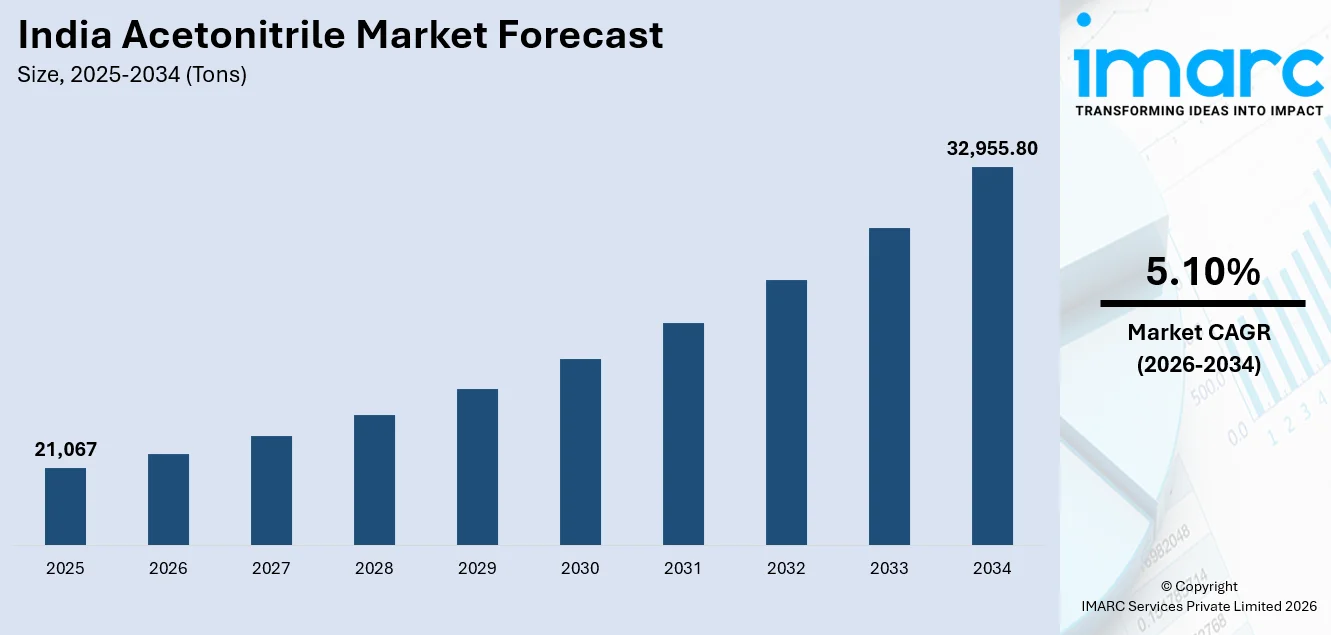
The India acetonitrile market size reached 21,067 Tons in 2025 and is projected to reach 32,955.80 Tons by 2034, growing at a compound annual growth rate of 5.10% from 2026-2034.
The market is fueled by the continuous demand from pharmaceutical manufacturing, agrochemical synthesis, and analytical laboratories. The factors that promote growth include the increasing domestic production of drugs, export of active pharmaceutical ingredients, and the use of high-purity solvents in chromatography. The supply conditions are strongly associated with the petrochemical supply, and the pricing is vulnerable to the feedstock in India.
Key Takeaways and Insights:
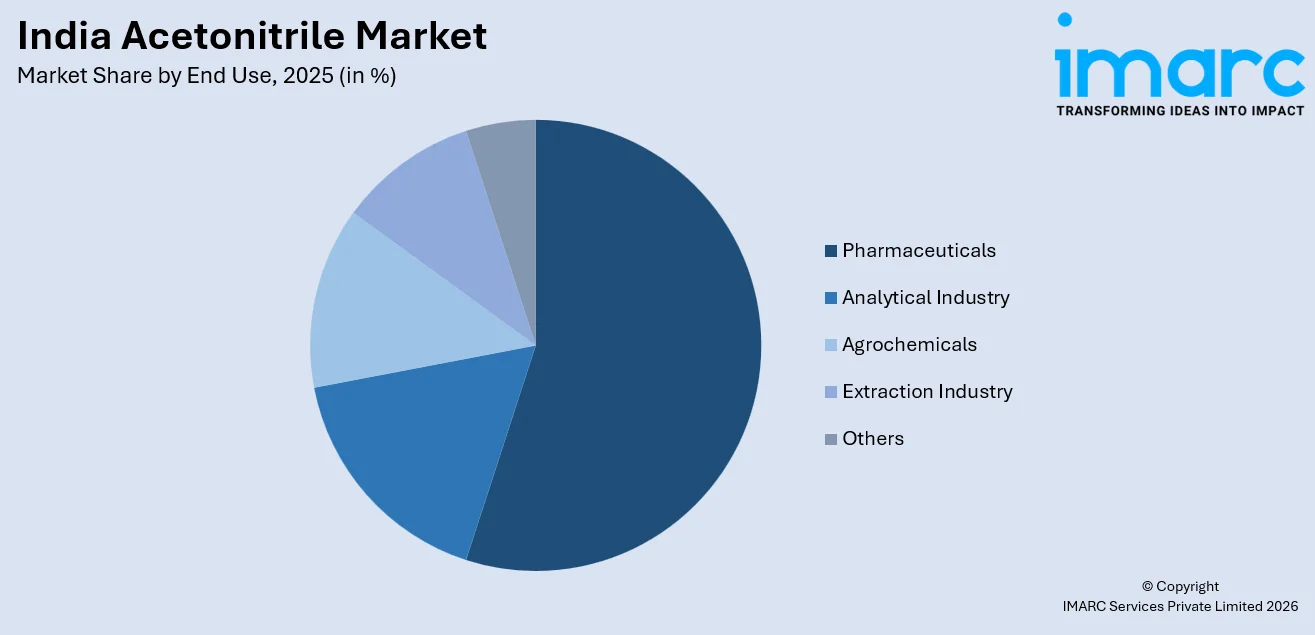
- By End Use: Pharmaceuticals dominate the market with a share of 55% in 2025, driven by India’s position as a leading global manufacturer of generic drugs and active pharmaceutical ingredients.
- Key Players: The India acetonitrile market features a moderately competitive landscape with domestic specialty chemical manufacturers expanding production capacities to reduce import dependence, alongside global suppliers maintaining supply through established trade channels.
To get more information on this market Request Sample
The India acetonitrile market is shaped by its critical role as a solvent in pharmaceutical manufacturing, agrochemical production, and laboratory applications. According to the data published by India Brand Equity Foundation, India’s agrochemicals industry is projected to grow at a 9% CAGR from FY25 to FY28, expanding from USD 10.3 Billion to USD 14.5 Billion. Demand is mainly driven by the growing active pharmaceutical ingredient manufacturing base in the country, rising formulation capacity, and steady growth in contract research and testing services. High-purity acetonitrile is also finding increasing acceptance because of its widespread use in chromatography and analytical applications, which are a result of stricter quality requirements in the regulated sectors. On the supply side, market forces are still impacted by the lack of domestic manufacturing capacity and dependence on imports, which are sensitive to upstream petrochemical production. Market pricing is thus closely tied to upstream feedstock and logistics costs. The overall market trend is stable to positive, supported by long-term growth in the pharmaceutical, life science research, and specialty chemical sectors in India.
India Acetonitrile Market Trends:
Growing Use in Analytical Applications
The application of acetonitrile in analytical and testing purposes is growing steadily, especially in chromatography and quality assurance testing. The pharmaceutical and biotech industry, as well as research institutions, are increasing the intensity of their analytical testing to ensure greater compliance. This is why high purity grades are finding favor, which will help the value growth, even if the volume growth is moderate. This is a part of the overall trend towards precision-driven manufacturing and testing protocols in the India acetonitrile market.
Rising Pharmaceutical Solvent Demand
Demand growth is strongly supported by increasing pharmaceutical manufacturing activity across formulations and active pharmaceutical ingredients. India’s pharmaceutical industry, the world’s largest generic drug supplier, ranks third globally by volume and 14th by value, growing at a 9.43% CAGR and contributing 1.72% to GDP. Valued at USD 55 Billion in 2025 and projected to reach USD 120-130 Billion by 2030, this expansion reinforces acetonitrile usage as a critical reaction and purification solvent in high volume drug production and quality control. Rising domestic capacity, export-oriented manufacturing, and tighter regulatory scrutiny are sustaining consistent demand across the India acetonitrile market.
Supply Sensitivity and Pricing Volatility
Market dynamics are still driven by the relatively low domestic production base and reliance on imported volumes, making them sensitive to global supply trends. Supply is inextricably tied to upstream petrochemical production, logistics optimization, and global trade patterns. Consequently, prices have tended to be volatile in reaction to feedstock trends and regional supply shortages. Buyers are increasingly concerned with supply chain security and sourcing strategies to mitigate price risks, influencing purchasing decisions in India.
Market Outlook 2026-2034:
The market outlook for India acetonitrile remains stable to positive, driven by growth in pharmaceutical production, specialty chemical production, and research. The market is expected to move forward in a positive manner as domestic production capacity increases. Although supply chain constraints and price sensitivity are expected to continue, the market fundamentals are positive. Industrialization and process development will continue to drive market trends in India. The market size was estimated at 21,067 Tons in 2025 and is expected to reach 32,955.80 Tons by 2034, reflecting a compound annual growth rate of 5.10% over the forecast period 2026-2034.
India Acetonitrile Market Report Segmentation:
|
Segment Category |
Leading Segment |
Market Share |
|
End Use |
Pharmaceuticals |
55% |
End Use Insights:
Access the comprehensive market breakdown Request Sample
- Pharmaceuticals
- Analytical Industry
- Agrochemicals
- Extraction Industry
- Others
The pharmaceuticals dominate with a market share of 55% of the total India acetonitrile market in 2025.
The pharmaceuticals segment dominates the India acetonitrile market, driven by its extensive use as a solvent and reaction medium in active pharmaceutical ingredient synthesis, purification, and analytical testing. This dominance is reinforced by the strong expansion of the domestic drug industry, with the India pharmaceutical market size valued at USD 68.38 Billion in 2025 and projected to reach USD 174.67 Billion by 2034, supporting sustained solvent demand from large scale formulation and export-oriented manufacturing.
Continued expansion of pharmaceutical manufacturing capacity further strengthens the leadership of this segment in the India acetonitrile market. Rising investments in complex generics, contract research, and contract manufacturing increase solvent intensity per unit of output. Additionally, the growing adoption of advanced analytical techniques in compliance driven environments elevates recurring demand, while stable procurement cycles and long-term supply arrangements consolidate pharmaceuticals as the most consistent end use segment.
Regional Insights:
- North India
- West and Central India
- East India
- South India
North India plays a significant role in the India acetonitrile market, supported by a dense concentration of pharmaceutical manufacturing hubs and research facilities. Strong demand from formulation units, analytical laboratories, and bulk drug producers drives steady consumption. Proximity to regulatory bodies and export focused manufacturers further strengthens regional demand stability.
West and Central India represent a major consumption base for the India acetonitrile market due to the presence of large-scale chemical and pharmaceutical clusters. Integrated industrial ecosystems, advanced infrastructure, and port connectivity support high volume procurement. Consistent production activity and contract manufacturing operations sustain long term solvent demand across the region.
East India contributes moderately to the India acetonitrile market, with demand primarily driven by emerging pharmaceutical units and research institutions. Gradual industrial development, coupled with increasing investments in specialty chemicals, supports incremental growth. Consumption remains stable, reflecting steady expansion rather than large scale capacity additions.
South India holds a strong position in the India acetonitrile market, underpinned by a well-established pharmaceutical and biotechnology base. High concentration of research centers, analytical testing facilities, and export-oriented manufacturers drives consistent usage. Focus on innovation, compliance, and high purity processes sustains robust regional demand.

Market Dynamics:
Growth Drivers:
Why is the India Acetonitrile Market Growing?
Expansion of Domestic Manufacturing Capacity
Growth in the India acetonitrile market is supported by sustained investments in domestic pharmaceutical and specialty chemical manufacturing capacity. New plants, capacity expansions, and backward integration initiatives are increasing solvent consumption at the production stage. Government focus on strengthening local manufacturing ecosystems is encouraging higher output volumes, which directly translates into consistent demand for process solvents. This structural expansion provides a long-term growth foundation independent of short-term market fluctuations.
Diversification of End Use Industries
Beyond pharmaceuticals, expanding usage across agrochemicals, electronics chemicals, and industrial processing is contributing to market growth. The India agrochemicals market size reached USD 15.5 Billion in 2024 and is expected to expand to USD 23.3 Billion by 2033, reinforcing solvent demand for synthesis and purification applications. Increasing reliance on acetonitrile across these segments supports processing efficiency, reduces dependence on a single end use sector, and broadens the overall demand base as industrial activity and process sophistication scale across India.
Rising Export Oriented Production Activity
Increasing exports of pharmaceuticals, intermediates, and specialty chemicals are acting as a key growth driver. Export focused manufacturers require stable input availability to meet international delivery schedules and quality benchmarks. Acetonitrile demand benefits from higher production runs aimed at global markets, particularly regulated regions. As export competitiveness improves, solvent consumption rises in parallel, reinforcing steady volume growth for the India acetonitrile market across multiple end use segments.
Market Restraints:
What Challenges the India Acetonitrile Market is Facing?
High Import Dependence
The India acetonitrile market faces challenges due to limited domestic production capacity, resulting in heavy reliance on imports. This dependence exposes buyers to supply uncertainties arising from international market disruptions, trade policy changes, and shipping constraints. Import led procurement can also extend lead times, making inventory planning and supply continuity more complex for end users.
Feedstock Availability Constraints
Acetonitrile availability is closely linked to upstream petrochemical operations, as it is largely produced as a byproduct. Any operational slowdowns, maintenance shutdowns, or shifts in production economics at upstream facilities can directly affect output levels. This structural linkage limits supply flexibility and creates periodic availability tightness in the domestic market.
Price Volatility and Cost Management
Frequent price fluctuations remain a key challenge for buyers due to sensitivity to global supply demand balances and feedstock movements. Volatile pricing complicates budgeting and procurement planning, particularly for manufacturers operating on fixed cost contracts. Managing solvent costs while maintaining quality and supply reliability continues to be a critical operational concern across India.
Competitive Landscape:
The competitive landscape of the India acetonitrile market is moderately consolidated, with competition shaped by a mix of import suppliers, regional distributors, and limited domestic producers. Market participants primarily compete on supply reliability, product purity, and consistency rather than aggressive price undercutting. Long term relationships with pharmaceutical and chemical manufacturers play a critical role in securing repeat demand. Import focused players with diversified sourcing networks are better positioned to manage supply disruptions, while domestic suppliers leverage proximity advantages and faster delivery cycles within India.
India Acetonitrile Market Report Coverage:
| Report Features | Details |
|---|---|
| Base Year of the Analysis | 2025 |
| Historical Period | 2020-2025 |
| Forecast Period | 2026-2034 |
| Units | ‘000 Tons |
| Scopr of the Report |
Exploration of Historical Trends and Market Outlook, Industry Catalysts and Challenges, Segment-Wise Historical and Future Market Assessment:
|
| End Uses Covered | Pharmaceuticals, Analytical Industry, Agrochemicals, Extraction Industry, Others |
| Region Covered | North India, West and Central India, South India, East India |
| Customization Scope | 10% Free Customization |
| Post-Sale Analyst Support | 10-12 Weeks |
| Delivery Format | PDF and Excel through Email (We can also provide the editable version of the report in PPT/Word format on special request) |
Frequently Asked Questions About the India Acetonitrile Market Report
The India acetonitrile market reached a volume of 21,067 Tons in 2025.
The India acetonitrile market is expected to grow at a compound annual growth rate of 5.10% from 2026-2034 to reach 32,955.80 Tons by 2034.
The pharmaceuticals segment held the largest India acetonitrile market share, accounting for 55% of total demand, supported by extensive use in active pharmaceutical ingredient manufacturing, purification processes, and analytical testing. Strong domestic production, export demand, and strict quality compliance sustained consistently high consumption levels.
Key factors driving the India acetonitrile market include expanding pharmaceutical manufacturing capacity, rising demand for high purity solvents in analytical applications, growth in contract research and manufacturing services, and increasing export-oriented drug production.
Major challenges include supply volatility linked to acrylonitrile availability, price fluctuations, dependence on imports, and stringent handling and environmental regulations that increase compliance and logistics costs.
Need more help?
- Speak to our experienced analysts for insights on the current market scenarios.
- Include additional segments and countries to customize the report as per your requirement.
- Gain an unparalleled competitive advantage in your domain by understanding how to utilize the report and positively impacting your operations and revenue.
- For further assistance, please connect with our analysts.
 Request Customization
 Speak to an Analyst
 Request Brochure
 Inquire Before Buying
Benefits of Customization
- Personalize this research
- Triangulate with your data
- Get data as per your format and definition
- Gain a deeper dive into a specific application, geography, customer, or competitor
- Any level of personalization
Get in Touch With Us
UNITED STATES
Phone: +1-201-971-6302
INDIA
Phone: +91-120-433-0800
UNITED KINGDOM
Phone: +44-753-714-6104
Email: [email protected]
Client Testimonials




.webp)




.webp)













Related Reports

Choose your plan
*Please note that the prices mentioned below are starting prices for each bundle type. Kindly contact our team for further details.*
Single User License
- 1 User License, Access on 2 Devices
- PDF Report + Excel Dataset (Password Protected)
- Lifetime Access
- No Printing Rights
- 10% Free Report Customization
- 10–12 Weeks of Analyst Support
Five User License
- Access for 5 Users, 2 Devices per User
- PDF Report + Excel Dataset (Password Protected)
- Lifetime Access
- Dedicated Account Manager
- 12–14 Weeks of Analyst Support
- No Printing Rights
- 15% Free Report Customization
- 25% Discount on Your Next Purchase
Corporate User License
- Unlimited User Access (Within Your Organization)
- PDF Report + Excel Dataset
- Lifetime Access
- Dedicated Account Manager
- 14–20 Weeks of Analyst Support
- No Printing Rights
- 20% Free Report Customization
- 30% Discount on Your Next Purchase
Essential Insights
What's included:
3 reports
- Lifetime Access
- PDF Reports
- Excel Datasets
- 2 Weeks of Free Analyst Support
- 2 User Licenses
- Access on 2 Devices
- Printing Rights
- Complimentary PowerPoint (PPT) Version
- Complimentary License Upgrade
Professional Access
What's included:
5 reports
- Lifetime Access
- PDF Reports
- Excel Datasets
- 8 Weeks of Free Analyst Support
- 2 User Licenses
- Access on 2 Devices
- Printing Rights
- Complimentary PowerPoint (PPT) Version
- Complimentary License Upgrade
Business Advantage
What's included:
8 reports
- Lifetime Access
- PDF Reports
- Excel Datasets
- 14 Weeks of Free Analyst Support
- 2 User Licenses
- Access on 2 Devices
- Printing Rights
- Complimentary PowerPoint (PPT) Version
- Complimentary License Upgrade
Enterprise Intelligence
What's included:
10 reports
- Lifetime Access
- PDF Reports
- Excel Datasets
- 20 Weeks of Free Analyst Support
- 2 User Licenses
- Access on 2 Devices
- Printing Rights
- Complimentary PowerPoint (PPT) Version
- Complimentary License Upgrade