
India Agritourism Market Size, Share, Trends and Forecast by Tourist Type, Activity, Booking Channel, Sales Channel, and Region, 2026-2034
India Agritourism Market Summary:
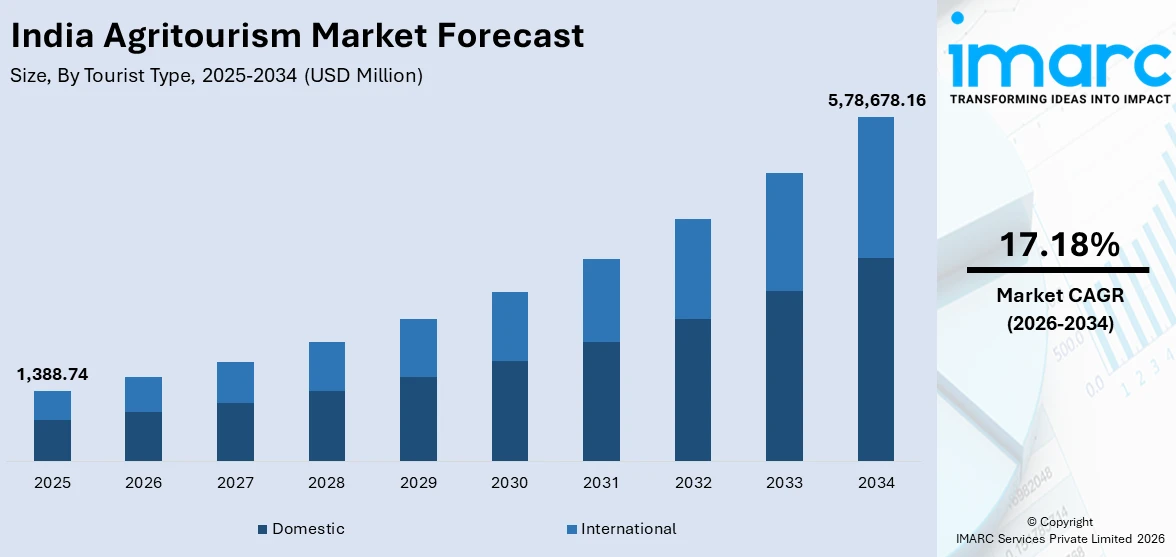
The India agritourism market size was valued at USD 1,388.74 Million in 2025 and is projected to reach USD 5,78,678.16 Million by 2034, growing at a compound annual growth rate of 17.18% from 2026-2034.
The India agritourism market is experiencing significant momentum as urban populations increasingly seek authentic rural experiences that combine agricultural heritage with recreational tourism. Rising disposable incomes, the growing environmental consciousness, and expanding digital infrastructure are catalyzing the demand for farm-based travel experiences. Government initiatives promoting rural tourism development, sustainable agriculture practices, and community-based tourism models are strengthening the market growth. Advancements in online booking platforms, increasing smartphone penetration, and the emergence of curated agritourism packages are reshaping visitor engagement patterns in the market.
Key Takeaways and Insights:
- By Tourist Type: Domestic dominates the market with a share of 78% in 2025, driven by the growing urban population seeking rural escapism, increasing awareness about farm-based experiences, and favorable government initiatives promoting domestic travel across India.
- By Activity: On-farm sales represent the largest segment with a market share of 30% in 2025, owing to the growing user preference for farm-fresh produce, direct farmer-to-consumer (DTC) engagement, and the appeal of authentic agricultural purchasing experiences during agritourism visits.
- By Booking Channel: Online leads the market with a share of 62% in 2025. This dominance is because of expanding internet penetration, smartphone-based travel planning, and the convenience of digital platforms offering curated farm stay experiences.
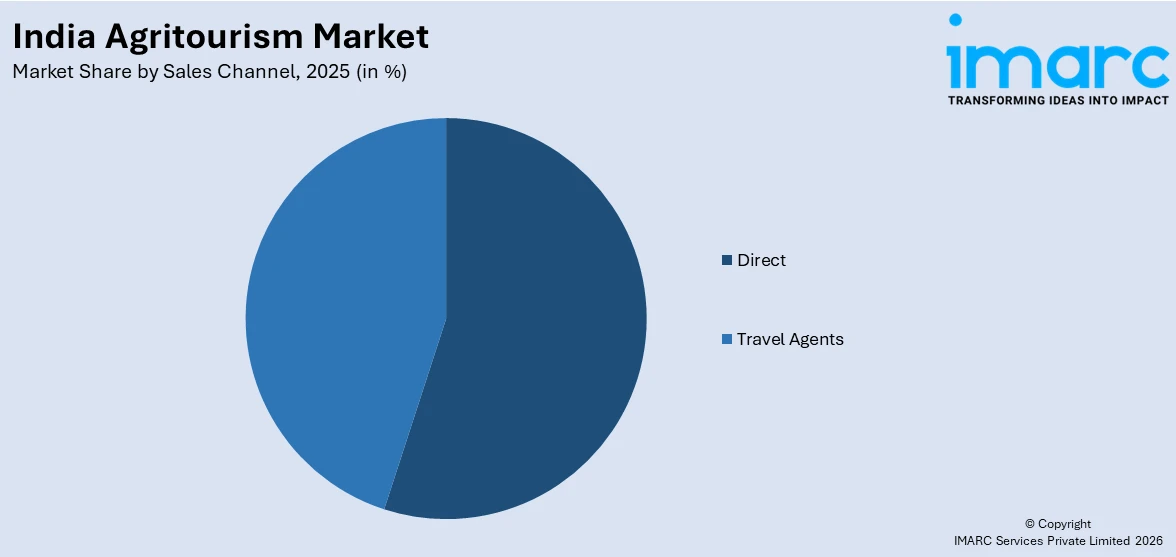
- By Sales Channel: Direct dominates the market with a share of 55% in 2025, supported by direct farmer-tourist interactions, farm-operated booking systems, and the growing preference for personalized agritourism experiences without intermediary involvement.
- By Region: North India represents the largest segment with a market share of 30% in 2025, due to its extensive agricultural landscapes, established tourism circuits, and strong state-level policy support for rural and farm-based tourism development.
- Key Players: The India agritourism market exhibits a fragmented competitive landscape, with numerous small-scale farm operators, regional tourism enterprises, and community-based organizations competing alongside organized hospitality chains and online travel platforms to capture market share and expand agritourism offerings.
To get more information on this market Request Sample
The India agritourism market is being driven by changing travel preferences, supportive rural development initiatives, and the steady expansion of urban populations seeking meaningful leisure experiences. As urban lifestyles become more fast-paced, travelers increasingly look for nature-based retreats that offer cultural immersion, wellness benefits, and hands-on agricultural activities. This shift is reinforced by demographic trends, as the Economic Survey 2023–24 highlights that more than 40% of India’s population is expected to live in urban areas by 2030, expanding the base of urban dwellers seeking rural escapes. Government-backed programs promoting agritourism as a source of rural income diversification are further strengthening the market growth. Improved connectivity, digital travel platforms, and online payment systems are enhancing accessibility and visibility of agritourism offerings. The growing interest in sustainability, community engagement, and educational travel continues to support agritourism’s evolution as a structured and inclusive segment of India’s domestic tourism market.
India Agritourism Market Trends:
State-Led Agritourism Promotion and Rural Livelihood Development Programs
The India agritourism market is being driven by increasing state-level initiatives that integrate tourism development with rural livelihood enhancement. Government-backed programs are encouraging structured agritourism growth by identifying priority destinations, improving visitor experiences, and creating supplementary income sources for farming communities. This momentum is reflected in 2025, when the governing body in Odisha identified 15 priority agritourism destinations under its Vision 2036 framework. Led jointly by the tourism and agriculture departments, the initiative promoted hands-on farm activities, local crafts, and regional cuisine. Supported through the Mukhyamantri Krushi Udyog Yojana, it also emphasized empowerment of women self-help groups and youth entrepreneurs, strengthening inclusive rural tourism expansion.
Educational Agritourism and Youth Engagement in Agricultural Awareness
The India agritourism market is being supported by the growing role of educational and learning-based farm tourism initiatives that connect visitors with agriculture. Agritourism is increasingly positioned as a platform for students and urban communities to gain hands-on exposure to farming practices, agriscience, and sustainable cultivation methods. This trend was reinforced in 2025 when ICAR–Krishi Vigyan Kendra in Shivamogga, Karnataka, launched the ‘Krishi Yaana’ program at its Navile campus, offering practical agricultural learning experiences for the public. Such initiatives help reconnect younger generations with rural livelihoods, increase awareness about sustainable farming systems, and contribute to agritourism demand beyond leisure travel into educational engagement.
Institutional Promotion of Rural Tourism Hubs
The India agritourism market is being driven by stronger institutional promotion of rural tourism and the organized development of farm stay infrastructure. State tourism bodies are increasingly positioning villages as experiential travel destinations while supporting homestay operators through incentives, training, and investment facilitation. This trend was highlighted in 2025 when Uttar Pradesh Tourism hosted the Rural Tourism Conclave in Lucknow, honoring over 40 farm stay and homestay owners and announcing that 234 villages have been identified as rural tourism hubs, with more than 750 homestays in development. Such initiatives strengthen rural livelihoods, improve accommodation capacity, and accelerate agritourism growth across emerging destinations.
Market Outlook 2026-2034:
The India agritourism market is poised for sustained advancement, supported by favorable demographic trends, expanding rural infrastructure, and rising demand for experiential tourism. The market generated a revenue of USD 1,388.74 Million in 2025 and is projected to reach a revenue of USD 5,78,678.16 Million by 2034, growing at a compound annual growth rate of 17.18% from 2026-2034. Increasing government investment in rural tourism circuits, digital integration of farm booking systems, and the growing individual preference for sustainable, nature-based travel experiences are expected to drive higher revenue streams and foster a more competitive and mature agritourism landscape across the country.
India Agritourism Market Report Segmentation:
|
Segment Category |
Leading Segment |
Market Share |
|
Tourist Type |
Domestic |
78% |
|
Activity |
On-farm Sales |
30% |
|
Booking Channel |
Online |
62% |
|
Sales Channel |
Direct |
55% |
|
Region |
North India |
30% |
Tourist Type Insights:
- Domestic
- International
Domestic dominates with a market share of 78% of the total India agritourism market in 2025.
Domestic leads the market due to the growing interest among travelers in India in authentic rural experiences, cultural engagement, and nature-based leisure. Increasing urban stress, rising disposable incomes, and demand for short distance weekend getaways are encouraging domestic visitors to explore farm stays, village tours, and local agricultural activities. Agritourism offers affordable travel options while promoting traditional lifestyles, regional cuisine, and hands on experiences. This strong domestic demand supports consistent visitor flows across agritourism destinations.
The dominance of domestic segment is further reinforced by improved rural connectivity, expansion of regional tourism initiatives, and greater promotion of local travel experiences. Many Indian families, students, and corporate groups prefer agritourism as an educational and recreational alternative to conventional tourism. Domestic also benefits from familiarity with local languages, customs, and lower travel costs compared to international visitors. As government programs promote rural development and sustainable tourism, domestic participation continues to hold the largest share of agritourism market in India.
Activity Insights:
- On-farm Sales
- Outdoor Recreation
- Agritainment
- Educational Tourism
- Accommodations
- Others
On-farm sales lead with a market share of 30% of the total India agritourism market in 2025.
On-farm sales dominate the market owing to the direct connection they create between farmers and visitors. Tourists increasingly value purchasing fresh produce, handmade food items, and locally processed goods directly from farms. This activity enhances visitor engagement while allowing farmers to generate additional income without complex infrastructure. On-farm sales also support transparency, authenticity, and trust, which are important factors for visitors seeking genuine rural experiences. The simplicity and immediate economic benefit of on-farm sales contribute to their strong adoption across agritourism destinations.
The dominance of on-farm sales is further reinforced by rising individual interest in organic products, traditional foods, and locally sourced goods. Visitors prefer farm-fresh items that reflect regional identity and agricultural practices. On-farm retail activities require lower investment compared to accommodation or large-scale experiences, making them accessible to small and marginal farmers. Government support for farmer producer organizations and rural entrepreneurship also encourages this model. As agritourism continues to expand, on-farm sales remain a core activity driving visitor satisfaction and revenue generation.
Booking Channel Insights:
- Online
- Offline
Online exhibits a clear dominance with a 62% share of the total India agritourism market in 2025.
Online represents the largest segment attributed to the increasing digitalization of travel planning and the growing preference for convenient, fast reservation systems. Tourists, especially urban dwellers, rely on online platforms to discover farm stays, compare packages, check reviews, and secure bookings with ease. Digital channels also help agritourism operators reach a wider audience beyond local networks, improving visibility and client engagement. The rise of smartphone usage and digital payment adoption further strengthens online booking as the dominant channel. As per the data provided by the IBEF, the population with smartphones is expected to reach 1.1 billion by 2025.
The dominance of online booking is reinforced by the expansion of travel aggregators, social media promotion, and rural tourism marketing initiatives. Agritourism experiences are often short duration trips, making online booking a practical option for weekend planning and group travel arrangements. Visitors value transparency in pricing, availability, and service offerings, which online platforms provide efficiently. Operators also benefit from streamlined communication and reduced reliance on intermediaries. As India’s tourism sector becomes increasingly technology driven, online booking continues to shape growth in the agritourism market.
Sales Channel Insights:
Access the comprehensive market breakdown Request Sample
- Travel Agents
- Direct
Direct dominates with a market share of 55% of the total India agritourism market in 2025.
Direct holds the biggest market share because of the personalized interaction it enables between farmers and visitors. Tourists often prefer direct communication with agritourism operators to understand farm activities, seasonal experiences, and accommodation details. This approach builds trust, ensures clarity, and allows customized experiences based on visitor preferences. Direct sale also helps farmers avoid commission fees charged by intermediaries, improving profitability. The simplicity of direct engagement supports strong adoption, especially among small and family operated agritourism enterprises across rural regions.
The dominance of direct sale is further reinforced by the community-based nature of agritourism in India. Many visitors rely on word of mouth, local networks, and repeat visits when planning farm experiences. Direct channel allows operators to manage bookings flexibly and maintain personal relationships with guests. Farmers can also promote on-site activities, local products, and add on experiences during direct interactions. As agritourism focuses on authenticity and cultural exchange, direct sale remains the preferred channel supporting the market growth.
Regional Insights:
- North India
- West and Central India
- South India
- East India
North India leads with a market share of 30% of the total India agritourism market in 2025.
North India exhibits a clear dominance in the market driven by its rich agricultural heritage, diverse rural landscapes, and strong domestic tourism activity. The region offers a wide range of farm-based experiences, including crop cultivation visits, dairy tourism, and traditional village lifestyles that attract urban travelers. High population density and proximity to major cities, such as Delhi and Chandigarh, support frequent short distance travel to rural destinations. This accessibility strengthens visitor inflows and positions North India as a key hub for agritourism growth.
The dominance of North India is further reinforced by established rural tourism circuits, cultural diversity, and increasing investment in farm stay infrastructure. States in the region benefit from fertile agricultural zones and well-known local produce, enhancing the appeal of farm-based leisure and educational tourism. Government initiatives promoting rural entrepreneurship and sustainable tourism also encourage agritourism development. With rising demand for authentic countryside experiences among domestic travelers, North India continues to capture the largest share of agritourism activity in the country.

Market Dynamics:
Growth Drivers:
Why is the India Agritourism Market Growing?
Expanding Domestic Tourism Base Fueling Rural Travel Demand
India's domestic tourism sector is experiencing unprecedented growth, creating a substantial demand base for agritourism and farm-based travel experiences. India recorded approximately 2,948.19 Million domestic tourist visits in 2024, marking a 17.5% increase over the previous year, as per the India Tourism Data Compendium 2025 published by the Ministry of Tourism. This robust growth in domestic travel is driving increasing visitor flows toward experiential and rural tourism segments. Rising disposable incomes among the expanding middle class, the growing preference for weekend getaways and short-duration trips, and increasing interest in nature-based and heritage experiences are channeling domestic travelers toward farm stays, agricultural tours, and rural recreational activities across diverse Indian states.
Digital Infrastructure Expansion Enabling Farm Tourism Accessibility
India’s expanding digital infrastructure is significantly reshaping the way agritourism offerings are promoted, accessed, and booked by individuals. The growth of the online travel market, which as per the IMARC Group, reached USD 51.00 Billion in 2024, is enabling farm operators in rural and remote areas to reach urban audiences seeking authentic agricultural and village-based experiences. Improved rural internet connectivity under national digital initiatives is strengthening online participation by agritourism providers. In addition, vernacular-language interfaces on travel platforms are drawing users from tier-two and tier-three cities. Digital payment systems, integrated booking platforms, and social media marketing tools are lowering entry barriers for farmers, supporting the professionalization and scalability of agritourism activities.
Rising Demand for Experiential and Rural-Based Travel
The India agritourism market is being supported by a growing preference among individuals for experiential travel that emphasizes cultural authenticity, relaxation, and engagement with local communities. Urban travelers are increasingly seeking alternatives to conventional tourism, opting for farm stays and rural destinations that offer participatory activities and a slower, more immersive pace of life. Agritourism responds effectively to this demand by providing direct exposure to agricultural practices, traditional lifestyles, and regional cuisines. The rising interest in personalized, nature-based travel experiences is encouraging repeat visitation and longer stays, contributing to the growth of the agritourism market in India.
Market Restraints:
What Challenges the India Agritourism Market is Facing?
Inadequate Rural Infrastructure Limiting Tourism Readiness
Poor road connectivity, limited public transportation, inadequate sanitation facilities, and insufficient healthcare access in remote rural areas significantly deter tourists and restrict the scalability of agritourism operations. Many potential agritourism sites remain inaccessible during monsoon seasons, while farmers lack the financial resources to invest in accommodation upgrades, hygiene improvements, and hospitality training necessary to meet visitor expectations.
Limited Awareness and Standardization of Agritourism Offerings
Low individual awareness about agritourism opportunities and the absence of standardized quality benchmarks across farm tourism operations impede the market penetration. Many potential visitors remain unfamiliar with available agritourism destinations, while inconsistent service quality across unregulated farm stays creates uncertainty and dampens repeat visitation and positive word-of-mouth recommendations.
Seasonal Dependency Constraining Year-Round Revenue Generation
Agritourism operations in India are heavily dependent on agricultural seasons and favorable weather conditions, creating significant revenue fluctuations throughout the year. Harvest seasons and pleasant weather periods attract peak visitor flows, while off-seasons characterized by extreme heat, monsoon rains, or limited agricultural activity result in substantially reduced tourist engagement and financial challenges for farm operators.
Competitive Landscape:
The India agritourism market exhibits a highly fragmented competitive structure characterized by numerous small-scale farm operators, community-based tourism organizations, and regional hospitality enterprises operating alongside organized travel platforms and state-supported development corporations. Market dynamics reflect diverse positioning, ranging from premium plantation stays offering luxury accommodations to budget-friendly farm experiences targeting domestic family travelers. Competition is increasingly shaped by digital visibility, online review ratings, social media marketing effectiveness, and the ability to offer differentiated, authentic agricultural experiences. Strategic partnerships between farm operators and online travel agencies, integration of sustainable practices, and government certification programs are emerging as key competitive differentiators shaping market positioning and visitor preference patterns.
Recent Developments:
- September 2025: Uttar Pradesh Tourism launched its first-ever farm stay investment drive to promote agritourism and transform villages into rural travel destinations. The scheme invited investors to build farm-based accommodations with immersive activities, supported by incentives like capital subsidies, interest support, and full exemptions on stamp duty and development charges. The initiative aimed to boost farmer incomes, create local jobs, and strengthen Uttar Pradesh’s position as a leading hub for authentic rural tourism.
- September 2025: Bengaluru saw the launch of its first pomegranate farm tourism initiative at NCR Farm near Yelahanka. The model allowed visitors to harvest pomegranates directly from orchards at nearly half the market price, creating a direct farmer-consumer link. The initiative blended leisure, education, and fair pricing, offering farmers better returns while introducing urban residents to farm-based tourism.
India Agritourism Market Report Coverage:
| Report Features | Details |
|---|---|
| Base Year of the Analysis | 2025 |
| Historical Period | 2020-2025 |
| Forecast Period | 2026-2034 |
| Units | Million USD |
| Scope of the Report |
Exploration of Historical Trends and Market Outlook, Industry Catalysts and Challenges, Segment-Wise Historical and Future Market Assessment:
|
| Tourist Types Covered | Domestic, International |
| Activities Covered | On-farm Sales, Outdoor Recreation, Agritainment, Educational Tourism, Accommodations, Others |
| Booking Channels Covered | Online, Offline |
| Sales Channels Covered | Travel Agents, Direct |
| Region Covered | North India, West and Central India, South India, East India |
| Customization Scope | 10% Free Customization |
| Post-Sale Analyst Support | 10-12 Weeks |
| Delivery Format | PDF and Excel through Email (We can also provide the editable version of the report in PPT/Word format on special request) |
Frequently Asked Questions About the India Agritourism Market Report
The India agritourism market size was valued at USD 1,388.74 Million in 2025.
The India agritourism market is expected to grow at a compound annual growth rate of 17.18% from 2026-2034 to reach USD 5,78,678.16 Million by 2034.
Domestic dominates the India agritourism market with a share of 78% in 2025, driven by the growing urban population seeking rural escapism, increasing awareness about farm-based experiences, and favorable government initiatives promoting domestic travel across India.
Key factors driving the India agritourism market include state-led programs that link tourism with rural income generation. This was evident in 2025 when Odisha identified 15 priority agritourism destinations under Vision 2036, promoting farm activities, local crafts, and community entrepreneurship.
Major challenges include inadequate rural infrastructure and road connectivity, limited individual awareness about agritourism offerings, absence of standardized quality benchmarks, seasonal dependency constraining year-round operations, and insufficient financial resources for farmers to invest in tourism-grade facilities.
Need more help?
- Speak to our experienced analysts for insights on the current market scenarios.
- Include additional segments and countries to customize the report as per your requirement.
- Gain an unparalleled competitive advantage in your domain by understanding how to utilize the report and positively impacting your operations and revenue.
- For further assistance, please connect with our analysts.
 Request Customization
 Speak to an Analyst
 Request Brochure
 Inquire Before Buying
Benefits of Customization
- Personalize this research
- Triangulate with your data
- Get data as per your format and definition
- Gain a deeper dive into a specific application, geography, customer, or competitor
- Any level of personalization
Get in Touch With Us
UNITED STATES
Phone: +1-201-971-6302
INDIA
Phone: +91-120-433-0800
UNITED KINGDOM
Phone: +44-753-714-6104
Email: [email protected]
Client Testimonials




.webp)




.webp)













Related Reports

Choose your plan
*Please note that the prices mentioned below are starting prices for each bundle type. Kindly contact our team for further details.*
Single User License
- 1 User License, Access on 2 Devices
- PDF Report + Excel Dataset (Password Protected)
- Lifetime Access
- No Printing Rights
- 10% Free Report Customization
- 10–12 Weeks of Analyst Support
Five User License
- Access for 5 Users, 2 Devices per User
- PDF Report + Excel Dataset (Password Protected)
- Lifetime Access
- Dedicated Account Manager
- 12–14 Weeks of Analyst Support
- No Printing Rights
- 15% Free Report Customization
- 25% Discount on Your Next Purchase
Corporate User License
- Unlimited User Access (Within Your Organization)
- PDF Report + Excel Dataset
- Lifetime Access
- Dedicated Account Manager
- 14–20 Weeks of Analyst Support
- No Printing Rights
- 20% Free Report Customization
- 30% Discount on Your Next Purchase
Essential Insights
What's included:
3 reports
- Lifetime Access
- PDF Reports
- Excel Datasets
- 2 Weeks of Free Analyst Support
- 2 User Licenses
- Access on 2 Devices
- Printing Rights
- Complimentary PowerPoint (PPT) Version
- Complimentary License Upgrade
Professional Access
What's included:
5 reports
- Lifetime Access
- PDF Reports
- Excel Datasets
- 8 Weeks of Free Analyst Support
- 2 User Licenses
- Access on 2 Devices
- Printing Rights
- Complimentary PowerPoint (PPT) Version
- Complimentary License Upgrade
Business Advantage
What's included:
8 reports
- Lifetime Access
- PDF Reports
- Excel Datasets
- 14 Weeks of Free Analyst Support
- 2 User Licenses
- Access on 2 Devices
- Printing Rights
- Complimentary PowerPoint (PPT) Version
- Complimentary License Upgrade
Enterprise Intelligence
What's included:
10 reports
- Lifetime Access
- PDF Reports
- Excel Datasets
- 20 Weeks of Free Analyst Support
- 2 User Licenses
- Access on 2 Devices
- Printing Rights
- Complimentary PowerPoint (PPT) Version
- Complimentary License Upgrade