
India Almond Oil Market Size, Share, Trends and Forecast by Type, Application, Distribution Channel, and Region, 2026-2034
India Almond Oil Market Summary:
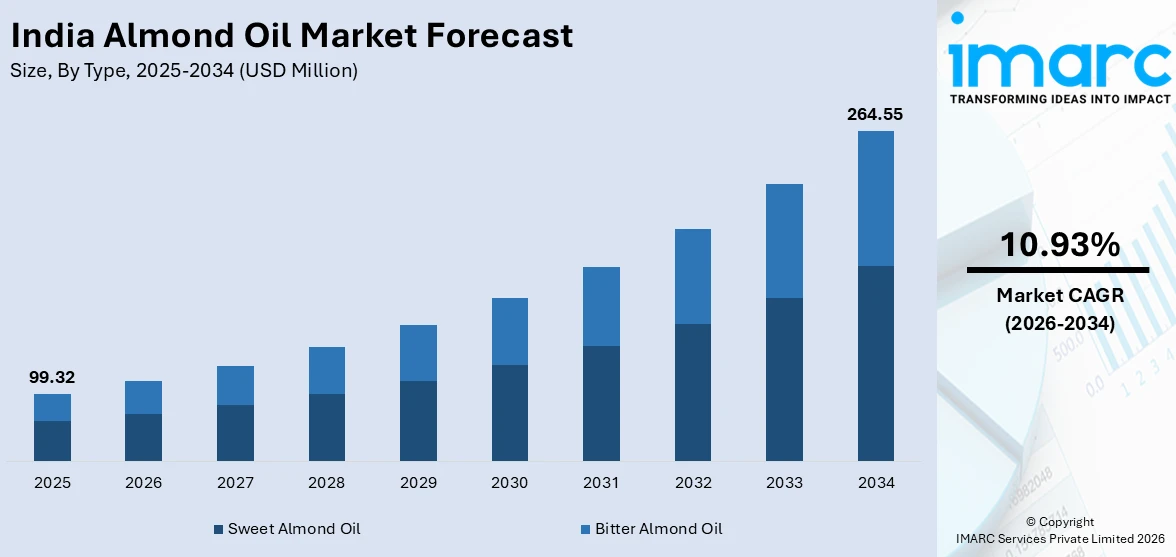
The India almond oil market size was valued at USD 99.32 Million in 2025 and is projected to reach USD 264.55 Million by 2034, growing at a compound annual growth rate of 10.93% from 2026-2034.
The India almond oil market is witnessing a steady growth with the increasing preference for natural and plant-based ingredients. The awareness about health, the need for chemical-free beauty products, and the ancient practice of Ayurvedic health are further propelling the demand. The advancements in cold-pressed extraction methods, the development of retail infrastructure, and the rising impact of e-commerce platforms are further changing the consumption patterns and increasing the India almond oil market share.
Key Takeaways and Insights:
-
By Type: Sweet almond oil leads the market with a share of 86.8% in 2025, driven by its mild composition, versatile application across cosmetics and food preparation, and its widespread preference as a safe and nourishing natural ingredient.
-
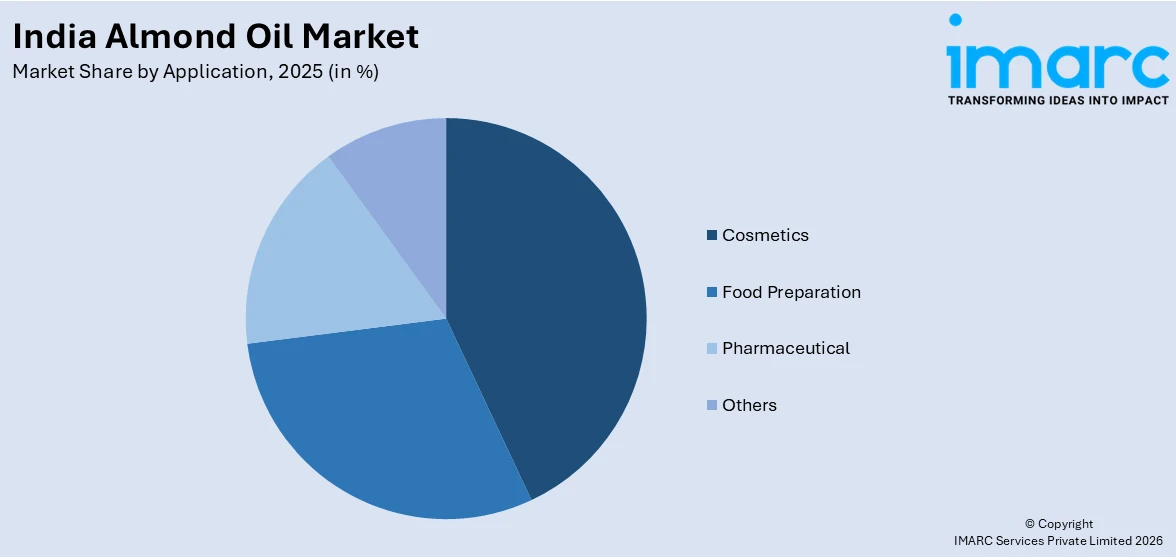
By Application: Cosmetics dominates the market with a share of 42.7% in 2025, owing to almond oil’s proven moisturizing, anti-inflammatory, and skin-nourishing properties that align with the growing consumer shift toward natural and chemical-free beauty products.
-
By Distribution Channel: Supermarkets and hypermarkets hold the largest share of 31.9% in 2025, supported by wide product visibility, organized retail expansion, and consumer preference for physical inspection before purchasing personal care and food-grade oil products.
-
By Region: North India dominates the market with a share of 33.2% in 2025, driven by strong cultural affinity toward almond-based wellness remedies, higher per capita consumption, and well-established distribution networks across metropolitan and semi-urban areas.
-
Key Players: The India almond oil market features a moderately competitive landscape, with established domestic manufacturers and global suppliers competing through product innovation, brand positioning, distribution expansion, and strategic diversification across personal care and food segments.
To get more information on this market Request Sample
The India almond oil market is moving ahead steadily as consumers in the country are increasingly showing preference for natural and wellness-based products. Almond oil, known for its high vitamin E content, essential fatty acids, and antioxidant properties, is seeing an increasing demand in the market for its use in skincare, haircare, aromatherapy, and culinary applications. The use of almond oil in the formulation of Ayurvedic and herbal products is further increasing its demand among health-conscious consumers who are looking for chemical-free products. In October 2024, the Government of India approved the National Mission on Edible Oils–Oilseeds with a budget of ₹10,103 crore to boost domestic oilseed production, expand cultivation, and strengthen oil extraction and processing infrastructure, supporting the broader availability and value chain development of plant-based oils in the country. The increasing retail modernization and premiumization trends in the country are further increasing the accessibility of the market and product diversification in India.
India Almond Oil Market Trends:
Rising Demand for Natural and Clean-Label Personal Care Products
Indian consumers are increasingly gravitating toward personal care products formulated with natural, organic, and plant-based ingredients, driving demand for almond oil in skincare and haircare formulations. Growing awareness about the harmful effects of synthetic chemicals such as parabens, sulfates, and artificial fragrances is encouraging a shift toward clean-label alternatives. In August 2024, Marico Ltd. launched its Hair & Care Oil in Serum enriched with almond oil and vitamin E, combining the styling benefits of a serum with the nourishing properties of almond oil to address consumer demand for lightweight, plant-based haircare solutions. This preference aligns with the broader wellness movement and is reshaping product development strategies across the beauty and personal care industry, supporting India almond oil market growth.
Integration of Almond Oil in Ayurvedic and Traditional Wellness Solutions
India’s deeply rooted Ayurvedic tradition continues to play a pivotal role in shaping consumer preferences for almond oil-based products. Almond oil, known as Badam Taila in Ayurveda, is extensively used in traditional remedies for skin nourishment, hair strengthening, and massage therapies. In December 2025, the Government of India launched the Ayush Mark certification to establish global quality standards and improve credibility for Ayurvedic and herbal products, strengthening consumer trust and encouraging the use of traditional ingredients such as almond oil in certified wellness formulations. The growing mainstream acceptance of Ayurvedic principles, combined with increasing government support for the traditional medicine sector, is reinforcing the incorporation of almond oil into modern herbal and wellness formulations.
Premiumization and Innovation in Multi-Functional Product Formats
The Indian market is witnessing a notable shift toward premium, multi-functional almond oil products that combine traditional nourishment with modern convenience. Cold-pressed, organic, and unrefined variants are gaining traction among discerning consumers seeking higher-quality options. In August 2023, Bajaj Consumer Care Limited launched Bajaj Almond Drops Nourishing Body Lotion in the skincare category, extending its almond-based personal care portfolio to offer lightweight, premium formulations aligned with evolving consumer demand for multi-functional and convenient beauty solutions. Product innovation is also driving the development of hybrid formats such as oil-serum blends, fortified formulations, and lightweight non-greasy compositions that cater to evolving urban consumer preferences for functional yet easy-to-use beauty and wellness solutions.
Market Outlook 2026-2034:
The India almond oil market is poised for sustained growth over the forecast period, supported by expanding consumer awareness, rising disposable incomes, and growing preference for natural ingredients across personal care, food, and pharmaceutical applications. Increasing adoption of Ayurvedic and herbal wellness practices is further strengthening demand for almond oil-based formulations. The expanding organized retail landscape, deeper e-commerce penetration into tier-2 and tier-3 cities, and ongoing product innovations in cold-pressed and organic variants are expected to strengthen revenue streams and foster a more diverse, competitive, and consumer-centric almond oil market across India. The market generated a revenue of USD 99.32 Million in 2025 and is projected to reach a revenue of USD 264.55 Million by 2034, growing at a compound annual growth rate of 10.93% from 2026-2034.
India Almond Oil Market Report Segmentation:
|
Segment Category |
Leading Segment |
Market Share |
|
Type |
Sweet Almond Oil |
86.8% |
|
Application |
Cosmetics |
42.7% |
|
Distribution Channel |
Supermarkets and Hypermarkets |
31.9% |
|
Region |
North India |
33.2% |
Type Insights:
- Sweet Almond Oil
- Bitter Almond Oil
The sweet almond oil dominates with a market share of 86.8% of the total India almond oil market in 2025.
Sweet almond oil dominates the India almond oil market owing to its mild, non-toxic composition that makes it suitable for a wide range of applications, including skincare, haircare, food preparation, and aromatherapy. Its rich nutritional profile, featuring high concentrations of vitamin E, oleic acid, and linoleic acid, has positioned it as a preferred ingredient in both traditional Ayurvedic remedies and modern cosmetic formulations. Indian consumers have long valued sweet almond oil for its emollient and moisturizing properties in daily wellness routines.
The increasing trend of consumers opting for plant-based and chemical-free products is also adding to the preference for sweet almond oil over bitter almond oil. Its mild properties make it a preferred choice for sensitive skin products, baby oil massage, and cooking purposes where a mild flavor is required. The increasing reach of cold-pressed and organic variants of sweet almond oil through modern retailing and online shopping is making it easily accessible to various consumer groups.
Application Insights:
Access the comprehensive market breakdown Request Sample
- Food Preparation
- Cosmetics
- Pharmaceutical
- Others
The cosmetics leads with a share of 42.7% of the total India almond oil market in 2025.
The cosmetics segment holds the largest share in the India almond oil market, driven by growing consumer demand for natural and plant-based beauty solutions. Almond oil is widely incorporated into skincare products such as moisturizers, serums, facial oils, and anti-aging formulations owing to its proven hydrating, anti-inflammatory, and skin-brightening benefits. The India cosmetics market size was valued at USD 15.46 Billion in 2025 and is projected to reach USD 25.39 Billion by 2034, reflecting the expanding opportunity for almond oil-based formulations within the broader beauty sector. In the haircare segment, almond oil remains a staple ingredient in hair oils, conditioners, and scalp treatment products that cater to diverse consumer needs across the country.
The rising influence of clean beauty trends and increasing preference for chemical-free cosmetics are reinforcing almond oil's prominence in India's personal care industry. Consumers are actively seeking products with transparent ingredient lists and natural compositions, positioning almond oil as a trusted and versatile cosmetic ingredient. The expanding portfolio of Ayurvedic and herbal beauty brands incorporating almond oil into their formulations is further strengthening demand, while growing social media awareness and influencer-driven product endorsements are accelerating adoption among younger consumer demographics.
Distribution Channel Insights:
- Supermarkets and Hypermarkets
- Food Specialty Stores
- Pharmacy
- Cosmetic Discounters
- Others
The supermarkets and hypermarkets dominates with a market share of 31.9% of the total India almond oil market in 2025.
Supermarkets and hypermarkets act as the most prominent distribution channel for almond oil in the Indian market, leveraging the expansion of organized retailing, product range, and the capacity to provide a one-stop shopping experience for consumers. These shopping centers offer improved product visibility through personal care and food product aisles, special promotions, and pricing strategies. The increasing expansion of modern retailing chains in major cities and developing urban hubs is increasing the importance of the distribution channel in bridging the gap between consumers and the varied range of almond oil products.
The consumer preference for evaluating product labels, certifications, and packaging before making a purchase decision for personal care and food oils further reinforces the dominance of supermarkets and hypermarkets. These shopping centers also make it easier for consumers to get familiar with brands through product sampling, joint purchases, and loyalty programs. The planned expansion of organized retailing into semi-urban and tier-2 cities is increasing market reach, allowing more consumers to experience the benefits of high-quality, cold-pressed, and organic almond oil products in established retail settings.
Regional Insights:
- North India
- South India
- East India
- West India
North India exhibits a clear dominance with a 33.2% share of the total India almond oil market in 2025.
North India leads the India almond oil market, supported by strong cultural traditions that favor almond-based wellness and beauty practices. The region's consumer base demonstrates a pronounced preference for almond oil in daily haircare routines, cooking, and traditional massage therapies, reflecting deep-rooted Ayurvedic influence. Higher disposable incomes in metropolitan centers and well-established distribution networks of supermarkets, pharmacies, and specialty stores further facilitate product accessibility across both urban and semi-urban areas throughout the northern region.
The proximity to Jammu and Kashmir, which accounts for the majority of India's domestic almond cultivation, also supports supply chain efficiency and product freshness in the northern market. Cultural practices such as winter oil massage rituals, festive gifting traditions involving almond-based products, and the widespread use of almond oil in North Indian cuisine contribute to consistently higher per capita consumption. Growing retail modernization and expanding e-commerce infrastructure in the region are further strengthening demand across diverse consumer segments and product categories.

Market Dynamics:
Growth Drivers:
Why is the India Almond Oil Market Growing?
Increasing Consumer Shift Toward Natural and Organic Personal Care Products
The India almond oil market is benefiting significantly from the expanding consumer preference for natural, organic, and chemical-free personal care products. Indian consumers, particularly in urban and semi-urban areas, are becoming increasingly aware of the adverse effects associated with synthetic ingredients commonly used in conventional beauty and skincare products. This growing health consciousness is prompting a transition toward plant-based alternatives, with almond oil emerging as a preferred ingredient due to its well-documented moisturizing, anti-aging, and skin-nourishing properties. Reflecting this shift, the Union Budget 2026–27 highlighted increased government focus on supporting cultivation and processing of high‑value nuts like almonds to boost farmers’ income and domestic value addition, potentially strengthening supply chains for almond‑derived products in India. The clean beauty movement, reinforced by social media awareness and influencer-led product endorsements, is further accelerating demand for almond oil across skincare, haircare, and aromatherapy segments, creating a favorable environment for sustained market expansion.
Deep-Rooted Ayurvedic Tradition and Rising Mainstream Acceptance of Herbal Wellness
India’s rich heritage of Ayurvedic medicine and traditional wellness practices continues to serve as a foundational growth driver for the almond oil market. Almond oil has been an integral component of Ayurvedic treatments for centuries, used extensively in massage therapies, scalp nourishment, skin rejuvenation, and overall health maintenance. Reflecting the government’s ongoing support for traditional Indian medicine systems, the Ministry of Ayush and the World Health Organization signed a Memorandum of Understanding in 2025 to create a dedicated traditional medicine module within the International Classification of Health Interventions, aimed at integrating practices like Ayurveda into global health frameworks. The resurgence of interest in traditional Indian medicine systems, supported by government initiatives promoting Ayurveda and natural remedies, is broadening the consumer base for almond oil-infused products. This cultural affinity, combined with modern product innovation that blends Ayurvedic principles with contemporary formulation techniques, is reinforcing almond oil’s position as a trusted and versatile wellness ingredient across diverse consumer demographics.
Expanding Retail Infrastructure and E-Commerce Penetration
The rapid modernization of India’s retail landscape, coupled with the explosive growth of e-commerce platforms, is significantly enhancing the accessibility and distribution reach of almond oil products. The expansion of organized retail chains, supermarkets, and hypermarkets in tier-2 and tier-3 cities is bringing premium and branded almond oil products closer to a wider consumer base. Reflecting this broader retail transformation, Indian retail giant Reliance Retail announced in 2026 that it is piloting an integrated search‑and‑discovery platform to bridge online and offline shopping experiences across its thousands of stores, reinforcing omnichannel reach. Simultaneously, online marketplaces and direct-to-consumer channels are enabling brands to reach geographically dispersed consumers, offering product variety, competitive pricing, and convenient doorstep delivery. The growing adoption of quick-commerce services and digital payment solutions is further lowering purchase barriers, contributing to increased market penetration and volume growth across both established and emerging consumer segments.
Market Restraints:
What Challenges the India Almond Oil Market is Facing?
High Cost of Pure and Cold-Pressed Almond Oil Variants
The high pricing associated with pure, cold-pressed, and organic almond oil continues to be a major hindrance to wider adoption in the cost-conscious market of India. The price difference between almond oil and other popular oils such as coconut, mustard, and sesame oil is a major factor that deters cost-conscious consumers from adopting the product, thus impeding the shift from traditional oils to almond oil-based products.
Dependency on Almond Imports and Supply Chain Vulnerabilities
The domestic production of almonds in India is still far too low to satisfy the increasing demand, thereby requiring a large dependence on imports, mainly from the United States of America. Such dependence creates risks of variations in international prices of almonds, exchange rate fluctuations, and disruptions in the supply chain due to changes in trade policies and weather conditions influencing the production of almonds worldwide.
Prevalence of Adulterated and Low-Quality Products
The widespread availability of adulterated and counterfeit almond oil products in the Indian market poses a serious challenge to consumer trust and industry credibility. Unregulated manufacturing practices, insufficient quality control mechanisms, and the mixing of almond oil with cheaper substitutes such as mineral oils undermine product authenticity. This prevalence of substandard products discourages informed consumers from purchasing, affects brand reputation, and hampers overall market growth prospects.
Competitive Landscape:
The India almond oil market has a moderately fragmented level of competition, with the presence of well-established local and global players. The market players compete on various fronts, such as quality, pricing, brand, and innovation in product offerings. The market players are increasingly focusing on the development of cold-pressed, organic, and multi-functional almond oil products to target the growing premium segment of consumers. The market players are increasingly focusing on investments in expanding retail networks, improving e-commerce presence, and increasing brand visibility through celebrity endorsements and online marketing campaigns. The market also experiences continuous product diversification, with players using almond oil in various applications, such as skincare, culinary, and pharmaceutical products, to increase revenue streams.
Recent Developments:
-
In September 2025, Marico Limited expanded its Parachute Advansed superblend portfolio, including Almond Enriched Coconut Hair Oil designed to improve hair softness and nourishment. The expansion highlights growing integration of almond oil in premium haircare formulations, reinforcing its strategic importance as a key natural ingredient supporting product differentiation and strengthening Marico’s position in India’s value-added hair oil segment.
India Almond Oil Market Report Coverage:
|
Report Features |
Details |
|
Base Year of the Analysis |
2025 |
|
Historical Period |
2020-2025 |
|
Forecast Period |
2026-2034 |
|
Units |
Million USD |
|
Scope of the Report |
Exploration of Historical Trends and Market Outlook, Industry Catalysts and Challenges, Segment-Wise Historical and Future Market Assessment:
|
|
Types Covered |
Sweet Almond Oil, Bitter Almond Oil |
|
Applications Covered |
Food Preparation, Cosmetics, Pharmaceutical, Others |
|
Distribution Channels Covered |
Supermarkets and Hypermarkets, Food Specialty Stores, Pharmacy, Cosmetic Discounters, Others |
|
Regions Covered |
North India, South India, East India, West India |
|
Customization Scope |
10% Free Customization |
|
Post-Sale Analyst Support |
10-12 Weeks |
|
Delivery Format |
PDF and Excel through Email (We can also provide the editable version of the report in PPT/Word format on special request) |
Frequently Asked Questions About the India Almond Oil Market Report
The India almond oil market size was valued at USD 99.32 Million in 2025.
The India almond oil market is expected to grow at a compound annual growth rate of 10.93% from 2026-2034 to reach USD 264.55 Million by 2034.
Sweet almond oil, holding the largest share of 86.8%, leads the India almond oil market owing to its mild composition, versatile applications across cosmetics, food preparation, and pharmaceuticals, and its widespread consumer preference as a safe, nutrient-rich natural ingredient.
Key factors driving the India almond oil market include rising consumer preference for natural and organic personal care products, deep-rooted Ayurvedic wellness traditions, expanding retail infrastructure, growing e-commerce penetration, and increasing demand for cold-pressed and premium almond oil variants.
Major challenges include high cost of pure and cold-pressed variants limiting mass adoption, heavy dependency on almond imports creating supply chain vulnerabilities, prevalence of adulterated products affecting consumer trust, and intense price competition from alternative natural oils.
Need more help?
- Speak to our experienced analysts for insights on the current market scenarios.
- Include additional segments and countries to customize the report as per your requirement.
- Gain an unparalleled competitive advantage in your domain by understanding how to utilize the report and positively impacting your operations and revenue.
- For further assistance, please connect with our analysts.
 Request Customization
 Speak to an Analyst
 Request Brochure
 Inquire Before Buying
Benefits of Customization
- Personalize this research
- Triangulate with your data
- Get data as per your format and definition
- Gain a deeper dive into a specific application, geography, customer, or competitor
- Any level of personalization
Get in Touch With Us
UNITED STATES
Phone: +1-201-971-6302
INDIA
Phone: +91-120-433-0800
UNITED KINGDOM
Phone: +44-753-714-6104
Email: [email protected]
Client Testimonials




.webp)




.webp)













Related Reports

Choose your plan
*Please note that the prices mentioned below are starting prices for each bundle type. Kindly contact our team for further details.*
Single User License
- 1 User License, Access on 2 Devices
- PDF Report + Excel Dataset (Password Protected)
- Lifetime Access
- No Printing Rights
- 10% Free Report Customization
- 10–12 Weeks of Analyst Support
Five User License
- Access for 5 Users, 2 Devices per User
- PDF Report + Excel Dataset (Password Protected)
- Lifetime Access
- Dedicated Account Manager
- 12–14 Weeks of Analyst Support
- No Printing Rights
- 15% Free Report Customization
- 25% Discount on Your Next Purchase
Corporate User License
- Unlimited User Access (Within Your Organization)
- PDF Report + Excel Dataset
- Lifetime Access
- Dedicated Account Manager
- 14–20 Weeks of Analyst Support
- No Printing Rights
- 20% Free Report Customization
- 30% Discount on Your Next Purchase
Essential Insights
What's included:
3 reports
- Lifetime Access
- PDF Reports
- Excel Datasets
- 2 Weeks of Free Analyst Support
- 2 User Licenses
- Access on 2 Devices
- Printing Rights
- Complimentary PowerPoint (PPT) Version
- Complimentary License Upgrade
Professional Access
What's included:
5 reports
- Lifetime Access
- PDF Reports
- Excel Datasets
- 8 Weeks of Free Analyst Support
- 2 User Licenses
- Access on 2 Devices
- Printing Rights
- Complimentary PowerPoint (PPT) Version
- Complimentary License Upgrade
Business Advantage
What's included:
8 reports
- Lifetime Access
- PDF Reports
- Excel Datasets
- 14 Weeks of Free Analyst Support
- 2 User Licenses
- Access on 2 Devices
- Printing Rights
- Complimentary PowerPoint (PPT) Version
- Complimentary License Upgrade
Enterprise Intelligence
What's included:
10 reports
- Lifetime Access
- PDF Reports
- Excel Datasets
- 20 Weeks of Free Analyst Support
- 2 User Licenses
- Access on 2 Devices
- Printing Rights
- Complimentary PowerPoint (PPT) Version
- Complimentary License Upgrade