
India Apparel Market Size, Share, Trends and Forecast by Category, End Use, Distribution Channel, and Region, 2026-2034
India Apparel Market Summary:
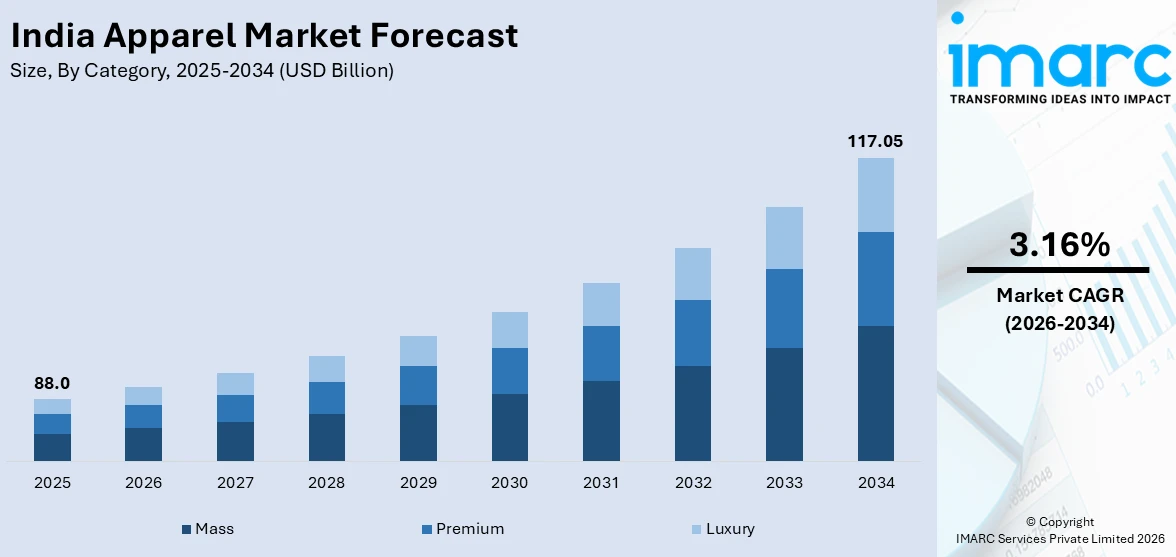
The India apparel market size was valued at USD 88 Billion in 2025 and is projected to reach USD 117.05 Billion by 2034, growing at a compound annual growth rate of 3.16% from 2026-2034.
India's apparel sector is undergoing a steady transformation underpinned by rising disposable incomes, expanding urban middle-class demographics, and the deepening penetration of organized retail across Tier I and Tier II cities. The confluence of evolving consumer aspirations, digital commerce enablement, and increased government support for domestic manufacturing through initiatives such as the Production Linked Incentive (PLI) scheme and the National Textile Policy 2025 is reshaping demand patterns throughout the value chain. These structural factors collectively expand the India apparel market share.
Key Takeaways and Insights:
- By Category: Mass dominates the market with a share of 71.6% in 2025, reflecting the vast price-sensitive consumer base across urban and rural geographies.
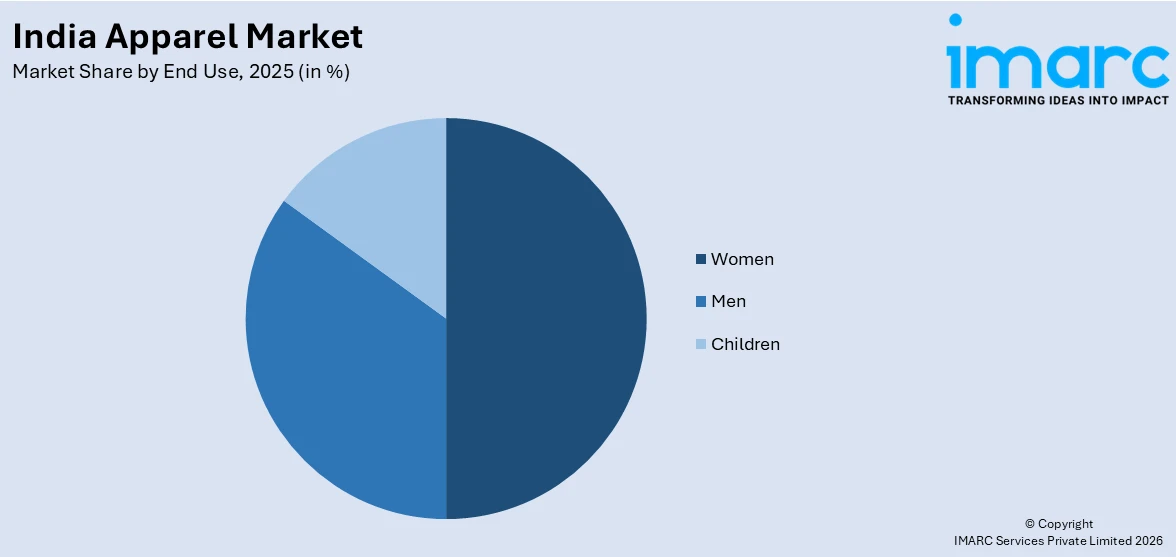
- By End Use: Women lead the market with a share of 41.5% in 2025, driven by rising female workforce participation and heightened fashion consciousness.
- By Distribution Channel: Offline holds the largest share at 57.8% in 2025, as Indian consumers continue to prefer tactile, in-store shopping experiences, particularly for occasion wear and ethnic categories.
- By Region: West India accounts for 35.4% of total market revenue in 2025, propelled by its commercial hubs of Mumbai, Pune, and Ahmedabad that act as fashion and trade epicenters.
- Key Players: India apparel leaders expand online reach, adopt AI sizing tools, speed sustainable fabrics, launch private labels, optimize supply chains, open experience stores, strengthen tier-2 presence, tie up with influencers, use data analytics for demand forecasting, and enhance customer loyalty programs.
To get more information on this market Request Sample
The Indian clothing industry has its roots in the mass market segment, which serves the country's large number of price-sensitive customers ranging from rural townships to Tier II cities. The increasing adoption of organized retail formats, shopping malls, and large-size stores has gradually enhanced the reach of branded clothing at reasonable prices. In February 2025, Spanish fashion retailer Bershka entered the Indian market by opening its first Indian store in Mumbai at Phoenix Palladium, marking its foray into one of the world's fastest-growing consumer markets. Spanning over 4596 sq. ft., the store showcases BERSHKA’s diverse collections, including BERSHKA Teen for those aged 10-12 years, along with BERSHKA Women & Men. The women's market is also witnessing further growth due to the rising number of women in the workforce, social acceptance of varied fashion trends, and the emergence of dedicated womenswear platforms. West India's commercialization and strong purchasing power maintains its leading position within the region.
India Apparel Market Trends:
Rise of Sustainable and Ethical Fashion Across the Value Chain
Rising awareness among Indian consumers about the environment is driving the demand for sustainable and eco-friendly clothing. To cater to this demand, fashion brands are now incorporating organic cotton, recycled materials, and fair trade practices into their designs. In March 2025, the Clothing Manufacturers Association of India (CMAI) launched the SU.RE Sustainable Supply Chain Directory, which is a revolutionary step that aims to connect buyers with sustainable suppliers. This move marks the beginning of a new era in the fashion industry, where sustainability is becoming a defining element for brands.
Digital Commerce and Omnichannel Retail Integration
The growing popularity of fashion e-commerce is changing the way Indians search and buy fashion. Fashion e-commerce is expected to contribute significantly to the total sales of fashion by 2030. Myntra, Ajio, and Flipkart Fashion are using AI-powered personalization, virtual try-on, and quick-commerce delivery solutions to improve the shopping experience. In 2026, Reliance Retail is testing a new approach that connects its offline stores to online shopping. Customers can use QR codes to search for products that match their interests. This initiative aims to enhance the shopping experience across Reliance Retail's vast network of stores. The company plans to roll out this technology to more of its retail stores soon.
Athleisure and Casualwear as Mainstream Fashion Categories
The fitness and wellness trend in India is also contributing to the mainstreaming of athleisure and casual wear in the fashion industry. With a considerable number of Indians engaging in fitness activities as of 2024, performance-driven wear is also gaining popularity in the Indian market. In 2026, Campus Activewear has forayed into the apparel segment by launching its first athleisure wear line in India. This marks the company's foray into a new category as it looks to strengthen its existing position in the sports and athleisure category, besides leveraging the growing demand for casual activewear among the younger generation of Indians. Online sports and activewear sales also registered year-over-year growth in 2024, indicating a permanent shift in fashion preferences in India.
Market Outlook 2026-2034:
India's apparel market is poised for consistent, broad-based growth throughout the forecast period, underpinned by powerful demographic tailwinds, expanding middle-class purchasing power, and the accelerating convergence of digital and physical retail channels. The market generated a revenue of USD 88 Billion in 2025 and is projected to reach a revenue of USD 117.05 Billion by 2034, growing at a compound annual growth rate of 3.16% from 2026-2034. As urbanization deepens and Tier II and III cities emerge as new consumption hubs, demand for organized apparel across mass and premium categories is set to expand well beyond the current metropolitan concentration. Policy initiatives are expected to catalyze domestic production capability, improve supply chain efficiency, and enhance export competitiveness for Indian apparel manufacturers.
India Apparel Market Report Segmentation:
|
Segment Category |
Leading Segment |
Market Share |
|
Category |
Mass |
71.6% |
|
End Use |
Women |
41.5% |
|
Distribution Channel |
Offline |
57.8% |
|
Region |
West India |
35.4% |
Category Insights:
- Mass
- Premium
- Luxury
Mass dominates with a market share of 71.6% of the total India apparel market in 2025.
The mass category obtains its leadership position because of the large population base in India, which has a large number of price-conscious consumers looking for practical and affordable clothing options in the daily wear, workwear, and casual wear segments. Organized retail chains such as Reliance Trends, Pantaloons, and Zudio have also increased their reach in Tier II and Tier III cities by providing mass-market branded apparel options at competitive price points, thus effectively pushing out the unorganized local retailers. Hypermarkets and supermarkets also act as important channels for the distribution of mass-category garments, especially in semi-urban areas where specialized apparel stores are fewer in number and variety.
The segment also obtains benefits from volume-based procurement models that help manufacturers remain cost-effective while providing consistent quality standards to price-conscious households. The expansion of private labels by large retail chains is also increasing margins and customer loyalty in this segment, as consumers react favorably to quality-assured branded options at affordable price points. The increasing penetration of value-based social commerce platforms is also dramatically increasing the addressable consumer base in the mass category, especially among first-time online consumers in rural and semi-urban geographies.
End Use Insights:
Access the comprehensive market breakdown Request Sample
- Men
- Women
- Children
Women lead with a share of 41.5% of the total India apparel market in 2025.
The women's wear category in India is witnessing robust and enduring demand, driven by underlying socioeconomic structural changes such as rising female participation in the workforce and rising household disposable income allocated to individual fashion statements. The category enjoys a broad and growing product ecosystem ranging from traditional ethnic wear like sarees, salwar kameez, and lehengas to modern western wear, sportswear, and occasion-based lines. The platforms indicate that the women's wear category has consistently contributed the largest share to their respective gross merchandise values, which is a testament to the category's immense digital appeal. In September 2024, Reliance Retail and Delta Galil announced a strategic partnership to create a dedicated apparel innovation platform using Delta Galil's knowledge and experience in intimate and activewear manufacturing, in collaboration with Reliance Retail's extensive pan-India distribution reach, with a key emphasis on the female consumer segment.
The growing availability of sustainable, size-inclusive, and occasion-specific womenswear collections is further broadening the category's consumer base beyond traditional fashion-forward urban demographics. Social media influencers and regional fashion content creators are amplifying trend adoption across Tier II and III cities, fuelling demand for contemporary ethnic-western fusion styles that blend Indian heritage with global fashion sensibilities. Brands are scaling both offline store presence and online capabilities to capture these emerging and diversifying consumer cohorts. The bridal and festive womenswear category, in particular, represents a high-value growth opportunity, with Indian consumers spending a huge amount annually on wedding-related expenditures that include substantial outlays on apparel and accessories.
Distribution Channel Insights:
- Online
- Offline
- Hypermarkets and Supermarkets
- Clothing Stores
- Others
Offline exhibits a clear dominance with a 57.8% share of the total India apparel market in 2025.
Offline retail remains the cornerstone of India's apparel distribution landscape, underpinned by consumers' deeply ingrained preference for physical try-ons, immediate product gratification, and the expert guidance of trained sales staff, especially when purchasing ethnic wear, bridal garments, or occasion-specific collections where fabric quality assessment is paramount. Large-format departmental stores, exclusive brand outlets (EBOs), and multi-brand retail chains such as Shoppers Stop, Lifestyle International, and Central provide organized and aspirational offline touchpoints in metropolitan and Tier I urban markets.
Meanwhile, unorganized local apparel shops, street markets, and weekly bazaars continue to serve rural and semi-urban populations efficiently with accessible, affordable garments. In October 2024, Raymond Lifestyle announced plans to hire approximately 9,000 workers to support the opening of 900 new stores planned between 2024 and 2027, signaling deep confidence in offline retail's long-term viability and growth potential. The expansion of organized retail into Tier II and III cities is further reinforcing offline's structural dominance throughout the forecast period.
Regional Insights:
- North India
- South India
- East India
- West India
West India leads with a share of 35.4% of the total India apparel market in 2025.
West India's leadership in the apparel market is driven by the exceptional commercial vibrancy of Mumbai, Pune, Ahmedabad, and Surat, cities that collectively function as India's fashion innovation, textile trading, and organized retail epicenters. Mumbai's status as the country's financial capital translates into the highest per-capita consumer purchasing power in India, sustaining robust demand across mass, premium, and luxury apparel categories simultaneously. The region's well-developed retail infrastructure, including India's largest premium shopping malls, global brand flagship stores, and a dense e-commerce last-mile delivery network, provides seamless multi-channel access to organized apparel brands. Surat, recognized as Asia's largest man-made fabric hub, and Ahmedabad, a major centre for cotton textile manufacturing, serve as strategically critical sourcing and wholesale distribution nodes that facilitate efficient and cost-effective supply chain operations for both domestic and international fashion retailers serving the broader Indian market.
West India's apparel consumer base is also distinguished by its high propensity to adopt premium and international fashion trends, particularly among the region's large business-owning and professional communities. The Gujarati and Marathi consumer demographics have strong traditions of festive and occasion dressing that sustain high-value purchases of ethnic and wedding wear throughout the year. The region's dominant contribution to apparel market revenue is expected to be sustained through the forecast period, with incremental growth driven by expansion into Tier II cities such as Nagpur, Vadodara, and Nashik as organized retail penetrates deeper into Maharashtra and Gujarat.
Market Dynamics:
Growth Drivers:
Why is the India Apparel Market Growing?
Rising Urban Middle-Class Population and Increasing Disposable Incomes
India's expanding middle-class population, projected to reach 600 million by 2025, constitutes the primary demand engine for apparel across all price segments. As household incomes rise in Tier I and II cities, consumers are allocating a greater share of discretionary spending to branded clothing, shifting from unorganized local shops to organized retail formats. The growth of dual-income households, particularly in metropolitan areas, amplifies fashion spending among both male and female segments. Organized retail players such as Reliance Trends and Tata Trent's Zudio brand have strategically expanded into emerging urban centres to capture this burgeoning consumer cohort. With India's urban population expected to increase, this structural demographic shift will sustain robust long-term demand growth for the apparel market throughout the forecast period.
Government Policy Support and Domestic Manufacturing Incentives
The Indian government has introduced a series of targeted policy measures to strengthen the apparel manufacturing ecosystem. The Production Linked Incentive (PLI) scheme for textiles offers INR 10,683 crore in incentives to manufacturers scaling production of man-made fibres and technical textiles. In 2024, the government announced the Textile Policy 2024 aimed at promoting industry growth through infrastructure investment and digital adoption in textile manufacturing. The policy offered several financial assistance options for businesses, featuring capital subsidies between 10 percent and 35 percent of qualifying fixed capital investments, limited to Rs100 crores depending on taluka and activity. Further, reductions in import duties on raw materials such as polyester and viscose staple fibre have improved cost competitiveness for domestic manufacturers.
Accelerating E-Commerce Adoption and Digital Retail Innovation
The proliferation of smartphones and internet connectivity, with internet penetration reaching 57% in 2026 in rural India, has supported the growth of fashion e-commerce as a significant demand channel. India's Internet user base approached 1 billion due to AI adoption, short-video usage, and E-Commerce, as reported by the Internet and Mobile Association of India (IAMAI), a non-profit organization representing the digital services industry. Platforms are deploying AI-driven product discovery, virtual try-on features, and quick-delivery models to attract and retain fashion-conscious consumers. The D2C apparel market is growing, enabling emerging brands to build direct consumer relationships and reduce dependency on traditional multi-brand retail channels.

Market Restraints:
What Challenges the India Apparel Market is Facing?
Dominance of the Unorganized Retail Sector
A significant portion of India's apparel market remains served by unorganized retailers, bazaars, and local clothing shops, with organized retail accounting for only an estimated 45% of sales as of 2025. This structural fragmentation creates pricing pressures for organized players and challenges in standardizing consumer experiences, quality control, and supply chain traceability across geographies.
High Product Return Rates in E-Commerce Channels
Fashion e-commerce in India faces persistently high return rates, with industry feedback indicating return rates of 35–50% in certain apparel product categories due to sizing inconsistencies, quality mismatches, and changed consumer preferences. These return volumes impose significant costs related to reverse logistics, restocking, and inventory management, constraining e-commerce profitability and operational efficiency for online-first apparel brands.
Raw Material Price Volatility and Supply Chain Disruptions
The apparel manufacturing sector in India is susceptible to volatility in raw material prices, including cotton, polyester, and viscose fibres, influenced by global commodity markets, monsoon variability, and geopolitical trade dynamics. Supply chain disruptions, exacerbated by infrastructure deficiencies in certain manufacturing clusters, increase production lead times and cost unpredictability, challenging manufacturers' ability to maintain competitive pricing for the mass-market segment.
Competitive Landscape:
Leading players in India’s apparel market are investing heavily in digital commerce, strengthening their own websites and partnering with major marketplaces to widen reach. Brands are expanding into tier 2 and tier 3 cities through smaller format stores and franchise models. Many are tightening supply chains to cut lead times and reduce excess inventory, using data analytics for demand planning. Sustainability is another focus, with increased use of recycled fabrics, water saving production methods, and garment take back programs. Companies are also pushing premium and private labels to improve margins while offering sharper price points in value segments. Collaborations with influencers, celebrity endorsements, and limited edition drops help attract younger shoppers. Several brands are experimenting with omnichannel services like click and collect and in store returns for online purchases to improve convenience and drive repeat buying.
Recent Developments:
- In February 2026, Apparel Group, a retail conglomerate located in Dubai, has revealed a strategic alliance with Cotton On, the largest global fashion and lifestyle brand from Australia, to introduce and expand the brand in the Indian market. The deal, revealed on February 17, 2026, focuses on India's swiftly growing population of young, affluent consumers. The partnership will implement a staged omnichannel launch, combining a countrywide network of brick-and-mortar stores with a specialized e-commerce site and a presence on key online marketplaces.
- In October 2025, Italian fashion powerhouse OVS has opened its inaugural Indian store in Delhi, seeking to rival international brands by providing high-quality, sustainable Italian fashion at affordable prices. The firm is making direct investments in the Indian market, ensuring price equivalence with Italy and planning a gradual expansion prioritizing physical retail before launching e-commerce.
- In October 2025, Men’s fashion label Snitch introduced a trial 60-minute clothing delivery service in Bengaluru, indicating an entry into rapid commerce that the brand claims will provide last-minute outfit solutions to Gen Z and millennial consumers.
India Apparel Market Report Coverage:
|
Report Features |
Details |
|
Base Year of the Analysis |
2025 |
|
Historical Period |
2020-2025 |
|
Forecast Period |
2026-2034 |
|
Units |
Billion USD |
|
Scope of the Report |
Exploration of Historical Trends and Market Outlook, Industry Catalysts and Challenges, Segment-Wise Historical and Future Market Assessment:
|
|
Categories Covered |
Mass, Premium, Luxury |
|
End Uses Covered |
Men, Women, Children |
|
Distribution Channels Covered |
Online, Offline, Hypermarkets and Supermarkets, Clothing Stores, Others |
|
Regions Covered |
North India, South India, East India, West India |
|
Customization Scope |
10% Free Customization |
|
Post-Sale Analyst Support |
10-12 Weeks |
|
Delivery Format |
PDF and Excel through Email (We can also provide the editable version of the report in PPT/Word format on special request) |
Frequently Asked Questions About the India Apparel Market Report
The India apparel market size was valued at USD 88 Billion in 2025.
The India apparel market is expected to grow at a compound annual growth rate of 3.16% from 2026-2034 to reach USD 117.05 Billion by 2034.
Mass holds the largest share at 71.6% in 2025, driven by India's large price-sensitive consumer base and the expanding reach of value-focused organized retail chains across Tier I, II, and III cities.
Key factors driving the India apparel market include rising disposable incomes, expanding urban middle-class demographics, government PLI incentives for textile manufacturing, accelerating e-commerce adoption, and growing demand for women's and sustainable apparel across Tier I and II cities.
Major challenges include the persistent dominance of unorganized retail limiting organized sector growth, high product return rates in e-commerce channels inflating operational costs, and raw material price volatility affecting manufacturing competitiveness and mass-segment pricing stability.
Need more help?
- Speak to our experienced analysts for insights on the current market scenarios.
- Include additional segments and countries to customize the report as per your requirement.
- Gain an unparalleled competitive advantage in your domain by understanding how to utilize the report and positively impacting your operations and revenue.
- For further assistance, please connect with our analysts.
 Request Customization
 Speak to an Analyst
 Request Brochure
 Inquire Before Buying
Benefits of Customization
- Personalize this research
- Triangulate with your data
- Get data as per your format and definition
- Gain a deeper dive into a specific application, geography, customer, or competitor
- Any level of personalization
Get in Touch With Us
UNITED STATES
Phone: +1-201-971-6302
INDIA
Phone: +91-120-433-0800
UNITED KINGDOM
Phone: +44-753-714-6104
Email: [email protected]
Client Testimonials




.webp)




.webp)













Related Reports

Choose your plan
*Please note that the prices mentioned below are starting prices for each bundle type. Kindly contact our team for further details.*
Single User License
- 1 User License, Access on 2 Devices
- PDF Report + Excel Dataset (Password Protected)
- Lifetime Access
- No Printing Rights
- 10% Free Report Customization
- 10–12 Weeks of Analyst Support
Five User License
- Access for 5 Users, 2 Devices per User
- PDF Report + Excel Dataset (Password Protected)
- Lifetime Access
- Dedicated Account Manager
- 12–14 Weeks of Analyst Support
- No Printing Rights
- 15% Free Report Customization
- 25% Discount on Your Next Purchase
Corporate User License
- Unlimited User Access (Within Your Organization)
- PDF Report + Excel Dataset
- Lifetime Access
- Dedicated Account Manager
- 14–20 Weeks of Analyst Support
- No Printing Rights
- 20% Free Report Customization
- 30% Discount on Your Next Purchase
Essential Insights
What's included:
3 reports
- Lifetime Access
- PDF Reports
- Excel Datasets
- 2 Weeks of Free Analyst Support
- 2 User Licenses
- Access on 2 Devices
- Printing Rights
- Complimentary PowerPoint (PPT) Version
- Complimentary License Upgrade
Professional Access
What's included:
5 reports
- Lifetime Access
- PDF Reports
- Excel Datasets
- 8 Weeks of Free Analyst Support
- 2 User Licenses
- Access on 2 Devices
- Printing Rights
- Complimentary PowerPoint (PPT) Version
- Complimentary License Upgrade
Business Advantage
What's included:
8 reports
- Lifetime Access
- PDF Reports
- Excel Datasets
- 14 Weeks of Free Analyst Support
- 2 User Licenses
- Access on 2 Devices
- Printing Rights
- Complimentary PowerPoint (PPT) Version
- Complimentary License Upgrade
Enterprise Intelligence
What's included:
10 reports
- Lifetime Access
- PDF Reports
- Excel Datasets
- 20 Weeks of Free Analyst Support
- 2 User Licenses
- Access on 2 Devices
- Printing Rights
- Complimentary PowerPoint (PPT) Version
- Complimentary License Upgrade