
India Asset Management Market Size, Share, Trends and Forecast by Component, Asset Type, Function, Application, and Region, 2026-2034
India Asset Management Market Summary:
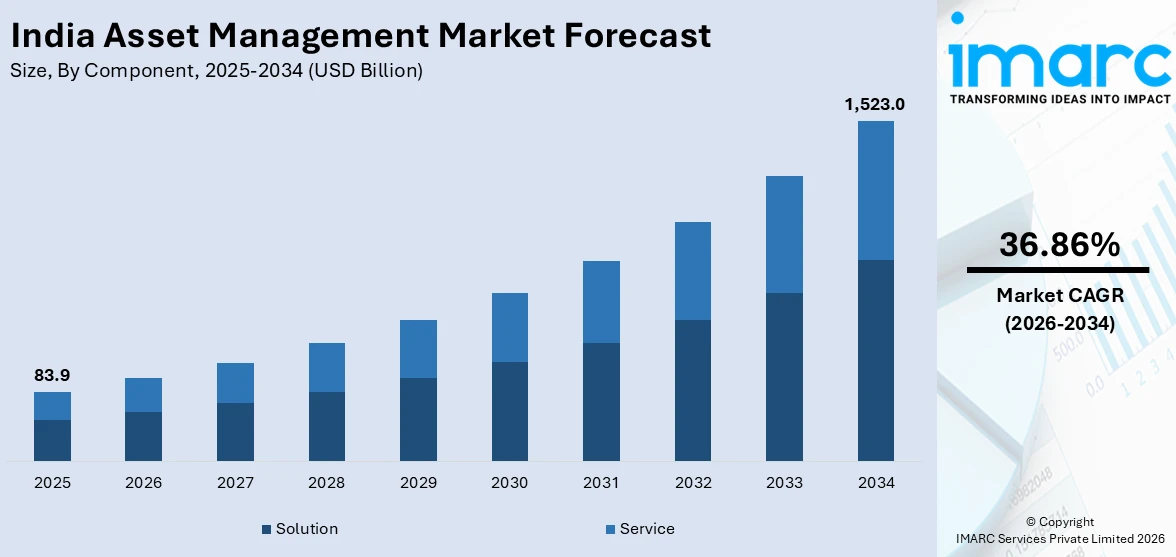
The India asset management market size was valued at USD 83.9 Billion in 2025 and is projected to reach USD 1,523.0 Billion by 2034, growing at a compound annual growth rate of 36.86% from 2026-2034.
The India asset management market encompasses a comprehensive range of solutions, services, and technologies that enable organizations to monitor, track, and optimize their physical and digital assets across diverse operational environments. This market integrates advanced technologies including real-time location systems, barcode scanning, GPS tracking, and mobile computing platforms to deliver enhanced visibility and control over enterprise assets, driving operational efficiency and cost reduction across sectors.
Key Takeaways and Insights:
- By Component: Solution dominates the market with a share of 61.7% in 2025, owing to rising enterprise demand for integrated tracking platforms that combine real-time location systems, barcode scanning, and GPS capabilities to enhance asset visibility and operational control.
- By Asset Type: Digital assets lead the market with a share of 29.6% in 2025. This dominance is driven by accelerating digital transformation across Indian enterprises, increasing adoption of cloud-based platforms, and growing need for monitoring software licenses, digital records, and intellectual property assets.
- By Function: Location & movement tracking represents the biggest segment with a market share of 38.9% in 2025, reflecting heightened demand for real-time visibility of assets across manufacturing floors, warehouses, logistics networks, and infrastructure facilities throughout India.
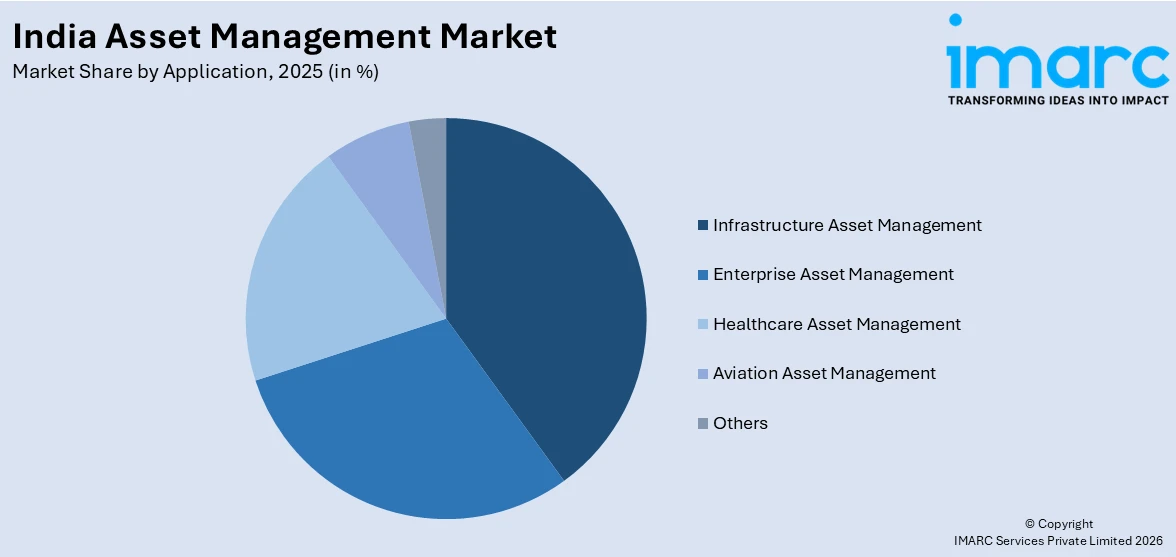
- By Application: Infrastructure asset management dominates the market with a share of 34.4% in 2025, owing to massive government investments in transportation, energy, water, and critical infrastructure modernization programs under the Smart Cities Mission and National Infrastructure Pipeline.
- By Region: South India represents the largest region with 32.8% share in 2025, driven by the concentration of technology hubs in Bengaluru, Chennai, and Hyderabad, where advanced manufacturing, IT services, and logistics operations fuel demand for sophisticated asset management solutions.
- Key Players: Key players drive the India asset management market by expanding product portfolios, investing in IoT-enabled tracking technologies, and strengthening partnerships with enterprise clients. Their investments in artificial intelligence, cloud computing, and RFID innovation accelerate adoption and ensure scalable asset visibility across diverse industrial sectors.
To get more information on this market Request Sample
The India asset management market is experiencing robust expansion, propelled by a convergence of technological advancement, regulatory support, and evolving industrial requirements. The proliferation of Internet of Things devices and sensors across manufacturing, logistics, and infrastructure sectors is generating unprecedented demand for solutions that provide real-time asset visibility, predictive maintenance capabilities, and automated workflow optimization. Government initiatives such as the Smart Cities Mission, Digital India programme, and National Infrastructure Pipeline are creating a supportive ecosystem for asset management technology adoption across both public and private sectors. The rapid growth of e-commerce and organized retail in India is further accelerating demand for warehouse management, inventory tracking, and supply chain visibility solutions. Additionally, the expansion of fifth-generation wireless networks across major industrial corridors is enabling low-latency, high-bandwidth connectivity essential for deploying advanced asset tracking systems in complex operational environments.
India Asset Management Market Trends:
Integration of Artificial Intelligence with IoT-Based Asset Tracking Platforms
The convergence of artificial intelligence and IoT sensor networks is transforming asset management from reactive monitoring to proactive intelligence-driven optimization. AI algorithms analyse vast volumes of data generated by connected sensors to identify usage patterns, detect anomalies, and predict maintenance requirements before equipment failures occur. This shift toward predictive asset management is enabling Indian enterprises to significantly reduce unplanned downtime and extend asset lifecycles. The integration of machine learning models with real-time tracking platforms allows organizations to automate decision-making processes, optimize asset deployment schedules, and continuously improve operational efficiency through data-driven insights across complex industrial environments.
Expansion of RFID Technology Across Indian Supply Chain and Retail Operations
Radio-frequency identification technology is witnessing accelerated adoption across Indian warehousing, manufacturing, and retail environments as businesses transition from manual barcode scanning to automated, contactless tracking systems. RFID eliminates the need for line-of-sight scanning, enabling simultaneous identification of thousands of tagged assets and dramatically improving inventory accuracy and throughput speed. Indian businesses are increasingly deploying hybrid RFID systems combining passive tags for inventory and active tags for high-value assets, supported by cloud-based analytics dashboards. India’s RFID market is projected to grow from USD 561.50 Million in 2024 to an estimated USD 1,446.63 Million by 2033, underscoring the rapid enterprise-level adoption of this technology.
Adoption of 5G-Enabled Real-Time Asset Tracking in Industrial Corridors
The deployment of fifth-generation wireless infrastructure across India's industrial corridors is unlocking new capabilities for real-time asset tracking that were previously constrained by connectivity limitations. The ultra-low latency and massive device density supported by advanced wireless networks enable seamless monitoring of assets across sprawling manufacturing plants, multi-modal logistics networks, and distributed infrastructure facilities. This technology evolution is particularly significant for applications requiring continuous, high-precision location data in dynamic environments. The expanding coverage of next-generation connectivity is also enabling edge computing deployments that process tracking data locally, reducing response times and enhancing operational reliability.
Market Outlook 2026-2034:
The India asset management market is positioned for substantial expansion over the forecast period, driven by accelerating digital transformation, rising industrial automation investments, and expanding smart city infrastructure across the country. The convergence of IoT, artificial intelligence, and cloud computing is creating integrated asset management ecosystems that deliver actionable intelligence and measurable operational improvements. The market generated a revenue of USD 83.9 Billion in 2025 and is projected to reach a revenue of USD 1,523.0 Billion by 2034, growing at a compound annual growth rate of 36.86% from 2026-2034. This strong growth trajectory reflects the deepening integration of asset tracking technologies across transportation, energy, healthcare, and enterprise operations throughout India.
India Asset Management Market Report Segmentation:
|
Segment Category |
Leading Segment |
Market Share |
|
Component |
Solution |
61.7% |
|
Asset Type |
Digital Assets |
29.6% |
|
Function |
Location & Movement Tracking |
38.9% |
|
Application |
Infrastructure Asset Management |
34.4% |
|
Region |
South India |
32.8% |
Component Insights:
- Solution
- Real-Time Location System (RTLS)
- Barcode
- Mobile Computer
- Labels
- Global Positioning System (GPS)
- Others
- Service
- Strategic Asset Management
- Operational Asset Management
- Tactical Asset Management
Solution dominates with a market share of 61.7% of the total India asset management market in 2025.
The solution segment encompasses hardware and software components including RTLS, barcode scanners, GPS trackers, mobile computers, and labels that form the technological backbone of asset management deployments across Indian enterprises. This segment's commanding position reflects the fundamental requirement for integrated tracking tools that enable organizations to monitor asset location, condition, and utilization in real time. Indian manufacturers and logistics providers are increasingly investing in multi-technology solution stacks that combine multiple wireless identification and positioning protocols to achieve comprehensive indoor and outdoor asset visibility across their operational footprint. The growing complexity of industrial operations and supply chain networks necessitates layered tracking architectures capable of functioning across diverse environmental conditions.
The growing preference for cloud-connected solution platforms is further reinforcing this segment's dominance, as enterprises seek scalable, subscription-based tracking systems that integrate seamlessly with existing enterprise resource planning and warehouse management software. Organizations are prioritizing interoperable solution ecosystems that unify data from multiple tracking technologies into centralized dashboards, enabling holistic asset visibility and streamlined decision-making. Government-led digital infrastructure modernization programmes are also mandating the installation of automated asset-tracking systems within public and private operational facilities, reflecting institutional momentum behind solution-based asset management deployments across the country.
Asset Type Insights:
- Digital Assets
- Returnable Transport Assets
- In-transit Assets
- Manufacturing Assets
- Personnel/Staff
Digital assets lead with a share of 29.6% of the total India asset management market in 2025.
Digital assets encompass software licenses, digital records, intellectual property, and data assets that require systematic monitoring, version control, and lifecycle management within enterprise environments. The rapid digitization of Indian businesses, driven by cloud migration and enterprise software adoption, has created a substantial base of digital assets requiring dedicated management solutions. Organizations are deploying specialized platforms to track software compliance, manage digital certificates, and optimize the utilization of cloud-based resources across distributed workforces, fuelling the segment's growth. The transition toward hybrid and remote working models has further expanded the volume of digital assets that enterprises must monitor, secure, and govern across geographically dispersed operational environments.
The convergence of digital asset management with broader enterprise IT governance frameworks is amplifying demand for integrated platforms that provide unified visibility across both physical and digital asset inventories. Enterprises are increasingly recognizing the operational risks associated with unmanaged software licenses, expired digital certificates, and fragmented data repositories, prompting investment in centralized management systems. The development of indigenous semiconductor and IoT chip capabilities within the country is expected to accelerate the deployment of cost-effective digital asset tracking solutions, enabling smaller enterprises to adopt sophisticated monitoring platforms that were previously accessible only to large-scale organizations with substantial technology budgets.
Function Insights:
- Location & Movement Tracking
- Check In/Check Out
- Repair and Maintenance
- Others
Location & movement tracking exhibits a clear dominance with 38.9% share of the total India asset management market in 2025.
Location and movement tracking functionality enables organizations to monitor the real-time position and transit patterns of assets across facilities, supply chains, and field operations using technologies such as GPS, RFID, and ultra-wideband sensors. The rising complexity of Indian supply chain networks and the increasing scale of manufacturing operations are driving robust demand for continuous asset location intelligence that minimizes search time, prevents loss, and optimizes utilization. Enterprises across logistics, healthcare, and manufacturing sectors are deploying zone-based tracking systems to automate asset flow monitoring and reduce manual intervention in high-throughput environments.
The integration of location tracking with predictive analytics platforms is enabling Indian organizations to move beyond simple position monitoring toward intelligent asset routing, proactive bottleneck identification, and automated workflow optimization across distributed operational environments. Advanced geofencing capabilities allow enterprises to receive instant alerts when assets deviate from designated zones, strengthening security and compliance oversight. Airtel currently supports over 45 million connected IoT devices across India, including logistics assets and smart infrastructure sensors, demonstrating the scale of real-time tracking connectivity infrastructure now available to enterprises seeking comprehensive location and movement visibility for their asset portfolios.
Application Insights:
Access the comprehensive market breakdown Request Sample
- Infrastructure Asset Management
- Transportation
- Energy Infrastructure
- Water & Waste Infrastructure
- Critical Infrastructure
- Others
- Enterprise Asset Management
- Healthcare Asset Management
- Aviation Asset Management
- Others
Infrastructure asset management prevails the market with 34.4% share of the total India asset management market in 2025.
Infrastructure asset management involves the monitoring, maintenance, and optimization of assets within transportation networks, energy grids, water systems, and critical infrastructure facilities. The country's massive infrastructure development programme is generating substantial demand for asset management solutions that enable real-time monitoring of bridges, roads, pipelines, power transmission equipment, and water distribution networks. The deployment of IoT-enabled sensors across infrastructure assets facilitates predictive maintenance and extends asset service life, reducing the frequency and cost of reactive repairs. Growing urbanization and the expansion of metropolitan utility networks are further intensifying the need for automated infrastructure asset oversight and condition monitoring capabilities.
The government's commitment to modernizing the national infrastructure ecosystem is creating sustained growth opportunities for asset management technology providers serving this segment. The development of new industrial smart cities across multiple major industrial corridors incorporates advanced ICT-enabled utilities and smart asset monitoring systems throughout these urban-industrial centres. Additionally, the expansion of renewable energy installations, high-speed rail corridors, and urban metro transit networks is creating new categories of infrastructure assets that require continuous digital monitoring and lifecycle management. These large-scale projects demand scalable, interoperable asset management platforms capable of integrating data from diverse sensor networks and operational technology environments across geographically distributed sites.
Regional Insights:
- North India
- South India
- East India
- West India
South India represents the leading region with 32.8% share of the total India asset management market in 2025.
South India's leadership in the asset management market is anchored by the region's concentration of technology and manufacturing ecosystems across its major metropolitan centres. These cities serve as prominent hubs for IT services, automotive manufacturing, aerospace, and electronics production, where enterprises maintain large inventories of high-value equipment and digital assets requiring sophisticated tracking and management solutions. The region's advanced digital infrastructure, robust connectivity networks, and skilled technology workforce facilitate the early adoption of cutting-edge asset management platforms. The presence of numerous research institutions and engineering colleges further supports a talent pipeline that enables rapid technology deployment and customization for local industrial requirements.
The concentration of global technology companies, system integrators, and IoT solution providers in the region creates a competitive environment that drives continuous innovation in asset management offerings. Leading automotive and industrial manufacturers across the southern corridor have implemented comprehensive connected solutions across their production facilities, establishing benchmarks for digital asset visibility and operational intelligence. Furthermore, the region's established position as a primary development hub for cloud-based enterprise software platforms ensures that locally developed asset management solutions are designed with deep domain expertise and tailored to the operational complexities of Indian manufacturing, logistics, and infrastructure sectors nationwide.

Market Dynamics:
Growth Drivers:
Why is the India Asset Management Market Growing?
Government-Led Digital Transformation and Smart Infrastructure Initiatives
The Indian government’s comprehensive suite of digital transformation programmes is creating a powerful catalyst for asset management market expansion. The Smart Cities Mission, encompassing over 100 cities, mandates the deployment of technology-enabled infrastructure monitoring and management systems across urban facilities, transportation networks, and utility services. The Digital India initiative, with a budget allocation of INR 14,903 Crore, is accelerating the digitization of government and public sector operations, generating substantial demand for enterprise-grade asset tracking and management solutions. The National Infrastructure Pipeline, targeting investments in infrastructure development, requires robust asset management frameworks to ensure optimal utilization and maintenance of newly created infrastructure assets. These policy-driven initiatives create a predictable demand pipeline that encourages technology providers to invest in India-specific solutions and localized manufacturing capabilities, strengthening the overall market ecosystem.
Rapid Expansion of IoT Connectivity and Sensor Infrastructure
The proliferation of affordable IoT sensors, edge computing devices, and connectivity infrastructure across India is fundamentally enabling the adoption of real-time asset management solutions at unprecedented scale. The expansion of fifth-generation wireless networks across major industrial corridors provides the low-latency, high-bandwidth connectivity essential for deploying advanced tracking systems in complex manufacturing, logistics, and infrastructure environments. The growing availability of low-power wide-area network technologies, including narrowband IoT and LoRaWAN, enables cost-effective asset monitoring in previously unconnected locations such as rural infrastructure sites, agricultural facilities, and remote energy installations. India’s electronics manufacturing sector is pursuing aggressive growth targets, creating substantial demand for IoT-enabled asset tracking solutions across production facilities. The convergence of affordable hardware, ubiquitous connectivity, and cloud-based analytics platforms is democratizing access to sophisticated asset management capabilities for small and medium enterprises that previously relied on manual tracking methods.
Growth of E-Commerce and Logistics Sector Demanding Supply Chain Visibility
India’s rapidly expanding e-commerce and organized logistics sector is generating substantial demand for asset tracking and inventory management solutions that provide end-to-end supply chain visibility. The exponential growth in online retail transactions, coupled with customer expectations for real-time delivery tracking and faster fulfilment cycles, is compelling logistics providers and warehouse operators to invest in automated asset management systems. The increasing complexity of multi-modal supply chain networks, spanning road, rail, air, and maritime transportation, requires sophisticated tracking solutions capable of maintaining continuous asset visibility across diverse transit environments and handoff points. Returnable transport assets such as pallets, containers, and crates represent significant capital investments for logistics companies, and effective tracking of these assets directly impacts operational profitability. The growing adoption of dark stores, micro-fulfilment centres, and quick-commerce delivery models is further intensifying the need for real-time inventory tracking and asset utilization monitoring systems throughout India’s evolving retail and logistics landscape.
Market Restraints:
What Challenges the India Asset Management Market is Facing?
High Initial Implementation and Integration Costs
The deployment of comprehensive asset management systems requires significant upfront investment in specialized hardware including RFID tags, GPS trackers, sensors, and readers, alongside sophisticated software platforms and integration services. Small and medium enterprises, which constitute the majority of Indian businesses, often find these capital requirements prohibitive, limiting market penetration beyond large corporations and government entities.
Challenges in Legacy System Integration and Interoperability
Many Indian enterprises operate on diverse legacy IT infrastructure and enterprise resource planning systems that were not designed to accommodate modern IoT-based asset tracking technologies. The complexity of integrating new asset management platforms with existing operational technology environments creates implementation delays, increases project costs, and requires specialized technical expertise that remains scarce in many regions.
Data Security and Cybersecurity Vulnerabilities
The expanding network of connected sensors and tracking devices across enterprise environments introduces new cybersecurity attack surfaces that organizations must address. The continuous transmission of sensitive asset location, condition, and operational data across wireless networks raises concerns about data privacy, unauthorized access, and potential exploitation, requiring robust security frameworks that add complexity and cost to deployments.
Competitive Landscape:
The India asset management market features a competitive ecosystem comprising global technology leaders, regional solution providers, and emerging startups offering specialized tracking and management capabilities. Established multinational corporations leverage extensive product portfolios spanning hardware, software, and services to deliver end-to-end asset management solutions tailored to Indian industrial requirements. Competition is intensifying as companies invest in artificial intelligence integration, cloud-based platform development, and strategic partnerships with Indian system integrators and channel partners to expand market reach. The market’s growth trajectory is attracting new entrants, including domestic IoT startups and telecommunications providers, that are introducing innovative, cost-effective solutions designed specifically for the price-sensitive Indian market, fostering continuous innovation and driving technological advancement across the competitive landscape.
India Asset Management Market Report Coverage:
|
Report Features |
Details |
|
Base Year of the Analysis |
2025 |
|
Historical Period |
2020-2025 |
|
Forecast Period |
2026-2034 |
|
Units |
Billion USD |
|
Scope of the Report |
Exploration of Historical Trends and Market Outlook, Industry Catalysts and Challenges, Segment-Wise Historical and Future Market Assessment:
|
|
Components Covered |
|
|
Asset Types Covered |
Digital Assets, Returnable Transport Assets, In-transit Assets, Manufacturing Assets, Personnel/Staff |
|
Functions Covered |
Location & Movement Tracking, Check In/Check Out, Repair and Maintenance, Others |
|
Applications Covered |
|
|
Regions Covered |
North India, South India, East India, West India |
|
Customization Scope |
10% Free Customization |
|
Post-Sale Analyst Support |
10-12 Weeks |
|
Delivery Format |
PDF and Excel through Email (We can also provide the editable version of the report in PPT/Word format on special request) |
Frequently Asked Questions About the India Asset Management Market Report
The India asset management market size was valued at USD 83.9 Billion in 2025.
The India asset management market is expected to grow at a compound annual growth rate of 36.86% from 2026-2034 to reach USD 1,523.0 Billion by 2034.
Solution dominated the market with a share of 61.7%, driven by rising enterprise demand for integrated tracking platforms combining RTLS, barcode, and GPS technologies to enhance asset visibility.
Key factors driving the India asset management market include government-led smart infrastructure initiatives, rapid IoT and 5G connectivity expansion, and growing e-commerce logistics requiring real-time supply chain visibility.
Major challenges include high initial implementation costs for hardware and software, difficulties integrating modern tracking systems with legacy enterprise infrastructure, cybersecurity vulnerabilities across expanding IoT networks, and limited technical expertise in smaller cities.
Need more help?
- Speak to our experienced analysts for insights on the current market scenarios.
- Include additional segments and countries to customize the report as per your requirement.
- Gain an unparalleled competitive advantage in your domain by understanding how to utilize the report and positively impacting your operations and revenue.
- For further assistance, please connect with our analysts.
 Request Customization
 Speak to an Analyst
 Request Brochure
 Inquire Before Buying
Benefits of Customization
- Personalize this research
- Triangulate with your data
- Get data as per your format and definition
- Gain a deeper dive into a specific application, geography, customer, or competitor
- Any level of personalization
Get in Touch With Us
UNITED STATES
Phone: +1-201-971-6302
INDIA
Phone: +91-120-433-0800
UNITED KINGDOM
Phone: +44-753-714-6104
Email: [email protected]
Client Testimonials




.webp)




.webp)













Related Reports

Choose your plan
*Please note that the prices mentioned below are starting prices for each bundle type. Kindly contact our team for further details.*
Single User License
- 1 User License, Access on 2 Devices
- PDF Report + Excel Dataset (Password Protected)
- Lifetime Access
- No Printing Rights
- 10% Free Report Customization
- 10–12 Weeks of Analyst Support
Five User License
- Access for 5 Users, 2 Devices per User
- PDF Report + Excel Dataset (Password Protected)
- Lifetime Access
- Dedicated Account Manager
- 12–14 Weeks of Analyst Support
- No Printing Rights
- 15% Free Report Customization
- 25% Discount on Your Next Purchase
Corporate User License
- Unlimited User Access (Within Your Organization)
- PDF Report + Excel Dataset
- Lifetime Access
- Dedicated Account Manager
- 14–20 Weeks of Analyst Support
- No Printing Rights
- 20% Free Report Customization
- 30% Discount on Your Next Purchase
Essential Insights
What's included:
3 reports
- Lifetime Access
- PDF Reports
- Excel Datasets
- 2 Weeks of Free Analyst Support
- 2 User Licenses
- Access on 2 Devices
- Printing Rights
- Complimentary PowerPoint (PPT) Version
- Complimentary License Upgrade
Professional Access
What's included:
5 reports
- Lifetime Access
- PDF Reports
- Excel Datasets
- 8 Weeks of Free Analyst Support
- 2 User Licenses
- Access on 2 Devices
- Printing Rights
- Complimentary PowerPoint (PPT) Version
- Complimentary License Upgrade
Business Advantage
What's included:
8 reports
- Lifetime Access
- PDF Reports
- Excel Datasets
- 14 Weeks of Free Analyst Support
- 2 User Licenses
- Access on 2 Devices
- Printing Rights
- Complimentary PowerPoint (PPT) Version
- Complimentary License Upgrade
Enterprise Intelligence
What's included:
10 reports
- Lifetime Access
- PDF Reports
- Excel Datasets
- 20 Weeks of Free Analyst Support
- 2 User Licenses
- Access on 2 Devices
- Printing Rights
- Complimentary PowerPoint (PPT) Version
- Complimentary License Upgrade