
India Athletic Footwear Market Size, Share, Trends and Forecast by Product Type, Distribution Channel, End User, and Region, 2026-2034
India Athletic Footwear Market Size, Share, Trends & Forecast (2026-2034)
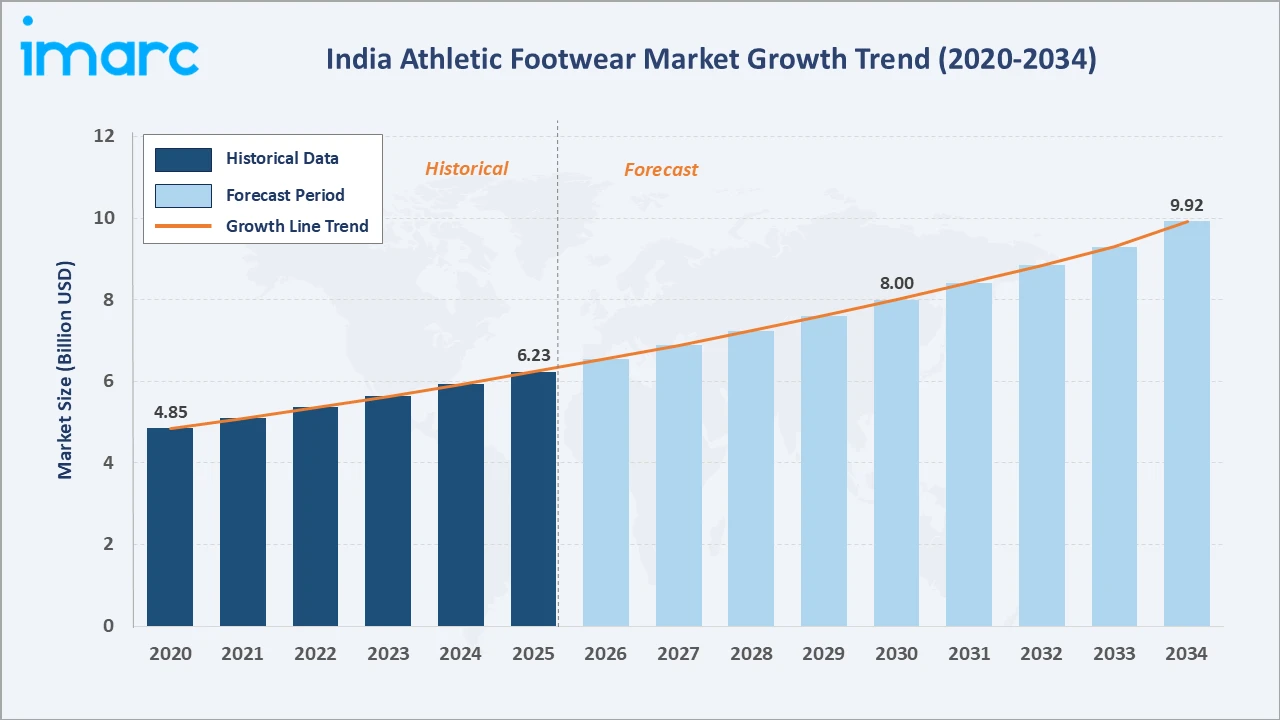
The India athletic footwear market grew from USD 6.23 Billion in 2025 to USD 6.64 Billion in 2026 and is projected to reach USD 9.92 Billion by 2034, exhibiting a CAGR of 5.14% during the forecast period 2026-2034. The market expansion is propelled by rising health consciousness, surging sports participation, and the rapid adoption of athleisure as an everyday fashion trend.
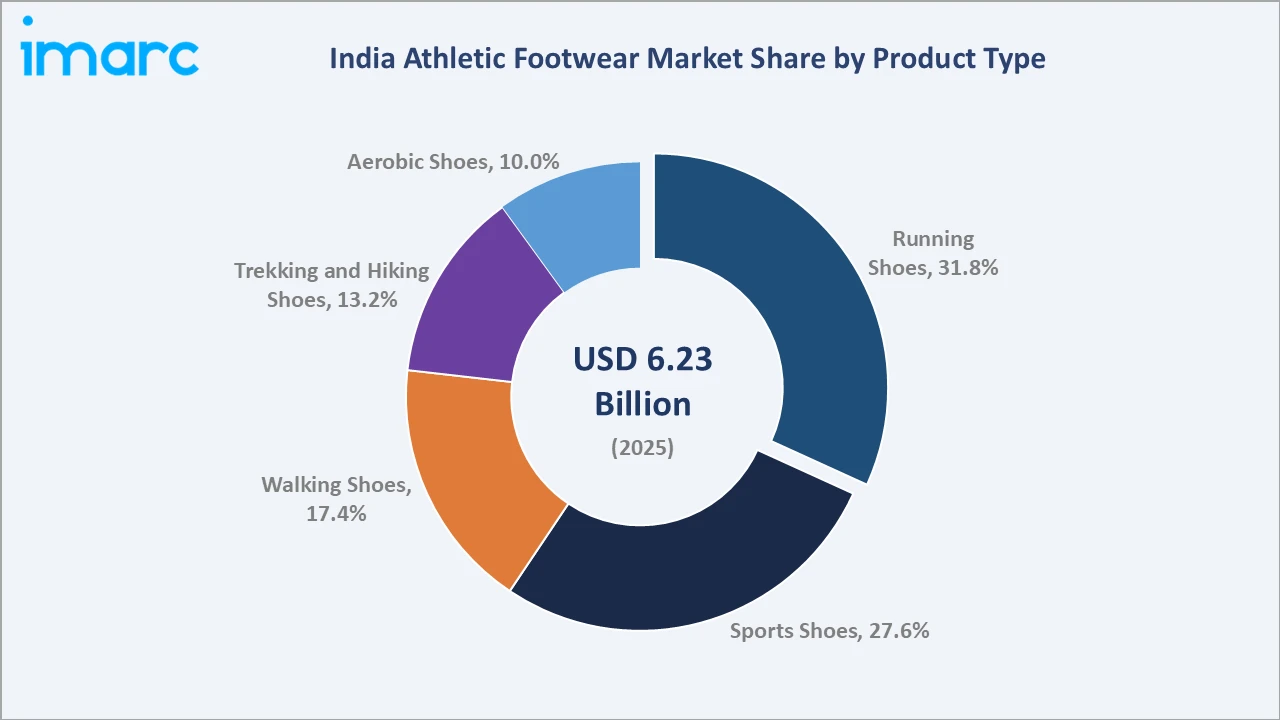
Running shoes dominate the product type mix at 31.8%, specialty stores lead distribution channel at 32.7%, and West and Central India commands the largest regional share at 32.8%.
Market Snapshot
|
Metric |
Value |
|
Base Year Market Size (2025) |
USD 6.23 Billion |
| Market Size (2026) | USD 6.64 Billion |
|
Forecast Market Size (2034) |
USD 9.92 Billion |
|
CAGR (2026-2034) |
5.14% |
|
Base Year |
2025 |
|
Historical Period |
2020-2025 |
|
Forecast Period |
2026-2034 |
|
Largest Region |
West and Central India (32.8%, 2025) |
|
Second Largest Region |
South India (27.6%, 2025) |
|
Leading Product Type |
Running Shoes (31.8%, 2025) |
|
Leading Distribution Channel |
Specialty Stores (32.7%, 2025) |
The India athletic footwear market expanded from USD 4.85 Billion in 2020 to USD 6.23 Billion in 2025 and an estimated USD 6.64 Billion in 2026, driven by widening digital access, growing youth demographics, and increasing adoption of sports and fitness lifestyles across urban and semi-urban India. Anchored at USD 8.00 Billion in 2030, the forecast to USD 9.92 Billion by 2034 is supported by premiumisation trends, e-commerce expansion, and sustained growth in sports participation.
To get more information on this market, Request Sample
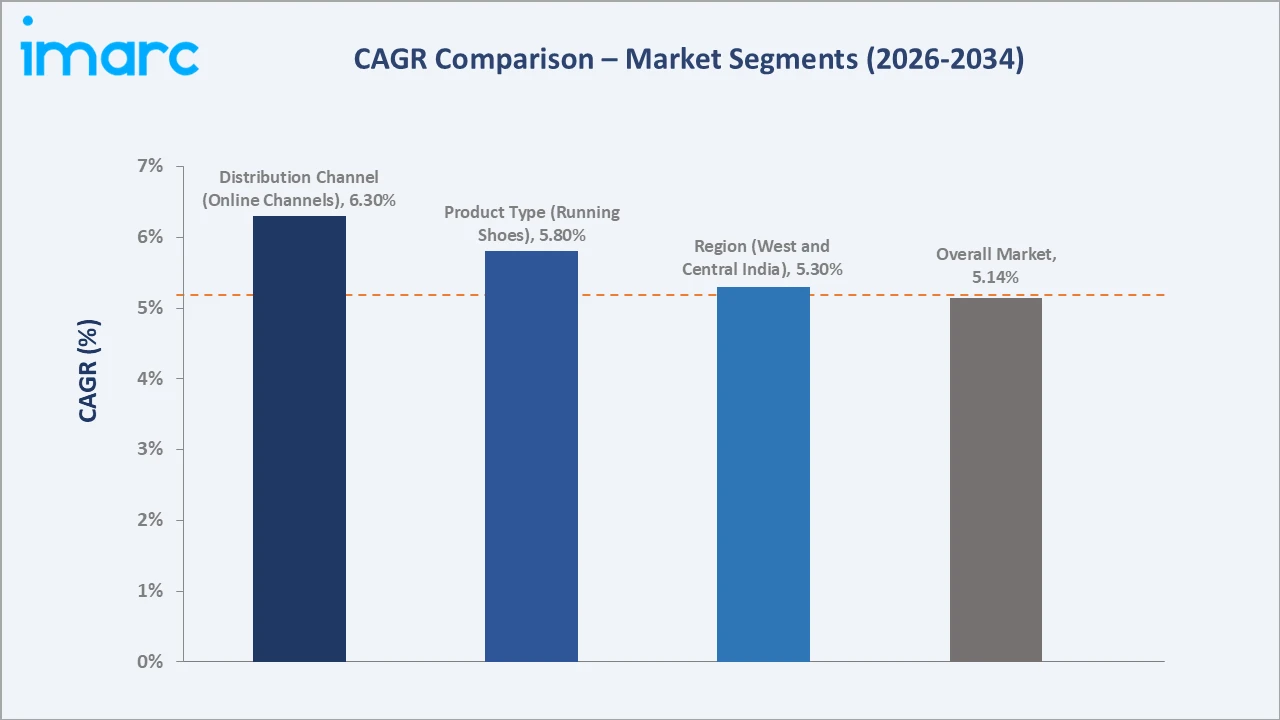
CAGR trajectories across product type and distribution channel sub-segments reveal running shoes and online channels expanding faster than the overall 5.14% market CAGR, anchored by technology-led product development, digital fitness trends, and e-commerce accessibility.
Executive Summary
The India athletic footwear market is on a sustained growth trajectory, expanding from USD 4.85 Billion in 2020 to an estimated USD 6.64 Billion in 2026 and reaching USD 9.92 Billion by 2034, at a CAGR of 5.14%. Market growth reflects structural tailwinds from India's young and health-conscious population, rising discretionary spending, and deepening penetration of organized retail and digital commerce across Tier 1 and Tier 2 cities.
Running shoes command the largest product type share at 31.8% in 2025, supported by growing marathon culture, fitness app usage, and awareness of biomechanical foot support. Specialty stores remain the dominant distribution channel at 32.7%, providing curated buying experiences and expert guidance. West and Central India leads regional demand at 32.8%, fueled by higher urbanization, expanding organized retail networks, and strong consumer spending on sports and fitness footwear.
Key Market Insights
|
Insight |
Data |
|
Leading Product Type |
Running Shoes – 31.8% share (2025) |
|
Second Largest Product Type |
Sports Shoes – 27.6% share (2025) |
|
Leading Distribution Channel |
Specialty Stores – 32.7% share (2025) |
|
Second Largest Distribution Channel |
Brand Outlets – 28.6% share (2025) |
|
Leading Region |
West and Central India – 32.8% share (2025) |
|
Second Largest Region |
South India – 27.6% share (2025) |
|
Top Companies |
Nike, Inc., Adidas AG, Puma SE, Relaxo Footwears Limited, Campus Activewear Limited |
Key Analytical Observations Supporting the Above Data:
- Running shoes leadership at 31.8% is supported by growing marathon participation, organized running events, and the increasing integration of biomechanical technology into performance footwear across urban India.
- Sports shoes at 27.6% are underpinned by cricket, badminton, and football participation trends, with school and collegiate sports driving consistent replacement demand and aspirational brand adoption among youth.
- Specialty stores at 32.7% are driven by consumers’ preference for product variety, expert assistance, and access to specialized athletic footwear across established retail locations.
- Brand outlets dominance at 28.6% is fueled by strong consumer trust in established brands, controlled product presentation, and increasing demand for premium and performance-oriented athletic footwear.
- West and Central India share at 32.8% is anchored by dense metro populations, high disposable incomes, and established organized retail networks in Mumbai, Pune, and Ahmedabad.
India Athletic Footwear Market Overview
Athletic footwear refers to purpose-designed shoes intended for specific sports, fitness activities, and high-performance physical use. The India market encompasses a wide range of products spanning running shoes, sports shoes, walking shoes, trekking and hiking shoes, and aerobic shoes.
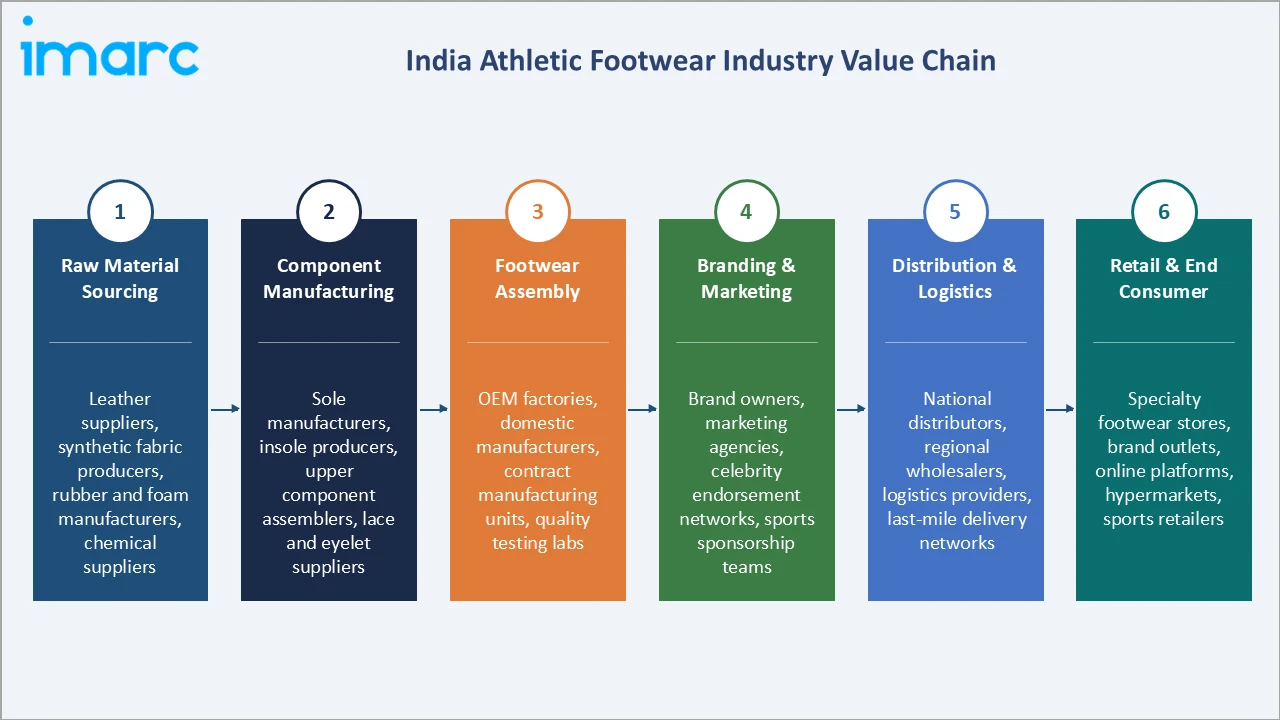
The Indian ecosystem integrates raw material and component suppliers, domestic and global footwear manufacturers, brand marketing entities, multi-channel distributors, and end consumers ranging from professional athletes to casual fitness enthusiasts. Macroeconomic drivers, including India's rising middle-class income levels, government investment in sports infrastructure, and the Make in India initiative, have further stimulated domestic manufacturing capabilities.
Market Dynamics
To evaluate market opportunities, Request Sample
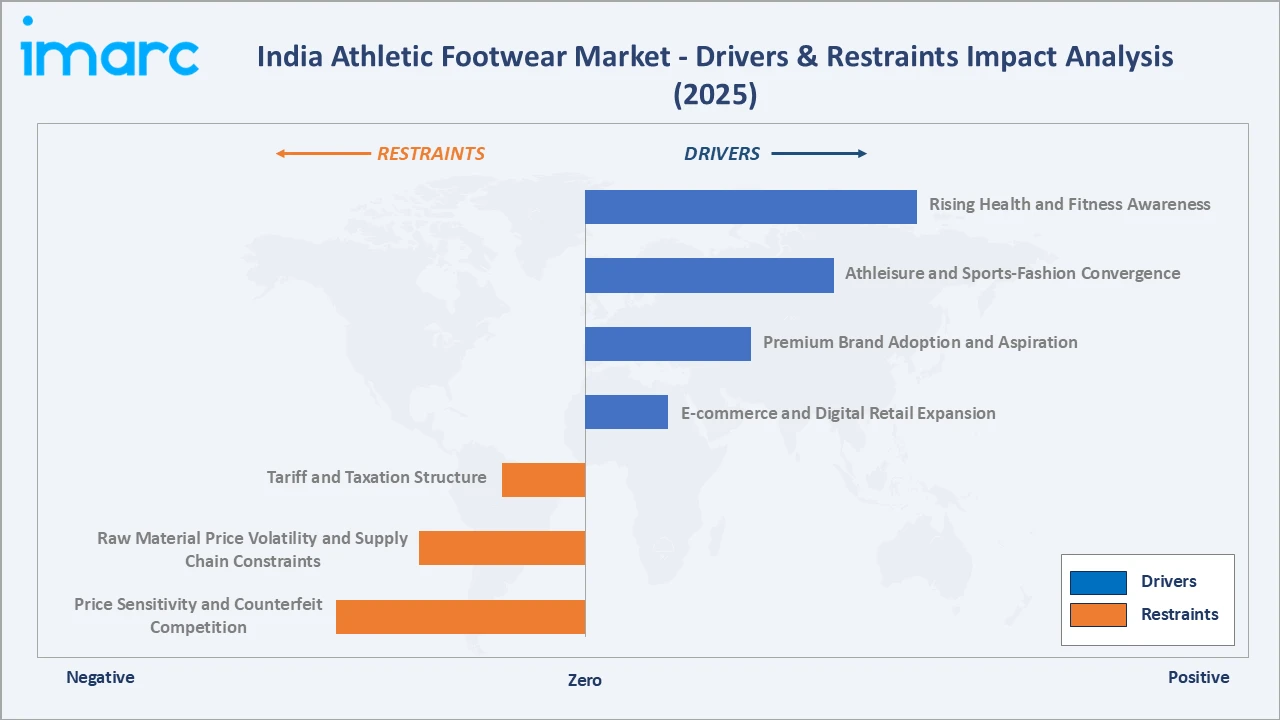
Market Drivers
- Rising Health and Fitness Awareness: As per IMARC Group, the India health and wellness market size was valued at USD 164.35 Billion in 2025. Growing participation in organized fitness, yoga, running clubs, and sports leagues is creating consistent demand for purpose-built athletic footwear with advanced cushioning, arch support, and sport-specific functionality.
- Athleisure and Sports-Fashion Convergence: The convergence of sports and fashion, commonly described as athleisure, has fundamentally altered consumer purchase behavior. Athletic shoes are worn across casual, professional, and social settings, extending purchase frequency and expanding the addressable consumer base well beyond traditional sports participants.
- E-commerce and Digital Retail Expansion: Online retail platforms and direct brand websites have significantly expanded the geographic reach of branded athletic footwear into Tier 2 and Tier 3 cities. Easy returns, size recommendations, and platform loyalty programs are reducing consumer friction and accelerating online conversion.
- Premium Brand Adoption and Aspiration: Increasing consumer aspiration for global performance brands is driving premiumization in the market. Young urban consumers are willing to pay significant premiums for technology-embedded footwear with performance credentials and brand status.
Market Restraints
- Price Sensitivity and Counterfeit Competition: A significant share of the market continues to be addressed by unbranded, counterfeit, and economy-grade products. The prevalence of imitation products at significantly lower price points limits the ability of branded players to penetrate price-sensitive consumer segments.
- Raw Material Price Volatility and Supply Chain Constraints: Athletic footwear manufacturing depends heavily on synthetic rubber, EVA foam, and specialty fabrics, which are subject to global commodity price fluctuations. These cost pressures constrain margin management for domestic manufacturers operating in the value and mid-range segments.
- Tariff and Taxation Structure: The Indian footwear import tariff structure, combined with GST applicable on branded footwear, increases the effective consumer price of imported athletic products and creates competitive disadvantages for international brands versus domestically manufactured alternatives.
Market Opportunities
- Smart and Technology-Integrated Footwear: The rapid proliferation of fitness tracking applications, smart insoles, and wearable health monitors is creating demand for technology-integrated athletic footwear. Brands embedding sensors for gait analysis and pressure mapping can command significant price premiums and build stronger consumer engagement ecosystems.
- Women's Athletic Footwear Segment Expansion: Women's participation in organized sports and fitness activities in India has increased substantially, yet female-specific athletic footwear remains underserved relative to market potential. Dedicated women's product lines and targeted marketing represent a significant untapped growth avenue.
Market Challenges
- Supply Chain Complexity and Quality Consistency: Maintaining consistent product quality and managing multi-tier supply chains across India's diverse geography requires significant investment in logistics infrastructure, vendor management, and quality control processes.
- Inventory Management and Demand Forecasting: Rapid product cycle transitions driven by technology innovation, seasonal collections, and trend shifts require agile inventory management. Excess inventory accumulation due to inaccurate demand forecasting results in significant discounting and margin erosion.
Emerging Market Trends
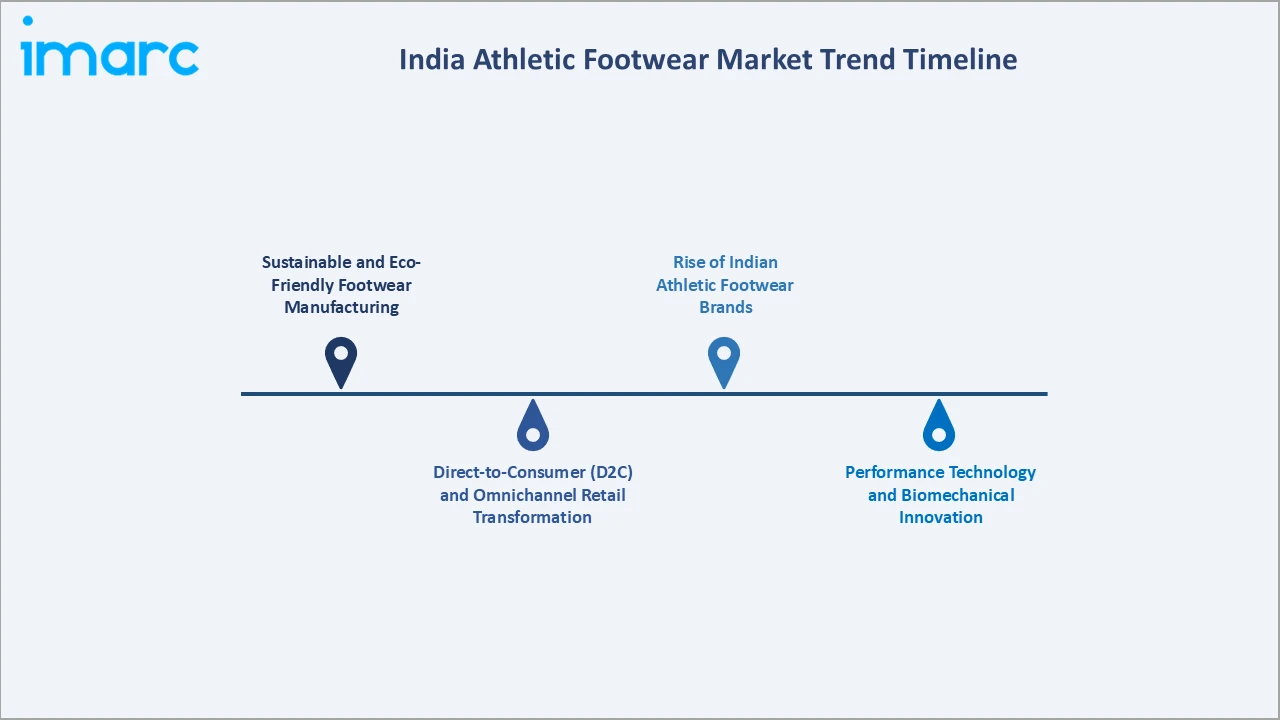
1. Sustainable and Eco-Friendly Footwear Manufacturing
Sustainability has transitioned from a niche differentiator to a mainstream market requirement. Leading brands are investing in recycled polyester uppers, bio-based midsoles, natural rubber outsoles, and low-waste manufacturing processes.
2. Direct-to-Consumer (D2C) and Omnichannel Retail Transformation
Brands are increasingly prioritizing D2C digital channels to capture higher margins, own consumer data, and deliver personalized buying experiences. Native brand apps, exclusive online product drops, and AR-based virtual try-on technologies are transforming the purchasing journey and reducing dependence on third-party retail.
3. Performance Technology and Biomechanical Innovation
Footwear brands are increasingly investing in proprietary cushioning technologies, carbon-fiber plates, and energy-return systems that were initially designed for elite athletes and are now being adapted for mainstream consumers. Collaborations with sports institutes on biomechanical research are further raising consumer expectations for performance, comfort, and efficiency.
4. Rise of Indian Athletic Footwear Brands
Homegrown brands are challenging established international players by offering well-designed, technology-enabled products at accessible price points. Their rapid e-commerce growth is reshaping competitive dynamics in the mid-market segment.
Industry Value Chain Analysis
The India athletic footwear value chain spans six stages from raw material sourcing through component manufacturing, footwear assembly, brand marketing, distribution logistics, and retail engagement with the end consumer.
|
Stage |
Key Players / Examples |
|
Raw Material Sourcing |
Leather suppliers, synthetic fabric producers, rubber and foam manufacturers, chemical suppliers |
|
Component Manufacturing |
Sole manufacturers, insole producers, upper component assemblers, lace and eyelet suppliers |
|
Footwear Assembly |
OEM factories, domestic manufacturers, contract manufacturing units, quality testing labs |
|
Branding & Marketing |
Brand owners, marketing agencies, celebrity endorsement networks, sports sponsorship teams |
|
Distribution & Logistics |
National distributors, regional wholesalers, logistics providers, last-mile delivery networks |
|
Retail & End Consumer |
Specialty footwear stores, brand outlets, online platforms, hypermarkets, sports retailers |
Vertically integrated players with proprietary manufacturing capabilities and direct retail presence capture the highest value share. Brands investing in D2C platforms are achieving structurally higher margins and stronger consumer engagement.
Technology Landscape in the India Athletic Footwear Industry
Advanced Cushioning and Energy-Return Systems
Modern athletic footwear is defined by proprietary cushioning technologies that manage impact forces and return energy to the runner or athlete. This technology is increasingly engineered to enhance comfort, stability, responsiveness, and overall performance across different sporting activities.
Smart Footwear and Wearable Integration
Embedded sensor technology capable of tracking steps, ground contact time, pronation angle, and force distribution is transitioning from research labs to consumer products. Smart insoles compatible with iOS and Android health platforms are gaining traction among serious runners and fitness athletes.
Sustainable Materials and Manufacturing Technologies
Bio-based materials, recycled synthetics, and waterless dyeing processes are being adopted across the supply chain in response to environmental regulations and consumer demand. 3D printing technologies are enabling rapid prototyping and on-demand customization of footwear components.
Market Segmentation Analysis
The report covers the following segments:
|
Segment Category |
Leading Segment |
Market Share |
Year |
|
Product Type |
Running Shoes |
31.8% |
2025 |
|
Distribution Channel |
Specialty Stores |
32.7% |
2025 |
|
End User |
🔒 |
🔒 |
2025 |
|
Region |
West and Central India |
32.8% |
2025 |

By Product Type
Running shoes command the largest product type share at 31.8% in 2025, driven by the exponential growth of organized running events, India's growing marathon culture, and consumer demand for technology-embedded cushioning and gait correction footwear. The segment benefits from strong brand investment in performance storytelling and elite athlete sponsorships.
To access detailed market analysis, Request Sample
Sports shoes at 27.6% are supported by broad sporting participation across cricket, badminton, football, and kabaddi. Growing interest in fitness and recreational sports further encourages consumers to purchase versatile footwear suitable for both sports and everyday activities.
By Distribution Channel
Specialty stores lead at 32.7% in 2025, offering curated assortments, expert staff guidance, professional fitting services, and immersive brand environments that justify premium pricing and build brand loyalty among performance-oriented buyers.
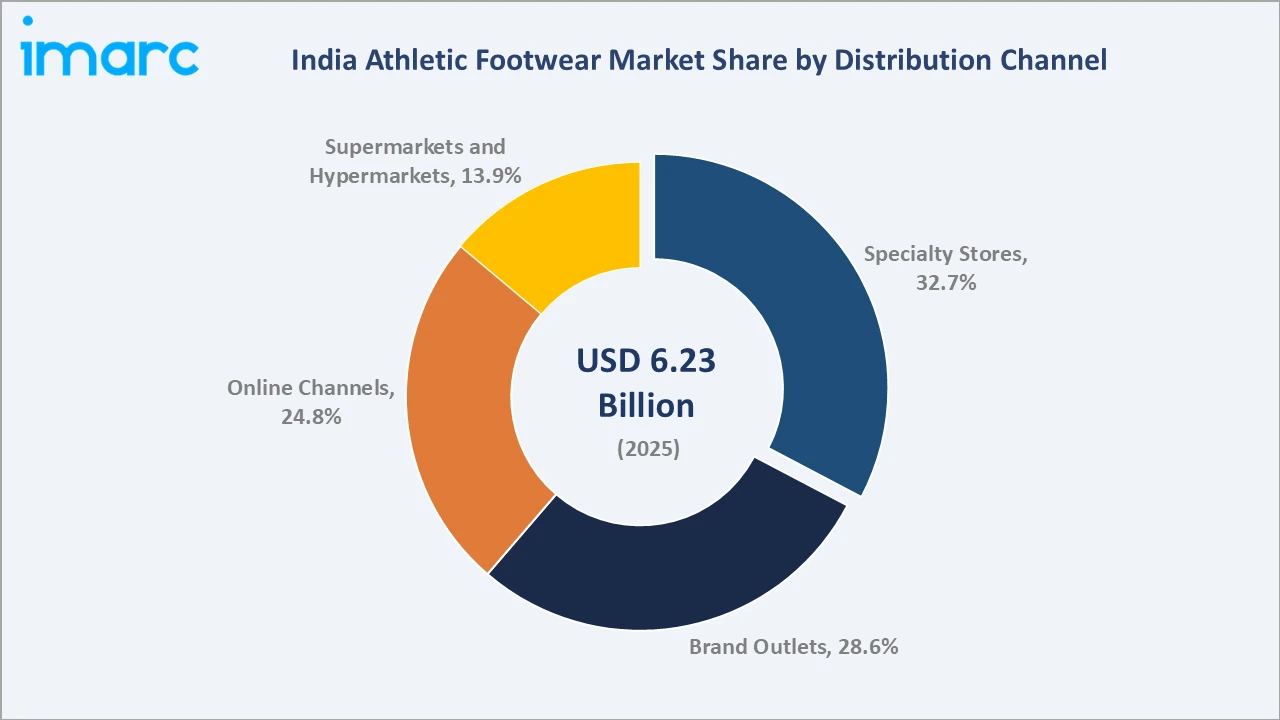
Brand outlets hold a 28.6% share, enabling manufacturers to deliver full product range visibility and controlled brand messaging.
Regional Market Insights
|
Region |
Share (2025) |
Key Growth Drivers |
|
West and Central India |
32.8% |
Strong urban consumer base, high disposable incomes, established retail infrastructure, premium brand penetration in metro cities |
|
South India |
27.6% |
Rising sports participation, rapidly growing IT-driven workforce, expanding e-commerce adoption, growing fitness consciousness |
|
North India |
24.7% |
Dense urban population, strong cricket and sports culture, expanding organized retail, rising youth demographics |
|
East & Northeast India |
14.9% |
Emerging digital adoption, improving logistics connectivity, growing awareness of branded footwear, rising disposable incomes |
West and Central India leads the regional landscape at 32.8% in 2025, anchored by India's financial capital Mumbai and the progressive consumer markets of Pune, Ahmedabad, and Nagpur. Deep organized retail penetration, high disposable incomes, and proximity to port infrastructure underpin regional leadership.
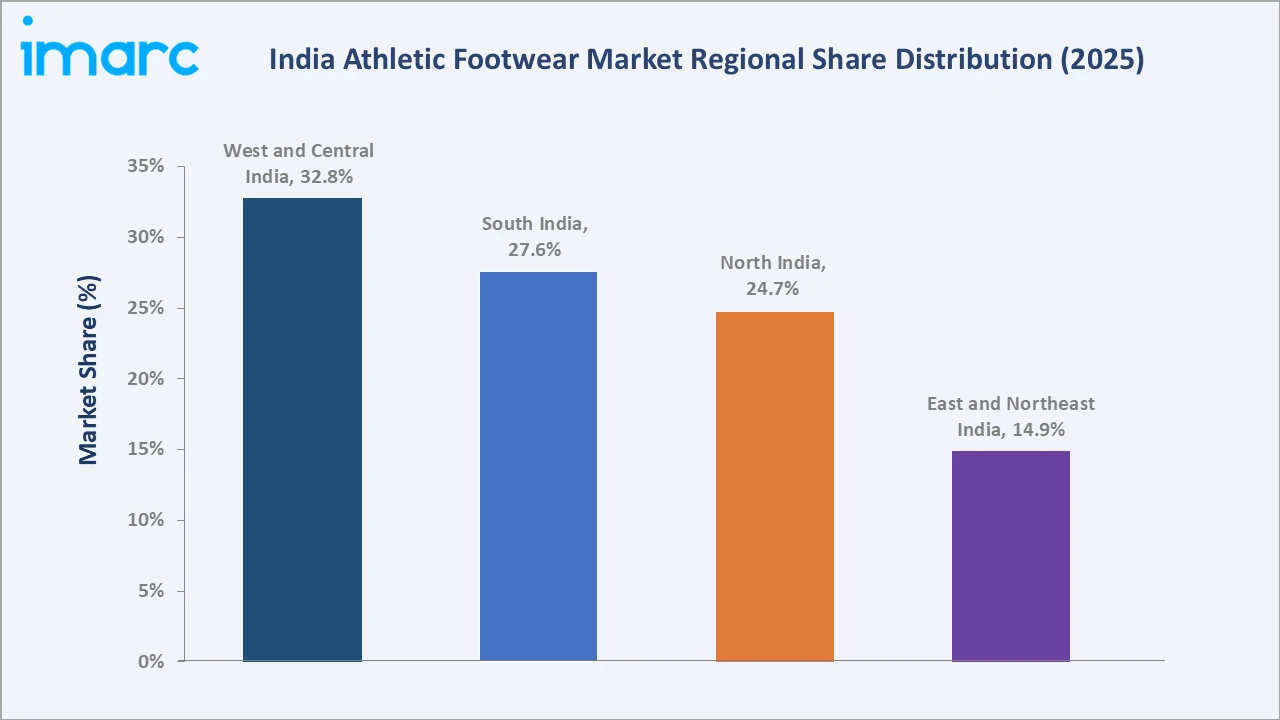
South India at 27.6% is the second largest region. The IT corridor spanning Bengaluru, Hyderabad, and Chennai is generating a large, young, fitness-aware professional workforce with significant discretionary spending power.
Competitive Landscape
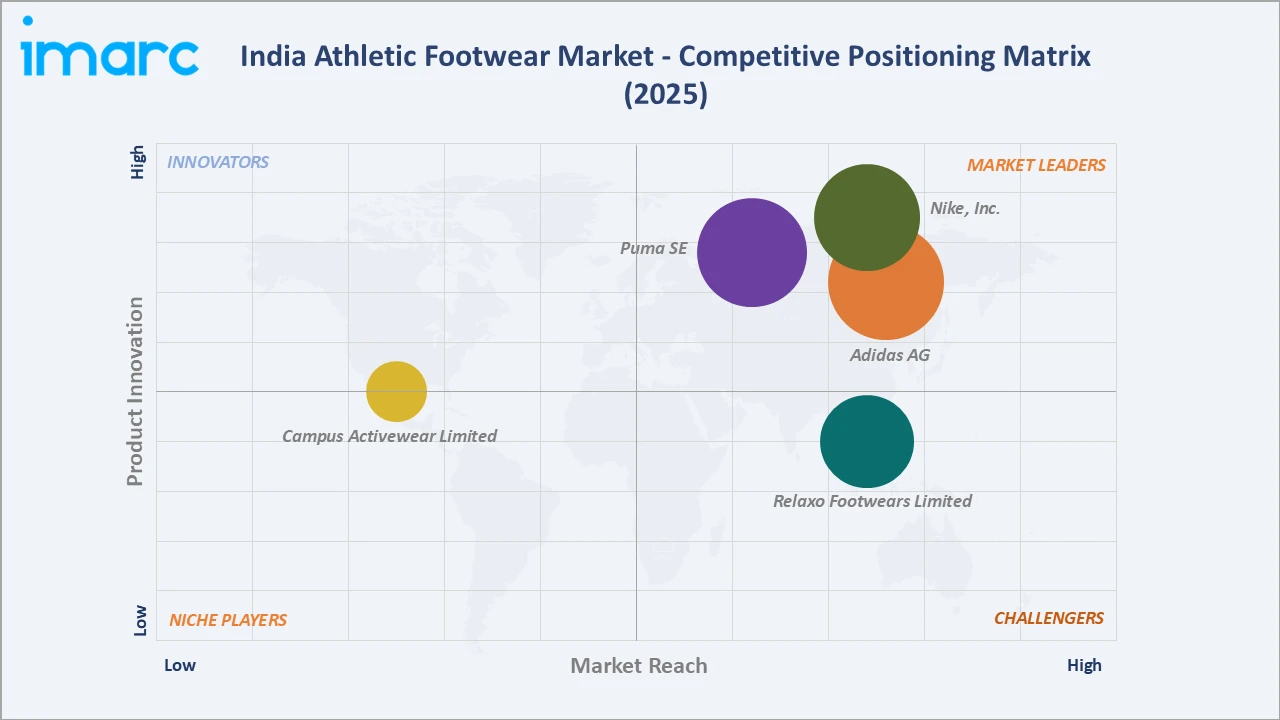
The India athletic footwear market is moderately fragmented, with international leaders commanding premium positioning through technology differentiation, elite sports sponsorships, and strong D2C digital platforms. Domestic players compete effectively in the value and mid-market segments through extensive distribution networks and localized product development.
|
Company Name |
Brand / Key Product |
Position |
Strategic Focus |
|
Nike, Inc. |
Nike Air, ReactX, ZoomX |
Leader |
Technology-led performance footwear with strong D2C digital expansion |
|
Adidas AG |
Ultraboost, Predator, Samba |
Leader |
Sustainability-driven product innovation and expanding athletic range |
|
Puma SE |
Puma Nitro, Velocity Nitro |
Leader |
Sports-fashion convergence with celebrity collaborations and performance focus |
|
Relaxo Footwears Limited |
Sparx, Flite |
Challenger |
Affordable athletic footwear targeting semi-urban and rural consumer segments |
|
Campus Activewear Limited |
Campus, OG Collection |
Emerging |
Domestic value-premium positioning with growing online channel penetration |
Key players include Nike, Inc., Adidas AG, Puma SE, Relaxo Footwears Limited, and Campus Activewear Limited, among others.
Key Company Profiles
Nike, Inc.
Nike, Inc. is an American multinational corporation engaged in the design, development, and worldwide marketing of athletic footwear, apparel, equipment, and accessories. Headquartered in Beaverton, Oregon, United States, the company operates through a combination of direct retail, digital commerce, and wholesale distribution across global markets, including India.
- Product Portfolio: Nike Air footwear range, ReactX-cushioned running shoes, ZoomX performance trainers, and sport-specific footwear designed for running, cricket, football, badminton, and basketball.
- Recent Developments: Nike, Inc. continues to expand its performance footwear portfolio, strengthen its digital and retail presence, and introduce innovations across running and sport-specific footwear categories.
- Strategic Focus: Expanding digital commerce reach through localized fulfilment partnerships, growing premium performance footwear penetration across metro and Tier 1 cities, and strengthening brand visibility through sports marketing and athlete endorsements.
Adidas AG
Adidas AG is a multinational corporation engaged in the design, manufacture, and marketing of athletic footwear, apparel, and accessories. The company operates through a global network of direct retail outlets, digital platforms, and wholesale distribution channels, with an active presence in the Indian market.
- Product Portfolio: Ultraboost running footwear, Predator football boots, and Samba lifestyle shoes.
- Recent Developments: Adidas AG continues to broaden its athletic footwear portfolio, strengthen its retail and digital presence, and introduce products across performance, sports, and lifestyle categories.
- Strategic Focus: Strengthening sustainability credentials through eco-innovation product lines, expanding women's athletic footwear, growing direct-to-consumer digital channels, and deepening sports partnership and endorsement programs.
Puma SE
Puma SE is a multinational corporation specializing in the design, development, and marketing of athletic and casual footwear, apparel, and accessories. The company distributes its products through branded retail outlets, e-commerce platforms, and wholesale channels across multiple markets, including India.
- Product Portfolio: Puma Nitro running footwear platform, Velocity Nitro everyday performance trainers, and sports lifestyle collections.
- Recent Developments: The firm is expanding its athletic footwear portfolio, strengthening digital and retail distribution, and introducing new products across performance and lifestyle categories.
- Strategic Focus: Driving performance footwear adoption through technology-led product innovation, expanding sports and lifestyle collaborations, and growing the brand's presence across metro and Tier 2 city markets.
Market Concentration Analysis
The India athletic footwear market is moderately concentrated, with leading international and domestic brands maintaining strong positions across premium, mid-range, and mass-market segments. These players compete through product innovation, pricing, distribution, and brand positioning.
Barriers to entry in the premium branded segment are high, driven by capital requirements for global supply chains, marketing investment, technology R&D, and established brand equity. Brand recognition also influences consumer purchase decisions.
Consolidation trends are visible in the market as established players expand their retail presence, strengthen distribution networks, and invest in product innovation and brand-building initiatives. Strategic partnerships further support market expansion.
Investment & Growth Opportunities
Fastest Growing Segments
Online channels are the fastest growing distribution channel within the India athletic footwear market. Investment in platform technology, last-mile delivery infrastructure, and influencer-led marketing is accelerating digital commerce penetration across both metro and non-metro geographies. Running shoes and sports shoes are the fastest growing product type categories by volume.
Emerging Markets
South India is the second largest regional market, anchored by rapid digital adoption, a large and growing IT-sector workforce, and expanding organized retail infrastructure in Bengaluru, Hyderabad, and Chennai. East and Northeast India represents a high-potential emerging geography where improving logistics infrastructure is unlocking branded athletic footwear demand at scale.
Venture & Investment Trends
Investment activity is concentrated in domestic D2C athletic footwear brands, smart footwear technology startups, and sustainable materials innovation companies. Investors are also showing interest in brands with strong digital reach, product differentiation, and scalable business models.
Future Market Outlook (2026-2034)
The India athletic footwear market is forecast to expand from USD 6.23 Billion in 2025 to USD 6.64 Billion in 2026 and is forecast to reach USD 9.92 Billion by 2034 at a CAGR of 5.14%, adding approximately USD 3.69 Billion in incremental market value over the nine-year period.
Four structural forces will define market evolution through 2034: continued premiumization driven by rising disposable incomes and brand aspiration; accelerating digital commerce penetration into Tier 2 and Tier 3 cities; the maturation of homegrown Indian athletic footwear brands competing credibly with international labels; and the integration of performance technology and sustainability credentials as baseline consumer expectations.
By 2034, the India athletic footwear market is expected to be defined by technology-embedded performance products, sustainable manufacturing mandates, and highly personalized omnichannel consumer journeys.
Research Methodology
Primary Research
Primary research included structured interviews with senior executives from leading athletic footwear brands, specialty footwear retailers, sports goods distributors, e-commerce category managers, and sports goods industry associations. Consumer surveys across major Indian cities validated purchase behavior, brand preference, and channel adoption data.
Secondary Research
Secondary sources included industry reports from leading trade associations, government publications from the Ministry of Commerce and Industry, data from the Footwear Design and Development Institute, sports goods export council reports, e-commerce platform market disclosures, and published financial statements and investor presentations from key market participants.
Forecasting Models
Market forecasts were developed using integrated top-down and bottom-up modelling approaches. Top-down models applied macroeconomic variables including GDP growth, consumer spending indices, urban population growth, and digital penetration rates. Bottom-up models aggregated segment-level volume and value estimates validated against industry supply data, manufacturer capacity utilization, and retail sell-through rates.
India Athletic Footwear Market Report Coverage:
| Report Features | Details |
|---|---|
| Base Year of the Analysis | 2025 |
| Historical Period | 2020-2025 |
| Forecast Period | 2026-2034 |
| Units | Billion USD |
| Scope of the Report | Exploration of Historical Trends and Market Outlook, Industry Catalysts and Challenges, Segment-Wise Historical and Future Market Assessment:
|
| Product Types Covered | Aerobic Shoes, Running Shoes, Walking Shoes, Trekking and Hiking Shoes, Sports Shoes |
| Distribution Channels Covered | Supermarkets and Hypermarkets, Specialty Stores, Brand Outlets, Online Channels |
| End Users Covered | Men, Women, Kids |
| Regions Covered | North India, West and Central India, South India, East and Northeast India |
| Companies Covered | Nike, Inc., Adidas AG, Puma SE, Relaxo Footwears Limited, Campus Activewear Limited, etc. |
| Customization Scope | 10% Free Customization |
| Post-Sale Analyst Support | 10-12 Weeks |
| Delivery Format | PDF and Excel through Email (We can also provide the editable version of the report in PPT/Word format on special request) |
Key Benefits for Stakeholders:
- IMARC’s industry report offers a comprehensive quantitative analysis of various market segments, historical and current market trends, market forecasts, and dynamics of the India athletic footwear market from 2020-2034.
- The research report provides the latest information on the market drivers, challenges, and opportunities in the India athletic footwear market.
- Porter's five forces analysis assist stakeholders in assessing the impact of new entrants, competitive rivalry, supplier power, buyer power, and the threat of substitution. It helps stakeholders to analyze the level of competition within the India athletic footwear industry and its attractiveness.
- Competitive landscape allows stakeholders to understand their competitive environment and provides an insight into the current positions of key players in the market.
Frequently Asked Questions About the India Athletic Footwear Market Report
The India athletic footwear market size is estimated at USD 6.64 Billion in 2026, driven by rising fitness awareness, growing sports participation, and expanding organized retail and e-commerce channels across urban and semi-urban India.
The market is projected to grow at a CAGR of 5.14% from 2026-2034, reaching USD 9.92 Billion, supported by premiumization trends, digital commerce growth, and rising youth demographics.
Running shoes lead at 31.8% in 2025, driven by organized running events, marathon culture, and growing consumer demand for biomechanically advanced performance footwear.
Specialty stores lead with 32.7% share in 2025, supported by curated product assortments, professional fitting expertise, and immersive brand environments that drive premium purchase decisions.
West and Central India commands 32.8% in 2025, led by Mumbai, Pune, and Ahmedabad, with high disposable incomes and strong organized retail penetration.
Key players include Nike, Inc., Adidas AG, Puma SE, Relaxo Footwears Limited, and Campus Activewear Limited, among others.
Key drivers include rising health and fitness awareness, the athleisure trend, e-commerce expansion, premium brand aspiration among urban youth, and government investment in sports infrastructure.
Key challenges include price sensitivity in semi-urban and rural segments, counterfeit product competition, raw material cost volatility, and complex multi-tier supply chain management.
Advanced cushioning systems, smart insole technology, sustainable bio-based materials, 3D printing for customization, and AR-based virtual try-on are reshaping product development and retail experiences.
E-commerce platforms are enabling branded athletic footwear to reach Tier 2 and Tier 3 consumers, with competitive pricing, free returns, personalized recommendations, and influencer-led discovery accelerating online penetration.
Need more help?
- Speak to our experienced analysts for insights on the current market scenarios.
- Include additional segments and countries to customize the report as per your requirement.
- Gain an unparalleled competitive advantage in your domain by understanding how to utilize the report and positively impacting your operations and revenue.
- For further assistance, please connect with our analysts.
 Request Customization
 Speak to an Analyst
 Request Brochure
 Inquire Before Buying
Benefits of Customization
- Personalize this research
- Triangulate with your data
- Get data as per your format and definition
- Gain a deeper dive into a specific application, geography, customer, or competitor
- Any level of personalization
Get in Touch With Us
UNITED STATES
Phone: +1-201-971-6302
INDIA
Phone: +91-120-433-0800
UNITED KINGDOM
Phone: +44-753-714-6104
Email: sales@imarcgroup.com
Client Testimonials




.webp)




.webp)













Related Reports

Choose your plan
*Please note that the prices mentioned below are starting prices for each bundle type. Kindly contact our team for further details.*
Single User License
- 1 User License, Access on 2 Devices
- PDF Report + Excel Dataset (Password Protected)
- Lifetime Access
- No Printing Rights
- 10% Free Report Customization
- 10–12 Weeks of Analyst Support
Five User License
- Access for 5 Users, 2 Devices per User
- PDF Report + Excel Dataset (Password Protected)
- Lifetime Access
- Dedicated Account Manager
- 12–14 Weeks of Analyst Support
- No Printing Rights
- 15% Free Report Customization
- 25% Discount on Your Next Purchase
Corporate User License
- Unlimited User Access (Within Your Organization)
- PDF Report + Excel Dataset
- Lifetime Access
- Dedicated Account Manager
- 14–20 Weeks of Analyst Support
- No Printing Rights
- 20% Free Report Customization
- 30% Discount on Your Next Purchase
Essential Insights
What's included:
3 reports
- Lifetime Access
- PDF Reports
- Excel Datasets
- 2 Weeks of Free Analyst Support
- 2 User Licenses
- Access on 2 Devices
- Printing Rights
- Complimentary PowerPoint (PPT) Version
- Complimentary License Upgrade
Professional Access
What's included:
5 reports
- Lifetime Access
- PDF Reports
- Excel Datasets
- 8 Weeks of Free Analyst Support
- 2 User Licenses
- Access on 2 Devices
- Printing Rights
- Complimentary PowerPoint (PPT) Version
- Complimentary License Upgrade
Business Advantage
What's included:
8 reports
- Lifetime Access
- PDF Reports
- Excel Datasets
- 14 Weeks of Free Analyst Support
- 2 User Licenses
- Access on 2 Devices
- Printing Rights
- Complimentary PowerPoint (PPT) Version
- Complimentary License Upgrade
Enterprise Intelligence
What's included:
10 reports
- Lifetime Access
- PDF Reports
- Excel Datasets
- 20 Weeks of Free Analyst Support
- 2 User Licenses
- Access on 2 Devices
- Printing Rights
- Complimentary PowerPoint (PPT) Version
- Complimentary License Upgrade