
India Automated Liquid Handling Technologies Market Size, Share, Trends and Forecast by Type, Modality, Procedure, End User, and Region, 2026-2034
India Automated Liquid Handling Technologies Market Summary:
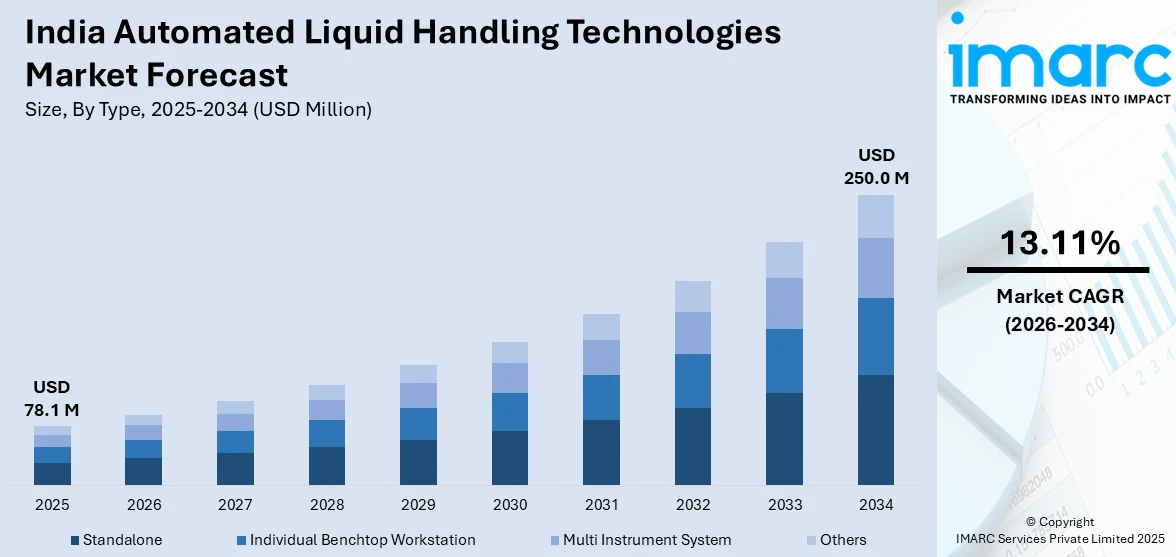
The India automated liquid handling technologies market size was valued at USD 78.1 Million in 2025 and is projected to reach USD 250.0 Million by 2034, growing at a compound annual growth rate of 13.11% from 2026-2034.
The India automated liquid handling technologies market is expanding as biotechnology, and pharmaceutical sectors accelerate investments in laboratory automation to enhance research throughput and experimental reproducibility. Rising demand for precision liquid dispensing in drug discovery, genomics research, and clinical diagnostics is propelling adoption of automated systems. Government initiatives supporting domestic biotech infrastructure development and increasing contract research outsourcing activities are further strengthening the India automated liquid handling technologies market share.
Key Takeaways and Insights:
- By Type: Standalone dominates the market with a share of 47.9% in 2025, owing to its operational flexibility, lower initial investment requirements, and compatibility with diverse laboratory workflows that enable small and medium-sized research facilities to implement targeted automation solutions without requiring extensive infrastructure modifications.
- By Modality: Disposable tip leads the market with a share of 51.2% in 2025, driven by stringent contamination prevention requirements across pharmaceutical quality control, genomics research, and clinical diagnostic applications where cross-sample integrity is essential for reliable experimental outcomes and regulatory compliance.
- By Procedure: PCR setup represents the largest segment with a market share of 39.8% in 2025, reflecting the growing adoption of molecular diagnostics, expanding genomic research initiatives, and rising demand for standardized nucleic acid amplification protocols across biotechnology and clinical laboratory settings throughout India.
- By End User: Biotechnology and pharmaceutical companies lead the market with a share of 43.5% in 2025, driven by escalating research and development expenditure, expanding drug discovery pipelines, and increasing emphasis on high-throughput screening capabilities that demand precise, reproducible liquid handling automation solutions.
- By Region: West India occupies the largest market share at 34.6% in 2025, fueled by the dense concentration of pharmaceutical manufacturing hubs and research infrastructure across Maharashtra and Gujarat, combined with a robust contract research organization ecosystem and proximity to major biotechnology innovation hubs.
- Key Players: Key players drive the India automated liquid handling technologies market by expanding product portfolios, enhancing system integration capabilities, investing in application-specific solutions, and strengthening regional distribution networks to ensure comprehensive technical support and service accessibility across diverse laboratory environments throughout India.
To get more information on this market Request Sample
The India automated liquid handling technologies market is advancing as pharmaceutical research expansion, growing contract research outsourcing, and genomics-driven diagnostic innovation create sustained demand for precision automation solutions. Automated liquid handling systems serve critical functions in drug discovery, clinical diagnostics, and bioprocess development where manual pipetting introduces unacceptable variability and limits experimental throughput. India's biotechnology sector expanded from USD 10 Billion in 2014 to USD 165.7 Billion in 2024, reflecting the rapid growth trajectory of life sciences research that underpins demand for advanced laboratory automation infrastructure. The country's pharmaceutical industry, valued at approximately USD 50 Billion in FY 2024, continues to invest heavily in research infrastructure modernization to support complex biologics development and advanced formulation research. Rising adoption of genomic testing, expanding bioprocess manufacturing capabilities, increasing regulatory emphasis on standardized laboratory practices, and growing demand for high-throughput screening in drug discovery pipelines are collectively reinforcing market expansion across research and clinical applications throughout India.
India Automated Liquid Handling Technologies Market Trends:
Expansion of pharmaceutical research and development infrastructure
India's pharmaceutical sector is significantly expanding research capabilities, driving demand for automated liquid handling systems that enhance experimental throughput and reproducibility. Leading Indian pharmaceutical companies allocated an average of 5.9% of revenue toward research and development during FY 2023-24, with aggregate expenditure reaching Rs 137.1 Billion across the top ten firms. This intensifying investment in drug discovery and formulation development is accelerating procurement of automated liquid handling platforms capable of supporting high-volume screening, compound management, and assay development workflows across research facilities.
Growth in contract research and outsourcing services
India's contract research organization sector is experiencing rapid expansion as global pharmaceutical companies increasingly outsource clinical and preclinical research activities. As such, in September 2024, the Indian government framed standard operating procedures for clinical research organizations under the New Drugs and Clinical Trials Amendment Rules, strengthening regulatory frameworks governing outsourced research. This regulatory maturation and growing outsourcing volume are driving India automated liquid handling technologies market growth as contract research facilities invest in automated platforms to meet international quality standards and accelerate project timelines.
Advancement in genomics and molecular diagnostics capabilities
India's diagnostic laboratory sector is witnessing transformative growth driven by expanding molecular testing adoption and next-generation sequencing capabilities. India's diagnostic laboratories market was valued at INR 1.54 Trillion in FY 2024 and is projected to reach INR 2.98 Trillion by FY 2030, reflecting the accelerating demand for precision diagnostic solutions. The proliferation of polymerase chain reaction testing, genetic screening, and pharmacogenomics applications is increasing reliance on automated liquid handling systems that deliver the precision and consistency required for sensitive nucleic acid processing workflows.
Market Outlook 2026-2034:
The India automated liquid handling technologies market is positioned for robust expansion over the forecast period, supported by accelerating biotechnology investments, pharmaceutical research modernization, and growing demand for high-throughput laboratory automation. In tandem, increasing adoption of automated systems in drug discovery, genomics research, and clinical diagnostics is expected to sustain demand growth as laboratories seek to improve throughput while maintaining precision and regulatory compliance. The expansion of contract research services, coupled with government initiatives promoting domestic biotechnology manufacturing under the BioE3 Policy approved in August 2024, is anticipated to create new growth avenues. Furthermore, rising investments in next-generation sequencing, bioprocess development, and personalized medicine are further expected to drive procurement of advanced liquid handling platforms across pharmaceutical, academic, and contract research facilities throughout India. The market generated a revenue of USD 78.1 Million in 2025 and is projected to reach a revenue of USD 250.0 Million by 2034, growing at a compound annual growth rate of 13.11% from 2026-2034.
India Automated Liquid Handling Technologies Market Report Segmentation:
|
Segment Category |
Leading Segment |
Market Share |
|
Type |
Standalone |
47.9% |
|
Modality |
Disposable Tip |
51.2% |
|
Procedure |
PCR Setup |
39.8% |
|
End User |
Biotechnology and Pharmaceutical Companies |
43.5% |
|
Region |
West India |
34.6% |
Type Insights:
- Standalone
- Individual Benchtop Workstation
- Multi Instrument System
- Others
Standalone dominates with a market share of 47.9% of the total India automated liquid handling technologies market in 2025.
Standalone automated liquid handling systems lead the India market owing to their operational flexibility, compact footprint, and ability to function independently without integration into larger laboratory automation platforms. These systems are particularly favored by small and medium-sized biotechnology firms, academic research laboratories, and emerging contract research organizations that require targeted automation for specific applications without committing to comprehensive laboratory-wide automation infrastructure. For instance, in August 2024, Eppendorf launched the epMotion 96 Flex, a 96-channel liquid handling system designed to bridge the gap between handheld electronic pipettes and fully automated platforms, addressing the needs of laboratories seeking standalone automation solutions.
The versatility of standalone systems enables deployment across diverse applications including sample preparation, reagent dispensing, serial dilution, and plate reformatting, making them the preferred choice for laboratories with variable workflow requirements. Standalone platforms offer lower capital investment thresholds compared with integrated multi-instrument configurations, enabling cost-conscious Indian laboratories to adopt automation incrementally. The Department of Biotechnology allocated INR 2,251.52 Crore (approximately USD 271 Million) in the Interim Budget 2024-25 for biotechnology development, supporting the expansion of research infrastructure where standalone automated liquid handling systems are commonly the first automation investment for emerging laboratories.
Modality Insights:
- Disposable Tip
- Fixed Tip
Disposable tip leads with a share of 51.2% of the total India automated liquid handling technologies market in 2025.
Disposable tip modality commands the largest share of the India automated liquid handling technologies market due to its critical role in preventing cross-contamination between samples, which is essential for maintaining data integrity in pharmaceutical quality control, genomics research, and clinical diagnostic applications. Laboratories processing sensitive biological specimens, nucleic acid samples, and pharmaceutical compounds increasingly mandate disposable tip systems to eliminate carryover risks that compromise experimental validity.
The growing emphasis on regulatory compliance and good laboratory practices across Indian pharmaceutical and diagnostic laboratories is further reinforcing preference for disposable tip systems that provide documented contamination-free liquid transfers. Applications in polymerase chain reaction setup, next-generation sequencing library preparation, and enzyme-linked immunosorbent assay processing require absolute sample integrity, making disposable tips indispensable.
Procedure Insights:
- PCR Setup
- Serial Dilution
- High-Throughput Screening
- Cell Culture
- Whole Genome Amplification
- Plate Reformatting
- Array Printing
- Others
PCR setup holds the largest share at 39.8% of the total India automated liquid handling technologies market in 2025.
Polymerase chain reaction setup procedures account for the largest share of the India automated liquid handling technologies market, driven by the expanding adoption of molecular diagnostics, infectious disease testing, and genomic research applications across healthcare and pharmaceutical sectors. Automated liquid handling systems ensure precise dispensing of primers, templates, and master mixes required for reliable amplification results, minimizing human error and enhancing reproducibility across high-volume testing environments.
The acceleration of pharmacogenomics research, genetic screening programs, and next-generation sequencing workflows is further strengthening demand for automated PCR setup capabilities across Indian laboratories. Precision in reaction component dispensing is critical for maintaining assay sensitivity and specificity, particularly in applications involving low-copy-number targets and multiplex amplification protocols. For example, MedGenome, which operates South Asia's largest CAP-accredited multiomics laboratory, has served over 10 lakh patients with genomic testing services, illustrating the scale of molecular testing infrastructure in India that relies on automated liquid handling for consistent PCR preparation across large sample volumes.
End User Insights:
Access the comprehensive market breakdown Request Sample
- Biotechnology and Pharmaceutical Companies
- Contract Research Organizations
- Academic and Government Research Institutes
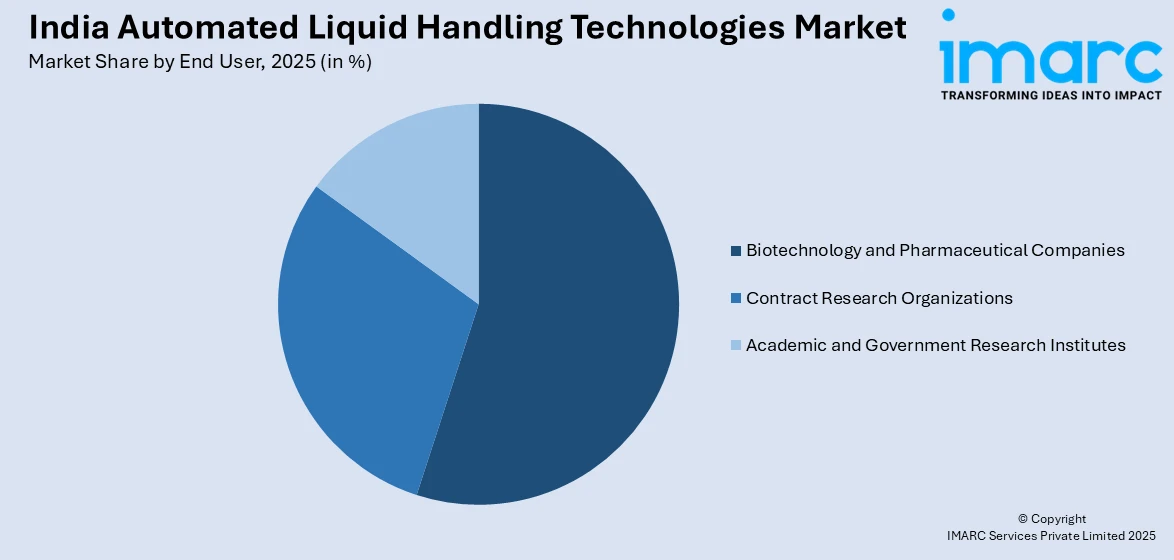
Biotechnology and pharmaceutical companies exhibit a clear dominance with a 43.5% share of the total India automated liquid handling technologies market in 2025.
Biotechnology and pharmaceutical companies represent the largest end user segment, driven by their extensive research and development operations, high-throughput screening requirements, and stringent quality control protocols that necessitate precision liquid handling automation. India hosts approximately 11,000 biotechnology startups alongside a mature pharmaceutical industry, creating a substantial installed base for automated liquid handling platforms across drug discovery, formulation development, and analytical testing laboratories.
The increasing complexity of pharmaceutical research pipelines, including biologics development, biosimilar characterization, and advanced drug delivery formulation, demands automated liquid handling systems capable of delivering nanoliter to microliter precision across thousands of samples. Besides this, Indian pharmaceutical companies are investing in automation to accelerate time-to-market for new drug candidates while meeting international regulatory standards for data integrity and process reproducibility.
Regional Insights:
- North India
- South India
- East India
- West India
West India represents the leading region with a 34.6% share of the total India automated liquid handling technologies market in 2025.
West India leads the automated liquid handling technologies market owing to the concentration of pharmaceutical manufacturing and research infrastructure across Maharashtra and Gujarat. Maharashtra contributes an estimated 25 to 30% of India's total pharmaceutical output and hosts approximately 40% of the country's pharmaceutical research and development centers, creating substantial demand for laboratory automation solutions. The Ahmedabad-Vadodara industrial corridor in Gujarat further strengthens regional demand through its established pharmaceutical manufacturing cluster and growing contract research ecosystem.
The region’s dominance is further reinforced by the presence of numerous biotech startups, CROs (Contract Research Organizations), and academic research institutions actively engaged in drug discovery and life sciences research. Likewise, increasing adoption of high-throughput screening, precision dosing, and automated sample preparation in these facilities is driving demand for sophisticated liquid handling instruments. Additionally, government incentives promoting biotechnology innovation, coupled with rising investments from private equity and multinational pharmaceutical companies, are expanding laboratory infrastructure and accelerating the uptake of automated solutions across West India.

Market Dynamics:
Growth Drivers:
Why is the India Automated Liquid Handling Technologies Market Growing?
Rising biotechnology sector investment and government support
India's biotechnology sector has experienced transformative growth, creating robust demand for laboratory automation infrastructure including automated liquid handling systems. The continual advancements in biopharma, bioindustrial, and bioagricultural sectors that collectively require sophisticated research instrumentation, is also impelling the market. Accordingly, the Union Budget 2026–27 proposed Biopharma SHAKTI, allocating INR 10,000 Crore over five years to bolster India’s biologics and biosimilars ecosystem, aiming to position India as a global biopharma leader with 5% market share. The approval of various policies led to the establishment of India's comprehensive biotechnology framework promoting high-performance biomanufacturing and innovation-driven research. Furthermore, government allocation of substantial budget directly supports research infrastructure development where automated liquid handling platforms serve as foundational investments for emerging laboratories.
Expanding pharmaceutical manufacturing and research capabilities
India's pharmaceutical industry continues to expand its research and manufacturing footprint, driving demand for automated liquid handling technologies across drug discovery, quality control, and analytical testing laboratories. Indian pharmaceutical companies are increasingly modernizing research infrastructure to support complex biologics development, biosimilar characterization, and advanced formulation research that requires precise automated liquid dispensing for high-throughput screening, compound management, and stringent analytical testing protocols meeting international regulatory standards. Accordingly, launched in 2023 with an INR 5,000 Crore outlay, the PRIP scheme aims to make India a global Pharma-MedTech innovation hub, supporting R&D in drugs, biosimilars, precision medicine, medical devices, and industry–academia collaborations.
Increasing demand for high-throughput screening and molecular diagnostics
The proliferation of molecular diagnostic testing, genomic research, and personalized medicine initiatives across India is creating accelerating demand for automated liquid handling systems capable of processing large sample volumes with consistent precision and minimal contamination risk. India's diagnostic laboratories market was valued at INR 1.54 Trillion in FY 2024, reflecting the substantial scale of testing infrastructure increasingly requiring automation to maintain throughput and quality standards. Expanding next-generation sequencing adoption, pharmacogenomics research programs, and infectious disease surveillance networks are driving procurement of automated platforms that deliver consistent, contamination-free sample preparation essential for reliable molecular analysis outcomes across clinical and research laboratory environments.
Market Restraints:
What Challenges the India Automated Liquid Handling Technologies Market is Facing?
High initial equipment costs and budget constraints
The significant capital investment required for procuring automated liquid handling systems presents a substantial barrier, particularly for academic institutions, small biotechnology startups, and government research laboratories operating within constrained budgets. Advanced multi-channel liquid handling platforms with integrated software, specialized consumables, and ongoing maintenance requirements create total cost of ownership profiles that exceed the financial capacity of many emerging Indian research facilities, limiting adoption to well-funded pharmaceutical companies and established contract research organizations.
Limited availability of skilled technical workforce
The effective operation and maintenance of automated liquid handling platforms demand specialized technical expertise in laboratory automation, robotic programming, and method development that remains scarce across India's research ecosystem. Many laboratories face challenges in recruiting and retaining trained personnel capable of optimizing automated liquid handling workflows, developing custom protocols, and troubleshooting system performance issues, resulting in underutilization of installed equipment and extended implementation timelines that reduce the operational efficiency gains expected from automation investments.
Infrastructure constraints in emerging research centers
Laboratories located in tier two and tier three cities across India frequently encounter infrastructure limitations including unreliable power supply, inadequate climate control systems, and insufficient laboratory space that hinder effective deployment of sensitive automated liquid handling equipment. These environmental constraints compromise instrument performance and accuracy, discouraging adoption outside established research hubs and limiting market penetration into India's rapidly expanding network of regional research institutions and diagnostic facilities that could otherwise benefit from laboratory automation technologies.
Competitive Landscape:
The India automated liquid handling technologies market is highly competitive, led by established multinational life science instrumentation firms leveraging advanced engineering, broad product portfolios, and global research collaborations. Market players compete on system precision, throughput, software integration, application versatility, and after-sales support. Likewise, continuous innovation drives development of compact, user-friendly, and application-specific solutions tailored to Indian research and diagnostic laboratories. Strategic investments in platforms for next-generation sequencing, high-throughput drug screening, and clinical sample processing allow companies to capture specialized market segments. At the same time, collaborations with Indian pharmaceutical, biotech, and academic institutions enhance market presence and enable customized solutions aligned with local workflows.
Recent Developments:
- In January 2026, Beckman Coulter Life Sciences partnered with Automata to integrate liquid handling, genomic analysis, and cell analysis technologies with AI-ready laboratory automation, creating comprehensive automated workflows for life science research and drug discovery applications.
- In December 2025, Integrated DNA Technologies and Beckman Coulter Life Sciences announced a partnership to automate next-generation sequencing assays using the new Biomek i3 benchtop liquid handler, targeting oncology and genetic disease research applications.
India Automated Liquid Handling Technologies Market Report Coverage:
|
Report Features |
Details |
|
Base Year of the Analysis |
2025 |
|
Historical Period |
2020-2025 |
|
Forecast Period |
2026-2034 |
|
Units |
USD Million |
|
Scope of the Report |
Exploration of Historical Trends and Market Outlook, Industry Catalysts and Challenges, Segment-Wise Historical and Future Market Assessment:
|
|
Types Covered |
Standalone, Individual Benchtop Workstation, Multi Instrument System, Others |
|
Modalities Covered |
Disposable Tip, Fixed Tip |
|
Procedures Covered |
PCR Setup, Serial Dilution, High-Throughput Screening, Cell Culture, Whole Genome Amplification, Plate Reformatting, Array Printing, Others |
|
End Users Covered |
Biotechnology and Pharmaceutical Companies, Contract Research Organizations, Academic and Government Research Institutes |
|
Regions Covered |
North India, South India, East India, West India |
|
Customization Scope |
10% Free Customization |
|
Post-Sale Analyst Support |
10-12 Weeks |
|
Delivery Format |
PDF and Excel through Email (We can also provide the editable version of the report in PPT/Word format on special request) |
Frequently Asked Questions About the India Automated Liquid Handling Technologies Market Report
The India automated liquid handling technologies market size was valued at USD 78.1 Million in 2025.
The India automated liquid handling technologies market is expected to grow at a compound annual growth rate of 13.11% from 2026-2034 to reach USD 250.0 Million by 2034.
Standalone dominated the market with a share of 47.9%, driven by its operational flexibility, compact footprint, and cost-effective deployment for targeted laboratory automation across diverse research and diagnostic applications.
Key factors driving the India automated liquid handling technologies market include rising biotechnology investments, expanding pharmaceutical research infrastructure, growing contract research outsourcing, increasing molecular diagnostics adoption, and government support for laboratory automation.
Major challenges include high initial equipment costs limiting adoption among smaller laboratories, limited availability of skilled technical workforce for system operation and maintenance, infrastructure constraints in emerging research centers, and the need for ongoing consumable expenditure.
Need more help?
- Speak to our experienced analysts for insights on the current market scenarios.
- Include additional segments and countries to customize the report as per your requirement.
- Gain an unparalleled competitive advantage in your domain by understanding how to utilize the report and positively impacting your operations and revenue.
- For further assistance, please connect with our analysts.
 Request Customization
 Speak to an Analyst
 Request Brochure
 Inquire Before Buying
Benefits of Customization
- Personalize this research
- Triangulate with your data
- Get data as per your format and definition
- Gain a deeper dive into a specific application, geography, customer, or competitor
- Any level of personalization
Get in Touch With Us
UNITED STATES
Phone: +1-201-971-6302
INDIA
Phone: +91-120-433-0800
UNITED KINGDOM
Phone: +44-753-714-6104
Email: [email protected]
Client Testimonials




.webp)




.webp)













Related Reports

Choose your plan
*Please note that the prices mentioned below are starting prices for each bundle type. Kindly contact our team for further details.*
Single User License
- 1 User License, Access on 2 Devices
- PDF Report + Excel Dataset (Password Protected)
- Lifetime Access
- No Printing Rights
- 10% Free Report Customization
- 10–12 Weeks of Analyst Support
Five User License
- Access for 5 Users, 2 Devices per User
- PDF Report + Excel Dataset (Password Protected)
- Lifetime Access
- Dedicated Account Manager
- 12–14 Weeks of Analyst Support
- No Printing Rights
- 15% Free Report Customization
- 25% Discount on Your Next Purchase
Corporate User License
- Unlimited User Access (Within Your Organization)
- PDF Report + Excel Dataset
- Lifetime Access
- Dedicated Account Manager
- 14–20 Weeks of Analyst Support
- No Printing Rights
- 20% Free Report Customization
- 30% Discount on Your Next Purchase
Essential Insights
What's included:
3 reports
- Lifetime Access
- PDF Reports
- Excel Datasets
- 2 Weeks of Free Analyst Support
- 2 User Licenses
- Access on 2 Devices
- Printing Rights
- Complimentary PowerPoint (PPT) Version
- Complimentary License Upgrade
Professional Access
What's included:
5 reports
- Lifetime Access
- PDF Reports
- Excel Datasets
- 8 Weeks of Free Analyst Support
- 2 User Licenses
- Access on 2 Devices
- Printing Rights
- Complimentary PowerPoint (PPT) Version
- Complimentary License Upgrade
Business Advantage
What's included:
8 reports
- Lifetime Access
- PDF Reports
- Excel Datasets
- 14 Weeks of Free Analyst Support
- 2 User Licenses
- Access on 2 Devices
- Printing Rights
- Complimentary PowerPoint (PPT) Version
- Complimentary License Upgrade
Enterprise Intelligence
What's included:
10 reports
- Lifetime Access
- PDF Reports
- Excel Datasets
- 20 Weeks of Free Analyst Support
- 2 User Licenses
- Access on 2 Devices
- Printing Rights
- Complimentary PowerPoint (PPT) Version
- Complimentary License Upgrade