
India Automotive Plastics Market Size, Share, Trends and Forecast by Vehicle Type, Material, Application, and Region, 2026-2034
India Automotive Plastics Market Size, Share, Trends & Forecast (2026-2034)
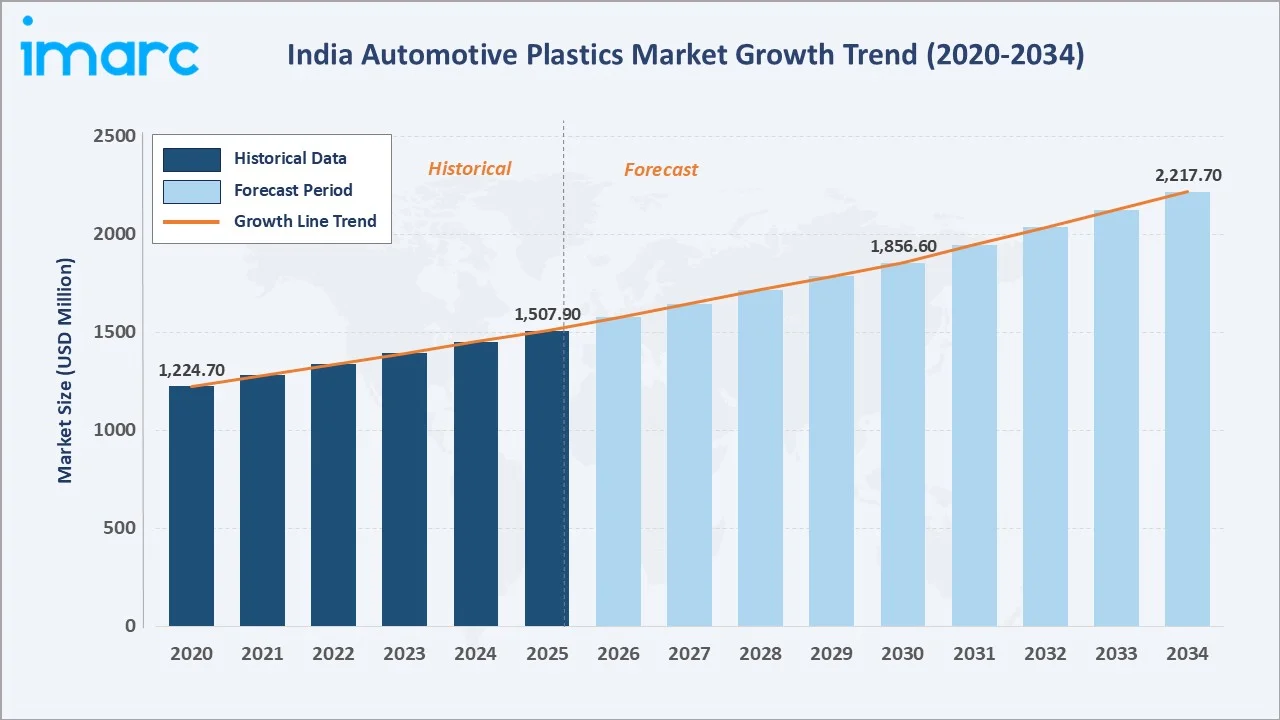
The India automotive plastics market was valued at USD 1,507.90 Million in 2025 and is projected to reach USD 2,217.70 Million by 2034, expanding at a CAGR of 4.25% during the forecast period (2026-2034). Growth is driven by India’s CAFE Phase II fuel efficiency mandates, accelerating EV adoption under FAME III and the PLI Automotive Scheme, rising domestic vehicle production, with automobile exports rose 19% in FY25 to over 5.3 million units, and systematic lightweight substitution of metal components with engineering plastics. Conventional and traditional vehicles dominate at 65%, while interior furnishings lead the application at 25%. North India commands 30% of the market share.
Market Snapshot
|
Metric |
Value |
|
Market Size (2025) |
USD 1,507.90 Million |
|
Forecast Market Size (2034) |
USD 2,217.70 Million |
|
CAGR (2026-2034) |
4.25% |
|
Base Year |
2025 |
|
Historical Period |
2020-2025 |
|
Forecast Period |
2026-2034 |
|
Dominant Region |
North India (30%, 2025) |
|
Fastest Growing Region |
South India (CAGR ~4.6%, 2026-2034) |
The India automotive plastics market growth expanded from USD 1,224.70 Million in 2020 to USD 1,507.90 Million in 2025, supported by post-COVID auto sector recovery and Maruti Suzuki’s, Tata Motors’, and Hyundai India’s accelerated model launches. Anchored at USD 1,856.60 Million in 2030, the forecast is to USD 2,217.70 Million by 2034, driven by EV-specific plastic demand and the government’s Make in India push for domestic polymer component manufacturing.
To get more information on this market, Request Sample
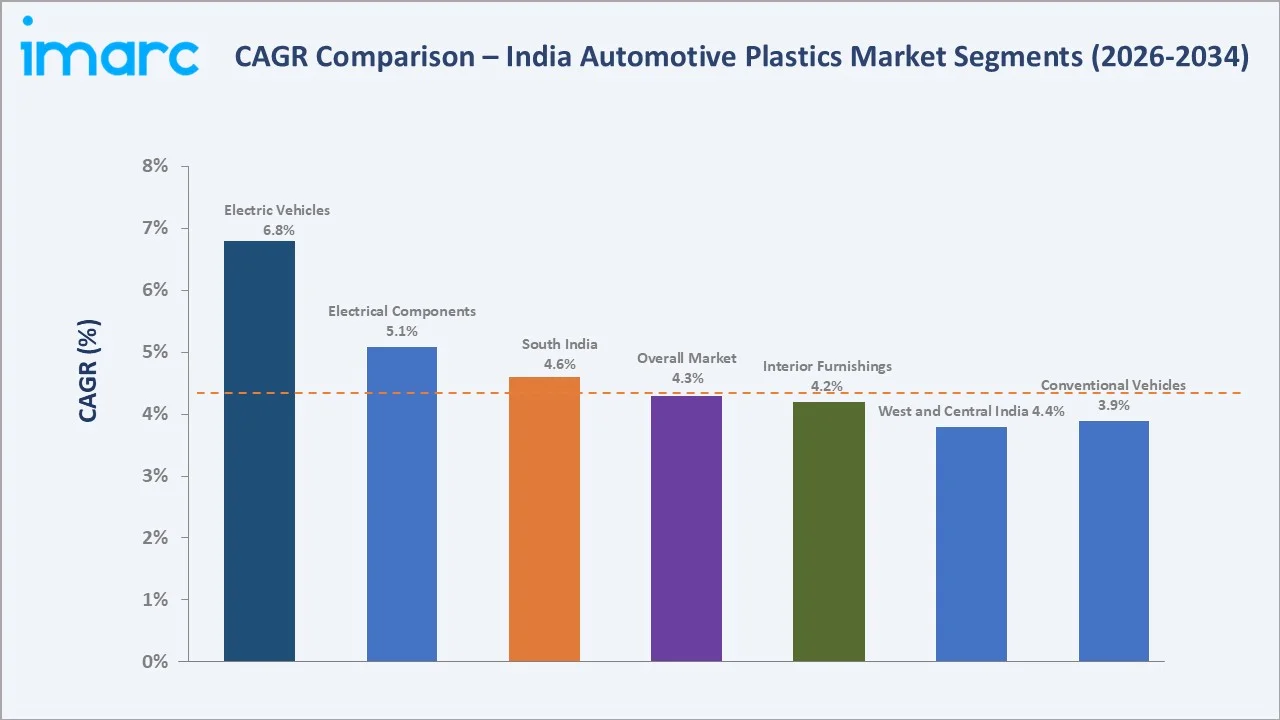
The CAGR across key segments with electric vehicles at ~6.8% CAGR is the fastest-growing vehicle type segment, reflecting India’s National Electric Mobility Mission Plan (NEMMP) targeting 30% EV penetration by 2030 and plastics’ essential role in EV battery housings, thermal management, and lightweight body panels. Electrical components at ~5.1% CAGR within applications reflect the increasing electronic content per vehicle.
Executive Summary
The India automotive plastics market has grown from USD 1,224.70 Million in 2020 to USD 1,507.90 Million in 2025, driven by India’s recovery from COVID-19 production disruptions, the systematic adoption of polypropylene and engineering plastic substitutes for metal components under CAFE Phase II norms, and the rapidly expanding domestic vehicle production base with the total production of passenger vehicles in October 2025 was ~2.8 million units. The market’s forecast path to USD 2,217.70 Million by 2034 at a 4.25% CAGR reflects three structural growth pillars: India’s vehicle production volume growth; the EV transition creating entirely new plastic demand categories for battery enclosures, thermal management housings, and high-voltage connector components; and the PLI Automotive Scheme’s INR 25,938 crore incentive generating domestic advanced automotive component manufacturing investment.
Conventional vehicles’ 65% dominance reflects India’s still-dominant ICE production base, collectively requiring systematic polypropylene, ABS, PVC, and polyamide plastic content at 90-140 kg per passenger car. Electric vehicles at 35% are growing at ~6.8% CAGR, drives unprecedented demand for lightweight battery-grade thermoplastics. Interior furnishings leads application at 25% as India’s SUV segment demands premium polypropylene and ABS interior modules.
North India’s 30% dominance anchors the Maruti Suzuki-Hero MotoCorp-Honda CIEL production cluster in Haryana’s NCR, generating the world’s highest concentration of automotive plastic demand. South India, at 25%, captures the Hyundai-Kia-Renault-Nissan export-focused Chennai corridor, while West & Central India, at 28%, hosts India’s most diversified EV manufacturing ecosystem.
Key Market Insights
|
Insight |
Data |
|
Dominant Vehicle Type |
Conventional & Traditional Vehicles – 65% share (2025) |
|
Dominant Application |
Interior Furnishings – 25% share (2025) |
|
Leading Region |
North India – 30% revenue share (2025) |
|
Fastest Growing Region |
South India (CAGR ~4.6%, 2026-2034) |
Key Analytical Observations Supporting The Above Data:
- Conventional vehicles at 65% (2025) with systematic plastic content growth: India’s more than 43.2 Lakh passenger cars sold in FY2025 each contain 90–140 kg of plastic, generating plastic content demand for passenger cars alone.
- Interior furnishings at 25% driven by SUV premiumization: India’s passenger car mix shifted to SUVs and MPVs contributed 65% in FY24-25, a transformation with profound automotive plastic implications, as SUVs require 35–45% more interior plastic by weight than equivalent compact cars.
- North India at 30% reflecting Maruti Suzuki and Hero MotoCorp concentration: The Maruti Suzuki-Hero MotoCorp-Honda CIEL Haryana triangle, within 60 km of each other in Gurugram, Manesar, and Neemrana, produces passenger cars and 2-wheelers, generating India’s highest automotive plastic demand concentration.
- South India growing fastest at ~4.6% CAGR driven by EV and export: Tamil Nadu’s Electric Mobility Policy 2023 attracted Ola Electric’s INR 7,614 crore EV manufacturing facility, Ather Energy’s Phase 2 Hosur plant expansion, and TVS Motor iQube production expansion at Hosur, collectively creating a new EV-specific automotive plastic demand cluster.
India Automotive Plastics Market Overview
India automotive plastics encompass thermoplastic and thermoset polymers, including polypropylene (PP), polyethylene (PE), acrylonitrile butadiene styrene (ABS), polycarbonate (PC), polyvinyl chloride (PVC), polyurethane (PU), polymethyl methacrylate (PMMA), and high-performance polyamides (PA), used in the manufacture of passenger cars, two-wheelers, commercial vehicles, and electric vehicles. The India market ecosystem integrates global engineering plastic suppliers, domestic compounder-manufacturers, and OEM first-fit and replacement supply networks.
Applications span all vehicle subsystems: interior furnishings (instrument panels, door trims, seats), exterior components (bumpers, body cladding, mirrors), powertrain housings (air intake manifolds, engine covers, cooling system parts), electrical connector and sensor housings for ICE and EV, under-hood chemical-resistant components, and chassis structural reinforcement inserts. India’s macroeconomic drivers include GDP growth, rising household incomes enabling first-vehicle ownership in Tier-2/3 cities, PLI Automotive Scheme incentives, CAFE Phase II lightweighting mandates, and FAME III’s INR 10,900 crore EV demand stimulus.
Market Dynamics
To evaluate market opportunities, Request Sample
Market Drivers
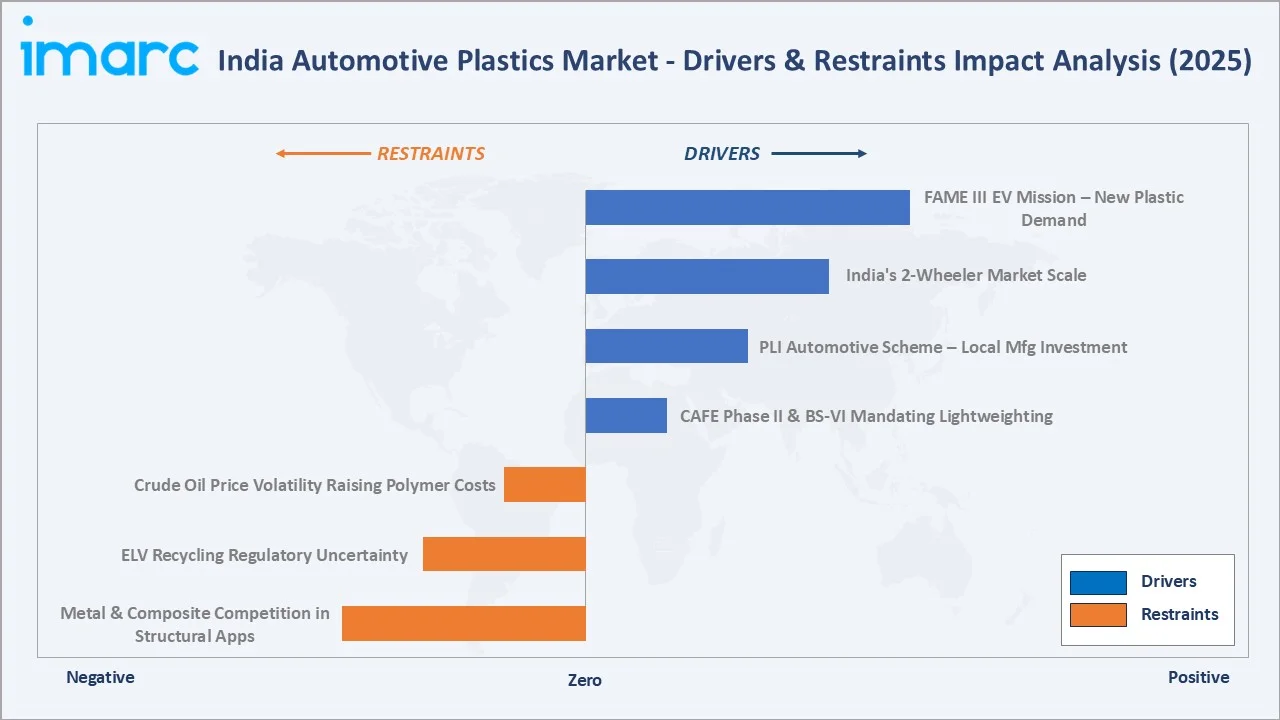
- CAFE Phase II and BS-VI Norms Mandating Plastic Lightweighting: India’s CAFE Phase I regulations targeted a fleet average of 130 gm CO2/km relative to the FY2017 baseline, requiring Indian OEMs to reduce vehicle weight by 80–120 kg per passenger car. Replacing steel with polypropylene, polyamide, and composite-reinforced plastics achieves weight reduction per component.
- PLI Automotive Scheme Driving Local Engineering Plastic Component Manufacturing: India’s PLI Scheme for Automobile and Auto Components (INR 25,938 crore, FY2022-23 to FY2026-27) targets advanced automotive technology, including EV-specific plastic components, battery management system plastic enclosures, high-voltage connector housings, and EV motor thermal management plastic components.
- India’s 2-Wheeler Market Scale Creating Automotive Plastic Volume: India's two-wheeler sector saw domestic dispatches reach 1,871,406 units in February 2026, up from 1,384,605 units in February 2025, marking a 35.2% year-over-year increase, is the largest single automotive plastic demand source by unit count. Each motorcycle and scooter uses 8–14 kg of plastic, accelerating the plastic demand in 2-wheeler plastic content annually.
- India’s EV Mission and FAME III INR 10,900 Crore Creating New Plastic Demand: FAME III’s INR 10,900 crore subsidy targeting 2-wheeler and 3-wheeler EV adoption is accelerating India’s EV base. EV-specific plastic demand, battery enclosure PA66 GF30 compounds, BMS housing UL94 V-0 flame-retardant PP, and high-voltage wiring conduit halogen-free PA12, commands price premiums over equivalent ICE plastic applications, generating disproportionate revenue versus volume growth.
Market Restraints
- Crude Oil Price Volatility Raising Polymer Input Costs: India imports 85% of crude oil requirements, making polymer feedstock (naphtha-derived PP, PE, ABS, PVC) directly correlated with international crude prices.
- End-of-Life Vehicle Recycling Regulatory Uncertainty: India’s End-of-Life Vehicle (ELV) rules under the Ministry of Road Transport’s vehicle scrappage policy create recycled content uncertainty for OEMs specifying virgin versus recycled plastic.
- Metal and Advanced Composite Competition in Structural Applications: High-strength steel (HSS) and ultra-high-strength steel (UHSS)’s improving strength-to-weight ratios, particularly from Tata Steel, JSW Steel, and SAIL’s automotive-grade steel programs, are contesting plastic’s role in semi-structural and structural applications including B-pillars, door intrusion beams, and floor panels.
Market Opportunities
- Bio-Based and Recycled Automotive Plastics Under India’s EPR Framework: India’s Extended Producer Responsibility (EPR) regulations for plastic packaging and the forthcoming Automotive EPR framework create commercial incentives for bio-based and recycled content automotive plastics.
- India’s Emerging ADAS and Autonomous Vehicle Sensor Plastic Requirements: India’s AIS-190 advanced software update regulations are creating demand for LCP and PPS radar sensor housings, PC camera lens covers, and polyamide ultrasonic sensor brackets in every new passenger car.
Market Challenges
- IATF 16949 Certification Barriers for Domestic Plastic Component SMEs: India’s automotive plastic component manufacturers include SMEs that lack IATF 16949 quality management certification required for direct OEM supply. This certification gap, certification costs high, plus 12–18 months of quality system development, prevents SME participation in the growing EV plastic component supply chain, where OEMs require certified suppliers.
- Import Competition from Chinese Automotive Plastic Components: China’s automotive plastic component industry, operating at 40–55% lower manufacturing cost through scale, subsidized resin access, and lower labor cost, is exporting bumpers, door trims, dashboard components, and lamp housings to India’s replacement market at 25-40% below domestic equivalent pricing.
Emerging Market Trends
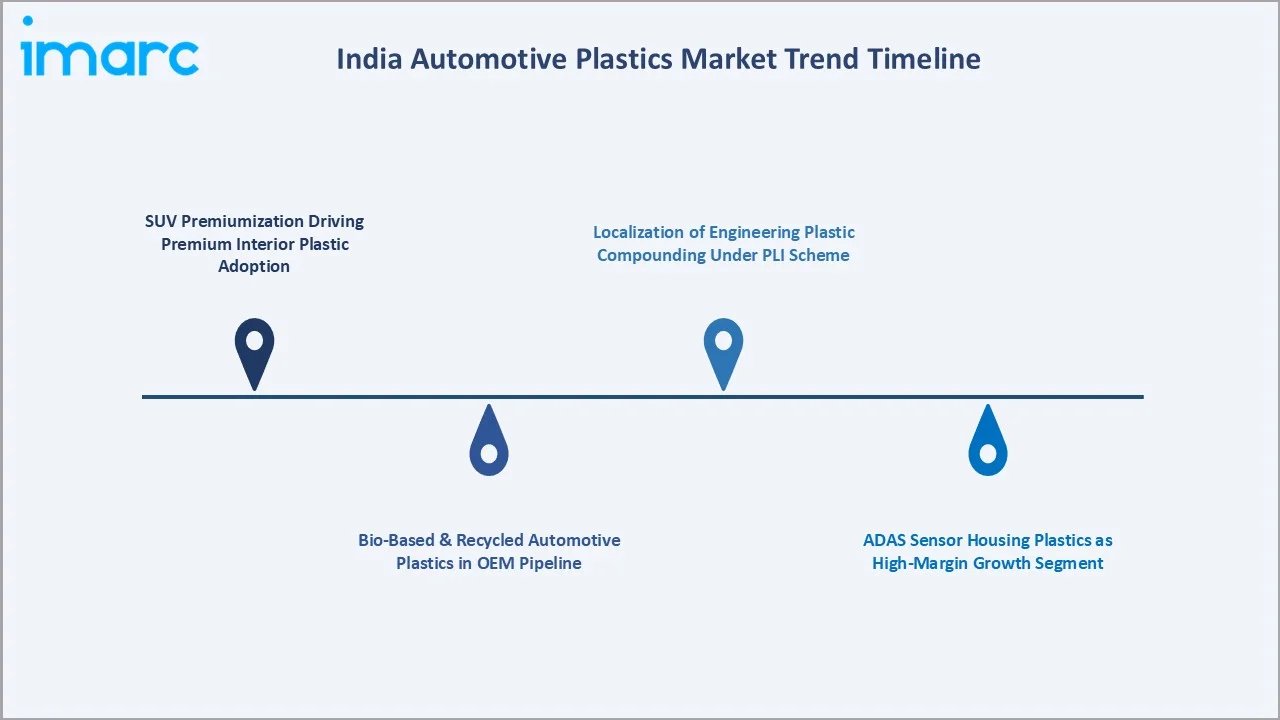
1. SUV Premiumization Driving Premium Interior Plastic Adoption
India’s passenger car market, which shifted to SUVs and MPVs, contributed 65% in FY24-25, and is systematically upgrading interior plastic specifications. Soft-touch thermoplastic polyolefin (TPO) door armrests, PC/ABS piano-black bezels, and polyurethane-wrapped steering wheels are transitioning from premium-only to mass-market SUV segments as OEMs compete on perceived quality.
2. Bio-Based and Recycled Automotive Plastics Entering India’s OEM Pipeline
India’s Extended Producer Responsibility framework and India’s published sustainability commitments are driving bio-based and recycled plastic qualification into India’s automotive supply chain.
3. ADAS Sensor Housing Plastics as a High-Margin Growth Segment
India’s AIS-190 ADAS regulation is creating systematic demand for radar-transparent plastic radomes, camera lens covers, and ultrasonic sensor brackets. Polycarbonate radomes for front radar, PMMA lens covers for camera modules, and PPS ultrasonic sensor housings represent high demand per vehicle in ADAS plastic content.
4. Localization of Engineering Plastic Compounding Under PLI Scheme
India’s PLI Automotive Scheme is catalyzing domestic engineering plastic compounding investment that reduces automotive plastic import dependence. This localization wave will improve India’s automotive plastic import dependency, reducing lead times, exchange rate risk, and supply chain vulnerability for India’s growing EV plastic demand.
Industry Value Chain Analysis
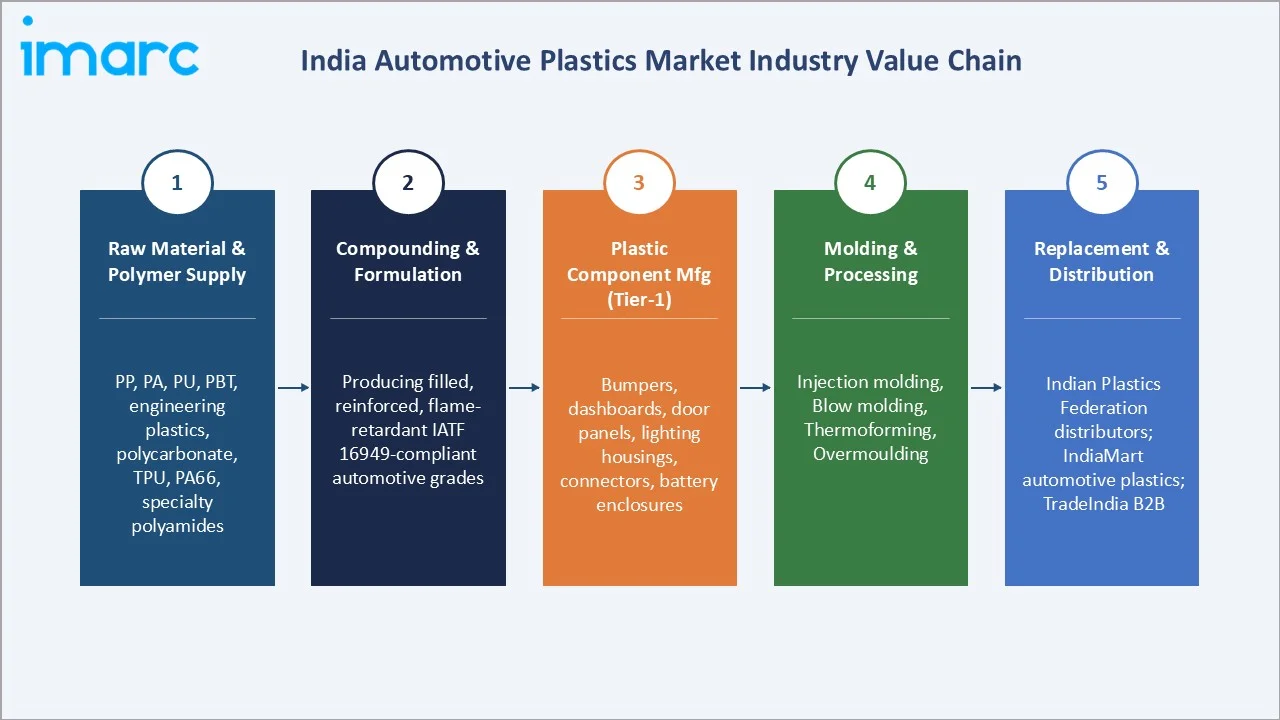
India’s automotive plastics value chain integrates global polymer suppliers and domestic compounders through molding and processing operations, OEM first-fit supply, and aftermarket replacement channels serving India’s 300+ million registered vehicles.
|
Stage |
Components |
|
Raw Material & Polymer Supply |
PP, PA, PU, PBT, engineering plastics, polycarbonate, TPU, PA6, PA66, PBT specialty compounds, PA12, PEEK, specialty polyamides, PVDF, PPS, high-performance polymers |
|
Compounding & Specialty Formulation |
Producing filled, reinforced, and flame-retardant grades for IATF 16949-compliant automotive applications |
|
Plastic Component Manufacturing (Tier-1) |
Bumpers, dashboards, door panels, lighting housings, electrical connectors, switches, battery enclosures, fuel systems, body modules |
|
Molding & Processing |
Injection molding, Blow molding, Thermoforming, Overmoulding |
|
Replacement & Distribution |
Indian Plastics Federation member distributors; online B2B marketplace: IndiaMart automotive plastics, TradeIndia |
Tier-1 plastic component manufacturers capture the highest per-vehicle plastic content revenue in plastic component value per passenger car in raw polymer value at the resin supply stage. Global engineering plastic suppliers’ IATF 16949 certification and technical service depth give them a structural advantage over domestic commodity resin producers in the higher-margin engineering plastic grades that represent 35-40% of total India automotive plastic market value but 55-65% of the total market gross profit.
Technology Landscape in the India Automotive Plastics Industry
ADAS-Grade Radar-Transparent and Optical-Grade Plastic Technology
India’s AIS-190 ADAS mandate is driving radar-transparent plastic technology adoption at an unprecedented scale. These are critical for India’s extreme climate variation from Ladakh’s -30°C to Rajasthan’s +50°C ambient conditions.
Lightweight PP and PA Composite Compounds for CAFE Compliance
India’s CAFE Phase II compliance is driving adoption of glass-fiber reinforced PP (PP-GF20, PP-GF30) and long-fiber thermoplastic (LFT) compounds achieving 25–40% weight reduction versus steel in semi-structural applications. India-specific formulations account for high ambient temperature stability, humidity resistance, and fuel resistance for under-hood applications.
Bio-Based and Circular Plastic Technology for India’s EPR Compliance
India’s EPR (Extended Producer Responsibility) framework and voluntary OEM sustainability commitments are accelerating bio-based and circular plastic technology adoption. BASF India’s ChemCycling focuses on plastic waste that is not recycled mechanically for technological, economic or ecological reasons, building ways to bio-based and circular plastic technology.
Market Segmentation Analysis
The report covers the following segments:
|
Segment Category |
Leading Segment |
Market Share |
Year |
|
Vehicle Type |
Conventional and Traditional Vehicles |
65.0% |
2025 |
|
Material |
🔒 |
🔒 |
2025 |
|
Application |
Interior Furnishings |
25.0% |
2025 |
|
Region |
North India |
30.0% |
2025 |

By Vehicle Type
To access detailed market analysis, Request Sample
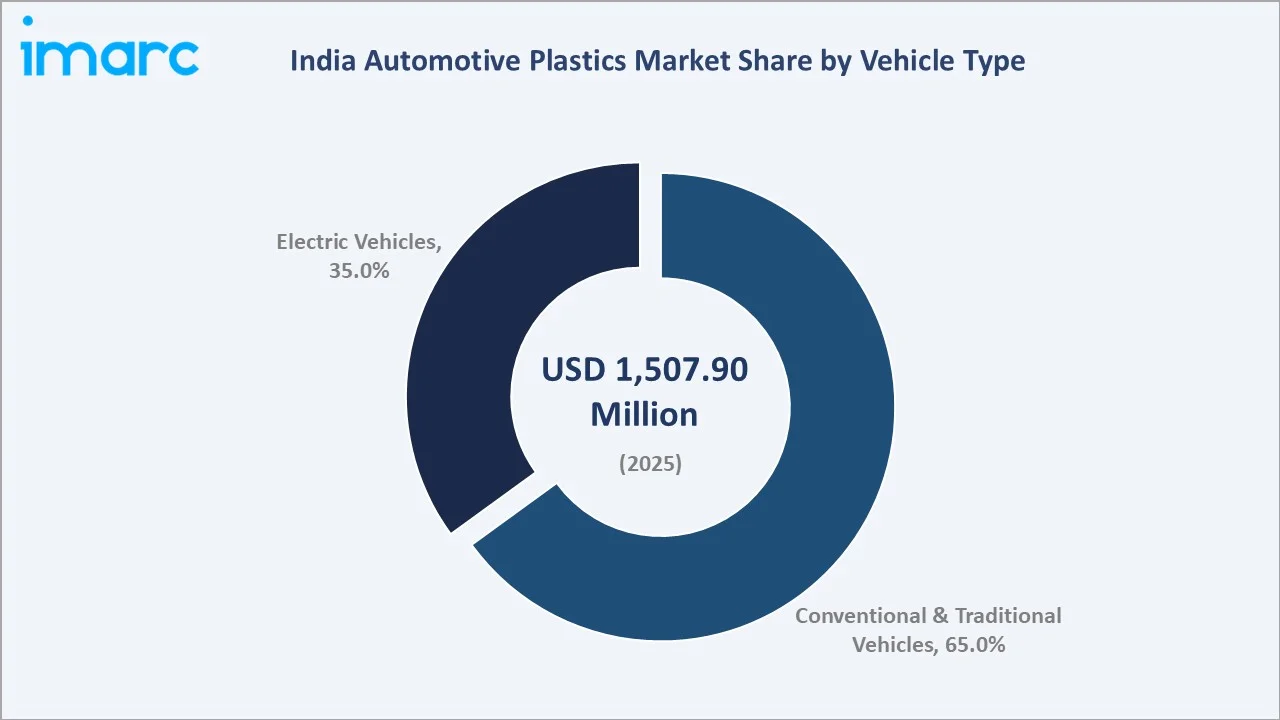
Conventional and traditional vehicles lead at 65.0% market share (2025). This segment encompasses ICE passenger cars, two-wheelers, three-wheelers, and commercial vehicles, with total production of approximately 2.8 million units in October 2025, generating the volume backbone of India’s automotive plastic demand. PP, ABS, PVC, and PMMA are the dominant materials, with India’s Reliance Industries providing 45–55% of PP requirements domestically, while engineering plastics (PA, PC, PBT) are primarily imported.
Electric vehicles at 35.0% are growing at ~6.8% CAGR, the highest segment growth rate, driven by electric vehicle adoption, with India’s EV sales reached 5,80,664 units, as of Q2 FY26. EV-specific plastic compounds for battery enclosures, BMS housings, and HV connectors command price premiums over ICE equivalents, elevating EV plastic content value per vehicle.
By Application
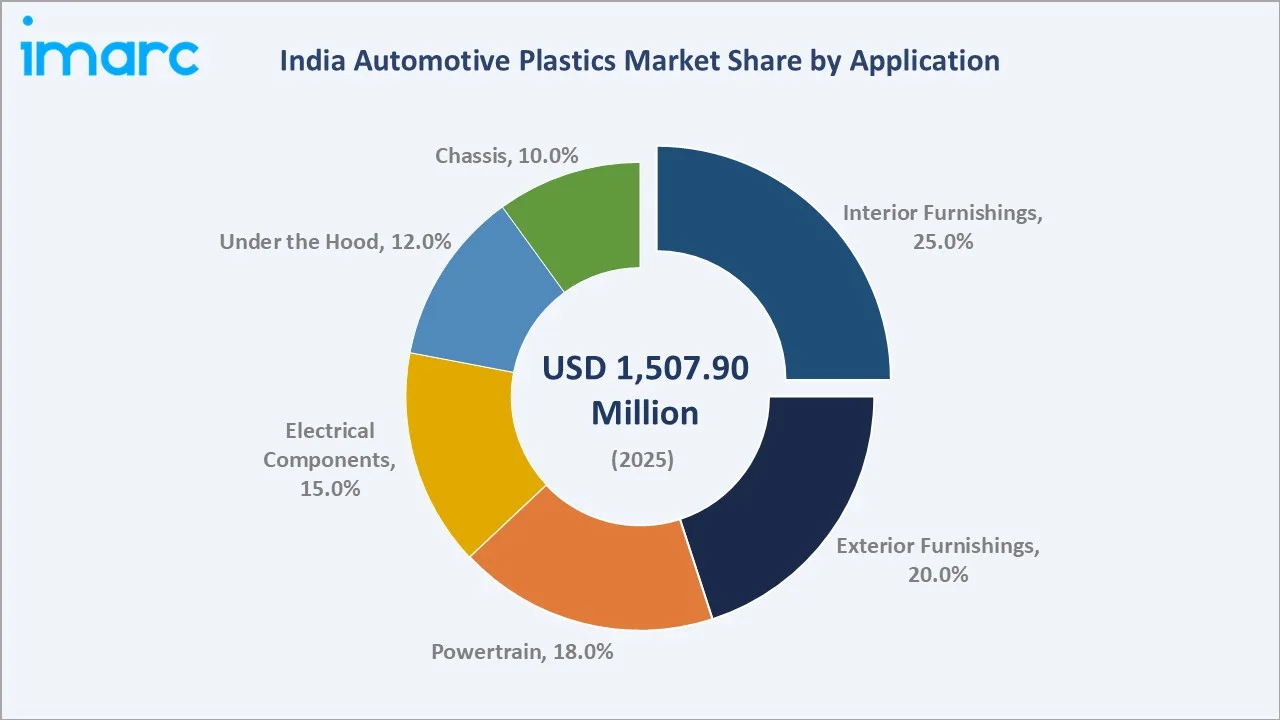
Interior furnishings leads at 25.0% market share (2025). This application encompasses instrument panels (PP, ABS), door trim panels (PP-GF, TPO), seats (PU foam, PP shell), headliners (PP, non-woven), center consoles (ABS, PC/ABS), and pillar trims (PP). India’s SUV premiumization is the primary driver, requiring soft-touch, premium-feel interior plastics that cost 2–3× standard entry-level equivalents.
Exterior furnishings at 20.0% serves bumpers (PP-GF, TPO), body side moldings, door mirrors, grilles, and spoilers. Powertrain at 18% covers air intake manifolds (PA66 GF35), engine covers (PP-GF, ABS), cooling system components (PA66 GF30), and fuel system components (HDPE, PA12). Electrical components at 15.0% encompasses wire harness connectors (PA, PBT, LCP), sensor housings (PPS, LCP, PC), and switch housings (ABS, PC/ABS). Under the Hood at 12.0% serves thermal and chemical-resistant applications, while Chassis at 10.0% covers structural reinforcement and suspension component inserts.
Regional Market Insights
|
Region |
Share (2025) |
Key Growth Drivers |
|
North India |
30% |
NCR automotive cluster: India’s highest passenger car production density; PLI Automotive Scheme beneficiary cluster |
|
West & Central India |
28% |
Pune-Nashik automotive corridor: Tata Motors Pune, Mahindra & Mahindra Chakan, Bajaj Auto Pune – India’s most diversified automotive production cluster |
|
South India |
25% |
Chennai “Detroit of India”: Hyundai India Chennai (India’s largest export vehicle plant), Ford India Sanand (legacy supplier network sustained post-Ford), – collectively India’s largest automotive export cluster |
|
East & Northeast India |
17% |
Kolkata automotive cluster: Tata Motors Jamshedpur (commercial vehicles – India’s largest commercial vehicle plant); Hindustan Motors Uttarpara (legacy) |
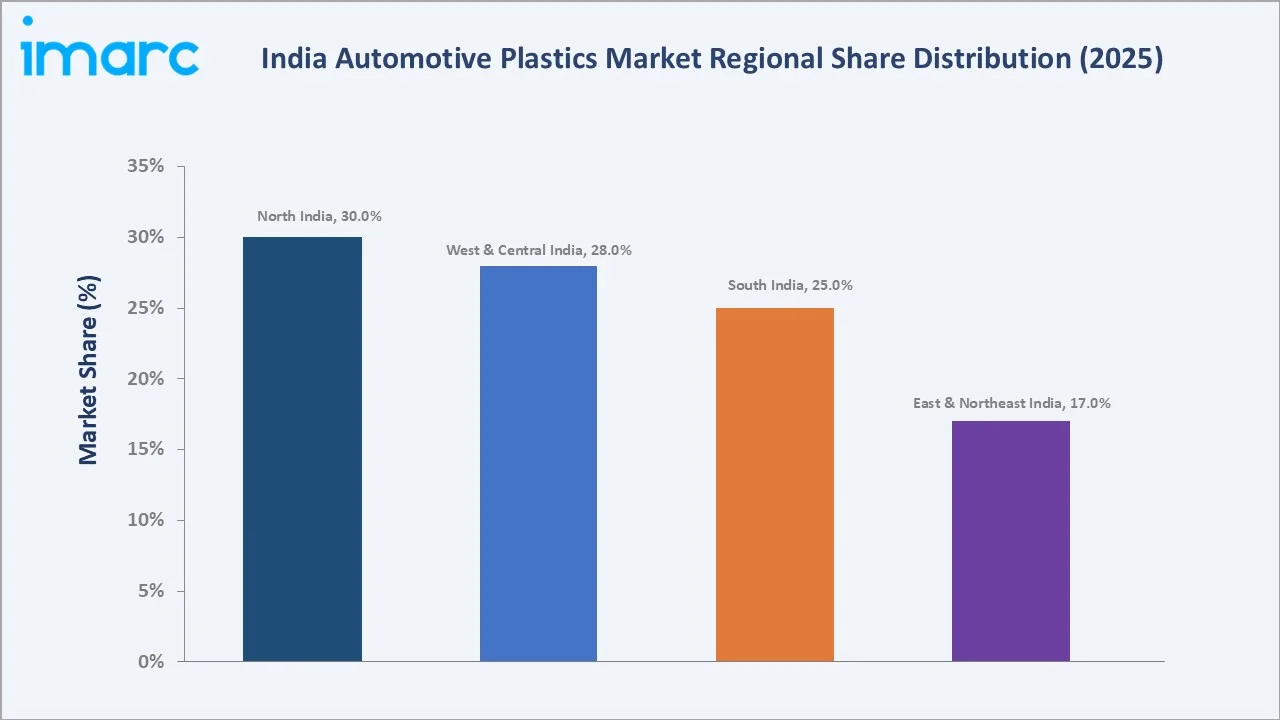
North India’s 30% dominance is anchored by the NCR-Haryana automotive production cluster, Maruti Suzuki Gurugram+Manesar and Hero MotoCorp Dharuhera+Gurugram, creating the world’s most concentrated automotive plastic demand zone outside Munich’s BMW-Audi-BMW cluster.
West & Central India’s 28% share hosts India’s most diverse automotive production ecosystem. South India’s 25% share is growing at the fastest regional CAGR, driven by Tamil Nadu’s vision of attracting Rs. 50,000 crore worth of investments in EV manufacturing, combined with Hyundai India’s export-grade plastic specification upgrades.
Competitive Landscape
The India automotive plastics market exhibits moderate concentration at the raw material tier and fragmentation at the component manufacturing tier. BASF and Covestro collectively supply approximately 35–40% of India’s engineering plastic demand for automotive applications.
|
Company Name |
Brand / Product Range |
Market Position |
Core Strength |
|
BASF |
Ultramid, Ultradur, Elastollan |
Dominant Market Leader |
Global chemistry leader’s India operations supply the broadest engineering plastic portfolio for automotive |
|
Covestro AG |
Makrolon, Bayblend, Desmopan |
Market Leader |
Covestro’s polycarbonate (Makrolon) is India’s standard specification for automotive headlamp and tail-lamp lenses |
|
Motherson |
Small plastic parts, Plastic body parts and panels |
Market Leader |
India’s one of the largest automotive component companies and the country’s one of the dominant plastic automotive body and interior parts manufacturers |
|
Varroc Group |
Body System Solutions, Advanced Safety Solutions |
Strong Challenger |
A polymer, electrical/electronics, and metallic components company focused on 2W/3W OEMs |
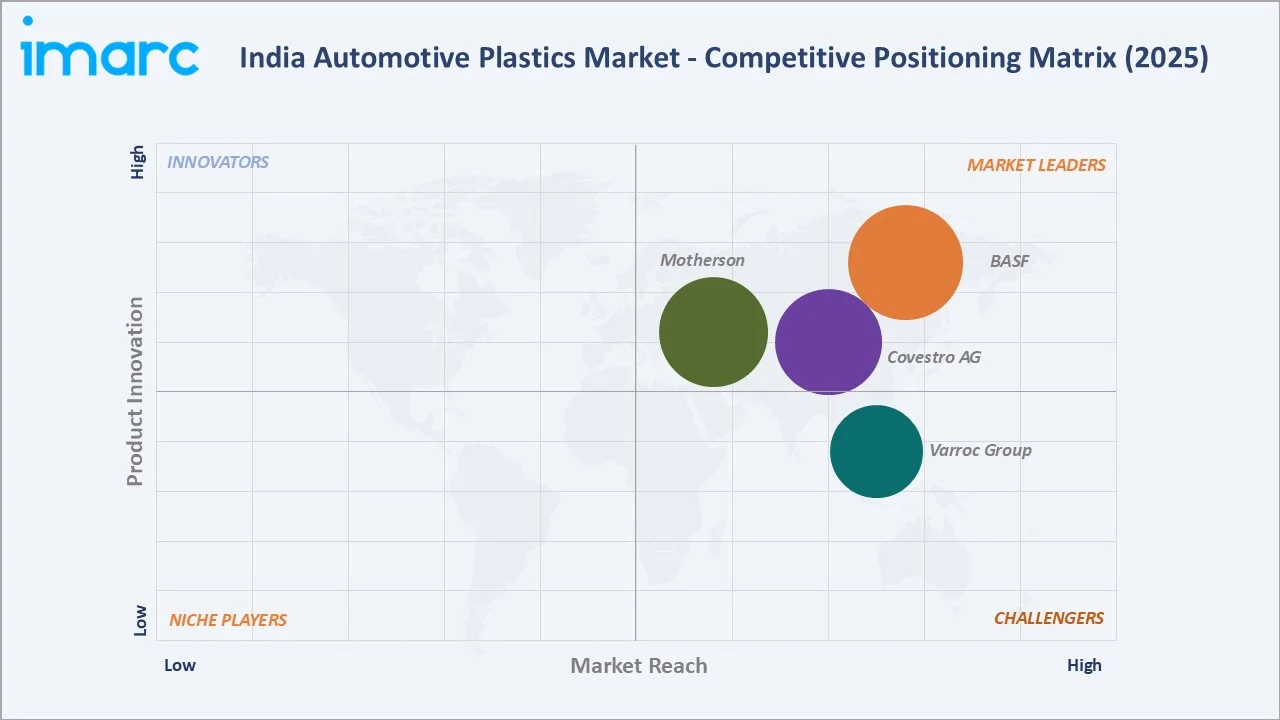
The top-five specialty polymer suppliers’ combined share is approximately 55–60% of engineering plastic volumes. The component manufacturing tier is highly fragmented, representing less than 30–35% combined share among India’s registered automotive plastic component manufacturers.
Key Company Profiles
BASF
BASF India is the Indian subsidiary of Germany’s BASF, the world’s largest chemicals company, and is India’s leading engineering plastic supplier for automotive applications.
- Product Portfolio: Ultramid, Ultradur, Elastollan.
- Recent Developments: In November 2025, BASF offered specialty grades of Ultradur, including flame-retardant (FR) and hydrolysis-resistant (HR) versions, in India. This move enhances supply reliability, response times, and flexibility for customers, supporting innovation in sectors like automotive and electronics, and underscores BASF's confidence in India's industrial growth.
- Strategic Focus: EV-grade compound leadership; PLI Scheme-aligned India domestic production expansion for PA66 automotive grades; sustainable plastic portfolio aligned with India EPR regulations.
Covestro AG
Covestro AG, majorly owned by ADNOC, is one of the world leaders in polycarbonate and PU materials and holds a dominant position in India’s automotive PC and PC/ABS market.
- Product Portfolio: Makrolon, Bayblend, Desmopan.
- Recent Developments: In March 2026, Covestro (India) was honored with the ‘Best Plastics & Polymers Brand 2026’ recognition by The Times Group, with BMGI as the knowledge partner.
- Strategic Focus: PC lens market leadership through systematic OEM headlamp specification dominance; ADAS radar-transparent Makrolon radome penetration as AIS-190 drives market adoption; circular economy investment aligned with India’s EPR framework for automotive plastics.
Motherson
Motherson, also known as Samvardhana Motherson International Ltd (SAMIL), is India’s largest automotive component company and the country’s dominant plastic body and interior parts manufacturer.
- Product Portfolio: Small plastic parts, Plastic body parts and panels.
- Recent Developments: In February 2026, Samvardhana Motherson International, in a 50:50 joint venture with Marelli Motherson Automotive Lighting India Private Limited (MMLI), launched a new manufacturing facility to produce exterior lighting systems for the automotive segment in Sanand, Gujarat.
- Strategic Focus: EV plastic component platform leadership through PLI Scheme investment in battery module plastic systems; premium interior plastic premiumization aligned with India’s SUV market shift.
Market Concentration Analysis
India’s automotive plastics market exhibits dual-tier concentration. At the specialty engineering plastic supply tier, the top-five global polymer companies account for approximately 55–60% of engineering plastic volumes for automotive applications, a moderate concentration reflecting global specialty chemical markets’ typical structure. However, commodity plastic supply (PP, PVC, PE) for automotive applications is much more fragmented, with 40–45% of commodity resin volumes without a dominant leader above 20% share.
The automotive plastic component manufacturing tier is highly fragmented among registered manufacturers, with the top 5 Tier-1 manufacturers representing less than 35–40% combined value of total India automotive plastic component production. This fragmentation reflects the industry’s historical development through SME OEM supplier networks across Haryana, Pune, and Chennai clusters, each hosting hundreds of small-scale injection molders supplying niche components. Consolidation is accelerating through PLI Scheme investment incentives, OEM supplier rationalization programs, reducing total supplier count, and M&A.
Investment & Growth Opportunities
Fastest Growing Segments
EV-specific plastic compounds (~6.8% CAGR), electrical components application (~5.1% CAGR), South India regional market (~4.6% CAGR), ADAS sensor housing plastics (~25–35% CAGR from small base), and recycled/bio-based automotive plastics (~12–18% CAGR from 2025 base) represent India’s highest-growth automotive plastic investment vectors through 2034.
Emerging Geographic Opportunities
Tamil Nadu’s EV cluster is creating a high-investment EV plastic demand hub growing at 25–30% annually; Gujarat’s Sanand EV industrial park and Rajasthan’s emerging automotive zone will create a new North India automotive plastic cluster supplementing the existing Haryana concentration.
Investment Themes
PLI Automotive Scheme’s INR 25,938 crore incentive, FAME III’s INR 10,900 crore EV demand stimulus, and India’s production target EVs collectively create the investment case for domestic engineering plastic compounding capacity.
- Key investment themes: Domestic PA66/PA66 GF30 EV-grade compounding capacity, recycled PP automotive OEM qualification programs, ADAS plastic sensor housing R&D, bio-based compound development for EPR compliance, and SME IATF 16949 quality system certification enabling direct OEM supply.
- Venture investment trends: India’s automotive startup ecosystem, collectively attracting EV investment annually, creates direct demand for EV-specific plastic component supply chain development per funded EV OEM.
Future Market Outlook (2026-2034)
The India automotive plastics market is positioned for sustained, policy-anchored growth through 2034. From USD 1,507.90 Million in 2025, the market will reach USD 2,217.70 Million by 2034, at a 4.25% CAGR. This growth, while moderate in absolute CAGR terms, represents transformative structural change in the composition of India’s automotive plastic demand. The 2026–2030 period will be defined by two parallel market evolutions: CAFE Phase II’s mandatory fuel efficiency compliance driving 8–12 kg additional plastic content per new ICE passenger car model, systematically increasing PP, PA, and PC content as part of compulsory regulatory compliance rather than optional premiumization; and India’s EV production scale-up creating a structural shift in automotive plastic composition toward EV-specific compounds commanding price premiums that elevate revenue per kilogram significantly above the commodity PP baseline.
Research Methodology
Primary Research
Primary research included structured interviews with 120+ industry stakeholders in 2025, comprising automotive plastic compound technical sales managers, Tier-1 component manufacturing directors, OEM material specification engineers, ACMA automotive plastic working group members, BIS technical committee experts for IS 14896 automotive standards, and regional plastic component SME owners across Haryana, Pune, and Chennai automotive clusters.
Secondary Research
Secondary research encompassed SIAM (Society of Indian Automobile Manufacturers) annual reports and production statistics, ACMA (Automotive Component Manufacturers Association of India) market surveys, Ministry of Heavy Industries PLI Scheme progress reports, BIS automotive plastic standards documentation, SMEV EV sales statistics, company annual reports, and commodity polymer price data from ICIS, Bloomberg, and FICCI Chemicals Committee. Over 180 secondary sources were reviewed.
Forecasting Models
Market forecasts were developed using a bottom-up vehicle type × application × region aggregation validated against top-down macroeconomic models. Key inputs include SIAM vehicle production forecasts, IEA India EV adoption scenarios, MHI CAFE Phase II compliance schedule, FAME III EV subsidy disbursement projections, and Reliance Industries PP resin price forward indicators.
India Automotive Plastics Market Report Coverage:
| Report Features | Details |
|---|---|
| Base Year of the Analysis | 2025 |
| Historical Period | 2020-2025 |
| Forecast Period | 2026-2034 |
| Units | Million USD |
| Scope of the Report | Exploration of Historical Trends and Market Outlook, Industry Catalysts and Challenges, Segment-Wise Historical and Future Market Assessment:
|
| Vehicle Types Covered | Conventional and Traditional Vehicles, Electric Vehicles |
| Materials Covered | Polyethylene (PE), Polypropylene (PP), Polyvinyl Chloride (PVC), Acrylonitrile Butadiene Styrene (ABS), Polyurethane (PU), Polymethyl Methacrylate (PMMA), Polycarbonate (PC), Polyamide, Others |
| Applications Covered | Powertrain, Electrical Components, Interior Furnishings, Exterior Furnishings, Under the Hood, Chassis |
| Regions Covered | North India, West and Central India, South India, East and Northeast India |
| Companies Covered | BASF, Covestro AG, Motherson, Varroc Group, etc. |
| Customization Scope | 10% Free Customization |
| Post-Sale Analyst Support | 10-12 Weeks |
| Delivery Format | PDF and Excel through Email (We can also provide the editable version of the report in PPT/Word format on special request) |
Key Benefits for Stakeholders:
- IMARC’s industry report offers a comprehensive quantitative analysis of various market segments, historical and current market trends, market forecasts, and dynamics of the India automotive plastics market from 2020-2034.
- The research report provides the latest information on the market drivers, challenges, and opportunities in the India automotive plastics market.
- Porter's five forces analysis assist stakeholders in assessing the impact of new entrants, competitive rivalry, supplier power, buyer power, and the threat of substitution. It helps stakeholders to analyze the level of competition within the India automotive plastics industry and its attractiveness.
- Competitive landscape allows stakeholders to understand their competitive environment and provides an insight into the current positions of key players in the market.
Frequently Asked Questions About the India Automotive Plastics Market Report
The India automotive plastics market was valued at USD 1,507.90 Million in 2025 and is projected to reach USD 2,217.70 Million by 2034.
The India automotive plastics market is forecast to grow at a CAGR of 4.25% during 2026-2034, driven by CAFE Phase II lightweighting mandates, EV adoption under FAME III, and PLI Automotive Scheme investment.
Conventional and traditional vehicles lead with 65% revenue share (2025), driven by Maruti Suzuki’s car production and Hero MotoCorp’s 2-wheeler production, consuming 90–140 kg and 8–14 kg plastic per vehicle, respectively.
Interior furnishings leads with 25% market share (2025), driven by India’s SUV segment reaching 65% of passenger car sales requiring premium ABS, PC/ABS, and TPO interior plastics.
North India dominates with 30% market share (2025), driven by the Maruti Suzuki-Hero MotoCorp-Honda NCR cluster in Haryana’s IMT Manesar and Bawal generating India’s highest automotive plastic demand concentration.
Key companies include BASF, Covestro AG, Motherson, Varroc Group, and others.
Key drivers include CAFE Phase II lightweighting mandates, FAME III EV adoption acceleration, India’s PLI Automotive Scheme, 2-wheeler market scale, SUV premiumization driving interior plastic upgrades, and AIS-190 ADAS plastic demand.
Key trends include EV-grade engineering plastic compound adoption, bio-based and recycled EPR-compliant plastics, ADAS radar-transparent polymer radomes, SUV interior premiumization, domestic engineering plastic compounding capacity development, and PLI-driven EV component localization.
EV transition drives 6.8% CAGR for electric vehicle plastic segment, requiring specialty PA66, PPS, LCP, and TPU compounds for battery enclosures, BMS housings, and HV connectors at price premiums over equivalent ICE applications.
Key challenges include crude oil price volatility raising polymer costs, limited domestic engineering plastic compounding capacity, Chinese import price competition in aftermarket, IATF 16949 certification barriers for SME suppliers, and ELV recycling regulatory uncertainty.
Top opportunities include domestic PA66/PA66 GF30 EV compounding capacity, recycled PP automotive OEM qualification, ADAS sensor housing PC/PPS supply, bio-based compound EPR development, South India EV cluster plastic supply, and SME IATF 16949 certification enabling OEM direct supply.
Need more help?
- Speak to our experienced analysts for insights on the current market scenarios.
- Include additional segments and countries to customize the report as per your requirement.
- Gain an unparalleled competitive advantage in your domain by understanding how to utilize the report and positively impacting your operations and revenue.
- For further assistance, please connect with our analysts.
 Request Customization
 Speak to an Analyst
 Request Brochure
 Inquire Before Buying
Benefits of Customization
- Personalize this research
- Triangulate with your data
- Get data as per your format and definition
- Gain a deeper dive into a specific application, geography, customer, or competitor
- Any level of personalization
Get in Touch With Us
UNITED STATES
Phone: +1-201-971-6302
INDIA
Phone: +91-120-433-0800
UNITED KINGDOM
Phone: +44-753-714-6104
Email: [email protected]
Client Testimonials




.webp)




.webp)













Related Reports

Choose your plan
*Please note that the prices mentioned below are starting prices for each bundle type. Kindly contact our team for further details.*
Single User License
- 1 User License, Access on 2 Devices
- PDF Report + Excel Dataset (Password Protected)
- Lifetime Access
- No Printing Rights
- 10% Free Report Customization
- 10–12 Weeks of Analyst Support
Five User License
- Access for 5 Users, 2 Devices per User
- PDF Report + Excel Dataset (Password Protected)
- Lifetime Access
- Dedicated Account Manager
- 12–14 Weeks of Analyst Support
- No Printing Rights
- 15% Free Report Customization
- 25% Discount on Your Next Purchase
Corporate User License
- Unlimited User Access (Within Your Organization)
- PDF Report + Excel Dataset
- Lifetime Access
- Dedicated Account Manager
- 14–20 Weeks of Analyst Support
- No Printing Rights
- 20% Free Report Customization
- 30% Discount on Your Next Purchase
Essential Insights
What's included:
3 reports
- Lifetime Access
- PDF Reports
- Excel Datasets
- 2 Weeks of Free Analyst Support
- 2 User Licenses
- Access on 2 Devices
- Printing Rights
- Complimentary PowerPoint (PPT) Version
- Complimentary License Upgrade
Professional Access
What's included:
5 reports
- Lifetime Access
- PDF Reports
- Excel Datasets
- 8 Weeks of Free Analyst Support
- 2 User Licenses
- Access on 2 Devices
- Printing Rights
- Complimentary PowerPoint (PPT) Version
- Complimentary License Upgrade
Business Advantage
What's included:
8 reports
- Lifetime Access
- PDF Reports
- Excel Datasets
- 14 Weeks of Free Analyst Support
- 2 User Licenses
- Access on 2 Devices
- Printing Rights
- Complimentary PowerPoint (PPT) Version
- Complimentary License Upgrade
Enterprise Intelligence
What's included:
10 reports
- Lifetime Access
- PDF Reports
- Excel Datasets
- 20 Weeks of Free Analyst Support
- 2 User Licenses
- Access on 2 Devices
- Printing Rights
- Complimentary PowerPoint (PPT) Version
- Complimentary License Upgrade