
India Avenanthramides Market Size, Share, Trends and Forecast by Product, End Use, and Region, 2026-2034
India Avenanthramides Market Summary:
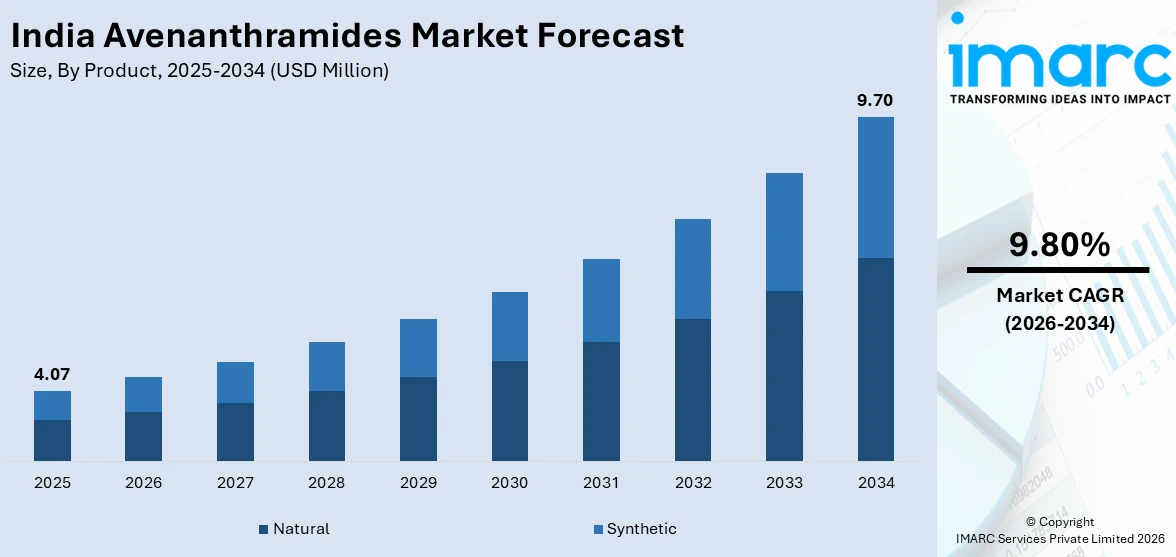
The India avenanthramides market size was valued at USD 4.07 Million in 2025 and is projected to reach USD 9.70 Million by 2034, growing at a compound annual growth rate of 9.80% from 2026-2034.
The India avenanthramides market is experiencing notable expansion driven by increasing consumer preference for natural, plant-derived bioactive ingredients across personal care and pharmaceutical applications. Rising awareness of the antioxidant and anti-inflammatory properties of oat-derived compounds is fueling demand for premium skincare formulations. Supportive regulatory frameworks, growing investments in cosmetic ingredient manufacturing, and the rapid expansion of e-commerce platforms are further strengthening market penetration, positioning India as a key emerging hub for avenanthramide-based product innovation and commercial growth.
Key Takeaways and Insights:
- By Product: Natural dominates the market with a share of 57.2% in 2025, owing to increasing consumer preference for clean-label, plant-based skincare ingredients and the growing demand for sustainably sourced oat-derived bioactive compounds in personal care formulations.
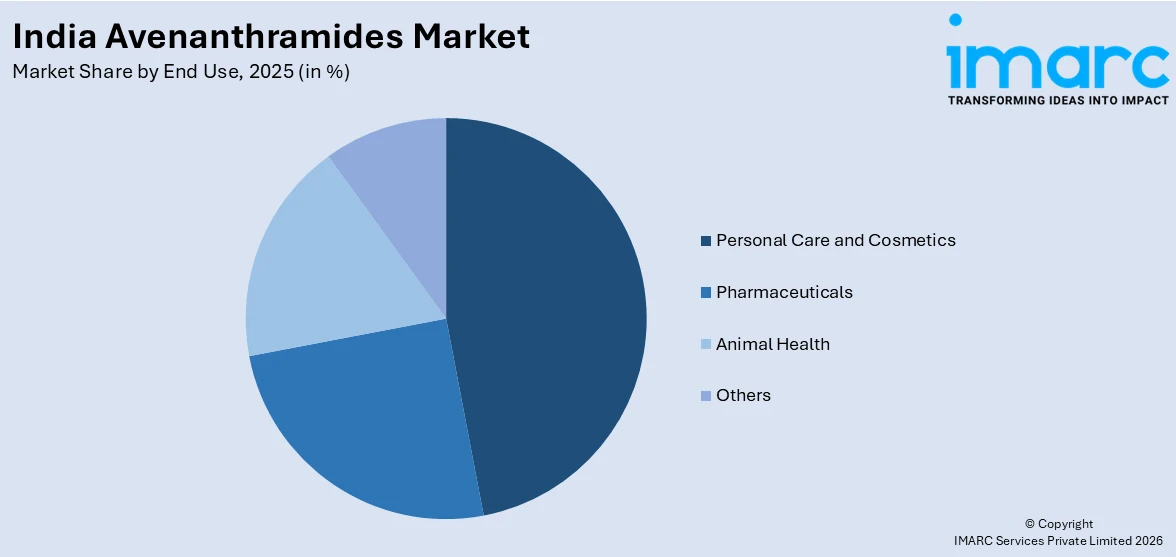
- By End Use: Personal care and cosmetics lead the market with a share of 46.9% in 2025. This dominance is driven by rising demand for clinically validated anti-inflammatory and antioxidant ingredients in moisturizers, serums, and sensitive skin treatment products.
- By Region: West India represents the largest region with 31.8% share in 2025, driven by the concentration of cosmetic manufacturing facilities, pharmaceutical research centres, and higher consumer spending on premium personal care products in Mumbai and surrounding metropolitan areas.
- Key Players: Key players drive the India avenanthramides market by expanding ingredient portfolios, advancing extraction and synthesis technologies, and strengthening distribution partnerships. Their investments in clinical validation, formulation innovation, and regional collaborations boost awareness, accelerate product development, and ensure consistent supply availability across diverse consumer and industrial segments.
To get more information on this market Request Sample
The India avenanthramides market is moving ahead with a steady pace due to the increasing health awareness, growing skin care awareness, and the rising demand for natural bioactive ingredients in the personal care, pharmaceutical, and animal health markets. The increasing demand for products containing scientifically proven plant-based ingredients with anti-inflammatory, antioxidant, and skin-soothing properties without any synthetic ingredients is driving the market for avenanthramides. The trend of ingredient-driven brands in the skin care industry, where transparency and scientific evidence are given utmost importance, is further fueling the demand for avenanthramides in the high-end market. Moreover, the growing support for natural product classification, the increasing pharmaceutical research for natural plant-based active ingredients, and the improvement of the cosmetic ingredient supply chain with local manufacturing are creating a favorable market environment for continued growth. Collaborations between international ingredient manufacturers and local formulators are further fueling innovation and market development in the country.
India Avenanthramides Market Trends:
Growing Adoption of Clean Beauty Formulations
The Indian market is experiencing a noticeable trend in the adoption of clean beauty products, as consumers are becoming increasingly interested in the development of products that do not contain any synthetic ingredients. The increasing demand for natural plant-derived bioactive compounds with established therapeutic properties is changing the way skincare product development strategies are being formulated across the country. Oat-derived actives, such as avenanthramides, are gaining popularity as high-end ingredients for sensitive skin, anti-aging, and dermatological uses. The clean beauty trend, fueled by social media and ingredient-smart consumer behavior, is encouraging the incorporation of natural actives into product development.
Expansion of Pharmaceutical Research into Plant-Based Bioactives
The pharmaceutical industry in India is also increasingly interested in plant-based compounds for medical uses, especially in the treatment of inflammation and skin care. Avenanthramides are being identified as new potential agents for anti-inflammatory drugs, with the help of increasing clinical evidence of their effectiveness and safety. Research organizations and biotech companies are working on new advanced methods of extraction and improving bioavailability to tap new uses in the pharmaceutical industry. This is propelling the India avenanthramides market.
Rise of Ingredient-Led Skincare Branding
Indian consumers are increasingly making purchasing decisions based on specific active ingredients rather than brand names alone. Transparency in ingredient sourcing, clinical validation, and functional efficacy have become central to product positioning strategies. Avenanthramides, recognized for their dual antioxidant and anti-inflammatory properties, are gaining prominence among ingredient-aware consumers seeking targeted skincare solutions. The growth of digital platforms and dermatologist-endorsed content is educating consumers about oat-derived bioactives, creating new demand pathways and encouraging brands to highlight avenanthramide inclusion as a premium differentiator.
Market Outlook 2026-2034:
The India avenanthramides market is set to witness steady growth over the forecast period, driven by growing demand across the personal care, pharmaceutical, and veterinary sectors. The rising preference for natural and scientifically proven bioactive compounds is set to fuel steady demand growth, while investments in the domestic production of cosmetic ingredients are set to improve supply chain capabilities. The rising interest in pharmaceuticals for anti-inflammatory plant extracts, in addition to the growing high-end skincare market in tier two and three cities, is set to unlock new market opportunities. Improved collaborations between international suppliers and domestic formulators will further improve market accessibility. The market generated a revenue of USD 4.07 Million in 2025 and is projected to reach a revenue of USD 9.70 Million by 2034, growing at a compound annual growth rate of 9.80% from 2026-2034.
India Avenanthramides Market Report Segmentation:
|
Segment Category |
Leading Segment |
Market Share |
|
Product |
Natural |
57.2% |
|
End Use |
Personal Care and Cosmetics |
46.9% |
|
Region |
West India |
31.8% |
Product Insights:
- Natural
- Synthetic
Natural dominates with a market share of 57.2% of the total India avenanthramides market in 2025.
The preference for natural avenanthramides in India is fueled by the rapidly growing clean beauty trend and the increasing demand for sustainably sourced and plant-based bioactive ingredients. Formulators in the personal care and cosmetics industry are increasingly opting for natural oat extracts due to their well-established antioxidant and anti-inflammatory properties, especially in sensitive skin and anti-aging product lines. The increasing focus on ingredient transparency and clean-label certification by the regulatory authorities is further fueling the demand for natural oat-derived compounds in the premium skincare segment.
The demand for natural avenanthramides in the high-end skincare market is being further fueled by regulatory bodies' growing emphasis on ingredient transparency and clean-label certification. Companies are investing in the latest bio-extraction technology to enhance the consistency of yield and product standardization, making it possible to mass-produce high-purity natural oat-derived compounds. Increasing awareness among the younger generation about the therapeutic properties of natural bioactives, along with the increasing penetration of e-commerce platforms into semi-urban and rural India, is widening the consumer base for natural avenanthramide-based products in India.
End Use Insights:
Access the comprehensive market breakdown Request Sample
- Personal Care and Cosmetics
- Pharmaceuticals
- Animal Health
- Others
Personal care and cosmetics lead with a share of 46.9% of the total India avenanthramides market in 2025.
The personal care and cosmetics sector represents the primary consumption channel for avenanthramides in India, fueled by increasing consumer demand for ingredient-led skincare products with clinically validated efficacy. Avenanthramides are valued for their anti-inflammatory, antioxidant, and skin-soothing properties, making them ideal for moisturizers, serums, and dermatological formulations. The India skincare market size reached USD 8.4 Billion in 2024. Looking forward, IMARC Group expects the market to reach USD 17.1 Billion by 2033, exhibiting a growth rate (CAGR) of 7.80% during 2025-2033, with natural and organic claims featuring prominently in approximately 70% of new product launches.
The expansion of digital-first beauty brands and dermatologist-endorsed skincare platforms is accelerating consumer awareness of avenanthramide-based formulations across India. Premium product segments targeting sensitive skin conditions, post-procedure care, and environmental protection are increasingly incorporating oat-derived bioactives as key functional ingredients. Growing urbanization and rising disposable incomes in metropolitan areas are enabling higher consumer spending on efficacy-driven personal care products. Strategic collaborations between global ingredient houses and domestic beauty brands are further embedding avenanthramides into mainstream skincare formulations throughout the Indian market.
Regional Insights:
- North India
- South India
- East India
- West India
West India represents the leading region with a 31.8% share of the total India avenanthramides market in 2025.
West India's dominance is anchored in Mumbai's position as the commercial capital and a major hub for cosmetic manufacturing, pharmaceutical research, and premium personal care distribution. The region benefits from a concentrated presence of multinational and domestic ingredient suppliers, advanced formulation laboratories, and robust logistics infrastructure. In September 2024, Symrise inaugurated its first cosmetic ingredients manufacturing facility in Chennai, signaling broader investment trends in India's cosmetic ingredient supply chain that strengthen West India's sourcing ecosystem.
The increased level of urbanization, disposable income, and sophisticated consumer base in the region drive the demand for high-end skincare and pharmaceuticals containing natural bioactive compounds. The established retail and e-commerce infrastructure in West India makes it easier to distribute avenanthramide-based formulations to various consumer groups. The presence of prominent pharmaceutical hubs in Maharashtra and Gujarat helps to support R&D efforts in plant-based active compounds. The increasing awareness of consumers about ingredient disclosure and clinical efficacy continues to make West India the leading revenue generator in the avenanthramides market in India.
Market Dynamics:
Growth Drivers:
Why is the India Avenanthramides Market Growing?
Increasing Consumer Preference for Natural and Organic Personal Care Products
India's personal care landscape is undergoing a fundamental transformation as consumers increasingly prioritize natural, plant-derived ingredients over synthetic alternatives. Growing awareness about the potential adverse effects of chemical-based formulations is driving a broad consumer shift toward clean beauty products that offer therapeutic benefits alongside aesthetic improvements. Avenanthramides, derived from oats, are gaining significant traction as premium bioactive ingredients due to their scientifically validated antioxidant and anti-inflammatory properties, which align perfectly with evolving consumer expectations for ingredient transparency and clinical efficacy. This preference for natural ingredients is particularly pronounced among younger demographics who rely on digital platforms and dermatologist recommendations to inform purchasing decisions. The expansion of online beauty retail channels has made ingredient-specific products more accessible to consumers across metropolitan and smaller cities alike. Rising disposable incomes, coupled with greater health consciousness and environmental awareness, are encouraging consumers to invest in premium skincare formulations that prioritize safety and sustainability. This broad-based demand for natural personal care solutions is creating a highly favorable environment for avenanthramide adoption across moisturizers, serums, anti-aging treatments, and sensitive skin care products throughout India.
Expanding Pharmaceutical and Nutraceutical Research for Plant-Derived Bioactives
The pharmaceutical and nutraceutical industries in India are increasingly looking towards plant-based bioactive compounds for therapeutic use, especially for the treatment of inflammation-related disorders, cardiovascular diseases, and dermatological conditions. Avenanthramides have received considerable attention from the scientific community for their established anti-inflammatory and antioxidant properties, making them prime candidates for incorporation into pharmaceutical and nutraceutical formulations. Ongoing clinical trials on the safety and efficacy of avenanthramides are providing important evidence for their therapeutic use. The Indian regulatory system is increasingly supportive of phytopharmaceutical development, with systems being put in place to facilitate the use of standardized plant-based active pharmaceutical ingredients in therapeutic products. Government policies encouraging the domestic production of active pharmaceutical ingredients and natural health products are further encouraging research into oat bioactives. The blending of Ayurvedic traditions with modern biotechnology is opening up new avenues for the incorporation of avenanthramides into holistic health products. In addition, the increasing demand for preventive healthcare and functional nutrition is creating new market opportunities for nutraceuticals containing natural anti-inflammatory compounds, providing a new application base for avenanthramides that goes beyond traditional personal care products.
Strengthening Cosmetic Ingredient Manufacturing Infrastructure in India
India is fast becoming a highly strategic manufacturing destination for cosmetic and personal care ingredients, with major investments being made by global suppliers of cosmetic ingredients to improve regional supply chain infrastructure and lower logistics costs. The development of sophisticated blending, processing, and distribution infrastructure across the country is enhancing the accessibility of high-quality bioactive ingredients, such as avenanthramides, to Indian formulators and manufacturers. Government policies and incentives encouraging domestic manufacturing and foreign direct investment in the chemicals and cosmetics industry are further fueling infrastructure development. The localization of capabilities for the manufacturing of cosmetic ingredients is helping to enhance product development cycles, reduce reliance on imported raw materials, and improve cost competitiveness for Indian personal care product manufacturers. Regional manufacturing clusters in western and southern India are developing niche expertise in natural ingredient processing and botanical extraction, providing conducive environments for the development of avenanthramide supply chain infrastructure. The adoption of sustainable and environmentally responsible manufacturing philosophies, such as the use of renewable energy resources and waste reduction technologies, is further improving the attractiveness of Indian-manufactured cosmetic ingredients to the domestic and international markets.
Market Restraints:
What Challenges the India Avenanthramides Market is Facing?
Limited Domestic Oat Cultivation and Raw Material Availability
India's oat cultivation is predominantly oriented toward fodder production, with limited agricultural infrastructure dedicated to growing oat varieties optimized for bioactive compound extraction. The relatively small area under oat cultivation constrains the domestic availability of high-quality raw material necessary for avenanthramide production. This dependency on imported oat-derived intermediates increases procurement costs, introduces supply chain vulnerabilities, and limits the ability of domestic manufacturers to scale production efficiently. Building specialized oat cultivation programmes and extraction capabilities remains a significant prerequisite for sustainable market growth.
Complex Extraction and Purification Processes
The extraction and purification of avenanthramides from oat biomass require sophisticated processing technologies, specialized equipment, and stringent quality control protocols. These technical demands result in elevated production costs and create barriers for smaller manufacturers seeking to enter the market. Variability in phytochemical yields across different oat cultivars further complicates standardization efforts, making consistent production of high purity avenanthramide ingredients challenging. The capital-intensive nature of these processes limits the number of suppliers capable of meeting pharmaceutical and cosmetic-grade quality requirements, constraining market supply expansion.
Low Consumer Awareness about Avenanthramides as a Specific Bioactive
Despite growing interest in natural and ingredient-led skincare, consumer awareness regarding avenanthramides as a distinct bioactive compound remains limited compared to more established ingredients such as niacinamide, hyaluronic acid, and retinol. Many consumers are unfamiliar with the specific therapeutic properties and applications of avenanthramides, which constrains direct demand generation. Building consumer recognition requires sustained educational marketing investments, clinical evidence dissemination, and dermatologist advocacy programmes. The relatively niche positioning of avenanthramides within the broader natural ingredients landscape presents challenges for rapid mainstream adoption.
Competitive Landscape:
The India avenanthramides market is observed to be moderately concentrated in terms of competition, with the presence of global biotechnology and cosmetic ingredient manufacturers, in addition to new entrants in the region. The competition in the market is driven by factors such as the purity of ingredients, clinical evidence, formulation development assistance, and supply chain integrity, as opposed to solely price-driven strategies. Market players are shifting their focus to the development of diversified product lines, advancements in extraction and synthesis technology, and strengthening of distribution networks to improve their relative position in the market. International ingredient manufacturers and Indian personal care companies are engaging in collaborative ventures to facilitate technology development, innovation, and easier market entry in India. Manufacturers are also investing in clinical validation studies to make their avenanthramide products more distinct and credible in the market. The increasing focus on sustainable sourcing, clean-label certification, and regulatory compliance is transforming the competitive landscape in favor of organizations with strong quality management systems and transparent supply chain practices. Innovation in natural extraction technology and bioavailability enhancement is anticipated to become a prominent differentiator among the top market players in the future.
Recent Developments:
- In October 2025, Symrise expanded its Scent & Care Creative and Commercial Center in Mumbai, India, uniting Consumer Fragrance, Fine Fragrance, Aroma Molecules, and Cosmetic Ingredients operations under one roof. The expansion reinforced the company's commitment to innovation, co-creation, and local ingredient supply for India's growing cosmetics and personal care market.
- In March 2025, COSCIENS Biopharma Inc. announced the initiation of its Phase 2a clinical efficacy study of avenanthramides as a potential anti-inflammatory product at the Montreal Heart Institute. A total of 20 patients were enrolled to assess efficacy at doses of 480 mg and 960 mg per day, following successful completion of the Phase 1 safety study.
India Avenanthramides Market Report Coverage:
|
Report Features |
Details |
|
Base Year of the Analysis |
2025 |
|
Historical Period |
2020-2025 |
|
Forecast Period |
2026-2034 |
|
Units |
Million USD |
|
Scope of the Report |
Exploration of Historical Trends and Market Outlook, Industry Catalysts and Challenges, Segment-Wise Historical and Future Market Assessment:
|
|
Products Covered |
Natural, Synthetic |
|
End Uses Covered |
Personal Care and Cosmetics, Pharmaceuticals, Animal Health, Others |
|
Regions Covered |
North India, South India, East India, West India |
|
Customization Scope |
10% Free Customization |
|
Post-Sale Analyst Support |
10-12 Weeks |
|
Delivery Format |
PDF and Excel through Email (We can also provide the editable version of the report in PPT/Word format on special request) |
Frequently Asked Questions About the India Avenanthramides Market Report
The India avenanthramides market size was valued at USD 4.07 Million in 2025.
The India avenanthramides market is expected to grow at a compound annual growth rate of 9.80% from 2026-2034 to reach USD 9.70 Million by 2034.
Natural dominated the market with a share of 57.2%, driven by increasing consumer preference for clean-label, sustainably sourced oat-derived bioactive compounds in personal care and pharmaceutical applications across India.
Key factors driving the India avenanthramides market include rising consumer preference for natural personal care ingredients, expanding pharmaceutical research into plant-derived bioactives, strengthening cosmetic ingredient manufacturing infrastructure, and growing awareness of clinically validated skincare solutions.
Major challenges include limited domestic oat cultivation for bioactive extraction, complex purification processes driving production costs, low consumer awareness of avenanthramides as a specific ingredient, supply chain dependence on imports, and standardization difficulties across different oat cultivars.
Need more help?
- Speak to our experienced analysts for insights on the current market scenarios.
- Include additional segments and countries to customize the report as per your requirement.
- Gain an unparalleled competitive advantage in your domain by understanding how to utilize the report and positively impacting your operations and revenue.
- For further assistance, please connect with our analysts.
 Request Customization
 Speak to an Analyst
 Request Brochure
 Inquire Before Buying
Benefits of Customization
- Personalize this research
- Triangulate with your data
- Get data as per your format and definition
- Gain a deeper dive into a specific application, geography, customer, or competitor
- Any level of personalization
Get in Touch With Us
UNITED STATES
Phone: +1-201-971-6302
INDIA
Phone: +91-120-433-0800
UNITED KINGDOM
Phone: +44-753-714-6104
Email: [email protected]
Client Testimonials




.webp)




.webp)













Related Reports

Choose your plan
*Please note that the prices mentioned below are starting prices for each bundle type. Kindly contact our team for further details.*
Single User License
- 1 User License, Access on 2 Devices
- PDF Report + Excel Dataset (Password Protected)
- Lifetime Access
- No Printing Rights
- 10% Free Report Customization
- 10–12 Weeks of Analyst Support
Five User License
- Access for 5 Users, 2 Devices per User
- PDF Report + Excel Dataset (Password Protected)
- Lifetime Access
- Dedicated Account Manager
- 12–14 Weeks of Analyst Support
- No Printing Rights
- 15% Free Report Customization
- 25% Discount on Your Next Purchase
Corporate User License
- Unlimited User Access (Within Your Organization)
- PDF Report + Excel Dataset
- Lifetime Access
- Dedicated Account Manager
- 14–20 Weeks of Analyst Support
- No Printing Rights
- 20% Free Report Customization
- 30% Discount on Your Next Purchase
Essential Insights
What's included:
3 reports
- Lifetime Access
- PDF Reports
- Excel Datasets
- 2 Weeks of Free Analyst Support
- 2 User Licenses
- Access on 2 Devices
- Printing Rights
- Complimentary PowerPoint (PPT) Version
- Complimentary License Upgrade
Professional Access
What's included:
5 reports
- Lifetime Access
- PDF Reports
- Excel Datasets
- 8 Weeks of Free Analyst Support
- 2 User Licenses
- Access on 2 Devices
- Printing Rights
- Complimentary PowerPoint (PPT) Version
- Complimentary License Upgrade
Business Advantage
What's included:
8 reports
- Lifetime Access
- PDF Reports
- Excel Datasets
- 14 Weeks of Free Analyst Support
- 2 User Licenses
- Access on 2 Devices
- Printing Rights
- Complimentary PowerPoint (PPT) Version
- Complimentary License Upgrade
Enterprise Intelligence
What's included:
10 reports
- Lifetime Access
- PDF Reports
- Excel Datasets
- 20 Weeks of Free Analyst Support
- 2 User Licenses
- Access on 2 Devices
- Printing Rights
- Complimentary PowerPoint (PPT) Version
- Complimentary License Upgrade