
India Bags Market Size, Share, Trends and Forecast by Product Type, Material Type, Distribution Channel, End User, and Region, 2026-2034
India Bags Market Size, Share, Trends & Forecast (2026-2034)
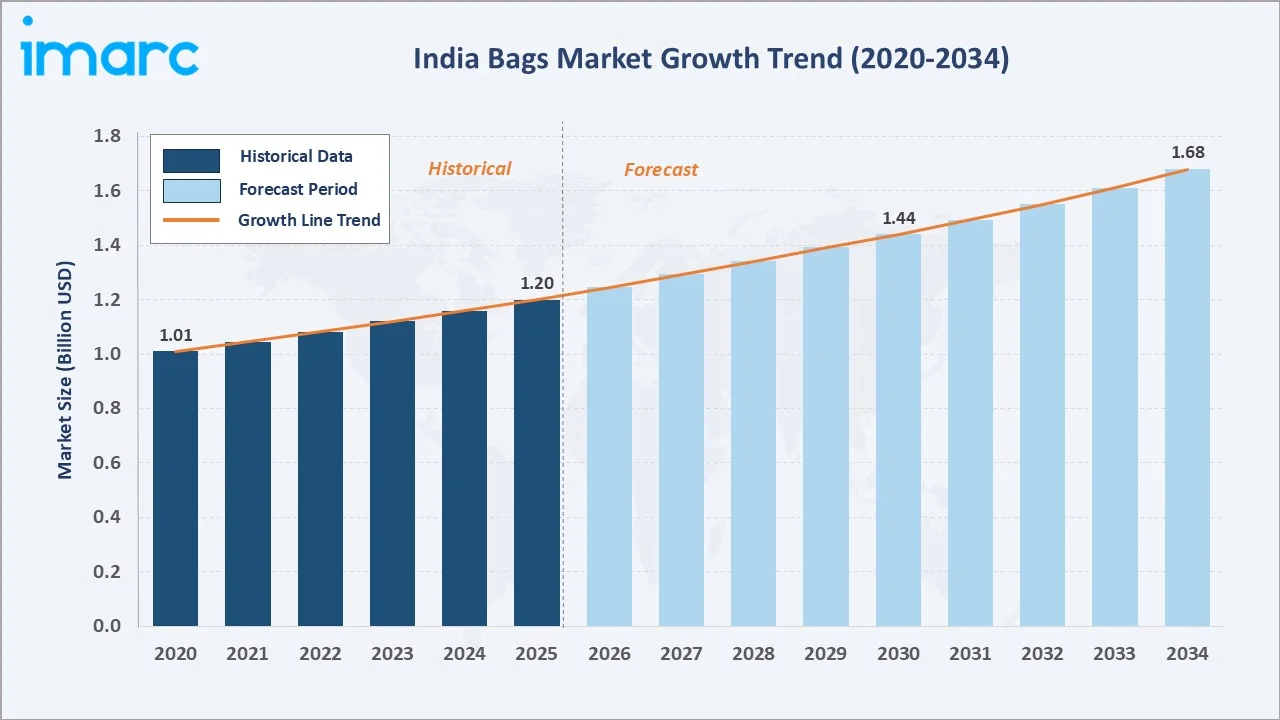
The India bags market size increased from USD 1.20 Billion in 2025 to USD 1.26 Billion in 2026 and is projected to reach USD 1.68 Billion by 2034, expanding at a CAGR of 3.62% during 2026-2034. Growth in the India bags market is driven by rising e-commerce penetration, a large school-going population, and increasing fashion consciousness among urban consumers. Backpacks lead the India bags market with a 24.8% share in 2025, supported by student and daily-commuter demand. Handbags, wallets, and purses follow closely at 22.6%, reflecting steady lifestyle and gifting demand. West India commands the largest regional share at 34.5%, aided by Mumbai's retail density and Gujarat's manufacturing base, while North India follows at 28.7%.
Market Snapshot
|
Metric |
Value |
|
Base Year Market Size (2025) |
USD 1.20 Billion |
| Market Size (2026) | USD 1.26 Billion |
|
Forecast Market Size (2034) |
USD 1.68 Billion |
|
CAGR (2026-2034) |
3.62% |
|
Base Year |
2025 |
|
Historical Period |
2020-2025 |
|
Forecast Period |
2026-2034 |
|
Dominant Product Type |
Backpacks (24.8%, 2025) |
|
Dominant Material Type |
Polyesters (39.6%, 2025) |
|
Leading Region |
West India (34.5%, 2025) |
India bags market expanded from USD 1.01 Billion in 2020 to USD 1.20 Billion in 2025 and an estimated USD 1.26 Billion in 2026, anchored at an estimated USD 1.44 Billion in 2030, and forecast to reach USD 1.68 Billion by 2034. The India bags market is structurally distinct among Asian bag markets, combining a mass-volume school and backpack segment with a fast-premiumizing handbag and leather-goods category, and a rapidly digitizing D2C manufacturing base that is reshaping how bags reach Indian consumers.
To get more information on this market, Request Sample
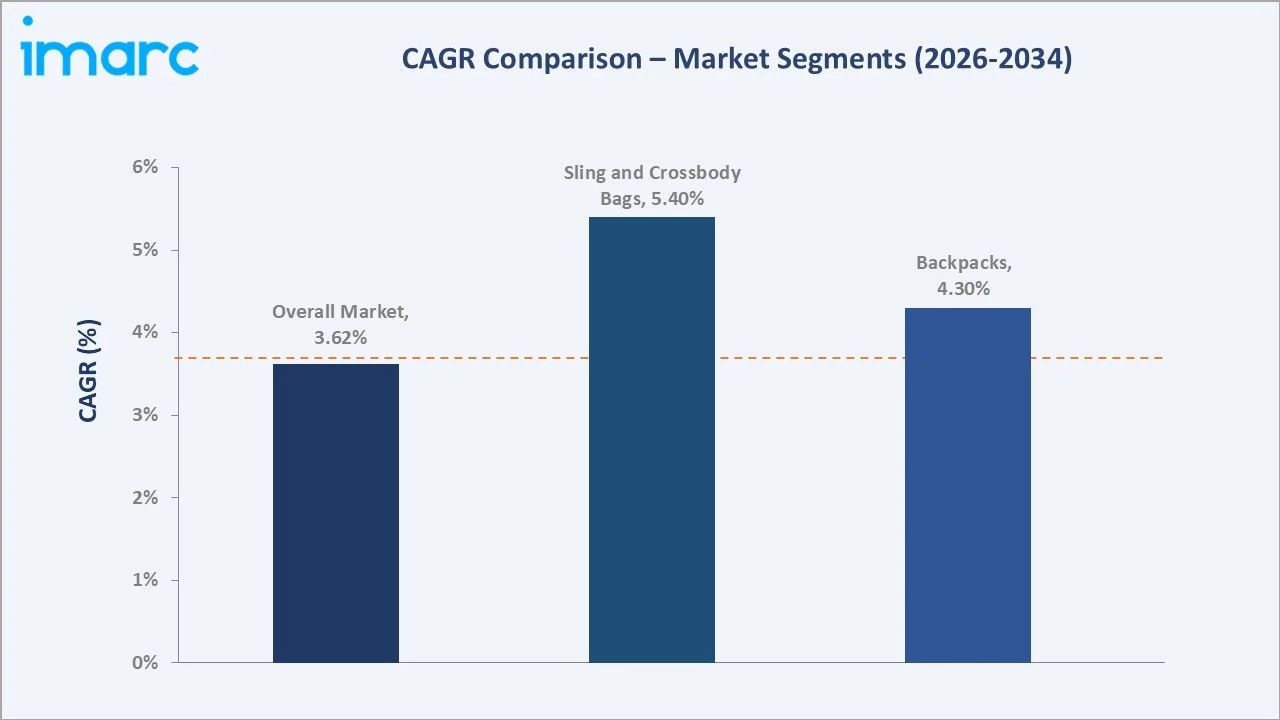
Sling and crossbody bags are estimated to grow fastest at approximately 5.4% CAGR through 2026-2034, supported by rising fashion-led, hands-free carrying preferences among younger urban consumers. Backpacks follow at an estimated 4.3% CAGR, sustained by school enrolment growth, campus commuting, and laptop-carry demand across India's expanding student and working-professional population.
Executive Summary
India bags market expanded from USD 1.20 Billion in 2025 to an estimated USD 1.26 Billion in 2026 ranks among the more commercially diverse bag markets in Asia, reflecting the country's large student population, deep gifting culture around handbags and wallets, and a fast-growing base of D2C and e-commerce-native bag brands. The market is projected to reach USD 1.68 Billion by 2034, growing at a 3.62% CAGR.
Backpacks lead product-type segmentation at 24.8% share, driven by school, college, and daily-commute demand, while handbags, wallets, and purses hold 22.6% share on the strength of fashion and gifting purchases. By material, polyesters dominate at 39.6% due to affordability and durability, followed by leather at 25.1%, which serves the market's premium and gifting-led demand.
West India leads regionally with 34.5% share, followed by North India at 28.7%. Rising e-commerce penetration, school enrolment growth, sustainability-linked material innovation, and expanding branded retail networks are expected to sustain steady India bags market growth through the 2026-2034 forecast period.
Key Market Insights
|
Insight |
Data |
|
Dominant Product Type |
Backpacks - 24.8% share (2025) |
|
Dominant Material Type |
Polyesters - 39.6% share (2025) |
|
Leading Region |
West India - 34.5% share (2025) |
|
Fastest-Growing Segment |
Sling & Crossbody Bags (~5.4% CAGR, 2026-2034) |
|
Top Companies |
VIP Industries Limited, Safari Industries (India) Limited, Samsonite Group S.A., and Wildcraft India Limited |
|
Market Opportunity |
D2C backpack and handbag brand expansion; sustainable and vegan-leather materials; tier-2/3 city organized retail penetration |
Key Analytical Observations Supporting The Above Data:
- Backpacks at 24.8%: Backpacks lead the India bags market due to consistent demand from school and college students, plus rising laptop-carry needs among young professionals. Wide price-point availability, from unbranded to premium D2C brands, supports the segment's broad penetration.
- Polyesters at 39.6%: Polyester dominates material-type segmentation because of its low cost, water resistance, and durability relative to natural fabrics. Its wide use across backpacks, school bags, and duffle bags makes it the default material for mass-market bag manufacturing in India.
- West India at 34.5%: West India leads regionally, driven by Mumbai and Pune's dense organized retail and e-commerce fulfilment infrastructure, alongside Gujarat's established bag and leather-goods manufacturing clusters in Kanpur-adjacent and western supply corridors.
- Handbags, wallets & purses at 22.6%: This segment benefits from India's strong gifting culture and rising fashion consciousness among urban women, with leather and vegan-leather variants commanding premium price points.
- School bags at 18.9%: Consistent annual replacement demand from India's large K-12 student population, anchors this segment's steady, recession-resilient revenue base.
- Sling & crossbody bags fastest-growing: Rising preference for compact, hands-free bags among Gen Z and millennial consumers, amplified by social media and influencer-led fashion trends, is driving this segment's above-market growth rate.
Global India Bags Market Overview
The India bags market covers backpacks, handbags, wallets and purses, school bags, sling and crossbody bags, duffle and gym bags, drawstring bags, and other carrying accessories manufactured from polyester, leather, nylon, cotton canvas, and other materials. The industry spans domestic manufacturing clusters, organized and unorganized retail, and a fast-expanding e-commerce and direct-to-consumer distribution layer. Macroeconomic tailwinds include rising urbanization, expanding disposable incomes, a young and large student population, and growing corporate and festive gifting demand across India's metro and tier-2 cities.
Market Dynamics
To evaluate market opportunities, Request Sample
Market Drivers
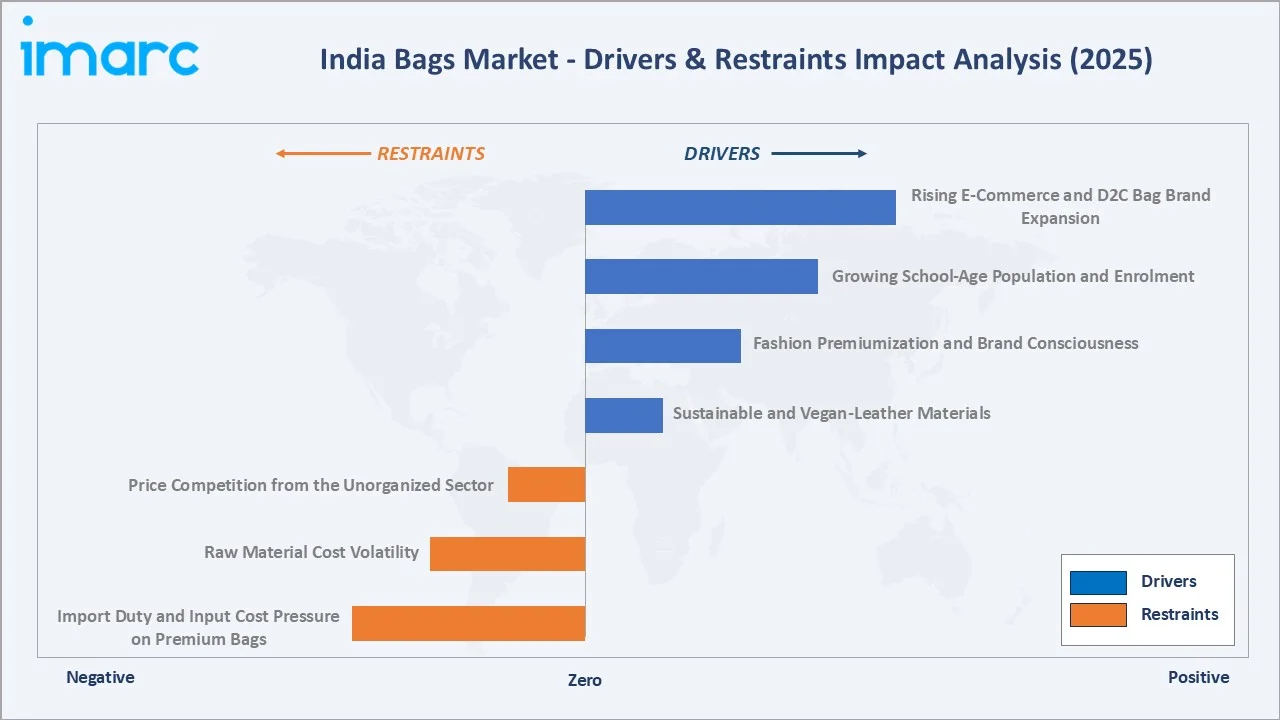
- Rising E-Commerce and D2C Bag Brand Expansion: E-commerce platforms and direct-to-consumer brands are giving Indian consumers easy access to a wide range of backpacks, handbags, and travel bags across price points. Digital-first brands are using targeted marketing and limited-edition drops to build loyal, younger customer bases, expanding overall category penetration.
- Growing School-Age Population and Enrolment: India's large school and college-going population sustains consistent annual replacement demand for school bags and backpacks. Government initiatives supporting primary and secondary education enrolment further reinforce this structurally stable demand base.
- Urbanization and Rising Disposable Income: Expanding urban middle-class incomes are increasing spending on branded, stylish, and durable bags across work, travel, and casual-use occasions, supporting premiumization across backpacks and handbags alike.
- Fashion Premiumization and Brand Consciousness: Growing exposure to global fashion trends through social media is driving demand for designer and branded handbags, sling bags, and backpacks, encouraging both domestic and international brands to expand India-specific product lines.
Market Restraints
- Price Competition from the Unorganized Sector: A large unorganized segment of local manufacturers continues to undercut branded players on price, particularly in school bags and basic backpacks, limiting margin expansion for organized brands.
- Raw Material Cost Volatility: Fluctuating prices of polyester, PU, and leather inputs, many of which are linked to crude-oil derivatives and import costs, create margin pressure for manufacturers, particularly smaller regional players with limited pricing power.
Market Opportunities
- Sustainable and Vegan-Leather Materials: Rising consumer and regulatory focus on sustainability is opening opportunities for recycled polyester, plant-based, and vegan-leather bags, allowing brands to differentiate on environmental credentials.
- Tier-2 and Tier-3 City Retail Expansion: Underpenetrated smaller cities present a significant opportunity for organized bag retail and franchise expansion as regional incomes and aspirational spending rise.
Market Challenges
- Import Duty and Input Cost Pressure on Premium Bags: Import duties on premium leather, hardware, and finished luxury bags raise retail prices, limiting the addressable market for high-end international brands in India.
- Counterfeit and Unbranded Product Penetration: Widespread availability of counterfeit branded bags and unbranded look-alikes, especially in school bags and handbags, continues to pressure organized players' volume growth and brand equity.
Emerging Market Trends
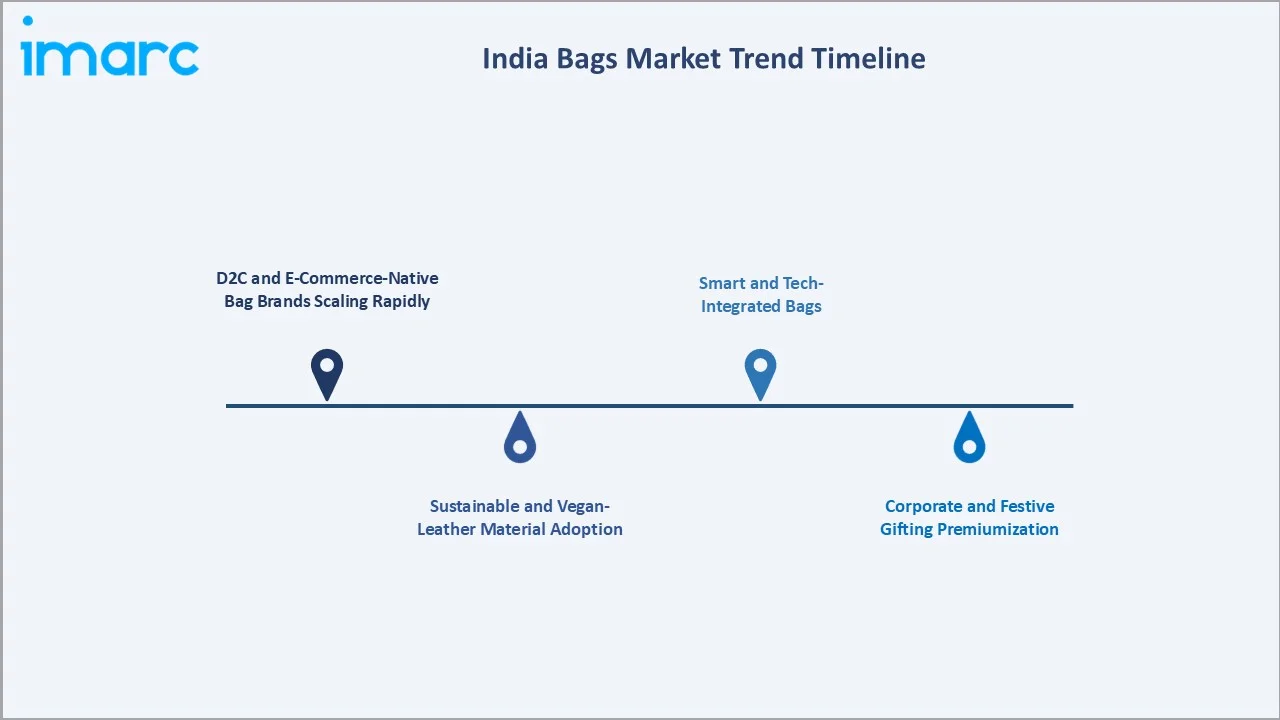
1. D2C and E-Commerce-Native Bag Brands Scaling Rapidly
Digital-first brands are scaling through Instagram-led marketing, influencer collaborations, and agile supply chains, capturing Gen Z and millennial spending away from legacy players. This trend is compressing product cycles and pushing established manufacturers to accelerate their own online-first product lines.
2. Sustainable and Vegan-Leather Material Adoption
Brands are increasingly adopting recycled polyester, organic cotton canvas, and vegan-leather alternatives in response to rising consumer environmental awareness. This shift is most visible in the handbag and premium backpack segments, where sustainability credentials are becoming a genuine purchase driver rather than a marketing add-on.
3. Smart and Tech-Integrated Bags
Bags with USB charging ports, RFID-protected compartments, and anti-theft features are gaining traction among urban commuters and frequent travelers, particularly in the laptop backpack and travel-bag categories.
4. Corporate and Festive Gifting Premiumization
Companies are increasingly gifting branded, feature-rich bags to employees and clients during festive seasons, positioning premium backpacks and handbags as status-linked corporate gifting items and creating structured bulk-purchase demand for mid-premium bag brands.
5. Circular Design and Bag Resale Platforms
Early-stage bag resale and rental platforms are emerging in India's metro markets, allowing consumers to access premium and luxury bags at lower entry costs while extending product lifecycles, a trend expected to gain further scale toward the later years of the forecast period.
Industry Value Chain Analysis
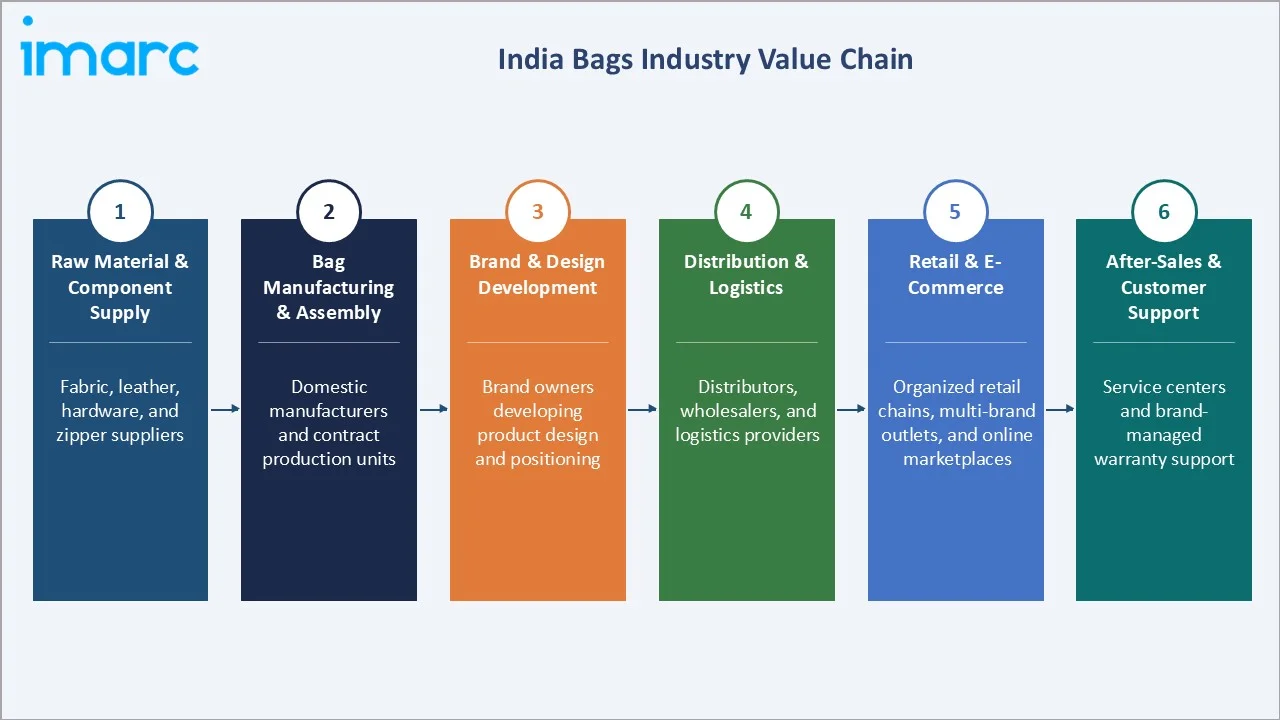
The India bags value chain spans raw material sourcing, component manufacturing, brand design, distribution, and after-sales support. This distributed structure allows domestic manufacturers to compete alongside imported and international brands across multiple price tiers, while giving retailers and e-commerce platforms an increasingly central role in shaping consumer access.
|
Stage |
Key Participants |
|
Raw Material & Component Supply |
Fabric, leather, hardware, and zipper suppliers |
|
Bag Manufacturing & Assembly |
Domestic manufacturers and contract production units |
|
Brand & Design Development |
Brand owners developing product design and positioning |
|
Distribution & Logistics |
Distributors, wholesalers, and logistics providers |
|
Retail & E-Commerce |
Organized retail chains, multi-brand outlets, and online marketplaces |
|
After-Sales & Customer Support |
Service centers and brand-managed warranty support |
Retail and e-commerce distribution has become the value chain's most commercially consequential stage, as brands increasingly compete on design, digital marketing, and last-mile delivery rather than manufacturing cost alone, reshaping investment priorities across the industry.
Technology Landscape in the India Bags Industry
Sustainable Material Innovation
Recycled polyester, organic cotton canvas, and vegan-leather alternatives are gaining adoption as brands respond to rising sustainability expectations, particularly among younger, urban consumers who increasingly factor environmental credentials into purchase decisions.
Smart Connectivity Features
USB charging ports, RFID-blocking compartments, and app-connected anti-theft alarms are being integrated into premium backpacks and travel bags, appealing to tech-savvy commuters and frequent travelers seeking functional, connected carrying solutions.
Automation in Manufacturing
Automated cutting, stitching, and quality-control equipment is gradually being adopted by larger manufacturers to improve consistency and reduce production lead times, supporting faster new-product turnaround for fashion-led segments such as handbags and sling bags.
Market Segmentation Analysis
The report covers the following segments:
|
Segment Category |
Leading Segment |
Market Share |
Year |
|
Product Type |
Backpacks |
24.8% |
2025 |
|
Material Type |
Polyesters |
39.6% |
2025 |
|
Distribution Channel |
🔒 |
🔒 |
2025 |
|
End User |
🔒 |
🔒 |
2025 |
|
Region |
West India |
34.5% |
2025 |

By Product Type
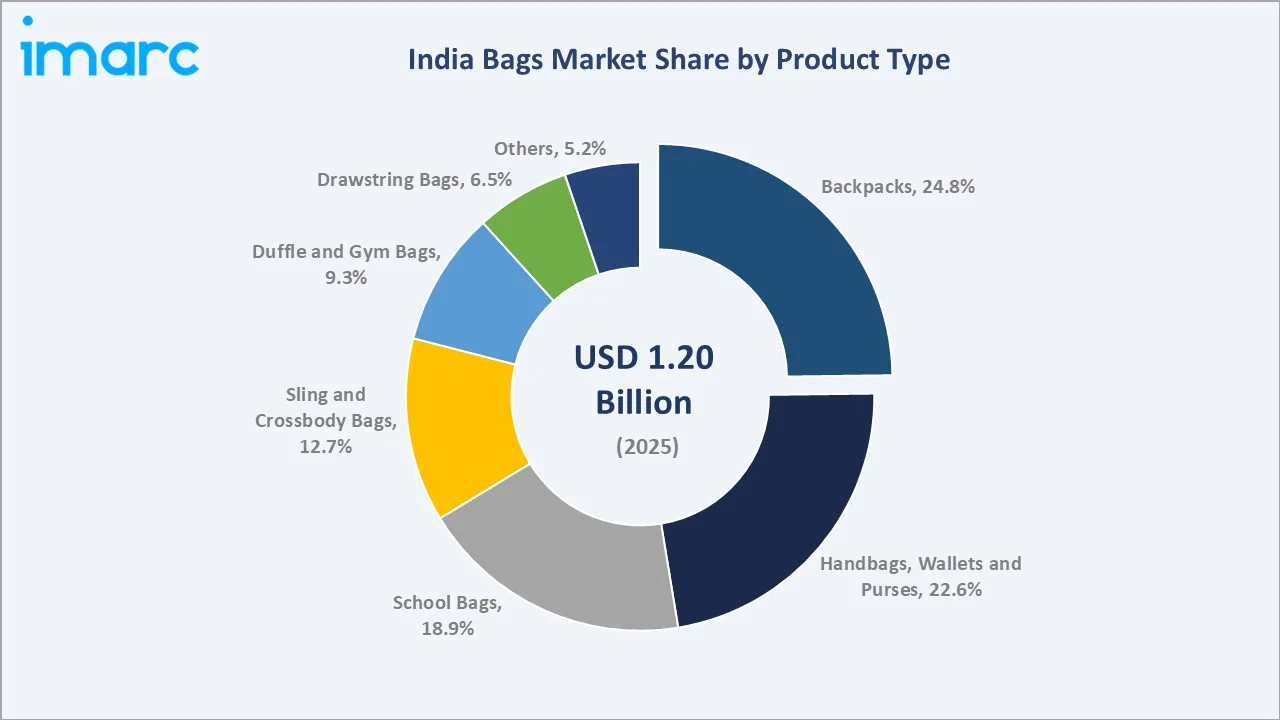
Backpacks lead product-type segmentation at 24.8% share in 2025, spanning school, college, laptop, and travel backpacks across price points from unbranded to premium D2C labels, making it the India bags market's most commercially diverse and resilient product category.
To access detailed market analysis, Request Sample
Handbags, wallets, and purses hold the second-largest share at 22.6%, driven by fashion and gifting demand, while school bags account for 18.9%, anchored by India's large annual student cohort. Sling and crossbody bags, at 12.7% share, are growing fastest at an estimated 5.4% CAGR through 2026-2034 as compact, hands-free carrying styles gain popularity among younger consumers. Duffle and gym bags hold 9.3% share, supported by rising fitness and active-lifestyle participation, while drawstring bags and other formats together account for 11.7% of the market.
By Material Type
Polyesters lead material-type segmentation at 39.6% share in 2025, reflecting their affordability, durability, and water-resistance across mass-market backpacks, school bags, and duffle bags, making polyester the default input material for India's high-volume bag manufacturing base.
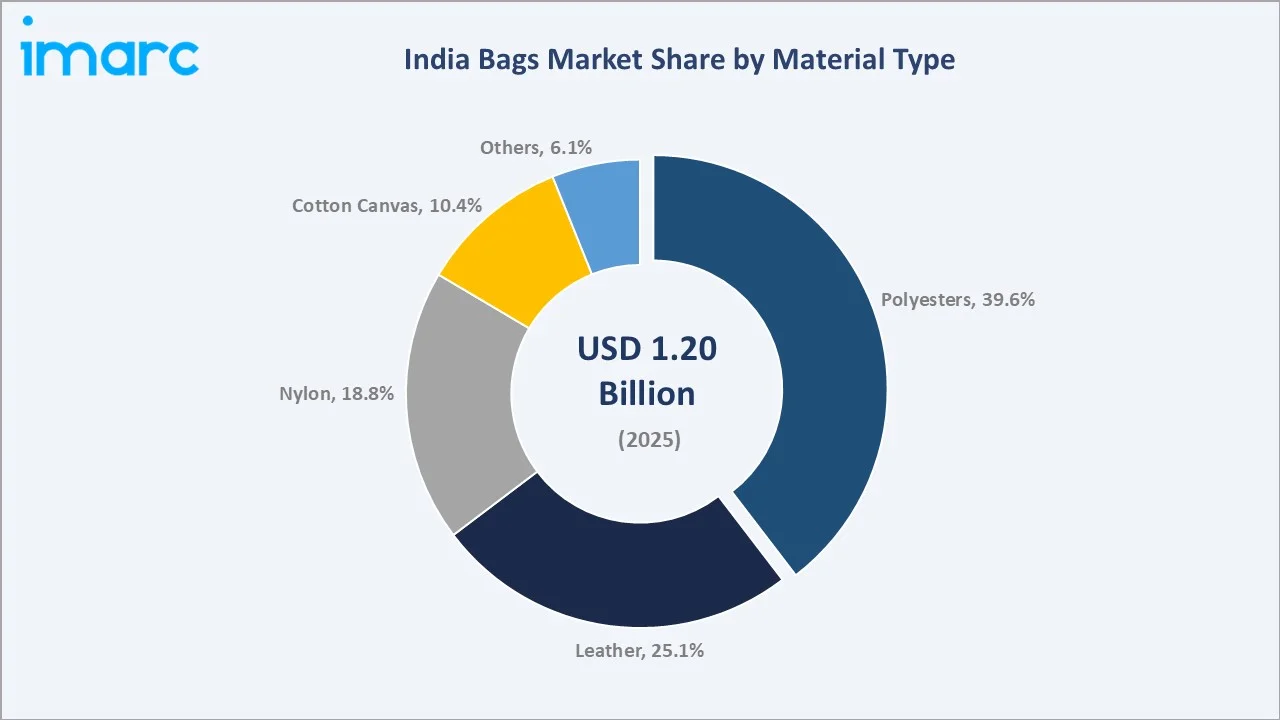
Leather follows at 25.1% share, serving the market's premium and gifting-led handbag and wallet demand, while nylon holds 18.8% share on the strength of its lightweight, tear-resistant qualities favored in travel and outdoor bags. Cotton canvas accounts for 10.4% share, led by eco-conscious tote and drawstring bag buyers, while other materials, including vegan-leather blends, make up the remaining 6.1%.
Regional Market Insights
|
Region |
Share (2025) |
Key India Bags Market Drivers & Characteristics |
|
West India |
34.5% |
Supported by dense organized retail, strong e-commerce fulfilment infrastructure, and established manufacturing clusters. |
|
North India |
28.7% |
Driven by high corporate gifting demand, dense multi-brand retail networks, and strong school-bag replacement demand. |
|
South India |
24.1% |
Reflects a tech-savvy, affluent population with growing demand for premium, branded, and design-led bags. |
|
East India |
12.7% |
Rising disposable incomes and expanding branded retail presence are gradually lifting demand for mid-range and premium bags. |
West India's regional leadership reflects Mumbai's status as a national retail and fashion hub, combined with Gujarat's manufacturing base for bags, leather goods, and components, giving the region both strong supply-side capacity and robust consumer demand.
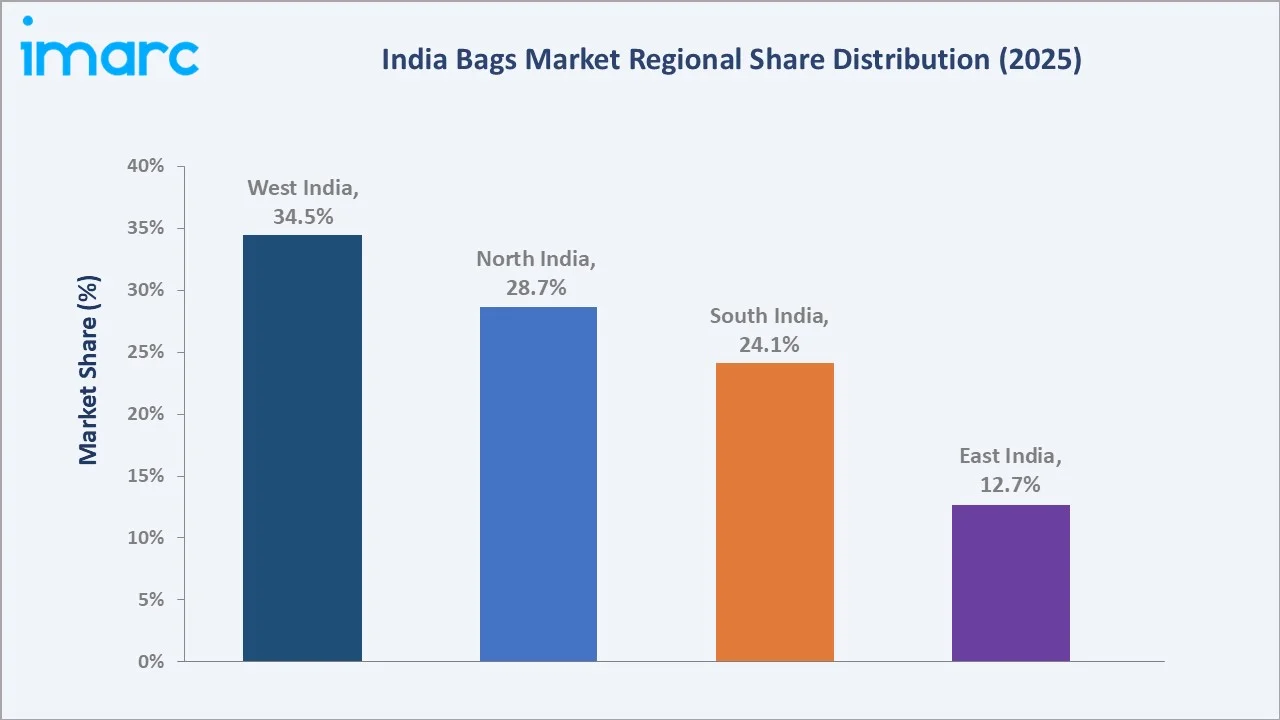
North India's 28.7% share is underpinned by Delhi-NCR's dense multi-brand retail and e-commerce warehousing footprint, while South India's 24.1% reflects Bengaluru, Hyderabad, and Chennai's affluent, design-conscious consumer base. East India, at 12.7% share, remains the most underpenetrated region but is expected to grow above the national average as organized retail expands into Kolkata and other emerging urban centers.
Competitive Landscape
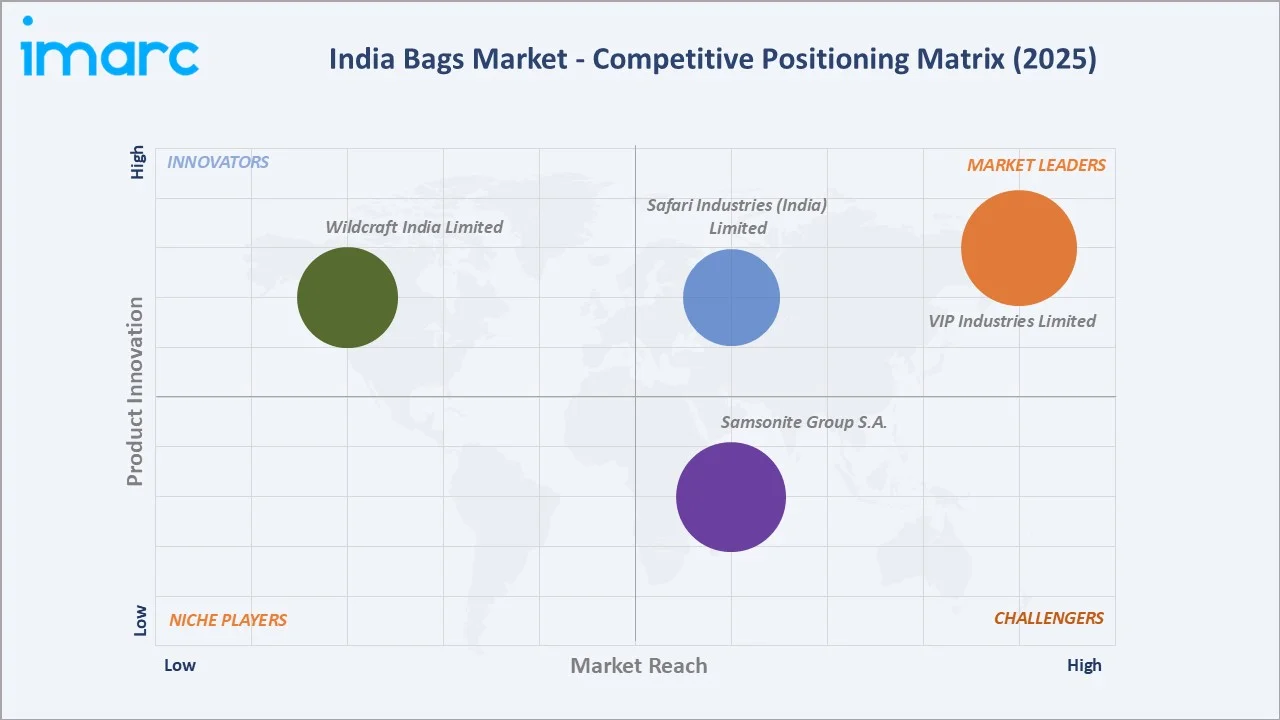
India bags market competition spans large diversified manufacturers, single-category specialists, and a fast-growing wave of D2C and e-commerce-native brands. Competitive intensity is rising as e-commerce lowers distribution barriers and consumers increasingly favor design and brand story over price alone.
|
Company |
Key Brands |
Market Position |
Core Strength |
|
VIP Industries Limited |
VIP, Skybags, Aristocrat, Caprese, Alfa |
Market Leader |
Widest multi-brand portfolio and retail distribution network across India. |
|
Safari Industries (India) Limited |
Safari, Genie, Urban Jungle |
Market Leader |
Value-focused positioning with fast-expanding mass-market and e-commerce presence. |
|
Samsonite Group S.A. |
American Tourister, Samsonite, Kamiliant |
Strong Challenger |
Global brand equity spanning mass and premium travel-bag price tiers. |
|
Wildcraft India Limited |
Wildcraft |
Innovator |
Outdoor and durability-led positioning, strong in trekking and daily-use backpacks. |
The competitive landscape's most consequential dynamic is the continued strength of India's unorganized manufacturing sector, which competes on price across school bags and basic backpacks, sustaining pressure on organized brands to differentiate through design, durability, and after-sales service.
Key Company Profiles
VIP Industries Limited
VIP Industries is India's one of the largest branded luggage and bags companies, with a multi-brand portfolio spanning value to premium price tiers across the domestic market.
- Key Brands: VIP, Skybags, Aristocrat, Caprese, and Alfa, among others.
- Product Portfolio: Backpacks, handbags, duffle bags, and travel luggage across multiple sub-brands targeting distinct consumer segments.
- Strategic Focus: Strengthening its multi-brand architecture and expanding e-commerce and D2C capabilities to defend category leadership against fast-growing digital-native competitors.
Safari Industries (India) Ltd
Safari Industries has built a strong position in India's value and mass-market bag segment through competitively priced, widely distributed products.
- Key Brands: Safari, Genie, Urban Jungle, and others.
- Product Portfolio: Backpacks, duffle bags, and luggage positioned primarily in the value and mid-price segments.
- Strategic Focus: Expanding manufacturing capacity and distribution reach to capture growing mass-market and e-commerce demand.
Samsonite Group S.A.
Samsonite's Indian operations, led by the American Tourister brand, hold a strong position across mass and premium bag and travel-luggage segments.
- Key Brands: American Tourister, Samsonite, Kamiliant, and others.
- Product Portfolio: Backpacks, travel bags, and luggage spanning value to premium price points.
- Strategic Focus: Leveraging global brand equity and product innovation to maintain leadership in India's premium travel-bag segment.
Market Concentration Analysis
India bags market concentration varies meaningfully by segment. Branded luggage and travel bags are moderately concentrated, with VIP Industries Limited, Safari Industries (India) Limited, and Samsonite Group S.A. together commanding a substantial share of organized-sector revenue. In contrast, school bags and basic backpacks remain highly fragmented, with a large unorganized manufacturing base competing primarily on price.
Market concentration is gradually increasing in the branded, e-commerce-led segments as D2C brands and established players expand distribution and marketing spend, while the unorganized sector's share is expected to erode slowly as consumers shift toward branded, quality-assured products over the forecast period.
Investment & Growth Opportunities
Highest Growth Segments
Sling and crossbody bags (~5.4% CAGR), backpacks (~4.3% CAGR), and duffle and gym bags (~4.1% CAGR) represent the India bags market's highest-growth product categories through 2034, driven by fashion trends, school enrolment, and rising fitness participation, respectively.
Emerging Investment Opportunities
India's sustainable and vegan-leather bag segment, though still nascent, is attracting early-stage investment as brands position around environmental credentials. D2C bag brands leveraging social commerce and influencer marketing also represent a high-growth, capital-efficient entry point for new market participants.
Investment Themes
- Tier-2 and tier-3 city organized retail expansion: Underserved smaller cities offer significant white space for branded bag retail as regional incomes rise.
- Sustainable material and manufacturing investment: Recycled polyester and vegan-leather production capacity represents a differentiated, forward-looking investment opportunity as sustainability becomes a genuine purchase driver.
Future Market Outlook (2026-2034)
India bags market is projected to grow from USD 1.20 Billion in 2025 to USD 1.26 Billion in 2026, reaching USD 1.68 Billion by 2034, delivering a 3.62% CAGR over the forecast period. The market's anchor value of USD 1.44 Billion in 2030 reflects steady, consistent growth rather than a single dramatic inflection, underscoring the India bags market's stable, demand-driven structure.
Three structural forces are expected to define India bags market growth through 2034: continued e-commerce and D2C brand expansion widening consumer access, sustained school-enrolment-linked demand providing a stable revenue base, and rising fashion and sustainability consciousness pushing gradual premiumization across handbags and backpacks alike.
Research Methodology
Primary Research
Primary research comprised structured interviews with India bags industry stakeholders, including brand managers, retail directors, e-commerce category managers, and manufacturing executives, alongside consumer surveys across West, North, South, and East India covering backpack, handbag, and school-bag buyers.
Secondary Research
Secondary research drew on company annual reports and investor presentations, IBEF and government trade and export data, industry association publications, and e-commerce and retail market data. Over 40 secondary sources were reviewed to validate market sizing and segmentation.
Forecasting Models
Market revenue forecasts were developed using a consumption-based model combining India's urban and student population by income segment, multiplied by average bag purchase frequency and ticket size per product category, aggregated to total market revenue by segment.
India Bags Market Report Coverage:
| Report Features | Details |
|---|---|
| Base Year of the Analysis | 2025 |
| Historical Period | 2020-2025 |
| Forecast Period | 2026-2034 |
| Units | Billion USD |
| Scope of the Report | Exploration of Historical Trends and Market Outlook, Industry Catalysts and Challenges, Segment-Wise Historical and Future Market Assessment:
|
| Product Types Covered | Backpacks, School Bags, Drawstring Bags, Handbags, Wallets & Purses, Duffle & Gym Bags, Sling & Crossbody Bags, Others |
| Material Types Covered | Polyesters, Nylon, Leather, Cotton Canvas, Others |
| Distribution Channels Covered | Store-Based, Supermarkets & Hypermarket, Convenience Stores, Specialty Stores, Others |
| End Users Covered | 5 To 12 Years, 13 To 19 Years, 20 Years & Above |
| Regions Covered | North India, South India, East India, West India |
| Companies Covered | VIP Industries Limited, Safari Industries (India) Limited, Samsonite Group S.A., Wildcraft India Limited, etc. |
| Customization Scope | 10% Free Customization |
| Post-Sale Analyst Support | 10-12 Weeks |
| Delivery Format | PDF and Excel through Email (We can also provide the editable version of the report in PPT/Word format on special request) |
Key Benefits for Stakeholders:
- IMARC’s industry report offers a comprehensive quantitative analysis of various market segments, historical and current market trends, market forecasts, and dynamics of the India bags market from 2020-2034.
- The research report provides the latest information on the market drivers, challenges, and opportunities in the India bags market.
- Porter's five forces analysis assist stakeholders in assessing the impact of new entrants, competitive rivalry, supplier power, buyer power, and the threat of substitution. It helps stakeholders to analyze the level of competition within the India bags industry and its attractiveness.
- Competitive landscape allows stakeholders to understand their competitive environment and provides an insight into the current positions of key players in the market.
Frequently Asked Questions About the India Bags Market Report
India bags market size is estimated at USD 1.26 Billion in 2026, driven by rising e-commerce penetration, school enrolment demand, and growing fashion consciousness across urban and semi-urban consumer segments.
India bags market grows at a 3.62% CAGR during 2026-2034, reaching USD 1.68 Billion by 2034, supported by D2C brand expansion, premiumization, and sustained backpack and handbag demand.
Backpacks lead at 24.8% share, driven by India's large school and college-going population and rising laptop-carry demand among young urban professionals.
Polyesters lead at 39.6% share due to their affordability, durability, and water resistance across mass-market backpacks, school bags, and duffle bags.
West India leads at 34.5% share, supported by Mumbai's retail and e-commerce infrastructure and Gujarat's established bag-manufacturing base.
Leading companies include VIP Industries Limited, Safari Industries (India) Limited, Samsonite Group S.A., and Wildcraft India Limited, among others.
India bags market is projected to reach approximately USD 1.44 Billion by 2030, as e-commerce penetration and premiumization continue to lift branded segment demand.
Key drivers include rising e-commerce and D2C brand expansion, growing school enrolment, urbanization, rising disposable incomes, and increasing fashion and brand consciousness among consumers.
Priority opportunities include tier-2 and tier-3 city organized retail expansion, sustainable and vegan-leather material investment, and D2C bag brand scaling through social commerce.
Sling and crossbody bags are estimated to grow fastest at approximately 5.4% CAGR through 2026-2034, driven by rising fashion-led, hands-free carrying preferences among younger consumers.
Need more help?
- Speak to our experienced analysts for insights on the current market scenarios.
- Include additional segments and countries to customize the report as per your requirement.
- Gain an unparalleled competitive advantage in your domain by understanding how to utilize the report and positively impacting your operations and revenue.
- For further assistance, please connect with our analysts.
 Request Customization
 Speak to an Analyst
 Request Brochure
 Inquire Before Buying
Benefits of Customization
- Personalize this research
- Triangulate with your data
- Get data as per your format and definition
- Gain a deeper dive into a specific application, geography, customer, or competitor
- Any level of personalization
Get in Touch With Us
UNITED STATES
Phone: +1-201-971-6302
INDIA
Phone: +91-120-433-0800
UNITED KINGDOM
Phone: +44-753-714-6104
Email: [email protected]
Client Testimonials




.webp)




.webp)













Related Reports

Choose your plan
*Please note that the prices mentioned below are starting prices for each bundle type. Kindly contact our team for further details.*
Single User License
- 1 User License, Access on 2 Devices
- PDF Report + Excel Dataset (Password Protected)
- Lifetime Access
- No Printing Rights
- 10% Free Report Customization
- 10–12 Weeks of Analyst Support
Five User License
- Access for 5 Users, 2 Devices per User
- PDF Report + Excel Dataset (Password Protected)
- Lifetime Access
- Dedicated Account Manager
- 12–14 Weeks of Analyst Support
- No Printing Rights
- 15% Free Report Customization
- 25% Discount on Your Next Purchase
Corporate User License
- Unlimited User Access (Within Your Organization)
- PDF Report + Excel Dataset
- Lifetime Access
- Dedicated Account Manager
- 14–20 Weeks of Analyst Support
- No Printing Rights
- 20% Free Report Customization
- 30% Discount on Your Next Purchase
Essential Insights
What's included:
3 reports
- Lifetime Access
- PDF Reports
- Excel Datasets
- 2 Weeks of Free Analyst Support
- 2 User Licenses
- Access on 2 Devices
- Printing Rights
- Complimentary PowerPoint (PPT) Version
- Complimentary License Upgrade
Professional Access
What's included:
5 reports
- Lifetime Access
- PDF Reports
- Excel Datasets
- 8 Weeks of Free Analyst Support
- 2 User Licenses
- Access on 2 Devices
- Printing Rights
- Complimentary PowerPoint (PPT) Version
- Complimentary License Upgrade
Business Advantage
What's included:
8 reports
- Lifetime Access
- PDF Reports
- Excel Datasets
- 14 Weeks of Free Analyst Support
- 2 User Licenses
- Access on 2 Devices
- Printing Rights
- Complimentary PowerPoint (PPT) Version
- Complimentary License Upgrade
Enterprise Intelligence
What's included:
10 reports
- Lifetime Access
- PDF Reports
- Excel Datasets
- 20 Weeks of Free Analyst Support
- 2 User Licenses
- Access on 2 Devices
- Printing Rights
- Complimentary PowerPoint (PPT) Version
- Complimentary License Upgrade