
India Bathroom Accessories Market Size, Share, Trends and Forecast by Product, Application, and Region, 2026-2034
India Bathroom Accessories Market Summary:
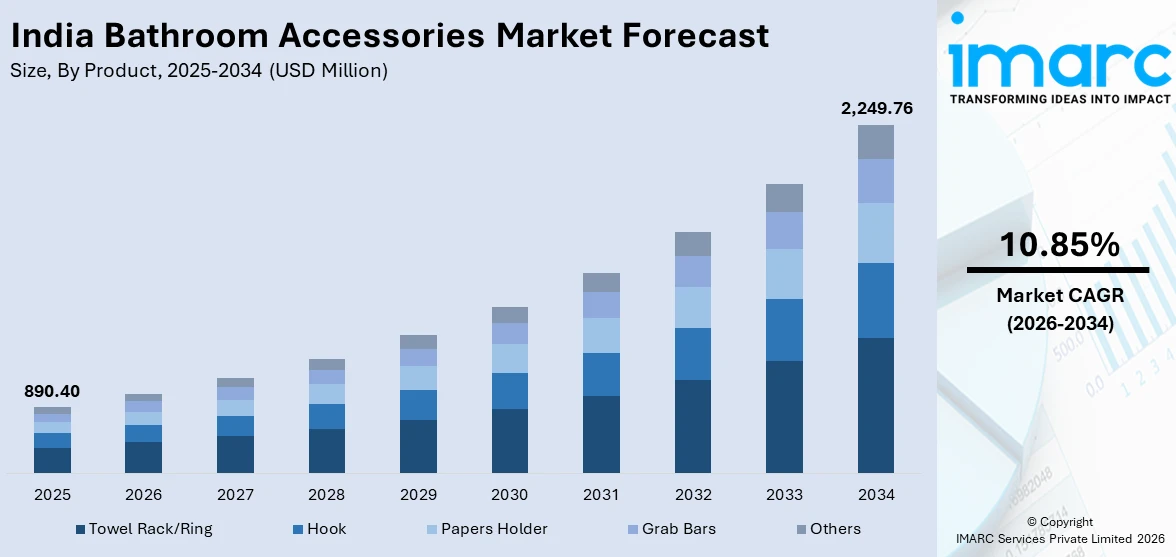
The India bathroom accessories market size was valued at USD 890.40 Million in 2025 and is projected to reach USD 2,249.76 Million by 2034, growing at a compound annual growth rate of 10.85% from 2026-2034.
The India bathroom accessories market is gaining significant momentum driven by rapid urbanization, expanding residential and commercial construction activities, and evolving user preferences toward modern and aesthetically appealing bathroom solutions. Rising disposable incomes, government-backed housing initiatives, and increasing penetration of organized retail and e-commerce platforms are broadening product accessibility. The growing adoption of smart and sensor-based bathroom fixtures, coupled with premiumization trends spreading into tier 2 and tier 3 cities, is further contributing to the India bathroom accessories market share.
Key Takeaways and Insights:
- By Product: Towel rack/ring dominates the market with a share of 32% in 2025, driven by widespread residential and commercial demand for functional and design-oriented bathroom organization solutions.
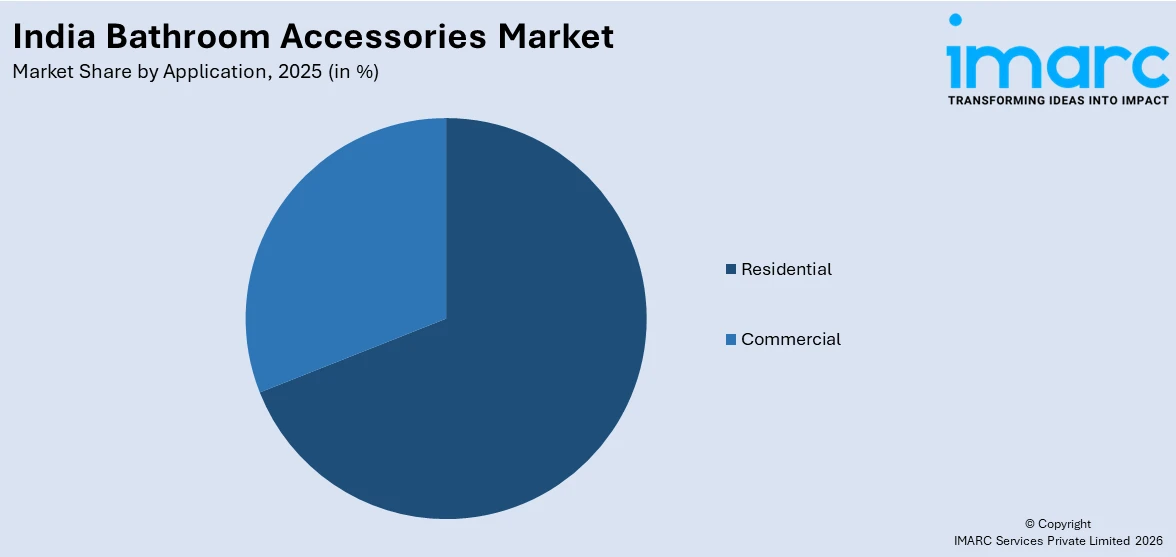
- By Application: Residential leads the market with a share of 69% in 2025, propelled by government housing schemes, rising homeownership rates, and the growing user investment in modern bathroom interiors.
- Key Players: The India bathroom accessories market exhibits intensifying competitive dynamics, with established domestic manufacturers and international premium brands competing across price segments through product innovation, retail expansion, and digital commerce strategies.
To get more information on this market Request Sample
The India bathroom accessories market is driven by the rapid urban housing growth, increasing real estate development, and rising user focus on modern bathroom interiors. Urbanization is a major structural contributor, as the country’s urban population represented approximately 36.87% of the total population in 2024 according to World Bank data, supporting sustained demand for new residential construction and upgraded living spaces. Higher disposable incomes among middle and upper-middle-class households are encouraging spending on premium fittings that offer durability, refined design, and improved comfort. Expansion of hospitality, healthcare, and commercial infrastructure is catalyzing the demand for standardized accessory installations. The growing renovation and home improvement trend is also accelerating replacement cycles for older fixtures. In addition, the rise of e-commerce platforms and organized retail networks is widening product access across tier-two and tier-three cities. Stronger domestic manufacturing and increasing hygiene awareness are further shifting demand toward branded, value-added bathroom accessory solutions.
India Bathroom Accessories Market Trends:
Urban Housing Expansion and Real Estate Development
The India bathroom accessories market is strongly supported by sustained growth in urban housing and real estate activity. Rising investments in residential apartments, gated communities, and commercial developments are catalyzing the demand for well-equipped and aesthetically consistent bathrooms. As construction accelerates across metro and tier-two cities, developers are increasingly incorporating modern accessory fittings as part of standard interior specifications. This momentum is reflected in major expansion plans, as in 2026, Puravankara Ltd announced the launch of 12–13 million sq ft of residential projects across Bengaluru, Mumbai, Kochi, and Coimbatore, highlighting strong premium housing demand. Such developments ensure steady procurement from builders and contractors.
Expansion of E-Commerce and Digital Purchase Channels
The rapid growth of e-commerce platforms is reshaping the distribution landscape for bathroom accessories in India. Digital channels offer buyers wider product visibility, detailed specifications, and convenient purchasing options, strengthening access across both urban and semi-urban markets. This shift is supported by the broader expansion of online retail, as per the IBEF, India’s e-commerce industry was valued at INR 10,82,875 Crore (USD 125 Billion) in 2024 and is projected to reach INR 29,88,735 Crore (USD 345 Billion) by 2030, growing at a CAGR of 15%. Such scale enables higher product discovery, informed comparisons, and increased preference for organized brands, driving consistent market growth.
Growth in Disposable Income and Premiumization Trends
Increasing disposable income among India’s middle and upper-middle-class population is enabling greater spending on home improvement products, including premium bathroom accessories. People are increasingly willing to invest in fittings that offer durability, refined design, and improved comfort, supporting a clear shift toward higher-value categories. This upward trend aligns with broader income growth expectations, as the State Bank of India has noted that India is set to transition into the upper-middle-income group by the end of this decade, with per capita income projected to reach around $4,000 by 2030. Such economic progress is reinforcing demand for branded, aesthetically advanced products over low-cost unorganized alternatives.

Market Outlook 2026-2034:
The India bathroom accessories market demonstrates notable growth potential throughout the forecast period, underpinned by sustained residential construction activity, expanding hospitality infrastructure, and evolving user preferences toward premium and smart solutions. The market generated a revenue of USD 890.40 Million in 2025 and is projected to reach a revenue of USD 2,249.76 Million by 2034, growing at a compound annual growth rate of 10.85% from 2026-2034. Increasing urbanization, government housing initiatives, and the growing e-commerce penetration are expected to broaden market accessibility and drive higher revenue streams across diverse geographic and demographic segments.
India Bathroom Accessories Market Report Segmentation:
|
Segment Category |
Leading Segment |
Market Share |
|
Product |
Towel Rack/Ring |
32% |
|
Application |
Residential |
69% |
Product Insights:
- Towel Rack/Ring
- Hook
- Papers Holder
- Grab Bars
- Others
Towel rack/ring dominates with a market share of 32% of the total India bathroom accessories market in 2025.
Towel rack/ring holds the biggest market share owing to its essential role in everyday bathroom organization and hygiene. This accessory is widely used across households, hotels, and commercial spaces, making it a high-demand category. The growing urbanization and increasing construction of modern residential apartments are boosting adoption. Individuals prefer towel rack and ring for their affordability, functionality, and ability to enhance bathroom aesthetics. Rising awareness about organized and stylish bathroom spaces further drives the market demand.
The proliferation of organized retail networks and e-commerce platforms has further strengthened the towel rack/ring segment by improving product visibility, enabling price comparisons, and expanding consumer access to diverse design options across urban and semi-urban markets. The commercial real estate sector, encompassing hotels, corporate offices, healthcare facilities, and educational institutions, contributes significantly to segment demand as large-scale institutional projects require standardized bathroom accessory installations. With increasing focus on convenience, durability, and design, towel racks and rings remain the leading product segment.
Application Insights:
Access the comprehensive market breakdown Request Sample
- Commercial
- Residential
Residential leads with a market share of 69% of the total India bathroom accessories market in 2025.
Residential segment's commanding market share reflects India's massive and expanding housing construction ecosystem, fueled by government policy interventions, demographic growth, and rising household formation rates. The Pradhan Mantri Awas Yojana continues to serve as a critical demand catalyst, with over 3.79 crore houses sanctioned as of February 2025 under the program, creating substantial volume-driven demand for bathroom accessories across affordable and mid-income housing segments. New residential developments increasingly incorporate modern bathroom designs featuring coordinated accessory sets, driving per-unit accessory spending upward.
The residential segment also dominates because of increasing renovation and remodeling activity across urban and semi-urban areas. People are investing in bathroom upgrades to improve comfort and property value. Easy availability of products through online platforms and home improvement stores supports higher adoption. Additionally, influence of interior design trends and the growing awareness about water-efficient and space-saving accessories strengthen the market demand. With homes remaining the primary end-use, residential applications continue to influence the market growth.
Regional Insights:
- North India
- South India
- East India
- West India
North India holds a notable share in the bathroom accessories market attributed to rapid urbanization, strong real estate growth, and rising home renovation activity. Cities, such as Delhi NCR, Chandigarh, and Jaipur, drive the demand for modern and premium bathroom fittings in residential and commercial construction projects.
South India represents a crucial segment in the market supported by expanding urban housing, strong hospitality development, and increasing individual preference for stylish bathroom interiors. Metro cities like Bengaluru, Chennai, and Hyderabad contribute to high adoption of organized and durable bathroom accessory product
East India shows steady growth in the bathroom accessories market with rising infrastructure development and increasing residential construction. Demand is expanding in cities like Kolkata and Bhubaneswar as people gradually invest in modern bathroom upgrades and improved hygiene-focused accessories.
West India is a crucial region in the market, strongly due to high construction activity, luxury housing demand, and a growing hospitality sector. Major urban centres, such as Mumbai, Pune, and Ahmedabad drive strong adoption of premium bathroom accessories, supported by higher disposable incomes and lifestyle modernization.
Market Dynamics:
Growth Drivers:
Why is the India Bathroom Accessories Market Growing?
Expanding Hospitality and Commercial Infrastructure Creating Premium Demand
India's hospitality sector expansion is generating substantial commercial demand for bathroom accessories, particularly in premium and luxury product categories. India’s organized hotel industry will add over 1,00,000 rooms, surpassing 3,00,000 rooms by 2029, according to the India Hotel Market Review 2024 by Horwath Hotel, Tourism and Leisure (HTL), with significant new property openings across both established and emerging markets. Hotels, corporate offices, retail spaces, healthcare facilities, and educational institutions require large-scale procurement of standardized bathroom accessories meeting durability, hygiene, and aesthetic standards. The commercial sector's emphasis on brand image and guest experience is driving preference for premium fixtures, sensor-based accessories, and design-coordinated accessory sets across major hospitality developments planned in the country.
Increasing Renovation and Home Improvement Activity
Homeowners in India are increasingly upgrading bathrooms to improve functionality, enhance space efficiency, and raise overall design quality. Replacement demand is supported by aging housing stock in older urban neighborhoods, where outdated fixtures are being modernized to meet current lifestyle expectations. Renovation cycles provide an opportunity to adopt newer materials, improved fittings, and better-quality accessories without requiring complete structural reconstruction. This trend is expanding the scope of bathroom improvement projects across urban households. As renovation activity increases, it strengthens aftermarket sales channels and drives demand across a wide range of bathroom accessory categories, contributing to steady and sustained market growth.
Technological Advancements in Materials and Manufacturing
Advancements in materials engineering and manufacturing processes are strengthening the bathroom accessories market in India by enabling products with improved durability, corrosion resistance, and superior surface finishes. These developments enhance performance and extend product lifespan, particularly in high-moisture bathroom environments. Manufacturers are achieving greater precision, uniformity, and quality consistency, supporting large-scale supply requirements for residential and commercial construction projects. Improved production capabilities also allow companies to offer more reliable and aesthetically refined accessory ranges. As overall product standards rise, user confidence in long-term value increases, encouraging households and institutions to replace older, low-quality fittings with modern alternatives.
Market Restraints:
What Challenges the India Bathroom Accessories Market is Facing?
High Cost of Premium and Smart Bathroom Accessories
The significant price differential between premium and basic bathroom accessories creates adoption barriers among price-sensitive user segments, particularly in lower and middle-income households. Smart and sensor-based products command substantially higher price points compared to conventional alternatives, while installation and maintenance costs further increase the total cost of ownership, limiting widespread penetration beyond affluent urban users and premium commercial projects across the country.
Limited Awareness and Product Knowledge Gaps
Insufficient awareness about bathroom accessory requirements, product specifications, and quality differentiation continues to constrain market development, particularly in semi-urban and rural markets. Many people remain uncertain about optimal product selections for their specific bathroom configurations and usage patterns, leading to suboptimal purchasing decisions and underinvestment in bathroom accessories that would otherwise enhance functionality, safety, and aesthetic appeal across residential and commercial settings.
Material Cost Volatility and Skilled Labor Shortages
Fluctuations in raw material prices, particularly for stainless steel, brass, and chrome plating materials, create margin pressures for manufacturers and contribute to product price instability. Additionally, the shortage of skilled technicians capable of installing and maintaining advanced smart bathroom systems creates post-purchase challenges that discourage adoption, particularly for sensor-enabled and electronically operated accessories in markets with limited aftermarket service infrastructure.
Competitive Landscape:
The India bathroom accessories market exhibits a competitive structure characterized by the presence of established domestic manufacturers competing alongside international premium brands across multiple price segments and distribution channels. Market dynamics reflect strategic positioning, ranging from innovation-driven premium offerings emphasizing advanced technology, design aesthetics, and material quality to value-oriented products targeting cost-conscious individuals in expanding housing segments. The competitive landscape is increasingly shaped by digital commerce capabilities, experiential retail strategies, product innovation in smart and sensor-based accessories, and sustainability initiatives. Companies are investing in manufacturing capacity expansion, multi-brand retail networks, and enhanced after-sales service infrastructure to strengthen market positioning.
Recent Developments:
- April 2025: Gravity Bath opened its first company-owned stores in New Delhi and Mumbai, featuring an immersive retail format. The outlets displayed a wide range of items, including premium faucets, showers, sanitaryware, bathroom accessories, along with live mock-up experience zones. This expansion supported the brand’s goal of offering transparent pricing, innovative hygiene solutions, and informed product selection.
- November 2024: Ruhe announced its expansion across India through exclusive Experience Centers for sanitaryware, bath fittings, and kitchen fittings. These outlets allowed clients to explore products in real-life setups, receive expert guidance, and access premium designs firsthand. The move strengthened Ruhe’s presence by combining its digital leadership with an enhanced in-store shopping experience.
India Bathroom Accessories Market Report Coverage:
| Report Features | Details |
|---|---|
| Base Year of the Analysis | 2025 |
| Historical Period | 2020-2025 |
| Forecast Period | 2026-2034 |
| Units | Billion USD |
| Scope of the Report | Exploration of Historical Trends and Market Outlook, Industry Catalysts and Challenges, Segment-Wise Historical and Future Market Assessment:
|
| Products Covered | Towel Rack/Ring, Hook, Paper Holder, Grab Bars, Others |
| Applications Covered | Commercial, Residential |
| Regions Covered | North India, South India, East India, West India |
| Customization Scope | 10% Free Customization |
| Post-Sale Analyst Support | 10-12 Weeks |
| Delivery Format | PDF and Excel through Email (We can also provide the editable version of the report in PPT/Word format on special request) |
Frequently Asked Questions About the India Bathroom Accessories Market Report
The India bathroom accessories market size was valued at USD 890.40 Million in 2025.
The India bathroom accessories market is expected to grow at a compound annual growth rate of 10.85% from 2026-2034 to reach USD 2,249.76 Million by 2034.
Towel rack/ring holds the largest revenue share of 32% in 2025, driven by widespread residential and commercial demand for essential bathroom organization solutions across diverse housing segments and commercial establishments.
Key factors driving the India bathroom accessories market include rising disposable incomes that encourage spending on premium fittings with better durability and design. This shift aligns with SBI projections that India will reach upper-middle-income status, with per capita income approaching $4,000 by 2030, strengthening demand for branded and higher-value products.
Major challenges include high-cost premiums for smart and designer accessories limiting mass-market adoption, limited user awareness about product specifications and quality differentiation, material cost volatility affecting pricing stability, skilled labor shortages for advanced installations, and uneven distribution infrastructure in semi-urban and rural markets.
Need more help?
- Speak to our experienced analysts for insights on the current market scenarios.
- Include additional segments and countries to customize the report as per your requirement.
- Gain an unparalleled competitive advantage in your domain by understanding how to utilize the report and positively impacting your operations and revenue.
- For further assistance, please connect with our analysts.
 Request Customization
 Speak to an Analyst
 Request Brochure
 Inquire Before Buying
Benefits of Customization
- Personalize this research
- Triangulate with your data
- Get data as per your format and definition
- Gain a deeper dive into a specific application, geography, customer, or competitor
- Any level of personalization
Get in Touch With Us
UNITED STATES
Phone: +1-201-971-6302
INDIA
Phone: +91-120-433-0800
UNITED KINGDOM
Phone: +44-753-714-6104
Email: [email protected]
Client Testimonials




.webp)




.webp)













Related Reports

Choose your plan
*Please note that the prices mentioned below are starting prices for each bundle type. Kindly contact our team for further details.*
Single User License
- 1 User License, Access on 2 Devices
- PDF Report + Excel Dataset (Password Protected)
- Lifetime Access
- No Printing Rights
- 10% Free Report Customization
- 10–12 Weeks of Analyst Support
Five User License
- Access for 5 Users, 2 Devices per User
- PDF Report + Excel Dataset (Password Protected)
- Lifetime Access
- Dedicated Account Manager
- 12–14 Weeks of Analyst Support
- No Printing Rights
- 15% Free Report Customization
- 25% Discount on Your Next Purchase
Corporate User License
- Unlimited User Access (Within Your Organization)
- PDF Report + Excel Dataset
- Lifetime Access
- Dedicated Account Manager
- 14–20 Weeks of Analyst Support
- No Printing Rights
- 20% Free Report Customization
- 30% Discount on Your Next Purchase
Essential Insights
What's included:
3 reports
- Lifetime Access
- PDF Reports
- Excel Datasets
- 2 Weeks of Free Analyst Support
- 2 User Licenses
- Access on 2 Devices
- Printing Rights
- Complimentary PowerPoint (PPT) Version
- Complimentary License Upgrade
Professional Access
What's included:
5 reports
- Lifetime Access
- PDF Reports
- Excel Datasets
- 8 Weeks of Free Analyst Support
- 2 User Licenses
- Access on 2 Devices
- Printing Rights
- Complimentary PowerPoint (PPT) Version
- Complimentary License Upgrade
Business Advantage
What's included:
8 reports
- Lifetime Access
- PDF Reports
- Excel Datasets
- 14 Weeks of Free Analyst Support
- 2 User Licenses
- Access on 2 Devices
- Printing Rights
- Complimentary PowerPoint (PPT) Version
- Complimentary License Upgrade
Enterprise Intelligence
What's included:
10 reports
- Lifetime Access
- PDF Reports
- Excel Datasets
- 20 Weeks of Free Analyst Support
- 2 User Licenses
- Access on 2 Devices
- Printing Rights
- Complimentary PowerPoint (PPT) Version
- Complimentary License Upgrade