
India Bike Market Size, Share, Trends and Forecast by Type, Product, End Use, Application, and Region, 2026-2034
India Bike Market Summary:
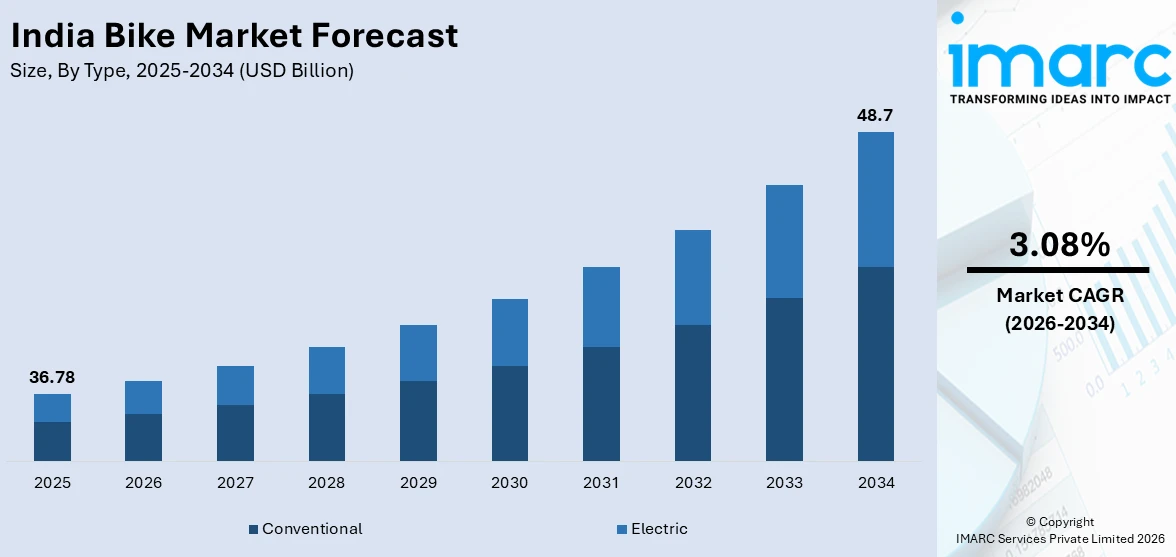
The India bike market size was valued at USD 36.78 Billion in 2025 and is projected to reach USD 48.7 Billion by 2034, growing at a compound annual growth rate of 3.08% from 2026-2034.
The bike market in India is registering strong growth due to rising health awareness among consumers, growing awareness about the environment, and rising traffic congestion in urban areas, which is triggering the need for different modes of transport. The government's efforts to promote cycling infrastructure and the rising trend of fitness-oriented cycling culture among urban populations are also adding to the India bike market share.
Key Takeaways and Insights:
-
By Type: Conventional dominate the market with a share of 88.5% in 2025, driven by their affordability, mechanical simplicity, and widespread consumer familiarity across urban and rural populations.
-
By Product: City/Commuter bikes hold the largest market share of 46.9% in 2025, reflecting strong demand for practical, affordable daily transportation solutions among working professionals and students.
-
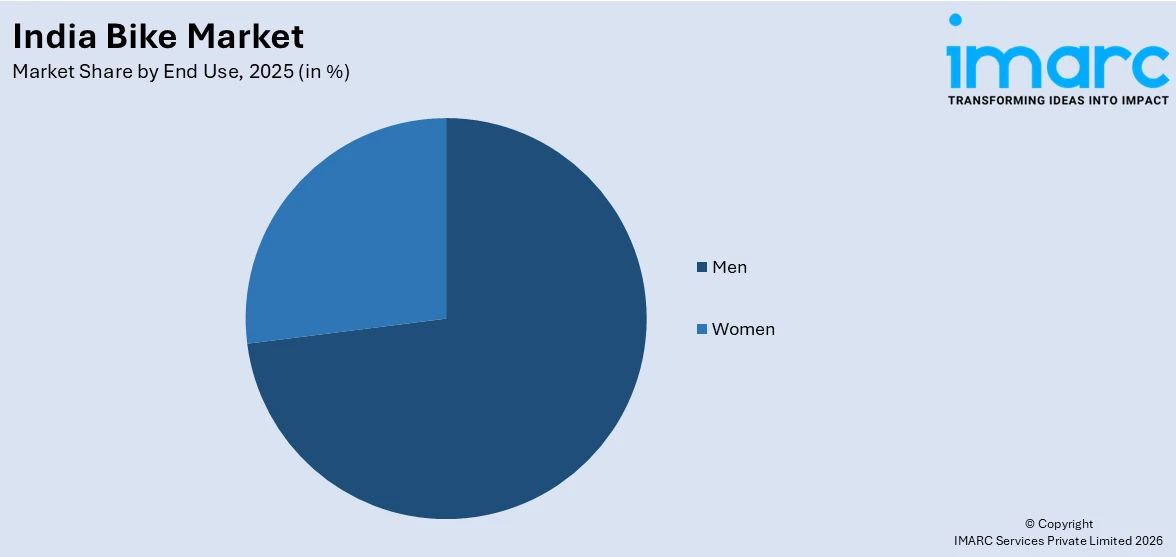
By End Use: Men represent the leading segment with a share of 72.6% in 2025, supported by higher cycling adoption for daily commuting, fitness activities, and recreational purposes.
-
By Application: Personal/Individual use dominates the market with a share of 81.3% in 2025, underscoring the dominance of individual cycling for commuting, exercise, and leisure activities.
-
By Region: North India leads the market with a share of 35.1% in 2025, driven by the concentration of major manufacturing hubs, high population density, and established retail networks.
-
Key Players: The India bike market features a competitive landscape with established domestic manufacturers and emerging electric mobility brands competing across price segments, expanding product portfolios, and strengthening distribution networks nationwide.
To get more information on this market Request Sample
The Indian bike market is moving ahead as the Indian government, industries, and people are adopting sustainable mobility solutions and active transportation. One of the key factors that are influencing this development is the increasing concern for health and fitness in the Indian population, which helps in ensuring the long-term sustainability of cycling as a means of transportation. Following the successful hosting of the international level Pune Grand Tour 2026, India’s first UCI-recognized multi-stage cycling race, bicycle shops in Pune reported a noticeable increase in consumer inquiries, reflecting a growing interest in cycling among residents, both as a sport and as a means of daily transportation. Government support through smart city projects, the development of cycling infrastructure such as dedicated cycling lanes and bike-sharing services, and the increasing demand for sustainable transportation solutions are helping to create a positive atmosphere for the adoption of bicycles. The development of electric bicycles is also increasing the customer base as people can now use bicycles with motors for assistance in longer routes and varied terrains. Urbanization, rising fuel costs, and awareness about environmental conservation are also increasing the popularity of bicycles as an economic and eco-friendly alternative mode of transportation in Indian cities.
India Bike Market Trends:
Rising Health and Fitness-Oriented Cycling Culture
India is experiencing a major transition towards healthier living, with cycling gaining popularity as a preferred activity that combines fitness with functionality. The government’s Fit India Sundays on Cycle programme, which completed its 55th consecutive weekly edition in late 2025 with participation from more than 22 million people across over 1.81 lakh locations nationwide, underscores the growing enthusiasm for cycling as a fitness and wellness activity. Urban residents are increasingly incorporating cycling into their wellness regimens, thereby driving the demand for high-quality bicycles that are suited for fitness purposes. Cycling clubs, group rides, and events are on the rise in major cities, thereby creating a thriving cycling culture that promotes long-term consumer engagement and fuels the growth of the India bike market.
Growing Adoption of Electric Bicycles
Electric bicycles are gaining substantial traction as consumers seek efficient alternatives that combine physical activity with motorized assistance for urban commuting. In August 2025, Pune‑based e‑cycle startup Emotorad reported strong export demand and targeted ₹150 crore worth of electric bicycle shipments to markets including the U.S., reflecting rising global interest in Indian e‑bike makers amid growing domestic adoption of electric two‑wheelers. Pedal-assisted models are particularly popular among daily commuters navigating congested city roads. Advancements in battery technology, declining component costs, and improving charging infrastructure are making electric bicycles more accessible and practical for a broader consumer base across metropolitan and tier-two urban centers.
Integration of Smart Connectivity and Technology Features
Contemporary bicycles are also increasingly integrating sophisticated technological elements such as smartphone connectivity, performance tracking, GPS, and ride analytics. In December 2025, Indian e‑cycle maker EMotorad launched the T‑Rex Smart, the country’s first electric cycle equipped with Bluetooth and GPS connectivity paired with a dedicated mobile app that offers real‑time trip tracking, route history, performance analytics, geofencing, and theft alerts, marking a notable shift toward connected biking solutions in India. Such smart technologies are not only improving the user experience but also increasing the safety of cyclists through geofencing and theft notifications. The use of light materials, advanced suspension technology, and accurate gear systems is also improving the quality and expectations of consumers.
Market Outlook 2026-2034:
The India bike market outlook remains positive, supported by favorable demographic trends, increasing health awareness, and government initiatives promoting sustainable transportation. The expansion of cycling infrastructure including dedicated lanes and public bike-sharing systems in smart cities is expected to encourage broader adoption. Growing environmental consciousness and rising fuel costs are reinforcing bicycles' appeal as economical and eco-friendly mobility solutions. The electric bicycle segment presents significant growth potential as battery costs decline and charging infrastructure improves. Rural and semi-urban markets offer expansion opportunities as distribution networks extend beyond metropolitan centers. The market generated a revenue of USD 36.78 Billion in 2025 and is projected to reach a revenue of USD 48.7 Billion by 2034, growing at a compound annual growth rate of 3.08% from 2026-2034.
India Bike Market Report Segmentation:
|
Segment Category |
Leading Segment |
Market Share |
|
Type |
Conventional |
88.5% |
|
Product |
City/Commuter Bikes |
46.9% |
|
End Use |
Men |
72.6% |
|
Application |
Personal/Individual |
81.3% |
|
Region |
North India |
35.1% |
Type Insights:
- Conventional
- Electric
The conventional dominates with a market share of 88.5% of the total India bike market in 2025.
Conventional bicycles continue to maintain a leading position in the Indian market due to their affordability, simplicity, and long-established consumer familiarity. These manually powered bicycles require little or no maintenance, are not dependent on the availability of electrical charging infrastructure, and are extremely affordable for price-conscious consumers across various economic strata. Their widespread distribution through organized dealership networks, retail, and government-supported welfare distribution programs further cements their leading market position, ensuring a steady stream of demand from a wide cross-section of consumers across the country.
The conventional segment enjoys the benefit of steady demand from various application segments such as commuting, student transport, recreational cycling, and commercial last-mile delivery services. The segment is being further innovated by manufacturers with the development of lighter frame materials, improved multi-speed gear systems, and design enhancements focused on improving the riding experience. Rural and semi-urban markets are key demand pockets for conventional bicycles, which remain the only affordable personal mobility solution for millions of households in these regions, meeting their mobility requirements for accessing markets, healthcare facilities, and employment commutes.
Product Insights:
- City/Commuter Bikes
- Road Bikes
- Mountain Bikes (MTB)
- Hybrid Bikes
- Cargo Bikes
- Others
The city/commuter bikes leads with a share of 46.9% of the total India bike market in 2025.
City and commuter bicycles represent the largest product segment in the Indian market, driven by their practicality for short-distance daily transportation across urban and semi-urban environments. These bicycles are specifically engineered for comfortable travel on paved roads, featuring upright riding positions, durable construction, and low-maintenance characteristics that appeal to working professionals, students, and everyday commuters seeking cost-effective mobility solutions. Their simple yet functional design ensures reliable performance for routine travel needs, while affordable pricing makes them accessible to a broad consumer base spanning diverse economic backgrounds and age groups.
The segment is driven by the high population density in Indian cities and the rising demand for economical last-mile connectivity solutions. Increasing traffic congestion and rising fuel prices are pushing commuters to opt for bicycles for short-distance commutes, and improving cycling infrastructure is helping to provide safer commuting conditions. The segment is also seeing the launch of bicycles with improved comfort features, storage solutions, and contemporary designs to appeal to a broader consumer base.
End Use Insights:
Access the comprehensive market breakdown Request Sample
- Men
- Women
The men dominates with a market share of 72.6% of the total India bike market in 2025.
Men are the leading end-use category in the Indian bike market, driven by higher adoption rates of cycling for commuting, exercise, recreation, and last-mile delivery services. Social and cultural factors, traditional product offerings in various categories of men's bicycles, and the prevalence of male cyclists in organized cycling events and activities have helped this segment maintain a leading market share. This is also driven by the growing interest of working-age males in healthy living styles, with cycling being a preferred low-impact exercise and transportation mode in urban and rural settings.
The men's market segment covers a broad product spectrum, ranging from economy-focused commuting bikes to high-performance road and mountain bikes. The growing awareness of the benefits of physical fitness, participation in cycling clubs and community events, and the growing culture of recreational cycling are all contributing to sustained demand growth. To cater to this demand, companies are expanding their product offerings in the men's segment with features such as advanced multi-speed gear systems, alloy and carbon frames, improved suspension technology, and specialized models designed for specific terrain types, performance levels, and commuting needs.
Application Insights:
- Personal/Individual
- Commercial
The personal/individual leads with a share of 81.3% of the total India bike market in 2025.
Personal and individual usage is most prevalent in the Indian bicycle market as consumers mainly purchase bicycles for personal use as a means of commuting, exercising, and transporting school-going students. The economic viability of bicycles over motorized transport, combined with increasing awareness about the environment and the need for an active lifestyle, continues to drive individual usage. Welfare government programs for distributing bicycles to school-going children and the economically weaker section of society further fuel personal usage.
Individual buyers include a wide range of consumers from school-going children, working professionals, and fitness enthusiasts to senior citizens looking for low-impact exercise solutions. Increasing urbanization and the need for a convenient short-distance transport solution are encouraging more consumers to adopt bicycles as a viable daily transport solution. The increasing availability of different types of bicycles catering to varied consumer preferences for riding, budget, and terrain conditions is widening the addressable market for manufacturers to tap into entry-level commuters and performance-oriented cycling enthusiasts.
Regional Insights:
- North India
- South India
- East India
- West India
North India exhibits a clear dominance with a 35.1% share of the total India bike market in 2025.
North India's market leadership stems from its concentration of major bicycle manufacturing clusters, which have historically served both domestic and export markets. The region benefits from high population density across key states, established distribution networks, and a strong retail presence in urban and semi-urban centers. Consumer demand is driven by diverse applications including daily commuting, student transportation, and growing recreational cycling adoption in metropolitan areas.
Market expansion in North India is supported by improving cycling infrastructure, government promotion of non-motorized transportation, and rising health awareness among urban populations. States within the region are implementing smart city initiatives that incorporate cycling lanes and bike-sharing programs to encourage adoption. The presence of established manufacturing hubs ensures competitive pricing and wider product availability, strengthening North India's position as the leading market for bicycle consumption.

Market Dynamics:
Growth Drivers:
Why is the India Bike Market Growing?
Increasing Health Consciousness and Fitness-Oriented Lifestyles
The rising awareness of the health benefits linked to regular physical exercise is fueling the adoption of bicycles among health-conscious Indian consumers. Cycling is associated with cardiovascular exercise, weight management, and stress relief, which are linked to health-conscious urban populations looking for easy and convenient ways to stay fit. British bicycle brand Muddyfox recently entered the Indian market with the launch of 18 different bike models, including mountain, road, and hybrid bikes, through a partnership with distribution firm Ananta Ventures, signalling growing interest from international companies in India’s expanding cycling community. This phenomenon is more evident among working professionals and the younger generation who have started incorporating cycling into their fitness regimes, leading to an increased demand for high-quality bicycles that are suitable for fitness activities. The emergence of cycling groups, community cycling events, and cycling competitions in major cities has created a healthy ecosystem that has normalized cycling as a mainstream fitness activity.
Supportive Government Initiatives and Cycling Infrastructure Development
Government initiatives related to sustainable transportation and non-motorized mobility are creating a favorable setting for the use of bicycles in India. Smart city projects that include separate cycling routes, bike-sharing services, and cycling-friendly designs are making infrastructure more accessible to cyclists. For example, the Government of Meghalaya launched Shillong’s first Public Bicycle Sharing (PBS) system in 2025 as part of its Urban Mobility Policy, aiming to enhance sustainable and non‑motorized transport by providing electric bicycles and promoting cycling as a viable green mobility option. Government initiatives at the national and state levels to decrease emissions from vehicles, ease congestion in urban areas, and promote sustainable transport are fueling government support for the expansion of cycling infrastructure. Bicycles for distribution initiatives focused on students and the economically weaker sections of society are making cycling more accessible and developing cycling habits among the young. Urban development strategies are increasingly focusing on non-motorized transport routes, safe cycling routes, and secure parking areas, making cycling a more feasible and viable transport solution for various sections of society in urban, semi-urban, and rural areas.
Rising Urbanization and Growing Need for Affordable Mobility Solutions
Rapid urbanization and the resulting traffic congestion in Indian cities are encouraging consumers to seek alternative, cost-effective transportation modes. Bicycles offer an economical mobility solution that eliminates fuel costs, parking challenges, and the financial burden of vehicle ownership and maintenance. Many cities are seeing this shift in practice; for example, Mumbai’s cycling community has grown significantly in recent years despite urban congestion, with local cyclists increasingly using bicycles for fitness, leisure, and short commutes as awareness about sustainable transport rises. The increasing cost of fuel and public transportation, combined with last-mile connectivity gaps, makes cycling particularly appealing for short-distance commuting in densely populated urban centers. Growing environmental consciousness among younger demographics, combined with the desire for sustainable living practices, is accelerating the shift toward bicycles as a preferred daily transport option. The expansion of organized retail networks and online distribution channels is improving bicycle accessibility and affordability, enabling manufacturers to reach a broader consumer base across urban and semi-urban areas throughout the country.
Market Restraints:
What Challenges the India Bike Market is Facing?
Intense Competition from Motorized Two-Wheelers
Motorized two-wheelers continue to dominate India's personal transportation landscape, offering speed, convenience, and longer travel range. The affordability of motorcycles and scooters, combined with easy financing options and extensive service networks, limits bicycle adoption for daily commuting. Consumers often perceive motorized vehicles as more practical for covering longer distances in challenging weather and traffic conditions, constraining the bicycle market's growth potential.
Inadequate Cycling Infrastructure and Safety Concerns
The absence of dedicated cycling lanes, secure parking facilities, and cyclist-friendly traffic management systems in most Indian cities deters potential riders. Shared roadways with heavy vehicular traffic pose significant safety risks, discouraging casual and commuter cyclists. Without substantial investment in protected cycling infrastructure and enforcement of traffic safety regulations, bicycle adoption rates remain constrained across many urban and peri-urban areas.
Seasonal Demand Fluctuations and Climate Challenges
India's diverse climate conditions, including extreme heat, monsoon rains, and humidity, create seasonal demand variations that affect consistent bicycle usage and sales patterns. Adverse weather conditions discourage outdoor cycling activities for extended periods, limiting year-round adoption. These seasonal fluctuations pose challenges for manufacturers and retailers in maintaining steady revenue streams and efficient inventory management throughout the calendar year.
Competitive Landscape:
The India bike market features a dynamic competitive landscape characterized by a mix of established domestic manufacturers with decades of market presence and emerging brands introducing innovative product offerings. The market structure ranges from mass-market producers offering affordable commuter and standard bicycles to premium-focused brands targeting fitness enthusiasts and performance cyclists. Competition is intensifying as manufacturers diversify product portfolios to include electric bicycles, smart-connected models, and specialized variants for mountain biking, road racing, and cargo transportation. Distribution strategies are evolving with the expansion of organized retail outlets, brand experience stores, and e-commerce platforms enabling direct-to-consumer sales. Manufacturers are investing in lightweight frame technologies, advanced gear systems, and ergonomic designs to differentiate their offerings. The growing electric bicycle segment is attracting new entrants and startups, further intensifying competitive dynamics as brands compete on battery performance, connectivity features, pricing, and after-sales service networks across the country.
Recent Developments:
-
In February 2026, Hero MotoCorp’s electric arm Vida has secured a design patent in India for the production‑ready Vida Ubex electric motorcycle, first shown at EICMA 2025 in Milan, marking a major step toward its launch and the company’s push into the electric motorcycle segment.
India Bike Market Report Coverage:
|
Report Features |
Details |
|
Base Year of the Analysis |
2025 |
|
Historical Period |
2020-2025 |
|
Forecast Period |
2026-2034 |
|
Units |
Billion USD |
|
Scope of the Report |
Exploration of Historical Trends and Market Outlook, Industry Catalysts and Challenges, Segment-Wise Historical and Future Market Assessment:
|
|
Types Covered |
Conventional, Electric |
|
Products Covered |
City/Commuter Bikes, Road Bikes, Mountain Bikes (MTB), Hybrid Bikes, Cargo Bikes, Others |
|
End Uses Covered |
Men, Women |
|
Applications Covered |
Personal/Individual, Commercial |
|
Regions Covered |
North India, South India, East India, West India |
|
Customization Scope |
10% Free Customization |
|
Post-Sale Analyst Support |
10-12 Weeks |
|
Delivery Format |
PDF and Excel through Email (We can also provide the editable version of the report in PPT/Word format on special request) |
Frequently Asked Questions About the India Bike Market Report
The India bike market size was valued at USD 36.78 Billion in 2025.
The India bike market is expected to grow at a compound annual growth rate of 3.08% from 2026-2034 to reach USD 48.7 Billion by 2034.
Conventional bikes, holding the largest share of 88.5%, remain the dominant type in India's bike market, driven by their affordability, low maintenance, widespread availability, and strong consumer familiarity across diverse economic segments.
Key factors driving the India bike market include increasing health consciousness, expanding cycling infrastructure, supportive government initiatives promoting sustainable mobility, rising urbanization and traffic congestion, growing environmental awareness, and technological advancements in bicycle design.
Major challenges include intense competition from motorized two-wheelers, inadequate cycling infrastructure and safety concerns in most cities, seasonal demand fluctuations due to climate conditions, consumer preference for motorized transport, and limited awareness of premium bicycle categories.
Need more help?
- Speak to our experienced analysts for insights on the current market scenarios.
- Include additional segments and countries to customize the report as per your requirement.
- Gain an unparalleled competitive advantage in your domain by understanding how to utilize the report and positively impacting your operations and revenue.
- For further assistance, please connect with our analysts.
 Request Customization
 Speak to an Analyst
 Request Brochure
 Inquire Before Buying
Benefits of Customization
- Personalize this research
- Triangulate with your data
- Get data as per your format and definition
- Gain a deeper dive into a specific application, geography, customer, or competitor
- Any level of personalization
Get in Touch With Us
UNITED STATES
Phone: +1-201-971-6302
INDIA
Phone: +91-120-433-0800
UNITED KINGDOM
Phone: +44-753-714-6104
Email: [email protected]
Client Testimonials




.webp)




.webp)













Related Reports

Choose your plan
*Please note that the prices mentioned below are starting prices for each bundle type. Kindly contact our team for further details.*
Single User License
- 1 User License, Access on 2 Devices
- PDF Report + Excel Dataset (Password Protected)
- Lifetime Access
- No Printing Rights
- 10% Free Report Customization
- 10–12 Weeks of Analyst Support
Five User License
- Access for 5 Users, 2 Devices per User
- PDF Report + Excel Dataset (Password Protected)
- Lifetime Access
- Dedicated Account Manager
- 12–14 Weeks of Analyst Support
- No Printing Rights
- 15% Free Report Customization
- 25% Discount on Your Next Purchase
Corporate User License
- Unlimited User Access (Within Your Organization)
- PDF Report + Excel Dataset
- Lifetime Access
- Dedicated Account Manager
- 14–20 Weeks of Analyst Support
- No Printing Rights
- 20% Free Report Customization
- 30% Discount on Your Next Purchase
Essential Insights
What's included:
3 reports
- Lifetime Access
- PDF Reports
- Excel Datasets
- 2 Weeks of Free Analyst Support
- 2 User Licenses
- Access on 2 Devices
- Printing Rights
- Complimentary PowerPoint (PPT) Version
- Complimentary License Upgrade
Professional Access
What's included:
5 reports
- Lifetime Access
- PDF Reports
- Excel Datasets
- 8 Weeks of Free Analyst Support
- 2 User Licenses
- Access on 2 Devices
- Printing Rights
- Complimentary PowerPoint (PPT) Version
- Complimentary License Upgrade
Business Advantage
What's included:
8 reports
- Lifetime Access
- PDF Reports
- Excel Datasets
- 14 Weeks of Free Analyst Support
- 2 User Licenses
- Access on 2 Devices
- Printing Rights
- Complimentary PowerPoint (PPT) Version
- Complimentary License Upgrade
Enterprise Intelligence
What's included:
10 reports
- Lifetime Access
- PDF Reports
- Excel Datasets
- 20 Weeks of Free Analyst Support
- 2 User Licenses
- Access on 2 Devices
- Printing Rights
- Complimentary PowerPoint (PPT) Version
- Complimentary License Upgrade