
India Biomass Gasification Market Size, Share, Trends and Forecast by Source, and Region, 2026-2034
India Biomass Gasification Market Summary:
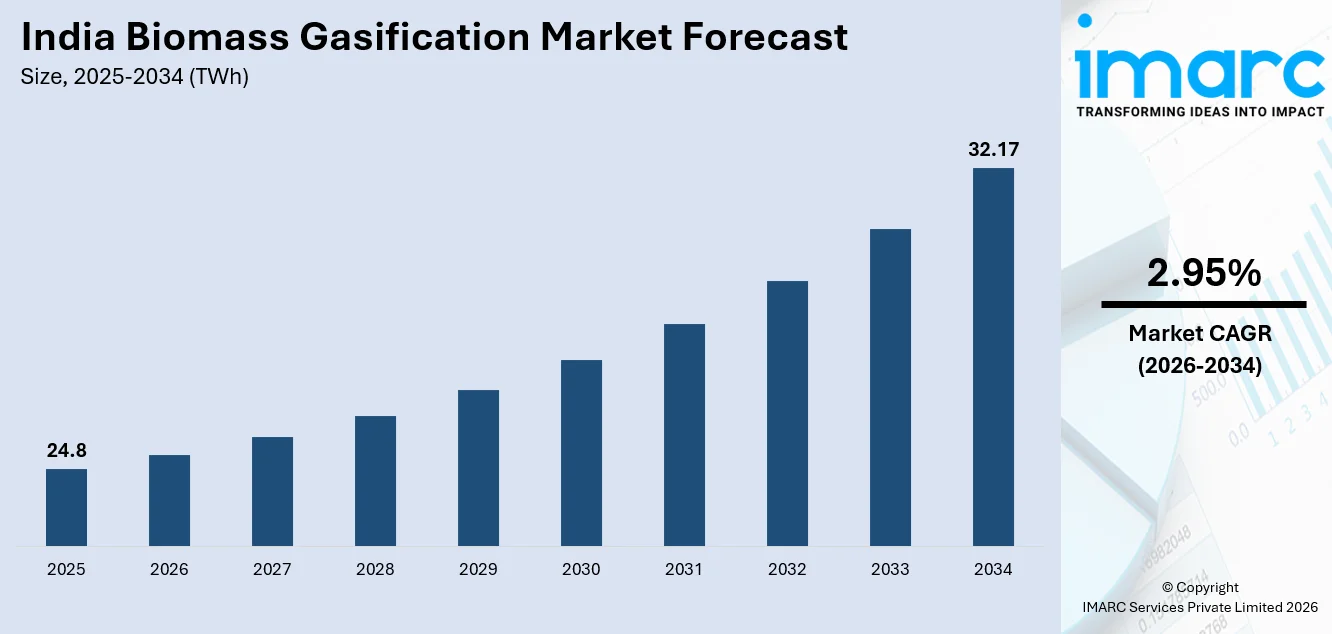
The India biomass gasification market size reached 24.8 TWh in 2025 and is projected to reach 32.17 TWh by 2034, growing at a compound annual growth rate of 2.95% from 2026-2034.
The India biomass gasification market is witnessing consistent growth as the country strengthens efforts to diversify its renewable energy mix and improve sustainable waste utilization. Wider adoption of thermo-chemical conversion technologies, along with enabling policy support and increasing demand for reliable rural power supply, is driving market development. Continuous improvements in gasifier performance and operational efficiency are enhancing commercial viability. In parallel, rising interest in decentralized energy systems and the potential alignment of biomass gasification with emerging green hydrogen initiatives are reinforcing its role within India’s evolving clean energy landscape.
Key Takeaways and Insights:
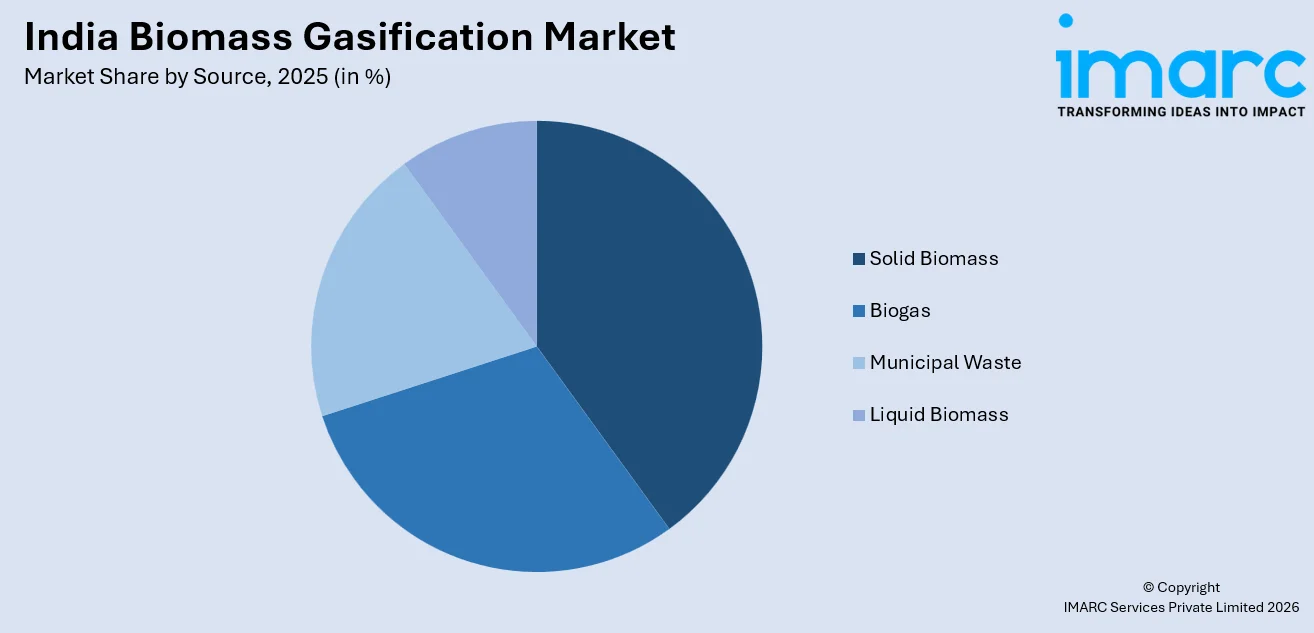
- By Source: Solid biomass dominates the market with a share of 40% in 2025, driven by abundant agricultural residue availability and rising demand for biomass pellets in industrial and power generation applications across the country.
- Key Players: The India biomass gasification market exhibits a semi-fragmented competitive structure, with domestic gasifier manufacturers competing alongside international technology providers. Companies are focusing on technological innovation, strategic partnerships, and capacity expansion to strengthen their market position and address growing demand for decentralized energy solutions.
To get more information on this market Request Sample
The India biomass gasification market is gaining traction as the country leverages its vast biomass resources to meet growing energy demands sustainably. With an estimated surplus biomass availability of approximately 230 million metric tonnes per annum, the conversion of agricultural residues, forestry by-products, and organic waste into synthesis gas through gasification presents a significant opportunity for clean energy generation. The technology enables both grid-linked and standalone power generation, making it especially suitable for rural and semi-urban areas where reliable electricity supply remains limited. Its flexibility supports decentralized energy access while reducing dependence on conventional fuels. Beyond power generation, biomass gasification is increasingly being applied in industrial settings, where it supplies thermal energy for agro-processing units such as rice mills and food processing facilities. The growing interest in integrating biomass gasification with clean fuel production pathways further broadens its application potential, positioning the technology as a versatile solution for sustainable energy and industrial energy needs.
India Biomass Gasification Market Trends:
Integration of Biomass Gasification with Green Hydrogen Production Pathways
Biomass gasification is increasingly being recognized as a viable route for green hydrogen production in India, catalyzing new investment and policy attention. For instance, in April 2025, India's Ministry of New and Renewable Energy launched the Green Hydrogen Certification Scheme, which formally classifies hydrogen produced via biomass gasification as green when emissions remain below two kilograms of CO2-equivalent per kilogram of hydrogen. As a result, biomass gasification is emerging as an important complementary route within India’s broader green hydrogen strategy, linking renewable energy goals with waste valorization and decarbonization objectives.
Expanding Biomass Co-firing Mandates Driving Feedstock Demand
India's mandatory biomass co-firing policy is creating significant upstream demand for processed biomass, indirectly bolstering the biomass gasification ecosystem. The Ministry of Power mandated a minimum of five percent biomass co-firing in coal-based thermal power plants from fiscal year 2024-25, with the obligation increasing to seven percent from fiscal year 2025-26. This policy shift has significantly increased the use of biomass in thermal power generation, reinforcing momentum in the biomass gasification market. The growing reliance on biomass is encouraging investments across collection, aggregation, processing, and logistics infrastructure, strengthening supply chains and improving feedstock availability for gasification and other bioenergy applications.
Deployment of Decentralized Biomass Gasification Systems for Rural Energy Access
Decentralized biomass gasification systems are emerging as an effective solution to address energy access challenges in rural India. These systems leverage locally available biomass resources to generate reliable power, reducing dependence on centralized grids and fossil fuels. By enabling community-level energy generation, biomass gasification supports rural electrification while creating local economic opportunities through feedstock sourcing, system operation, and maintenance. Continued emphasis on decentralized energy models is encouraging wider deployment of small-scale gasification plants, strengthening energy resilience in remote and underserved regions across the country.
Market Outlook 2026-2034:
The India biomass gasification market is positioned for consistent expansion over the forecast period, supported by favorable government policies, increasing biomass feedstock utilization, and growing demand for decentralized clean energy solutions. Integration with green hydrogen production and mandatory co-firing requirements in thermal power plants are creating new avenues for technology deployment and investment. As India targets 500 GW of non-fossil energy capacity by 2030, biomass gasification is expected to play an increasingly important role in the country's renewable energy portfolio. The market size was estimated at 24.8 TWh in 2025 and is expected to reach 32.17 TWh by 2034, reflecting a compound annual growth rate of 2.95% over the forecast period 2026-2034.
India Biomass Gasification Market Report Segmentation:
|
Segment Category |
Leading Segment |
Market Share |
|
Source |
Solid Biomass |
40% |
Source Insights:
Access the comprehensive market breakdown Request Sample
- Solid Biomass
- Biogas
- Municipal Waste
- Liquid Biomass
Solid biomass dominates the market with a share of 40% of the total India biomass gasification market in 2025.
Solid biomass accounts for the leading share of India’s biomass gasification market due to the country’s strong agricultural foundation and consistent availability of feedstock such as crop residues, wood waste, and forestry by-products. These materials are widely accessible across rural and industrial regions, making solid biomass a practical and economical input for gasification systems. Its ease of collection, storage, and processing supports reliable operations for decentralized power generation as well as industrial energy use, reinforcing its dominance as the preferred feedstock across diverse applications.
The prominence of solid biomass is further supported by policy measures encouraging its use in energy generation. Government-backed initiatives have strengthened pelletization and briquetting ecosystems, improving feedstock standardization and supply reliability. The expanding network of biomass aggregators, pellet producers, and briquette manufacturers has enhanced logistics efficiency and reduced fuel variability. These developments have created a more resilient supply chain for gasification projects, supporting stable operations and encouraging broader adoption of solid biomass across India’s bioenergy landscape.
Regional Insights:
- North India
- West and Central India
- South India
- East India
North India represents a significant market for biomass gasification, benefiting from extensive agricultural activity across states such as Punjab, Haryana, and Uttar Pradesh. The region generates substantial quantities of crop residues, particularly rice and wheat straw, creating abundant feedstock availability for gasification systems.
West and Central India are emerging as a key biomass gasification hub, driven by industrial demand for clean thermal energy in states like Gujarat, Maharashtra, and Madhya Pradesh. The region's diverse agricultural landscape provides a steady supply of cotton stalks, sugarcane bagasse, and oilseed residues for gasification applications.
South India is witnessing growing adoption of biomass gasification technologies, supported by strong renewable energy policies and industrial demand. Tamil Nadu, Karnataka, and Andhra Pradesh are leading deployment, with state utilities actively commissioning biomass gasification projects for decentralized power generation.
East India offers strong untapped opportunities for biomass gasification, supported by the wide availability of rice husk and other agricultural residues across states such as Bihar, West Bengal, and Odisha. Persistent rural power gaps in the region make decentralized and off-grid gasification systems an attractive solution for reliable energy access.

Market Dynamics:
Growth Drivers:
Why is the India Biomass Gasification Market Growing?
Abundant Agricultural Residue Availability and Surplus Biomass Resources
India's position as one of the world's largest agricultural producers ensures a consistent and renewable supply of biomass feedstock for gasification. The Ministry of New and Renewable Energy estimates that the current availability of biomass residues for gasification stands at approximately 750 million metric tonnes per year, with surplus availability of about 230 million metric tonnes per annum, equivalent to a potential of approximately 28 GW of power generation. For instance, in May 2024, the Indian Biogas Association confirmed that India produces approximately 990 million metric tonnes of agricultural residues annually across 139.3 million hectares of farmland. This immense biomass base, comprising rice straw, wheat straw, cotton stalks, sugarcane bagasse, and various crop residues, provides an economically viable and readily accessible fuel source for gasification systems.
Supportive Government Policies and Financial Incentives for Biomass Energy
The Indian government's sustained commitment to bioenergy development through targeted policies and financial mechanisms is a critical growth enabler for biomass gasification. The National Bioenergy Programme, approved for implementation from fiscal year 2021-22 to 2025-26 with an outlay of INR 858 crore for Phase-I, provides central financial assistance for biomass gasification projects of any capacity. Policy support for biomass-based energy pathways is strengthening the ecosystem for biomass gasification and related applications. Targeted funding mechanisms and research-focused initiatives are encouraging pilot projects that explore the conversion of biomass into clean fuels such as green hydrogen. At the same time, improved access to institutional finance for biomass pellet manufacturing is easing capital constraints across the feedstock supply chain. These measures are fostering investment, supporting scale-up efforts, and improving the overall viability of biomass-based energy solutions in India.
Rising Demand for Rural Electrification and Decentralized Power Solutions
Addressing India’s rural energy gap is accelerating interest in decentralized biomass gasification systems that utilize locally available organic resources for power generation. These systems offer a practical alternative to grid-dependent electricity by enabling community-level energy production. Ongoing efforts to deploy biomass-based mini-grids are helping improve power reliability while creating local employment in feedstock collection, plant operation, and maintenance. As a result, decentralized gasification is emerging as a sustainable solution for rural electrification and economic development. For instance, in September 2024, the Department of Science and Technology, IIT Delhi, and Thermax collaborated to launch India's first CO2-to-methanol pilot plant in Pune at a cost of INR 31 crore, demonstrating the growing integration of biomass conversion technologies with India's broader decarbonization and energy self-reliance objectives.
Market Restraints:
What Challenges the India Biomass Gasification Market is Facing?
Biomass Feedstock Supply Chain Fragmentation and Seasonal Variability
Despite abundant overall biomass availability, securing consistent and affordable feedstock supply remains a significant challenge for gasification plant operators. The dispersed nature of agricultural residue generation, seasonal harvest patterns, and inadequate collection and storage infrastructure create supply chain bottlenecks that can disrupt operations and increase input costs, particularly during off-season periods.
High Initial Capital Investment and Limited Project Financing
The high initial investment of permanent facilities of biomass gasification, such as reactor systems, gas cleaning facilities, and power generation facilities, can discourage expansion of usage in the market. The lack of awareness among financial institutions regarding the commercial viability of the gasification projects, as well as the perceived risk of the technologies, impedes the access of the small and medium-scale developers to the relatively cheap financing of their projects.
Technical Efficiency Limitations and Tar Management Challenges
The biomass gasification systems continue to be challenged by technical issues surrounding tar formation in the conversion process, which can lead to destruction of downstream equipment as well as the entire system efficiency. The differences in the quality of the feedstock, such as moisture level and ash composition, also complicate predictability in the quality of the gas produced, necessitating advanced gas cleaning equipment, which further complicates the operation and increases maintenance costs.
Competitive Landscape:
The India biomass gasification market has a semi-fragmented competitive environment, which is manifested by the presence of well-established local manufacturers, technology-driven startups, and foreign equipment suppliers. The players in the market are also engaged in research and development to improve the efficiency of the gasifier, minimize the formation of tar, and come up with hybrid systems that integrate gasification of biomass with other renewable energy sources such as solar energy. Technology commercialization is hastening strategic partnerships between government research institutions and private companies. Competitive environment is also influenced by government procurement programs, central financial assistance schemes, and increased demand by industrial users who utilize alternatives that are cost-efficient to solutions based on fossil fuels.
Recent Developments:
- November 2025: India's Biotechnology Industry Research Assistance Council announced INR 100 crore in funding under the National Green Hydrogen Mission for pilot projects focused on producing green hydrogen from biomass gasification and other alternative pathways.
- September 2024: The Gensol Engineering and Matrix Gas and Renewables consortium secured an INR 164 crore engineering, procurement, and construction contract for India's first bio-hydrogen project, designed to convert 25 tonnes of bio-waste daily into one tonne of green hydrogen using pre-gasification plasma-induced radiant energy-based gasification system technology.
India Biomass Gasification Market Report Coverage:
| Report Features | Details |
|---|---|
| Base Year of the Analysis | 2025 |
| Historical Period | 2020-2025 |
| Forecast Period | 2026-2034 |
| Units | TWh |
| Scope of the Report |
Exploration of Historical Trends and Market Outlook, Industry Catalysts and Challenges, Segment-Wise Historical and Future Market Assessment:
|
| Sources Covered | Solid Biomass, Biogas, Municipal Waste, Liquid Biomass |
| Region Covered | North India, West and Central India, South India, East India |
| Customization Scope | 10% Free Customization |
| Post-Sale Analyst Support | 10-12 Weeks |
| Delivery Format | PDF and Excel through Email (We can also provide the editable version of the report in PPT/Word format on special request) |
Frequently Asked Questions About the India Biomass Gasification Market Report
The India biomass gasification market size reached 24.8 TWh in 2025.
The India biomass gasification market is expected to grow at a compound annual growth rate of 2.95% from 2026-2034 to reach 32.17 TWh by 2034.
Solid biomass represents the largest market share at 40% in 2025, driven by India's vast agricultural residue base, widespread pellet manufacturing infrastructure, and strong government support for biomass-based energy generation across industrial and rural applications.
Key factors driving the India biomass gasification market include abundant agricultural residue availability, supportive government policies and financial incentives under the National Bioenergy Programme, rising demand for rural electrification and decentralized energy, and emerging integration with green hydrogen production.
Major challenges include fragmented biomass supply chains with seasonal variability, high initial capital investment requirements, limited project financing access, technical efficiency limitations related to tar management, and feedstock quality inconsistencies affecting operational reliability.
Need more help?
- Speak to our experienced analysts for insights on the current market scenarios.
- Include additional segments and countries to customize the report as per your requirement.
- Gain an unparalleled competitive advantage in your domain by understanding how to utilize the report and positively impacting your operations and revenue.
- For further assistance, please connect with our analysts.
 Request Customization
 Speak to an Analyst
 Request Brochure
 Inquire Before Buying
Benefits of Customization
- Personalize this research
- Triangulate with your data
- Get data as per your format and definition
- Gain a deeper dive into a specific application, geography, customer, or competitor
- Any level of personalization
Get in Touch With Us
UNITED STATES
Phone: +1-201-971-6302
INDIA
Phone: +91-120-433-0800
UNITED KINGDOM
Phone: +44-753-714-6104
Email: [email protected]
Client Testimonials




.webp)




.webp)













Related Reports

Choose your plan
*Please note that the prices mentioned below are starting prices for each bundle type. Kindly contact our team for further details.*
Single User License
- 1 User License, Access on 2 Devices
- PDF Report + Excel Dataset (Password Protected)
- Lifetime Access
- No Printing Rights
- 10% Free Report Customization
- 10–12 Weeks of Analyst Support
Five User License
- Access for 5 Users, 2 Devices per User
- PDF Report + Excel Dataset (Password Protected)
- Lifetime Access
- Dedicated Account Manager
- 12–14 Weeks of Analyst Support
- No Printing Rights
- 15% Free Report Customization
- 25% Discount on Your Next Purchase
Corporate User License
- Unlimited User Access (Within Your Organization)
- PDF Report + Excel Dataset
- Lifetime Access
- Dedicated Account Manager
- 14–20 Weeks of Analyst Support
- No Printing Rights
- 20% Free Report Customization
- 30% Discount on Your Next Purchase
Essential Insights
What's included:
3 reports
- Lifetime Access
- PDF Reports
- Excel Datasets
- 2 Weeks of Free Analyst Support
- 2 User Licenses
- Access on 2 Devices
- Printing Rights
- Complimentary PowerPoint (PPT) Version
- Complimentary License Upgrade
Professional Access
What's included:
5 reports
- Lifetime Access
- PDF Reports
- Excel Datasets
- 8 Weeks of Free Analyst Support
- 2 User Licenses
- Access on 2 Devices
- Printing Rights
- Complimentary PowerPoint (PPT) Version
- Complimentary License Upgrade
Business Advantage
What's included:
8 reports
- Lifetime Access
- PDF Reports
- Excel Datasets
- 14 Weeks of Free Analyst Support
- 2 User Licenses
- Access on 2 Devices
- Printing Rights
- Complimentary PowerPoint (PPT) Version
- Complimentary License Upgrade
Enterprise Intelligence
What's included:
10 reports
- Lifetime Access
- PDF Reports
- Excel Datasets
- 20 Weeks of Free Analyst Support
- 2 User Licenses
- Access on 2 Devices
- Printing Rights
- Complimentary PowerPoint (PPT) Version
- Complimentary License Upgrade