
India Breakfast Cereal Market Size, Share, Trends and Forecast by Product Type, Distribution Channel, and Region, 2026-2034
India Breakfast Cereal Market Summary:
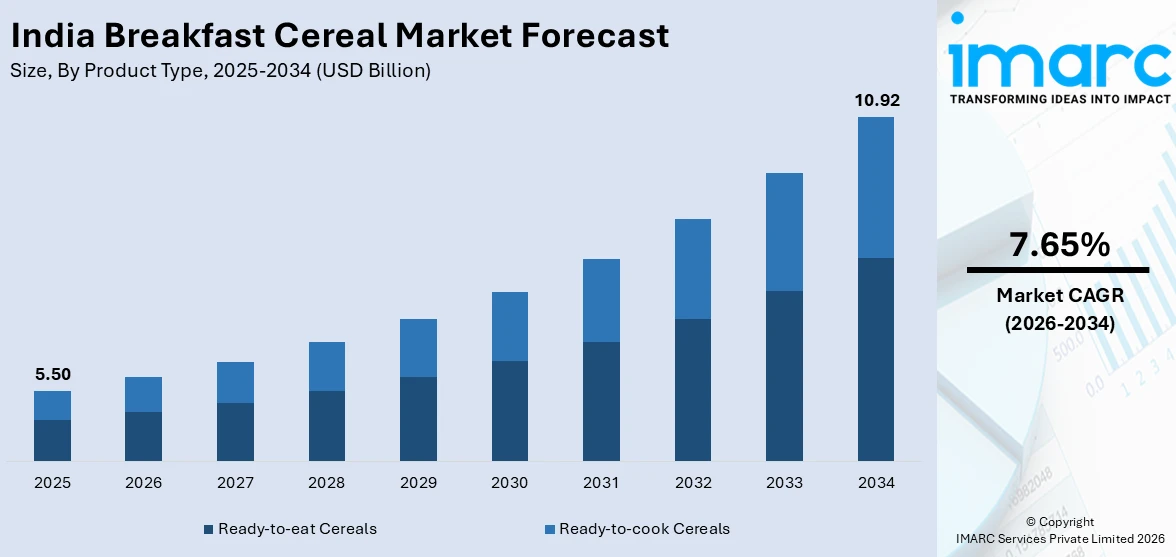
The India breakfast cereal market grew from USD 5.50 Billion in 2025 to USD 6.06 Billion in 2026 and is projected to reach USD 10.92 Billion by 2034, growing at a compound annual growth rate of 7.65% from 2026-2034.
The desire for quick and wholesome breakfast options is being driven by changing dietary tastes, increasing urbanization, and rising health consciousness, which is causing the breakfast cereal market in India to rise quickly. For dual-income metropolitan households looking for quick meal solutions, the shift from traditional Indian breakfasts to packaged, ready-to-eat options is especially noticeable. Consumers are able to purchase premium and fortified cereal goods that are enhanced with proteins, fibers, and vital micronutrients because to rising disposable incomes, especially among the growing middle class. Health-conscious food products are becoming more popular due to consumer segments' expanding purchasing power. Breakfast cereals are becoming more widely available in tier-two and metropolitan areas due to the growth of e-commerce and rapid commerce platforms. India's breakfast cereal market share is growing and customer engagement is being strengthened by product innovation that combines local grains with clean-label and organic formulations.
Key Takeaways and Insights:
- By Product Type: Ready-to-eat cereals dominate the market with a share of 74.5% in 2025, because of their unparalleled ease of use, variety of flavors, and fortification with vital vitamins and minerals that satisfy the changing dietary needs of Indian customers who are concerned about their health.
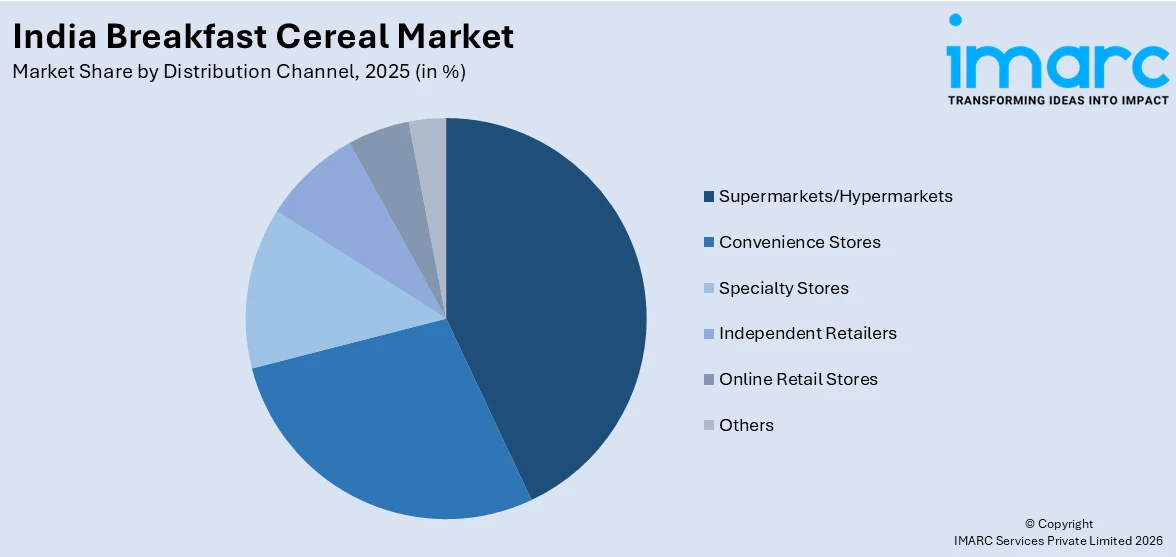
- By Distribution Channel: Supermarkets/hypermarkets lead the market with a share of 42.5% in 2025. Their wide range of products, well-organized retail spaces, special discounts, and strategic locations throughout major cities that make it simple for a wide range of customers to access them are what propel their leadership.
- By Region: West and Central India is the largest region with 29.8% share in 2025, driven by growing disposable incomes, robust retail infrastructure, the concentration of India's urban population in Mumbai and Pune metropolitan areas, and increased access to both domestic and foreign cereal brands.
- Key Players: The market for breakfast cereals in India is driven by major companies who increase product portfolios, enhance multigrain and nutritional formulations, and bolster national distribution. They increase awareness, hasten uptake, and guarantee consistent product availability across various consumer segments through their investments in marketing, affordability, and collaborations with health-focused platforms.
To get more information on this market Request Sample
India Breakfast Cereal Market Trends:
Rising Demand for Millet-Based and Multigrain Cereal Formulations
A wider trend toward nutrient-dense, locally derived ingredients is reflected in Indian customers' growing preference for morning cereals that include native grains like millets, jowar, and ragi. The combination of contemporary cereal formats with traditional Indian grains is increasing product diversity and drawing in health-conscious parents looking for nutritious breakfast options for their family. Existing products are being reformulated by manufacturers to incorporate multigrain blends that increase the amount of fiber and protein while removing refined flour. India's breakfast cereal business is expanding thanks to consumers' increased desire for locally inspired cereal varieties.
Expansion of Quick Commerce and Digital Distribution Channels
Indian consumers' breakfast cereal purchases are changing as a result of the quick commerce platforms' explosive growth. These platforms' lightning-fast delivery windows turn cereal purchases into impulsive purchases rather than scheduled shopping occasions. By allowing customers to order their favorite cereal brands from the comfort of their homes and receive deliveries in a matter of minutes, digital distribution channels are revolutionizing accessibility. This change is especially noticeable among Gen Z and urban millennials who value seamless shopping experiences. Consumer engagement and repeat business on digital platforms are being further improved by the incorporation of subscription models and personalized recommendations.
Growing Focus on Protein-Enriched and Functional Breakfast Cereals
In order to fill nutritional deficiencies and satisfy fitness-conscious consumers throughout India, manufacturers are progressively creating protein-rich and functional breakfast cereals. Product development tactics are changing throughout the competitive landscape due to the growing focus on functional ingredients, clean-label formulations, and fortification with important vitamins and minerals. To appeal to customers who see breakfast as a chance for proactive nutrition management, companies are launching variations that offer specific health benefits, such as enhanced immunity, digestive wellness, and prolonged energy release. The nation's established and up-and-coming cereal manufacturers are competing more fiercely and launching new products more quickly as a result of this wellness-driven innovation cycle.
Market Outlook 2026-2034:
The India breakfast cereal market is positioned for robust expansion, supported by deepening health awareness, accelerating urbanization, and continuous product innovation tailored to evolving consumer preferences. The market generated a revenue of USD 5.50 Billion in 2025 which is expected to reach USD 6.06 Billion in 2026 and further grow to USD 10.92 Billion by 2034, at a compound annual growth rate of 7.65% during 2026-2034. Increasing penetration of organized retail and quick commerce channels, coupled with government-supported nutrition initiatives and rising consumer preference for fortified and multigrain options, are expected to drive higher revenue streams and foster a more competitive, mature, and dynamic breakfast cereal landscape across the country.
India Breakfast Cereal Market Report Segmentation:
| Segment Category | Leading Segment | Market Share |
|---|---|---|
|
Product Type |
Ready-to-eat Cereals |
74.5% |
|
Distribution Channel |
Supermarkets/Hypermarkets |
42.5% |
|
Region |
West and Central India |
29.8% |
Product Type Insights:
- Ready-to-cook Cereals
- Ready-to-eat Cereals
Ready-to-eat cereals dominate with a market share of 74.5% of the total India breakfast cereal market in 2025.
Because of its unparalleled convenience, speedy preparation, and variety of flavor profiles, ready-to-eat cereals have become the go-to breakfast option in Indian households. The market benefits from urban customers' growing health consciousness and desire for nutrient-dense meals that don't require a lot of cooking. The demand for quick breakfast options has increased due to the rise in dual-income homes and fast-paced lives, especially among working professionals and school-age children. Consumer preference for ready-to-eat options over conventional breakfast options is being reinforced by the growth of fortified varieties that are enhanced with vitamins, minerals, and fiber.
In order to meet changing dietary tastes, producers are launching multigrain, millet-based, and protein-enriched formulations in the ready-to-eat market. Businesses are spending money on product development to produce nutrient-enhanced products that meet the rising demand from consumers for healthy, well-balanced breakfast options. In metropolitan and tier-two cities across the nation, aggressive marketing campaigns, appealing packaging designs, and increased availability through supermarkets, e-commerce platforms, and fast commerce channels are all working together to increase reach and speed uptake.
Distribution Channel Insights:
Access the comprehensive market breakdown Request Sample
- Convenience Stores
- Supermarkets/Hypermarkets
- Specialty Stores
- Independent Retailers
- Online Retail Stores
- Others
Supermarkets/hypermarkets lead with a share of 42.5% of the total India breakfast cereal market in 2025.
In India, supermarkets and hypermarkets are the main distribution channels for morning cereals because of their wide range of products, well-organized shelf displays, and advantageous placement throughout large cities. High foot traffic, regular promotions, and aggressive pricing tactics that promote large purchases and brand research are advantages of these contemporary retail establishments. For health-conscious customers looking for a variety of cereal options, the concentrated presence of organized shops in major cities like Mumbai, Delhi, Bangalore, and Chennai guarantees continuous accessibility.
Supermarkets and hypermarkets' capacity to provide in-store sampling, special morning aisle displays, and loyalty programs that increase customer interaction further solidifies their dominance. The government's approval of foreign direct investment in multi-brand retail has accelerated the steady growth of India's organized retail industry. In order to increase the potential consumer base for breakfast cereal producers and enable deeper market penetration outside of typical urban strongholds, retail chains are continuing to expand their footprints into tier-two and tier-three cities.
Regional Insights:
- North India
- West and Central India
- South India
- East and Northeast India
West and Central India holds the largest share at 29.8% of the total India breakfast cereal market in 2025.
With the economic powerhouse of Maharashtra and the major cities of Mumbai and Pune as its anchors, West and Central India has become the leading regional market for breakfast cereals. Higher disposable incomes, a well-established, contemporary retail infrastructure, and a diversified customer base that is open to packaged and convenient food items are all advantages for the area. Large manufacturing plants and distribution networks in the area guarantee effective supply chain management and increased product accessibility in urban and semi-urban areas.
The region's dominant position is being further reinforced by the swift growth of organized retail chains, quick commerce platforms, and e-commerce penetration throughout West and Central India. The base of Kellanova India's cereal production for the Indian market is its manufacturing facility in Taloja, Maharashtra. There is a persistent need for wholesome and practical morning cereal options due to growing urbanization in places like Ahmedabad, Surat, and Nagpur, as well as growing health consciousness and the younger population's adoption of western eating patterns.

Market Dynamics:
Growth Drivers:
Why is the India Breakfast Cereal Market Growing?
Increasing Health Consciousness and Demand for Nutritious Breakfast Alternatives
India is witnessing a fundamental shift in consumer dietary behavior as health awareness intensifies across urban and semi-urban populations. Rising incidences of lifestyle-related conditions such as diabetes and obesity are prompting consumers to seek healthier breakfast alternatives enriched with fiber, protein, and essential micronutrients. The growing influence of digital health platforms, fitness communities, and government nutrition campaigns is amplifying awareness about the benefits of fortified and whole-grain cereals. This trend is catalyzing manufacturers to invest in product innovation, developing variants that incorporate functional ingredients, reduced sugar content, and clean-label formulations. Consumers across different age groups are actively seeking breakfast options that deliver nutritional value alongside taste and convenience. The alignment between rising disposable incomes and growing health-focused consumption patterns is creating a sustained demand trajectory for nutritious breakfast cereals, positioning the category as a mainstream dietary choice rather than a niche product offering.
Rapid Urbanization and Evolving Lifestyle Patterns
India’s accelerating urbanization is reshaping breakfast consumption habits as nuclear families, working professionals, and students increasingly prioritize quick and convenient meal options. The expansion of metropolitan areas and the growth of tier-two and tier-three cities are creating new consumer segments with limited time for traditional meal preparation. Dual-income households, which represent a growing proportion of urban families, are driving demand for ready-to-eat breakfast products that offer nutrition without compromising on time efficiency. According to the Ministry of Statistics and Programme Implementation, India’s real GDP grew by 6.5% in fiscal year 2024-25, reflecting the underlying economic expansion fueling lifestyle changes. Furthermore, the structural transformation of Indian households toward smaller family units, coupled with increasing female workforce participation, is reinforcing the shift away from elaborate home-cooked breakfasts toward packaged alternatives. This evolving lifestyle dynamic is supported by improved retail access, greater product variety, and heightened marketing efforts by cereal manufacturers targeting convenience-seeking consumers. As urban populations continue to expand, the addressable market for breakfast cereals is expected to deepen across diverse demographic and geographic segments.
Expansion of Digital Commerce and Modern Retail Infrastructure
The proliferation of e-commerce platforms and quick commerce services is significantly enhancing the accessibility and visibility of breakfast cereals across India. Quick commerce platforms are converting cereal purchases into impulse buying occasions through ultra-fast delivery windows, fundamentally changing consumer purchasing behavior. Online retail channels are enabling manufacturers to reach consumers in geographies beyond the reach of traditional organized retail, while personalized recommendations and targeted digital marketing are driving trial and repeat purchases. Modern retail expansion is complementing the digital commerce surge, with supermarket chains and hypermarkets steadily extending their footprints into smaller cities and towns. The integration of offline and online retail strategies, supported by omnichannel distribution models, is creating seamless consumer experiences that facilitate brand discovery and product accessibility. This evolving distribution landscape is expected to remain a pivotal growth driver, enabling breakfast cereal manufacturers to penetrate underserved markets and capture incremental demand.
Market Restraints:
What Challenges the India Breakfast Cereal Market is Facing?
Strong Competition from Traditional Indian Breakfast Options
India’s deeply rooted culinary traditions present a significant challenge for breakfast cereal adoption, particularly in semi-urban and rural areas where home-cooked meals such as idli, dosa, paratha, and upma remain the preferred breakfast choices. Cultural attachment to freshly prepared, savory breakfasts limits the willingness of many consumers to substitute these with packaged cereal products. Regional dietary diversity across states further complicates market penetration strategies, requiring manufacturers to develop highly localized product offerings that compete with entrenched food habits.
Price Sensitivity among Indian Consumers
Branded breakfast cereals are often positioned as premium products with price points significantly higher than traditional breakfast alternatives, creating affordability barriers for a large segment of price-sensitive consumers. The cost disparity between packaged cereals and homemade breakfast options limits market expansion, particularly in lower-income households and rural regions. Inflationary pressures on raw material costs and packaging further constrain manufacturers’ ability to offer competitive pricing without compromising on product quality or margins.
Limited Penetration in Rural and Semi-Urban Markets
Despite significant growth in urban centers, breakfast cereals face limited awareness and availability in rural and semi-urban India, where traditional food preferences dominate and modern retail infrastructure remains underdeveloped. Distribution challenges, inadequate cold chain logistics, and lower consumer familiarity with packaged breakfast products restrict market penetration beyond metropolitan areas. Bridging this urban-rural divide requires substantial investments in last-mile distribution, consumer education, and affordable product variants tailored to rural consumption patterns.
Competitive Landscape:
The India breakfast cereal market is characterized by intensifying competition as both multinational corporations and domestic players vie for consumer attention through product innovation and distribution expansion. Companies are focusing on diversifying their product portfolios with multigrain, millet-based, protein-enriched, and clean-label formulations to capture evolving consumer preferences. Strategic investments in digital marketing, influencer partnerships, and quick commerce integrations are reshaping competitive dynamics. Players are strengthening their manufacturing capabilities, optimizing supply chains, and leveraging research and development to introduce differentiated offerings that address nutritional gaps while delivering appealing taste profiles, thereby fostering sustained market growth.
India Breakfast Cereal Market Report Coverage:
| Report Features | Details |
|---|---|
| Base Year of the Analysis | 2025 |
| Historical Period | 2020-2025 |
| Forecast Period | 2026-2034 |
| Units | Billion USD |
| Scope of the Report | Exploration of Historical Trends and Market Outlook, Industry Catalysts and Challenges, Segment-Wise Historical and Future Market Assessment:
|
| Product Types Covered | Ready-to-cook Cereals, Ready-to-eat Cereals |
| Distribution Channels Covered | Convenience Stores, Supermarkets/Hypermarkets, Specialty Stores, Independent Retailers, Online Retail Stores, Others |
| Regions Covered | North India, West and Central India, South India, East and Northeast India |
| Customization Scope | 10% Free Customization |
| Post-Sale Analyst Support | 10-12 Weeks |
| Delivery Format | PDF and Excel through Email (We can also provide the editable version of the report in PPT/Word format on special request) |
Frequently Asked Questions About the India Breakfast Cereal Market Report
The India breakfast cereal market size increased from USD 5.50 Billion in 2025 to USD 6.06 Billion in 2026.
The India breakfast cereal market is expected to grow at a compound annual growth rate of 7.65% from 2026-2034 to reach USD 10.92 Billion by 2034.
Ready-to-eat cereals, holding the largest revenue share of 74.5%, dominate the India breakfast cereal market owing to their convenience, diverse flavor offerings, fortification with essential nutrients, and strong alignment with the fast-paced lifestyles of urban consumers.
Key factors driving the India breakfast cereal market include rising health consciousness, rapid urbanization, expanding digital commerce and quick commerce platforms, growing disposable incomes, increasing demand for fortified and multigrain products, and evolving consumer lifestyles.
Major challenges include strong competition from traditional Indian breakfast options, price sensitivity among consumers, limited penetration in rural and semi-urban markets, fluctuating raw material costs, and low consumer awareness about packaged breakfast cereals beyond metropolitan areas.
Need more help?
- Speak to our experienced analysts for insights on the current market scenarios.
- Include additional segments and countries to customize the report as per your requirement.
- Gain an unparalleled competitive advantage in your domain by understanding how to utilize the report and positively impacting your operations and revenue.
- For further assistance, please connect with our analysts.
 Request Customization
 Speak to an Analyst
 Request Brochure
 Inquire Before Buying
Benefits of Customization
- Personalize this research
- Triangulate with your data
- Get data as per your format and definition
- Gain a deeper dive into a specific application, geography, customer, or competitor
- Any level of personalization
Get in Touch With Us
UNITED STATES
Phone: +1-201-971-6302
INDIA
Phone: +91-120-433-0800
UNITED KINGDOM
Phone: +44-753-714-6104
Email: [email protected]
Client Testimonials




.webp)




.webp)













Related Reports

Choose your plan
*Please note that the prices mentioned below are starting prices for each bundle type. Kindly contact our team for further details.*
Single User License
- 1 User License, Access on 2 Devices
- PDF Report + Excel Dataset (Password Protected)
- Lifetime Access
- No Printing Rights
- 10% Free Report Customization
- 10–12 Weeks of Analyst Support
Five User License
- Access for 5 Users, 2 Devices per User
- PDF Report + Excel Dataset (Password Protected)
- Lifetime Access
- Dedicated Account Manager
- 12–14 Weeks of Analyst Support
- No Printing Rights
- 15% Free Report Customization
- 25% Discount on Your Next Purchase
Corporate User License
- Unlimited User Access (Within Your Organization)
- PDF Report + Excel Dataset
- Lifetime Access
- Dedicated Account Manager
- 14–20 Weeks of Analyst Support
- No Printing Rights
- 20% Free Report Customization
- 30% Discount on Your Next Purchase
Essential Insights
What's included:
3 reports
- Lifetime Access
- PDF Reports
- Excel Datasets
- 2 Weeks of Free Analyst Support
- 2 User Licenses
- Access on 2 Devices
- Printing Rights
- Complimentary PowerPoint (PPT) Version
- Complimentary License Upgrade
Professional Access
What's included:
5 reports
- Lifetime Access
- PDF Reports
- Excel Datasets
- 8 Weeks of Free Analyst Support
- 2 User Licenses
- Access on 2 Devices
- Printing Rights
- Complimentary PowerPoint (PPT) Version
- Complimentary License Upgrade
Business Advantage
What's included:
8 reports
- Lifetime Access
- PDF Reports
- Excel Datasets
- 14 Weeks of Free Analyst Support
- 2 User Licenses
- Access on 2 Devices
- Printing Rights
- Complimentary PowerPoint (PPT) Version
- Complimentary License Upgrade
Enterprise Intelligence
What's included:
10 reports
- Lifetime Access
- PDF Reports
- Excel Datasets
- 20 Weeks of Free Analyst Support
- 2 User Licenses
- Access on 2 Devices
- Printing Rights
- Complimentary PowerPoint (PPT) Version
- Complimentary License Upgrade