
India Butter Market Size, Share, Trends and Forecast by Type, End Use, and Region, 2026-2034
India Butter Market Summary:
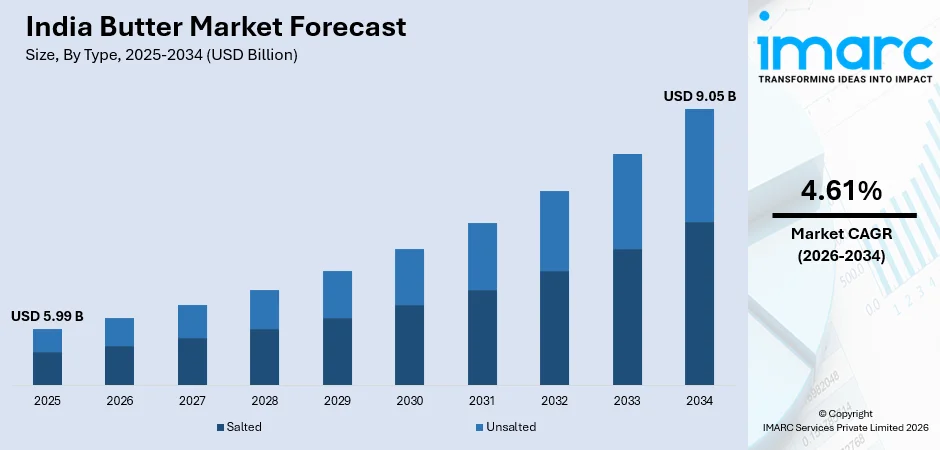
The India butter market size was valued at USD 5.99 Billion in 2025 and is projected to reach USD 9.05 Billion by 2034, growing at a compound annual growth rate of 4.61% from 2026-2034.
The market is experiencing sustained growth, driven by evolving dietary preferences, rising urban developments, and the growing influence of western food culture across the country. Increasing household consumption, expanding bakery and foodservice sectors, and the rising popularity of packaged and branded butter products are driving the demand. Improvements in cold chain logistics, developing organized retail networks, and growing consumer interest in premium, flavored, and organic butter variants are further reshaping the market landscape and expanding the India butter market share.
Key Takeaways and Insights:
- By Type: Salted dominates the market with a share of 62.7% in 2025, driven by its widespread household use, extended shelf life, and strong presence across retail and foodservice channels.
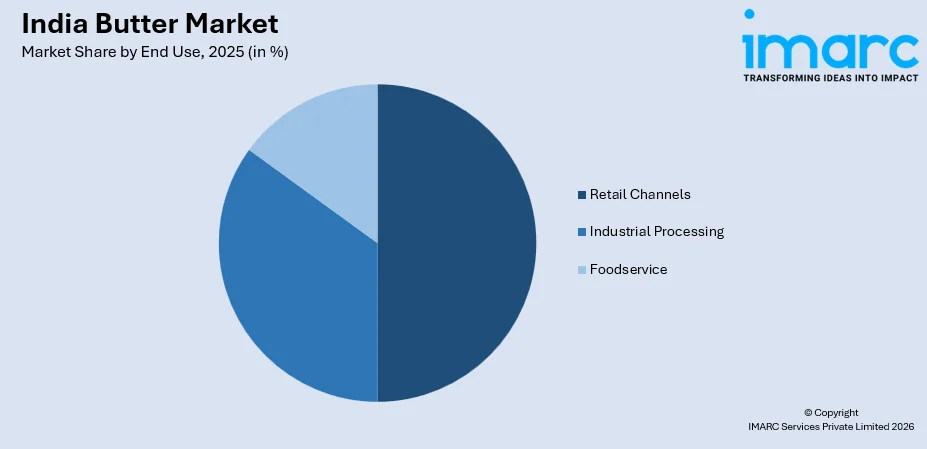
- By End Use: Retail channels lead the market with a share of 46.3% in 2025, supported by the rapid expansion of supermarkets, hypermarkets, and online grocery platforms enhancing product accessibility.
- By Region: North India holds the largest share at 38.9% in 2025, attributed to the region’s strong dairy farming traditions, high per capita milk availability, and significant butter consumption patterns.
- Key Players: The India butter market features a competitive mix of large dairy cooperatives, national brands, and regional manufacturers, all leveraging extensive distribution networks, product innovation, and strong brand recognition to capture market share.
To get more information on this market Request Sample
The India butter market is moving ahead as consumers in urban and semi-urban regions are increasingly adopting butter in their daily cooking, breakfast, and baking activities. Being the largest producer of milk in the world, accounting for 25% of global production with 239.2 million tonnes in 2023-24, provides a strong base for butter production in the country. The dairy sector in India is the largest agricultural product, accounting for 5 percent of the country’s economy, providing direct employment to over 8 crore farmers. India's importance in the dairy sector is both domestic and global, as it ranks first in milk production, accounting for 25 percent of the world’s milk production. The growing organized retailing, increasing per capita income, and increasing acceptance of Western cuisine are fueling the adoption of butter. The government’s efforts in supporting the development of dairy infrastructure and cooperative societies are further strengthening market fundamentals and ensuring the availability of the product in the market.
India Butter Market Trends:
Rising Demand for Premium and Flavored Butter Variants
The butter market in India is experiencing an increasing demand for special, artisan, and flavored butters, apart from the conventional salted and unsalted ones. Flavors like garlic and herb, peri-peri, and chocolate are gaining popularity in the retail stores of the urban sector. The organic food market in India is growing at a fast pace, with organic butter contributing largely to the demand for special dairy products in the urban sector of India. According to the forecasts by the IMARC Group, the table butter market in India has reached INR 90.35 Billion in 2024.
Expansion of E-Commerce and Modern Retail Channels
Butter availability is being largely aided by online butter shopping platforms and organized retailing. The rise in quick commerce delivery services, dedicated dairy sections in hypermarkets, and delivery services are increasing the sale of packaged butter. In addition to this, it is estimated by the government that more than 40% of the Indian population will be living in urban areas by 2030, thereby increasing the demand for branded and conveniently available dairy products such as butter.
Growing Adoption of Butter in Bakery and Foodservice Applications
The growing bakery and foodservice sector is propelling substantial institutional demand for butter in India. The Indian bakery industry, estimated at USD 15.05 Billion in 2024 and projected to expand at an 8.76% CAGR from 2033, is largely dependent on butter as a primary ingredient for bread, pastries, cakes, and confectionery products. In addition to this, the QSR, café, and hotel sectors are increasingly adopting butter-based dishes, thus fueling steady institutional consumption growth.
Market Outlook 2026-2034:
India’s butter market is positioned for steady advancement, underpinned by expanding dairy infrastructure, rising consumer awareness, and growing demand from bakery, foodservice, and household segments. The market generated a revenue of USD 5.99 Billion in 2025 and is projected to reach a revenue of USD 9.05 Billion by 2034, growing at a compound annual growth rate of 4.61% from 2026-2034. Increasing premiumization, product diversification, and the rapid expansion of organized retail and e-commerce channels are expected to unlock new revenue opportunities. Government-backed dairy development programs and strengthened cold chain networks will further reinforce supply-side capabilities, fostering a more competitive and mature butter market landscape across India.
India Butter Market Report Segmentation:
|
Segment Category |
Leading Segment |
Market Share |
|
Type |
Salted |
62.7% |
|
End Use |
Retail Channels |
46.3% |
|
Region |
North India |
38.9% |
Type Insights:
- Salted
- Unsalted
Salted with a market share of 62.7% of the total India butter market in 2025.
Salted butter remains the preferred choice among Indian consumers owing to its versatile culinary applications, enhanced flavor profile, and naturally extended shelf life compared to unsalted alternatives. The segment benefits from deep-rooted dietary habits, with salted butter being widely used as a bread spread, cooking ingredient, and accompaniment in traditional Indian preparations such as parathas, rotis, and dal. Its consistent taste and ease of storage make it a household staple across both urban and rural regions.
The widespread availability of salted butter across modern retail outlets, neighborhood stores, and online grocery platforms further reinforces its market leadership. Growing demand from bakeries, restaurants, and quick-service establishments, where salted butter serves as a key flavoring and cooking agent, continues to support volume-driven growth. The segment’s dominance is also strengthened by affordable pricing strategies, diverse packaging options, and strong consumer trust in established dairy brands that offer reliable quality and taste.
End Use Insights:
Access the comprehensive market breakdown Request Sample
- Industrial Processing
- Retail Channels
- Foodservice
Retail channels lead with a share of 46.3% of the total India butter market in 2025.
Retail channels maintain their position as the primary distribution avenue for butter in India, driven by the rapid expansion of supermarkets, hypermarkets, convenience stores, and organized retail chains across metropolitan and tier-two cities. The growing penetration of branded and packaged butter products in modern trade outlets has enhanced product visibility and consumer accessibility. Online grocery platforms and quick-commerce services have further amplified retail sales by offering doorstep delivery, promotional offers, and a diverse selection of butter variants.
Consumer preference for convenient, ready-to-use dairy products is fueling sustained retail demand, particularly among urban households and young professionals. The shift toward branded over unbranded butter, supported by increasing health consciousness and quality awareness, is strengthening organized retail’s share. Private label butter offerings by major retail chains and the introduction of premium, organic, and flavored butter options in retail spaces are attracting a broader consumer base and driving higher-value purchases across the segment.
Regional Insights:
- North India
- South India
- East India
- West India
North India exhibits a clear dominance with a 38.9% share of the total India butter market in 2025.
North India’s dominance in the butter market is underpinned by the region’s deep-rooted dairy farming traditions, high per capita milk availability, and culturally ingrained butter consumption habits. States such as Punjab, Haryana, Uttar Pradesh, and Rajasthan are among India’s leading milk-producing regions, ensuring abundant raw material supply for butter manufacturing. The region’s dietary culture, which prominently features butter in daily meals, snacks, and traditional recipes like makhan with parathas, sustains strong household demand throughout the year.
The presence of well-established dairy cooperative networks and extensive cold chain infrastructure in North India facilitates efficient procurement, processing, and distribution of butter products. Additionally, the concentration of major metropolitan areas including Delhi-NCR, with their large urban populations, rising disposable incomes, and flourishing foodservice and bakery sectors, amplifies institutional and retail butter demand. Government support for dairy development in the northern states further strengthens the supply ecosystem and reinforces the region’s market leadership.
Market Dynamics:
Growth Drivers:
Why is the India Butter Market Growing?
Rising Urbanization and Evolving Dietary Preferences
India’s accelerating urbanization is fundamentally reshaping food consumption patterns, with a growing number of households adopting western-influenced dietary habits that prominently feature butter. The typical personal monthly earnings in Tier 2 and Tier 3 cities are currently Rs 32,000, close to the metro average of Rs 35,000. As rural populations migrate to cities and towns in search of economic opportunities, exposure to diverse cuisines and modern food formats increases, driving greater butter incorporation into everyday meals. The shift from traditional cooking fats toward branded, packaged butter products reflects broader lifestyle changes, including smaller family units, dual-income households, and busier schedules that prioritize convenience and taste. This urban dietary transformation is steadily expanding the consumer base for butter products across metropolitan, tier-two, and emerging tier-three cities throughout the country.
Expanding Bakery, Confectionery, and Foodservice Sectors
The rapid growth of India’s bakery, confectionery, and foodservice industries is creating robust institutional demand for butter as a critical ingredient in food preparation and flavor enhancement. The proliferation of cafés, patisseries, quick-service restaurants, and artisanal bakeries across urban centers is driving bulk butter procurement for breads, cakes, pastries, cookies, and savory preparations. The increasing popularity of western-style breakfast culture, home baking trends, and gourmet dining experiences is amplifying butter usage across both commercial kitchens and household settings. This expanding downstream demand provides a sustained growth catalyst for butter manufacturers and suppliers operating within the Indian market.
Government Support for Dairy Infrastructure and Cooperative Strengthening
India’s dairy sector benefits from comprehensive government support aimed at enhancing milk production, improving processing capabilities, and strengthening cooperative networks across the country. National programs focused on dairy development, bovine health improvement, and cold chain infrastructure modernization are creating a more efficient and reliable supply chain for dairy products including butter. The dairy industry’s achievements are fueled by efforts like the Rashtriya Gokul Mission and the Livestock Health and Disease Control Programme (LHDCP), which target better breeding, superior genetic quality, and the advancement of animal health. Moreover, combining Ethnoveterinary Medicine (EVM) with Ayurveda provides sustainable, affordable substitutes for antibiotics, thus improving the overall health and resilience of animals. Initiatives promoting artificial insemination, veterinary healthcare access, and farmer training programs are boosting milk yields and quality, while investments in automated processing facilities and integrated cold storage networks are reducing post-harvest losses. This supportive policy environment strengthens the overall ecosystem, ensuring consistent raw material availability and facilitating broader market penetration for butter products.
Market Restraints:
What Challenges the India Butter Market is Facing?
Growing Competition from Margarine and Plant-Based Alternatives
The butter market faces increasing competition from margarine, vegetable oil-based spreads, and emerging plant-based alternatives that appeal to health-conscious and cost-sensitive consumers. Rising awareness of cholesterol and saturated fat content in butter is prompting some consumer segments, particularly younger urban demographics, to explore dairy-free substitutes. The expanding availability of these alternatives in organized retail channels and their competitive pricing pose a notable challenge to sustaining butter’s market share among health-oriented consumers.
Volatility in Raw Milk Procurement Prices
Fluctuations in raw milk prices, driven by seasonal variations in milk availability, fodder costs, and climatic disruptions, pose challenges for butter manufacturers in maintaining stable production costs and consumer pricing. This price volatility can compress margins for processors and result in periodic retail price increases that may temporarily dampen consumer demand. Smaller and regional butter manufacturers are particularly vulnerable to these supply-side cost pressures, which can affect overall market stability and competitiveness.
Inadequate Cold Chain Infrastructure in Rural and Semi-Urban Areas
Despite significant improvements in urban cold chain networks, many rural and semi-urban regions continue to face inadequate refrigerated storage and transportation facilities. This infrastructure gap limits the distribution of perishable dairy products like butter to remote areas, restricts market penetration, and contributes to product wastage. The high capital requirements for establishing cold chain infrastructure and inconsistent power supply in certain regions further compound these logistical challenges, constraining the market’s full geographic potential.
Competitive Landscape:
The India butter market is characterized by the strong presence of large dairy cooperatives and established national brands that collectively command significant market influence through extensive procurement networks, diversified product portfolios, and deep distribution reach. These market leaders benefit from decades of brand recognition, consumer trust, and economies of scale in milk procurement and butter processing. The competitive landscape also includes a substantial number of regional dairy brands and private manufacturers that cater to local taste preferences and price segments, creating a dynamic multi-tier market structure. Competition is intensifying as players invest in product innovation, including flavored, organic, and premium butter variants, to capture evolving consumer preferences. The expansion of organized retail and e-commerce platforms is reshaping distribution dynamics, enabling smaller brands to reach wider audiences while prompting established players to strengthen their digital and direct-to-consumer capabilities. Strategic focus on packaging innovation, sustainability initiatives, and value-added offerings continues to define competitive differentiation across the market.
India Butter Market Report Coverage:
|
Report Features |
Details |
|
Base Year of the Analysis |
2025 |
|
Historical Period |
2020-2025 |
|
Forecast Period |
2026-2034 |
|
Units |
Billion USD |
|
Scope of the Report |
Exploration of Historical Trends and Market Outlook, Industry Catalysts and Challenges, Segment-Wise Historical and Future Market Assessment:
|
|
Types Covered |
Salted, Unsalted |
|
End Uses Covered |
Industrial Processing, Retail Channels, Foodservice |
|
Regions Covered |
North India, South India, East India, West India |
|
Customization Scope |
10% Free Customization |
|
Post-Sale Analyst Support |
10-12 Weeks |
|
Delivery Format |
PDF and Excel through Email (We can also provide the editable version of the report in PPT/Word format on special request) |
Frequently Asked Questions About the India Butter Market Report
The India butter market size was valued at USD 5.99 Billion in 2025.
The India butter market is expected to grow at a compound annual growth rate of 4.61% from 2026-2034 to reach USD 9.05 Billion by 2034.
Salted, holding the largest revenue share of 62.7% in 2025, leads the India butter market owing to its widespread household use, versatile culinary applications, and extended shelf life that makes it a preferred choice across retail and foodservice channels.
Key factors driving the India butter market include rising urbanization and changing dietary habits, expanding bakery and foodservice sectors, growing demand for premium and branded butter products, and government support for dairy infrastructure development.
Major challenges include growing competition from margarine and plant-based alternatives, raw milk price volatility affecting production costs, cold chain infrastructure gaps in rural areas, and shifting consumer preferences toward low-fat dairy options.
Need more help?
- Speak to our experienced analysts for insights on the current market scenarios.
- Include additional segments and countries to customize the report as per your requirement.
- Gain an unparalleled competitive advantage in your domain by understanding how to utilize the report and positively impacting your operations and revenue.
- For further assistance, please connect with our analysts.
 Request Customization
 Speak to an Analyst
 Request Brochure
 Inquire Before Buying
Benefits of Customization
- Personalize this research
- Triangulate with your data
- Get data as per your format and definition
- Gain a deeper dive into a specific application, geography, customer, or competitor
- Any level of personalization
Get in Touch With Us
UNITED STATES
Phone: +1-201-971-6302
INDIA
Phone: +91-120-433-0800
UNITED KINGDOM
Phone: +44-753-714-6104
Email: [email protected]
Client Testimonials




.webp)




.webp)













Related Reports

Choose your plan
*Please note that the prices mentioned below are starting prices for each bundle type. Kindly contact our team for further details.*
Single User License
- 1 User License, Access on 2 Devices
- PDF Report + Excel Dataset (Password Protected)
- Lifetime Access
- No Printing Rights
- 10% Free Report Customization
- 10–12 Weeks of Analyst Support
Five User License
- Access for 5 Users, 2 Devices per User
- PDF Report + Excel Dataset (Password Protected)
- Lifetime Access
- Dedicated Account Manager
- 12–14 Weeks of Analyst Support
- No Printing Rights
- 15% Free Report Customization
- 25% Discount on Your Next Purchase
Corporate User License
- Unlimited User Access (Within Your Organization)
- PDF Report + Excel Dataset
- Lifetime Access
- Dedicated Account Manager
- 14–20 Weeks of Analyst Support
- No Printing Rights
- 20% Free Report Customization
- 30% Discount on Your Next Purchase
Essential Insights
What's included:
3 reports
- Lifetime Access
- PDF Reports
- Excel Datasets
- 2 Weeks of Free Analyst Support
- 2 User Licenses
- Access on 2 Devices
- Printing Rights
- Complimentary PowerPoint (PPT) Version
- Complimentary License Upgrade
Professional Access
What's included:
5 reports
- Lifetime Access
- PDF Reports
- Excel Datasets
- 8 Weeks of Free Analyst Support
- 2 User Licenses
- Access on 2 Devices
- Printing Rights
- Complimentary PowerPoint (PPT) Version
- Complimentary License Upgrade
Business Advantage
What's included:
8 reports
- Lifetime Access
- PDF Reports
- Excel Datasets
- 14 Weeks of Free Analyst Support
- 2 User Licenses
- Access on 2 Devices
- Printing Rights
- Complimentary PowerPoint (PPT) Version
- Complimentary License Upgrade
Enterprise Intelligence
What's included:
10 reports
- Lifetime Access
- PDF Reports
- Excel Datasets
- 20 Weeks of Free Analyst Support
- 2 User Licenses
- Access on 2 Devices
- Printing Rights
- Complimentary PowerPoint (PPT) Version
- Complimentary License Upgrade