
India Calcium Nitrate Market Size, Share, Trends and Forecast by Form, Application, and Region, 2026-2034
India Calcium Nitrate Market Summary:
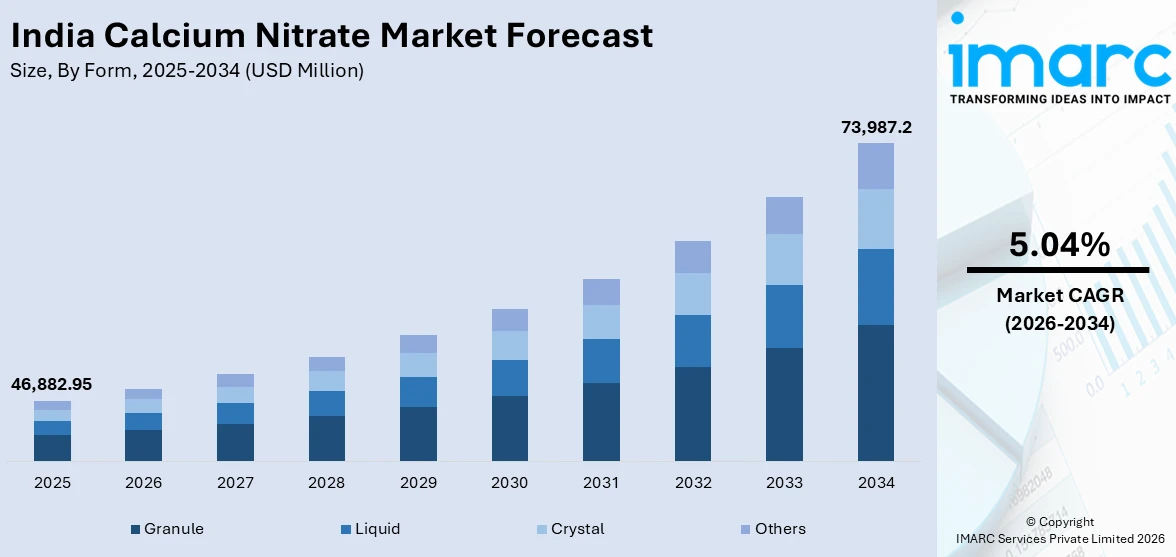
The India calcium nitrate market size was valued at USD 46,882.95 Million in 2025 and is projected to reach USD 73,987.2 Million by 2034, growing at a compound annual growth rate of 5.04% from 2026-2034.
The India calcium nitrate market is registering significant growth as the country is increasing its efforts towards agricultural modernization and food security. The increasing use of water-soluble fertilizers, the growth of horticulture and greenhouse farming, and the rising focus on precise nutrient application are fueling the demand. At the same time, the development of infrastructure in both urban and rural routes, along with the rising investments in wastewater treatment plants, is opening new avenues for use beyond agriculture, thereby increasing the India calcium nitrate market share.
Key Takeaways and Insights:
- By Form: Granule dominates the market with a share of 38.9% in 2025, driven by its ease of handling, controlled nutrient release, and widespread suitability across diverse soil and fertigation applications in Indian agriculture.
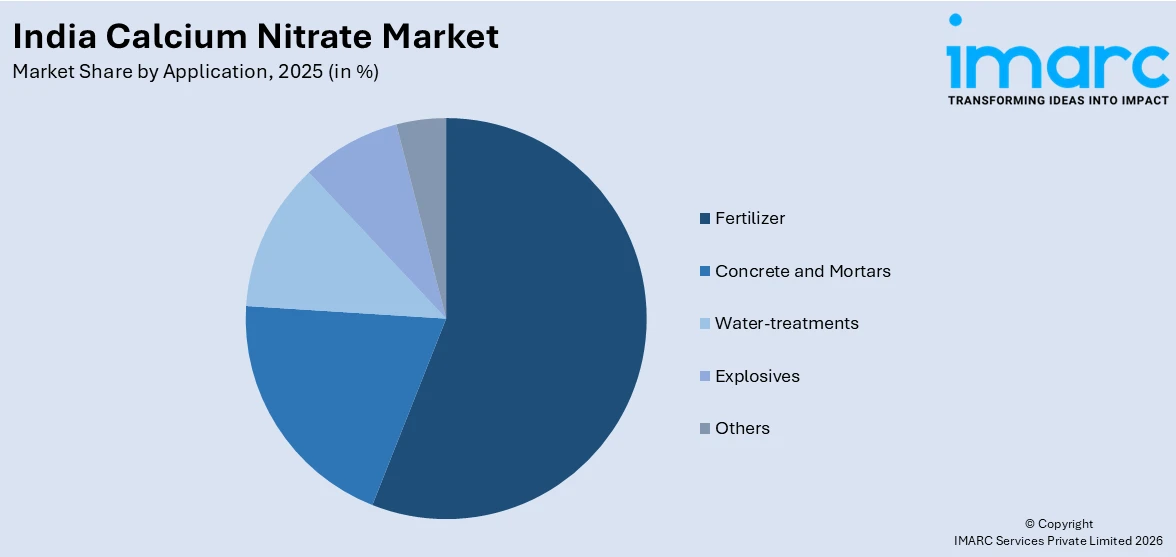
- By Application: Fertilizer leads the market with a share of 56.4% in 2025, owing to the growing demand for calcium and nitrogen-enriched water-soluble fertilizers supporting horticulture, floriculture, and precision crop nutrition programs.
- By Region: North India holds the largest share at 33.8% in 2025, underpinned by the concentration of major agricultural states, extensive horticultural activities, and strong government-backed fertilizer distribution networks.
- Key Players: The India calcium nitrate market features a moderately competitive landscape, with a mix of domestic fertilizer manufacturers and international specialty chemical companies competing through product innovation, distribution expansion, and strategic pricing strategies.
To get more information on this market Request Sample
The India calcium nitrate market is being driven by the growing focus on agricultural intensification, infrastructure development, and environmental sustainability. With the Indian agricultural sector shifting towards high efficiency and crop-specific nutrient management practices, calcium nitrate has become an essential nutrient for providing dual calcium and nitrogen nutrition in water-soluble and granular forms. The chemical has widespread use in horticultural, floricultural, and greenhouse farming practices, where its fast-acting solubility properties help promote improved crop quality and yield. In May 2023, Deepak Fertilisers and Petrochemicals Corporation Limited commissioned a new ammonia production facility at Taloja, Maharashtra, aimed at strengthening domestic fertilizer raw material supply and reducing dependence on imported ammonia, thereby supporting India’s fertilizer manufacturing ecosystem. Apart from agricultural use, the increasing construction activity in the country requires the use of calcium nitrate as a concrete setting accelerator, while the rising wastewater treatment infrastructure takes advantage of its odor-suppression properties. Government support for protected cultivation, micro-irrigation, and sustainable farming practices also supports demand. Furthermore, initiatives to develop indigenous production capacities are expected to make the industry less dependent on imports, opening up new avenues for growth.
India Calcium Nitrate Market Trends:
Accelerating Adoption of Precision Fertigation in Indian Agriculture
The Indian farming community is slowly adopting precision fertigation technology, which allows the application of nutrients directly through irrigation channels, thereby boosting the demand for water-soluble nutrients. According to the Government of India’s Pradhan Mantri Krishi Sinchayee Yojana (PMKSY), over 75 lakh hectares have been brought under micro-irrigation since 2016, reflecting strong national efforts to expand drip and sprinkler systems that support efficient fertilizer application through fertigation. Calcium nitrate is in high demand in drip and sprinkler-based fertigation systems due to its high solubility and ability to provide two nutrients at once. The development of micro-irrigation infrastructure in horticultural areas and the need for efficient farming practices are thus fueling this demand, thereby boosting the India calcium nitrate market.
Rising Prominence of Protected Cultivation and Greenhouse Farming
The expansion of polyhouse, shadenet, and greenhouse cultivation across Indian states is creating sustained demand for specialty fertilizers including calcium nitrate. In June 2025, the Uttar Pradesh government announced subsidies of up to 50% for polyhouse and greenhouse construction across 44 districts under the Integrated Horticulture Development Mission, with dozens of greenhouse facilities already completed and more under development to promote protected cultivation and high-value crop production. Protected cultivation environments require precise nutrient management to optimize crop quality and yields for high-value vegetables, flowers, and exotic produce. As government schemes continue to incentivize the establishment of controlled-environment agricultural infrastructure, calcium nitrate consumption within this segment is expected to accelerate significantly.
Growing Industrial Applications Beyond Traditional Agriculture
Calcium nitrate is gaining traction in non-agricultural applications across India, particularly in construction and wastewater management. In March 2025, VA Tech WABAG secured a ₹340 crore contract from GAIL (India) Limited to design and build advanced wastewater treatment and effluent recycling facilities at its petrochemical complex in Uttar Pradesh, highlighting growing industrial investments in wastewater infrastructure and treatment technologies. Its role as a chloride-free concrete setting accelerator aligns with rising infrastructure quality standards, while its effectiveness in suppressing hydrogen sulfide odors positions it favorably within expanding municipal wastewater treatment networks. This diversification of end-use applications is broadening the market base and reducing seasonal dependency on agricultural cycles.
Market Outlook 2026-2034:
The India calcium nitrate market is poised for sustained expansion over the forecast period, driven by the continued modernization of agricultural practices, the scaling up of protected cultivation infrastructure, and the broadening of industrial applications. Government policies supporting water-soluble fertilizer adoption, micro-irrigation expansion, and domestic manufacturing capabilities are expected to create a supportive regulatory environment. Simultaneously, increasing urbanization and infrastructure development will stimulate demand from the construction and wastewater treatment sectors. The market generated a revenue of USD 46,882.95 Million in 2025 and is projected to reach a revenue of USD 73,987.2 Million by 2034, growing at a compound annual growth rate of 5.04% from 2026-2034.
India Calcium Nitrate Market Report Segmentation:
|
Segment Category |
Leading Segment |
Market Share |
|
Form |
Granule |
38.9% |
|
Application |
Fertilizer |
56.4% |
|
Region |
North India |
33.8% |
Form Insights:
- Liquid
- Crystal
- Granule
- Others
The granule dominates with a market share of 38.9% of the total India calcium nitrate market in 2025.
Granular calcium nitrate is most favored among Indian farmers because of its greater handling convenience, longer storage life, and easy compatibility with existing broadcasting and mixing machinery. The granular form of the product makes it easier to distribute nutrients evenly over a large area of the field, along with easy integration with existing fertilizer application machinery. The granular form also has a controlled rate of dissolution, which helps to maintain the availability of nutrients in the root zone for a longer period of time, thereby reducing leaching losses and improving the efficiency of calcium and nitrogen uptake in the diverse soil types of the Indian farming regions.
The growing acceptance of granular calcium nitrate is also supported by its ease of use in both field crop and orchard applications, where farmers require the product to perform well under varying soil moisture conditions. The dust-free nature and reduced hygroscopicity of the granular form of the product make it more convenient to handle and store for a longer period of time, which is particularly beneficial in the humid subtropical climate of India, where higher atmospheric moisture can accelerate caking and reduce the quality of conventional fertilizer products.
Application Insights:
Access the comprehensive market breakdown Request Sample
- Fertilizer
- Concrete and Mortars
- Water-treatments
- Explosives
- Others
The fertilizer leads with a share of 56.4% of the total India calcium nitrate market in 2025.
Calcium nitrate is an important water-soluble fertilizer that simultaneously meets the calcium and nitrogen requirements of plants, which is essential for optimal plant growth and improvement in crop quality. The dominance of the fertilizer category is supported by the growing adoption of precision nutrient management techniques in Indian horticultural, floricultural, and greenhouse crop production systems. Calcium nitrate is an effective solution to the calcium deficiency problem in Indian soils, which is a common problem in the acidic and laterite soil areas of the country, and its nitrate nitrogen form ensures quick plant uptake and no soil acidification.
The growing need for high-quality crop production, such as fruits, vegetables, and flowers, has further increased the demand for calcium nitrate-based fertilizer programs. Its property of preventing physiological disorders like blossom end rot in tomatoes and tip burn in lettuce makes it an essential component in quality-oriented crop production systems. The shift towards fertigation and foliar application technologies in the irrigated agricultural areas further supports the use of calcium nitrate as a special fertilizer input.
Regional Insights:
- North India
- South India
- East India
- West India
North India exhibits a clear dominance with a 33.8% share of the total India calcium nitrate market in 2025.
The dominance of North India in the calcium nitrate market is fueled by the region's strong agricultural infrastructure, large-scale horticultural production, and established fertilizer distribution channels. The major states in North India are major contributors to the country's vegetable and fruit production, thereby creating a constant market demand for specialized fertilizers that enhance the quality and marketable yield of produce. The widespread use of micro-irrigation systems and the gradual adoption of modern agricultural practices in the advanced farming clusters of the region further boost the consumption of calcium nitrate in the region.
In addition, North India has strong government-backed agricultural programs that promote well-balanced fertilization practices and the use of water-soluble fertilizers. The region's proximity to the country's major manufacturing plants and distribution centers further facilitates the smooth operation of supply chain management, thereby ensuring the timely availability of products in line with the region's agricultural cycles. The region's high concentration of floriculture production, growing greenhouse production clusters, and commercial vegetable production areas further cements North India's established lead as the country's major consumption hub for calcium nitrate products.
Market Dynamics:
Growth Drivers:
Why is the India Calcium Nitrate Market Growing?
Expanding Horticulture Sector and High-Value Crop Cultivation
India's horticulture sector is experiencing significant expansion as farmers increasingly shift toward high-value crop cultivation to maximize returns per unit area. Fruits, vegetables, flowers, and medicinal plants require precise nutrient management programs that address both macro and micronutrient requirements throughout growth stages. According to data released by the Ministry of Agriculture & Farmers Welfare and reported by The Economic Times, India’s horticulture production increased to 369.05 million tonnes in the 2024–25 crop year, driven by higher output of fruits and vegetables and expansion in cultivation area. Calcium nitrate is uniquely positioned to meet these demands by providing readily available calcium and nitrogen simultaneously, preventing nutritional deficiencies that compromise crop quality, shelf life, and market value. The growing consumer preference for premium-quality produce with superior appearance, taste, and nutritional content is compelling growers to adopt specialized fertilization strategies. Protected cultivation facilities, including polyhouses and greenhouses, rely heavily on calcium nitrate for achieving consistent crop outcomes year-round, further reinforcing its essential role in India's evolving agricultural ecosystem.
Government Support for Micro-Irrigation and Precision Agriculture
The Indian government's sustained investments in micro-irrigation infrastructure and precision agriculture technologies are creating favorable conditions for calcium nitrate market expansion. In April 2025, the Union Cabinet approved a ₹1,600 crore sub-scheme under the Pradhan Mantri Krishi Sinchayee Yojana (PMKSY) to modernize irrigation networks and deliver water directly to farm gates through underground pressurized piped systems, benefiting around 80,000 farmers and strengthening micro-irrigation infrastructure nationwide. Policy frameworks promoting drip and sprinkler irrigation systems across agricultural zones are facilitating the adoption of water-soluble fertilizers that can be delivered efficiently through fertigation channels. These government-backed initiatives aim to optimize water and nutrient use efficiency while enhancing agricultural productivity across diverse agro-climatic regions. The emphasis on balanced fertilization and soil health improvement further supports the integration of calcium nitrate into mainstream nutrient management practices.
Rising Infrastructure Development and Industrial Demand
India's ambitious infrastructure development programs are generating substantial demand for calcium nitrate in non-agricultural applications, particularly as a concrete setting accelerator and in wastewater treatment processes. In April 2025, the Delhi Jal Board approved sewage treatment infrastructure projects worth ₹917 crore to upgrade existing plants and construct new facilities, increasing treatment capacity and strengthening urban wastewater management systems. The construction sector's focus on improving structural quality and accelerating project timelines has increased the use of calcium nitrate-based admixtures in concrete and mortar formulations. Simultaneously, the rapid expansion of municipal wastewater treatment infrastructure, driven by national clean water and sanitation initiatives, is opening new application avenues for calcium nitrate in odor control and biological treatment processes. Urban expansion, industrial corridor development, and the modernization of existing infrastructure are collectively creating diversified demand channels that reduce market dependency on agricultural seasonality and provide year-round consumption stability for calcium nitrate manufacturers and distributors.
Market Restraints:
What Challenges the India Calcium Nitrate Market is Facing?
High Import Dependency and Supply Chain Vulnerabilities
India continues to rely heavily on imports to fulfill its calcium nitrate requirements, with the majority of supply sourced from international manufacturers. This dependence exposes the market to global price fluctuations, currency exchange volatility, and geopolitical supply disruptions. Limited domestic production capacity constrains the ability to respond swiftly to sudden demand surges, creating periodic supply-demand imbalances that adversely affect pricing stability and market accessibility for agricultural and industrial end-users.
Limited Farmer Awareness and Adoption Barriers
Despite its proven agronomic benefits, calcium nitrate remains underutilized across many Indian farming communities owing to limited awareness about its application advantages over conventional fertilizers. Smallholder farmers, who constitute the majority of Indian agriculture, frequently lack access to technical guidance on water-soluble fertilizer usage and fertigation practices. Prevailing cost sensitivity and strong preference for government-subsidized conventional fertilizer alternatives further restrict widespread adoption, particularly in regions with limited micro-irrigation infrastructure.
Handling and Storage Challenges in Tropical Conditions
Calcium nitrate's inherently hygroscopic nature presents significant handling and storage challenges within India's predominantly hot and humid tropical climate. The compound readily absorbs atmospheric moisture, leading to caking, clumping, and progressive degradation of product quality during transportation and warehousing. These storage limitations substantially increase distribution costs and material wastage, particularly across regions lacking adequate climate-controlled storage facilities, thereby constraining overall supply chain efficiency and product availability for end-users.
Competitive Landscape:
The India calcium nitrate market operates within a moderately competitive framework characterized by the participation of both domestic fertilizer manufacturers and international specialty chemical companies. Market players compete through product quality differentiation, pricing strategies, distribution network expansion, and technical agronomic support services. The competitive dynamics are shaped by the ongoing shift toward domestic production capabilities, which is gradually reducing reliance on imports while fostering innovation in product formulations tailored to Indian soil and crop conditions. Companies are increasingly investing in expanding their water-soluble fertilizer portfolios, strengthening distribution partnerships with agricultural cooperatives and retail networks, and offering customized nutrient solutions for specific crop segments. Strategic collaborations between domestic entities and international technology providers are also reshaping competitive positioning within the market.
Recent Developments:
-
In September 2025, Yara International ASA expanded specialty fertilizer exports to India to approximately 135,000–140,000 tonnes annually, with calcium nitrate forming a significant share. Around 70% of supplies originated from its Norway facilities. The expansion highlights rising demand from India’s horticulture sector and underscores continued dependence on imports alongside domestic specialty fertilizer production growth.
India Calcium Nitrate Market Report Coverage:
|
Report Features |
Details |
|
Base Year of the Analysis |
2025 |
|
Historical Period |
2020-2025 |
|
Forecast Period |
2026-2034 |
|
Units |
Million USD |
|
Scope of the Report |
Exploration of Historical Trends and Market Outlook, Industry Catalysts and Challenges, Segment-Wise Historical and Future Market Assessment:
|
|
Forms Covered |
Liquid, Crystal, Granule, Others |
|
Applications Covered |
Fertilizer, Concrete and Mortars, Water-treatments, Explosives, Others |
|
Regions Covered |
North India, South India, East India, West India |
|
Customization Scope |
10% Free Customization |
|
Post-Sale Analyst Support |
10-12 Weeks |
|
Delivery Format |
PDF and Excel through Email (We can also provide the editable version of the report in PPT/Word format on special request) |
Frequently Asked Questions About the India Calcium Nitrate Market Report
The India calcium nitrate market size was valued at USD 46,882.95 Million in 2025.
The India calcium nitrate market is expected to grow at a compound annual growth rate of 5.04% from 2026-2034 to reach USD 73,987.2 Million by 2034.
Granule, holding the largest share of 38.9%, remains the dominant form in India's calcium nitrate market, driven by its handling convenience, storage stability, and broad compatibility with diverse agricultural and industrial application methods.
Key factors driving the India calcium nitrate market include expanding horticulture and protected cultivation, government support for micro-irrigation and precision agriculture, rising infrastructure development, growing wastewater treatment investments, and increasing domestic production initiatives.
Major challenges include high import dependency, limited farmer awareness about water-soluble fertilizer benefits, handling and storage difficulties in tropical climates, price sensitivity among smallholder farmers, and insufficient domestic manufacturing capacity.
Need more help?
- Speak to our experienced analysts for insights on the current market scenarios.
- Include additional segments and countries to customize the report as per your requirement.
- Gain an unparalleled competitive advantage in your domain by understanding how to utilize the report and positively impacting your operations and revenue.
- For further assistance, please connect with our analysts.
 Request Customization
 Speak to an Analyst
 Request Brochure
 Inquire Before Buying
Benefits of Customization
- Personalize this research
- Triangulate with your data
- Get data as per your format and definition
- Gain a deeper dive into a specific application, geography, customer, or competitor
- Any level of personalization
Get in Touch With Us
UNITED STATES
Phone: +1-201-971-6302
INDIA
Phone: +91-120-433-0800
UNITED KINGDOM
Phone: +44-753-714-6104
Email: [email protected]
Client Testimonials




.webp)




.webp)













Related Reports

Choose your plan
*Please note that the prices mentioned below are starting prices for each bundle type. Kindly contact our team for further details.*
Single User License
- 1 User License, Access on 2 Devices
- PDF Report + Excel Dataset (Password Protected)
- Lifetime Access
- No Printing Rights
- 10% Free Report Customization
- 10–12 Weeks of Analyst Support
Five User License
- Access for 5 Users, 2 Devices per User
- PDF Report + Excel Dataset (Password Protected)
- Lifetime Access
- Dedicated Account Manager
- 12–14 Weeks of Analyst Support
- No Printing Rights
- 15% Free Report Customization
- 25% Discount on Your Next Purchase
Corporate User License
- Unlimited User Access (Within Your Organization)
- PDF Report + Excel Dataset
- Lifetime Access
- Dedicated Account Manager
- 14–20 Weeks of Analyst Support
- No Printing Rights
- 20% Free Report Customization
- 30% Discount on Your Next Purchase
Essential Insights
What's included:
3 reports
- Lifetime Access
- PDF Reports
- Excel Datasets
- 2 Weeks of Free Analyst Support
- 2 User Licenses
- Access on 2 Devices
- Printing Rights
- Complimentary PowerPoint (PPT) Version
- Complimentary License Upgrade
Professional Access
What's included:
5 reports
- Lifetime Access
- PDF Reports
- Excel Datasets
- 8 Weeks of Free Analyst Support
- 2 User Licenses
- Access on 2 Devices
- Printing Rights
- Complimentary PowerPoint (PPT) Version
- Complimentary License Upgrade
Business Advantage
What's included:
8 reports
- Lifetime Access
- PDF Reports
- Excel Datasets
- 14 Weeks of Free Analyst Support
- 2 User Licenses
- Access on 2 Devices
- Printing Rights
- Complimentary PowerPoint (PPT) Version
- Complimentary License Upgrade
Enterprise Intelligence
What's included:
10 reports
- Lifetime Access
- PDF Reports
- Excel Datasets
- 20 Weeks of Free Analyst Support
- 2 User Licenses
- Access on 2 Devices
- Printing Rights
- Complimentary PowerPoint (PPT) Version
- Complimentary License Upgrade