
India Calibration Services Market Size, Share, Trends and Forecast by Service Type, Calibration Type, End Use Industry, and Region, 2026-2034
India Calibration Services Market Summary:
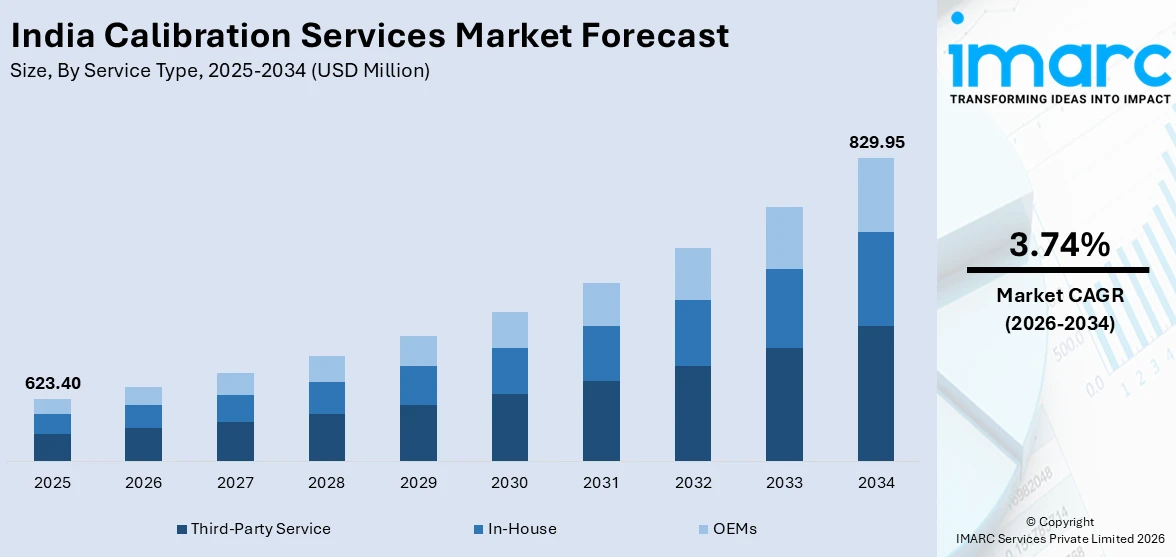
The India calibration services market size was valued at USD 623.40 Million in 2025 and is projected to reach USD 829.95 Million by 2034, growing at a compound annual growth rate of 3.74% from 2026-2034.
India's calibration services market is advancing on the strength of surging industrial output, tightening regulatory compliance mandates, and rapid expansion across electronics manufacturing, aerospace, defense, and healthcare. The proliferation of precision-dependent technologies, from automated production lines to sophisticated medical devices, continues to drive demand for reliable, accredited measurement services. As both public-sector undertakings and private manufacturers pursue international quality certifications, the need for traceable, standards-aligned calibration is intensifying across the India calibration services market.
Key Takeaways and Insights:
- By Service Type: Third-party service dominates the market with a share of 46.0% in 2025, driven by its ability to deliver cost-efficient, NABL-accredited, and scalable calibration solutions to a wide range of industries without the overhead of maintaining in-house laboratories.
- By Calibration Type: Electrical calibration leads the market with a share of 34.0% in 2025, reflecting the pervasive use of electrical and electronic instruments across manufacturing, telecommunications, energy, and semiconductor sectors requiring precise measurement verification.
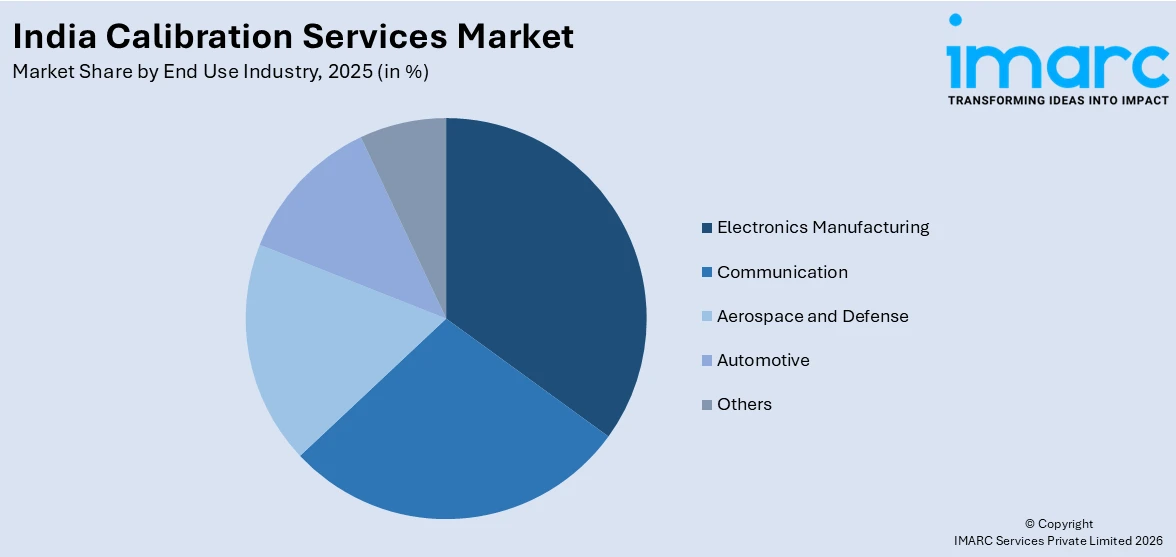
- By End Use Industry: Electronics manufacturing dominates the market with a share of 29.0% in 2025, supported by India's expanding role as a global electronics production hub through government PLI incentives and surging domestic and export-oriented production.
- By Region: West India represents the largest regional segment with a share of 33.0% in 2025, driven by the dense concentration of industrial estates, chemical plants, pharmaceutical manufacturers, and electronics clusters across Maharashtra and Gujarat.
- Key Players: The India calibration services market is characterized by a competitive landscape that includes NABL-accredited domestic laboratories as well as international metrology service providers. The presence of both local and global participants strengthens technical capabilities, expands service offerings, and supports the growing demand for precise measurement, testing, and calibration solutions across multiple industrial sectors.
To get more information on this market Request Sample
India's calibration services landscape is evolving rapidly in tandem with the country's industrial ambitions. The government's eMaap portal, introduced in December 2024, has digitized legal metrology functions across states, creating a unified compliance infrastructure that has significantly lowered administrative barriers for both service providers and instrument users. Simultaneously, the PLI scheme for electronics manufacturing has driven production to ₹5.25 lakh crore in FY 2024-25, expanding the pool of precision instruments requiring regular calibration. The India calibration services market is increasingly emphasizing accessibility and operational flexibility through the development of field-deployable and mobile calibration solutions. Service providers are focusing on delivering on-site testing and verification across diverse locations. This shift reflects a broader industry move toward outsourced, accredited, and digitally integrated calibration services that improve efficiency, reliability, and compliance with quality standards across various sectors.
India Calibration Services Market Trends:
Digitization of Calibration Compliance Infrastructure
India’s calibration compliance ecosystem is experiencing a notable digital transformation as the government advances the modernization of metrology governance. The introduction of centralized digital platforms for legal metrology functions is enabling more efficient management of licensing, verification records, and regulatory oversight across jurisdictions. By replacing manual administrative processes with streamlined digital systems, these initiatives improve transparency, traceability, and operational efficiency within the compliance framework. This transition is also making it easier for laboratories and service providers to participate in the accredited calibration services market, encouraging broader industry participation and supporting the overall development of a more organized and technology-driven metrology ecosystem.
Growth of Mobile and On-Site Calibration Services
The expansion of manufacturing and healthcare infrastructure into smaller cities and rural areas is accelerating demand for mobile and on-site calibration capabilities. Traditional laboratory-centric models are being supplemented by field-deployable solutions that deliver accreditation-grade precision at the point of use. For instance, in April 2024, IIT Madras inaugurated India's first mobile calibration facility for medical devices, a nationally traveling unit offering on-site testing, calibration, and safety verification in accordance with international standards. This development is catalyzing interest in portable calibration units suited to geographically dispersed industrial and healthcare environments.
Expansion of NABL-Accredited Calibration Capacity Across Industrial Sectors
The rising emphasis on globally recognized quality credentials is driving a wave of new NABL accreditations across India's industrial sectors. Organizations in energy, solar, aerospace, and advanced manufacturing are investing in dedicated calibration infrastructure to meet export requirements and international supply chain standards. For instance, in December 2024, Waaree Energies received NABL accreditation for its PV Module Test Lab in Gujarat, strengthening domestic solar testing capacity and reducing dependence on overseas laboratories, a trend that is replicating across India's evolving high-technology manufacturing ecosystem.
Market Outlook 2026-2034:
The India calibration services market is expected to experience steady growth during the forecast period, driven by the expansion of industries that rely heavily on precise measurement and quality assurance. Government initiatives aimed at strengthening domestic manufacturing and improving industrial standards are further supporting this momentum. At the same time, the development of digital compliance systems is enhancing traceability and regulatory alignment across sectors. As industries such as electronics manufacturing, aerospace development, and healthcare infrastructure continue to grow, especially across major industrial regions, demand for dependable and accredited calibration services is anticipated to remain strong and consistent. The market generated a revenue of USD 623.40 Million in 2025 and is projected to reach a revenue of USD 829.95 Million by 2034, growing at a compound annual growth rate of 3.74% from 2026-2034.
India Calibration Services Market Report Segmentation:
| Segment Category | Leading Segment | Market Share |
|---|---|---|
|
Service Type |
Third-Party Service |
46.0% |
|
Calibration Type |
Electrical |
34.0% |
|
End Use Industry |
Electronics Manufacturing |
29.0% |
|
Region |
West India |
33.0% |
Service Type Insights:
- In-House
- OEMs
- Third-Party Service
Third-party service dominates the India calibration services market with a share of 46.0% of the total market in 2025.
Third-party calibration services have emerged as the preferred modality for Indian enterprises seeking to balance quality compliance with cost optimization. Rather than bearing the capital expenditure and ongoing operational costs of maintaining in-house calibration laboratories, including investment in precision reference standards, environmental controls, and accredited personnel, manufacturers and testing facilities increasingly contract specialist providers. These third-party firms maintain NABL-accredited facilities with broad instrument scopes, delivering traceable calibration reports that satisfy both domestic regulatory mandates and international supply chain expectations.
The scalability and flexibility of third-party calibration also appeal to India's growing mid-market manufacturing base, which lacks the scale to justify in-house metrology infrastructure. Service providers operating across multiple disciplines, electrical, mechanical, thermodynamic, and dimensional, offer bundled calibration contracts that streamline compliance management. As India's electronics, pharmaceutical, and automotive sectors integrate increasingly sophisticated instrumentation into their production processes, the business case for expert third-party calibration continues to strengthen throughout the forecast period.
Calibration Type Insights:
- Electrical
- Mechanical
- Thermodynamic
- Physical/Dimensional
- Others
Electrical calibration represemt the largest share of 34.0% of the total India calibration services market in 2025.
The primacy of electrical calibration in India's market reflects the pervasiveness of electrical and electronic instrumentation across virtually every industrial sector. From multimeters and oscilloscopes used in electronics assembly to high-voltage testing equipment deployed in power generation, the breadth of instruments requiring regular electrical calibration is extensive. Demand is further amplified by India's rapidly expanding semiconductor-adjacent manufacturing base and the growth of telecommunications infrastructure, both of which rely on instruments calibrated to exacting electrical specifications.
Regulatory drivers reinforce the segment's position. Industries including healthcare, where electromedical devices require periodic verification, automotive, and aerospace mandate accurate electrical calibration as a condition of compliance with NABL standards and international quality management systems such as ISO/IEC 17025. The integration of increasingly sophisticated automation systems in Indian factories, including programmable logic controllers and sensor arrays, has further broadened the universe of electrical instruments requiring traceable calibration services throughout the forecast period.
End Use Industry Insights:
Access the comprehensive market breakdown Request Sample
- Electronics Manufacturing
- Communication
- Aerospace and Defense
- Automotive
- Others
Electronics manufacturing led the highest revenue share of 29.0% of the total India calibration services market in 2025.
India’s electronics manufacturing industry has become the leading end-use sector for calibration services, driven by the rapid expansion of domestic production capabilities. As the sector scales up, a growing number of precision instruments are being deployed across manufacturing facilities. Equipment such as soldering systems, environmental testing chambers, and automated inspection technologies require periodic calibration to maintain measurement accuracy and product reliability. Ensuring compliance with quality standards and international export requirements further increases the need for accredited calibration services, making the electronics sector a major contributor to demand within the broader calibration services market.
India’s electronics industry is gradually shifting from primarily assembly-focused operations toward more advanced component manufacturing. This transition involves the production of complex electronic components that require highly precise measurement, testing, and quality control processes. As a result, manufacturing environments increasingly rely on accurate and consistent calibration of testing and measurement equipment. The growing complexity of production systems and tighter tolerance requirements are expected to increase the frequency and importance of calibration activities. Consequently, the electronics segment will remain a key driver of demand for calibration services as the industry continues to evolve.
Regional Insights:
- North India
- South India
- East India
- West India
West India represents the leading regional segment with a 33.0% share of the total India calibration services market in 2025.
West India represents the leading regional segment of the India calibration services market due to its strong concentration of industrial and manufacturing activities. Major states such as Maharashtra and Gujarat host a wide range of industries including pharmaceuticals, chemicals, automotive, electronics, and engineering equipment manufacturing. These sectors rely heavily on precise measurement and quality assurance processes, creating consistent demand for calibration of laboratory instruments, testing equipment, and production machinery. The presence of large industrial clusters and export-oriented manufacturing units further strengthens the region’s requirement for accredited calibration services.
The region also benefits from a well-developed ecosystem of research institutions, testing laboratories, and technology-driven enterprises that require regular instrument calibration to comply with quality and regulatory standards. Major urban centers such as Mumbai, Pune, and Ahmedabad serve as hubs for advanced manufacturing and industrial research and development (R&D) activities. Additionally, strong logistics infrastructure, extensive industrial corridors, and a high presence of accredited laboratories enable service providers to efficiently cater to diverse sectors, reinforcing West India’s dominant position in the calibration services market.

Market Dynamics:
Growth Drivers:
Why is the India Calibration Services Market Growing?
Expansion of India's Electronics Manufacturing Ecosystem Under PLI Incentives
The transformative growth of India's electronics manufacturing sector under the Production Linked Incentive framework has created a structurally expanding demand base for calibration services. Electronics production has more than doubled in value over the past four years, with mobile phone output scaling to ₹5.45 lakh crore in FY 2024-25 from ₹18,000 crore a decade earlier. Every new manufacturing facility established for products such as smartphones, consumer electronics, or advanced electronic components introduces a wide range of precision instruments that require regular calibration to ensure accuracy, product quality, and regulatory compliance. As the electronics industry expands and production processes become more sophisticated, the number and complexity of measurement and testing devices continue to increase. With the gradual shift from assembly-focused operations toward component-level manufacturing, calibration requirements are becoming more frequent and technically demanding, broadening the scope of instruments needing accredited services and creating sustained long-term demand for calibration services in India.
Strengthening Regulatory and Quality Compliance Framework
India’s regulatory framework for measurement standards and quality assurance is gradually broadening the scope of mandatory calibration across multiple industries. National accreditation and quality bodies continue to expand certification coverage to additional technical disciplines and industrial sectors, encouraging wider adoption of standardized calibration practices. At the same time, improvements in regulatory processes and digital systems are simplifying compliance management and documentation for businesses. As a result, organizations are placing greater emphasis on obtaining traceable and accredited calibration credentials that align with internationally recognized standards. Demonstrating reliable measurement accuracy has become increasingly important for companies seeking participation in government procurement, exports, and high-precision industrial applications.
Growing Demand Across Aerospace, Defense, and Healthcare Sectors
India’s increasing focus on strengthening domestic aerospace and defense manufacturing, along with the expansion of healthcare infrastructure, is creating strong multi-sector demand for specialized calibration services. Advanced defense systems require highly precise calibration and testing to maintain operational reliability and measurement accuracy. At the same time, the healthcare sector is becoming more dependent on medical technologies such as diagnostic analyzers, electromedical devices, and imaging systems, all of which require routine calibration to ensure accurate clinical results. As healthcare facilities expand into smaller cities and emerging regions, the number of instruments requiring regular calibration is growing. This trend is creating new opportunities for service providers offering mobile and on-site calibration solutions across wider geographic areas.
Market Restraints:
What Challenges the India Calibration Services Market is Facing?
Shortage of Skilled Calibration Professionals
India's calibration services market faces a structural constraint in the form of a limited pool of technically trained metrologists and calibration specialists. Advanced calibration disciplines, particularly in thermodynamic, physical/dimensional, and high-frequency electrical calibration, demand specialized competencies that current technical education and vocational training pipelines have not fully addressed. This skills gap constrains service providers' ability to expand laboratory scope and capacity, limiting market scalability in high-growth regions.
High Capital Investment Requirements for Laboratory Setup
Establishing and maintaining NABL-accredited calibration laboratories requires significant upfront capital investment in precision reference standards, controlled environmental infrastructure, traceability documentation systems, and ongoing proficiency testing participation. For smaller or regional service providers, these cost barriers limit market entry and geographic coverage. This concentration of accredited capacity in metropolitan industrial clusters can leave instrument users in emerging manufacturing hubs without convenient access to compliant calibration services.
Fragmented Market Structure and Standardization Challenges
India's calibration services sector remains fragmented, with a wide variance in service quality, accreditation status, and pricing transparency across providers. The coexistence of NABL-accredited specialists and non-accredited operators creates market opacity for instrument users seeking reliable compliance documentation. Inconsistent enforcement of mandatory calibration requirements across state jurisdictions further complicates standardization, enabling cost-competitive but quality-compromised alternatives to undercut properly accredited service providers in price-sensitive end markets.
Competitive Landscape:
The India calibration services market is characterized by a moderately fragmented competitive landscape that includes domestic NABL-accredited laboratories as well as local operations of international metrology service providers. Many service providers maintain wide accreditation coverage across electrical, mechanical, thermal, and dimensional measurement disciplines, enabling them to serve industries such as automotive, aerospace, electronics, pharmaceuticals, and heavy manufacturing. Competition within the market is increasingly shaped by factors such as the scope of accreditation, service reliability, turnaround time, and the ability to provide on-site calibration services. Additionally, the adoption of digital calibration management systems is becoming a key differentiator. Providers that offer integrated solutions such as equipment asset tracking, automated documentation, and compliance reporting are gaining stronger preference among large industrial clients seeking efficient quality management and regulatory alignment.
Recent Developments:
- January 2026: The CSIR–National Physical Laboratory (CSIR-NPL) introduced two advanced calibration facilities aimed at enhancing India’s national quality infrastructure and lowering dependence on overseas certification services. Among these is the National Primary Standard Facility for Solar Cell Calibration, designed to perform accurate calibration of solar cells and photovoltaic modules. The facility is based on a laser-driven differential spectral responsivity primary reference measurement system, developed through collaboration with PTB Germany, enabling precise evaluation and standardization of solar energy devices.
- November 2024: Israel Aerospace Industries inaugurated the HELA Systems facility in Hyderabad, a specialized center for radar system calibration and testing. The facility represents a significant expansion of India's defense calibration infrastructure, reducing reliance on foreign metrology services for radar-related instruments and strengthening the indigenous aerospace and defense calibration ecosystem.
India Calibration Services Market Report Coverage:
| Report Features | Details |
|---|---|
| Base Year of the Analysis | 2025 |
| Historical Period | 2020-2025 |
| Forecast Period | 2026-2034 |
| Units | Million USD |
| Scope of the Report |
Exploration of Historical Trends and Market Outlook, Industry Catalysts and Challenges, Segment-Wise Historical and Future Market Assessment:
|
| Service Types Covered | In-House, OEMs, Third-Party Service |
| Calibration Types Covered | Electrical, Mechanical, Thermodynamic, Physical/Dimensional, Others |
| End Use Industries Covered | Electronics Manufacturing, Communication, Aerospace and Defense, Automotive, Others |
| Regions Covered | North India, South India, East India, West India |
| Customization Scope | 10% Free Customization |
| Post-Sale Analyst Support | 10-12 Weeks |
| Delivery Format | PDF and Excel through Email (We can also provide the editable version of the report in PPT/Word format on special request) |
Frequently Asked Questions About the India Calibration Services Market Report
The India calibration services market size was valued at USD 623.40 Million in 2025.
The India calibration services market is expected to grow at a compound annual growth rate of 3.74% from 2026-2034 to reach USD 829.95 Million by 2034.
Third-party service held the largest market share at 46.0% in 2025, driven by its cost efficiency, NABL accreditation credentials, and flexibility for industries seeking to outsource precision measurement compliance without maintaining in-house laboratory infrastructure.
Key factors driving the India calibration services market include the rapid expansion of electronics manufacturing under PLI incentives, growing NABL accreditation requirements across industries, the digitization of legal metrology compliance through the eMaap portal, and rising demand from aerospace, defense, and healthcare sectors for specialized calibration services.
Major challenges include a shortage of skilled calibration professionals in advanced disciplines, high capital investment requirements for establishing and maintaining NABL-accredited laboratories, fragmented market structure with inconsistent quality standards, and uneven geographic distribution of accredited calibration capacity across India's industrial regions.
Need more help?
- Speak to our experienced analysts for insights on the current market scenarios.
- Include additional segments and countries to customize the report as per your requirement.
- Gain an unparalleled competitive advantage in your domain by understanding how to utilize the report and positively impacting your operations and revenue.
- For further assistance, please connect with our analysts.
 Request Customization
 Speak to an Analyst
 Request Brochure
 Inquire Before Buying
Benefits of Customization
- Personalize this research
- Triangulate with your data
- Get data as per your format and definition
- Gain a deeper dive into a specific application, geography, customer, or competitor
- Any level of personalization
Get in Touch With Us
UNITED STATES
Phone: +1-201-971-6302
INDIA
Phone: +91-120-433-0800
UNITED KINGDOM
Phone: +44-753-714-6104
Email: [email protected]
Client Testimonials




.webp)




.webp)













Related Reports

Choose your plan
*Please note that the prices mentioned below are starting prices for each bundle type. Kindly contact our team for further details.*
Single User License
- 1 User License, Access on 2 Devices
- PDF Report + Excel Dataset (Password Protected)
- Lifetime Access
- No Printing Rights
- 10% Free Report Customization
- 10–12 Weeks of Analyst Support
Five User License
- Access for 5 Users, 2 Devices per User
- PDF Report + Excel Dataset (Password Protected)
- Lifetime Access
- Dedicated Account Manager
- 12–14 Weeks of Analyst Support
- No Printing Rights
- 15% Free Report Customization
- 25% Discount on Your Next Purchase
Corporate User License
- Unlimited User Access (Within Your Organization)
- PDF Report + Excel Dataset
- Lifetime Access
- Dedicated Account Manager
- 14–20 Weeks of Analyst Support
- No Printing Rights
- 20% Free Report Customization
- 30% Discount on Your Next Purchase
Essential Insights
What's included:
3 reports
- Lifetime Access
- PDF Reports
- Excel Datasets
- 2 Weeks of Free Analyst Support
- 2 User Licenses
- Access on 2 Devices
- Printing Rights
- Complimentary PowerPoint (PPT) Version
- Complimentary License Upgrade
Professional Access
What's included:
5 reports
- Lifetime Access
- PDF Reports
- Excel Datasets
- 8 Weeks of Free Analyst Support
- 2 User Licenses
- Access on 2 Devices
- Printing Rights
- Complimentary PowerPoint (PPT) Version
- Complimentary License Upgrade
Business Advantage
What's included:
8 reports
- Lifetime Access
- PDF Reports
- Excel Datasets
- 14 Weeks of Free Analyst Support
- 2 User Licenses
- Access on 2 Devices
- Printing Rights
- Complimentary PowerPoint (PPT) Version
- Complimentary License Upgrade
Enterprise Intelligence
What's included:
10 reports
- Lifetime Access
- PDF Reports
- Excel Datasets
- 20 Weeks of Free Analyst Support
- 2 User Licenses
- Access on 2 Devices
- Printing Rights
- Complimentary PowerPoint (PPT) Version
- Complimentary License Upgrade