
India Capital Market Size, Share, Trends and Forecast by Type, Application, and Region, 2026-2034
India Capital Market Summary:
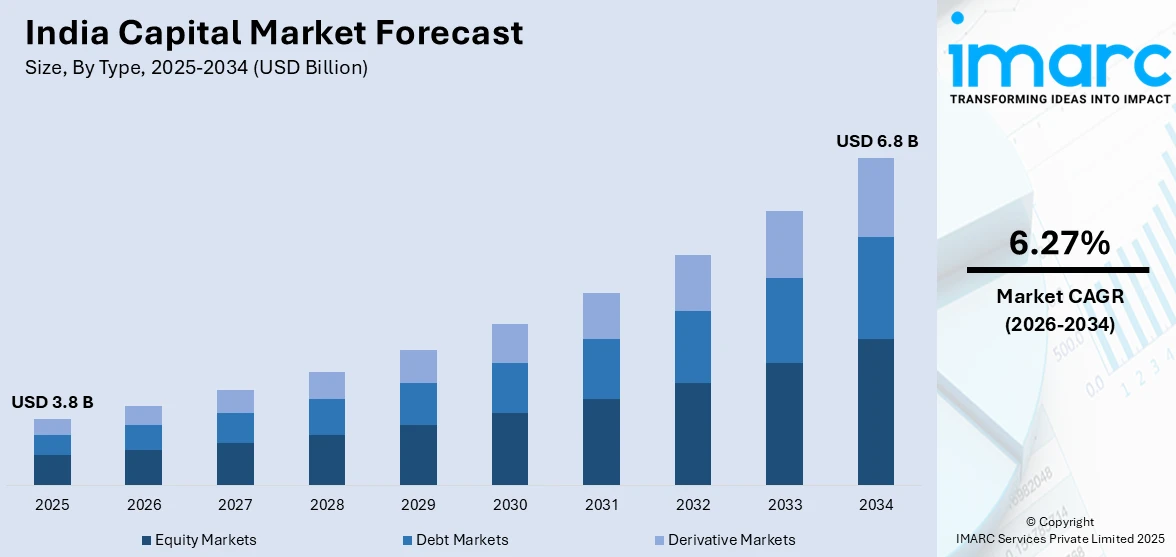
The India capital market size was valued at USD 3.8 Billion in 2025 and is projected to reach USD 6.8 Billion by 2034, growing at a compound annual growth rate of 6.27% from 2026-2034.
The India capital market is experiencing robust expansion, driven by rising retail investor participation, digital transformation of financial services, and strong domestic economic fundamentals. The market benefits from a growing middle class with increasing disposable income, enhanced regulatory frameworks supporting investor protection, and expanding financial literacy initiatives. Government reforms promoting ease of doing business and global bond index inclusions are further catalyzing market growth and foreign investment inflows.
Key Takeaways and Insights:
- By Type: Equity markets dominate the market with a share of 56.8% in 2025, driven by strong retail investor participation through systematic investment plans, enhanced digital trading platforms, and a flourishing initial public offering ecosystem attracting both domestic and foreign investments.
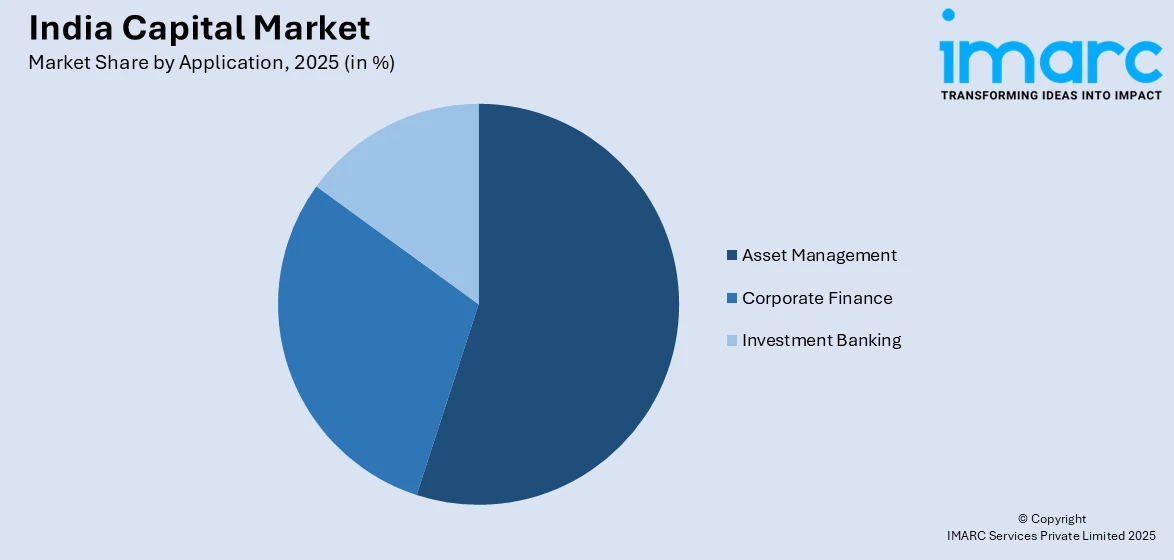
- By Application: Asset management leads the market with a share of 41.3% in 2025, owing to surging mutual fund assets under management, growing popularity of systematic investment plans among retail investors, and expanding wealth management services catering to high-net-worth individuals.
- By Region: West India represents the largest region with 36.4% share in 2025, driven by Mumbai's status as the financial capital hosting major stock exchanges, headquarters of leading financial institutions, and concentration of corporate headquarters and investment banking operations.
- Key Players: Key players drive the India capital market by expanding digital trading platforms, enhancing investor education initiatives, and strengthening regulatory compliance frameworks. Their investments in technology infrastructure, product innovations, and strategic partnerships accelerate market penetration and ensure consistent service delivery across diverse investor segments.
To get more information on this market Request Sample
The India capital market is undergoing a transformative phase, characterized by unprecedented retail investor participation and institutional deepening. The market benefits from supportive regulatory frameworks that promote transparency, investor protection, and market efficiency. Digital transformation has revolutionized market access, enabling millions of new investors to participate through user-friendly mobile trading applications and seamless electronic know-your-customer (KYC) processes. As of June 2025, the number of demat accounts in India reached 200 Million, reflecting the remarkable expansion of retail investor base. The integration of technology with financial services has reduced transaction costs and improved market liquidity, attracting both domestic and international capital flows. Government initiatives promoting financial inclusion and investor awareness campaigns have strengthened market fundamentals, while the inclusion of Indian government bonds in global indices has enhanced international investor confidence.
India Capital Market Trends:
Surge in Retail Investor Participation Through Digital Platforms
The India capital market is witnessing an unprecedented surge in retail investor participation driven by widespread adoption of digital trading platforms and mobile applications. The democratization of investment access has enabled millions of first-time investors from tier-two and tier-three cities to participate in equity markets. User-friendly interfaces, zero-brokerage trading options, and simplified electronic KYC processes have significantly lowered entry barriers, transforming investment behavior across demographic segments. Rising financial literacy initiatives and social media–driven awareness around equity investing are further encouraging sustained retail participation in the market.
Growth of Systematic Investment Plans and Passive Investing
The India capital market is experiencing substantial growth in systematic investment plans, as investors increasingly embrace disciplined, long-term wealth creation strategies. Monthly contributions through systematic investment plans have reached record levels, reflecting growing financial literacy and changing investor preferences towards market-linked instruments. The popularity of passive investing through exchange-traded funds and index funds continues to rise as cost-conscious investors seek diversified exposure to market indices. Motilal Oswal Mutual Fund’s passive survey 2025 revealed that 68% of Indian investors used passive funds, while 93% of distributors plan to boost passive allocation in FY25-26.
Global Integration and Bond Index Inclusion
The India capital market is achieving deeper global integration, following the inclusion of Indian government bonds in major international bond indices. This landmark development has attracted significant foreign portfolio investment into the domestic debt market, enhancing market liquidity and reducing borrowing costs. The increased foreign participation is strengthening India's position in global financial markets while providing domestic issuers with access to a broader investor base. India's foreign direct investment (FDI) equity inflows for FY26 (April-September 2025) increased by 18% (in USD terms) compared to FY25, reaching INR 3,03,402 Crore (USD 35.18 Billion), featuring notable investments in the services and computer software and hardware industries.
Market Outlook 2026-2034:
The India capital market outlook remains positive, supported by strong economic fundamentals, favorable demographic trends, and continued regulatory reforms. The market generated a revenue of USD 3.8 Billion in 2025 and is projected to reach a revenue of USD 6.8 Billion by 2034, growing at a compound annual growth rate of 6.27% from 2026-2034. Growing financial awareness, increasing disposable incomes, and expanding digital infrastructure will continue to drive retail participation. The asset management industry is projected to witness substantial growth as mutual fund penetration deepens across smaller cities. Foreign portfolio investment flows are expected to remain supportive as India maintains its position as a preferred emerging market investment destination.
India Capital Market Report Segmentation:
|
Segment Category |
Leading Segment |
Market Share |
|
Type |
Equity Markets |
56.8% |
|
Application |
Asset Management |
41.3% |
|
Region |
West India |
36.4% |
Type Insights:
- Equity Markets
- Debt Markets
- Derivative Markets
Equity markets dominate with a market share of 56.8% of the total India capital market in 2025.
Equity markets have gained significance in the market, driven by robust domestic investor participation and improving corporate earnings. The market benefits from a diverse universe of listed companies spanning multiple sectors, providing investors with comprehensive exposure to India's economic growth story. Expanding sectoral representation reduces concentration risk and enhances portfolio diversification opportunities. Rising market capitalization and consistent new listings are further strengthening equity market depth and resilience.
The growth of equity markets is underpinned by strong retail investor participation through direct investments and mutual fund channels. Digital trading platforms have democratized market access, enabling participation from smaller cities and towns. The National Stock Exchange of India demonstrates the market's depth and liquidity. The equity markets segment continues to attract foreign portfolio investments, supported by India's favorable economic outlook and improving corporate governance standards across listed companies.
Application Insights:
Access the comprehensive market breakdown Request Sample
- Corporate Finance
- Investment Banking
- Asset Management
Asset management leads with a share of 41.3% of the total India capital market in 2025.
Asset management has witnessed remarkable expansion in India, driven by increasing household savings channeled into market-linked instruments. The sector benefits from growing investor preference for professionally managed investment vehicles offering diversification and returns potential. Systematic investment plans have emerged as the preferred investment route for retail investors, contributing significantly to sustained asset growth. Rising income levels and long-term wealth creation awareness are further supporting consistent inflows across equity and hybrid fund categories.
The asset management landscape is characterized by expanding product offerings catering to diverse investor preferences and risk appetites. Passive investing has gained substantial traction, with exchange-traded funds and index funds attracting significant inflows from cost-conscious investors. The number of unique mutual fund investors continues to grow, with participation expanding beyond metropolitan areas to smaller cities. Digital onboarding, simplified disclosures, and investor education campaigns are strengthening trust and accelerating adoption across emerging regional markets.
Regional Insights:
- North India
- South India
- East India
- West India
West India exhibits a clear dominance with a 36.4% share of the total India capital market in 2025.
West India dominates the capital market landscape, primarily due to Mumbai's status as the country's financial capital. The region hosts both major stock exchanges, the National Stock Exchange and Bombay Stock Exchange, along with headquarters of the Reserve Bank of India and Securities and Exchange Board of India. Mumbai generated 6.16% of India's total GDP in the fiscal year 2025-26, contributing significantly to national income tax collections and cementing its position as the nerve center of India's financial ecosystem.
The region benefits from a well-developed financial services infrastructure, supporting banking, insurance, asset management, and investment banking activities. Major domestic and international financial institutions maintain their corporate headquarters in Mumbai, facilitating efficient capital market operations. The presence of leading corporate conglomerates and a robust network of financial intermediaries across the region creates a thriving ecosystem for capital formation and investment activities, attracting both domestic and foreign institutional investors.

Market Dynamics:
Growth Drivers:
Why is the India Capital Market Growing?
Rising Retail Investor Participation and Financial Inclusion
The India capital market growth is significantly driven by the unprecedented surge in retail investor participation fueled by enhanced financial inclusion initiatives and digital transformation. The government's push for financial literacy, combined with technology-enabled access, has brought millions of first-time investors into the capital market. Digital trading platforms and mobile applications have democratized investment access, particularly benefiting investors in tier-two and tier-three cities who previously lacked convenient market access. The simplification of account opening procedures through electronic KYC verification has reduced entry barriers and accelerated investor onboarding. Growing awareness about wealth creation through market-linked instruments has shifted household savings from traditional deposits toward equity and mutual fund investments. The popularity of systematic investment plans has introduced disciplined investing habits among retail investors, ensuring consistent capital flows into the market. Young professionals with increasing disposable incomes are actively participating in equity markets, viewing investments as essential tools for long-term wealth accumulation and financial security.
Strong Economic Fundamentals and Corporate Earnings Growth
India's robust economic fundamentals provide a strong foundation for capital market expansion, attracting both domestic and international investors. The country's position as one of the fastest-growing major economies globally creates favorable conditions for corporate earnings growth and equity market performance. Government initiatives promoting manufacturing, infrastructure development, and digital economy have created multiple growth avenues for listed companies across sectors. The production-linked incentive schemes are attracting substantial investments in manufacturing, creating value across supply chains and improving corporate profitability. Strong domestic consumption supported by a growing middle class and rising disposable incomes provides sustainable revenue growth opportunities for consumer-facing businesses. As per Trading Economics, in 2023, disposable personal income in India rose to 296383300 INR Million from 273364818.90 INR Million in 2022. The services sector, particularly information technology and financial services, continues to demonstrate resilience and growth, contributing to overall market performance. Policy reforms aimed at improving ease of doing business have enhanced corporate competitiveness and attracted FDI.
Rising Initial Public Offering (IPO) Activity and Primary Market Participation
Increasing IPO activity is emerging as a strong growth driver for the India capital market. A growing number of companies across the technology, manufacturing, consumer services, and new-age sectors are tapping equity markets to raise growth capital. In 2024, the Indian stock market experienced a surge in IPOs. The 268 successful IPOs on the mainboard (90) and SME (178) garnered INR 1.67 Lakh Crore, marking the highest volume of IPOs in Asia. IPOs provide investors access to emerging business models and high-growth companies, expanding investment opportunities beyond traditional large-cap stocks. Strong institutional participation in primary issuances reflects rising confidence in long-term economic prospects and corporate growth stories. Successful listings and post-IPO performance further reinforce positive investor sentiment, encouraging repeat participation. The visibility created by public listings also improves corporate transparency and brand credibility, attracting broader investor interest. As more private companies view capital markets as preferred fundraising avenues, sustained IPO momentum continues to deepen market breadth and strengthen overall capital market expansion.
Market Restraints:
What Challenges the India Capital Market is Facing?
Market Volatility and Valuation Concerns
The India capital market faces challenges from heightened market volatility and elevated valuation levels that increase correction risks. High price-to-earnings ratios compared to historical averages and emerging market peers raise concerns about sustainability of market performance. Foreign portfolio investor outflows during periods of global risk aversion create significant market fluctuations, impacting investor sentiment and portfolio values across market segments.
Limited Financial Literacy in Rural Areas
Despite improvements in financial inclusion, limited financial literacy, particularly in rural and semi-urban areas, constrains broader market participation. Many potential investors lack adequate understanding of investment products, risk assessment, and portfolio management principles. The complexity of financial instruments and insufficient investor education infrastructure in smaller towns hinder the expansion of capital market participation beyond urban centers.
Regulatory Compliance Complexity
The India capital market faces challenges from complex regulatory compliance requirements that increase operational costs for market participants. Frequent regulatory changes require continuous system upgrades and process modifications by intermediaries. Small and medium-sized market participants find compliance burdens disproportionately challenging, potentially limiting competition and innovation within the financial services ecosystem while increasing costs for end investors.
Competitive Landscape:
The India capital market features a dynamic competitive landscape, characterized by diverse participants, including stock exchanges, brokerage firms, asset management companies, and investment banks. The market structure promotes healthy competition through regulatory frameworks, ensuring transparency and fair practices. Leading participants differentiate themselves through technology-driven platforms, comprehensive research capabilities, and superior customer service offerings. Digital transformation has intensified competition, as traditional players adapt to compete with technology-first entrants offering innovative products and lower transaction costs. Asset management companies compete through product innovations, performance track records, and distribution network expansion. Investment banks focus on building sector expertise and advisory capabilities to serve corporate clients effectively.
Recent Developments:
- In December 2025, Finance Minister Nirmala Sitharaman presented the Securities Markets Code Bill, 2025 to Parliament, proposing to consolidate three key securities laws, the SEBI Act, 1992, the Depositories Act, 1996, and the Securities Contracts (Regulation) Act, 1956, into a single unified statute aimed at simplifying compliance, establishing a cohesive legal framework for safeguarding investors and facilitating capital mobilization.
India Capital Market Report Coverage:
|
Report Features |
Details |
|
Base Year of the Analysis |
2025 |
|
Historical Period |
2020-2025 |
|
Forecast Period |
2026-2034 |
|
Units |
USD Billion |
|
Scope of the Report |
Exploration of Historical Trends and Market Outlook, Industry Catalysts and Challenges, Segment-Wise Historical and Future Market Assessment:
|
|
Types Covered |
Equity Markets, Debt Markets, Derivative Markets |
|
Applications Covered |
Corporate Finance, Investment Banking, Asset Management |
|
Regions Covered |
North India, South India, East India, West India |
|
Customization Scope |
10% Free Customization |
|
Post-Sale Analyst Support |
10-12 Weeks |
|
Delivery Format |
PDF and Excel through Email (We can also provide the editable version of the report in PPT/Word format on special request) |
Frequently Asked Questions About the India Capital Market Report
The India capital market size was valued at USD 3.8 Billion in 2025.
The India capital market is expected to grow at a compound annual growth rate of 6.27% from 2026-2034 to reach USD 6.8 Billion by 2034.
Equity markets dominated the market with a share of 56.8%, driven by strong retail investor participation, digital trading platform adoption, and robust initial public offering activity attracting domestic and foreign investments.
Key factors driving the India capital market include rising retail investor participation through digital platforms, strong economic fundamentals supporting corporate earnings, regulatory reforms enhancing market efficiency, and global bond index inclusions attracting foreign investments.
Major challenges include market volatility and elevated valuations increasing correction risks, limited financial literacy in rural areas constraining broader participation, regulatory compliance complexity increasing operational costs, and foreign portfolio investor outflows during global uncertainty periods.
Need more help?
- Speak to our experienced analysts for insights on the current market scenarios.
- Include additional segments and countries to customize the report as per your requirement.
- Gain an unparalleled competitive advantage in your domain by understanding how to utilize the report and positively impacting your operations and revenue.
- For further assistance, please connect with our analysts.
 Request Customization
 Speak to an Analyst
 Request Brochure
 Inquire Before Buying
Benefits of Customization
- Personalize this research
- Triangulate with your data
- Get data as per your format and definition
- Gain a deeper dive into a specific application, geography, customer, or competitor
- Any level of personalization
Get in Touch With Us
UNITED STATES
Phone: +1-201-971-6302
INDIA
Phone: +91-120-433-0800
UNITED KINGDOM
Phone: +44-753-714-6104
Email: [email protected]
Client Testimonials




.webp)




.webp)













Related Reports

Choose your plan
*Please note that the prices mentioned below are starting prices for each bundle type. Kindly contact our team for further details.*
Single User License
- 1 User License, Access on 2 Devices
- PDF Report + Excel Dataset (Password Protected)
- Lifetime Access
- No Printing Rights
- 10% Free Report Customization
- 10–12 Weeks of Analyst Support
Five User License
- Access for 5 Users, 2 Devices per User
- PDF Report + Excel Dataset (Password Protected)
- Lifetime Access
- Dedicated Account Manager
- 12–14 Weeks of Analyst Support
- No Printing Rights
- 15% Free Report Customization
- 25% Discount on Your Next Purchase
Corporate User License
- Unlimited User Access (Within Your Organization)
- PDF Report + Excel Dataset
- Lifetime Access
- Dedicated Account Manager
- 14–20 Weeks of Analyst Support
- No Printing Rights
- 20% Free Report Customization
- 30% Discount on Your Next Purchase
Essential Insights
What's included:
3 reports
- Lifetime Access
- PDF Reports
- Excel Datasets
- 2 Weeks of Free Analyst Support
- 2 User Licenses
- Access on 2 Devices
- Printing Rights
- Complimentary PowerPoint (PPT) Version
- Complimentary License Upgrade
Professional Access
What's included:
5 reports
- Lifetime Access
- PDF Reports
- Excel Datasets
- 8 Weeks of Free Analyst Support
- 2 User Licenses
- Access on 2 Devices
- Printing Rights
- Complimentary PowerPoint (PPT) Version
- Complimentary License Upgrade
Business Advantage
What's included:
8 reports
- Lifetime Access
- PDF Reports
- Excel Datasets
- 14 Weeks of Free Analyst Support
- 2 User Licenses
- Access on 2 Devices
- Printing Rights
- Complimentary PowerPoint (PPT) Version
- Complimentary License Upgrade
Enterprise Intelligence
What's included:
10 reports
- Lifetime Access
- PDF Reports
- Excel Datasets
- 20 Weeks of Free Analyst Support
- 2 User Licenses
- Access on 2 Devices
- Printing Rights
- Complimentary PowerPoint (PPT) Version
- Complimentary License Upgrade