
India Cashew Market Size, Share, Trends and Forecast by Form, Distribution Channel, Application, and Region, 2026-2034
India Cashew Market Summary:
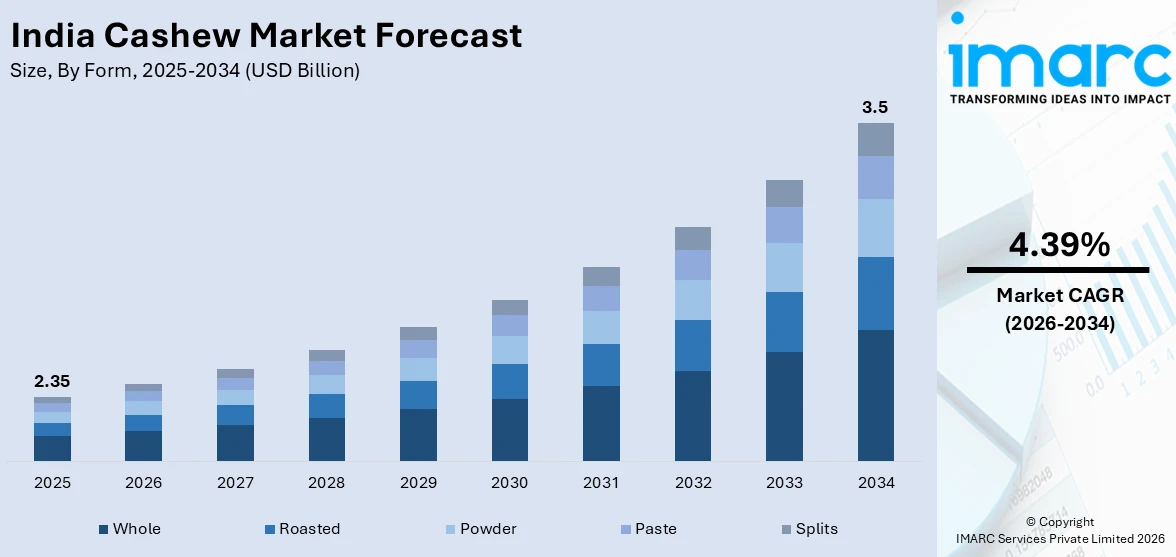
The India cashew market size was valued at USD 2.35 Billion in 2025 and is projected to reach USD 3.5 Billion by 2034, growing at a compound annual growth rate of 4.39% from 2026-2034.
The India cashew market is experiencing sustained expansion driven by rising health consciousness among consumers, growing preference for nutrient-dense snacking alternatives, and increasing culinary applications across traditional and modern food segments. Strengthening domestic processing capabilities, expanding retail and e-commerce distribution networks, and flourishing export demand from international markets are collectively reinforcing the upward trajectory. Additionally, the proliferation of value-added cashew products, including plant-based alternatives and flavored variants, is broadening the consumer base and stimulating market penetration across diverse demographic and geographic segments nationwide.
Key Takeaways and Insights:
- By Form: Whole dominates the market with a share of 39.6% in 2025, owing to its widespread consumption as a premium snacking option, extensive use in festive gifting, traditional Indian cuisine, and growing demand for unprocessed nutrient-rich foods.
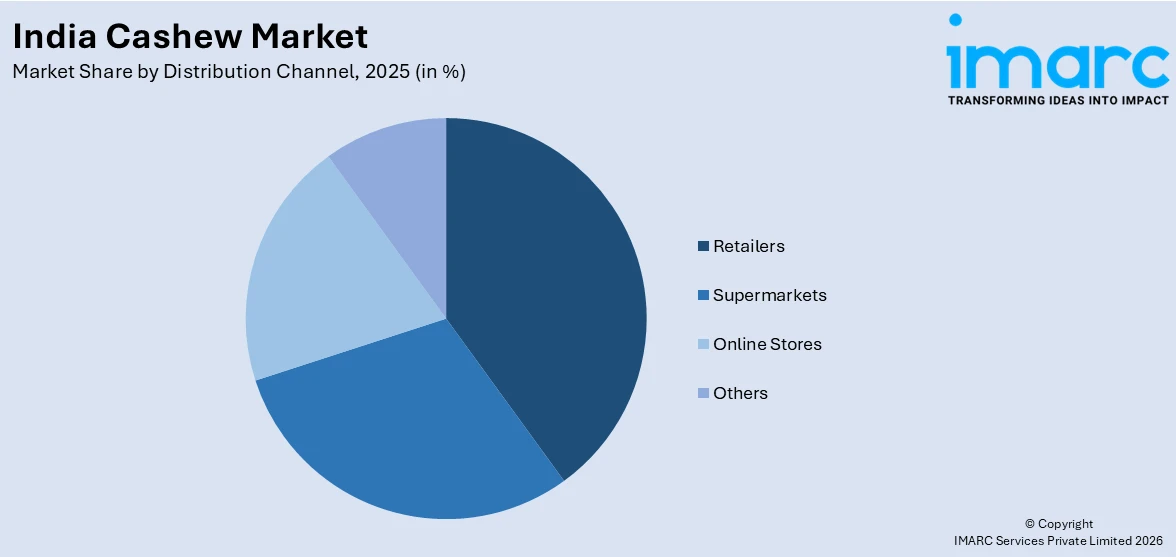
- By Distribution Channel: Retailers lead the market with a share of 36.2% in 2025. This dominance is driven by deep penetration of local retail networks, consumer preference for in-store purchases enabling quality inspection, and widespread availability in neighbourhood outlets.
- By Application: Snacks and bars hold the largest segment with a market share of 27.9% in 2025, reflecting the accelerating shift toward convenient, protein-rich snacking options that align with evolving health-conscious dietary preferences among urban and semi-urban populations.
- By Region: West India represents the leading region with 34.5% share in 2025, driven by the concentration of major cashew-producing states, extensive processing infrastructure, established trade networks, and high consumer demand across Maharashtra, Goa, and Gujarat.
- Key Players: Key players drive the India cashew market by expanding product portfolios, investing in automated processing technologies, strengthening distribution across modern trade and e-commerce platforms, and diversifying into value-added cashew products to capture evolving consumer preferences nationwide.
To get more information on this market Request Sample
The India cashew market is advancing as domestic consumption patterns evolve and industrial applications expand. India continues to hold its position as the world’s largest consumer of cashews, processing close to half of the global cashew kernels and accounting for a significant share of worldwide output. Rising urbanization, growing preference for plant-based protein sources, and expanding applications in bakery, confectionery, and beverage segments are fuelling consistent demand growth. The proliferation of flavored, organic, and premium cashew variants is attracting health-conscious consumers seeking clean-label products. Simultaneously, modern retail expansion and rapid e-commerce penetration are improving accessibility across tier-two and tier-three cities. Strengthened government support through agricultural development programs and enhanced processing mechanization initiatives are further bolstering the sector’s competitiveness and enabling broader market reach across domestic and international channels, thereby reinforcing overall India cashew market share.
India Cashew Market Trends:
Rising Demand for Value-Added and Flavored Cashew Products
The India cashew market is witnessing a significant shift toward value-added products as consumers increasingly seek innovative and convenient snacking options. Flavored variants such as chili-roasted, honey-coated, and masala-seasoned cashews are gaining traction among urban consumers, complementing the traditional preference for plain and salted varieties. Product diversification into cashew butter, cashew milk, and plant-based dairy alternatives is further broadening the market’s consumer base, particularly among vegan and lactose-intolerant demographics. These product innovations are enhancing shelf presence, strengthening brand differentiation, and supporting India cashew market growth.
Expansion of Modern Retail and E-Commerce Distribution
Modern trade channels and digital commerce platforms are transforming how cashews reach Indian consumers. The rapid expansion of supermarkets, hypermarkets, and quick-commerce services is improving product accessibility across metropolitan and emerging urban centers. According to the IMARC Group, the India e-commerce market size was valued at USD 129.72 Billion in 2025 and is projected to reach USD 651.10 Billion by 2034, growing at a compound annual growth rate of 19.63% from 2026-2034. Online platforms are enabling direct-to-consumer sales and facilitating premium product discovery. This retail modernization is particularly benefiting branded cashew offerings, as packaging innovations such as nitrogen-flush sealing extend shelf life and maintain freshness, enabling wider geographic distribution and strengthening consumer trust in packaged cashew products.
Advancements in Cashew Processing Automation and Technology
Modernization of processing infrastructure is accelerating across India’s cashew sector as producers adopt automated shelling, peeling, and grading technologies to improve efficiency and product quality. Deep-learning visual sorters and steam-based softening systems are reducing kernel breakage and enhancing recovery rates of premium grades. These technological upgrades are enabling processors to achieve higher throughput while maintaining consistent quality standards, lowering per-unit processing costs, and strengthening competitiveness against technologically advanced processing nations in global export markets.
Market Outlook 2026-2034:
The India cashew market is positioned for continued expansion over the forecast period, supported by rising domestic consumption, strengthening processing capabilities, and sustained export demand from key international markets. Growing health awareness, expanding applications in food processing and cosmetics, coupled with government initiatives promoting cashew cultivation and mechanized processing, are expected to drive higher revenue streams. The increasing availability of premium and organic cashew products through modern retail and e-commerce channels will further catalyze market growth across diverse consumer segments and geographic regions. The market generated a revenue of USD 2.35 Billion in 2025 and is projected to reach a revenue of USD 3.5 Billion by 2034, growing at a compound annual growth rate of 4.39% from 2026-2034.
India Cashew Market Report Segmentation:
|
Segment Category |
Leading Segment |
Market Share |
|
Form |
Whole |
39.6% |
|
Distribution Channel |
Retailers |
36.2% |
|
Application |
Snacks and Bars |
27.9% |
|
Region |
West India |
34.5% |
Form Insights:
- Whole
- Roasted
- Powder
- Paste
- Splits
Whole dominates with a share of 39.6% of the total India cashew market in 2025.
Whole cashews continue to command the largest share of the India cashew market, driven by strong consumer preference for unprocessed, nutrient-dense nuts consumed as premium snacks and essential ingredients in traditional Indian cuisine. The form's prominence is reinforced by its cultural significance in festive gifting during occasions such as Diwali, Eid, and weddings, where whole cashew assortments remain a preferred choice. Rising demand for clean-label, minimally processed food products among health-conscious urban consumers is further strengthening adoption, while the versatility of whole cashews across culinary preparations, confectionery formulations, and direct consumption occasions continues to sustain broad-based appeal across diverse demographic segments.
The growing urban middle class and rising disposable incomes are further elevating demand for premium whole cashew grades such as W180 and W240, which command higher price points in both domestic and international markets. Advances in automated shelling and visual sorting technologies are improving kernel recovery rates and reducing processing wastage, enabling processors to meet quality benchmarks more consistently. The expansion of branded packaging with nitrogen-flush sealing is extending shelf life and enhancing consumer confidence, supporting wider distribution through modern trade outlets and e-commerce platforms across India.
Distribution Channel Insights:
Access the comprehensive market breakdown Request Sample
- Supermarkets
- Retailers
- Online Stores
- Others
Retailers lead with a share of 36.2% of the total India cashew market in 2025.
Retailers maintain a commanding presence in the India cashew distribution landscape, benefiting from deep penetration across urban neighbourhoods and semi-urban centres. Local retail shops, Kirana stores, and specialty dry fruit outlets serve as the primary purchasing points for Indian consumers, who traditionally prefer in-person evaluation of product freshness and quality before purchase. The trust-driven relationship between local retailers and consumers, combined with convenient proximity, flexible pricing options, and personalized service, reinforces this channel's sustained dominance across both traditional and emerging cashew consumption markets nationwide.
The retail channel’s strength is further reinforced by the cultural role of cashews in Indian festive traditions, where consumers frequently purchase whole and assorted cashew packs from trusted local retailers during peak seasons. Retailers benefit from established supplier relationships that ensure consistent stock replenishment and competitive pricing. The growing trend toward branded and packaged cashew products is encouraging traditional retailers to upgrade their product assortments with premium offerings, enabling them to compete effectively with organized retail chains while retaining their proximity advantage and personalized customer service.
Application Insights:
- Dairy Products
- Bakery Products
- Snacks and Bars
- Confectionaries
- Cereals
- Desserts
- Beverages
- Cosmetic Products
- Others
Snacks and bars exhibit a clear dominance with a 27.9% share of the total India cashew market in 2025.
Snacks and bars represent the fastest-expanding application segment in the India cashew market, driven by the accelerating consumer shift toward convenient, protein-rich, and nutrient-dense snacking alternatives. Health-conscious consumers are increasingly replacing traditional high-calorie snacks with cashew-based energy bars, trail mixes, and roasted nut packs. The growing preference for on-the-go nutrition, coupled with rising awareness of plant-based protein benefits and expanding product availability across modern retail and quick-commerce platforms, is further reinforcing sustained demand growth within this application category.
The proliferation of innovative product formats, including flavored cashews in spicy, sweet, and tangy variants, is attracting younger demographics and expanding the addressable market. Quick-commerce platforms and modern retail chains are providing convenient access to premium cashew snack products, enabling brands to reach consumers across metropolitan and tier-two cities. The growing penetration of branded healthy snacking options in office canteens, gyms, and airport retail outlets is further amplifying consumption occasions and driving sustained volume growth in this application category.
Regional Insights:
- North India
- South India
- East India
- West India
West India represents the leading region with a 34.5% share of the total India cashew market in 2025.
West India holds the biggest regional share of the Indian cashew market due to the concentration of important cashew-producing and processing regions like Maharashtra, Goa, and Gujarat. Maharashtra is currently India's top cashew-producing state owing to favorable coastal agroclimatic conditions, the gradual adoption of high-yielding clonal cultivars, and a long history of cultivation throughout its western coastal strip. The region's competitive standing within the national cashew supply chain is strengthened by its vast processing infrastructure, which includes both old processing hubs and contemporary automated facilities.
The dominance of West India is further reinforced by the presence of a strong trade network that links producers with local and global consumers, well-developed port infrastructure that supports export logistics, and high per-capita consumption rates fueled by the presence of affluent consumer groups in Mumbai, Pune, and Ahmedabad. The region has a well-developed retail market for dry fruits and an increasing presence of organized retail that further improves the visibility and availability of products. The government’s efforts through horticulture development missions and the development of non-traditional cashew-producing regions in Gujarat are further cementing the region’s leadership in the market.
Market Dynamics:
Growth Drivers:
Why is the India Cashew Market Growing?
Increasing Health Consciousness and Demand for Nutrient-Dense Foods
The India cashew market is benefiting significantly from the growing awareness about health and wellness among consumers, who are increasingly incorporating nutrient-rich foods into their daily diets. Cashews, abundant in heart-healthy monounsaturated fats, essential minerals including copper, zinc, and magnesium, along with vitamins B6 and E, are gaining recognition as a wholesome dietary component. This nutritional profile aligns with the broader consumer shift toward clean-label, minimally processed food products that support cardiovascular health, immune function, and overall well-being. The rising prevalence of lifestyle-related health conditions such as obesity and cardiovascular disorders is accelerating dietary transitions toward healthier snacking alternatives. Urban consumers are actively seeking protein-rich, plant-based food options, positioning cashews as a preferred choice within daily meal plans, smoothie preparations, and on-the-go snacking routines. This sustained health-driven demand is reinforcing consumption volumes across diverse demographic groups and supporting premium product development in the cashew sector.
Expansion of Domestic Processing Infrastructure and Government Support
India’s cashew processing capabilities are expanding significantly through modernization investments, government support programs, and private sector participation. The country maintains a robust processing ecosystem comprising thousands of units across organized and unorganized sectors, handling substantial volumes of raw cashew nuts annually. Government initiatives under the Mission for Integrated Development of Horticulture and Rashtriya Krishi Vikas Yojana are driving area expansion, adoption of high-yielding varieties, and replacement of senile plantations to boost domestic raw nut supply. Additionally, the Department of Agriculture has approved roadmap programs to extend cashew cultivation by 1.20 lakh hectares through the Directorate of Cashewnut and Cocoa Development. The Medium-Term Framework scheme specifically targets process mechanization and automation of cashew processing units, enabling processors to enhance throughput, reduce labor dependency, and improve kernel quality. These coordinated efforts between public institutions and private enterprises are strengthening the domestic supply chain, reducing import dependency for raw cashew nuts, and positioning India to capture greater value in global cashew trade.
Growing Export Demand and International Market Diversification
India’s cashew export sector continues to contribute significantly to market growth, with the country maintaining its position as one of the world’s leading exporters of cashew kernels. Key export destinations including the United States, United Arab Emirates, Japan, the Netherlands, and Saudi Arabia sustain consistent demand for Indian-processed cashew products. The government and the Cashew Export Promotion Council of India actively support exporters through trade facilitation programs, buyer-seller meets, development workshops, and financial assistance schemes. Reductions in basic customs duty on raw cashew nuts to facilitate efficient sourcing from African suppliers have further enhanced processing economics and export competitiveness. The expanding global preference for healthy, sustainably sourced nut products is creating additional opportunities for Indian exporters to diversify into premium and organic cashew segments. India’s established grading standards and quality assurance systems continue to reinforce buyer confidence in international markets, supporting sustained export growth and foreign exchange contributions from the cashew sector.

Market Restraints:
What Challenges the India Cashew Market is Facing?
Outdated Processing Technology and Operational Inefficiencies
Many small and medium-sized cashew processing units in India continue to rely on labor-intensive, traditional methods for shelling, peeling, and grading operations. This reliance on manual processes limits productivity, increases per-unit processing costs, and results in inconsistent kernel quality and higher breakage rates. The absence of widespread automation places Indian processors at a competitive disadvantage compared with technologically advanced nations, constraining scalability and restricting the ability to meet growing demand while maintaining quality benchmarks.
Labor Shortages and Workforce Skill Gaps
The cashew processing industry faces escalating labor shortages as younger workers increasingly migrate toward alternative employment opportunities in urban centers. The sector’s historical dependence on manual labor for intricate tasks such as peeling and sorting creates vulnerability to workforce attrition. Insufficient training programs and limited mechanization adoption among smaller processors further exacerbate skill gaps, reducing operational efficiency and threatening the long-term sustainability of traditional processing operations.
Climate Vulnerability and Raw Material Supply Fluctuations
Cashew production in India remains highly susceptible to climatic variability, including erratic monsoon patterns, prolonged dry spells, and pest infestations that directly impact crop yields and nut quality. Domestic production has plateaued in recent years, necessitating substantial raw cashew nut imports from African nations to meet processing demand. Supply chain disruptions arising from global trade dynamics, shipping cost volatility, and currency fluctuations introduce pricing uncertainty and compress processor margins.
Competitive Landscape:
The India cashew market has a fragmented competitive environment that includes large processors, local brands, and small and medium-sized enterprises in the unorganized sector. The competition is based on quality, pricing, brand, and distribution strength. The players in the market are increasingly adopting automated processing technology, high-quality product development, and multi-channel distribution to tap into the growing demand for branded, hygienic, and value-added cashew products. Strategic collaborations with modern retail and e-commerce companies are becoming the need of the day for market presence and reach. The players in the market are also adopting sustainable sourcing, organic, and innovative packaging solutions to differentiate their products and develop long-term brand loyalty in the market.
Recent Developments:
- In April 2025, experts from the Indian Council of Agricultural Research (ICAR) introduced automated tools for cashew nut separation designed to improve processing efficiency and reduce labour requirements. The technology enhances throughput and quality during pre-processing stages, benefiting both small and large-scale cashew processors across India.
- In February 2025, the Cashew Board of India commenced e-tender procurement of raw cashew nuts from producing states to enhance farmer returns and reduce import dependency for domestic processing requirements.
India Cashew Market Report Coverage:
|
Report Features |
Details |
|
Base Year of the Analysis |
2025 |
|
Historical Period |
2020-2025 |
|
Forecast Period |
2026-2034 |
|
Units |
Billion USD |
|
Scope of the Report |
Exploration of Historical Trends and Market Outlook, Industry Catalysts and Challenges, Segment-Wise Historical and Future Market Assessment:
|
|
Forms Covered |
Whole, Roasted, Powder, Paste, Splits |
|
Distribution Channels Covered |
Supermarkets, Retailers, Online Stores, Others |
|
Applications Covered |
Dairy Products, Bakery Products, Snacks and Bars, Confectionaries, Cereals, Desserts, Beverages, Cosmetic Products, Others |
|
Regions Covered |
North India, South India, East India, West India |
|
Customization Scope |
10% Free Customization |
|
Post-Sale Analyst Support |
10-12 Weeks |
|
Delivery Format |
PDF and Excel through Email (We can also provide the editable version of the report in PPT/Word format on special request) |
Frequently Asked Questions About the India Cashew Market Report
The India cashew market size was valued at USD 2.35 Billion in 2025.
The India cashew market is expected to grow at a compound annual growth rate of 4.39% from 2026-2034 to reach USD 3.5 Billion by 2034.
Whole dominated the market with a share of 39.6%, driven by its extensive use in premium snacking, festive gifting, traditional Indian cuisine, and strong consumer preference for unprocessed, nutrient-dense cashew products.
Key factors driving the India cashew market include rising health consciousness, growing demand for plant-based protein sources, expanding domestic processing capabilities, strong export demand, and increasing penetration of branded cashew products through modern retail and e-commerce.
Major challenges include outdated processing technology in smaller units, escalating labour shortages and skill gaps, climate vulnerability affecting crop yields, dependence on imported raw cashew nuts, and intense global competition from technologically advanced processing nations.
Need more help?
- Speak to our experienced analysts for insights on the current market scenarios.
- Include additional segments and countries to customize the report as per your requirement.
- Gain an unparalleled competitive advantage in your domain by understanding how to utilize the report and positively impacting your operations and revenue.
- For further assistance, please connect with our analysts.
 Request Customization
 Speak to an Analyst
 Request Brochure
 Inquire Before Buying
Benefits of Customization
- Personalize this research
- Triangulate with your data
- Get data as per your format and definition
- Gain a deeper dive into a specific application, geography, customer, or competitor
- Any level of personalization
Get in Touch With Us
UNITED STATES
Phone: +1-201-971-6302
INDIA
Phone: +91-120-433-0800
UNITED KINGDOM
Phone: +44-753-714-6104
Email: [email protected]
Client Testimonials




.webp)




.webp)













Related Reports

Choose your plan
*Please note that the prices mentioned below are starting prices for each bundle type. Kindly contact our team for further details.*
Single User License
- 1 User License, Access on 2 Devices
- PDF Report + Excel Dataset (Password Protected)
- Lifetime Access
- No Printing Rights
- 10% Free Report Customization
- 10–12 Weeks of Analyst Support
Five User License
- Access for 5 Users, 2 Devices per User
- PDF Report + Excel Dataset (Password Protected)
- Lifetime Access
- Dedicated Account Manager
- 12–14 Weeks of Analyst Support
- No Printing Rights
- 15% Free Report Customization
- 25% Discount on Your Next Purchase
Corporate User License
- Unlimited User Access (Within Your Organization)
- PDF Report + Excel Dataset
- Lifetime Access
- Dedicated Account Manager
- 14–20 Weeks of Analyst Support
- No Printing Rights
- 20% Free Report Customization
- 30% Discount on Your Next Purchase
Essential Insights
What's included:
3 reports
- Lifetime Access
- PDF Reports
- Excel Datasets
- 2 Weeks of Free Analyst Support
- 2 User Licenses
- Access on 2 Devices
- Printing Rights
- Complimentary PowerPoint (PPT) Version
- Complimentary License Upgrade
Professional Access
What's included:
5 reports
- Lifetime Access
- PDF Reports
- Excel Datasets
- 8 Weeks of Free Analyst Support
- 2 User Licenses
- Access on 2 Devices
- Printing Rights
- Complimentary PowerPoint (PPT) Version
- Complimentary License Upgrade
Business Advantage
What's included:
8 reports
- Lifetime Access
- PDF Reports
- Excel Datasets
- 14 Weeks of Free Analyst Support
- 2 User Licenses
- Access on 2 Devices
- Printing Rights
- Complimentary PowerPoint (PPT) Version
- Complimentary License Upgrade
Enterprise Intelligence
What's included:
10 reports
- Lifetime Access
- PDF Reports
- Excel Datasets
- 20 Weeks of Free Analyst Support
- 2 User Licenses
- Access on 2 Devices
- Printing Rights
- Complimentary PowerPoint (PPT) Version
- Complimentary License Upgrade