
India Castor Oil Market Size, Share, Trends and Forecast by End Use and Region, 2026-2034
India Castor Oil Market Summary:
The India castor oil market size reached 103.8 Kilo Tons in 2025 and is projected to reach 109.3 Kilo Tons by 2034.
The market is growing due to increasing industrial demand, especially in the lubricants, cosmetics, and pharmaceutical industries. This is further fueled by an increasing awareness of the biodegradability of castor oil. Enhancements in domestic production capacities, export potential, and sustainability preferences are also contributing factors. However, price fluctuations in feedstock and climatic conditions are the most significant factors hindering the growth of the market.
Key Takeaways and Insights:
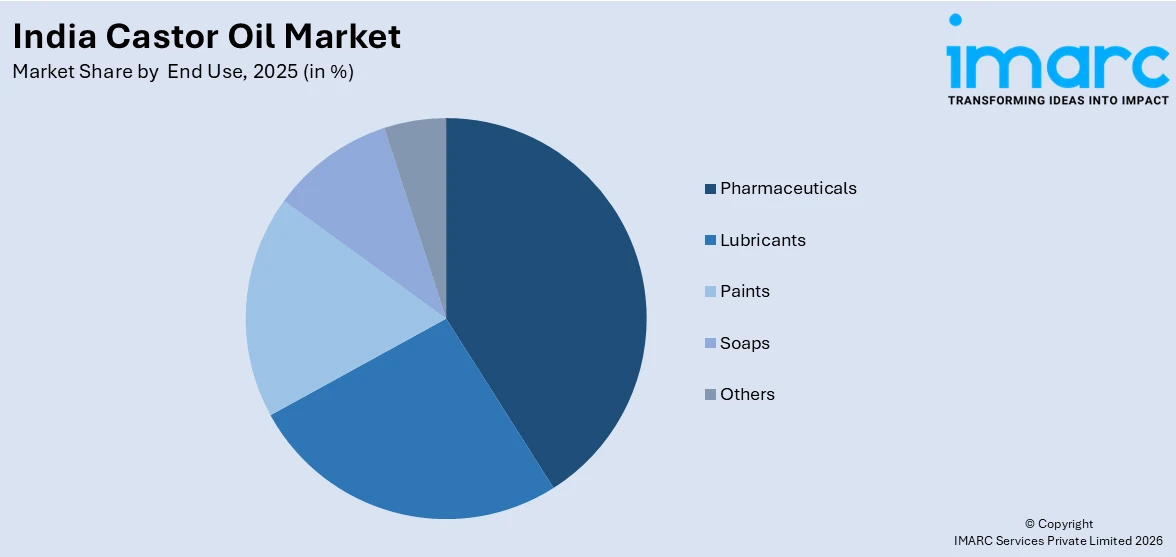
- By End Use: Pharmaceuticals dominate the market with a share of 50% in 2025, driven by the widespread use of castor oil in formulations, laxatives, and cosmetic-pharmaceutical preparations.
- Key Players: The India castor oil market is moderately consolidated, with established processors leading through vertically integrated operations spanning seed crushing, refining, and derivative manufacturing.
The India castor oil market represents a structurally important segment within the country’s agri-based chemical value chain, supported by India’s position as the world’s leading producer and exporter of castor seeds. According to the reports, for 2024-25, India’s castor production is estimated at 15.88 lakh tonnes from 8.28 lakh ha, with Gujarat leading at 12.50 lakh tonnes. Castor oil exports rose to 6.63 lakh tonnes, while seed meal exports declined to 3.00 lakh tonnes. Telangana produced 0.01 lakh tonnes with 789 kg/ha productivity. Supportive agro-climatic factors, a focus on large-scale production in major states, and the presence of processing capacities ensure a stable supply base. Market demand is largely fueled by downstream industries such as lubricants, pharmaceuticals, cosmetics, food additives, and specialty chemicals, in which castor oil is sought after for its biodegradability and superior properties. Exports to North America, Europe, and Asia Pacific have remained a crucial factor in shaping demand volumes, thus reiterating the global competitiveness of the Indian market. However, the price structure continues to be interwoven with the performance of monsoons, seed output variations, and input costs. Advances in processing capabilities, quality, and value-added castor oil derivatives are expected to improve market stability and profitability in the India castor oil market.
India Castor Oil Market Trends:
Rising Demand from Specialty Chemical Applications
The India castor oil market is witnessing an increasing demand from specialty chemical producers. Castor oil derivatives are finding increasing uses in coatings, adhesives, elastomers, surfactants, and performance polymers due to their bio-based nature and functional properties. This trend is encouraging value addition in the supply chain, and processors are finding it essential to focus on refined products and derivatives rather than commodity sales. This, in turn, is increasing profitability, market positioning, and stability of demand in the India castor oil market.
Growing Preference for Bio-Based and Sustainable Inputs
Sustainability is becoming a major growth trend in the India castor oil market. Industries like personal care, pharmaceuticals, and lubricants are increasingly substituting petroleum-based inputs with renewable, biodegradable alternatives. For instance, on July 14, 2025, Jayant Agro-Organics launched SATVA, its flagship sustainability program rooted in Indian ethos and the company’s legacy. SATVA integrates environmental stewardship, ethical practices, and eco-efficient operations across all business functions, engaging employees and value chain partners to promote measurable sustainability, renewable energy adoption, and responsible innovation throughout the castor oil value chain. Castor oil’s non-edible nature and low environmental impact make it highly compatible with global sustainability standards.
Expansion of Export-Oriented Production and Processing Capacity
Export-led growth remains one of the major positive influencing factors for the India castor oil market. Indian manufacturers are increasing their processing capacities and upgrading their refining technology to meet international quality requirements. The increasing demand from the international market is pushing manufacturers to invest in supply chain management, quality, and traceability. This will help India establish itself as a reliable supplier and increase its competitiveness in the international market. Export-led growth is, therefore, making the India castor oil market more competitive.
Market Outlook 2026-2034:
The Indian castor oil market is expected to grow steadily with increasing domestic demand, strong export demand, and the growing use of sustainable and bio-based applications. Efforts to improve processing efficiency, quality standardization, and value-added derivatives are expected to improve competitiveness and margins. Although the supply chain is tied to climatic and seed availability factors, modernization and the growing end-use industries are expected to offer stability. In general, the market outlook suggests a stable demand growth for castor oil producers and exporters. The market size was estimated at 103.8 Kilo Tons in 2025 and is expected to reach 109.3 Kilo Tons by 2034.
India Castor Oil Market Report Segmentation:
| Segment Category | Leading Segment | Market Share |
|---|---|---|
|
End Use |
Pharmaceuticals |
50% |
End Use Insights:
Access the comprehensive market breakdown Request Sample
- Pharmaceuticals
- Lubricants
- Paints
- Soaps
- Others
The pharmaceuticals dominate with a market share of 50% of the total India castor oil market in 2025.
The pharmaceuticals segment accounts for the largest share of the India castor oil market, supported by the widespread use of castor oil in drug formulations, excipients, and therapeutic applications. Its chemical stability, high purity, and solubilizing properties make it suitable for oral, topical, and injectable medicines. Growth in pharmaceutical manufacturing is a key driver, with the India pharmaceutical manufacturing market reaching USD 19.25 billion in 2024 and projected by IMARC Group to reach USD 35.13 billion by 2033, reinforcing sustained demand for pharmaceutical-grade castor oil.
The growth of this market is further aided by increasing investments in generic drugs, contract manufacturing, and active pharmaceutical ingredient production. Castor oil derivatives are being increasingly used as carriers and solubilizers in advanced formulations, which enhance bioavailability and efficacy. The increasing healthcare spending and advancements in the pharmaceutical sector will ensure that the pharmaceuticals segment maintains its leading position in the India castor oil market.
Regional Insights:
- North India
- West and Central India
- South India
- East India
Demand in North India is sustained by pharmaceutical manufacturing, industrial lubricants, and food processing. Demand is fueled by the development of the healthcare infrastructure and organized industrialization, with the region being dependent on inter-regional supplies from the western producing states due to limited domestic production.
West and Central India represent the main market for the India castor oil market, driven by concentrated castor seed production, large-scale processing, and export-oriented infrastructure. Strong farmer ties, low-cost production, and easy access to ports further consolidate the region’s dominance in both domestic and export markets.
South India experiences increasing castor oil demand from pharmaceutical, personal care, and specialty chemical manufacturing. The region is driven by industrialization, formulation unit expansions, and an increasing focus on value-added applications, despite having relatively lower production of castor oil compared to the western regions.
The East India market is smaller but is gradually expanding, driven by the development of the pharmaceutical and industrial sector. The region has limited castor oil production and processing infrastructure, making it more dependent on supplies from other regions to fulfil domestic demand.

Market Dynamics:
Growth Drivers:
Why is the India Castor Oil Market Growing?
Strong Agricultural Base and Seed Availability
The India castor oil market is supported by a robust agricultural ecosystem, with favorable soil conditions, region-specific hybrids, and extensive farmer expertise in castor cultivation. High crop resilience and consistent seed availability ensure a reliable raw material supply for processors. Stable cultivation acreage and the adoption of improved farming practices reduce the risk of supply disruptions, allowing processors to maintain optimal operating rates. This dependable domestic supply enables long-term capacity planning, minimizes reliance on imports, and supports the sustained growth and stability of the India castor oil market.
Expanding Domestic End-Use Consumption Base
Rising domestic consumption across pharmaceuticals, personal care, food processing, and industrial lubricants is driving robust demand growth in the India castor oil market. The personal care segment is a key contributor, with the India personal care ingredients market reaching USD 487.8 million in 2025 and projected by IMARC Group to reach USD 795.1 million by 2034. Rapid urbanization, rising healthcare expenditure, and expanding organized manufacturing are steadily increasing local offtake. This strengthening domestic demand reduces reliance on volatile export markets, enhances diversification, supports volume absorption during global slowdowns, and reinforces long-term market resilience and competitiveness.
Cost Competitiveness and Processing Efficiency
India’s inherent cost advantages remain a key growth driver for the India castor oil market. Low cultivation expenses, affordable labor, and economies of scale in processing enable domestic producers to supply competitively priced castor oil to global markets. Well-established clusters of crushers and refiners minimize logistics challenges and improve operational efficiency. This cost-effective production framework ensures steady demand from price-sensitive international buyers, enhances India’s export competitiveness, and reinforces its leadership in the global castor oil trade. Efficient supply chains further support scalability and long-term market growth.
Market Restraints:
What Challenges the India Castor Oil Market is Facing?
Price Volatility of Castor Seeds
Fluctuations in castor seed prices, driven by monsoon variability, crop yield uncertainties, and input cost changes, pose a significant challenge to the India castor oil market. Sudden price spikes increase production costs for refiners and downstream industries, affecting profitability and sometimes leading to supply-demand imbalances. This volatility creates planning and financial risks for both producers and end-users.
Dependence on Monsoon and Climatic Conditions
Castor cultivation in India is heavily rain-dependent, making the market vulnerable to erratic monsoon patterns, droughts, and extreme weather events. Unfavorable climatic conditions can reduce seed yield, disrupt raw material availability, and lead to temporary supply shortages. This dependency on natural factors constrains consistent production and affects both domestic consumption and export commitments.
Limited Technological Adoption in Processing
Many castor oil processors in India still rely on traditional extraction and refining methods, limiting efficiency and product quality. Inadequate mechanization, suboptimal yield recovery, and inconsistent quality standards hinder competitiveness, especially in premium export markets. This constraint slows market expansion, reduces profit margins, and creates challenges in meeting growing demand for high-purity, value-added castor oil derivatives.
Competitive Landscape:
The India castor oil market is highly competitive, characterized by the presence of both established domestic players and regional processors. Leading manufacturers focus on expanding processing capacities, enhancing product quality, and diversifying into value-added derivatives to differentiate themselves. Strong supply chain networks, backward integration with seed sourcing, and compliance with international quality standards are key factors shaping competition. Export-oriented strategies further intensify rivalry, with companies vying for global market share. Smaller players face challenges in technology adoption and cost efficiency, making partnerships and consolidation common strategies to maintain competitiveness and sustain growth in the market.
Recent Developments:
- In February 2026, the US and India agreed to cut tariffs on Indian imports, including castor oil products, from 50% to 18%. Announced by Donald Trump, the move eases trade tensions and supports US industries reliant on India, which supplies about 97% of US castor oil demand.
- In July 2025, Arkema launched the Castor Farmer Education Fund in India to support sustainable farming. Managed with TTFA and Solidaridad, the initiative aims to train 100,000–150,000 farmers by 2030, promoting resilient practices, improved livelihoods, and environmental stewardship across castor-growing regions, engaging stakeholders across the value chain.
India Castor Oil Market Report Coverage:
| Report Features | Details |
|---|---|
| Base Year of the Analysis | 2025 |
| Historical Period | 2020-2025 |
| Forecast Period | 2026-2034 |
| Units | '000 Tons |
| Scope of the Report |
Exploration of Historical Trends and Market Outlook, Industry Catalysts and Challenges, Segment-Wise Historical and Future Market Assessment:
|
| End Uses Covered | Pharmaceuticals, Lubricants, Paints, Soaps, Others |
| Region Covered | North India, West and Central India, South India, East India |
| Customization Scope | 10% Free Customization |
| Post-Sale Analyst Support | 10-12 Weeks |
| Delivery Format | PDF and Excel through Email (We can also provide the editable version of the report in PPT/Word format on special request) |
Frequently Asked Questions About the India Castor Oil Market Report
The India castor oil market reached a volume of 103.8 Kilo Tons in 2025.
The India castor oil market is expected to reach 109.3 Kilo Tons by 2034.
Pharmaceuticals holds the largest share at 50%, driven by the widespread application of castor oil in drug formulations, topical preparations, cosmetics, and health supplements, leveraging its antibacterial and anti-inflammatory properties.
Key factors driving the India castor oil market include India’s dominant global supply position, expanding pharmaceutical and personal care applications, growing demand for bio-based industrial derivatives, supportive government oilseed policies, and strong international export demand.
Major challenges include climate vulnerability affecting rainfed castor cultivation, price volatility driven by seasonal supply fluctuations and speculative trading and limited domestic capacity for advanced value-added derivative processing.
Need more help?
- Speak to our experienced analysts for insights on the current market scenarios.
- Include additional segments and countries to customize the report as per your requirement.
- Gain an unparalleled competitive advantage in your domain by understanding how to utilize the report and positively impacting your operations and revenue.
- For further assistance, please connect with our analysts.
 Request Customization
 Speak to an Analyst
 Request Brochure
 Inquire Before Buying
Benefits of Customization
- Personalize this research
- Triangulate with your data
- Get data as per your format and definition
- Gain a deeper dive into a specific application, geography, customer, or competitor
- Any level of personalization
Get in Touch With Us
UNITED STATES
Phone: +1-201-971-6302
INDIA
Phone: +91-120-433-0800
UNITED KINGDOM
Phone: +44-753-714-6104
Email: [email protected]
Client Testimonials




.webp)




.webp)













Related Reports

Choose your plan
*Please note that the prices mentioned below are starting prices for each bundle type. Kindly contact our team for further details.*
Single User License
- 1 User License, Access on 2 Devices
- PDF Report + Excel Dataset (Password Protected)
- Lifetime Access
- No Printing Rights
- 10% Free Report Customization
- 10–12 Weeks of Analyst Support
Five User License
- Access for 5 Users, 2 Devices per User
- PDF Report + Excel Dataset (Password Protected)
- Lifetime Access
- Dedicated Account Manager
- 12–14 Weeks of Analyst Support
- No Printing Rights
- 15% Free Report Customization
- 25% Discount on Your Next Purchase
Corporate User License
- Unlimited User Access (Within Your Organization)
- PDF Report + Excel Dataset
- Lifetime Access
- Dedicated Account Manager
- 14–20 Weeks of Analyst Support
- No Printing Rights
- 20% Free Report Customization
- 30% Discount on Your Next Purchase
Essential Insights
What's included:
3 reports
- Lifetime Access
- PDF Reports
- Excel Datasets
- 2 Weeks of Free Analyst Support
- 2 User Licenses
- Access on 2 Devices
- Printing Rights
- Complimentary PowerPoint (PPT) Version
- Complimentary License Upgrade
Professional Access
What's included:
5 reports
- Lifetime Access
- PDF Reports
- Excel Datasets
- 8 Weeks of Free Analyst Support
- 2 User Licenses
- Access on 2 Devices
- Printing Rights
- Complimentary PowerPoint (PPT) Version
- Complimentary License Upgrade
Business Advantage
What's included:
8 reports
- Lifetime Access
- PDF Reports
- Excel Datasets
- 14 Weeks of Free Analyst Support
- 2 User Licenses
- Access on 2 Devices
- Printing Rights
- Complimentary PowerPoint (PPT) Version
- Complimentary License Upgrade
Enterprise Intelligence
What's included:
10 reports
- Lifetime Access
- PDF Reports
- Excel Datasets
- 20 Weeks of Free Analyst Support
- 2 User Licenses
- Access on 2 Devices
- Printing Rights
- Complimentary PowerPoint (PPT) Version
- Complimentary License Upgrade