
India Child Care Services Market Size, Share, Trends and Forecast by Delivery Type and Region, 2026-2034
India Child Care Services Market Size, Share, Trends & Forecast (2026-2034)
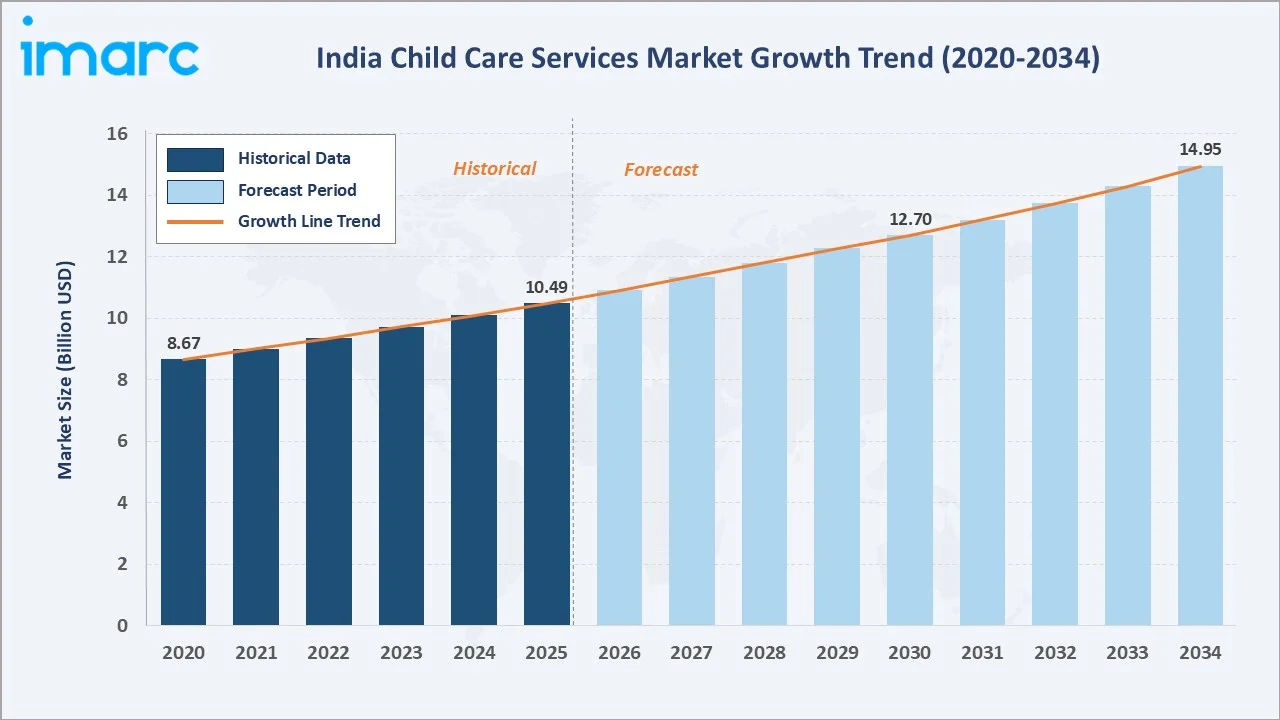
The India child care services market reached USD 10.49 Billion in 2025 and is projected to reach USD 14.95 Billion by 2034, growing at a CAGR of 3.89% during 2026-2034. The market is driven by rising dual-income households, rapid urbanization, nuclear family structures, and heightened awareness of early childhood development. According to the Economic Survey 2024-25, India’s female labor force participation rate increased substantially from 23.3% in 2017-18 to 41.7% in 2023-24. This rising workforce participation is strengthening the India child care services market, as a growing number of working mothers require reliable and accessible child care support during working hours. Center-based leads at 64.5% of the delivery type (2025). North India leads regionally at 31.5% (2025).
Market Snapshot
|
Metric |
Value |
|
Market Size (2025) |
USD 10.49 Billion |
|
Forecast Market Size (2034) |
USD 14.95 Billion |
|
CAGR (2026-2034) |
3.89% |
|
Base Year |
2025 |
|
Historical Period |
2020-2025 |
|
Forecast Period |
2026-2034 |
|
Dominant Delivery Type |
Center-Based (64.5%, 2025) |
|
Leading Region |
North India (31.5%, 2025) |
The India child care services market has demonstrated steady growth, increasing from USD 8.67 Billion in 2020 to USD 10.49 Billion in 2025, reflecting expanding organized care infrastructure across urban India. The market is projected to reach USD 12.70 Billion by 2030 and further grow to USD 14.95 Billion by 2034, supported by increasing parental investment in professional child care, growing EdTech integration, and expanding center-based service networks across Tier-1 and Tier-2 cities.
To get more information on this market, Request Sample
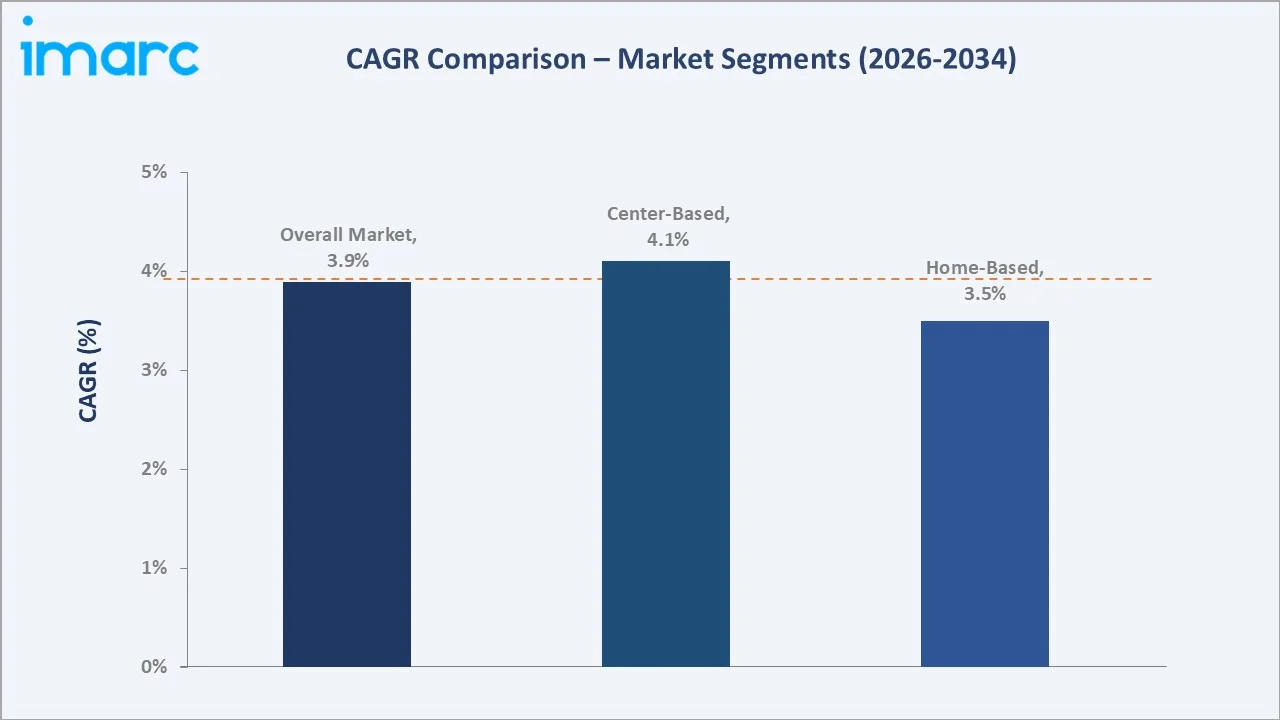
Center-based services grow at ~4.1% CAGR through expanding organized preschool chains, franchise models, and curriculum-driven daycare centers. Home-based services grow at ~3.5% CAGR through demand from families seeking personalized, flexible care arrangements. Overall market CAGR of 3.89% reflects steady, demographically driven structural demand growth.
Executive Summary
Child care in India is experiencing steady growth driven by fundamental shifts in India's socioeconomic structure. The rapid rise of nuclear families, increasing female labor force participation and accelerating urbanization have collectively created strong demand for organized, professional child care solutions. Working parents in metropolitan and Tier-1 cities are prioritizing safe, structured, and developmentally enriching environments for their children, fueling adoption of both center-based and home-based child care services. Center-based services lead the delivery type at 64.5%. North India leads regionally at 31.5% (2025).
Key Market Insights
|
Insight |
Data |
|
Dominant Delivery Type |
Center-Based - 64.5% share (2025) |
|
Leading Region |
North India - 31.5% share (2025) |
|
Market Opportunity |
Premium center expansion; EdTech integration; Tier-2/3 city penetration; home-based aggregator platforms |
Key Analytical Observations Supporting the Above Data:
- Center-Based at 64.5%: Center-based child care dominates due to parental preference for structured environments offering professional educators, peer socialization, age-appropriate curricula, and safety-compliant facilities across daycare, preschool, and after-school program formats.
- North India at 31.5%: North India leads regionally, driven by high urban density in Delhi-NCR, rapid growth of organized child care chains in metropolitan areas, and strong government-backed Anganwadi infrastructure under ICDS programs.
India Child Care Services Market Overview
The India child care services market encompasses a broad range of organized and semi-organized services providing professional care, supervision, and early education for children aged 0-12 years. It includes center-based services such as daycare centers, preschools, crèches, and after-school programs, as well as home-based services including nanny services, in-home daycare, and au pair arrangements. The market serves dual-income households, single-parent families, and working parents across urban, semi-urban, and rural geographies. Macro-level enablers include rising female workforce participation, expanding franchise-based child care chains, and growing parental investment in holistic early childhood development.
Market Dynamics
To evaluate market opportunities, Request Sample
Market Drivers
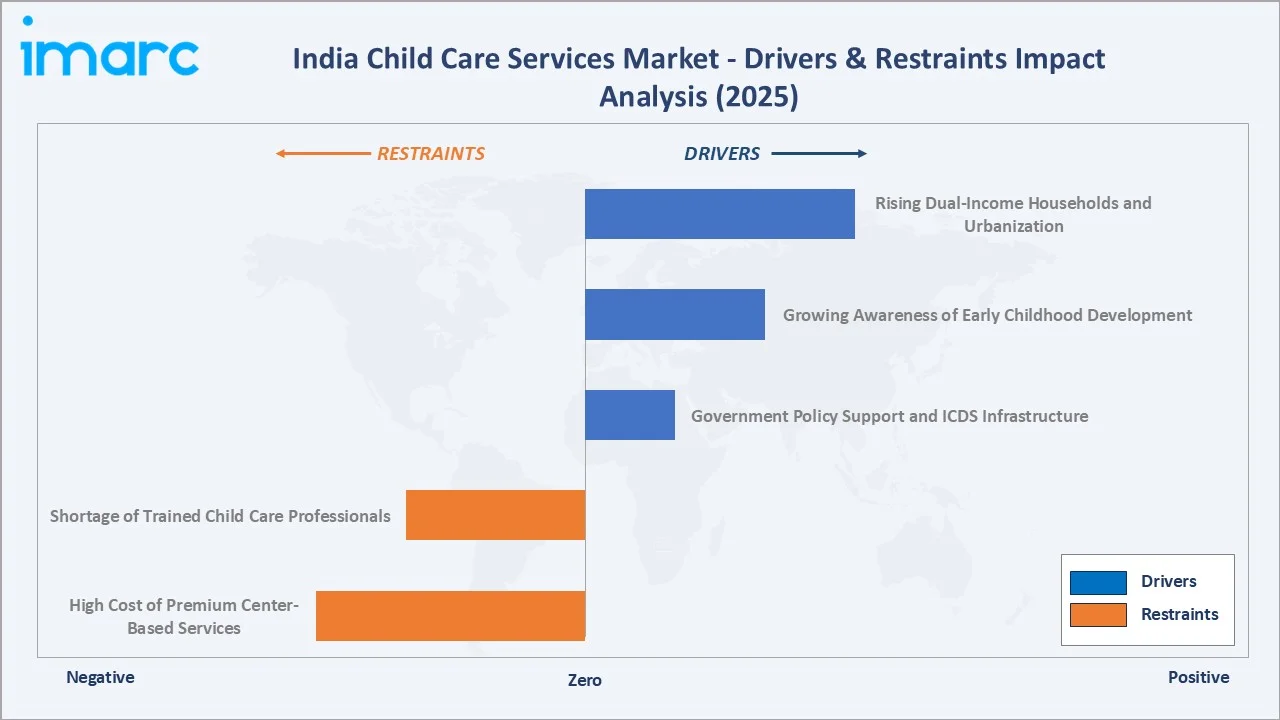
- Rising Dual-Income Households and Urbanization: According to the Economic Survey 2024-25, India’s female labor force participation rate increased significantly, rising from 23.3% in 2017-18 to 41.7% in 2023-24. India's rapid urbanization and increasing female labor force participation have significantly expanded the addressable market for organized child care services. Nuclear families in metropolitan cities like Mumbai, Delhi, and Bengaluru increasingly require reliable, professional child care arrangements, driving demand for both daycare centers and premium home-based care services.
- Growing Awareness of Early Childhood Development: Nearly 38% of Indian children under five are stunted, while gaps in pre-primary education quality leave around 20 million marginalized children without adequate preschool access, affecting their growth and development. Modern Indian parents, particularly from the millennial generation, demonstrate heightened awareness of the importance of early childhood education and holistic development.
- Government Policy Support and ICDS Infrastructure: The Indian government's sustained investment in Integrated Child Development Services (ICDS), operating over 1.3 million Anganwadi centers across India, provides foundational child care infrastructure.
Market Restraints
- High Cost of Premium Center-Based Services: Premium child care centers in metropolitan cities charge premium monthly fees per child, placing organized center-based services beyond the reach of middle- and lower-income families. This affordability gap limits market penetration in non-metropolitan geographies and constrains overall demand growth for organized child care services.
- Shortage of Trained Child Care Professionals: India faces a significant shortage of formally trained early childhood educators, caregivers, and child development specialists. High staff attrition rates, low-wage structures, and limited professional training programs constrain service quality and scalability for organized child care providers.
Market Opportunities
- Tier-2 and Tier-3 City Expansion: Emerging urban centers across Tier-2 and Tier-3 cities, including Jaipur, Pune, Coimbatore, and Bhopal, represent significant under-penetrated markets for organized child care services. Rising disposable incomes and growing aspirational parenting culture in these cities create high-growth expansion opportunities for established child care brands.
- Technology Integration and EdTech-Enabled Care: EdTech platforms, digital monitoring tools, and AI-driven curriculum personalization represent substantial growth opportunities for premium child care providers. Apps enabling real-time parent updates, digital progress tracking, and online activity logs are increasingly differentiating premium services.
Market Challenges
- Regulatory Fragmentation and Compliance Complexity: Child care services in India are governed by a complex mix of central and state-level regulations and building safety codes. Navigating inconsistent regulatory frameworks across states creates compliance complexity for multi-location child care operators seeking pan-India expansion.
- Informal Sector Competition: A large unorganized informal child care sector comprising neighborhood crèches, unregistered daycare facilities, and domestic worker arrangements competes directly with organized providers on price, constraining pricing power particularly in semi-urban and rural markets.
Emerging Market Trends
1. Premium Center-Based Service Expansion
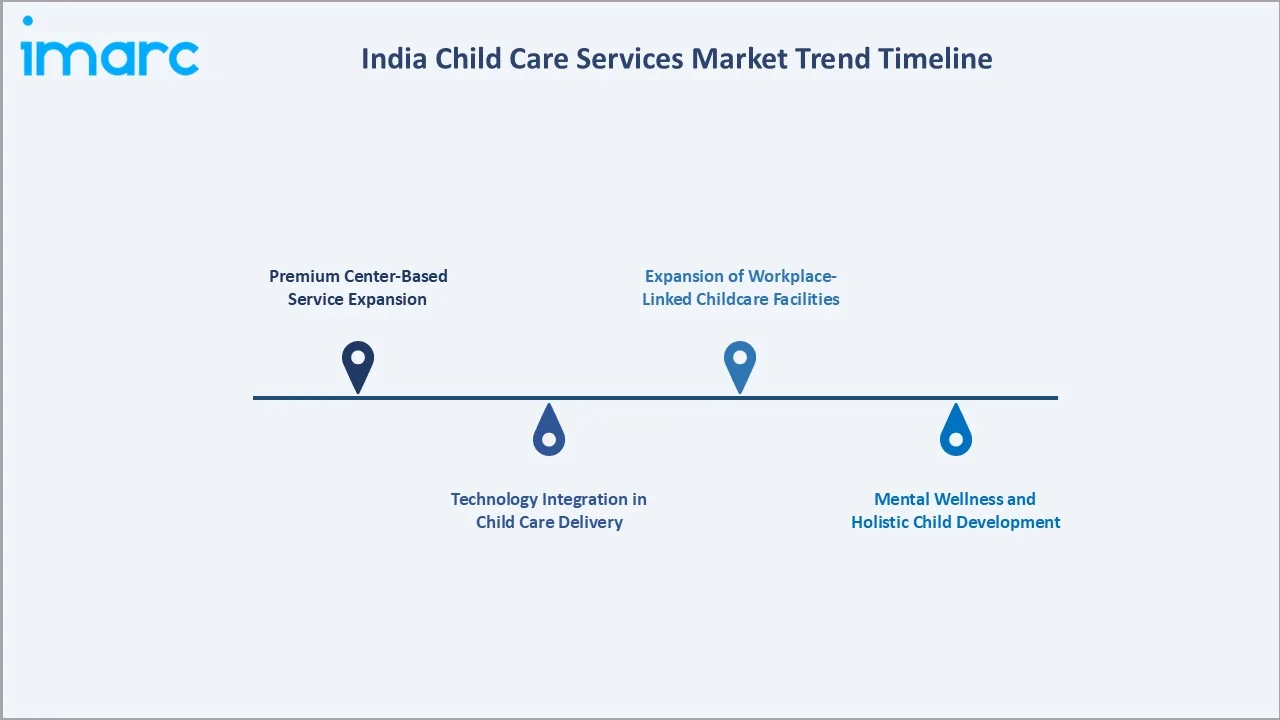
Organized child care chains are aggressively expanding their premium center-based networks across India's metropolitan and Tier-1 cities. Brands are scaling franchise models with standardized curriculum, safety protocols, and trained educators. Premium centers offering Montessori, Reggio Emilia, and play-based learning approaches command higher fee premiums and are driving the center-based market dominance.
2. Technology Integration in Child Care Delivery
EdTech and digital monitoring platforms are becoming essential features of premium child care centers. Real-time parent communication apps, digital learning management systems, CCTV monitoring, and AI-driven developmental assessment tools are increasingly embedded into service offerings. Digital-first child care startups are emerging to serve tech-savvy urban parents seeking transparent, data-driven child care experiences.
3. Expansion of Workplace-Linked Childcare Facilities
In March 2026, the Association of Lady Entrepreneurs of India (ALEAP) inaugurated the UNDP-supported ALEAP Aarohi Childcare Center at the ALEAP Industrial Estate in Pragathinagar. The facility is part of the UNDP-backed “Boosting Female Labor Force Participation through Strengthened Urban Care Ecosystem” project and aims to provide working women with safe, affordable, and reliable childcare services close to their workplaces. The launch highlights a growing trend toward establishing childcare centers within or near industrial estates and workplaces. Such facilities are helping employers and institutions improve childcare accessibility, support working mothers, and encourage higher female workforce participation.
4. Mental Wellness and Holistic Child Development
Growing parental awareness of children's mental health and social-emotional learning is driving demand for child care services extending beyond academic preparation. Providers incorporating structured wellness activities, mindfulness programs, creative arts, and physical activity modules are gaining significant traction among educated urban parents.
Industry Value Chain Analysis
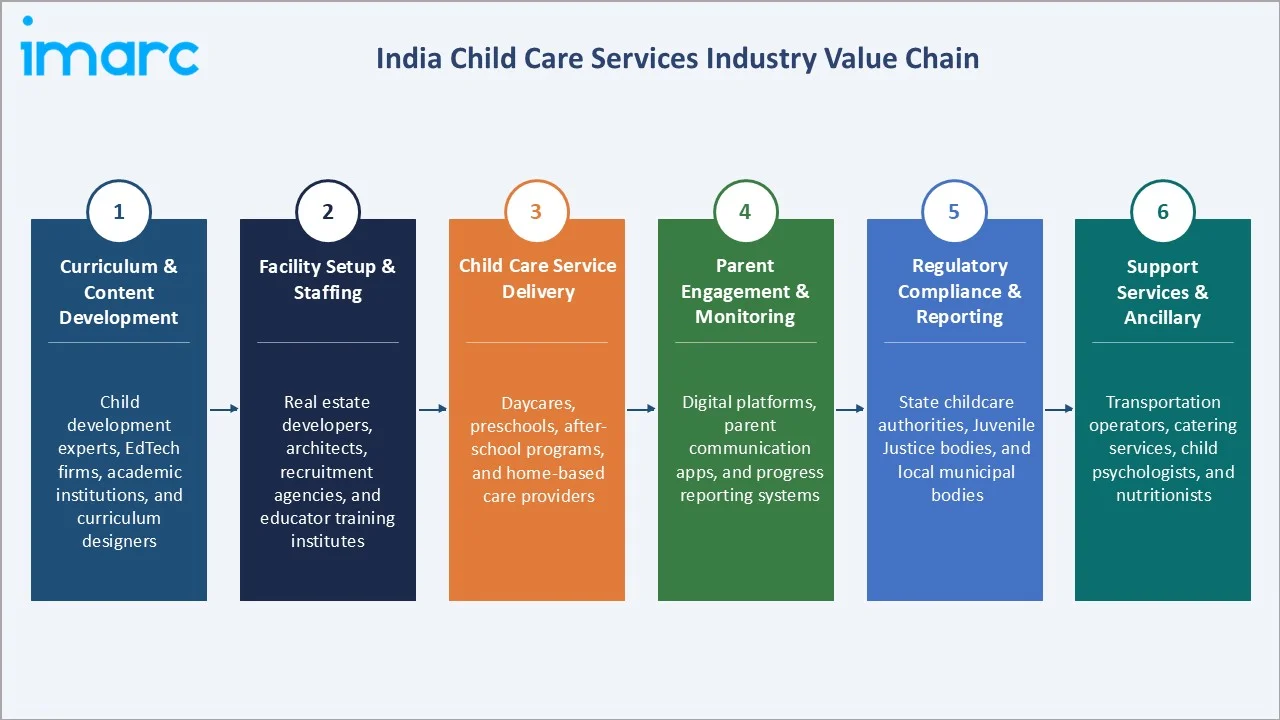
The India child care services value chain spans curriculum and content development, facility setup and staffing, direct child care service delivery, parent engagement and progress monitoring, regulatory compliance, and support services. Each stage contributes to the overall quality, safety, and developmental efficacy of the child care service.
|
Stage |
Key Participants |
|
Curriculum & Content Development |
Child development experts, EdTech firms, academic institutions, and curriculum designers. |
|
Facility Setup & Staffing |
Real estate developers, architects, recruitment agencies, and educator training institutes. |
|
Child Care Service Delivery |
Daycares, preschools, after-school programs, and home-based care providers. |
|
Parent Engagement & Monitoring |
Digital platforms, parent communication apps, and progress reporting systems. |
|
Regulatory Compliance & Reporting |
State childcare authorities, Juvenile Justice bodies, and local municipal bodies. |
|
Support Services & Ancillary |
Transportation operators, catering services, child psychologists, and nutritionists. |
Service delivery and parent engagement represent the most value-intensive stages of the child care value chain. Service quality, safety compliance, and curriculum effectiveness are the primary competitive differentiators that determine parent retention and brand premium positioning in India's organized child care market.
Technology Landscape in the India Child Care Services Industry
Parent Communication and Monitoring Technology
Digital parent engagement platforms, including dedicated mobile apps, real-time photo and video updates, daily progress reports, and CCTV monitoring portals, are becoming standard in premium child care centers. These technologies address parental anxiety about child safety and development transparency, driving premium fee justification and improving parent retention rates for organized providers.
Assessment and Child Development Analytics
AI-powered developmental assessment tools enable child care providers to track and report individual children's progress across cognitive, motor, social, and emotional development milestones. Data-driven progress reporting generates parent confidence, supports early intervention for developmental delays, and differentiates technology-enabled centers from informal competitors in India's growing organized child care market.
Mental Wellness Applications
Mental health platforms targeting children's emotional wellness are integrating calming environments, emotional reflection tools, and guided mindfulness activities. These digital wellness solutions represent an emerging service layer complementing traditional child care offerings and addressing growing parental awareness of pediatric mental health.
Market Segmentation Analysis
The report covers the following segments:
|
Segment Category |
Leading Segment |
Market Share |
Year |
|
Delivery Type |
Center-Based |
64.5% |
2025 |
|
Region |
North India |
31.5% |
2025 |

By Delivery Type
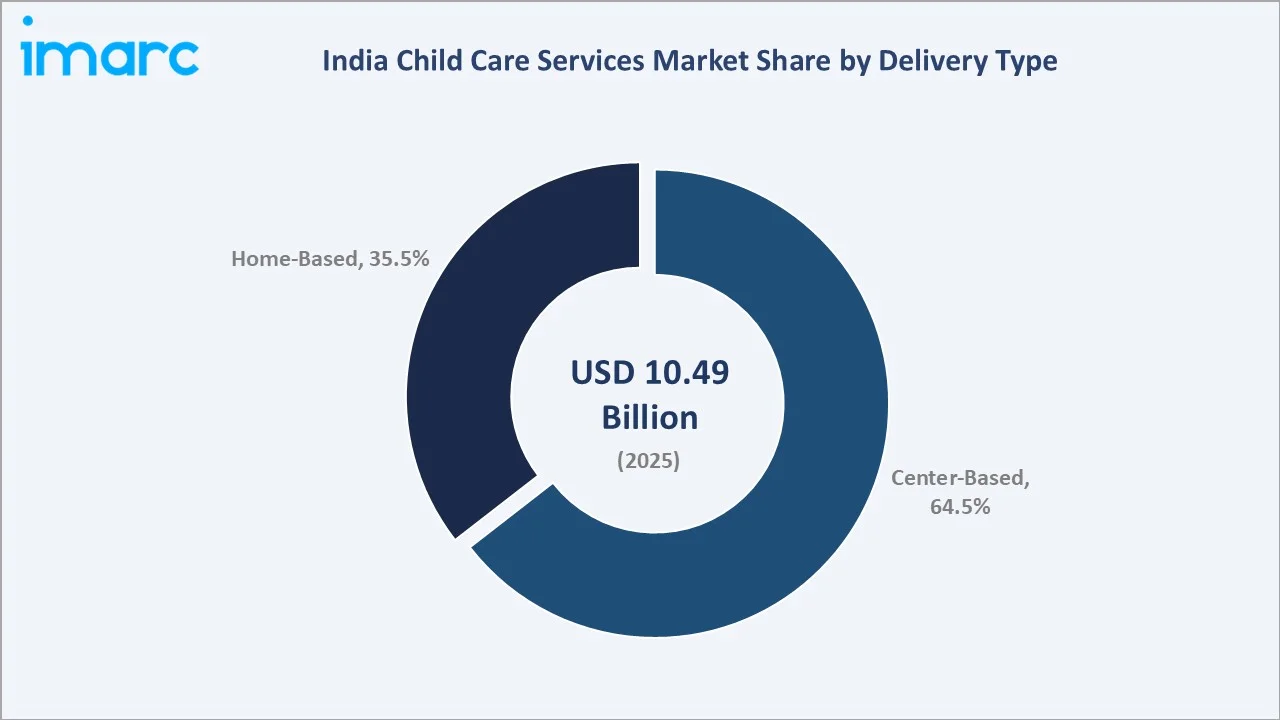
Center-based child care services lead at 64.5% (2025), driven by parental preference for structured environments offering professional educators, peer socialization, age-appropriate curricula, and safety-compliant facilities. Organized preschool chains, franchise daycare networks, and corporate creches collectively dominate this segment, growing at an estimated ~4.1% CAGR through 2034.
To access detailed market analysis, Request Sample
Home-based child care services account for 35.5% (2025), serving families seeking personalized, flexible, and often more affordable care arrangements. Demand is particularly strong in Tier-2 and Tier-3 cities where organized center infrastructure is less developed.
Regional Market Insights
|
Region |
Share (2025) |
Key India Child Care Services Market Drivers & Characteristics |
|
North India |
31.5% |
Reflecting the high urban density in Delhi-NCR and surrounding cities, rapid growth of organized child care chains, strong dual-income household concentration, and robust ICDS Anganwadi infrastructure supporting foundational child care access. |
|
South India |
27.8% |
Reflecting strong female workforce participation, advanced educational awareness, established preschool networks in Bengaluru, Chennai, and Hyderabad, and high disposable income concentration driving premium center-based child care adoption. |
|
West India |
24.6% |
Reflecting the concentration of large corporates and dual-income professional families in Mumbai and Pune, high early childhood development awareness, and expanding employer-sponsored child care programs in BFSI and IT sectors. |
|
East India |
16.1% |
Reflecting improving healthcare and education infrastructure, expanding organized child care presence in Kolkata and Bhubaneswar, and growing awareness of professional child care services among emerging urban middle-class families. |
North India's 31.5% dominance is driven by the concentration of nuclear dual-income households in Delhi-NCR, the country's largest metropolitan area, and the widespread Anganwadi infrastructure complementing private organized child care. South India's 27.8% reflects high female labor force participation, advanced educational culture, and well-established preschool franchise penetration in Bengaluru and Chennai.
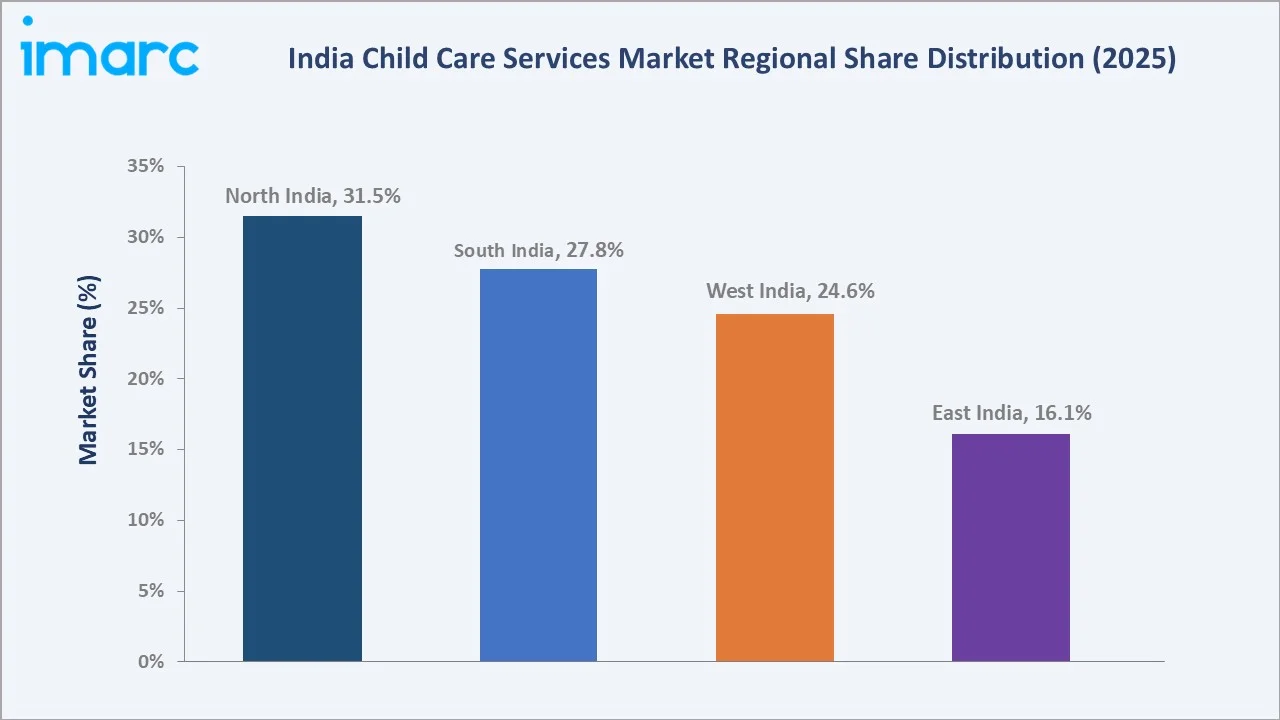
West India's 24.6% share is driven by Mumbai and Pune's large corporate workforce, high disposable incomes, and expanding employer-sponsored child care programs in the IT, BFSI, and pharmaceutical sectors. East India's 16.1% reflects nascent but accelerating growth, with organized child care operators establishing franchises in Kolkata and Tier-2 East Indian cities driven by rising urban middle-class family formation.
Competitive Landscape
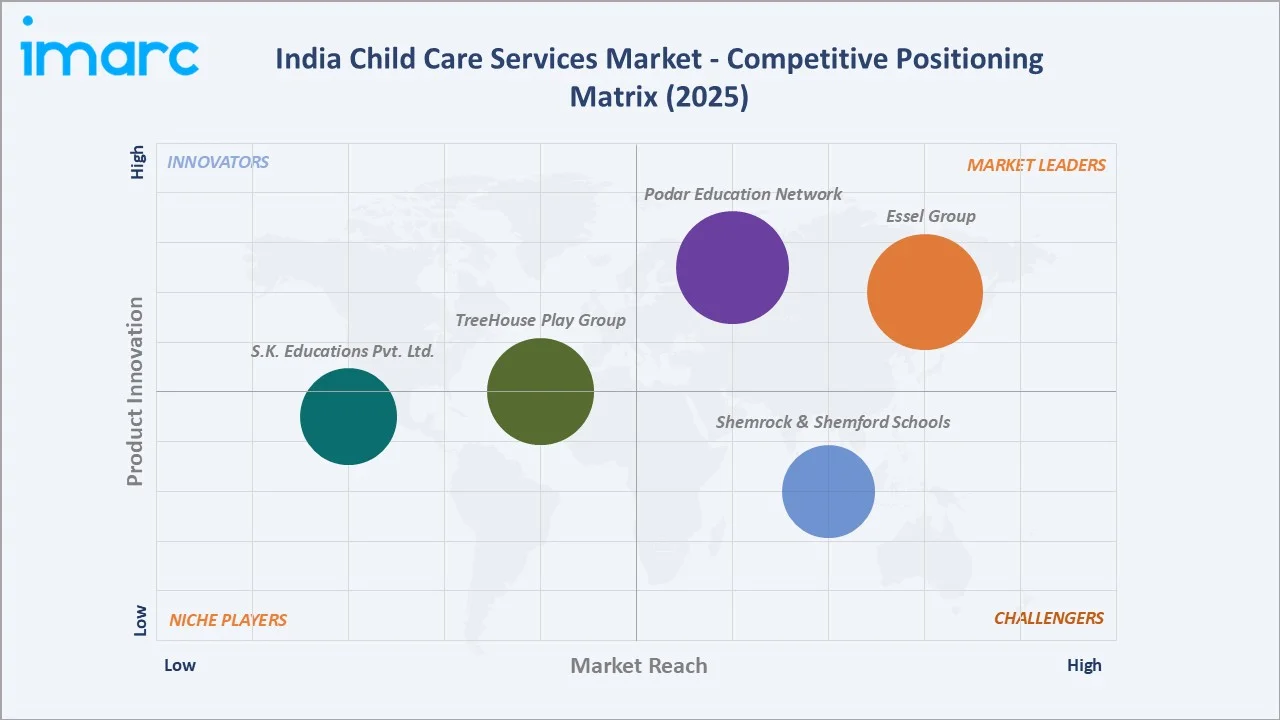
The India child care services market is moderately fragmented, with competition among established national franchise chains, regional organized providers, and a large unorganized informal sector. Market participants compete on curriculum quality, safety standards, facility infrastructure, technology integration, brand trust, and geographic reach. Franchise-based expansion, EdTech integration, and premium service differentiation are the primary competitive strategies deployed by organized players.
|
Company |
Key Offerings |
Market Position |
Core Strength |
|
Essel Group |
Kidzee Preschool, Mount Litera World Preschool |
Market Leader |
Essel Group contributes to India's child care and early childhood space primarily through its education subsidiary, Zee Learn Ltd., by operating a major preschool chain. |
|
Podar Education Network |
Podar Prep (Podar Jumbo Kids) |
Market Leader |
The Podar Education Network provides early childhood care and education in India through a large network of preschools and pre-primary options. |
|
TreeHouse Play Group |
TreeHouse playgroup center, Day Care Services |
Established Player |
TreeHouse Play Group provides early childhood education, preschool programs, and daycare services across India. |
|
Shemrock & Shemford Schools |
Shemrock & Shemford Preschools and Primary Schools |
Challenger |
Shemrock and Shemford provide foundational early childhood education, preschool services, day care, and K-12 schooling. |
|
S.K. Educations Pvt. Ltd. |
Bachpan Play Schools |
Established Player |
S.K. Educations Pvt. Ltd. operates in India's early childhood care and preschool education sector, primarily through its flagship brand Bachpan Play School. |
The competitive landscape is characterized by franchise-driven geographic expansion, curriculum differentiation, and increasing digital integration. Established chains are investing in proprietary EdTech platforms, parent communication apps, and educator development programs. Emerging players are targeting under-penetrated Tier-2 and Tier-3 city markets through affordable franchise models.
Key Company Profiles
Essel Group
Essel Group is a diversified Indian business conglomerate with interests across media, entertainment, education, infrastructure, and consumer-focused services. In the India child care services market, the group’s relevance is primarily linked to its education and learning-oriented businesses, which support early childhood development and preschool-related services. Its broad brand presence, operating experience, and access to a large consumer base provide a foundation for participation in organized child care and early learning services.
- Key Offerings: Kidzee Preschool, Mount Litera World Preschool.
- Strategic Focus: Centers on expanding its preschool and early-learning presence through Zee Learn and Kidzee, supported by franchise-led growth. The strategy emphasizes structured daycare programs, technology-enabled learning, age-appropriate educational content, and stronger parent engagement to enhance early childhood learning and care services.
Podar Education Network
Podar Education Network is a prominent Indian education group with a broad presence across schools, preschools, and early childhood learning services. In the India child care services market, the group participates through its preschool and early education offerings, focusing on structured learning, child development, and safe care environments. Its established education network, standardized curriculum, and strong brand recognition support its position in the organized child care and preschool segment.
- Key Offerings: Podar Prep (Podar Jumbo Kids).
- Strategic Focus: Focuses on expanding its early childhood education footprint through Podar Prep, supported by a network of preschools. Its strategy emphasizes learner-centric education, holistic child development, technology-enabled learning, modern infrastructure, and standardized educational experiences to strengthen its position in India’s organized preschool and child care services market.
Market Concentration Analysis
The India child care services market is moderately fragmented, with organized providers collectively accounting for an estimated 30-35% of total market revenue (2025), while the unorganized sector, comprising informal crèches, unregistered daycare facilities, and domestic worker-based arrangements, captures the majority of the remaining share. Among organized players, the top 5 chains, including Essel Group, Podar Education Network, TreeHouse Play Group, Shemrock & Shemford Schools, and S.K. Educations Pvt. Ltd., account for approximately 15-20% of total organized market activity. The market is expected to witness gradual consolidation through franchise acquisitions, brand partnerships, and private equity-backed expansion of leading organized providers through 2034.
Investment & Growth Opportunities
Highest Growth Segments
Center-based premium preschool expansion in Tier-2 cities (~4.1% CAGR est.), EdTech-enabled child care platform development, employer-sponsored corporate creche programs, and home-based care aggregator platforms represent India's highest-priority investment vectors in child care services through 2034.
Investment Themes
- Tier-2 and Tier-3 City Franchise Expansion: India's Tier-2 and Tier-3 cities represent the most significant under-penetrated growth opportunity in organized child care. Rising urban middle-class formation, improving infrastructure, and growing aspirational parenting culture create strong conditions for affordable franchise-based child care expansion beyond saturated metropolitan markets.
- EdTech and Digital Care Platform Investment: Proprietary parent engagement apps, AI-driven developmental assessment tools, and digital curriculum platforms represent high-value technology investment areas for child care providers seeking premium differentiation and parent retention in India's growing organized child care segment.
Future Market Outlook (2026-2034)
The India child care services market is projected to grow from USD 10.49 Billion in 2025 to USD 14.95 Billion by 2034, delivering a 3.89% CAGR over the forecast period through center-based service expansion, increasing organized sector penetration, EdTech integration, and Tier-2 city market development. The market's anchor value of USD 12.70 Billion in 2030 represents the inflection point at which organized child care chains achieve meaningful penetration across India's secondary urban markets.
Three structural forces are expected to define the India child care services market's trajectory through 2034. First, the continued rise of dual-income nuclear households, driven by increasing female workforce participation, will sustain strong structural demand for professional child care services. Second, technology integration will emerge as the primary competitive differentiator separating premium organized providers from informal competitors. EdTech-enabled curriculum delivery, AI-driven developmental tracking, parent monitoring platforms, and mental wellness digital tools will become standard service expectations among urban middle-class parents. Third, geographic expansion into Tier-2 and Tier-3 cities will drive the next phase of market growth.
Research Methodology
Primary Research
Primary research comprised in-depth interviews with senior executives and operators from preschool chains, daycare centers, home-based care service providers, EdTech companies, child development specialists, regulatory officials, and industry consultants. These discussions validated market size estimates, assessed delivery type and regional growth dynamics, evaluated competitive positioning, and gathered qualitative insights on parent preferences, regulatory developments, and technology adoption trends.
Secondary Research
Secondary research encompassed company annual reports, franchise disclosure documents, government ICDS program data, academic early childhood development research, industry databases, press releases, and reputed market intelligence publications. These resources were used to analyze market trends, competitive positioning, policy developments, and regional market dynamics across India's child care services sector.
Forecasting Models
Forecasting models were developed using a combination of historical market data (2020-2025), demographic trends including urbanization rates and female workforce participation, franchise expansion pipeline data, government policy impact assessments, and macroeconomic household income projections. The analysis incorporated both top-down and bottom-up approaches, validated through primary research, to generate reliable market forecasts through 2034.
India Child Care Services Market Report Coverage:
| Report Features | Details |
|---|---|
| Base Year of the Analysis | 2025 |
| Historical Period | 2020-2025 |
| Forecast Period | 2026-2034 |
| Units | Billion USD |
| Scope of the Report |
Exploration of Historical Trends and Market Outlook, Industry Catalysts and Challenges, Segment-Wise Historical and Future Market Assessment:
|
| Delivery Types Covered | Center-Based, Home-Based |
| Regions Covered | North India, South India, East India, West India |
| Companies Covered | Essel Group, Podar Education Network, TreeHouse Play Group, Shemrock & Shemford Schools, S.K. Educations Pvt. Ltd., etc. |
| Customization Scope | 10% Free Customization |
| Post-Sale Analyst Support | 10-12 Weeks |
| Delivery Format | PDF and Excel through Email (We can also provide the editable version of the report in PPT/Word format on special request) |
Key Benefits for Stakeholders:
- IMARC’s industry report offers a comprehensive quantitative analysis of various market segments, historical and current market trends, market forecasts, and dynamics of the India child care services market from 2020-2034.
- The research report provides the latest information on the market drivers, challenges, and opportunities in the India child care services market.
- Porter's five forces analysis assist stakeholders in assessing the impact of new entrants, competitive rivalry, supplier power, buyer power, and the threat of substitution. It helps stakeholders to analyze the level of competition within the India child care services industry and its attractiveness.
- Competitive landscape allows stakeholders to understand their competitive environment and provides an insight into the current positions of key players in the market.
Frequently Asked Questions About the India Child Care Services Market Report
The India child care services market reached USD 10.49 Billion in 2025, driven by rising dual-income households, rapid urbanization, growing early childhood development awareness, and expanding organized center-based child care networks across India.
The market is projected to grow at a CAGR of 3.89% during 2026-2034, reaching USD 14.95 Billion by 2034, supported by female workforce participation growth, EdTech integration, and Tier-2 city market expansion.
Center-based services lead at 64.5% (2025) due to parental preference for structured, professionally managed environments offering curriculum-driven early education, peer socialization, and safety compliance, delivered through organized preschool and daycare chains across India.
North India leads at 31.5% (2025), driven by high urban density in Delhi-NCR, strong dual-income household concentration, rapid organized chain expansion, and extensive government Anganwadi infrastructure under the ICDS program.
Leading companies include Essel Group, Podar Education Network, TreeHouse Play Group, Shemrock & Shemford Schools, and S.K. Educations Pvt. Ltd., among others.
The market is projected to reach approximately USD 12.70 Billion by 2030, reflecting steady expansion in organized center-based service networks, increasing EdTech integration across premium centers, and growing penetration of Tier-2 and Tier-3 city markets across India.
Key drivers include rising dual-income households and female workforce participation, rapid urbanization and nuclear family formation, growing early childhood development awareness, government ICDS infrastructure, and increasing parental investment in professional child care services.
Primary challenges include high cost of premium center-based services limiting affordability, shortage of formally trained child care professionals, regulatory fragmentation across states, and competition from the large unorganized informal sector offering lower-cost alternatives to organized providers.
Priority investment opportunities include franchise-based Tier-2 and Tier-3 city expansion for organized chains, EdTech and parent engagement platform development, employer-sponsored corporate creche programs, home-based care aggregator platforms, and private equity-backed consolidation of organized child care providers.
Need more help?
- Speak to our experienced analysts for insights on the current market scenarios.
- Include additional segments and countries to customize the report as per your requirement.
- Gain an unparalleled competitive advantage in your domain by understanding how to utilize the report and positively impacting your operations and revenue.
- For further assistance, please connect with our analysts.
 Request Customization
 Speak to an Analyst
 Request Brochure
 Inquire Before Buying
Benefits of Customization
- Personalize this research
- Triangulate with your data
- Get data as per your format and definition
- Gain a deeper dive into a specific application, geography, customer, or competitor
- Any level of personalization
Get in Touch With Us
UNITED STATES
Phone: +1-201-971-6302
INDIA
Phone: +91-120-433-0800
UNITED KINGDOM
Phone: +44-753-714-6104
Email: [email protected]
Client Testimonials




.webp)




.webp)













Related Reports

Choose your plan
*Please note that the prices mentioned below are starting prices for each bundle type. Kindly contact our team for further details.*
Single User License
- 1 User License, Access on 2 Devices
- PDF Report + Excel Dataset (Password Protected)
- Lifetime Access
- No Printing Rights
- 10% Free Report Customization
- 10–12 Weeks of Analyst Support
Five User License
- Access for 5 Users, 2 Devices per User
- PDF Report + Excel Dataset (Password Protected)
- Lifetime Access
- Dedicated Account Manager
- 12–14 Weeks of Analyst Support
- No Printing Rights
- 15% Free Report Customization
- 25% Discount on Your Next Purchase
Corporate User License
- Unlimited User Access (Within Your Organization)
- PDF Report + Excel Dataset
- Lifetime Access
- Dedicated Account Manager
- 14–20 Weeks of Analyst Support
- No Printing Rights
- 20% Free Report Customization
- 30% Discount on Your Next Purchase
Essential Insights
What's included:
3 reports
- Lifetime Access
- PDF Reports
- Excel Datasets
- 2 Weeks of Free Analyst Support
- 2 User Licenses
- Access on 2 Devices
- Printing Rights
- Complimentary PowerPoint (PPT) Version
- Complimentary License Upgrade
Professional Access
What's included:
5 reports
- Lifetime Access
- PDF Reports
- Excel Datasets
- 8 Weeks of Free Analyst Support
- 2 User Licenses
- Access on 2 Devices
- Printing Rights
- Complimentary PowerPoint (PPT) Version
- Complimentary License Upgrade
Business Advantage
What's included:
8 reports
- Lifetime Access
- PDF Reports
- Excel Datasets
- 14 Weeks of Free Analyst Support
- 2 User Licenses
- Access on 2 Devices
- Printing Rights
- Complimentary PowerPoint (PPT) Version
- Complimentary License Upgrade
Enterprise Intelligence
What's included:
10 reports
- Lifetime Access
- PDF Reports
- Excel Datasets
- 20 Weeks of Free Analyst Support
- 2 User Licenses
- Access on 2 Devices
- Printing Rights
- Complimentary PowerPoint (PPT) Version
- Complimentary License Upgrade