
India Cinema Advertising Market Size, Share, Trends and Forecast by Type and Region, 2026-2034
India Cinema Advertising Market Size, Share, Trends & Forecast (2026-2034)
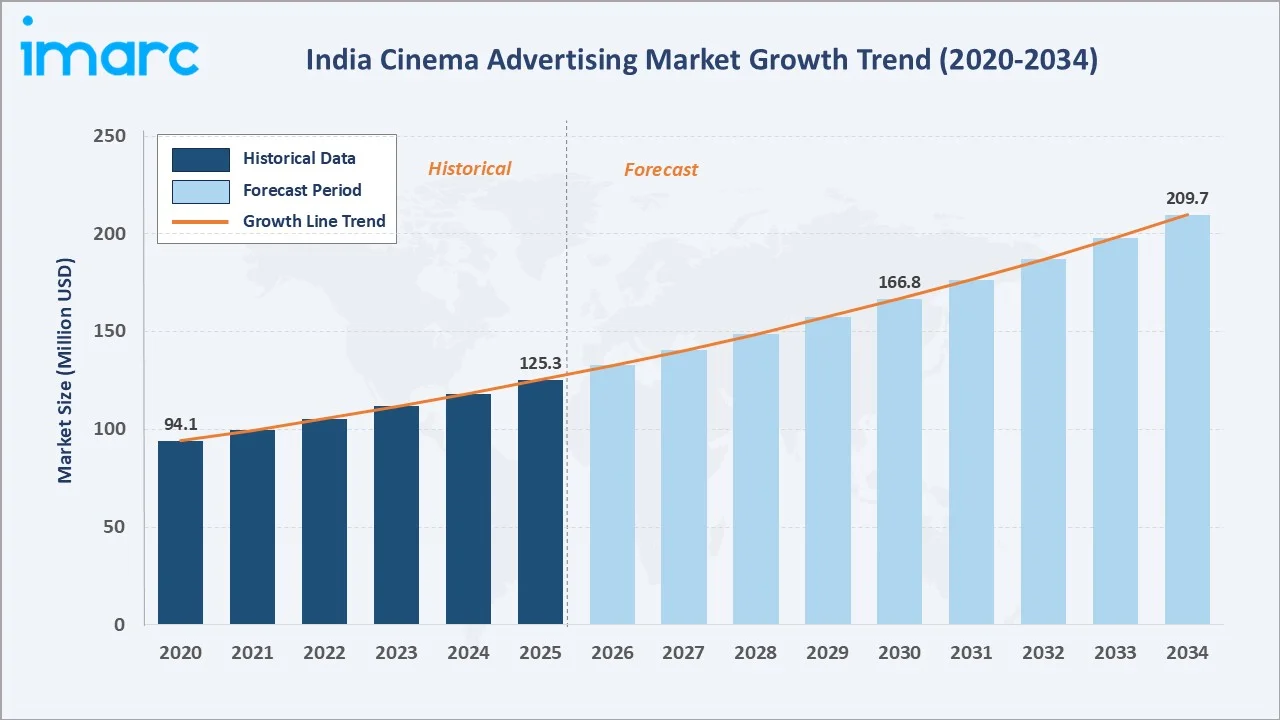
The India cinema advertising market grew from USD 125.3 Million in 2025 to USD 132.7 Million in 2026 and is projected to reach USD 209.7 Million by 2034, exhibiting a steady CAGR of 5.89% during 2026-2034. In India, more than 307,000 admissions were recorded across 13,879 tracked shows, generating nearly ₹5.38 crore in gross box-office collections. Average nationwide occupancy stood at 9.17%, while the average ticket price was approximately ₹175.32 per admission. Higher admissions and ticket spending improve advertiser access to captive audiences, strengthen demand for on-screen ads, lobby branding, and integrated cinema promotional campaigns. On-screen advertising leads at 82.4%, and West India commands the largest regional share at 31.4%.
Market Snapshot
|
Metric |
Value |
|
Base Year Market Size (2025) |
USD 125.3 Million |
| Market Size (2026) | USD 132.7 Million |
|
Forecast Market Size (2034) |
USD 209.7 Million |
|
CAGR (2026-2034) |
5.89% |
|
Base Year |
2025 |
|
Historical Period |
2020-2025 |
|
Forecast Period |
2026-2034 |
|
Dominant Type |
On-Screen Advertising – 82.4% (2025) |
|
Leading Region |
West India – 31.4% (2025) |
The India cinema advertising market grew from USD 94.1 Million in 2020 to USD 125.3 Million in 2025, reaching an estimated USD 132.7 Million in 2026 as India’s box office demonstrated unprecedented resilience through blockbuster releases and multiplexes’ immersive experience advantage over OTT platforms. The market is projected to reach USD 166.8 Million by 2030 and USD 209.7 Million by 2034.
To get more information on this market, Request Sample
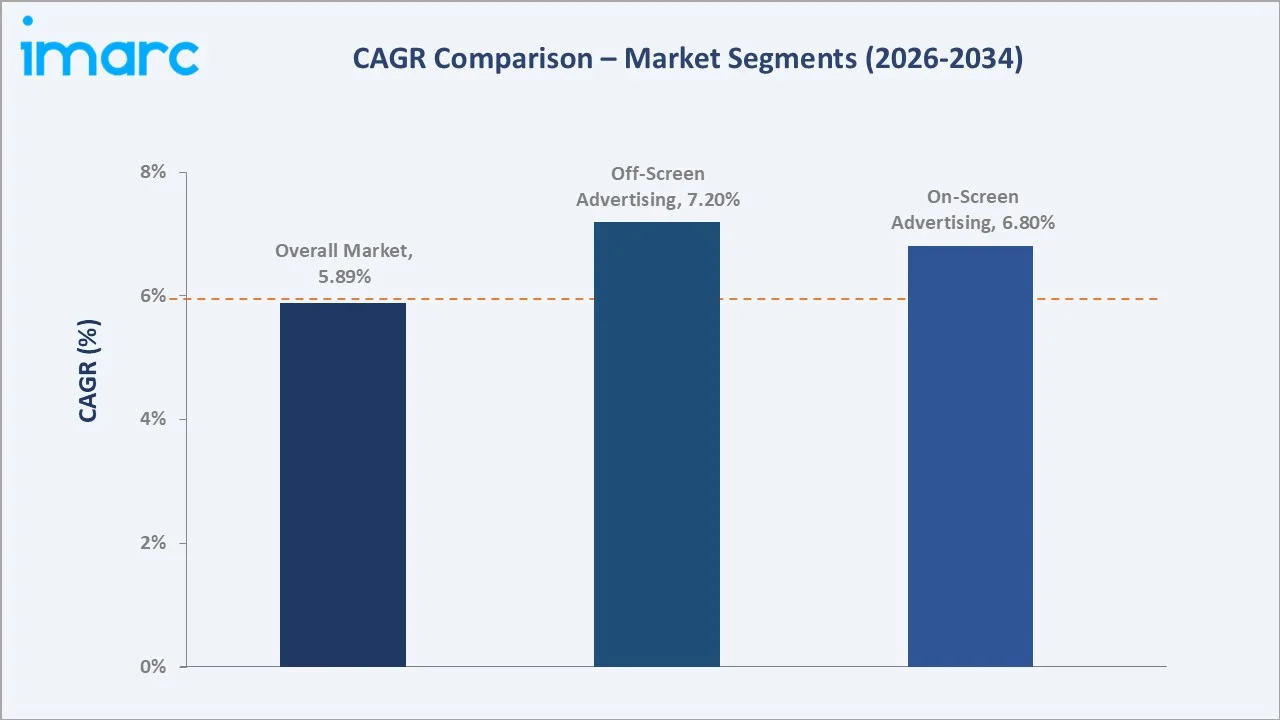
Off-screen advertising grows fastest at ~7.20% CAGR through experiential foyer activation, digital signage, and brand integration. On-screen advertising above 60 seconds grows at ~6.80% CAGR as premium brands invest in storytelling formats that leverage the cinema’s immersive audio-visual environment.
Executive Summary
India cinema advertising market occupies a unique and structurally irreplaceable position within the country’s advertising ecosystem, where the combination of captive audience, premium audio-visual environment, and psychographic targeting by geography and content genre creates an advertising impact dynamic unachievable through digital, TV, or outdoor media. The cinema screen’s fundamental advertising proposition rests on three pillars that collectively define its premium positioning: audience captivity, sensory immersion, and psychographic concentration.
On-screen advertising’s 82.4% dominance reflects cinema’s fundamental value proposition as a screen-based experience where the audience’s visual attention is guaranteed and maximally engaged during pre-movie advertising slots. West India’s 31.4% regional leadership reflects the concentration of India’s highest-value advertising markets within Maharashtra and Gujarat’s multiplex ecosystem.
Key Market Insights
|
Insight |
Data |
|
Dominant Type |
On-Screen Advertising – 82.4% share (2025) |
|
Leading Region |
West India – 31.4% share (2025) |
|
Market Opportunity |
Programmatic digital cinema advertising for SME and regional advertisers; luxury brand cinema partnership for immersive experience marketing; regional language blockbuster content leveraging vernacular advertising; AI-powered geo-targeted cinema ad at district and city level |
Key Analytical Observations:
- On-screen advertising at 82.4% (2025): On-screen cinema advertising in India encompasses three distinct format categories that serve different advertiser objectives and budget levels. Video advertisements represent the premium inventory where India’s largest FMCG, automotive, BFSI, and consumer electronics brands invest their highest-impact creative content for maximum brand recall in the pre-movie advertising window. Muted slides serve as the entry-level format for regional businesses, local service providers, and geographically targeted campaigns that cannot justify production costs for full-video creative.
- West India at 31.4% (2025): West India leads the market, supported by a dense network of multiplexes, high movie-going activity, and strong advertiser presence in major urban centers such as Mumbai, Pune, and Ahmedabad. The region also benefits from Bollywood’s concentration in Mumbai, which strengthens cinema-related promotional spending and brand partnerships.
India Cinema Advertising Market Overview
The India cinema advertising market encompasses advertising displayed within movie theaters, including on-screen advertisements, pre-show commercials, branded content, and trailer-linked promotions. It also includes off-screen formats such as lobby displays, standees, digital screens, ticket branding, and experiential activations. The market serves brands seeking captive urban audiences across multiplexes and single-screen cinemas, supported by film releases, theater footfall, and growing digital integration. Macroeconomic factors include rising disposable incomes, urbanization, growth in consumer spending, and expansion of the entertainment and media sector.
Market Dynamics
To evaluate market opportunities, Request Sample
Market Drivers
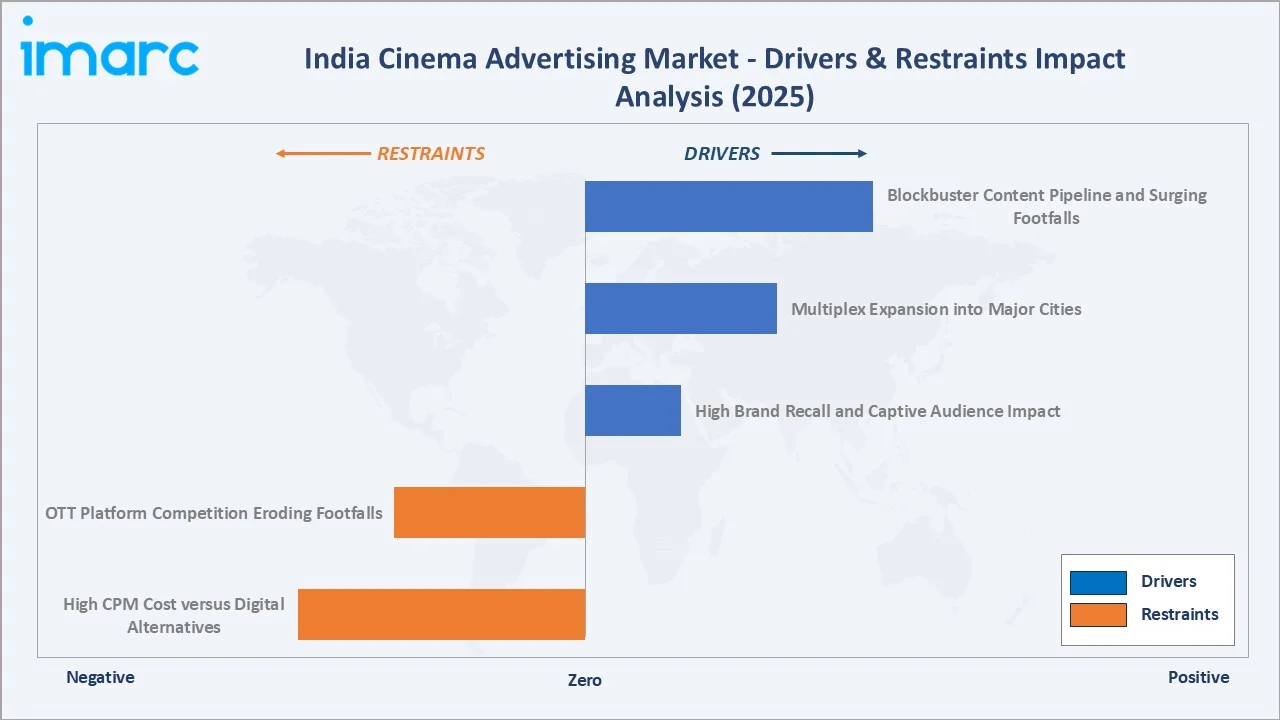
- Blockbuster Content Pipeline and Surging Footfalls: India’s cinema advertising market’s recovery and growth has been powerfully driven by the restoration and amplification of India’s box office through a series of historic blockbuster releases that have re-established cinema as India’s pre-eminent entertainment format in the hearts and screens of the nation. India’s Bollywood, Kollywood, Tollywood, and regional language film industries ensure a continuous content rotation that sustains weekday and weekend audience flow across multiplex properties regardless of any single film’s performance, providing advertisers with consistent weekly impression delivery that makes cinema a reliable media plan component rather than a blockbuster-dependent gamble.
- Multiplex Expansion into Major Cities: The expansion of multiplex chains across major Indian cities is increasing the number of premium advertising screens and improving brand access to urban movie-going audiences. New luxury properties with advanced projection, audio, and digital display infrastructure also create more opportunities for high-impact on-screen and off-screen campaigns. In December 2025, Roongta Cinemas expanded into South India with the opening of a luxury multiplex at Novum near Nampally Metro Station in Hyderabad. The new property features Dolby Atmos audio, high-definition projection, premium seating, and acoustically optimized interiors, enhancing the overall movie-going experience. This expansion is strengthening advertiser interest and supporting growth in the market.
- High Brand Recall and Captive Audience Impact: Cinema advertising’s fundamental value proposition, a guaranteed captive audience in a distraction-free, premium sensory environment with legally enforced no-mobile-phone usage during screening, creates measurably superior advertising effectiveness that sustains premium pricing versus digital alternatives where ad-blocking, scroll-past, and sound-off viewing create systematic impression quality degradation.
Market Restraints
- OTT Platform Competition Eroding Footfalls: The growing availability of OTT platforms provides consumers with convenient, low-cost access to movies and premium entertainment at home, reducing dependence on theater visits. Lower cinema footfalls can weaken audience reach for advertisers and reduce the value of screen-based campaigns. This shift is creating pressure on the India cinema advertising market, particularly for theaters with limited premium or experiential offerings.
- High CPM Cost versus Digital Alternatives: Cinema advertising can involve relatively high cost per thousand impressions (CPM) compared with digital channels that offer broader reach, flexible budgets, and precise target audiences. Advertisers may therefore shift spending toward social media, video streaming, and programmatic platforms where campaign performance is easier to measure. This cost disadvantage can limit cinema advertising demand, particularly among smaller and performance-focused brands.
Market Opportunities
- Programmatic Digital Cinema Advertising for SME Market Penetration: Programmatic cinema advertising creates an opportunity for SMEs to access theater audiences through automated campaign buying, flexible budgets, and location-based targeting. Digital cinema networks can enable smaller brands to select specific screens, cities, and campaign periods instead of committing to large nationwide campaigns. This can broaden the advertiser base and generate incremental revenue for the India cinema advertising market.
- Regional Language Content and Vernacular Advertising Growth: The rising popularity of regional-language films is creating opportunities for advertisers to reach audiences in culturally relevant and localized formats. Vernacular cinema advertising allows brands to tailor messaging by language, geography, and consumer preferences, improving campaign relevance. This can attract regional businesses as well as national brands seeking deeper penetration beyond major metropolitan markets.
Market Challenges
- Limited Audience Measurement and Attribution: Measuring the direct impact of cinema advertisements on consumer purchases remains challenging compared with digital advertising. Limited real-time audience data and attribution capabilities can make campaign effectiveness difficult to quantify. This may discourage performance-focused advertisers from allocating larger budgets to cinema.
- Dependence on Strong Film Release Pipelines: Advertising demand is closely linked to the availability of popular films capable of generating sustained theater traffic. Delayed releases or periods with fewer blockbuster titles can reduce admissions and advertiser interest. This dependence creates revenue volatility for cinema advertising operators.
Emerging Market Trends
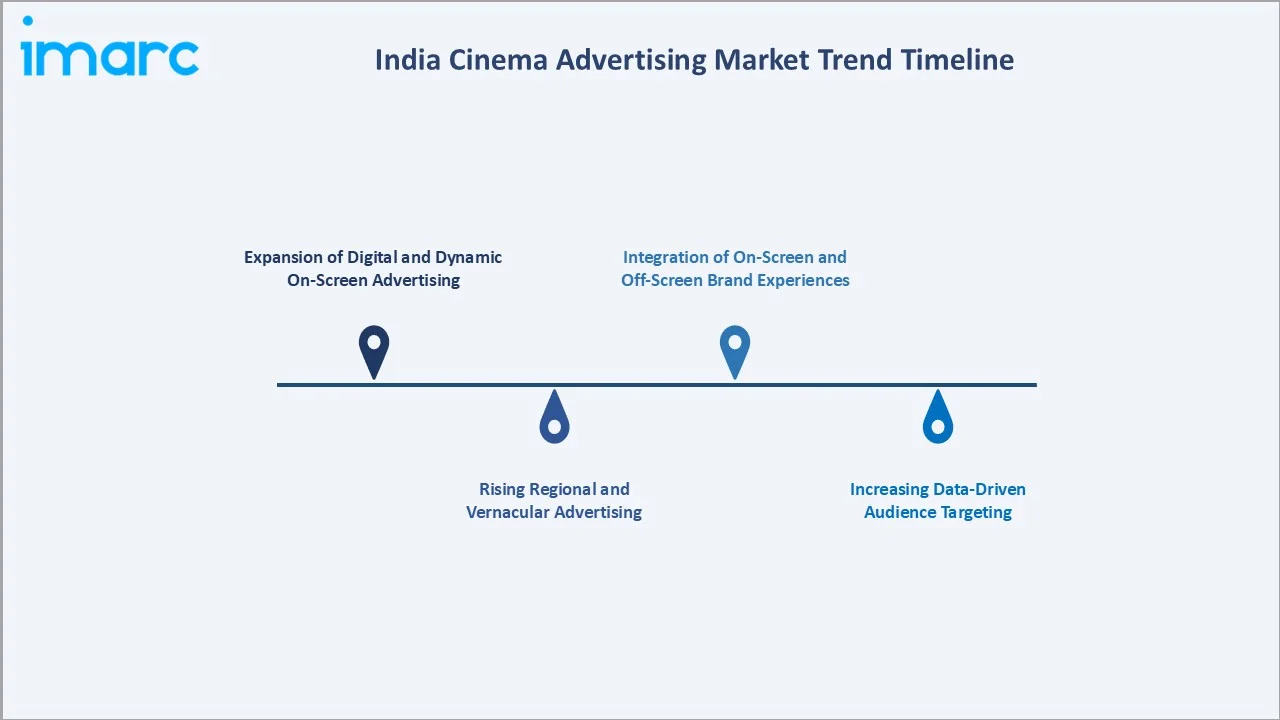
1. Expansion of Digital and Dynamic On-Screen Advertising
Digital cinema infrastructure is enabling theaters to deliver advertisements more flexibly than traditional film-based systems. In January 2026, Cinépolis India expanded into cinema advertising through a major rollout of digital display infrastructure across its theater network. The initiative includes more than 350 LED screens, video walls, and digital displays across 101 cinemas in 63 cities and 23 states and Union Territories, enabling advertisers to access a broad national audience. This improves campaign relevance while reducing distribution complexity. Digitalization is therefore increasing the flexibility and scalability of cinema advertising.
2. Rising Regional and Vernacular Advertising
The popularity of regional-language cinema is encouraging brands to develop localized advertising campaigns for different Indian markets. Advertisers are increasingly adapting messaging according to language, culture, and regional consumer preferences. This enables national brands to deepen penetration in Tier II and Tier III cities while creating opportunities for local businesses. Regional cinema also provides advertisers with concentrated geographic audience reach. Vernacular campaigns consequently become an important component of cinema advertising strategies.
3. Integration of On-Screen and Off-Screen Brand Experiences
Cinema campaigns are increasingly extending beyond pre-movie advertisements into lobby branding, interactive displays, sampling, standees, and experiential marketing. Combining on-screen exposure with physical consumer engagement can improve brand recall and campaign visibility. Multiplexes provide controlled environments where advertisers can engage audiences before and after screenings. QR codes and digital interactions can further connect cinema campaigns with online channels. This is transforming theaters into integrated advertising and engagement destinations.
4. Increasing Data-Driven Audience Targeting
Cinema operators and advertising platforms are increasingly using ticketing, location, movie genre, show timing, and audience profile data to improve campaign targeting. Brands can align advertisements with specific films and consumer segments rather than purchasing broad cinema inventory. Better audience segmentation can improve campaign relevance and advertising efficiency. Data analytics also supports more informed media planning and performance evaluation. This trend is narrowing the targeting gap between cinema and digital advertising.
Industry Value Chain Analysis
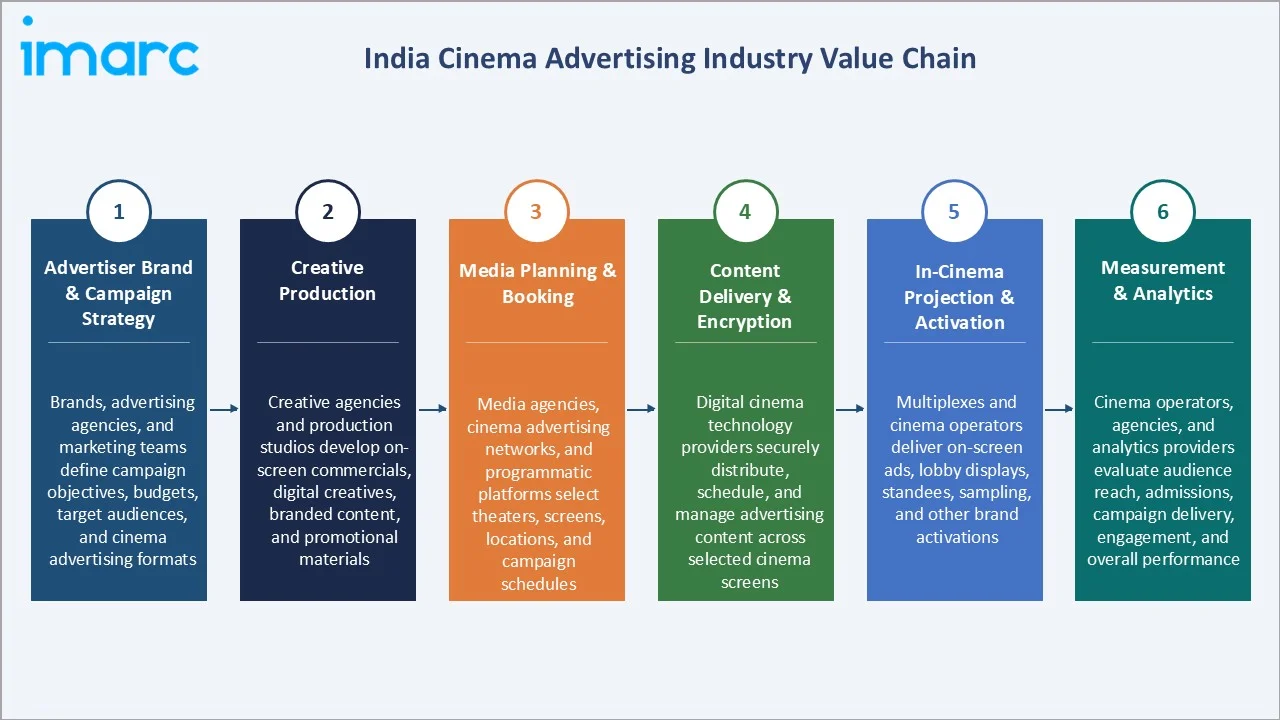
India cinema advertising value chain integrates advertiser brand strategy, creative production, media planning and booking, content delivery and encryption, in-cinema projection and experiential activation, and post-campaign measurement into a specialized media delivery process distinct from television or digital advertising value chains.
|
Stage |
Key Participants |
|
Advertiser Brand & Campaign Strategy |
Brands, advertising agencies, and marketing teams define campaign objectives, budgets, target audiences, and cinema advertising formats. |
|
Creative Production |
Creative agencies and production studios develop on-screen commercials, digital creatives, branded content, and promotional materials. |
|
Media Planning & Booking |
Media agencies, cinema advertising networks, and programmatic platforms select theaters, screens, locations, and campaign schedules. |
|
Content Delivery & Encryption |
Digital cinema technology providers securely distribute, schedule, and manage advertising content across selected cinema screens. |
|
In-Cinema Projection & Activation |
Multiplexes and cinema operators deliver on-screen ads, lobby displays, standees, sampling, and other brand activations. |
|
Measurement & Analytics |
Cinema operators, agencies, and analytics providers evaluate audience reach, admissions, campaign delivery, engagement, and overall performance. |
Media planning & booking is the most value-added stage, as it determines optimal cinema locations, screens, audience segments, campaign timing, and advertising inventory allocation. Effective media planning maximizes audience reach and engagement while improving campaign efficiency and return on advertising spend.
Technology Landscape in the India Cinema Advertising Industry
Interactive QR Code and Mobile Engagement Technology
Cinema advertisements increasingly integrate QR codes, mobile coupons, and digital call-to-action features to connect offline campaigns with online engagement. Audiences can instantly access brand websites, promotional offers, contests, or product information through their smartphones. This technology improves consumer interaction beyond the theater environment. It also enables advertisers to measure engagement more effectively. Mobile integration is strengthening omnichannel cinema advertising strategies.
AI-Based Advertisement Scheduling and Personalization Technology
Artificial intelligence is being used to optimize advertisement scheduling based on audience behavior, movie genres, location, and show timing. AI-powered platforms help improve campaign relevance by selecting suitable advertising slots for different audience segments. The technology can also automate inventory allocation and performance optimization. This enhances operational efficiency while improving advertiser targeting. AI is gradually becoming an important technology in the digital cinema advertising ecosystem.
Audience Analytics and Data Measurement Solutions
Audience analytics platforms use ticketing data, occupancy levels, movie genres, show timings, and audience profiles to improve campaign planning. The technology helps advertisers understand audience reach and optimize media selection. Real-time reporting and performance analytics improve campaign evaluation. Data-driven insights also support better audience segmentation. These solutions are increasing the effectiveness of cinema advertising campaigns.
Market Segmentation Analysis
The report covers the following segments:
|
Segment Category |
Leading Segment |
Market Share |
Year |
|
Type |
On-Screen Advertising |
82.4% |
2025 |
|
Region |
West India |
31.4% |
2025 |

By Type
On-screen advertising leads at 82.4% (2025) through cinema’s fundamental value proposition of guaranteed audience attention during pre-movie and interval advertising windows.
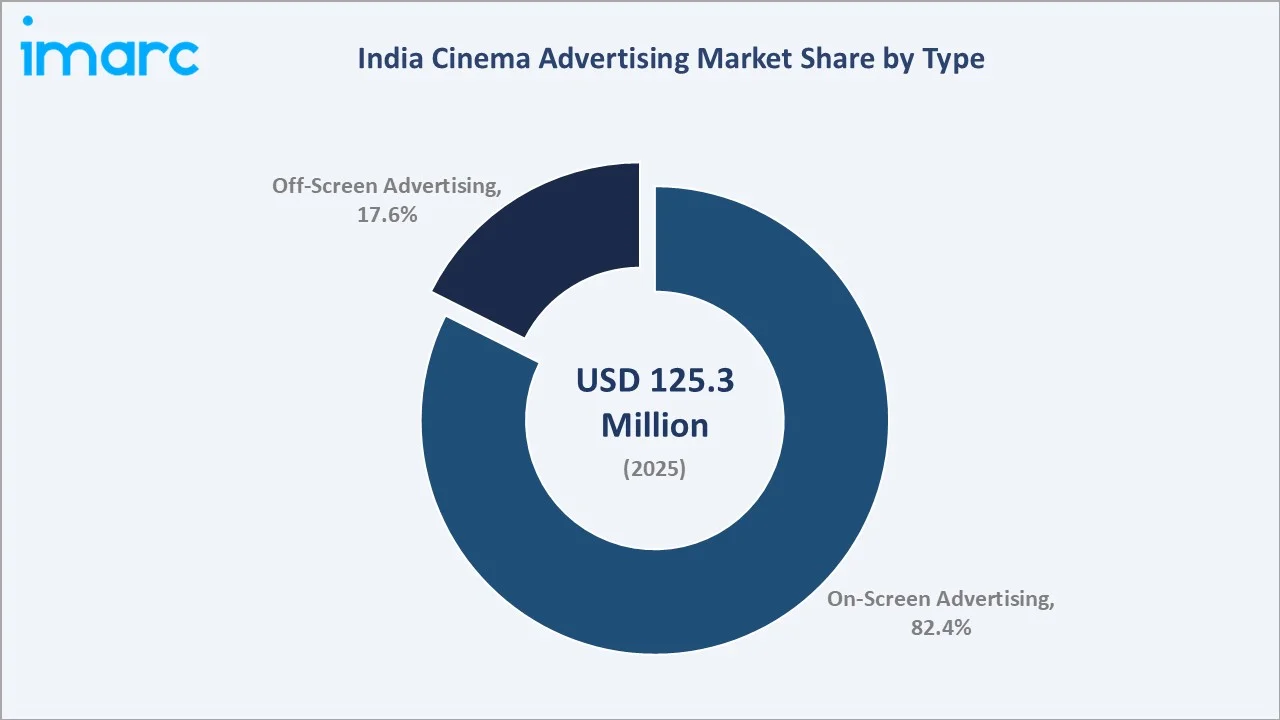
Off-screen advertising at 17.6% is growing fastest at ~7.20% CAGR through experiential foyer activations, digital lobby signage networks, and integrated cinema property branding campaigns.
Regional Market Insights
|
Region |
Share (2025) |
Key Cinema Advertising Market Drivers & Characteristics |
|
West India |
31.4% |
Leads due to a strong multiplex presence, Bollywood concentration in Mumbai, high urban footfalls, and substantial brand advertising activity. |
|
North India |
28.8% |
Supported by extensive multiplex networks across Delhi-NCR and other major cities, along with strong consumer spending and advertiser demand. |
|
South India |
26.7% |
Benefits from a large regional film industry, strong movie-going culture, expanding premium multiplexes, and growing vernacular advertising. |
|
East India |
13.1% |
Driven by gradual multiplex expansion, increasing urbanization, regional-language cinema, and growing advertising activity in emerging cities. |
West India leads at 31.4% in 2025, supported by high multiplex density, Bollywood activity, and strong advertiser presence. North India accounts for 28.8%, driven by extensive cinema networks across Delhi-NCR and other major urban centers.
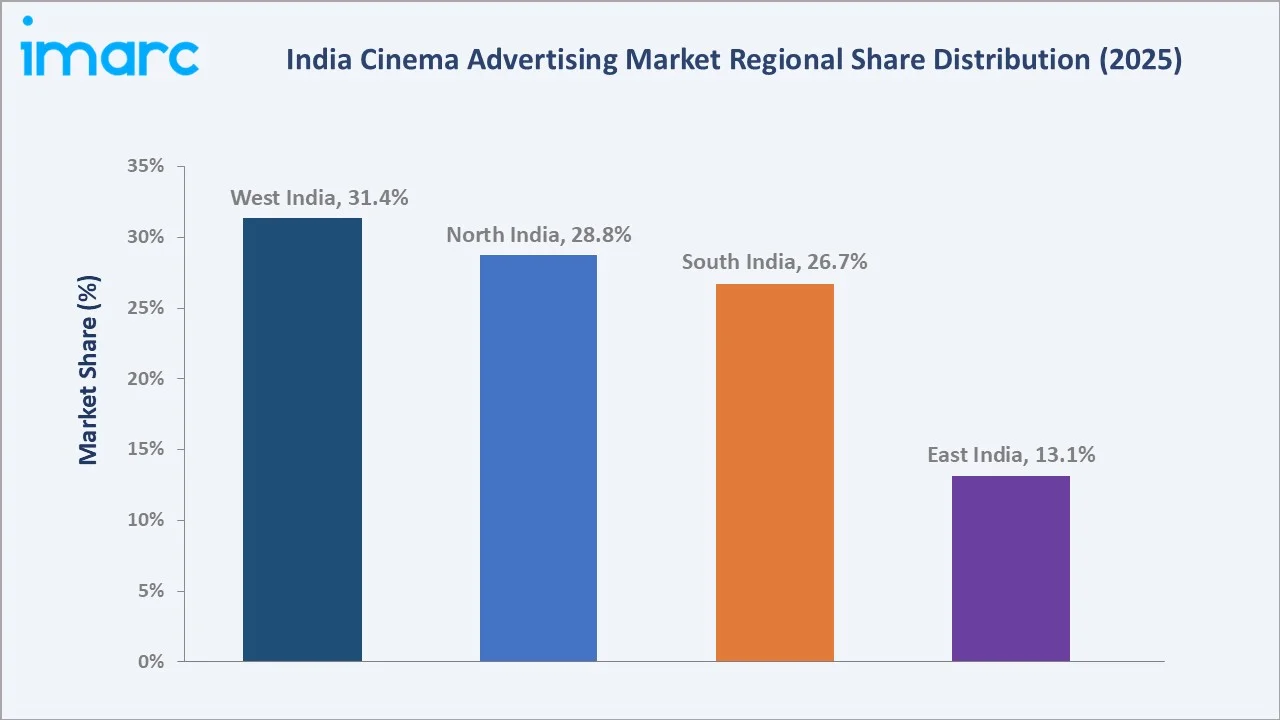
South India holds 26.7%, supported by a strong regional film industry, high theater attendance, and growing vernacular advertising. East India represents 13.1%, with demand expanding through multiplex growth, urbanization, and increasing regional-language content consumption.
Competitive Landscape
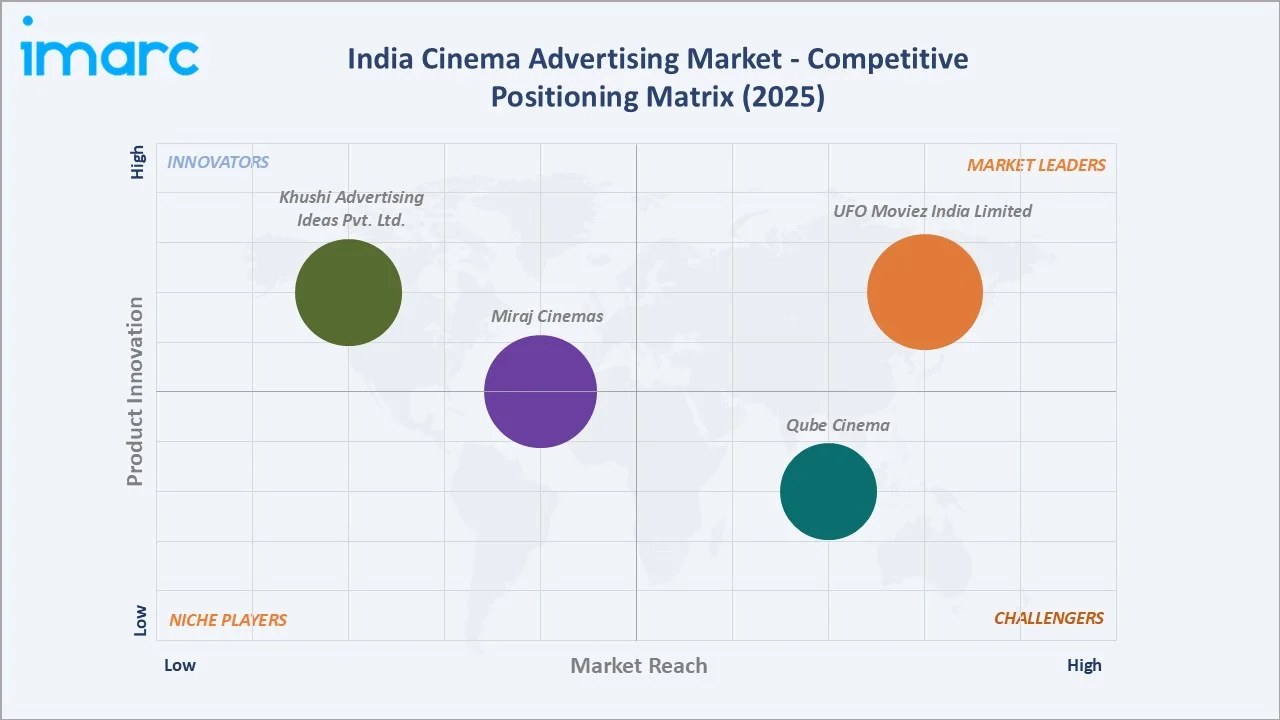
The India cinema advertising market is moderately concentrated, with major multiplex chains, cinema advertising agencies, and digital media networks competing for advertiser budgets. Competition is increasingly centered on digital screen networks, programmatic advertising, audience targeting, premium inventory, regional reach, and integrated on-screen and off-screen campaigns.
|
Company |
Key Offerings |
Market Position |
Core Strength |
|
UFO Moviez India Limited |
UFO Digital Cinema Advertising, In-Cinema Advertising |
Market Leader |
UFO Moviez India Limited is a leading digital cinema distribution network and the largest in-cinema advertising platform in India. |
|
Miraj Cinemas |
On-Screen and Off-Screen Advertising |
Established Player |
Miraj Cinemas plays a vital role in Indian cinema advertising as one of India’s largest movie theater chains. |
|
Qube Cinema |
QCN Digital Cinema Advertising |
Challenger |
The company operates the Qube Cinema Network (QCN), which allows advertisers to easily and securely schedule commercials across thousands of screens in India. |
|
Khushi Advertising Ideas Pvt. Ltd. |
Khushi Plex |
Innovator |
Khushi Advertising Ideas Pvt. Ltd. is a leading integrated Out-of-Home (OOH) and cinema advertising agency in India. |
India cinema advertising competitive landscape is evolving toward a technology-stratified structure, where premium screen inventory, national distribution reach, and programmatic technology collectively serve distinct advertiser segments that will progressively converge as programmatic digital cinema advertising matures to cover premium multiplex inventory with the same real-time booking capabilities currently limited to Tier 2 and Tier 3 screen networks.
Key Company Profiles
UFO Moviez India Limited
UFO Moviez India Limited is a digital cinema distribution and advertising company with a broad presence across India’s theatrical exhibition ecosystem. The company provides digital cinema infrastructure, content delivery, and cinema advertising solutions to multiplexes and single-screen theaters. In the India cinema advertising market, UFO Moviez enables brands to run targeted on-screen campaigns across its network of connected screens. Its scale, technology platform, and theater relationships support wide geographic reach and efficient campaign deployment.
- Key Offerings: UFO Digital Cinema Advertising, In-Cinema Advertising.
- Strategic Focus: Focused on expanding its pan-India cinema advertising network across multiplexes and standalone screens to strengthen advertiser reach. The company emphasizes digital delivery, micro-geographic targeting, and flexible campaign customization for national, regional, and hyperlocal advertisers.
Miraj Cinemas
Miraj Cinemas is an Indian multiplex chain engaged in theatrical film exhibition and cinema-based advertising across multiple cities. The company operates a growing network of screens and focuses on delivering modern viewing experiences through upgraded projection, sound, seating, and theater infrastructure. In the India cinema advertising market, Miraj Cinemas offers on-screen commercials, lobby branding, digital displays, and promotional activations. Its expanding footprint across metropolitan and emerging cities supports broader advertiser reach and regional audience engagement.
- Key Offerings: On-Screen and Off-Screen Advertising.
- Strategic Focus: Focused on expanding its cinema footprint and advertising inventory, providing brands with greater access to audiences across Tier 1 and Tier 2 markets. Its advertising portfolio spans high-definition on-screen commercials and off-screen activations, allowing brands to combine screen visibility with theater-based consumer engagement.
Market Concentration Analysis
The India cinema advertising market is moderately concentrated, with a mix of large multiplex operators, digital cinema networks, and specialized advertising agencies. Leading players benefit from extensive screen networks, established advertiser relationships, and integrated on-screen and off-screen advertising capabilities. Market concentration is higher in major urban centers where premium multiplex infrastructure is well developed. However, regional cinema chains and independent advertising platforms continue to maintain a meaningful presence in Tier 2 and Tier 3 cities. Competition is increasingly driven by digital screen expansion, programmatic buying, audience targeting, and nationwide campaign reach.
Investment & Growth Opportunities
Highest Growth Segments
Off-screen advertising (~7.20% CAGR) and on-screen advertising (~6.80% CAGR) represent India’s cinema advertising market’s highest-growth investment opportunities through 2034, driven by experiential marketing growth and premium brand immersive storytelling, respectively.
Investment Themes
- Programmatic Cinema Advertising Technology Platform: Investment in programmatic cinema advertising platforms can automate campaign booking, audience targeting, scheduling, and inventory management across theater networks. These platforms can improve efficiency, attract SMEs through flexible budgets, and enable location- and audience-specific advertising at scale.
- Cinema Advertising Measurement Infrastructure: Investment in audience measurement, occupancy tracking, campaign verification, and attribution technologies can improve transparency and advertiser confidence. Better measurement infrastructure can help brands evaluate reach, engagement, and campaign effectiveness, making cinema advertising more competitive with digital media channels.
Future Market Outlook (2026-2034)
The India cinema advertising market is projected to grow from USD 125.3 Million in 2025 to USD 132.7 Million in 2026, reaching USD 209.7 Million by 2034, registering a steady CAGR of 5.89% that reflects a market in structural recovery and progressive modernization, where the intersection of India’s multiplex expansion, content pipeline quality, and cinema advertising technology innovation creates a compound growth trajectory anchored in both expanding inventory supply and evolving advertiser demand quality. The midpoint anchor of USD 166.8 Million in 2030 confirms a measured but durable growth trajectory that the market’s structural underpinnings support.
First, India’s organized multiplex sector’s geographic expansion is the market’s most reliable supply-side growth engine. Second, the programmatic digital cinema advertising revolution will mature into a mainstream advertising buying infrastructure by 2027-2030 that fundamentally transforms the cinema advertising market’s buyer composition. Third, India’s content pipeline quality and quantity are sustaining cinema advertising’s value proposition through the forecast period in a way that was uncertain in the immediate post-COVID, OTT-competition anxiety period of 2020-2022.
Research Methodology
Primary Research
Primary research comprised in-depth interviews with advertising sales leadership, the marketing and advertising business division, the commercial team, advertising agency media planners who include cinema in national media plans, brand managers on cinema advertising effectiveness experience, and media and entertainment industry experts on cinema advertising market structure and growth drivers.
Secondary Research
Secondary research encompassed a detailed review of industry reports, company publications, government sources, trade associations, media releases, and advertising industry databases. The research also covered cinema footfalls, multiplex expansion, advertising formats, digital technology adoption, regional trends, and competitive developments across the India cinema advertising market.
Forecasting Models
Forecasting models developed using historical India cinema advertising market revenue data (2020-2025), India organized multiplex screen count growth trajectory, India gross box office collection trajectory, cinema advertising revenue per screen trend analysis, programmatic digital cinema advertising platform adoption rate modeling, OTT-cinema audience behavioral segmentation analysis, advertiser budget allocation trend for cinema as percent of total advertising spend, regional cinema screen expansion in Tier 2 and Tier 3 markets, and blockbuster release calendar impact on premium advertising rate cycles.
India Cinema Advertising Market Report Coverage:
| Report Features | Details |
|---|---|
| Base Year of the Analysis | 2025 |
| Historical Period | 2020-2025 |
| Forecast Period | 2026-2034 |
| Units | Million USD |
| Scope of the Report |
Exploration of Historical Trends and Market Outlook, Industry Catalysts and Challenges, Segment-Wise Historical and Future Market Assessment:
|
| Types Covered |
|
| Regions Covered | North India, South India, East India, West India |
| Companies Covered | UFO Moviez India Limited, Miraj Cinemas, Qube Cinema, Khushi Advertising Ideas Pvt. Ltd., etc. |
| Customization Scope | 10% Free Customization |
| Post-Sale Analyst Support | 10-12 Weeks |
| Delivery Format | PDF and Excel through Email (We can also provide the editable version of the report in PPT/Word format on special request) |
Key Benefits for Stakeholders:
- IMARC’s industry report offers a comprehensive quantitative analysis of various market segments, historical and current market trends, market forecasts, and dynamics of the India cinema advertising market from 2020-2034.
- The research report provides the latest information on the market drivers, challenges, and opportunities in the India cinema advertising market.
- Porter's five forces analysis assist stakeholders in assessing the impact of new entrants, competitive rivalry, supplier power, buyer power, and the threat of substitution. It helps stakeholders to analyze the level of competition within the India cinema advertising industry and its attractiveness.
- Competitive landscape allows stakeholders to understand their competitive environment and provides an insight into the current positions of key players in the market.
Frequently Asked Questions About the India Cinema Advertising Market Report
India cinema advertising market size is estimated at USD 132.7 Million in 2026, driven by expanding multiplex networks, rising brand spending on captive-audience formats, and growing adoption of digital on-screen and lobby advertising. Increasing regional-language content, premium cinema formats, and data-driven campaign planning are further supporting market growth.
The market grows at 5.89% CAGR, reaching USD 209.7 Million by 2034, supported by continued multiplex expansion, digitalization of advertising inventory, and increasing demand for targeted brand engagement. Growth in regional cinema, programmatic advertising, and premium theater formats is also expected to strengthen market expansion.
On-screen advertising leads at 82.4% (2025) through cinema’s guaranteed audience captivity, premium Dolby Atmos and IMAX sensory immersion, and unaided brand recall effectiveness that no other Indian advertising medium achieves.
West India leads at 31.4% through Mumbai’s headquarters concentration of India’s largest advertising spenders, Maharashtra’s premium properties commanding India’s highest cinema advertising CPMs, and Gujarat’s growing Ahmedabad-Surat multiplex ecosystem serving India’s highest-savings-rate consumer population.
Leading companies include UFO Moviez India Limited, Miraj Cinemas, Qube Cinema, and Khushi Advertising Ideas Pvt. Ltd., among others.
The market is projected to reach USD 166.8 Million by 2030, driven by expanding multiplex networks, increasing digital advertising inventory, and stronger brand interest in captive theater audiences. Growth in regional cinema, premium formats, and data-driven advertising solutions is also expected to support market expansion.
Top opportunities include programmatic cinema advertising platform scaling, AI-personalized cinema advertising, Tier 2 local advertiser development, luxury brand cinema experience marketing, and DOOH-cinema integrated advertising.
Need more help?
- Speak to our experienced analysts for insights on the current market scenarios.
- Include additional segments and countries to customize the report as per your requirement.
- Gain an unparalleled competitive advantage in your domain by understanding how to utilize the report and positively impacting your operations and revenue.
- For further assistance, please connect with our analysts.
 Request Customization
 Speak to an Analyst
 Request Brochure
 Inquire Before Buying
Benefits of Customization
- Personalize this research
- Triangulate with your data
- Get data as per your format and definition
- Gain a deeper dive into a specific application, geography, customer, or competitor
- Any level of personalization
Get in Touch With Us
UNITED STATES
Phone: +1-201-971-6302
INDIA
Phone: +91-120-433-0800
UNITED KINGDOM
Phone: +44-753-714-6104
Email: [email protected]
Client Testimonials




.webp)




.webp)













Related Reports

Choose your plan
*Please note that the prices mentioned below are starting prices for each bundle type. Kindly contact our team for further details.*
Single User License
- 1 User License, Access on 2 Devices
- PDF Report + Excel Dataset (Password Protected)
- Lifetime Access
- No Printing Rights
- 10% Free Report Customization
- 10–12 Weeks of Analyst Support
Five User License
- Access for 5 Users, 2 Devices per User
- PDF Report + Excel Dataset (Password Protected)
- Lifetime Access
- Dedicated Account Manager
- 12–14 Weeks of Analyst Support
- No Printing Rights
- 15% Free Report Customization
- 25% Discount on Your Next Purchase
Corporate User License
- Unlimited User Access (Within Your Organization)
- PDF Report + Excel Dataset
- Lifetime Access
- Dedicated Account Manager
- 14–20 Weeks of Analyst Support
- No Printing Rights
- 20% Free Report Customization
- 30% Discount on Your Next Purchase
Essential Insights
What's included:
3 reports
- Lifetime Access
- PDF Reports
- Excel Datasets
- 2 Weeks of Free Analyst Support
- 2 User Licenses
- Access on 2 Devices
- Printing Rights
- Complimentary PowerPoint (PPT) Version
- Complimentary License Upgrade
Professional Access
What's included:
5 reports
- Lifetime Access
- PDF Reports
- Excel Datasets
- 8 Weeks of Free Analyst Support
- 2 User Licenses
- Access on 2 Devices
- Printing Rights
- Complimentary PowerPoint (PPT) Version
- Complimentary License Upgrade
Business Advantage
What's included:
8 reports
- Lifetime Access
- PDF Reports
- Excel Datasets
- 14 Weeks of Free Analyst Support
- 2 User Licenses
- Access on 2 Devices
- Printing Rights
- Complimentary PowerPoint (PPT) Version
- Complimentary License Upgrade
Enterprise Intelligence
What's included:
10 reports
- Lifetime Access
- PDF Reports
- Excel Datasets
- 20 Weeks of Free Analyst Support
- 2 User Licenses
- Access on 2 Devices
- Printing Rights
- Complimentary PowerPoint (PPT) Version
- Complimentary License Upgrade