
India Cloud Managed Services Market Size, Share, Trends and Forecast by Service Type, Deployment Model, Organization Size, Vertical, and Region, 2026-2034
India Cloud Managed Services Market Size, Share, Trends & Forecast (2026-2034)
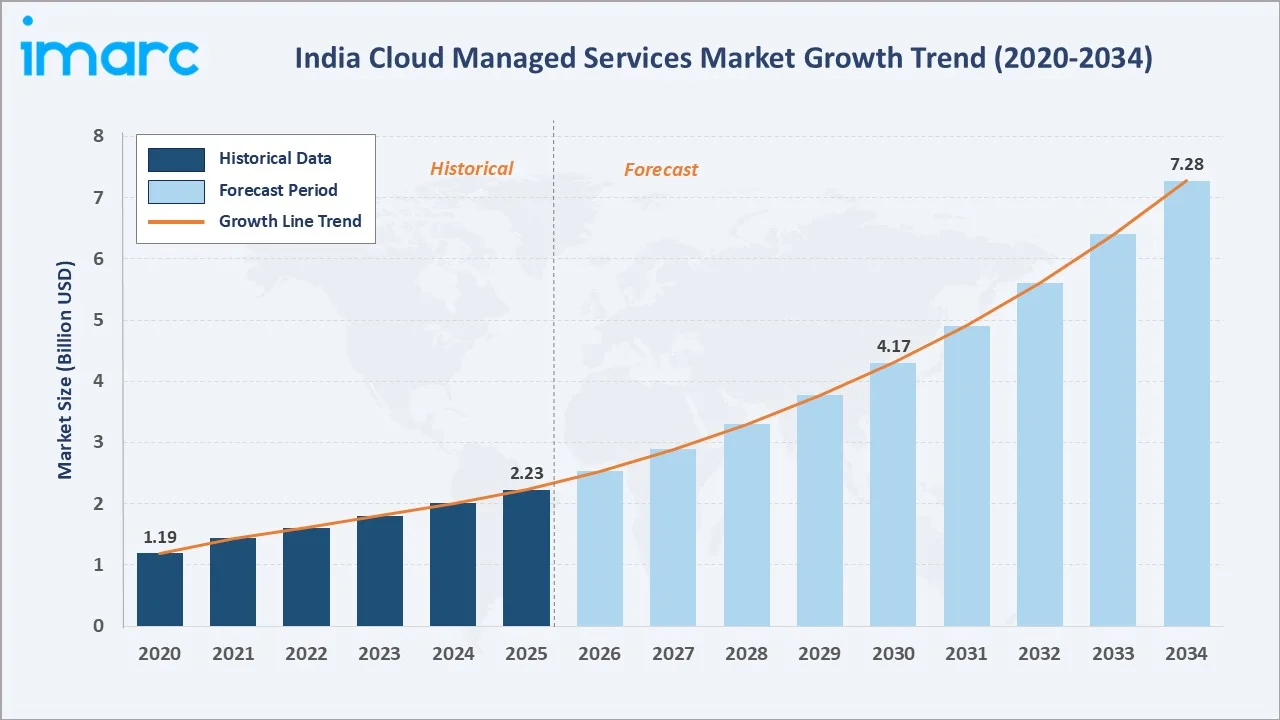
The India cloud managed services market grew from USD 2.23 Billion in 2025 to USD 2.53 Billion in 2026 and is projected to reach USD 7.28 Billion by 2034, exhibiting a CAGR of 13.35% during 2026-2034, driven by accelerating enterprise cloud adoption, Digital India initiatives, and rising demand for managed security and infrastructure services. The market is driven by accelerating enterprise cloud adoption, rising cybersecurity outsourcing requirements, and government-backed digital transformation programmes including Digital India and BharatNet. India hosts over 1,700 global capability centres that collectively generate substantial managed cloud service demand, reflecting the country’s deep integration into global technology delivery ecosystems. This strong institutional demand is supporting cloud managed services growth across public cloud, private cloud, security operations, and application management segments.
Expanding digital transformation across BFSI, healthcare, retail, and government sectors is fuelling sustained demand for cloud managed services, as enterprises seek operational agility, cost optimisation, and regulatory compliance through specialist providers. Public Cloud dominates at 58.4%. Large Enterprises lead at 61.3%. South India commands 34.7% of the national market share.
Market Snapshot
|
Metric |
Value |
|
Base Year Market Size (2025) |
USD 2.23 Billion |
|
Market Size (2026) |
USD 2.53 Billion |
|
Forecast Market Size (2034) |
USD 7.28 Billion |
|
CAGR (2026-2034) |
13.35% |
|
Base Year |
2025 |
|
Historical Period |
2020-2025 |
|
Forecast Period |
2026-2034 |
|
Dominant Deployment Model |
Public Cloud (58.4%, 2025) |
|
Dominant Organization Size |
Large Enterprises (61.3%, 2025) |
|
Leading Region |
South India (34.7%, 2025) |
The India cloud managed services market size increased from USD 1.19 Billion in 2020 to USD 2.23 Billion in 2025 and is estimated to reach USD 2.53 Billion in 2026. The market is further expected to grow to USD 4.17 Billion by 2030 and USD 7.28 Billion by 2034.
To get more information on this market, Request Sample
India's rapid digital transformation, fuelled by government initiatives such as Digital India and increasing adoption of cloud infrastructure across BFSI, healthcare, IT, and retail, is reshaping the cloud managed services landscape into a high-growth, commercially strategic sector.
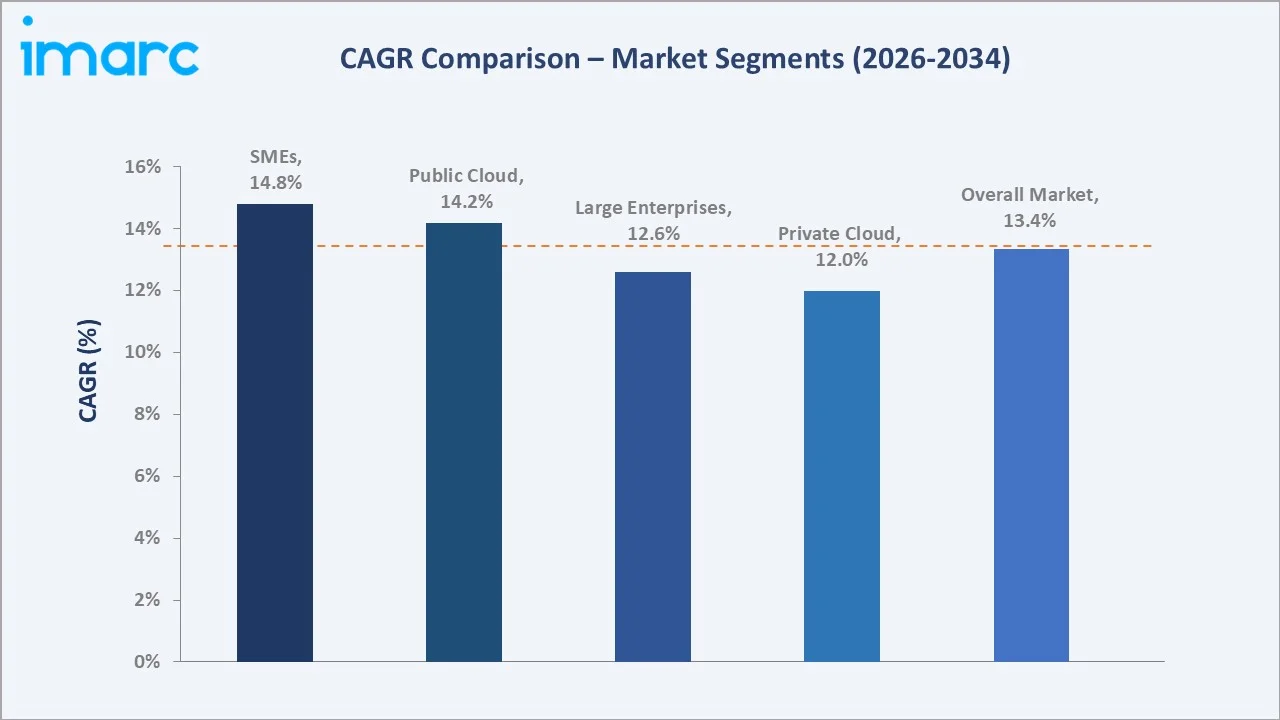
The public cloud segment commands 58.4% of the market in 2025. Large enterprises leverage managed services for security, compliance, and operational scalability, while SMEs are the fastest-growing adopters driven by cost-efficiency and limited in-house IT capabilities.
Executive Summary
The India cloud managed services market expanded from USD 2.23 Billion in 2025 to an estimated USD 2.53 Billion in 2026, positioning it among the fastest-growing technology services markets in Asia by value. The market’s scale is underpinned by India’s large enterprise base, the enduring significance of managed cloud infrastructure as a business-critical operational requirement, and rising demand from BFSI, healthcare, and government sectors. These structural demand drivers are supporting the expansion of the public cloud managed services segment at a rate that outpaces India’s overall IT services sector growth. India cloud managed services market is commercially distinguished from other major Asian cloud markets by its extraordinary depth of domestic IT service provider capabilities and world-class NOC/SOC delivery ecosystems. The market is projected to reach USD 7.28 Billion by 2034. Public Cloud at 58.4% leads through hyperscaler ecosystem dominance and enterprise scalability advantages. Large Enterprises at 61.3% reflects the concentration of complex managed service demand in India’s major corporations. South India leads regionally at 34.7%.
Key Market Insights
|
Insight |
Data |
|
Dominant Deployment Model |
Public Cloud – 58.4% share (2025) |
|
Dominant Organization Size |
Large Enterprises – 61.3% market share (2025) |
|
Leading Region |
South India – 34.7% share (2025) |
|
Market Opportunity |
Public cloud migration acceleration in BFSI, healthcare, and retail sectors |
Key Analytical Observations Supporting the Above Data:
- Public Cloud at 58.4%: Public cloud dominates due to scalability, pay-as-you-go pricing, and managed service ecosystems from AWS, Microsoft Azure, and Google Cloud. AI-native capabilities, automated security management, and FinOps tools are increasingly standard in hyperscaler managed service engagements.
- Large Enterprises at 61.3%: Large enterprises require comprehensive portfolios covering multi-cloud orchestration, 24x7 security operations centres, compliance management, and application lifecycle management. Multi-year contract structures spanning 3-5 years create highly predictable revenue streams for IT service providers.
- South India at 34.7%: South India leads driven by Bangalore hosting over 1,700 global capability centres, Hyderabad's IT corridor, and Chennai's manufacturing-IT ecosystem, collectively forming India's highest concentration of enterprise cloud managed service demand.
India Cloud Managed Services Market Overview
India cloud managed services market is at a critical inflection point as regulatory compliance mandates, cybersecurity imperatives, and digital-first strategies compel organisations across verticals to outsource cloud management to specialised providers.
India's cloud managed services ecosystem integrates global hyperscalers, domestic IT majors, and specialised providers offering comprehensive solutions across infrastructure management, security operations, data analytics, and application management in BFSI, healthcare, manufacturing, and government.
Market Dynamics
To evaluate market opportunities, Request Sample
Market Drivers
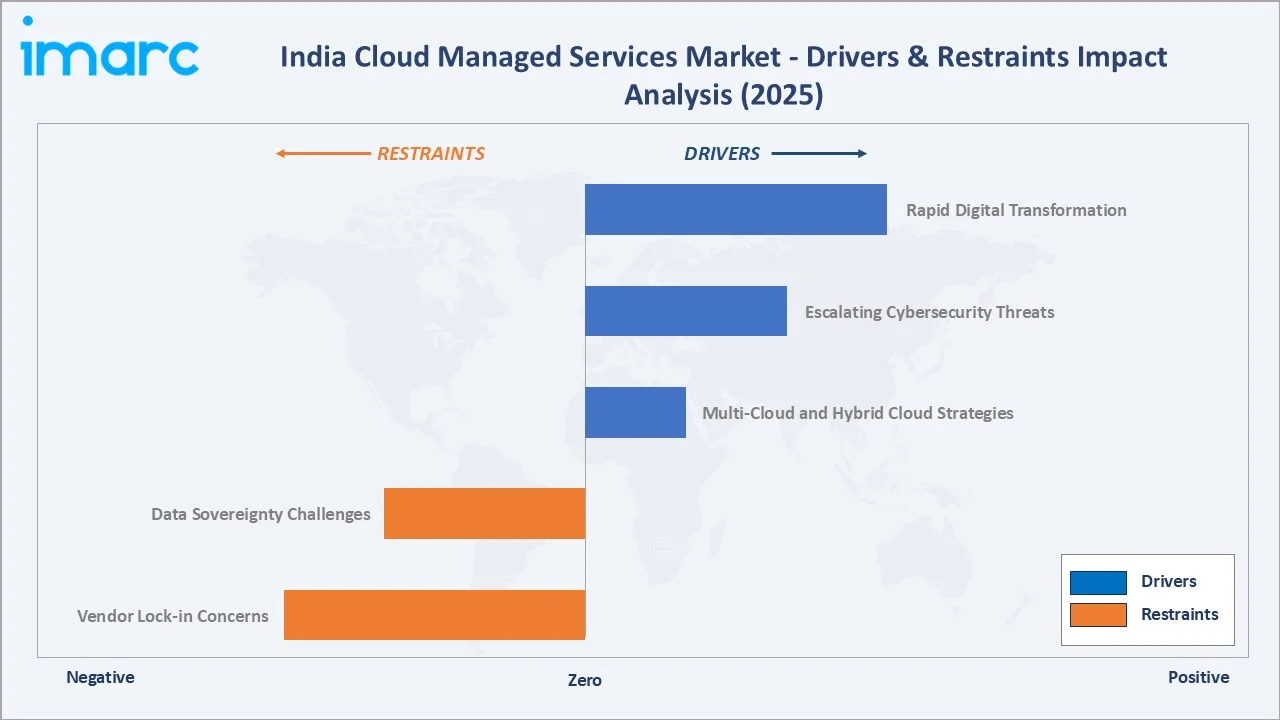
- Rapid Digital Transformation: India's enterprise sector is undergoing accelerated cloud migration driven by government-backed digital transformation initiatives. Enterprises across BFSI, manufacturing, retail, and healthcare are progressively migrating workloads to cloud environments, generating sustained demand for managed services covering infrastructure management, security operations, and application lifecycle management.
- Escalating Cybersecurity Threats: Rising cyberattack frequency and evolving regulatory compliance frameworks are compelling enterprises to outsource security operations to specialised managed service providers. Organisations across highly regulated sectors are increasingly recognising the operational and commercial advantages of outsourced managed security services over building internal SOC capabilities.
- Growth of SME Sector: Small and medium enterprises are adopting cloud managed services to access enterprise-grade technology capabilities without significant capital expenditure. Government digitisation programmes and the growing availability of affordable subscription-based managed service packages are accelerating adoption across Tier 2 and Tier 3 cities.
- Multi-Cloud and Hybrid Cloud Strategies: Enterprises adopting multi-cloud and hybrid cloud architectures create operational complexity that drives outsourcing to managed service providers. As organisations operate across multiple cloud platforms simultaneously, the need for specialist orchestration expertise, unified monitoring, and cross-platform compliance management grows significantly.
Market Restraints
- Data Sovereignty Challenges: Evolving data localisation requirements and varying compliance frameworks across banking, healthcare, and government sectors create operational complexity, delaying procurement decisions among highly regulated enterprises seeking cloud managed service engagements.
- Talent Shortage: The cloud managed services sector faces significant skilled workforce constraints, with managed service providers competing intensely for qualified cloud and cybersecurity professionals against global technology organisations, creating recruitment costs and attrition challenges that affect service delivery quality and scalability.
- Vendor Lock-in Concerns: Enterprises remain cautious about single-provider dependency for critical cloud infrastructure. Complex legacy system integration involving core business platforms extends implementation timelines and increases migration risk, slowing managed service adoption decisions among large enterprises with established IT environments.
Market Opportunities
- BFSI Sector Modernisation: India's banking and financial services sector represents the largest cloud managed services opportunity, with regulatory mandates creating sustained compliance-driven demand. Core banking modernisation, payments infrastructure management, and financial analytics platforms require specialist managed services with rigorous SLA commitments and domain expertise.
- Healthcare Digitisation: Government healthcare digitisation programmes are creating nationwide health data infrastructure requiring cloud managed service support. Electronic health record management, telemedicine platform operations, and health analytics represent concentrated managed service demand across hospitals, diagnostics, and pharmaceutical organisations.
Market Challenges
- Rapid Technological Evolution: The accelerating pace of change in AI-native services, serverless architectures, and edge computing requires continuous capability investment from managed service providers. Organisations failing to integrate intelligent automation and cloud-native security risk commoditisation as hyperscalers expand their own managed service portfolios.
- Price Sensitivity and Commoditisation: Increasing competition for standard infrastructure management services drives price compression across the market. Enterprise procurement teams are disaggregating contracts and bidding infrastructure components separately, compelling providers to shift toward differentiated, outcome-based service categories to sustain commercial viability.
Emerging Market Trends
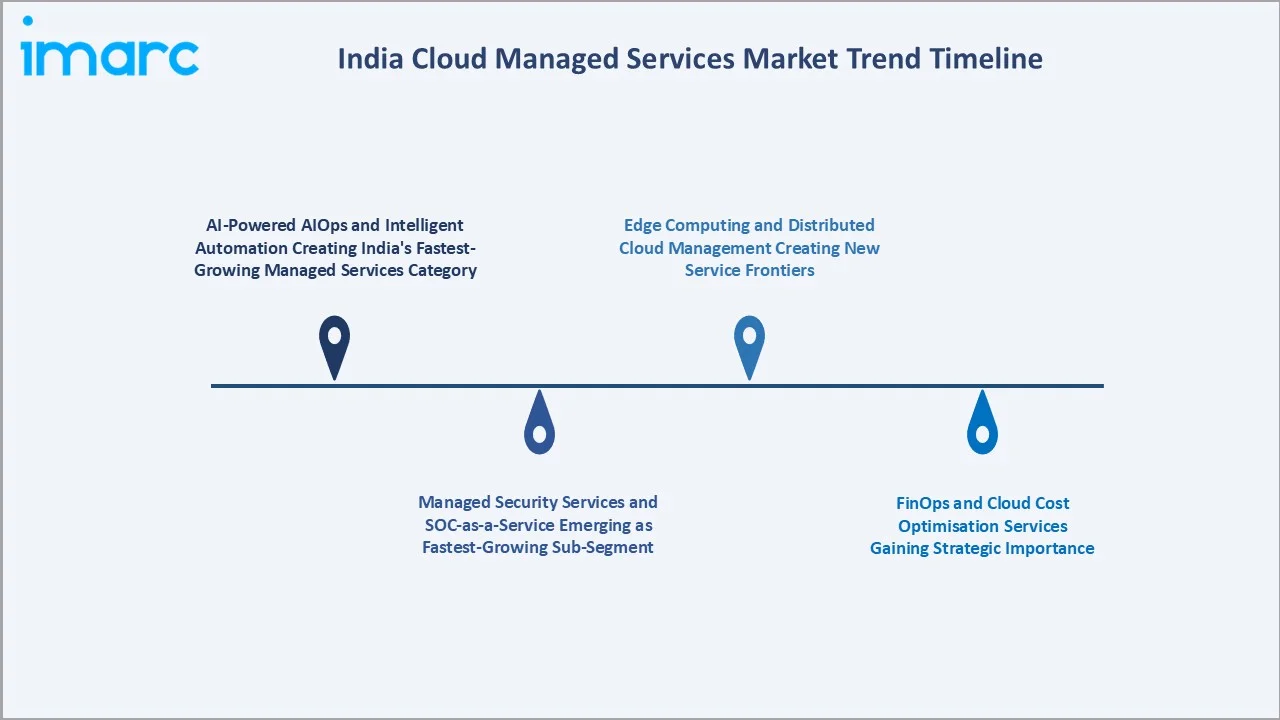
1. AI-Powered AIOps and Intelligent Automation Creating India's Fastest-Growing Managed Services Category
AIOps platforms are transforming cloud managed services through predictive infrastructure management and automated incident resolution. Leading managed service providers are embedding machine learning capabilities within service delivery platforms, enabling proactive identification and remediation of infrastructure issues before they impact business operations, significantly improving service quality and operational efficiency.
2. Managed Security Services and SOC-as-a-Service Emerging as Fastest-Growing Sub-Segment
Escalating cyber threats and India's evolving regulatory compliance landscape are driving accelerated growth in managed security services. SOC outsourcing is becoming a strategic priority as enterprises recognise that continuous 24x7 threat monitoring and response requires specialised investment and expertise that exceeds the capacity of most internal IT security teams.
3. Edge Computing and Distributed Cloud Management Creating New Service Frontiers
5G deployment, IoT proliferation, and Industry 4.0 automation are generating managed service requirements for distributed cloud and edge computing environments. The growing adoption of connected devices and smart infrastructure across manufacturing, retail, logistics, and smart city deployments is expanding the addressable market for specialised distributed cloud managed services.
4. FinOps and Cloud Cost Optimisation Services Gaining Strategic Importance
As enterprise cloud spending scales rapidly, organisations are engaging managed service providers for FinOps and cloud cost optimisation capabilities. Demonstrable cloud cost reduction commitments and financial governance services are increasingly influencing enterprise managed service provider selection decisions as cloud expenditure reaches financial materiality in organisational budgets.
Industry Value Chain Analysis
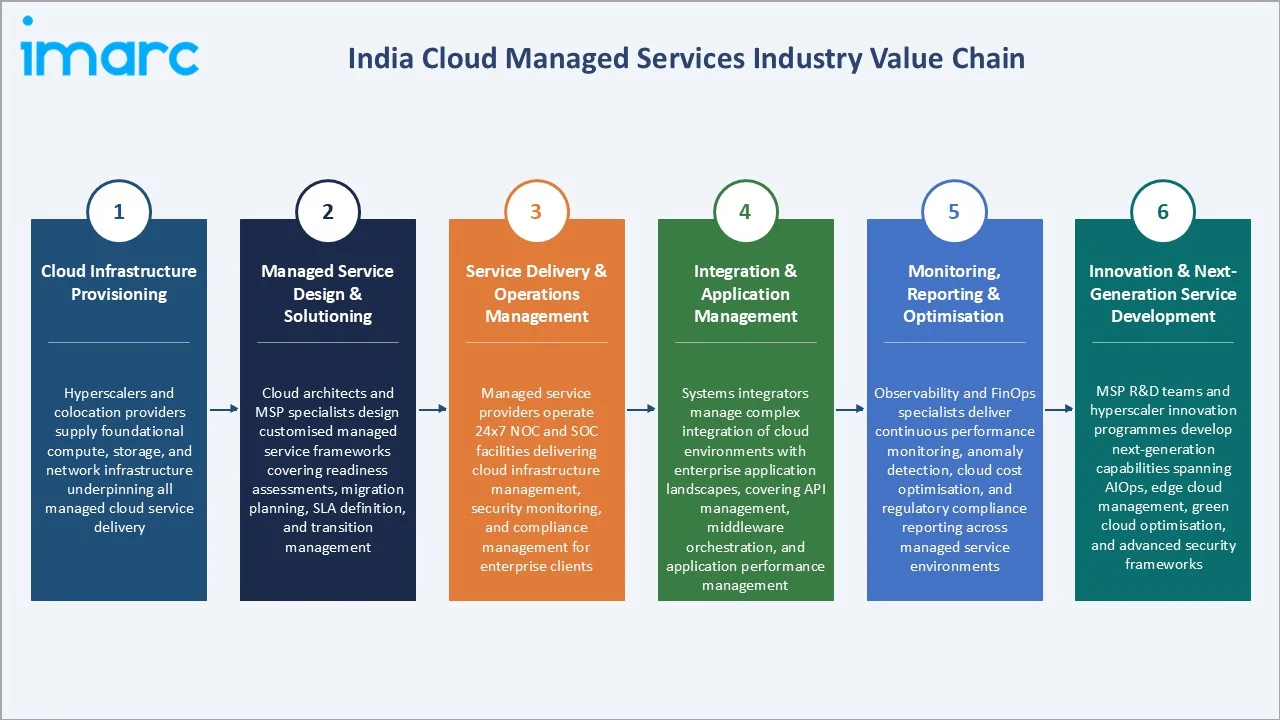
India cloud managed services value chain is structured across six interdependent stages from infrastructure provisioning through service innovation, with India's IT service majors occupying the highest-value tiers of service delivery and integration.
| Stage | Key Participants & Functions |
|---|---|
| Cloud Infrastructure Provisioning | Hyperscalers and colocation providers supply foundational compute, storage, and network infrastructure underpinning all managed cloud service delivery. |
| Managed Service Design & Solutioning | Cloud architects and MSP specialists design customised managed service frameworks covering readiness assessments, migration planning, SLA definition, and transition management. |
| Service Delivery & Operations Management | Managed service providers operate 24x7 NOC and SOC facilities delivering cloud infrastructure management, security monitoring, and compliance management for enterprise clients. |
| Integration & Application Management | Systems integrators manage complex integration of cloud environments with enterprise application landscapes, covering API management, middleware orchestration, and application performance management. |
| Monitoring, Reporting & Continuous Optimisation | Observability and FinOps specialists deliver continuous performance monitoring, anomaly detection, cloud cost optimisation, and regulatory compliance reporting across managed service environments. |
| Innovation & Next-Generation Service Development | MSP R&D teams and hyperscaler innovation programmes develop next-generation capabilities spanning AIOps, edge cloud management, green cloud optimisation, and advanced security frameworks. |
The service delivery and operations management stage represents India's primary competitive advantage, with world-class NOC/SOC capabilities and large talent pools enabling globally competitive 24x7 managed service delivery at attractive price points.
Technology Landscape in the India Cloud Managed Services Industry
Cloud-Native Architecture and Container Orchestration Technologies
Cloud-native architecture frameworks and container orchestration technologies are enabling managed service providers to deliver scalable, resilient services across multi-cloud environments. Growing enterprise adoption of containerised application deployment is creating sustained demand for specialist expertise in cluster lifecycle management, network policy configuration, access control governance, and container security hardening across BFSI, manufacturing, and retail verticals.
AI/ML and AIOps Platform Integration
Artificial intelligence and machine learning integration within managed service delivery platforms is fundamentally transforming infrastructure operations from reactive incident response to predictive, autonomous management. AIOps capabilities embedded in managed service contracts enable providers to identify and remediate infrastructure anomalies proactively, improving service quality, reducing operational costs, and commanding premium pricing through demonstrable performance improvements.
Zero Trust Security Architecture and SASE Implementation
Zero Trust Network Access and Secure Access Service Edge frameworks are now foundational components of managed security service offerings, enabling perimeter-less security architectures for distributed enterprise environments across hybrid cloud deployments. The convergence of network and security management under unified frameworks is creating new managed service contract structures that bundle connectivity and security into integrated, outcome-based service level agreements for enterprise clients.
Market Segmentation Analysis
The report covers the following segments:
| Segment Category | Leading Segment | Market Share | Year |
|---|---|---|---|
| Deployment Model | Public Cloud | 58.4% | 2025 |
| Organization Size | Large Enterprises | 61.3% | 2025 |
| Service Type | 🔒 | 🔒 | 2025 |
| Vertical | 🔒 | 🔒 | 2025 |
| Region | South India | 34.7% | 2025 |

By Deployment Model
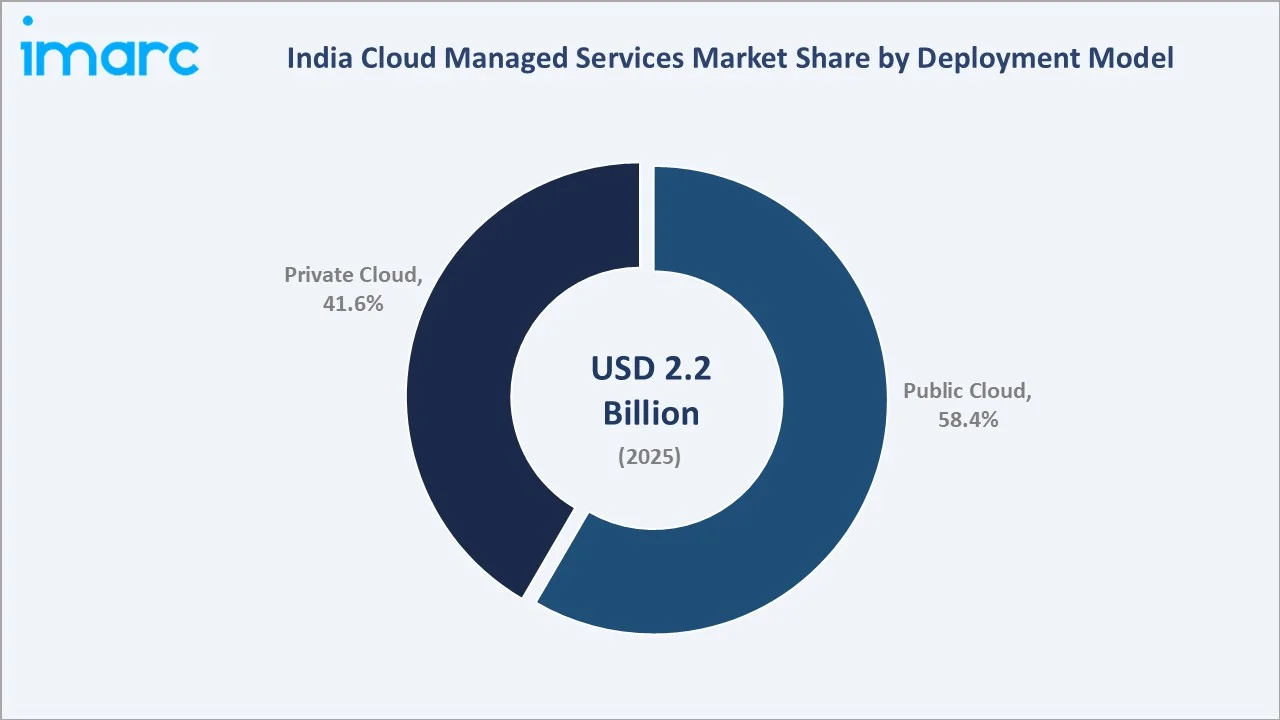
Public Cloud leads at 58.4% (2025). Public cloud managed services are delivered on hyperscaler platforms including AWS, Microsoft Azure, and Google Cloud, catering to enterprises seeking rapid scalability, global reach, and pay-as-you-go cost structures for infrastructure management.
To access detailed market analysis, Request Sample
Private Cloud at 41.6% serves regulated industries including BFSI, healthcare, and defence that require dedicated infrastructure with guaranteed compliance and data sovereignty. RBI's cloud outsourcing framework drives private cloud adoption for core banking and payment processing systems.
By Organization Size
Large Enterprises lead at 61.3% (2025), requiring comprehensive portfolios covering multi-cloud orchestration, security operations, disaster recovery, and application management. Multi-year contract structures create highly predictable revenue streams supporting managed service provider business planning.
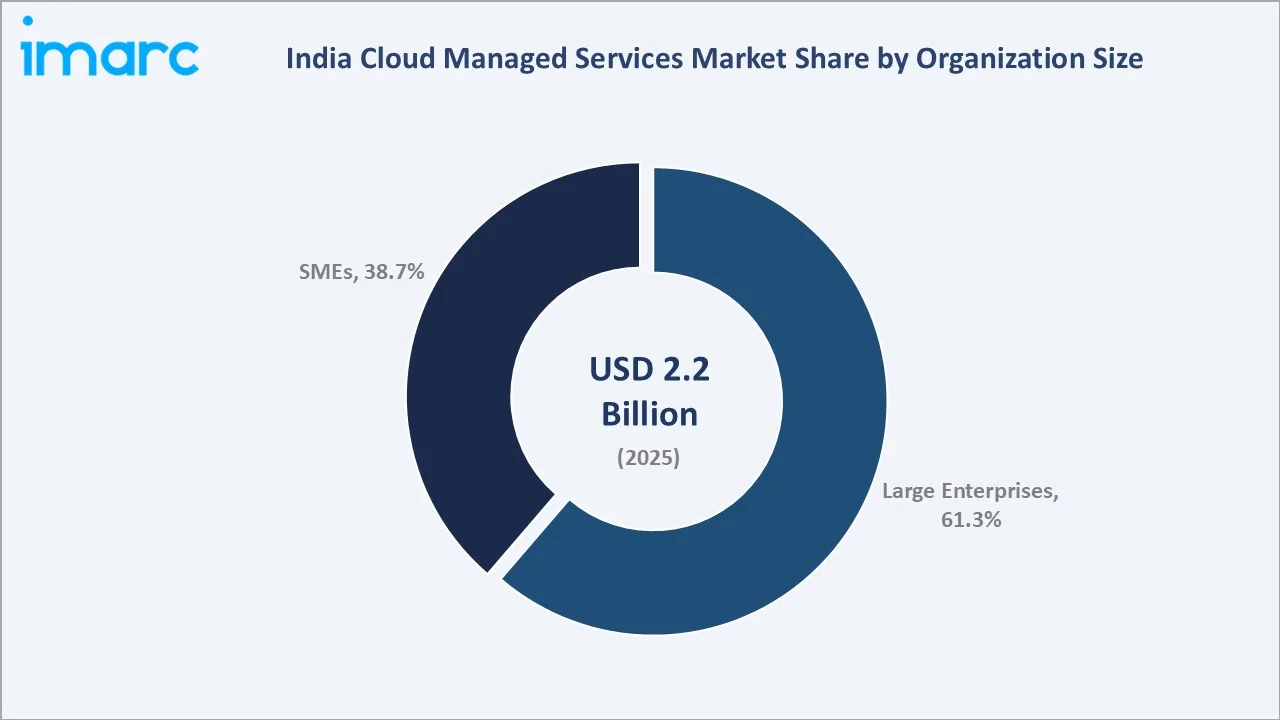
SMEs at 38.7% are the fastest-growing segment, driven by increasing cloud accessibility, affordable pricing tiers, and recognition that outsourced cloud management delivers superior outcomes versus limited in-house IT teams and constrained technology budgets.
Regional Market Insights
| Region | Share (2025) | Key India Cloud Managed Services Market Drivers & Characteristics |
|---|---|---|
| South India | 34.7% | Anchored by Bangalore's technology ecosystem, Hyderabad's IT corridor, and Chennai's manufacturing-IT services nexus, driving enterprise cloud adoption across software, aerospace, and BFSI sectors. |
| West & Central India | 29.8% | Driven by Mumbai's BFSI concentration, Pune's IT and manufacturing ecosystem, and Ahmedabad's growing SME digitisation, supporting widespread adoption of managed cloud, security, and analytics services. |
| North India | 23.6% | Supported by the Delhi-NCR technology corridor, Gurugram and Noida IT hubs, and government sector cloud adoption including NIC and NICSI mandates for cloud infrastructure. |
| East & Northeast India | 11.9% | Rising IT infrastructure investments in Kolkata and Bhubaneswar, combined with state government digital transformation initiatives, are expanding the managed services addressable market. |
South India leads with a 34.7% share in 2025, anchored by Bangalore's technology ecosystem hosting over 1,700 global capability centres, Hyderabad's HITEC City, and Chennai's manufacturing-IT nexus. West & Central India holds 29.8%, driven by Mumbai's BFSI concentration and Pune's IT and engineering ecosystem.
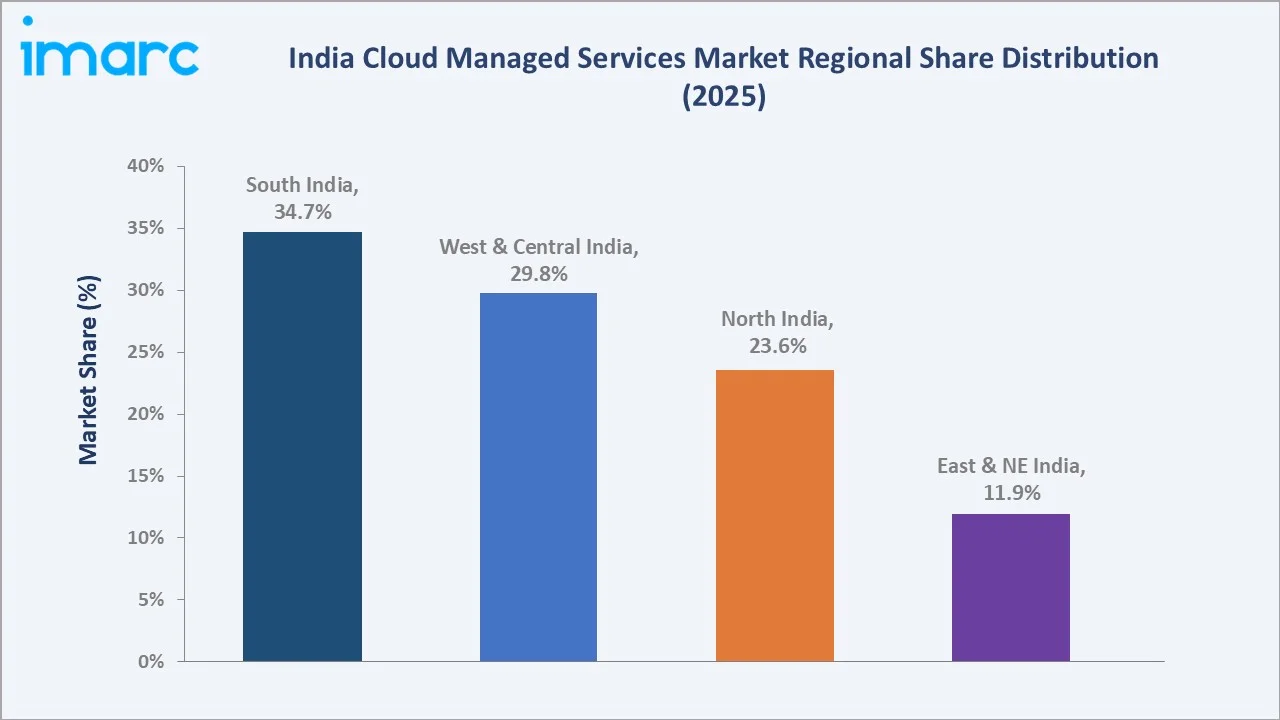
North India accounts for 23.6%, supported by the Delhi-NCR technology corridor and government sector cloud adoption. East & Northeast India holds 11.9%, with rising IT investments in Kolkata and Bhubaneswar expanding the managed services addressable market through state-driven digital transformation initiatives.
Competitive Landscape
India cloud managed services competitive landscape is defined by India's IT majors — TCS, Infosys, Wipro, HCL Technologies, and Tech Mahindra — combined with global technology giants including IBM India and AWS India, offering platform-native managed service capabilities leveraging proprietary AI, automation, and hyperscaler infrastructure advantages.
| Company | Key Services | Market Position | Core Strength |
|---|---|---|---|
| Tata Consultancy Services Limited (TCS) | Cloud Migration, Managed Security, AIOps, Multi-Cloud Management | Market Leader | TCS leverages its global delivery model and TCS Cognix™ AI platform to deliver enterprise cloud managed services across 50+ countries, with deep domain expertise in BFSI and manufacturing sectors. |
| Infosys Limited | Cobalt Cloud Platform, Managed Security, Cloud DevOps | Strong Challenger | Infosys Cobalt provides a comprehensive cloud-first managed services portfolio covering over 35,000 cloud instances, with particular strength in financial services, retail, and healthcare verticals. |
| Wipro Limited | FullStride Cloud, Managed Infrastructure, Cloud Security | Strong Challenger | Wipro FullStride Cloud Services integrates proprietary engineering platforms with hyperscaler partnerships to deliver hybrid and multi-cloud managed services globally. |
| HCL Technologies Limited | DRYiCE AI Platform, Managed Infrastructure, Cloud Factory, Security | Innovator | HCL's AI-driven DRYiCE platform enables autonomous IT operations management, with strong cloud managed services capabilities across manufacturing, telecom, and government sectors. |
Competitive differentiation is increasingly driven by AIOps maturity, cybersecurity depth, FinOps excellence, and vertical domain expertise. Hyperscaler-native managed services from AWS, Azure, and Google Cloud are simultaneously expanding, creating a complex vendor selection environment for enterprise clients evaluating technical capability and commercial engagement models.
Key Company Profiles
Tata Consultancy Services Limited (TCS)
Tata Consultancy Services Limited is India's largest IT services company and a global leader in cloud managed services, operating across 50+ countries with a comprehensive portfolio spanning cloud migration, application management, cybersecurity, and AI-powered IT operations.
- Key Services: Cloud migration, managed security services, AIOps, digital workplace managed services, SAP RISE on cloud, and multi-cloud management through TCS Cognix™ AI platform.
- Recent Developments: In June 2025, Tata Consultancy Services (TCS) expanded its long-standing collaboration with Microsoft to develop new AI and cloud solutions for business transformation. Under the multi-year collaboration, TCS is integrating Microsoft Azure services into its engineering and solutions teams to support customers in migrating critical applications and workloads from legacy systems to the cloud. The collaboration covers sectors including financial services, retail and consumer goods, manufacturing and automotive, and life sciences and healthcare. TCS also holds Azure Expert Managed Service Provider certification and 19 Microsoft specializations.
- Strategic Focus: Expanding autonomous operations capabilities through AI-embedded managed service delivery frameworks to achieve zero-touch infrastructure management for global enterprise clients.
Infosys Limited
Infosys Limited is a global technology leader and one of India's most commercially significant cloud managed services providers, operating its Infosys Cobalt cloud platform to manage over 35,000 cloud instances for enterprise clients across regulated industries worldwide.
- Key Services: Infosys Cobalt cloud managed services, managed security operations, cloud DevOps, FinOps and cloud cost management, and AI-driven application lifecycle management.
- Recent Developments: In June 2026, Infosys expanded its collaboration with GlobalFoundries through a multi-year engagement to deliver AI-led managed services across the semiconductor manufacturer’s enterprise IT landscape. Infosys will manage GlobalFoundries’ end-to-end application, infrastructure, data, and service desk operations, transitioning the company toward an AI-, automation-, and continuous-optimization-driven managed services model.
- Strategic Focus: Deepening AI and automation integration across managed service delivery to achieve intelligent autonomous operations and expand FinOps capabilities for cost-optimisation mandates.
Wipro Limited
Wipro Limited's FullStride Cloud Services represents one of India's most comprehensive managed cloud service frameworks, integrating engineering platforms with hyperscaler partnerships to manage complex hybrid and multi-cloud environments for global enterprise clients.
- Key Services: FullStride Cloud managed infrastructure, cloud security and compliance, SAP on cloud management, cloud-native application operations, and hybrid cloud network management.
- Recent Developments: In June 2025, Wipro extended its strategic partnership with METRO AG for two years to continue providing integrated digital services across cloud, data, application development, and AI-enabled IT support. As part of the engagement, Wipro had already migrated 80% of METRO’s on-premise infrastructure to the cloud and will continue supporting its cloud-first strategy through cloud, automation, advanced analytics, and Gen-AI-powered solutions.
- Strategic Focus: Accelerating FullStride Cloud industrialisation to deliver repeatable, automated managed service outcomes at scale, with particular emphasis on cloud security and regulatory compliance management.
Market Concentration Analysis
India cloud managed services market shows moderate-to-high concentration at the enterprise tier. TCS, Infosys, Wipro, and HCL Technologies command a combined 40-45% revenue share among large enterprise accounts, reinforced by multi-year contracts and deep integration with client IT environments.
Below the enterprise tier, the market shows lower concentration. A diverse ecosystem of technology companies, telecom-affiliated providers, and regional specialists compete for mid-market and SME contracts, with greater price sensitivity and competitive tendering than the enterprise segment.
Two structural forces simultaneously shape market concentration. Enterprise consolidation accelerates through IT major acquisitions of niche cloud firms. Simultaneously, cloud automation democratises mid-market delivery, enabling smaller providers to compete effectively through hyperscaler partner programmes.
Enterprise procurement is evolving toward dual-MSP models to maintain competitive tension and operational resilience. This trend creates commercial opportunities for second-tier providers to win partial mandates from enterprises implementing multi-vendor managed service strategies.
Investment & Growth Opportunities
Highest Growth Segments
Public Cloud managed services will grow at ~14.2% CAGR through 2034 driven by enterprise workload migration. SME-focused services represent a ~14.8% CAGR opportunity.
Emerging Investment Opportunities
FinOps and cloud cost optimisation represent high-conviction emerging investment themes. AIOps platforms integrating generative AI for autonomous incident management offer significant opportunity. Edge computing managed services for manufacturing and smart cities represent early-stage but high-potential investments as 5G proliferates.
Strategic Investment Themes
- Managed security services and SOC-as-a-Service targeting BFSI and healthcare compliance mandates. RBI, IRDAI, and Ayushman Bharat Digital Mission regulatory frameworks create compliance-driven demand pipelines rewarding investment in sector-specific SOC capabilities and certified compliance management.
- SME-focused managed cloud services platform development targeting India's 63 million SME sector. Subscription-based models, hyperscaler channel programmes, and regional integrator networks enable scalable service delivery across Tier 2 and Tier 3 cities.
- AIOps platform development and AI-driven managed operations capability building. Providers investing in predictive infrastructure management build durable competitive advantages enabling larger estate management per engineer and premium pricing for AI-enhanced services.
- Hyperscaler partnership and multi-cloud managed services specialisation. Achieving advanced certifications across AWS, Azure, and Google Cloud creates differentiated positioning for enterprises requiring demonstrated cross-platform expertise as a vendor qualification prerequisite.
Future Market Outlook (2026-2034)
The India cloud managed services market is projected to expand from USD 2.53 Billion in 2026 to USD 7.28 Billion by 2034, at a CAGR of 13.35%, driven by accelerating enterprise migration to managed public cloud platforms, rising demand for managed security and compliance services across BFSI and healthcare, sustained government cloud procurement under Digital India, and India’s deepening role as a globally competitive cloud managed services delivery hub. Public cloud managed services will remain the dominant deployment segment as enterprises progressively outsource AWS, Azure, and Google Cloud infrastructure management to specialised providers for 24x7 NOC support, FinOps, and performance optimisation.
Managed security services and SOC-as-a-Service will emerge as the highest-growth sub-segment, driven by RBI and IRDAI cloud compliance mandates and the DPDP Act 2023 compelling BFSI and healthcare enterprises to outsource security operations. SME cloud adoption will accelerate significantly through 2034 as affordable managed cloud platforms, hyperscaler partner programmes, and government digitisation incentives enable India’s 63 million SMEs to adopt professionally managed cloud services, creating a new high-volume, subscription-based demand segment for domestic managed service providers.
Research Methodology
IMARC Group's report is produced through rigorous research combining primary intelligence from industry practitioners with comprehensive secondary data collection and proprietary quantitative forecasting models to ensure accurate, actionable market sizing and competitive assessments.
Primary Research
Primary research comprised structured interviews with 50+ industry participants: cloud managed services executives, architects, enterprise IT decision-makers, and sector specialists across BFSI, healthcare, IT, manufacturing, and government verticals. Insights were aggregated and anonymised under confidentiality agreements.
Secondary Research
Secondary research reviewed Ministry of Electronics and IT reports, RBI and SEBI cloud compliance frameworks, NASSCOM cloud analyses, Gartner and IDC enterprise surveys, and IT major financial disclosures, alongside the Digital Personal Data Protection Act 2023, RBI cloud outsourcing guidelines, and CERT-In cybersecurity guidelines.
Market Estimation and Forecasting Models
Revenue estimates for 2020-2025 used bottom-up aggregation of IT major financials and private provider benchmarks. Forecasts for 2026-2034 incorporated workload migration models, sector compliance-driven adoption projections, SME digitisation trajectories, and hyperscaler investment data, with sensitivity analysis applied to key assumptions.
India Cloud Managed Services Market Report Coverage:
| Report Features | Details |
|---|---|
| Base Year of the Analysis | 2025 |
| Historical Period | 2020-2025 |
| Forecast Period | 2026-2034 |
| Units | Billion USD |
| Scope of the Report |
Exploration of Historical Trends and Market Outlook, Industry Catalysts and Challenges, Segment-Wise Historical and Future Market Assessment:
|
| Service Types Covered | Managed Network Services, Managed Business Services, Managed Security Services, Managed Infrastructure Services, Managed Mobility Services, Managed Communication and Collaboration Services |
| Deployment Models Covered | Private Cloud, Public Cloud |
| Organization Sizes Covered | Large Enterprises, Small and Medium-sized Enterprises |
| Verticals Covered | Retail and Consumer Goods, BFSI, Telecom, Government and Public Sector, Healthcare and Lifesciences, Manufacturing, Energy and Utilities, IT, Others |
| Regions Covered | North India, West and Central India, South India, East and Northeast India |
| Comapnies Covered | Tata Consultancy Services Limited (TCS), Infosys Limited, Wipro Limited, HCL Technologies Limited, etc. |
| Customization Scope | 10% Free Customization |
| Post-Sale Analyst Support | 10-12 Weeks |
| Delivery Format | PDF and Excel through Email (We can also provide the editable version of the report in PPT/Word format on special request) |
Key Benefits for Stakeholders:
- IMARC’s industry report offers a comprehensive quantitative analysis of various market segments, historical and current market trends, market forecasts, and dynamics of the India cloud managed services market from 2020-2034.
- The research report provides the latest information on the market drivers, challenges, and opportunities in the India cloud managed services market.
- Porter's five forces analysis assist stakeholders in assessing the impact of new entrants, competitive rivalry, supplier power, buyer power, and the threat of substitution. It helps stakeholders to analyze the level of competition within the India cloud managed services industry and its attractiveness.
- Competitive landscape allows stakeholders to understand their competitive environment and provides an insight into the current positions of key players in the market.
Frequently Asked Questions About the India Cloud Managed Services Market Report
India cloud managed services market size is estimated at USD 2.53 Billion in 2026, driven by accelerating enterprise cloud adoption, rising cybersecurity outsourcing requirements, and government-backed digital transformation initiatives including Digital India and BharatNet. Growing demand from BFSI, healthcare, and IT sectors, alongside India’s expanding base of global capability centres, further supports sustained market expansion across public cloud, private cloud, and managed security service segments.
India cloud managed services market grows at 13.35% CAGR during 2026-2034, reaching USD 7.28 Billion by 2034, underpinned by regulatory cloud mandates, cybersecurity outsourcing, and SME digitalisation.
Public Cloud leads at 58.4% through enterprise adoption of hyperscaler managed services from AWS, Microsoft Azure, and Google Cloud for scalable, cost-efficient infrastructure management.
Large Enterprises lead at 61.3% through complex multi-cloud managed service requirements spanning security operations, compliance management, and application lifecycle management.
South India leads at 34.7% through Bangalore's technology hub concentration, Hyderabad's IT corridor, and Chennai's manufacturing-IT services ecosystem collectively driving enterprise cloud managed service demand.
Leading companies include Tata Consultancy Services Limited (TCS), Infosys Limited, Wipro Limited and HCL Technologies Limited, among others.
India cloud managed services market is projected to reach approximately USD 4.17 Billion by 2030, reflecting sustained 13.35% CAGR growth driven by enterprise cloud transformation and managed security service expansion.
Three priority investment opportunities: managed security services and SOC-as-a-Service targeting enterprise compliance mandates, SME-focused cloud managed service platforms capitalising on India's 63 million SME digitisation wave, and AIOps and FinOps platform development for enterprise cost optimisation.
Need more help?
- Speak to our experienced analysts for insights on the current market scenarios.
- Include additional segments and countries to customize the report as per your requirement.
- Gain an unparalleled competitive advantage in your domain by understanding how to utilize the report and positively impacting your operations and revenue.
- For further assistance, please connect with our analysts.
 Request Customization
 Speak to an Analyst
 Request Brochure
 Inquire Before Buying
Benefits of Customization
- Personalize this research
- Triangulate with your data
- Get data as per your format and definition
- Gain a deeper dive into a specific application, geography, customer, or competitor
- Any level of personalization
Get in Touch With Us
UNITED STATES
Phone: +1-201-971-6302
INDIA
Phone: +91-120-433-0800
UNITED KINGDOM
Phone: +44-753-714-6104
Email: [email protected]
Client Testimonials






















Related Reports

Choose your plan
*Please note that the prices mentioned below are starting prices for each bundle type. Kindly contact our team for further details.*
Single User License
- 1 User License, Access on 2 Devices
- PDF Report + Excel Dataset (Password Protected)
- Lifetime Access
- No Printing Rights
- 10% Free Report Customization
- 10–12 Weeks of Analyst Support
Five User License
- Access for 5 Users, 2 Devices per User
- PDF Report + Excel Dataset (Password Protected)
- Lifetime Access
- Dedicated Account Manager
- 12–14 Weeks of Analyst Support
- No Printing Rights
- 15% Free Report Customization
- 25% Discount on Your Next Purchase
Corporate User License
- Unlimited User Access (Within Your Organization)
- PDF Report + Excel Dataset
- Lifetime Access
- Dedicated Account Manager
- 14–20 Weeks of Analyst Support
- No Printing Rights
- 20% Free Report Customization
- 30% Discount on Your Next Purchase
Essential Insights
What's included:
3 reports
- Lifetime Access
- PDF Reports
- Excel Datasets
- 2 Weeks of Free Analyst Support
- 2 User Licenses
- Access on 2 Devices
- Printing Rights
- Complimentary PowerPoint (PPT) Version
- Complimentary License Upgrade
Professional Access
What's included:
5 reports
- Lifetime Access
- PDF Reports
- Excel Datasets
- 8 Weeks of Free Analyst Support
- 2 User Licenses
- Access on 2 Devices
- Printing Rights
- Complimentary PowerPoint (PPT) Version
- Complimentary License Upgrade
Business Advantage
What's included:
8 reports
- Lifetime Access
- PDF Reports
- Excel Datasets
- 14 Weeks of Free Analyst Support
- 2 User Licenses
- Access on 2 Devices
- Printing Rights
- Complimentary PowerPoint (PPT) Version
- Complimentary License Upgrade
Enterprise Intelligence
What's included:
10 reports
- Lifetime Access
- PDF Reports
- Excel Datasets
- 20 Weeks of Free Analyst Support
- 2 User Licenses
- Access on 2 Devices
- Printing Rights
- Complimentary PowerPoint (PPT) Version
- Complimentary License Upgrade