
India Coconut Oil Market Size, Share, Trends and Forecast by Source, Type, Application, Distribution Channel, and Region, 2026-2034
India Coconut Oil Market Summary:
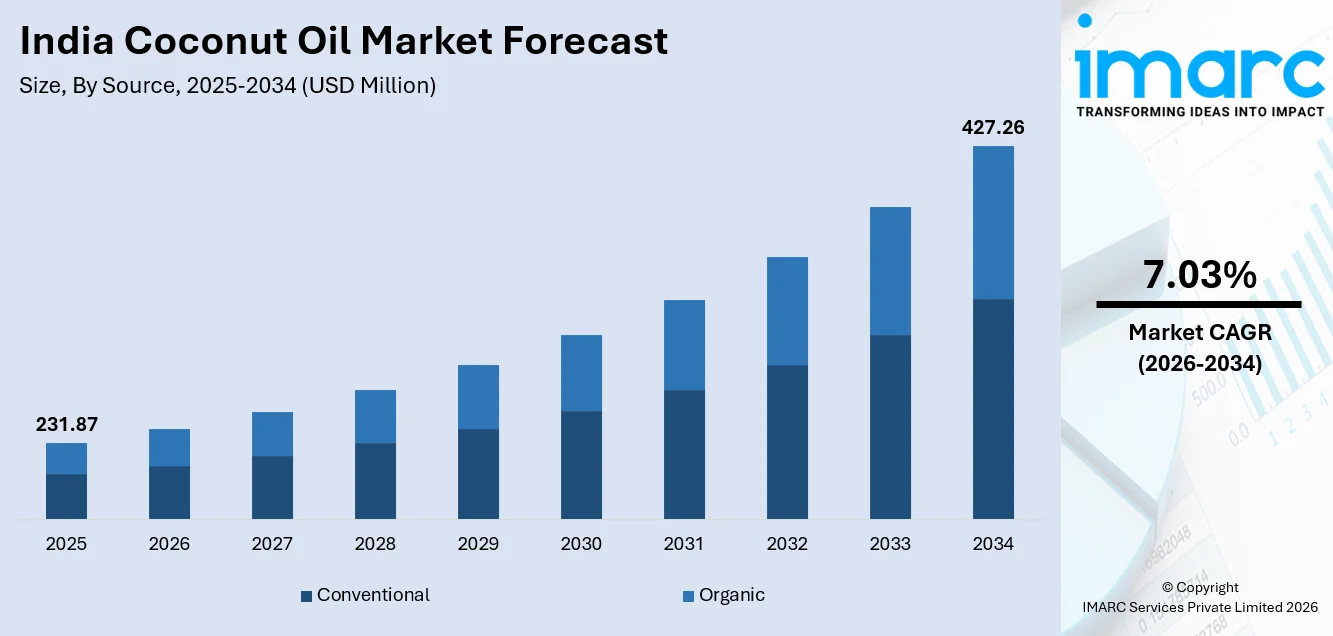
The India coconut oil market grew from USD 231.87 Million in 2025 to USD 248.11 Million in 2026 and is projected to reach USD 427.26 Million by 2034, growing at a compound annual growth rate of 7.03% from 2026-2034.
The coconut oil market in India is growing due to individual preference for natural and organic edible oils, heightened health awareness, and the rising use in food, cosmetics, and pharmaceutical sectors. The deeply embedded cultural importance of coconut oil in Indian cooking and traditional health practices still supports robust local demand. The growth of contemporary retail infrastructure, swift adoption of e-commerce, and advancements in product offerings within premium and virgin coconut oil segments are contributing to India coconut oil market share.
Key Takeaways and Insights:
- By Source: Conventional dominates the market with a share of 65% in 2025, driven by its widespread availability, cost-effectiveness, and deep integration into traditional cooking and personal care routines across Indian households.
- By Type: Refined leads the market with a share of 40% in 2025, owing to its neutral taste, high smoke point suitability for diverse culinary applications, and extended shelf life preferred by food processing industries.
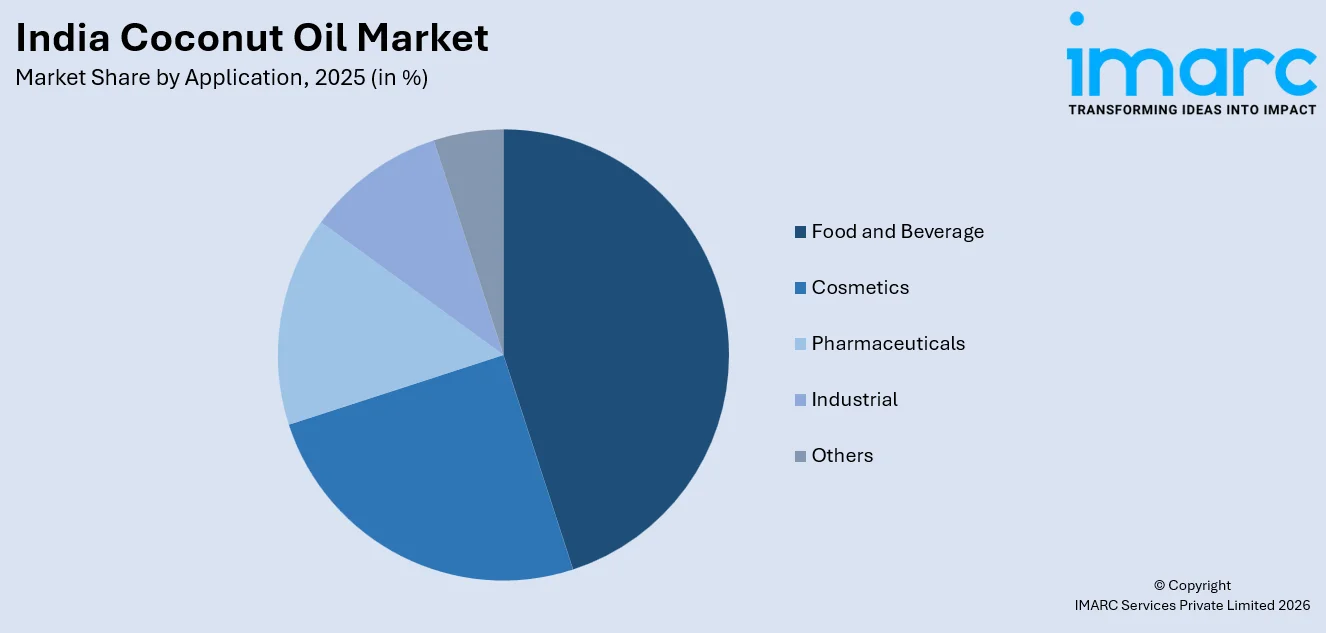
- By Application: Food and beverage represent the largest segment with a market share of 45% in 2025. This dominance is because of coconut oil's integral role in South Indian cuisine, increasing use in bakery and confectionery products, and growing demand for plant-based cooking oils.
- By Distribution Channel: Supermarket and hypermarket dominate the market with a share of 38% in 2025, supported by extensive product assortments, competitive pricing, and the ability to offer multiple brands and packaging formats under one roof.
- Key Players: The India coconut oil market features a competitive landscape with established domestic FMCG companies competing alongside regional coconut oil producers and emerging organic brands across diverse price segments and distribution channels.
To get more information on this market Rrequest Sample
The coconut oil market in India is experiencing growth as people are becoming more aware about the health, culinary, and personal care advantages of products made from coconuts. Increasing awareness regarding natural and multifunctional oils is encouraging households to integrate coconut oil into cooking, hair care, and wellness practices. Producers are reacting with focused product developments, promotions, and educational programs to emphasize nutritional, cosmetic, and lifestyle benefits. For example, in 2024, Marico Limited's Nihar Naturals initiated a campaign showcasing actress Rukmini Maitra to advocate for hair fitness with its Coconut Hair Oil infused with methi and jasmine. The campaign highlighted the importance of consistent hair oiling for healthier, fuller, and more resilient hair, tackling environmental and lifestyle challenges. Utilizing television, digital, and social media channels, the program involves users and strengthens regular hair care habits. This marketing centered on products, along with increasing health awareness and lifestyle-oriented use, is driving the demand for coconut oil in both personal care and household categories in India.
India Coconut Oil Market Trends:
Rising Demand for Premium and Functional Hair Oils
The increasing user preference for premium and multifunctional hair oils is a crucial factor bolstering the growth of India coconut oil market. People are looking for products which not only nourish and strengthen hair but also offer additional benefits, such as scent, shine, and easy application. This trend is encouraging companies to innovate and differentiate their product offerings to serve contemporary or quality-oriented user. In line with this, in 2025, KLF Nirmal launched Oudh Coconut Hair Oil, India’s first hair oil to blend the nourishing benefits of Kerala coconut oil with the luxurious essence of Oudh. This product strengthens and revitalizes hair while delivering a long-lasting, indulgent fragrance, exemplifying the shift toward premium, multifunctional hair care solutions.
Growing Focus on Health-Conscious Cooking
The rising awareness about health and wellness among Indian consumers is driving the demand for natural and nutritious cooking oils, including coconut oil. Consumers increasingly seek oils that offer functional benefits, such as antioxidants, heart health support, and purity, aligning with healthier dietary habits. In line with this preference, QNET India launched the #HealthyCookingFirst campaign on World Health Day to promote smarter cooking practices using Nutriplus Virgin Coconut Oil in 2025. Highlighting its cold-pressed purity and antioxidant-rich, heart-friendly profile, the initiative engaged consumers digitally, with celebrity chef Ayesha Nallaseth demonstrating nutritious recipes. This example underscores the trend of leveraging functional, health-oriented coconut oils to meet the growing consumer demand for wellness-focused culinary solutions.
Rise of E-Commerce
The increasing number of e-commerce channels offering coconut oil is enhancing access accessibility, product range and user convenience. Online platforms allow people in urban and semi-urban areas to discover products under multiple brands, premium versions, and specialty oils, thus facilitating increased usage. According to IBEF, India’s e-commerce industry was valued at INR 10,82,875 crore (USD 125 billion) in 2024 and will reach INR 29,88,735 crore (USD 345 billion) by 2030, growing at a CAGR of 15%, indicating the massive and lucrative potential of the industry. Such growth enables coconut oil makers to target a much larger user base, promote innovative products digitally, and serve health-minded, convenience-conscious users across the country.
Market Outlook 2026-2034:
The India coconut oil market is set for consistent growth during the forecast period, backed by positive demographic shifts, increasing applications, and heightened consumer awareness about health advantages. The market generated a revenue of USD 231.87 Million in 2025, which is expected to reach USD 248.11 Million in 2026 and further grow to USD 427.26 Million by 2034, at a compound annual growth rate of 7.03% from 2026-2034. The growing governmental investment in coconut farming, heightened premiumization across various product sectors, and broadening industrial uses are anticipated to boost revenue across the value chain
India Coconut Oil Market Report Segmentation:
|
Segment Category |
Leading Segment |
Market Share |
|
Source |
Conventional |
65% |
|
Type |
Refined |
40% |
|
Application |
Food and Beverage |
45% |
|
Distribution Channel |
Supermarket and Hypermarket |
38% |
Source Insights:
- Organic
- Conventional
Conventional dominates with a market share of 65% of the total India coconut oil market in 2025.
Conventional holds the biggest market share because of its widespread availability, cost-effectiveness, and reliable extraction methods. Sourced directly from mature coconuts using traditional cold-press or copra-based processes, it delivers consistent quality suitable for cooking, hair care, and cosmetic applications. Conventional coconut oil offers a balance of affordability and functional benefits, including moderate aroma, stable shelf life, and essential fatty acids. Its established supply chains across Kerala, Tamil Nadu, and Karnataka ensure steady production volumes, making it accessible to urban and rural consumers alike. This combination of reliability, versatility, and price competitiveness strengthens its market dominance.
The leadership of conventional coconut oil is further reinforced by India’s large culinary and personal care demand, where cost, availability, and multipurpose usability are key factors. Households, small-scale food manufacturers, and cosmetic product makers rely on conventional coconut oil for frying, hair nourishment, and skincare routines, appreciating its consistency and affordability. Government-supported coconut cultivation programs and well-established coir and oil extraction industries contribute to sustained supply. Serving as a foundational product for both traditional and modern uses, conventional coconut oil meets user expectations for quality, versatility, and economic value. Its continued preference underpins growth across domestic and regional markets nationwide.
Type Insights:
- Virgin
- Extra Virgin
- Refined
- Others
Refined leads with a market share of 40% of the total India coconut oil market in 2025.
Refined dominates the market due to its adaptability, mild scent, and appropriateness for various culinary and industrial uses. Created through methods like bleaching, deodorizing, and filtering, it provides a reliable, superior product with a longer shelf life than unrefined options. Its mild taste and scent make it ideal for cooking, baking, and producing processed foods, while its stability during high-temperature frying guarantees exceptional performance in professional kitchens. The extensive accessibility of processed coconut oil, coupled with its affordability and suitability for both conventional and contemporary applications, strengthens its prevalence in homes and businesses across the country.
The dominance of refined coconut oil is bolstered by the increasing user demand for odorless, multifunctional oils that cater to both cooking and beauty applications. Foodservice providers, packaged food producers, and personal care industries are increasingly depending on refined coconut oil due to its reliable quality, safety, and versatility in various applications. Furthermore, government programs encouraging coconut farming and advanced processing facilities ensure consistent supply and competitive pricing. Refined coconut oil provides a dependable and practical substitute for traditional or virgin coconut oils, harmonizing quality, usability, and cost-effectiveness, fostering ongoing use and solidifying its status as the favored choice in India's transforming coconut oil market.
Application Insights:
Access the comprehensive market breakdown Request Sample
- Food and Beverage
- Cosmetics
- Pharmaceuticals
- Industrial
- Others
Food and beverage exhibit a clear dominance with a 45% share of the total India coconut oil market in 2025.
Food and beverage represents the largest segment owing to its widespread use in cooking, baking, frying, and packaged food production. Coconut oil’s stability at high temperatures, neutral flavor, and natural fatty acid composition make it ideal for diverse culinary applications. It is preferred for frying snacks, preparing traditional dishes, and enhancing flavor profiles in baked goods. Additionally, its inclusion in packaged and processed foods, such as instant mixes, confectionery, and ready-to-eat items, further drives demand. This combination of versatility, safety, and functionality positions food and beverage as the dominant application segment.
The leadership of food and beverage is reinforced by India’s growing urban population, rising disposable incomes, and increasing demand for ready-to-eat (RTE) and packaged foods. Health-conscious consumers also favor coconut oil for its perceived nutritional benefits, including medium-chain fatty acids and natural antioxidant content. Restaurants, catering services, and snack manufacturers increasingly adopt both refined and conventional coconut oils to meet consistent quality and safety standards. The robust supply chain from coconut-producing regions, combined with competitive pricing and large-scale processing capabilities, ensures reliable availability. Serving as a key ingredient across diverse culinary and food-processing applications, coconut oil continues to dominate the food and beverage segment in India.
Distribution Channel Insights:
- Supermarket and Hypermarket
- Convenience Store
- Online
- Others
Supermarket and hypermarket dominate with a market share of 38% of the total India coconut oil market in 2025.
Supermarkets and hypermarkets lead the market due to their extensive reach, organized retail infrastructure, and ability to provide users with branded and standardized products. These outlets offer convenience, wide product visibility, and variety, allowing buyers to choose between conventional, refined, and specialty coconut oils. Compared to traditional local stores, supermarkets and hypermarkets ensure better shelf presentation, consistent pricing, and reliable stock availability. Their structured supply chains and partnerships with leading coconut oil manufacturers further enhance product accessibility. The combination of convenience, product range, and trust in organized retail formats strengthens supermarkets and hypermarkets as the preferred distribution channel nationwide.
The dominance of supermarkets and hypermarkets is further reinforced by the growing urban middle class, rising disposable incomes, and increasing user preference for organized retail shopping. Promotional campaigns, in-store branding, and loyalty programs drive consumer engagement and repeat purchases of coconut oil. Additionally, these retail formats support bulk packaging, premium variants, and ready-to-use products, catering to diverse household and commercial needs. By offering easy access to high-quality, branded coconut oils, supermarkets and hypermarkets play a pivotal role in shaping consumer purchasing patterns. Their efficiency, visibility, and reliability ensure sustained growth, positioning them as the leading distribution channel in India’s evolving coconut oil market.
Regional Insights:
- North India
- West and Central India
- South India
- East and Northeast India
North India shows steady demand for coconut oil, driven by urban households and the growing awareness about health and wellness benefits. Regions like Delhi, Punjab, and Haryana increasingly prefer refined and conventional coconut oils for cooking, hair care, and skincare. Supermarkets and hypermarkets play a key role in distribution, ensuring product availability across both urban and semi-urban markets.
West India, particularly Maharashtra, Gujarat, and Goa, is experiencing increasing coconut oil demand due to rising health consciousness and urban lifestyle trends. Refined and conventional oils are widely used in cooking and personal care. Supermarkets, hypermarkets, and e-commerce platforms enhance accessibility, making the region a significant contributor to India’s coconut oil consumption.
South India remains a vital consumer and producer of coconut oil, with Kerala, Tamil Nadu, and Karnataka leading production. High household usage, traditional recipes, and personal care routines sustain strong demand for conventional, refined, and cold-pressed variants. Local markets, supermarkets, and retail chains facilitate widespread distribution, reinforcing South India as crucial region in India’s coconut oil market.
East India, including West Bengal, Odisha, and Assam, is witnessing higher usage of coconut oil for culinary and cosmetic applications. Awareness about nutritional benefits and the availability of branded products through organized retail and supermarkets drive adoption. The expansion of distribution networks and introduction of value-added variants is bolstering the market growth.
Market Dynamics:
Growth Drivers:
Why is the India Coconut Oil Market Growing?
Increasing Government Support
Government interventions and subsidies play a crucial role in sustaining the demand and ensuring accessibility in India coconut oil market. Price fluctuations due to declining production or climatic challenges can affect affordability and consumption patterns, particularly during high-demand periods. To tackle such issues, the Government of Kerala in 2025 announced it would provide coconut oil at subsidized rates during the Onam festival. This initiative, implemented through Supplyco outlets, aimed to ease the financial burden on households while maintaining product availability. Such measures help stabilize the market, protect consumers, and encourage continued usage despite price volatility, supporting overall market growth.
Growing Use in Healthy and Traditional Snacks
The rising consumer preference for healthier, natural, and culturally authentic snack options is driving the demand for coconut oil in India. Products that combine traditional flavors with nutritional benefits appeal to health-conscious and modern households seeking guilt-free indulgences. In line with this, in 2024, Beyond Snack, a Kerala-based brand, launched Kerala Banana Chips in Coconut Oil, prepared without onion and garlic and using rock salt, making them wholesome and fasting-friendly. The product was the first branded banana chips cooked in coconut oil to be widely available across retail and e-commerce platforms. This example highlights how the integration of coconut oil into healthier snack alternatives is contributing to the market growth while preserving cultural authenticity.
Rising Disposable Income and Urbanization
Rising disposable income and rapid urbanization in India are contributing to increased coconut oil consumption. The Ministry of Statistics (MoSPI) reported that per capita Net National Income (a key proxy for disposable income) rose to ₹2,05,324 in FY2024–25, compared with ₹1,88,892 in FY2023–24, reflecting improved earnings and consumption capacity. As people gain purchasing power, they are willing to spend more on premium and health-oriented cooking oils. Urban households increasingly prioritize nutritional value, convenience, and lifestyle-driven choices, opting for virgin, cold-pressed, or fortified coconut oils. The trend is further supported by exposure to health information, social media, and food trends that promote natural oils.
Market Restraints:
What Challenges the India Coconut Oil Market is Facing?
Price Volatility Due to Supply-Demand Imbalances
Significant price fluctuations in copra and coconut oil create market instability that affects both consumer demand and manufacturer profitability. Climate-induced production shortfalls, seasonal variations in coconut harvests, and competition from tender coconut exports reduce copra availability, leading to sharp price surges that prompt consumers to switch to alternative edible oils such as palm and sunflower oil.
Competition from Alternative Edible Oils
Coconut oil faces intensifying competition from more affordable edible oil alternatives, including palm oil, soybean oil, sunflower oil, and mustard oil, which offer lower price points and broader culinary versatility. In regions where coconut oil is not a traditional cooking medium, consumer adoption remains limited due to price sensitivity and unfamiliarity with coconut oil's distinct flavor profile.
Climate Change Affecting Coconut Production Yields
Unpredictable weather patterns, including prolonged droughts, erratic monsoon cycles, and increased pest infestations in key coconut-growing states, are adversely affecting production yields and creating supply chain vulnerabilities. Aging coconut palm plantations and slow replanting rates in traditional growing regions further constrain long-term production capacity.
Competitive Landscape:
The India coconut oil market features a moderately consolidated competitive structure characterized by the presence of established national FMCG brands alongside numerous regional coconut oil processors and emerging organic product companies. Market participants compete across price segments, ranging from mass-market conventional oils to premium virgin and organic variants, employing diverse strategies, including brand premiumization, distribution network expansion, product innovation, and digital-first marketing approaches. The competitive landscape is increasingly shaped by sustainability credentials, organic certifications, and direct-to-consumer (DTC) capabilities that enable differentiation in an evolving marketplace.
Recent Developments:
- September 2025: Marico introduced Parachute Advansed Olive Enriched Coconut Hair Oil, the latest addition to its premium haircare range, combining the nourishing benefits of olive and coconut oils. This launch emphasized natural ingredients to strengthen hair from within and expanded the brand’s superblend portfolio, which included variants enriched with rosemary, bhringraj, almond, and castor & shea. By blending traditional and modern haircare wisdom, Marico aims to offer consumers an effective, natural solution for healthier, stronger, and more resilient hair.
- July 2025: The Onge tribe of Little Andaman launched cold-pressed coconut oil under the PM JANMAN Mission, marking a historic step toward economic empowerment for India’s Particularly Vulnerable Tribal Groups. This initiative, supported by TRIFED through VDVKs, promotes sustainable self-reliance, enhances income opportunities for tribal artisans, and celebrates JanJatiya Gaurav Varsh. By leveraging traditional skills and local resources, the program strengthened tribal entrepreneurship and integrated their products into national markets.
India Coconut Oil Market Report Coverage:
| Report Features | Details |
|---|---|
| Base Year of the Analysis | 2025 |
| Historical Period | 2020-2025 |
| Forecast Period | 2026-2034 |
| Units | Million USD |
| Scope of the Report | Exploration of Historical and Forecast Trends, Industry Catalysts and Challenges, Segment-Wise Historical and Predictive Market Assessment:
|
| Sources Covered | Organic, Conventional |
| Types Covered | Virgin, Extra Virgin, Refined, Others |
| Applications Covered | Food and Beverage, Cosmetics, Pharmaceuticals, Industrial, Others |
| Distribution Channels Covered | Supermarket and Hypermarket, Convenience Store, Online, Others |
| Regions Covered | North India, West and Central India, South India, East and Northeast India |
| Customization Scope | 10% Free Customization |
| Post-Sale Analyst Support | 10-12 Weeks |
| Delivery Format | PDF and Excel through Email (We can also provide the editable version of the report in PPT/Word format on special request) |
Frequently Asked Questions About the India Coconut Oil Market Report
The India coconut oil market size increased from USD 231.87 Million in 2025 to USD 248.11 Million in 2026.
The India coconut oil market is expected to grow at a compound annual growth rate of 7.03% from 2026-2034 to reach USD 427.26 Million by 2034.
Conventional dominates the India coconut oil market with 65% share in 2025, driven by widespread availability, affordability, and deep integration into traditional cooking and personal care practices across Indian households.
Key factors driving the India coconut oil market include the rapid expansion of e-commerce channels, enhancing accessibility, assortment, and convenience. According to IBEF, India’s e-commerce industry was valued at INR 10,82,875 crore (USD 125 billion) in 2024 and is projected to reach INR 29,88,735 crore (USD 345 billion) by 2030 at a 15% CAGR, enabling coconut oil brands to digitally reach wider, health-conscious consumers.
Major challenges include price volatility driven by copra supply-demand imbalances, intensifying competition from alternative edible oils such as palm and sunflower oil, climate change impacts on coconut production yields, aging palm plantations with slow replanting rates, and limited consumer awareness in non-traditional coconut-consuming regions.
Need more help?
- Speak to our experienced analysts for insights on the current market scenarios.
- Include additional segments and countries to customize the report as per your requirement.
- Gain an unparalleled competitive advantage in your domain by understanding how to utilize the report and positively impacting your operations and revenue.
- For further assistance, please connect with our analysts.
 Request Customization
 Speak to an Analyst
 Request Brochure
 Inquire Before Buying
Benefits of Customization
- Personalize this research
- Triangulate with your data
- Get data as per your format and definition
- Gain a deeper dive into a specific application, geography, customer, or competitor
- Any level of personalization
Get in Touch With Us
UNITED STATES
Phone: +1-201-971-6302
INDIA
Phone: +91-120-433-0800
UNITED KINGDOM
Phone: +44-753-714-6104
Email: [email protected]
Client Testimonials




.webp)




.webp)













Related Reports

Choose your plan
*Please note that the prices mentioned below are starting prices for each bundle type. Kindly contact our team for further details.*
Single User License
- 1 User License, Access on 2 Devices
- PDF Report + Excel Dataset (Password Protected)
- Lifetime Access
- No Printing Rights
- 10% Free Report Customization
- 10–12 Weeks of Analyst Support
Five User License
- Access for 5 Users, 2 Devices per User
- PDF Report + Excel Dataset (Password Protected)
- Lifetime Access
- Dedicated Account Manager
- 12–14 Weeks of Analyst Support
- No Printing Rights
- 15% Free Report Customization
- 25% Discount on Your Next Purchase
Corporate User License
- Unlimited User Access (Within Your Organization)
- PDF Report + Excel Dataset
- Lifetime Access
- Dedicated Account Manager
- 14–20 Weeks of Analyst Support
- No Printing Rights
- 20% Free Report Customization
- 30% Discount on Your Next Purchase
Essential Insights
What's included:
3 reports
- Lifetime Access
- PDF Reports
- Excel Datasets
- 2 Weeks of Free Analyst Support
- 2 User Licenses
- Access on 2 Devices
- Printing Rights
- Complimentary PowerPoint (PPT) Version
- Complimentary License Upgrade
Professional Access
What's included:
5 reports
- Lifetime Access
- PDF Reports
- Excel Datasets
- 8 Weeks of Free Analyst Support
- 2 User Licenses
- Access on 2 Devices
- Printing Rights
- Complimentary PowerPoint (PPT) Version
- Complimentary License Upgrade
Business Advantage
What's included:
8 reports
- Lifetime Access
- PDF Reports
- Excel Datasets
- 14 Weeks of Free Analyst Support
- 2 User Licenses
- Access on 2 Devices
- Printing Rights
- Complimentary PowerPoint (PPT) Version
- Complimentary License Upgrade
Enterprise Intelligence
What's included:
10 reports
- Lifetime Access
- PDF Reports
- Excel Datasets
- 20 Weeks of Free Analyst Support
- 2 User Licenses
- Access on 2 Devices
- Printing Rights
- Complimentary PowerPoint (PPT) Version
- Complimentary License Upgrade