
India Collectibles Market Size, Share, Trends and Forecast by Category, Type, and Region, 2026-2034
India Collectibles Market Summary:
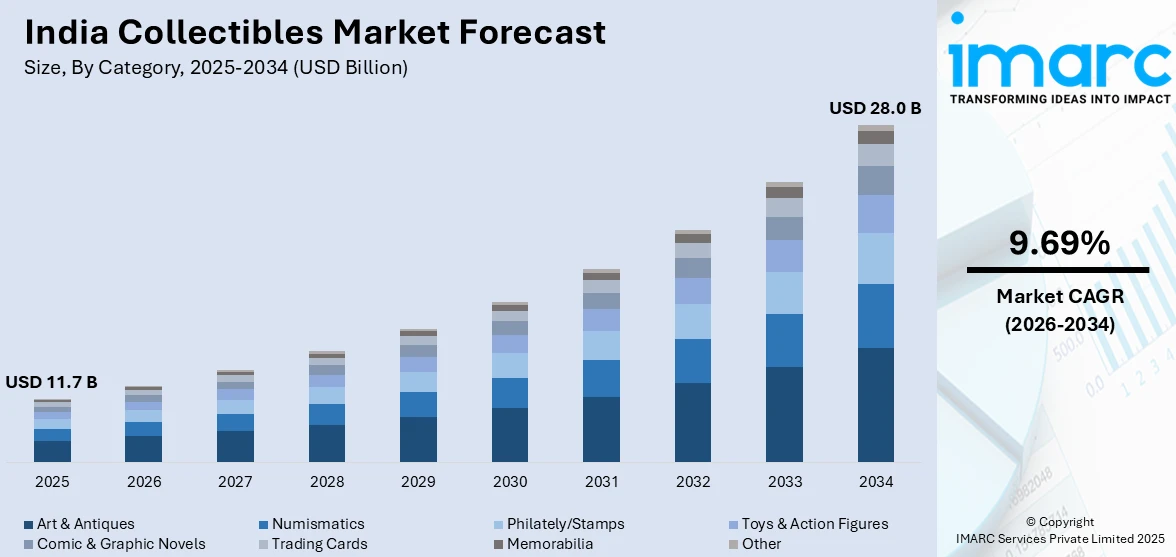
The India collectibles market size was valued at USD 11.7 Billion in 2025 and is projected to reach USD 28.0 Billion by 2034, growing at a compound annual growth rate of 9.69% from 2026-2034.
The market is driven by rising disposable incomes among urban populations, growing appreciation for cultural heritage preservation, and increasing interest in alternative investment assets. The expanding middle class and younger demographics are embracing collectibles as both passion investments and status symbols. Digital platforms have democratized access to rare items, while auction houses continue to facilitate premium transactions. Nostalgia-driven purchasing behavior and the desire for tangible assets amid economic uncertainty further support demand, contributing to India collectibles market share expansion.
Key Takeaways and Insights:
- By Category: Art & antiques dominates the market with a share of 32.5% in 2025, driven by strong demand for traditional Indian paintings, sculptures, and heritage artifacts among high-net-worth individuals seeking culturally significant investments.
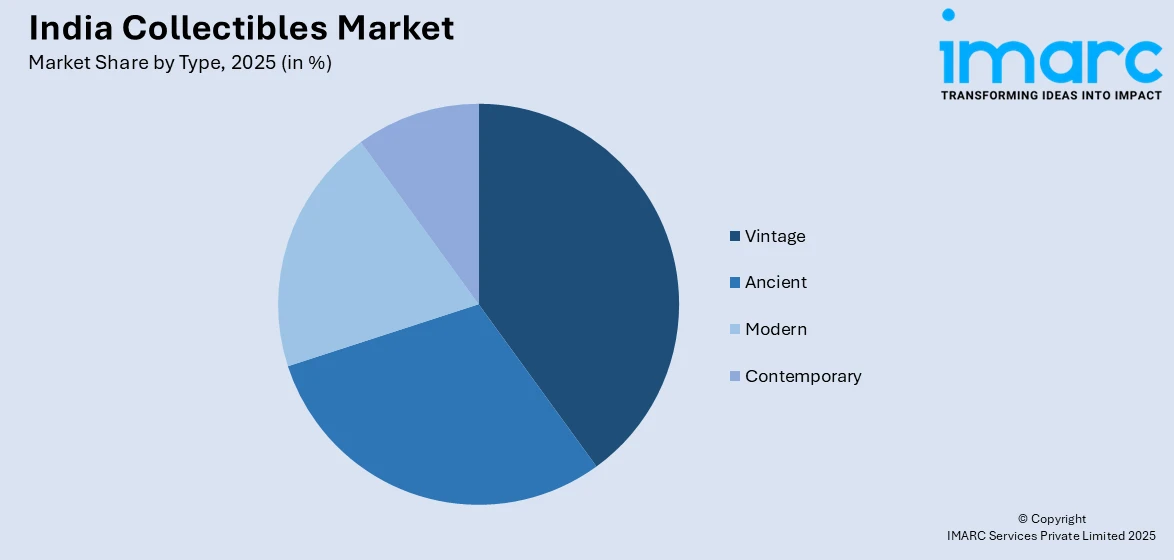
- By Type: Vintage leads the market with a share of 38.1% in 2025, owing to heightened collector interest in mid-twentieth century items that evoke nostalgia, represent historical milestones, and offer clear authentication advantages.
- By Region: West India represents the market with a share of 34.6% in 2025, attributed to the concentration of affluent collectors in Mumbai and Gujarat, established auction houses, thriving art galleries, and robust commercial transaction infrastructure.
- Key Players: The India collectibles market exhibits a fragmented competitive landscape, with established auction houses competing alongside specialized dealers, online marketplaces, and regional galleries. Market participants differentiate through authentication expertise, curated collections, and exclusive access to rare items, while digital platforms increasingly bridge traditional and contemporary collector segments.
To get more information on this market Request Sample
The India collectibles market is experiencing robust growth propelled by multiple converging factors that are reshaping collector behavior and market dynamics. Rising affluence among urban populations has created a substantial base of high-net-worth individuals seeking alternative investment avenues beyond traditional financial instruments. As per sources, in September 2025, Saffronart’s 25th anniversary auction recorded Vasudeo Gaitonde’s painting selling for ₹67.08 Crore, contributing to total proceeds of ₹355.8 Crore, the highest-value South Asian art auction globally, highlighting the increasing recognition of Indian art as a valuable investment. Moreover, cultural renaissance and heritage consciousness are driving demand for artifacts that embody India's rich artistic traditions and historical legacy. The proliferation of digital platforms has transformed market accessibility, enabling collectors across geographic boundaries to discover, authenticate, and acquire rare items.
India Collectibles Market Trends:
Digital Transformation and Online Marketplace Expansion
The collectibles landscape is witnessing significant digital transformation as online platforms revolutionize how collectors discover, evaluate, and purchase items. Virtual auction houses and e-commerce marketplaces are democratizing access to rare collectibles previously confined to physical galleries and exclusive dealer networks. In October 2024, Indian SocialFi platform RECRD partnered with media house Shemaroo Entertainment to launch blockchain‑based digital collectibles from popular Bollywood film titles, expanding mainstream collector engagement via Web3 technology. Furthermore, advanced imaging technologies enable detailed examination of items remotely, while blockchain-based authentication systems are emerging to verify provenance and ownership history.
Nostalgia-Driven Collecting Among Younger Demographics
A notable trend is the emergence of younger collectors driven by nostalgia for cultural touchstones from their formative years. This demographic gravitates toward vintage toys, comic books, trading cards, and memorabilia associated with beloved franchises and entertainment properties. In 2025, the Kolkata Comics Karnival showcased a surge in youth participation with dedicated stalls for One Piece and Pokémon trading cards, anime figurines, and pop‑culture merchandise, highlighting India’s growing community of young collectors. Unlike traditional collectors focused primarily on monetary appreciation, these enthusiasts often prioritize emotional connection and community belonging.
Integration of Collectibles into Alternative Investment Portfolios
Collectibles are increasingly recognized as a legitimate alternative investment asset capable of portfolio diversification and wealth preservation. Sophisticated collectors and wealth managers are approaching acquisitions with investment discipline, analyzing historical price trends, rarity metrics, and market demand indicators. In May 2025, Indian billionaire Adar Poonawalla acquired a significant stake in leading auction house AstaGuru, signaling strategic investment confidence and professionalization of the Indian art and collectibles market. This professionalization is elevating authentication standards and transparency expectations across the market. Art advisory services and collectible investment funds are emerging to serve clients seeking exposure to tangible assets with potential appreciation.
Market Outlook 2026-2034:
The India collectibles market is poised for sustained revenue expansion throughout the forecast period, supported by favorable demographic trends and evolving collector preferences. Rising disposable incomes and wealth accumulation among urban populations will continue driving demand for premium collectible categories. Digital platform proliferation is expected to enhance market accessibility and transaction volumes, while authentication technologies will strengthen buyer confidence. The growing intersection of passion and investment motivations will attract diverse collector segments. Regional markets beyond traditional metropolitan hubs are anticipated to emerge as significant revenue contributors as infrastructure and awareness develop, supporting overall market revenue growth trajectory. The market generated a revenue of USD 11.7 Billion in 2025 and is projected to reach a revenue of USD 28.0 Billion by 2034, growing at a compound annual growth rate of 9.69% from 2026-2034.
India Collectibles Market Report Segmentation:
|
Segment Category |
Leading Segment |
Market Share |
|
Category |
Art & Antiques |
32.5% |
|
Type |
Vintage |
38.1% |
|
Region |
West India |
34.6% |
Category Insights:
- Art & Antiques
- Numismatics
- Philately/Stamps
- Toys & Action Figures
- Comic & Graphic Novels
- Trading Cards
- Memorabilia
- Other
Art & antiques dominates with a market share of 32.5% of the total India collectibles market in 2025.
Art and antiques dominate the Indian collectibles market, driven by the country’s deep-rooted cultural heritage and strong appreciation for traditional art forms. This market segment includes traditional paintings, sculptures, furniture, decorative items, and historical artifacts that represent the rich artistic heritage of India over the centuries. High net worth individuals treat these collectibles as a means to connect with their cultural heritage while also using them as a sophisticated investment tool. The value of handcrafted artistic expression and historical significance remains a strong draw for discerning collectors in search of meaningful acquisitions.
The segment benefits from established authentication frameworks, reputable auction house presence, and extensive dealer networks that facilitate premium transactions. Institutional collectors including museums and corporate entities participate alongside individual enthusiasts, creating robust demand dynamics. Art & antiques appeals to collectors seeking items with provenance documentation, historical significance, and aesthetic merit that enhance residential and commercial spaces. The growing interest in preserving cultural heritage among younger affluent demographics further strengthens long-term demand foundations for this segment.
Type Insights:
Access the comprehensive market breakdown Request Sample
- Ancient
- Vintage
- Modern
- Contemporary
Vintage leads with a share of 38.1% of the total India collectibles market in 2025.
Vintage leads type-based classification, encompassing items typically originating from the mid-twentieth century through recent decades that evoke nostalgic connections among collectors. This category spans diverse items including vintage toys, fashion accessories, advertising memorabilia, electronics, automobiles, and entertainment-related collectibles that resonate across demographic segments. In January 2026, the VCCCI Annual Vintage Car Fiesta in Mumbai showcased various classic automobiles, celebrating automotive heritage and drawing significant attention from vintage car collectors and enthusiasts nationwide.
Vintage offer authentication advantages compared to ancient artifacts, with documentation, manufacturing records, and provenance trails more readily verifiable through existing archives and records. The segment attracts both seasoned collectors appreciating historical significance and newer enthusiasts driven by personal nostalgia and pop culture connections. Growing interest in mid-century design aesthetics and retro styling has elevated demand for vintage decorative items and furniture, while entertainment memorabilia benefit from enduring franchise popularity and generational emotional connections among passionate collectors.
Regional Insights:
- North India
- South India
- East India
- West India
West India dominates with a market share of 34.6% of the total India collectibles market in 2025.
West India dominates regional market distribution, anchored by Mumbai's position as the nation's financial capital and primary hub for high-value collectible transactions. The region hosts prominent auction houses, established galleries, and sophisticated dealer networks catering to affluent collector bases concentrated in Maharashtra and Gujarat. In December 2025, a Rabindranath Tagore artwork sold for ₹10.7 Crore at AstaGuru’s online “Historic Masterpieces” auction in Mumbai, contributing to total sales of ₹163.65 Crore and underscoring the region’s strong collector engagement and market activity. Further, strong commercial infrastructure, banking facilities, and logistics capabilities support premium market operations effectively.
The region's collector community benefits from proximity to international art market connections, exposure to global collecting trends, and access to authentication expertise from established institutions. Corporate collections, institutional acquisitions, and individual high-net-worth collectors collectively drive substantial transaction volumes throughout the region. Cultural factors including historical mercantile traditions and wealth concentration patterns contribute to West India's market leadership, while emerging collector segments in secondary cities like Pune and Ahmedabad expand the regional demand base beyond primary metropolitan centers.

Market Dynamics:
Growth Drivers:
Why is the India Collectibles Market Growing?
Rising Affluence and Expanding High-Net-Worth Population
India's economic development trajectory is generating substantial wealth accumulation among urban populations, creating an expanding base of high-net-worth individuals with discretionary capital for collectible acquisitions. This affluent demographic increasingly views collectibles as sophisticated additions to diversified portfolios, combining aesthetic enjoyment with potential financial appreciation. According to reports, in 2024, India imported $79 Million of antiques, a 376 % increase over 2023, while paintings accounted for $164.3 Million, reflecting surging demand for culturally significant art and collectibles. Growing exposure to international collecting practices through travel, media, and digital platforms is elevating awareness of collectibles as legitimate asset classes.
Cultural Heritage Preservation and National Pride
Heightened awareness of cultural heritage preservation is motivating collectors to acquire artifacts embodying India's rich artistic traditions and historical legacy. This cultural consciousness spans demographic segments, from established collectors focusing on classical art forms to younger enthusiasts discovering traditional craftsmanship and indigenous artistic expressions. Government initiatives promoting cultural preservation and heritage tourism amplify public appreciation for historical artifacts and traditional arts. Collectors increasingly view acquisitions as contributions to cultural conservation, preventing significant items from deteriorating or leaving national boundaries, adding emotional dimension beyond financial considerations and creating resilient demand foundations.
Digital Platform Proliferation and Market Accessibility
The expansion of digital marketplaces and online auction platforms is fundamentally transforming collectibles market accessibility, enabling participation from collectors previously excluded by geographic or knowledge barriers. E-commerce platforms provide discovery mechanisms for rare items, price transparency through comparable sales data, and transaction convenience eliminating traditional intermediary requirements. In May 2025, premium online auction house AstaGuru’s “Heirloom Collectibles” digital sale in Mumbai demonstrated this shift, with collectors nationwide bidding remotely on rare jewellery, vintage silver, and timepieces via its digital platform. Furthermore, virtual viewing technologies enable detailed remote examination of items, while secure payment systems address trust concerns in high-value transactions.
Market Restraints:
What Challenges the India Collectibles Market is Facing?
Authentication Challenges and Counterfeit Concerns
The collectibles market faces persistent challenges related to authentication accuracy and counterfeit proliferation that undermine buyer confidence. Sophisticated forgeries targeting high-value categories require specialized expertise for detection, while authentication infrastructure remains unevenly developed across market segments. Limited availability of qualified authenticators and inconsistent certification standards create transaction friction that constrains market expansion among cautious collectors.
Illiquidity and Valuation Uncertainty
Collectibles inherently face liquidity constraints compared to traditional financial assets, with sale timelines often extending months for specialized items seeking appropriate buyers. Valuation uncertainty compounds this challenge, as price discovery mechanisms remain less developed than established securities markets. Collectors may struggle to realize fair value during urgent sale situations, while insurance and estate planning face complications from valuation subjectivity.
Regulatory Complexity and Taxation Ambiguity
Navigating regulatory frameworks governing collectible transactions presents ongoing challenges, particularly for items with cultural heritage implications or cross-border movement requirements. Taxation treatment varies across collectible categories and transaction types, creating compliance uncertainty for collectors and dealers. Import restrictions, export permissions, and documentation requirements add complexity and cost that potentially discourages broader market participation.
Competitive Landscape:
The India collectibles market exhibits a highly fragmented competitive structure characterized by diverse participant categories operating across specialized segments and price tiers. Established auction houses with international affiliations compete for premium consignments and high-net-worth clients through brand prestige, authentication expertise, and curated event experiences. Regional galleries and specialized dealers serve collector communities focused on specific categories, leveraging deep domain knowledge and relationship-based client development approaches. Digital platforms are emerging as significant competitive forces, challenging traditional intermediaries through accessibility advantages and transaction convenience while attracting technology-comfortable younger collectors.
Recent Developments:
-
In April 2025, Pune-based startup Infinity Toy Tronics (ITT) launched Cricket Icons, India’s first officially licensed cricket collectable miniatures featuring top IPL players. Available across online and offline channels, the initiative integrates digital fan engagement, marking a significant development in India’s sports memorabilia and collectibles market.
India Collectibles Market Report Coverage:
|
Report Features |
Details |
|
Base Year of the Analysis |
2025 |
|
Historical Period |
2020-2025 |
|
Forecast Period |
2026-2034 |
|
Units |
USD Billion |
|
Scope of the Report |
Exploration of Historical Trends and Market Outlook, Industry Catalysts and Challenges, Segment-Wise Historical and Future Market Assessment:
|
|
Categories Covered |
Art & Antiques, Numismatics, Philately/Stamps, Toys & Action Figures, Comic & Graphic Novels, Trading Cards, Memorabilia, Other |
|
Types Covered |
Ancient, Vintage, Modern, Contemporary |
|
Regions Covered |
North India, South India, East India, West India |
|
Customization Scope |
10% Free Customization |
|
Post-Sale Analyst Support |
10-12 Weeks |
|
Delivery Format |
PDF and Excel through Email (We can also provide the editable version of the report in PPT/Word format on special request) |
Frequently Asked Questions About the India Collectibles Market Report
The India collectibles market size was valued at USD 11.7 Billion in 2025.
The India collectibles market is expected to grow at a compound annual growth rate of 9.69% from 2026-2034 to reach USD 28.0 Billion by 2034.
Art & antiques held the largest India collectibles market share, driven by strong demand for traditional Indian paintings, sculptures, and heritage artifacts among high-net-worth collectors seeking culturally significant investment pieces with historical importance and aesthetic value.
Key factors driving the India collectibles market include rising affluence among urban populations, growing cultural heritage appreciation, digital platform proliferation enhancing market accessibility, and increasing recognition of collectibles as alternative investment assets offering portfolio diversification.
Major challenges include authentication difficulties and counterfeit concerns undermining buyer confidence, inherent illiquidity compared to traditional assets, valuation uncertainty affecting price discovery, regulatory complexity governing heritage items, and limited awareness among potential collectors outside established enthusiast communities.
Need more help?
- Speak to our experienced analysts for insights on the current market scenarios.
- Include additional segments and countries to customize the report as per your requirement.
- Gain an unparalleled competitive advantage in your domain by understanding how to utilize the report and positively impacting your operations and revenue.
- For further assistance, please connect with our analysts.
 Request Customization
 Speak to an Analyst
 Request Brochure
 Inquire Before Buying
Benefits of Customization
- Personalize this research
- Triangulate with your data
- Get data as per your format and definition
- Gain a deeper dive into a specific application, geography, customer, or competitor
- Any level of personalization
Get in Touch With Us
UNITED STATES
Phone: +1-201-971-6302
INDIA
Phone: +91-120-433-0800
UNITED KINGDOM
Phone: +44-753-714-6104
Email: [email protected]
Client Testimonials




.webp)




.webp)













Related Reports

Choose your plan
*Please note that the prices mentioned below are starting prices for each bundle type. Kindly contact our team for further details.*
Single User License
- 1 User License, Access on 2 Devices
- PDF Report + Excel Dataset (Password Protected)
- Lifetime Access
- No Printing Rights
- 10% Free Report Customization
- 10–12 Weeks of Analyst Support
Five User License
- Access for 5 Users, 2 Devices per User
- PDF Report + Excel Dataset (Password Protected)
- Lifetime Access
- Dedicated Account Manager
- 12–14 Weeks of Analyst Support
- No Printing Rights
- 15% Free Report Customization
- 25% Discount on Your Next Purchase
Corporate User License
- Unlimited User Access (Within Your Organization)
- PDF Report + Excel Dataset
- Lifetime Access
- Dedicated Account Manager
- 14–20 Weeks of Analyst Support
- No Printing Rights
- 20% Free Report Customization
- 30% Discount on Your Next Purchase
Essential Insights
What's included:
3 reports
- Lifetime Access
- PDF Reports
- Excel Datasets
- 2 Weeks of Free Analyst Support
- 2 User Licenses
- Access on 2 Devices
- Printing Rights
- Complimentary PowerPoint (PPT) Version
- Complimentary License Upgrade
Professional Access
What's included:
5 reports
- Lifetime Access
- PDF Reports
- Excel Datasets
- 8 Weeks of Free Analyst Support
- 2 User Licenses
- Access on 2 Devices
- Printing Rights
- Complimentary PowerPoint (PPT) Version
- Complimentary License Upgrade
Business Advantage
What's included:
8 reports
- Lifetime Access
- PDF Reports
- Excel Datasets
- 14 Weeks of Free Analyst Support
- 2 User Licenses
- Access on 2 Devices
- Printing Rights
- Complimentary PowerPoint (PPT) Version
- Complimentary License Upgrade
Enterprise Intelligence
What's included:
10 reports
- Lifetime Access
- PDF Reports
- Excel Datasets
- 20 Weeks of Free Analyst Support
- 2 User Licenses
- Access on 2 Devices
- Printing Rights
- Complimentary PowerPoint (PPT) Version
- Complimentary License Upgrade