
India Compressed Natural Gas Market Size, Share, Trends and Forecast by Source, Application, and Region, 2026-2034
India Compressed Natural Gas Market Summary:
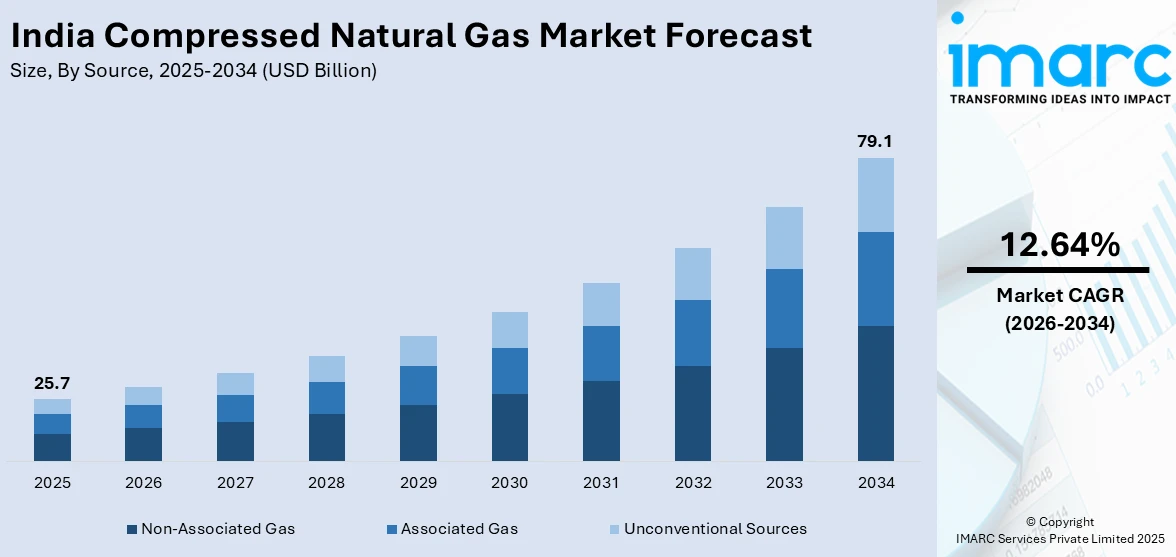
The India compressed natural gas market size was valued at USD 25.7 Billion in 2025 and is projected to reach USD 79.1 Billion by 2034, growing at a compound annual growth rate of 12.64% from 2026-2034.
The India compressed natural gas (CNG) market is experiencing strong momentum driven by the government's ambitious vision to increase the share of natural gas in the national energy mix and reduce dependence on crude oil imports. The growing environmental concerns, rising fuel costs, and an expanding city gas distribution network are accelerating CNG adoption across transportation and industrial sectors. Advancements in vehicle technology, favorable regulatory frameworks, and increasing individual awareness about cost-effective cleaner fuel alternatives are reshaping India's energy landscape, positioning CNG as a pivotal component in the country's sustainable energy transition.
Key Takeaways and Insights:
- By Source: Non-associated gas dominates the market with a share of 57.8% in 2025, driven by dedicated gas field production from major basins, including Krishna-Godavari and Mumbai Offshore, which provide reliable and consistent supply volumes for the growing CNG distribution network.
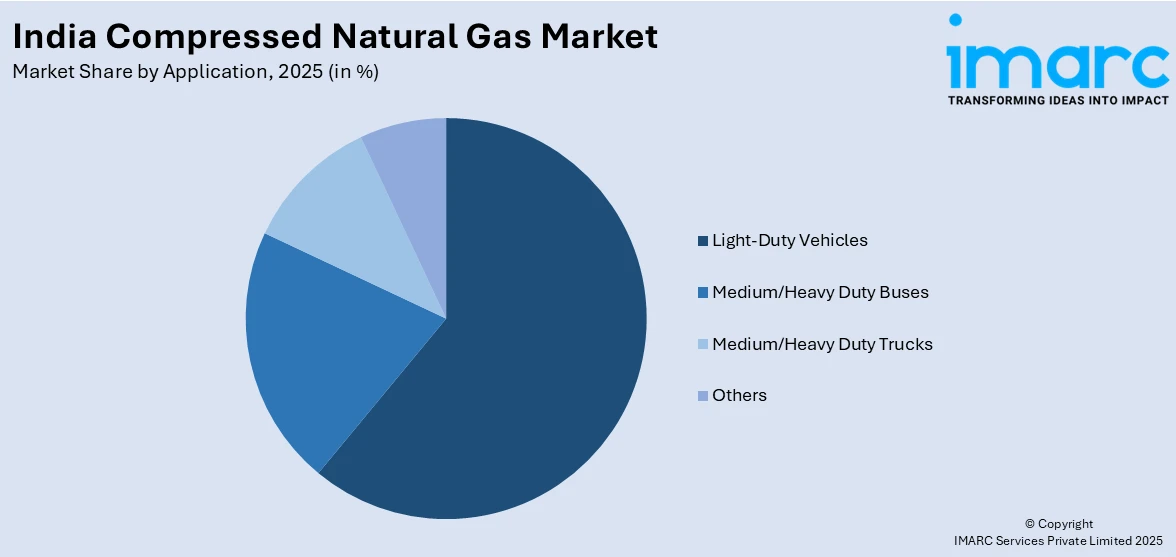
- By Application: Light-duty vehicles represent the largest segment with a market share of 61.4% in 2025, owing to the expanding fleet of factory-fitted CNG passenger cars and two-wheelers alongside rising user preference for fuel-efficient transportation in urban centers.
- By Region: West India leads the market with a share of 36.9% in 2025, supported by the concentration of CNG infrastructure in Gujarat and Maharashtra, higher industrial demand, and a well-established city gas distribution network across major metropolitan areas.
- Key Players: The India compressed natural gas market features a competitive landscape characterized by the presence of large public sector undertakings and private players strategically expanding their distribution networks, investing in infrastructure modernization, and diversifying fuel offerings to strengthen market positioning.
To get more information on this market Request Sample
The India compressed natural gas market is being driven by expanding city gas distribution networks, rising fuel cost sensitivity, and stricter emission standards encouraging cleaner mobility. Improved station availability across urban and semi-urban regions is enhancing accessibility and supporting vehicle adoption. Cost benefits over conventional fuels, along with lower maintenance expenses, continue to attract private users and commercial fleets. Technological advancements and factory-fitted CNG options are further strengthening the market confidence. This shift is reflected in 2026 when Tata Motors launched the XPRES sedan in Petrol and CNG variants for fleet customers, featuring a 70-litre twin-cylinder CNG tank designed to improve driving range without compromising boot space, reinforcing fleet-focused adoption. Furthermore, government policies promoting a gas-based economy and diversifying the national energy mix are impelling the market growth.
India Compressed Natural Gas Market Trends:
Integration of CNG Infrastructure in Emerging Urban and Commercial Hubs
The incorporation of CNG infrastructure within newly developed urban and commercial hubs is contributing to the market growth by embedding clean fuel access into planned ecosystems. As mixed-use districts, business parks, and transport-oriented developments prioritize sustainability, integrated gas distribution systems support long-term demand from fleet operators and commercial users. This trend was reinforced in 2025 when Bengaluru Airport City Limited partnered with GAIL Gas to establish a city gas distribution facility near Kempegowda International Airport, including a dedicated CNG station and PNG infrastructure for taxis, buses, logistics fleets, and last-mile vehicles, strengthening adoption within high-traffic mobility corridors.
Urban Air Quality Concerns and Public Awareness
The growing public concern over air pollution and its health impact is reshaping fuel preferences in major urban centers, strengthening the demand for cleaner alternatives, such as CNG. Its comparatively lower emissions make it a suitable option for daily commuting and commercial transport fleets seeking regulatory compliance and environmental responsibility. This shift is reinforced by policy action, as in 2025 the Delhi government announced that from November 1 only BS6, CNG, or electric commercial vehicles would be permitted to enter the capital under the Air Pollution Mitigation Plan 2025. Such measures accelerate adoption of cleaner fuels and support the growth of the CNG market.
Expansion of Private-Led CNG Refueling Networks
Private sector participation is accelerating the growth of the India CNG market by improving the speed of station rollout, enhancing service accessibility, and supporting wider adoption across urban mobility segments. Increased private investment strengthens refueling availability for both individuals and commercial fleets, making cleaner fuel options more practical in high-demand cities. This trend was demonstrated in 2024 when Confidence Petroleum India Limited, in partnership with GAIL, launched five new CNG stations in Bengaluru, increasing its total network to 40 stations. Such infrastructure growth reinforces greener transport transitions and offers scalable expansion models for other Indian urban centers.
Market Outlook 2026-2034:
The India compressed natural gas market demonstrates exceptional growth potential throughout the forecast period, driven by irreversible policy commitments and expanding infrastructure fundamentals. The market generated a revenue of USD 25.7 Billion in 2025 and is projected to reach a revenue of USD 79.1 Billion by 2034, growing at a compound annual growth rate of 12.64% from 2026-2034. This growth trajectory is underpinned by the government's target of more than doubling CNG station density, rising adoption across light-duty and commercial vehicle segments, and the strategic positioning of CNG as a transitional bridge fuel within India's broader decarbonization agenda.
India Compressed Natural Gas Market Report Segmentation:
|
Segment Category |
Leading Segment |
Market Share |
|
Source |
Non-Associated Gas |
57.8% |
|
Application |
Light-Duty Vehicles |
61.4% |
|
Region |
West India |
36.9% |
Source Insights:
- Associated Gas
- Non-Associated Gas
- Unconventional Sources
Non-associated gas dominates with a market share of 57.8% of the total India compressed natural gas market in 2025.
Non-associated gas represents the largest segment because of its stable and dedicated supply profile. Unlike gas produced alongside crude oil, non-associated gas fields are developed primarily for natural gas extraction, ensuring more consistent production volumes. This reliability supports long term contracts and steady feedstock availability for city gas distribution networks. As demand for cleaner transport fuels increases across Indian cities, dependable upstream supply becomes critical. Non-associated gas provides that stability, strengthening its role in meeting rising CNG consumption.
Another reason for its leadership is the expanding development of standalone gas fields and supportive policy focus on boosting domestic gas output. Infrastructure investments in pipelines and processing facilities are aligned with non-associated gas production hubs, enabling efficient transmission to urban markets. The predictable output profile reduces supply volatility and improves planning for distributors. With India aiming to increase the share of natural gas in its energy mix, consistent and scalable sources are essential. Non-associated gas fulfills these requirements, reinforcing its dominance in the CNG supply chain.
Application Insights:
Access the comprehensive market breakdown Request Sample
- Light-Duty Vehicles
- Medium/Heavy Duty Buses
- Medium/Heavy Duty Trucks
- Others
Light-duty vehicles lead with a market share of 61.4% of the total India compressed natural gas market in 2025.
Light-duty vehicles hold the biggest market share driven by their high presence in urban transportation and daily commuting needs. Passenger cars, taxis, and small commercial vehicles account for a significant share of fuel usage in cities where CNG infrastructure is expanding. These vehicles benefit from lower running costs compared to petrol and diesel, making CNG an attractive option for cost conscious users. The growing emphasis on reducing vehicular emissions also encourages adoption of cleaner fuel alternatives in this segment.
Another key driver is the strong policy and regulatory push toward cleaner mobility solutions in densely populated areas. Light-duty vehicles are easier to convert to CNG and are widely supported by city gas distribution networks. The availability of refueling stations in metropolitan regions further boosts usage. Fleet operators also prefer CNG powered light vehicles due to operational savings and compliance with emission norms. As urbanization increases and demand for affordable transport rises, light-duty vehicles continue to dominate CNG usage across India.
Regional Insights:
- North India
- South India
- East India
- West India
West India exhibits a clear dominance with a 36.9% share of the total India compressed natural gas market in 2025.
West India leads the market due to its well-established city gas distribution infrastructure and early adoption of CNG as a transport fuel. Major urban centers in this region have extensive pipeline networks and a dense concentration of refueling stations, supporting large scale vehicle conversion. Strong industrial activity and high vehicle ownership further contribute to steady demand. The presence of key ports and energy hubs also facilitates efficient gas sourcing and supply management, strengthening regional dominance.
Another factor supporting West India’s leadership is proactive policy measures and sustained investment in expanding gas connectivity and cleaner mobility infrastructure. Urban transport fleets in the region widely adopt CNG due to cost efficiency and emission control requirements, supported by mature distribution networks and stable supply systems. This commitment is reflected in 2026 when the Ahmedabad Municipal Corporation proposed a ₹20 crore Bio-CNG plant in its 2026–27 budget to convert organic waste into Bio-CNG as part of its “Zero Waste City” initiative. Such developments reinforce West India’s continued dominance in cleaner fuel adoption.

Market Dynamics:
Growth Drivers:
Why is the India Compressed Natural Gas Market Growing?
Expansion of CNG Retrofit Solutions
The growing availability of manufacturer-approved CNG retrofit solutions is emerging as an important factor influencing the India CNG market. Original equipment manufacturer (OEM)-backed kits improve user confidence by ensuring safety compliance, performance reliability, and warranty coverage, reducing concerns traditionally associated with aftermarket conversions. This trend was reinforced in 2025 when Citroen India introduced a retrofittable CNG kit for the C3 hatchback through authorized dealerships, offering up to 28.1 km/kg efficiency without compromising boot space. Such developments make CNG adoption more accessible, support dual-fuel flexibility, and expand the addressable user base for CNG vehicles.
Rising Adoption of CNG in Two-Wheeler Mobility
The expansion of CNG usage beyond passenger cars into the two-wheeler segment is becoming an important factor impelling the market growth in India. Since two-wheelers represent a major share of daily commuting, the introduction of CNG-powered motorcycles significantly increases fuel penetration in mass mobility categories. This shift supports wider adoption by offering users a more economical and cleaner alternative to conventional petrol vehicles. The trend is evident in the Bajaj Freedom 125, the world’s first CNG-powered motorcycle, which has surpassed 50,000 units in domestic retail sales since its launch on July 5, 2024, demonstrating strong demand.
Nationwide Policy Campaigns Promoting Adoption
Large-scale government-supported awareness and adoption campaigns are playing a significant role in bolstering the growth of India CNG market. By promoting natural gas as a cleaner, safer, and more affordable alternative, such initiatives strengthen user acceptance and encourage wider infrastructure utilization. This momentum is reflected in 2026 when BPCL announced the nationwide rollout of PNG & CNG Drive 2.0, running from January 1 to March 31, 2026, with participation from all City Gas Distribution entities under the guidance of MoPNG and PNGRB. Programs like these support India’s transition toward a gas-based economy and its Net Zero 2070 goals.
Market Restraints:
What Challenges the India Compressed Natural Gas Market is Facing?
Uneven Geographic Distribution of CNG Refueling Infrastructure
Despite significant infrastructure expansion, CNG station availability remains heavily concentrated in western and northern Indian states, creating access disparities that constrain market penetration in southern, eastern, and northeastern regions. This uneven distribution limits CNG adoption in areas with growing vehicle populations but insufficient refueling networks, causing range anxiety and deterring potential users from switching to CNG-powered vehicles.
Rising Competition from Electric Vehicle Adoption in Urban Markets
The accelerating adoption of electric vehicles (EVs), supported by substantial government subsidies and rapidly declining battery costs, is emerging as a competitive threat to CNG's market positioning particularly in urban passenger vehicle and two-wheeler segments. As EV charging infrastructure expands in metropolitan areas, price-conscious individuals may increasingly consider EVs as an alternative clean mobility solution.
Volatility in Natural Gas Input Costs Affecting Retail Price Stability
Fluctuations in domestic gas allocation policies and international LNG prices create input cost volatility for city gas distribution companies, periodically narrowing the price advantage of CNG over conventional fuels. Reductions in cheaper administered price mechanism gas allocations are compelling distributors to source higher-priced alternatives, impacting retail CNG pricing and potentially reducing its cost competitiveness relative to diesel.
Competitive Landscape:
The India compressed natural gas market features a moderately consolidated competitive structure dominated by large public sector undertakings and joint ventures operating across the city gas distribution value chain. Market participants are strategically differentiated through their geographic coverage of authorized geographical areas, infrastructure scale encompassing CNG stations and pipeline networks, and ability to secure cost-effective natural gas supply. Competition is intensifying as players invest in capacity expansion, adopt digital technologies for user engagement, diversify into complementary fuel offerings including LNG and compressed biogas, and forge strategic partnerships to broaden retail reach across emerging geographical territories.
Recent Developments:
- December 2025: Union Home Minister inaugurated multiple multi-crore projects of Banas Dairy in Banaskantha, Gujarat, including a Bio-CNG plant, milk powder facility, paneer plant, and cheese unit. The ₹58.67 crore Bio-CNG plant processes cattle dung to produce renewable fuel and organic fertilizer, supporting farmers and reducing carbon emissions.
- September 2025: The Chief Minister of Delhi inaugurated Delhi’s first biogas-based CBG-CNG plant at Ghogha Dairy as part of clean energy and waste management initiatives. The 100-ton-per-day facility, operated by Indraprastha Gas Limited, will convert household waste into around four tons of gas daily, creating both clean fuel and income opportunities.
India Compressed Natural Gas Market Report Coverage:
|
Report Features |
Details |
|
Base Year of the Analysis |
2025 |
|
Historical Period |
2020-2025 |
|
Forecast Period |
2026-2034 |
|
Units |
Billion USD |
|
Scope of the Report |
Exploration of Historical Trends and Market Outlook, Industry Catalysts and Challenges, Segment-Wise Historical and Future Market Assessment:
|
|
Sources Covered |
Associated Gas, Non-Associated Gas, Unconventional Sources |
|
Applications Covered |
Light-Duty Vehicles, Medium/Heavy Duty Buses, Medium/Heavy Duty Trucks, Others |
|
Regions Covered |
North India, South India, East India, West India |
|
Customization Scope |
10% Free Customization |
|
Post-Sale Analyst Support |
10-12 Weeks |
|
Delivery Format |
PDF and Excel through Email (We can also provide the editable version of the report in PPT/Word format on special request) |
Frequently Asked Questions About the India Compressed Natural Gas Market Report
The India compressed natural gas market size was valued at USD 25.7 Billion in 2025.
The India compressed natural gas market is expected to grow at a compound annual growth rate of 12.64% from 2026-2034 to reach USD 79.1 Billion by 2034.
Non-associated gas holds the largest revenue share of 57.8% in 2025, driven by dedicated gas field production from major basins including Krishna-Godavari and Mumbai Offshore, providing reliable supply for the expanding CNG distribution network.
Key factors driving the India compressed natural gas market include expanding private sector investment in refueling infrastructure, as seen in 2024 when Confidence Petroleum India Limited, in partnership with GAIL, launched five new CNG stations in Bengaluru, increasing its network to 40 stations and strengthening cleaner urban mobility adoption.
Major challenges include uneven geographic distribution of CNG refueling infrastructure, rising competition from EVs in urban markets, volatility in natural gas input costs affecting retail price stability, and limited CNG availability in southern, eastern, and northeastern regions.
Need more help?
- Speak to our experienced analysts for insights on the current market scenarios.
- Include additional segments and countries to customize the report as per your requirement.
- Gain an unparalleled competitive advantage in your domain by understanding how to utilize the report and positively impacting your operations and revenue.
- For further assistance, please connect with our analysts.
 Request Customization
 Speak to an Analyst
 Request Brochure
 Inquire Before Buying
Benefits of Customization
- Personalize this research
- Triangulate with your data
- Get data as per your format and definition
- Gain a deeper dive into a specific application, geography, customer, or competitor
- Any level of personalization
Get in Touch With Us
UNITED STATES
Phone: +1-201-971-6302
INDIA
Phone: +91-120-433-0800
UNITED KINGDOM
Phone: +44-753-714-6104
Email: [email protected]
Client Testimonials




.webp)




.webp)













Related Reports

Choose your plan
*Please note that the prices mentioned below are starting prices for each bundle type. Kindly contact our team for further details.*
Single User License
- 1 User License, Access on 2 Devices
- PDF Report + Excel Dataset (Password Protected)
- Lifetime Access
- No Printing Rights
- 10% Free Report Customization
- 10–12 Weeks of Analyst Support
Five User License
- Access for 5 Users, 2 Devices per User
- PDF Report + Excel Dataset (Password Protected)
- Lifetime Access
- Dedicated Account Manager
- 12–14 Weeks of Analyst Support
- No Printing Rights
- 15% Free Report Customization
- 25% Discount on Your Next Purchase
Corporate User License
- Unlimited User Access (Within Your Organization)
- PDF Report + Excel Dataset
- Lifetime Access
- Dedicated Account Manager
- 14–20 Weeks of Analyst Support
- No Printing Rights
- 20% Free Report Customization
- 30% Discount on Your Next Purchase
Essential Insights
What's included:
3 reports
- Lifetime Access
- PDF Reports
- Excel Datasets
- 2 Weeks of Free Analyst Support
- 2 User Licenses
- Access on 2 Devices
- Printing Rights
- Complimentary PowerPoint (PPT) Version
- Complimentary License Upgrade
Professional Access
What's included:
5 reports
- Lifetime Access
- PDF Reports
- Excel Datasets
- 8 Weeks of Free Analyst Support
- 2 User Licenses
- Access on 2 Devices
- Printing Rights
- Complimentary PowerPoint (PPT) Version
- Complimentary License Upgrade
Business Advantage
What's included:
8 reports
- Lifetime Access
- PDF Reports
- Excel Datasets
- 14 Weeks of Free Analyst Support
- 2 User Licenses
- Access on 2 Devices
- Printing Rights
- Complimentary PowerPoint (PPT) Version
- Complimentary License Upgrade
Enterprise Intelligence
What's included:
10 reports
- Lifetime Access
- PDF Reports
- Excel Datasets
- 20 Weeks of Free Analyst Support
- 2 User Licenses
- Access on 2 Devices
- Printing Rights
- Complimentary PowerPoint (PPT) Version
- Complimentary License Upgrade