
India Convenience Food Market Size, Share, Trends and Forecast by Type, Product, Distribution Channel, and Region, 2026-2034
India Convenience Food Market Size, Share, Trends & Forecast (2026-2034)
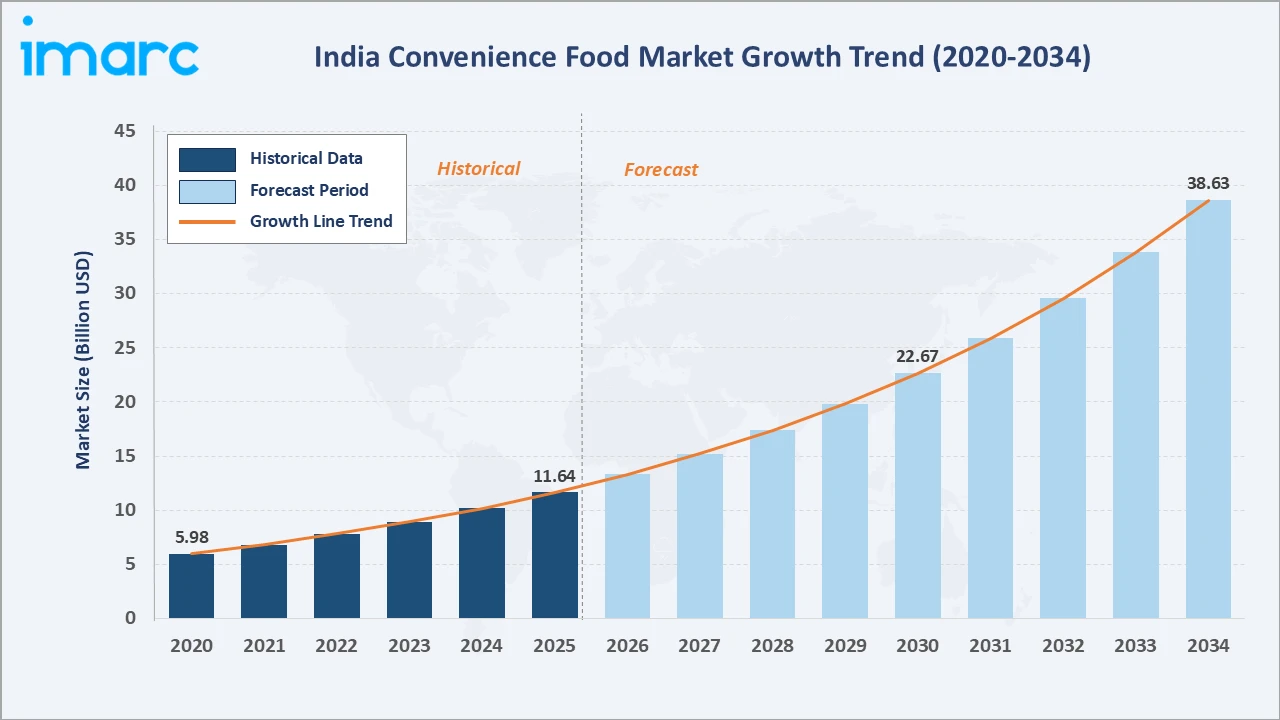
The India convenience food market grew from USD 11.64 Billion in 2025 to USD 13.30 Billion in 2026 and is projected to reach USD 38.63 Billion by 2034, growing at a CAGR of 14.26% during 2026-2034. Rising urbanization, expanding dual-income households, and the rapid growth of organized retail and e-commerce food delivery platforms are the primary demand drivers. The processed food sector plays an increasingly significant role in India's overall food manufacturing output, reflecting the sector's expanding scale and production capabilities. Ready-to-eat leads at 28.7% by type, cereal-based products dominate at 36.8% by product, and North India commands the largest regional share at 29.4% in 2025.
Market Snapshot
|
Metric |
Value |
|
Base Year Market Size (2025) |
USD 11.64 Billion |
|
Market Size (2026) |
USD 13.30 Billion |
|
Forecast Market Size (2034) |
USD 38.63 Billion |
|
CAGR (2026-2034) |
14.26% |
|
Base Year |
2025 |
|
Historical Period |
2020-2025 |
|
Forecast Period |
2026-2034 |
|
Dominant Type |
Ready-To-Eat (28.7%, 2025) |
|
Dominant Product |
Cereal-based Products (36.8%, 2025) |
|
Leading Region |
North India (29.4%, 2025) |
The India convenience food market grew from USD 5.98 Billion in 2020 to USD 11.64 Billion in 2025, and further to USD 13.30 Billion in 2026, underpinned by consistent urban consumption growth and rapid expansion of food processing infrastructure. The market is projected to reach USD 22.67 Billion by 2030 before reaching USD 38.63 Billion by 2034.
To get more information on this market, Request Sample
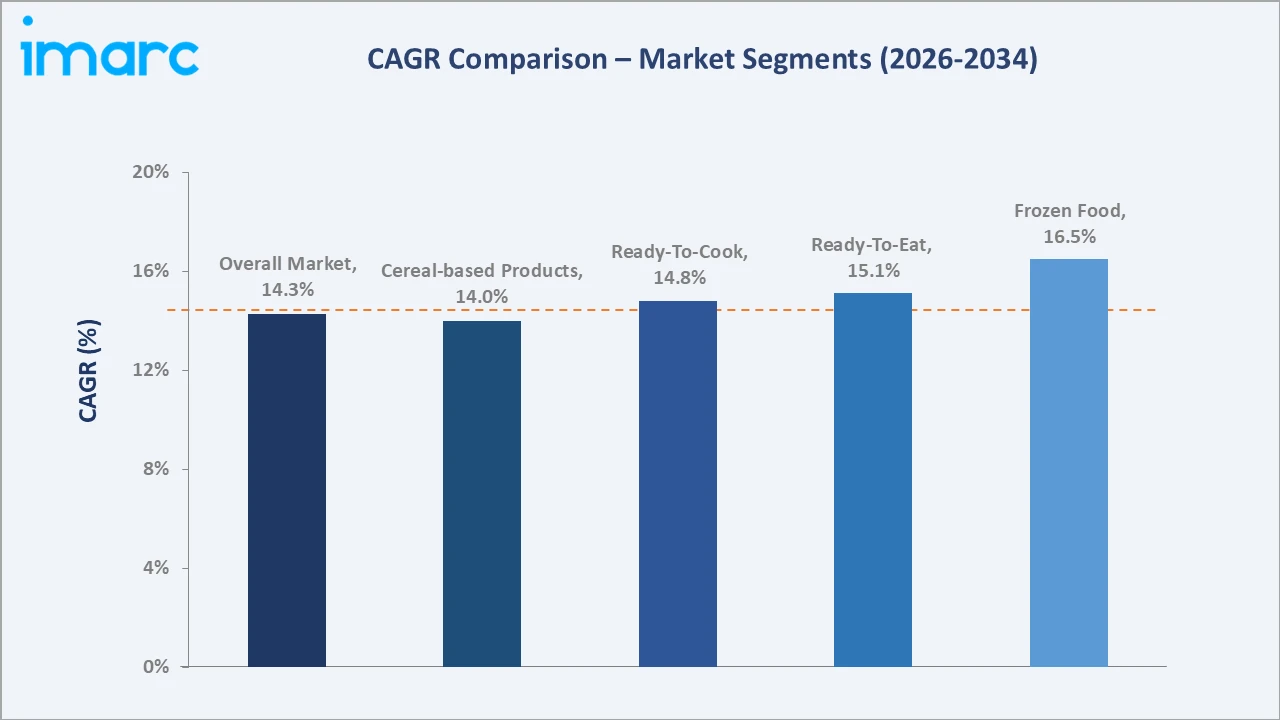
Frozen food grows at approximately 16.5% CAGR, driven by expanding cold-chain infrastructure and consumer demand for longer shelf-life products. Ready-to-eat, at a 15.1% CAGR, benefits from urbanization-led time scarcity and improved product quality. The overall market CAGR of 14.26% reflects India's structurally strong convenience food demand cycle.
Executive Summary
The India convenience food market is on a sustained high-growth trajectory, propelled by rapid urbanization, rising disposable incomes, and a structural shift toward time-saving meal solutions among working professionals and nuclear families. The market is supported by the post-COVID normalization of packaged food consumption, the scaling of organized cold-chain logistics, and aggressive product innovation by leading FMCG companies.
Ready-to-eat leads at 28.7%, reflecting the primacy of fully prepared convenience meal formats in the market. Cereal-based products at 36.8% are the dominant product segment, driven by the wide consumption of packaged biscuits, breakfast cereals, noodles, and pasta across income groups. North India leads regionally at 29.4%, supported by high urban density, strong organized retail penetration, and a large working-age consumer base in major metro and tier-2 cities.
Key Market Insights
|
Insight |
Data |
|
Dominant Type |
Ready-To-Eat – 28.7% share (2025) |
|
Dominant Product |
Cereal-based Products – 36.8% share (2025) |
|
Leading Region |
North India – 29.4% (2025) |
|
Key Market Opportunity |
Expanding cold-chain infrastructure, premiumization of RTE products, and rapid e-commerce food delivery growth are creating high-value investment opportunities across the supply chain. |
Key Analytical Observations Supporting the Above Data:
- Ready-To-Eat at 28.7%: RTE dominates because it offers zero preparation time, making it the preferred choice for urban consumers, working professionals, and single-person households. The availability of microwaveable and shelf-stable RTE formats across modern trade and e-commerce channels further reinforces category leadership.
- Cereal-based at 36.8%: Cereal-based products lead the product mix because they serve multiple meal occasions, breakfast, snacks, and main meals, at accessible price points across income segments. Packaged biscuits and instant noodles account for a substantial share of this category, with leading FMCG players holding dominant positions.
- North India at 29.4%: North India's regional leadership reflects the high urban consumer density across key metro and tier-2 cities, combined with strong organized retail penetration and a culture of packaged snack and ready-meal consumption that drives consistent category demand.
India Convenience Food Market Overview
The India convenience food market encompasses the production, processing, distribution, and sale of packaged food products designed to minimize consumer preparation time and effort. Core product categories include ready-to-eat meals, instant noodles and pasta, frozen snacks and entrees, canned and preserved foods, breakfast cereals, packaged biscuits, and other processed food formats. The market serves a broad consumer base spanning urban working professionals, nuclear families, students, and institutional food service operators.
The market ecosystem spans agri-input suppliers, food processors, FMCG manufacturers, packaging companies, cold-chain logistics operators, modern trade and e-commerce retailers, and end consumers across household, institutional, and quick-service restaurant channels. The sector is governed by applicable food safety and quality standards covering labeling, additives, hygiene, and safety requirements to ensure consumer protection and product integrity.
Market Dynamics
To evaluate market opportunities, Request Sample
Market Drivers
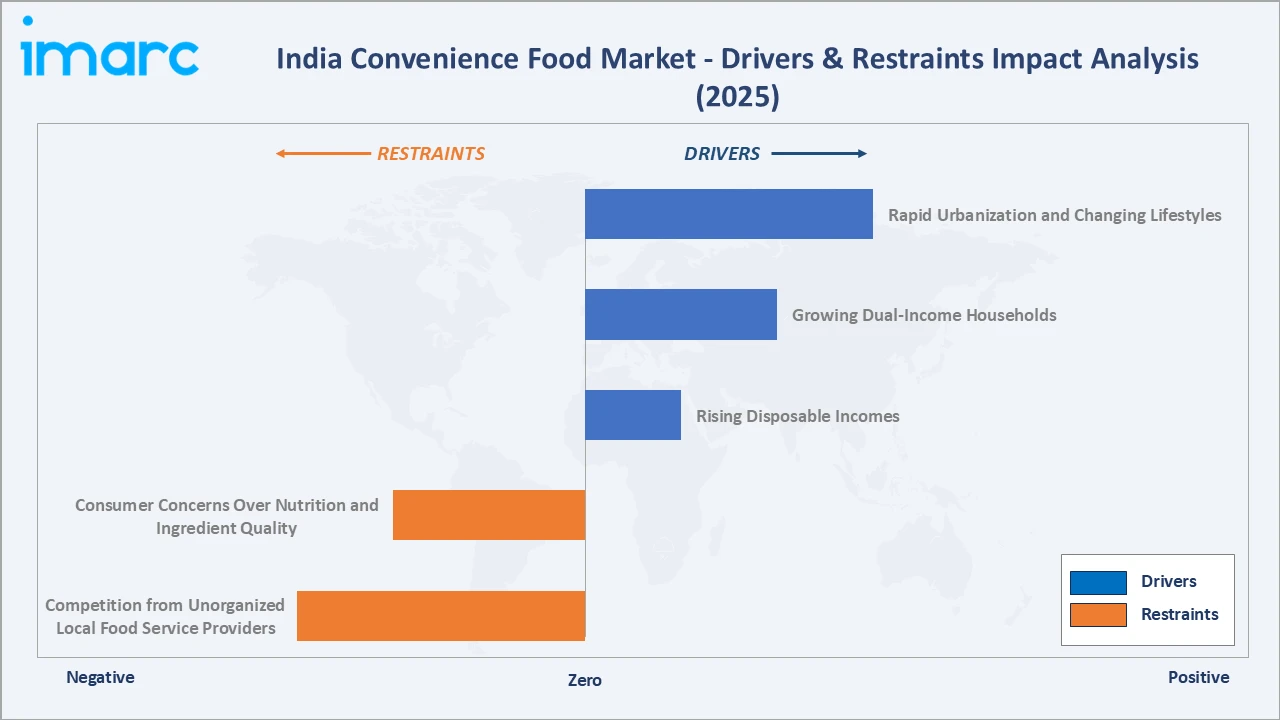
- Rapid Urbanization and Changing Lifestyles: According to the Economic Survey 2023–24, over 40% of India’s population is projected to reside in urban areas by 2030. India's ongoing urbanization is shifting consumer behavior toward time-efficient meal solutions. As more households migrate to urban areas and adopt busier professional lifestyles, the demand for convenient, ready-to-consume food products continues to rise across all major metro and tier-2 city markets.
- Growing Dual-Income Households: The rise of dual-income nuclear families across urban and semi-urban centers has structurally increased demand for packaged convenience meals. With limited time available for meal preparation, working households increasingly rely on convenience food products for daily meal planning across multiple occasions.
- Rising Disposable Incomes: India’s per capita disposable income reached INR 2.14 lakh in FY2023–24, registering a strong growth of 13.3% compared with FY2022–23. India's expanding middle class and increasing per-capita income levels are enabling consumers to trade up from home-cooked meals to branded packaged food products. This income-led premiumization trend supports both volume and value growth across the convenience food category.
Market Restraints
- Consumer Concerns Over Nutrition and Ingredient Quality: Growing awareness among consumers regarding nutritional content, ingredient labeling, and food processing practices is creating hesitation toward certain packaged convenience formats. Health-conscious consumer segments tend to scrutinize product formulations, which can influence purchasing decisions negatively for products perceived as highly processed or artificial.
- Competition from Unorganized Local Food Service Providers: India's established culture of freshly prepared food from local eateries, traditional food vendors, and home-based food services presents a consistent competitive alternative to packaged convenience food. This competition is particularly pronounced in price-sensitive urban and semi-urban markets where fresh, low-cost food options remain widely available.
Market Opportunities
- Cold-Chain Infrastructure Expansion: Ongoing investment in cold-chain logistics and refrigerated warehousing is enabling frozen and chilled food distribution to extend progressively beyond metro cities into emerging tier-2 and tier-3 markets, opening significant new geographic opportunities for manufacturers of temperature-sensitive convenience food products.
- Health and Wellness Convenience Food Innovation: Growing consumer preference for functional, fortified, and clean-label convenience food products is creating a high-value innovation opportunity for brands to develop and scale health-positioned packaged meal and snack formats that command premium pricing across modern trade and e-commerce channels.
Market Challenges
- Raw Material Cost Volatility: Convenience food manufacturers face ongoing pressure from fluctuations in agricultural commodity prices, including key inputs such as grains, edible oils, and dairy. These cost variations affect product pricing strategy, profitability, and the ability to maintain competitive shelf prices, particularly in value-oriented mass-market segments.
- Fragmented Distribution Infrastructure in Emerging Markets: Outside major urban centers, building reliable distribution networks for chilled and frozen convenience food products remains operationally complex. The absence of consistent cold-chain infrastructure in smaller markets limits the geographic reach of premium product formats and poses a structural challenge to achieving national market coverage.
Emerging Market Trends
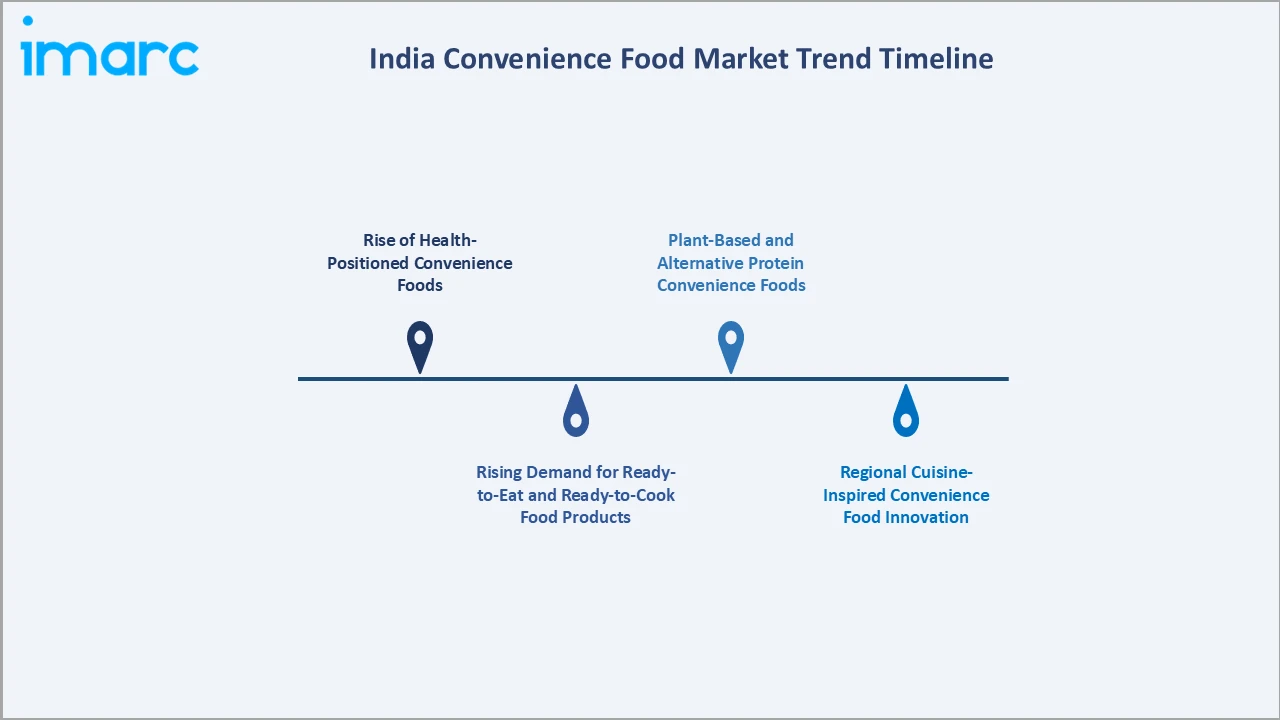
1. Rise of Health-Positioned Convenience Foods
Consumer demand for healthier packaged food options is reshaping product development strategies across the convenience food segment. Brands are increasingly developing fortified, high-protein, low-sodium, and natural-ingredient variants of popular convenience formats. This trend is most pronounced among urban consumers who actively evaluate nutritional labels and seek products with recognizable, clean ingredients. Manufacturers are responding by incorporating functional ingredients and reducing artificial additives across their core product portfolios.
2. Rising Demand for Ready-to-Eat and Ready-to-Cook Food Products
India’s convenience food market is experiencing growth as urbanization, busy lifestyles, and increasing disposable incomes drive demand for quick and easy meal solutions. In March 2025, Ready-to-cook food brand iD Fresh Food entered the ₹5,000-crore ready-to-heat food market with the launch of instant homestyle sambar. This move aligns with the company’s strategy to broaden its breakfast portfolio and develop a comprehensive range of food products.
3. Plant-Based and Alternative Protein Convenience Foods
The growing flexitarian and health-conscious consumer segment is driving demand for plant-based convenience food products including vegetable-based protein snacks, lentil-based ready-to-eat meals, and grain-based ready-to-cook products. This emerging category is attracting both established FMCG companies and new-age brands seeking to differentiate through plant-forward product innovation that aligns with broader global health and sustainability trends.
4. Regional Cuisine-Inspired Convenience Food Innovation
Manufacturers are increasingly developing convenience food products inspired by authentic regional Indian cuisines to address growing consumer demand for regional taste authenticity in packaged formats. Products drawing from diverse Indian culinary traditions provide manufacturers with strong product differentiation opportunities while enabling them to serve the broad spectrum of regional taste preferences across the Indian consumer base.
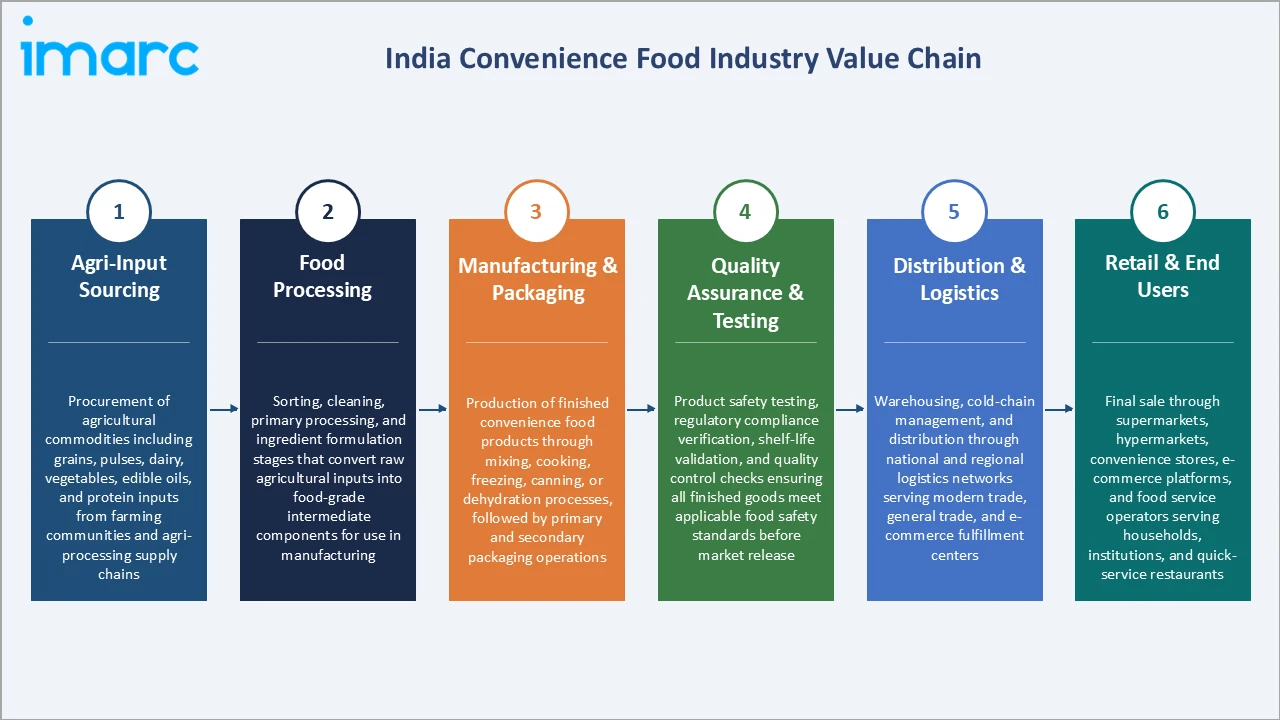
Industry Value Chain Analysis
The India convenience food value chain is structured across six integrated stages, from raw material sourcing through end-consumer delivery. Value addition increases progressively from raw commodity sourcing through manufacturing and brand differentiation, with the highest margin capture occurring at the manufacturing and retail stages where product quality, formulation expertise, and brand equity create durable competitive advantages.
|
Stage |
Key Value-Chain Activities |
|
Agri-Input Sourcing |
Procurement of agricultural commodities including grains, pulses, dairy, vegetables, edible oils, and protein inputs from farming communities and agri-processing supply chains. |
|
Food Processing |
Sorting, cleaning, primary processing, and ingredient formulation stages that convert raw agricultural inputs into food-grade intermediate components for use in manufacturing. |
|
Manufacturing & Packaging |
Production of finished convenience food products through mixing, cooking, freezing, canning, or dehydration processes, followed by primary and secondary packaging operations. |
|
Quality Assurance & Testing |
Product safety testing, regulatory compliance verification, shelf-life validation, and quality control checks ensuring all finished goods meet applicable food safety standards before market release. |
|
Distribution & Logistics |
Warehousing, cold-chain management, and distribution through national and regional logistics networks serving modern trade, general trade, and e-commerce fulfillment centers. |
|
Retail & End Users |
Final sale through supermarkets, hypermarkets, convenience stores, e-commerce platforms, and food service operators serving households, institutions, and quick-service restaurants. |
The manufacturing stage holds the greatest strategic significance in the convenience food value chain, as formulation expertise, food safety certifications, and brand investment create differentiation that is difficult for new entrants to replicate. The quality assurance stage ensures regulatory compliance and consumer safety across all product categories. The distribution stage is progressively being transformed by digital logistics platforms and quick-commerce networks that improve delivery speed and extend geographic reach.
Technology Landscape in the India Convenience Food Industry
Advanced Food Processing and Preservation Technologies
The adoption of advanced food processing and preservation technologies is enabling manufacturers to extend product shelf life while maintaining nutritional quality and taste integrity. Innovations in processing methods support the growing consumer preference for products with fewer artificial additives. These technologies allow manufacturers to meet evolving health, and wellness demands while maintaining the production efficiencies required for competitive pricing across mass-market and premium convenience food segments.
Cold-Chain Automation and Supply Chain Technology
Investment in automated warehousing, temperature-monitoring systems, and real-time supply chain visibility platforms is enabling manufacturers to extend frozen and chilled food distribution progressively beyond metro markets. Supply chain technology solutions are reducing product spoilage rates, improving order fulfillment accuracy, and strengthening the reliability of cold-chain logistics for manufacturers of temperature-sensitive convenience food products.
Digital Consumer Engagement and Data Analytics
Food manufacturers are increasingly leveraging digital analytics tools and consumer data platforms to understand evolving preference patterns, optimize product assortments, and personalize marketing communications. Data-driven approaches to new product development and demand forecasting are helping manufacturers accelerate innovation cycles, reduce new product failure rates, and align portfolio strategy with emerging consumer trends across urban and digital-first market segments.
Market Segmentation Analysis
The report covers the following segments:
| Segment Category | Leading Segment | Market Share | Year |
|---|---|---|---|
| Type | Ready-To-Eat | 28.7% | 2025 |
| Product | Cereal-based Products | 36.8% | 2025 |
| Distribution Channel | 🔒 | 🔒 | 2025 |
| Region | North India | 29.4% | 2025 |

By Type
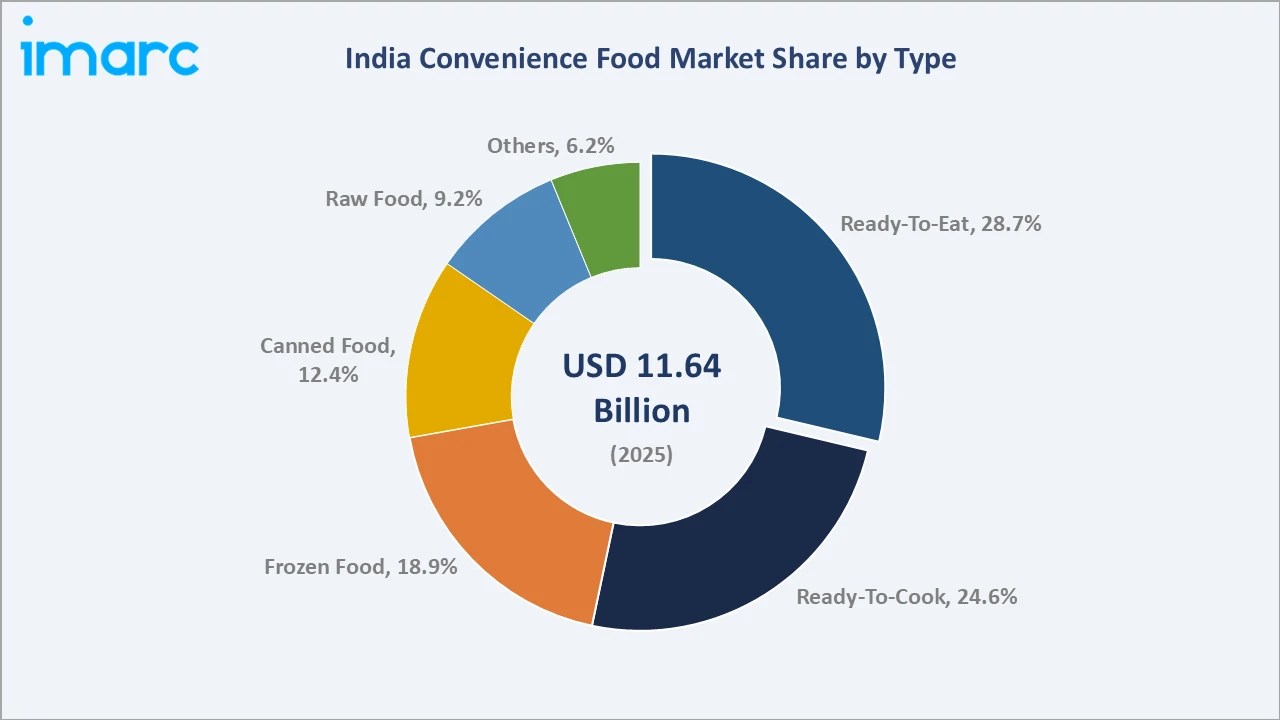
Ready-to-eat leads at 28.7% in 2025, reflecting its position as the most time-efficient convenience food format, requiring no preparation or cooking before consumption. Growing urban consumer preference for single-serve meal formats, combined with the availability of microwaveable and shelf-stable RTE products across modern trade and online channels, sustains category leadership through the forecast period.
To access detailed market analysis, Request Sample
Ready-to-cook at 24.6% is the second-largest type segment, anchored by the broad range of instant meal formats and spice-mix assisted cooking products that offer convenience while retaining consumer cooking involvement. Frozen food at 18.9% is the fastest-growing type, driven by expanding cold-chain availability and growing demand for frozen snacks, potato-based products, and protein-based frozen entrees. Canned food at 12.4%, raw food at 9.2%, and others at 6.2%.
By Product
Cereal-based products lead at 36.8% in 2025, encompassing packaged biscuits, breakfast cereals, instant noodles, pasta, and grain-based snack foods. This segment's leadership reflects the broad consumption base across income groups and meal occasions. Meat, fish and poultry products at 31.5% represent a rapidly growing segment driven by rising protein consumption awareness and the expansion of frozen and chilled protein-based convenience food formats.
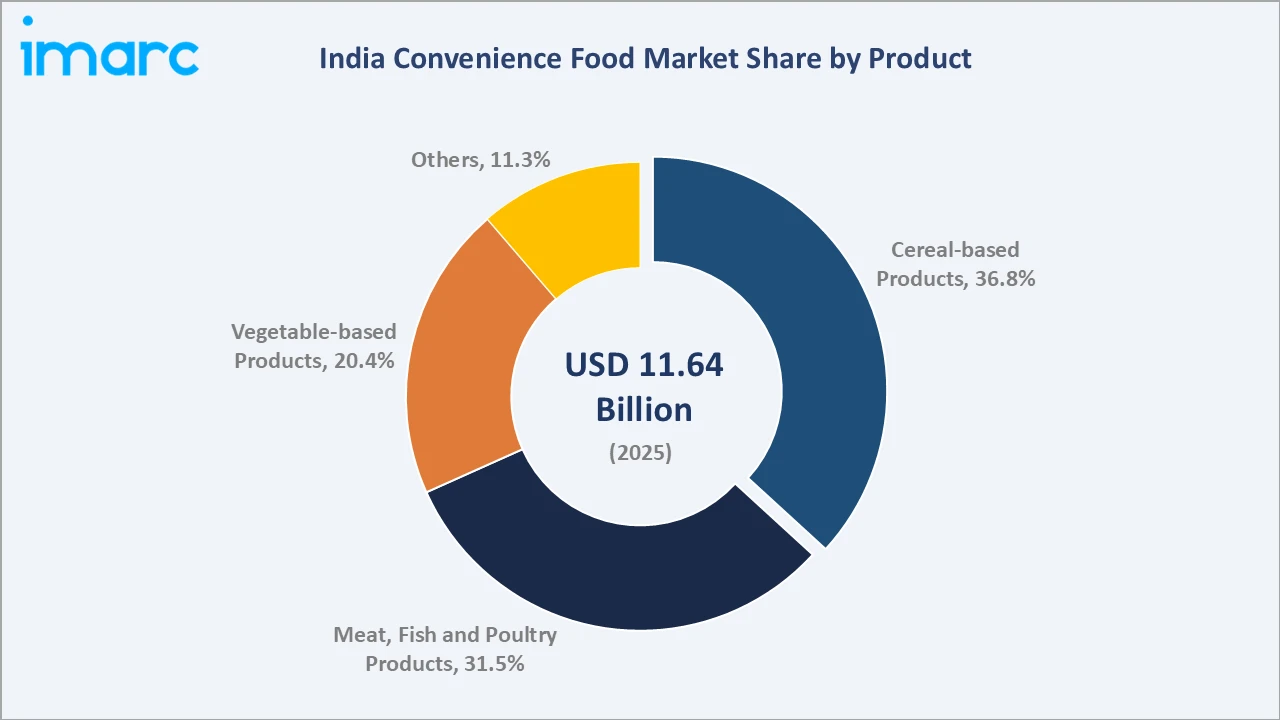
Vegetable-based products at 20.4% serve the large vegetarian consumer segment in India through frozen vegetable snacks, vegetable-based ready meals, and plant-protein formats. Others at 11.3% include dairy-based convenience products, fruit-based snacks, and specialty convenience food formats catering to diverse dietary preferences.
Regional Market Insights
|
Region |
Share (2025) |
Key Market Drivers & Characteristics |
|
North India |
29.4% |
High urban consumer density, strong organized retail penetration, and a large working-age population drive consistent convenience food demand across key metropolitan and tier-2 markets. |
|
South India |
27.6% |
Technology sector-driven professional workforce in major cities, strong café and quick-service restaurant culture, and high per-capita packaged food spend support category growth. |
|
West & Central India |
25.8% |
Large urban consumer base, strong manufacturing and industrial workforce, and high organized retail density in commercial hubs drive consistent convenience food consumption. |
|
East & Northeast India |
17.2% |
Smallest regional contributor with growing momentum from urbanization in state capitals, improving retail infrastructure, and rising packaged food acceptance among urban consumers. |
North India accounts for the largest regional share at 29.4% in 2025, driven by its high concentration of urban consumers in major metropolitan and tier-2 cities, supported by well-developed organized retail infrastructure and a strong consumer culture around packaged snacks, ready-to-eat meals, and cereal-based products. South India holds a 27.6% market share, benefits from a large and growing professional workforce concentrated in major technology and industrial cities.
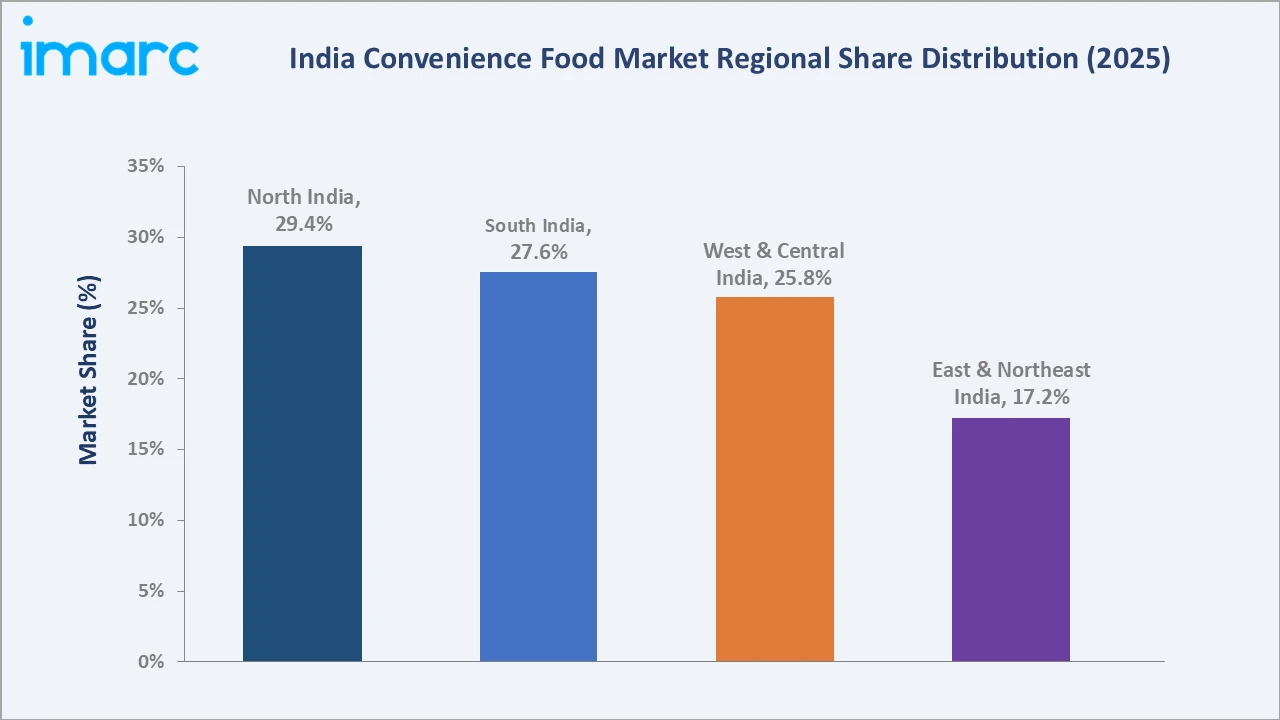
West and Central India contributes 25.8% of the market, anchored by large commercial and industrial hubs with a significant working urban population. The region benefits from high organized retail density in major commercial centers and strong consumer familiarity with packaged food products across a wide range of income segments. East and Northeast India holds a 17.2% share, representing the smallest regional contributor.
Competitive Landscape
The India convenience food market is moderately fragmented, with a mix of large diversified FMCG conglomerates, focused convenience food companies, and a large number of regional and private-label producers. Leading players hold strong positions through brand equity, distribution scale, and product portfolio breadth, while emerging brands compete through niche positioning, innovation, and digital-first go-to-market strategies.
| Company | Key Brands | Market Position | Core Strength |
|---|---|---|---|
| ITC Limited | Aashirvaad, Sunfeast, Yippee! | Market Leader | ITC Limited is one of India's largest and fastest-growing packaged and convenience food players, having grown into a market leader in the country's fast-moving consumer goods (FMCG) food sector |
| Nestlé | Maggi | Market Leader | Nestlé plays a foundational and dominant role in shaping India's convenience food market, largely anchored by the cultural ubiquity of Maggi instant noodles. |
| PepsiCo | Quaker Oats | Established Player | PepsiCo plays a dominant role in India's convenience food and savoury snacks market, acting as one of the country's primary growth engines and top anchor markets. |
| Orkla | MTR, Eastern | Innovator | Orkla India plays a major role in the Indian convenience food and packaged spice market through its heritage brands, MTR and Eastern. |
| iD Fresh Food | iD Fresh | Innovator | iD Fresh Food transformed India's convenience food market by replacing unorganized, preservative-laden packaged foods with fresh, clean-label, ready-to-cook traditional staples. |
Competition in India's convenience food market is intensifying as large FMCG players expand product portfolios, invest in health-positioned SKUs, and aggressively compete for digital shelf space on e-commerce platforms. Emerging brands are capturing premium urban segments through digital-first go-to-market strategies, while traditional players respond with portfolio diversification and premiumization initiatives.
Key Company Profiles
ITC Limited
ITC Limited is a diversified Indian conglomerate with a substantial presence across the branded food sector. The company's food division operates across multiple convenience food categories, serving a broad consumer base through an extensive nationwide manufacturing and distribution network. The company's backward integration into agricultural supply chains supports consistent raw material quality and cost management across its diversified product portfolio.
- Key Brands: Aashirvaad, Sunfeast, Yippee!
- Strategic Focus: Focuses on broadening its convenience food portfolio through product innovation, strengthening its distribution reach across emerging markets, and investing in sustainable packaging and supply chain capabilities.
Nestlé
Nestlé is a global food and nutrition conglomerate and maintains a strong position in the Indian packaged food market across multiple convenience food categories. The company combines food technology expertise with locally adapted product formulations to serve Indian consumers across various meal and snack occasions. Its strong distribution network and established consumer trust provide a solid foundation for ongoing portfolio growth.
- Key Brands: Maggi
- Strategic Focus: Focused on strengthening its nutrition and wellness positioning, expanding its digital commerce presence, and accelerating product innovation in high-growth convenience food categories.
Market Concentration Analysis
The India convenience food market reflects a moderately concentrated structure at the organized sector level, where a small number of large, diversified food companies hold dominant positions through established brand equity, extensive distribution infrastructure, and broad product portfolio coverage. These leading players benefit from significant scale advantages in manufacturing efficiency, retail shelf presence, and consumer brand recognition that create durable barriers to competitive displacement within core product categories.
Outside the organized sector, the broader market landscape is considerably fragmented, with regional manufacturers, private-label producers, and unbranded local providers serving geographically defined consumer segments. The specialty and regionally inspired convenience food segments in particular remain competitive across a wide range of emerging and category-focused brands. Ongoing market evolution is expected to bring gradual consolidation as leading players seek to extend their geographic and product category reach through innovation, acquisition, and portfolio expansion initiatives.
Investment & Growth Opportunities
Highest Growth Segments
Frozen food at approximately 16.5% CAGR represents the highest growth rate segment, driven by expanding cold-chain availability and consumer appetite for frozen snacks, potato-based products, and frozen protein formats. Ready-to-eat at approximately 15.1% CAGR offers the highest volume opportunity given its dominant segment share and broad urban consumer demand base. Health-positioned and premium convenience formats represent the highest-margin growth opportunity as premiumization accelerates across the market.
Investment Themes
- Cold-Chain Infrastructure Investment: Building refrigerated warehousing and last-mile cold delivery capabilities in tier-2 and tier-3 Indian cities is the single largest structural opportunity to unlock frozen and chilled convenience food market growth beyond current metro-concentrated penetration levels.
- Health and Wellness Convenience Food Innovation: Developing and scaling fortified, high-protein, plant-based, and clean-label convenience food formats addresses the fastest-growing consumer preference segment and commands above-average pricing and margin profiles across modern trade and e-commerce channels.
- Digital-First D2C Brand Building: Investment in digital consumer brand building, social commerce, and quick-commerce channel activation enables new entrants to compete in premium urban segments without the scale requirements of traditional FMCG distribution, representing a capital-efficient route to market capture.
Future Market Outlook (2026-2034)
The India convenience food market grew from USD 11.64 Billion in 2025 to USD 13.30 Billion in 2026, reaching USD 38.63 Billion by 2034, exhibiting a CAGR of 14.26% during the forecast period. The market is expected to reach an intermediate milestone of approximately USD 22.67 Billion by 2030, as urban household penetration of packaged convenience food products deepens and the organized retail and e-commerce infrastructure reaches tier-2 and tier-3 markets at scale.
Three structural forces will define India's convenience food market through 2034. First, continued urbanization and the growth of working-age dual-income households will sustain high-volume demand for time-saving meal solutions across RTE, RTC, and frozen food categories. Second, expanding cold-chain infrastructure investment will unlock the frozen food segment's growth potential in geographies currently underserved by refrigerated logistics. Third, progressive premiumization driven by rising incomes and health-consciousness will shift value toward higher-margin, wellness-positioned, and gourmet convenience food formats that command significant price premiums over standard packaged food products through 2034.
Research Methodology
Primary Research
Primary research comprised structured consultations with convenience food manufacturing executives, retail category managers, food service procurement specialists, supply chain and cold-chain logistics operators, and investor representatives active in the India packaged food sector. These discussions validated market sizing, assessed segment growth dynamics, identified competitive positioning, and provided insights into consumer preference shifts and technology adoption trends.
Secondary Research
Secondary research drew on published data from food regulatory databases, Ministry of Food Processing Industries reports, national consumption statistics, company annual reports and investor presentations, trade publications, and market databases covering the India packaged and convenience food sectors. Historical data spanning 2020 through 2025 was cross-validated across primary and secondary sources.
Forecasting Models
Market forecasts were developed using bottom-up and top-down modeling incorporating historical sector growth rates, urbanization and demographic projections, income growth models, organized retail expansion plans, cold-chain infrastructure investment data, corporate capacity expansion announcements, and macroeconomic indicators including GDP growth, consumer price trends, and food expenditure share benchmarks.
India Convenience Food Market Report Coverage:
| Report Features | Details |
|---|---|
| Base Year of the Analysis | 2025 |
| Historical Period | 2020-2025 |
| Forecast Period | 2026-2034 |
| Units | Billion USD |
| Scope of the Report |
Exploration of Historical and Forecast Trends, Industry Catalysts and Challenges, Segment-Wise Historical and Predictive Market Assessment:
|
| Types Covered | Raw Food, Canned Food, Frozen Food, Ready-To-Eat, Ready-To-Cook, Others |
| Products Covered | Meat, Fish and Poultry Products, Cereal-based Products, Vegetable-based Products, Others |
| Distribution Channels Covered | Supermarkets and Hypermarkets, Convenience Stores, Specialty Stores, Others |
| Regions Covered | North India, West and Central India, South India, East and Northeast India |
| Companies Covered | ITC Limited, Nestlé, PepsiCo, Orkla, iD Fresh Food, etc. |
| Customization Scope | 10% Free Customization |
| Post-Sale Analyst Support | 10-12 Weeks |
| Delivery Format | PDF and Excel through Email (We can also provide the editable version of the report in PPT/Word format on special request) |
Key Benefits for Stakeholders:
- IMARC’s industry report offers a comprehensive quantitative analysis of various market segments, historical and current market trends, market forecasts, and dynamics of the India convenience food market from 2020-2034.
- The research report provides the latest information on the market drivers, challenges, and opportunities in the India convenience food market.
- Porter's five forces analysis assist stakeholders in assessing the impact of new entrants, competitive rivalry, supplier power, buyer power, and the threat of substitution. It helps stakeholders to analyze the level of competition within the India convenience food industry and its attractiveness.
- Competitive landscape allows stakeholders to understand their competitive environment and provides an insight into the current positions of key players in the market.
Frequently Asked Questions About the India Convenience Food Market Report
The India convenience food market reached USD 13.30 Billion in 2026, driven by urbanization, rising dual-income households, and expanding organized retail and e-commerce food channels.
The market is projected to grow at a CAGR of 14.26% during 2026-2034, supported by structural urbanization, cold-chain expansion, and progressive premiumization of convenience food categories.
The market is projected to reach approximately USD 22.67 Billion by 2030, driven by deepening urban penetration, tier-2 city market expansion, and frozen food category scale-up.
Ready-to-eat leads with a 28.7% share in 2025, reflecting consumer demand for zero-preparation meal formats supported by growing availability across modern trade and e-commerce channels.
Cereal-based products lead with a 36.8% share in 2025, driven by broad consumption of packaged biscuits, instant noodles, breakfast cereals, and pasta across income groups and meal occasions.
North India leads with a 29.4% share in 2025, reflecting high urban consumer density, strong organized retail penetration, and consistent convenience food demand in major metro and tier-2 cities.
Key players include ITC Limited, Nestlé, PepsiCo, Orkla, and iD Fresh Food, among others.
The market is projected to reach USD 38.63 Billion by 2034, driven by sustained urbanization, health-wellness innovation, e-commerce channel growth, and premiumization of convenience formats.
Need more help?
- Speak to our experienced analysts for insights on the current market scenarios.
- Include additional segments and countries to customize the report as per your requirement.
- Gain an unparalleled competitive advantage in your domain by understanding how to utilize the report and positively impacting your operations and revenue.
- For further assistance, please connect with our analysts.
 Request Customization
 Speak to an Analyst
 Request Brochure
 Inquire Before Buying
Benefits of Customization
- Personalize this research
- Triangulate with your data
- Get data as per your format and definition
- Gain a deeper dive into a specific application, geography, customer, or competitor
- Any level of personalization
Get in Touch With Us
UNITED STATES
Phone: +1-201-971-6302
INDIA
Phone: +91-120-433-0800
UNITED KINGDOM
Phone: +44-753-714-6104
Email: [email protected]
Client Testimonials















Related Reports

Choose your plan
*Please note that the prices mentioned below are starting prices for each bundle type. Kindly contact our team for further details.*
Single User License
- 1 User License, Access on 2 Devices
- PDF Report + Excel Dataset (Password Protected)
- Lifetime Access
- No Printing Rights
- 10% Free Report Customization
- 10–12 Weeks of Analyst Support
Five User License
- Access for 5 Users, 2 Devices per User
- PDF Report + Excel Dataset (Password Protected)
- Lifetime Access
- Dedicated Account Manager
- 12–14 Weeks of Analyst Support
- No Printing Rights
- 15% Free Report Customization
- 25% Discount on Your Next Purchase
Corporate User License
- Unlimited User Access (Within Your Organization)
- PDF Report + Excel Dataset
- Lifetime Access
- Dedicated Account Manager
- 14–20 Weeks of Analyst Support
- No Printing Rights
- 20% Free Report Customization
- 30% Discount on Your Next Purchase
Essential Insights
What's included:
3 reports
- Lifetime Access
- PDF Reports
- Excel Datasets
- 2 Weeks of Free Analyst Support
- 2 User Licenses
- Access on 2 Devices
- Printing Rights
- Complimentary PowerPoint (PPT) Version
- Complimentary License Upgrade
Professional Access
What's included:
5 reports
- Lifetime Access
- PDF Reports
- Excel Datasets
- 8 Weeks of Free Analyst Support
- 2 User Licenses
- Access on 2 Devices
- Printing Rights
- Complimentary PowerPoint (PPT) Version
- Complimentary License Upgrade
Business Advantage
What's included:
8 reports
- Lifetime Access
- PDF Reports
- Excel Datasets
- 14 Weeks of Free Analyst Support
- 2 User Licenses
- Access on 2 Devices
- Printing Rights
- Complimentary PowerPoint (PPT) Version
- Complimentary License Upgrade
Enterprise Intelligence
What's included:
10 reports
- Lifetime Access
- PDF Reports
- Excel Datasets
- 20 Weeks of Free Analyst Support
- 2 User Licenses
- Access on 2 Devices
- Printing Rights
- Complimentary PowerPoint (PPT) Version
- Complimentary License Upgrade