
India Conveyor Belt Market Size, Share, Trends and Forecast by Type, End Use, and Region, 2026-2034
India Conveyor Belt Market Summary:
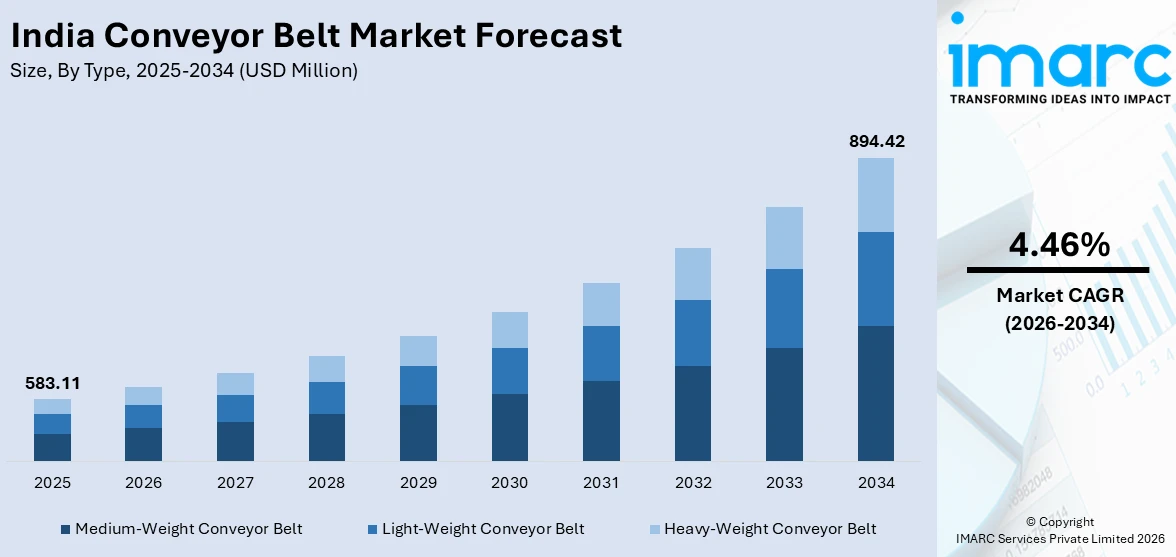
The India conveyor belt market size was valued at USD 583.11 Million in 2025 and is projected to reach USD 894.42 Million by 2034, growing at a compound annual growth rate of 4.46% from 2026-2034.
The market is driven by rapid industrialization and large-scale infrastructure development across the country, alongside surging demand from the mining and metallurgy sector for efficient bulk material transportation. The widespread adoption of Industry 4.0 technologies, including IoT-enabled conveyor monitoring systems and AI-driven predictive maintenance, is transforming the operational efficiency of conveyor systems. Growing emphasis on worker safety and ergonomics, coupled with increasing investments in airports, seaports, and warehouse facilities, further fuels demand, reinforcing India conveyor belt market share.
Key Takeaways and Insights:
- By Type: Medium-weight conveyor belt dominates the market with a share of 42.5% in 2025, driven by its versatile applicability across manufacturing, chemicals, logistics, and aviation industries.
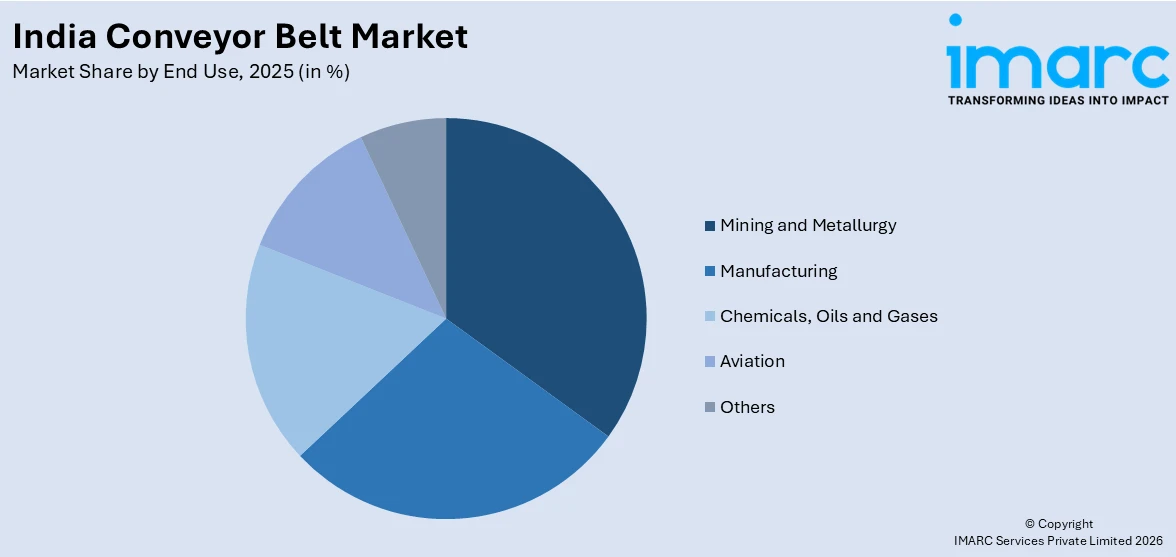
- By End Use: Mining and metallurgy lead the market with a share of 32.8% in 2025, owing to India's extensive coal, iron ore, and non-ferrous metal extraction activities requiring heavy-duty belting solutions.
- By Region: South India dominates the market with a share of 30.2% in 2025, driven by its strong automotive, electronics, pharmaceutical, and aerospace manufacturing clusters across the region's key industrial states.
- Key Players: The India conveyor belt market features established domestic and international manufacturers competing through specialized belt variants, including textile-reinforced, steel cord-reinforced, eco-friendly, and self-cleaning product innovations across diverse end-use sectors. Some of the key players operating in the market include Ace Conveyor Solutions, Continental Belting Pvt. Ltd., Dura Conveyor Belting Pvt. Ltd., Dynamic Rubbers Pvt Ltd., Fenner Conveyor Belting Pvt Ltd, Jaytex International, Mahajan Beltings Industrial Corporation India, Oriental Rubber Industries Pvt. Ltd., Pentagon Rubber Limited, Sempertrans India Private Limited, Shriram Beltings, and Somi Conveyor Beltings Ltd.
To get more information of this market Request Sample
India conveyor belt market continues to expand on the back of the country's accelerating industrial transformation. The surge in mining operations, driven by government initiatives to boost domestic coal and critical mineral production, is one of the most consistent demand drivers. In December 2025, NTPC Ltd set a target to increase coal output to 100 million tonnes and strengthen coal dispatch systems, aligning with broader national resource strategies that inherently depend on robust conveyor systems for material movement in mines and railheads. Simultaneously, the rapid scaling of manufacturing under production-linked incentive schemes is drawing significant investments into automotive, electronics, and specialty steel plants, all of which rely heavily on conveyor infrastructure. The rise of e-commerce and organized logistics is adding another demand layer as warehouses and distribution centers adopt automated material handling systems. Investments in airport modernization and new seaport infrastructure are further widening the market's addressable base, with aviation baggage systems and cargo handling representing a growing segment.
India Conveyor Belt Market Trends:
Accelerating Integration of IoT and Predictive Maintenance Technologies
A significant trend shaping the India conveyor belt market is the growing deployment of Internet of Things sensors and AI-driven analytics platforms across industrial facilities. Manufacturers and mining operators are increasingly equipping conveyor systems with real-time monitoring devices that track belt tension, speed, temperature, and vibration. In 2026, Indian firms such as Chennai‑based Tech4LYF Corporation are designing and deploying IoT‑based conveyor belt monitoring solutions that enable real‑time visibility and predictive alerts, helping reduce downtime and boost operational efficiency across automotive, mining and packaging plants. This data-driven approach enables early fault detection and proactive maintenance scheduling, reducing unplanned downtime significantly.
Rising Demand for Sustainable and Eco-Friendly Conveyor Belt Materials
Environmental consciousness and regulatory compliance requirements are reshaping material preferences in India's conveyor belt market. Industrial buyers are increasingly prioritizing belts manufactured from recyclable polymers, bio-based compounds, and low-carbon-footprint materials. The shift toward sustainable sourcing is especially visible in food processing, pharmaceuticals, and chemical industries, where both regulatory standards and corporate sustainability commitments influence procurement decisions. In January 2026, Indian manufacturer Avro India opened the country’s largest flexible plastic recycling facility in Ghaziabad, Uttar Pradesh, designed to process challenging‑to‑recycle plastics into industrial‑grade recycled pellets, reinforcing the availability of recycled raw materials that can be used in eco‑friendly industrial applications.
Expansion of Modular and Flexible Conveyor System Designs
The India conveyor belt market is witnessing increasing adoption of modular and reconfigurable conveyor systems, particularly in the logistics, e-commerce, and FMCG sectors. As Indian businesses face dynamic production demands and evolving supply chain requirements, the ability to quickly reconfigure, extend, or scale material handling infrastructure is becoming a critical operational advantage. In February 2026, Bharat Q Conveyor Automation, based in IMT Manesar, showcased its full range of bag, belt, roller, slat, and overhead conveyors at LogiMAT India, engaging professionals across chemical, food processing, pharmaceutical, and manufacturing sectors.
Market Outlook 2026-2034:
The India conveyor belt market is poised for steady and sustained revenue expansion over the forecast period, underpinned by structural demand from mining, manufacturing, and infrastructure development. The market's growth trajectory will be shaped by accelerating industrialization, government-backed mineral extraction programs, and deepening penetration of automation technologies across key end-use sectors. As smart conveyor systems with embedded monitoring capabilities transition from premium installations to mainstream deployments, the market's revenue base will diversify toward higher-value integrated solutions, contributing to a favorable long-term outlook. The market generated a revenue of USD 583.11 Million in 2025 and is projected to reach a revenue of USD 894.42 Million by 2034, growing at a compound annual growth rate of 4.46% from 2026-2034.
India Conveyor Belt Market Report Segmentation:
| Segment Category | Leading Segment | Market Share |
|---|---|---|
|
Type |
Medium-Weight Conveyor Belt |
42.5% |
|
End Use |
Mining and Metallurgy |
32.8% |
|
Region |
South India |
30.2% |
Type Insights:
- Medium-Weight Conveyor Belt
- Light-Weight Conveyor Belt
- Heavy-Weight Conveyor Belt
Medium-weight conveyor belt dominates with a market share of 42.5% of the total India conveyor belt market in 2025.
The medium-weight conveyor belt leads the India conveyor belt market, driven by its exceptional versatility across a broad spectrum of industrial applications. These belts strike an optimal balance between load-bearing capacity and operational flexibility, making them the preferred choice for manufacturing facilities, chemical processing plants, logistics warehouses, and aviation ground-handling systems. Their construction using durable materials such as nylon, polyester, and PVC compounds ensures reliable performance across varied production environments, positioning them as the most widely adopted belt type across India's expanding industrial landscape.
The segment's leadership is further reinforced by growing adoption in food processing, consumer goods manufacturing, and organized logistics, where medium-weight belts with specialized surface coatings meet both operational and hygiene requirements. As India's manufacturing sector scales under production-linked incentive programs, new production facilities are increasingly standardizing on medium-weight conveyor infrastructure for assembly lines and material flow processes. The availability of customized configurations in varying widths, surface profiles, and tensile strengths allows manufacturers to address diverse operational needs, ensuring the segment retains its dominant position throughout the forecast period.
End Use Insights:
Access the comprehensive market breakdown Request Sample
- Mining and Metallurgy
- Manufacturing
- Chemicals, Oils and Gases
- Aviation
- Others
Mining and metallurgy lead with a share of 32.8% of the total India conveyor belt market in 2025.
The mining and metallurgy hold the leading position in the India conveyor belt market, underpinned by the country's extensive and continuously expanding mineral extraction activities. India's role as a major producer of coal, iron ore, and aluminium generates persistent high-volume demand for heavy-duty conveyor belts capable of transporting abrasive bulk materials over long distances in harsh operating conditions. Government-backed initiatives to increase domestic coal and critical mineral production are directly accelerating conveyor infrastructure investments across both new and upgraded mine sites across mineral-rich states.
The dominance of this segment is further supported by the need for massive expansions of integrated steel plant conveyor systems and non-ferrous metals processing conveyor systems, which demand high volumes of intra-plant conveyor solutions. Additionally, safety compliances for underground mining environments are also creating demand for fire-resistant and anti-static conveyor belt types, which need to adhere to very high levels of compliance. Thus, as India develops its metallurgical industry to support its growing infrastructure and manufacturing needs, the mining and metallurgy segment continues to create the highest demand for conveyor belts, making it the largest segment in the market.
Regional Insights:
- North India
- West and Central India
- South India
- East India
South India dominates with a market share of 30.2% of the total India conveyor belt market in 2025.
South India dominates the regional landscape of the India conveyor belt market, supported by the region's exceptionally diverse and well-established industrial base. The presence of large-scale automotive manufacturing clusters, rapidly growing electronics production facilities, and a significant pharmaceutical and bulk drug manufacturing ecosystem creates multi-sector demand for conveyor systems across varying load capacities and specifications. Proactive state industrial policies, including investment incentives and infrastructure development support, continue attracting greenfield manufacturing projects that require modern conveyor infrastructure from the outset of operations.
The position of the region is further strengthened by the growth in the aerospace and defense manufacturing sector, the expansion in the port infrastructure, and the development of new industrial corridors that are attracting considerable domestic and foreign investment. South India is the most active market in terms of the purchase and upgrade of conveyor belts, driven by the diversity of the industrial sector, the availability of the skilled workforce, and the connectivity in the logistics sector.

Market Dynamics:
Growth Drivers:
Why is the India Conveyor Belt Market Growing?
Rapid Expansion of India's Mining and Mineral Extraction Sector
India's ambitious push toward domestic mineral self-sufficiency is serving as a powerful structural growth driver for the conveyor belt market. Government initiatives to expand coal production capacity and accelerate critical mineral exploration are generating accelerated demand for conveyor infrastructure across open-pit and underground mining environments. As per sources, the Government of India launched the ₹34,300 crore National Critical Mineral Mission to strengthen domestic critical mineral production, support exploration and processing, and reduce import dependency, a strategic move expected to catalyse mining expansion and related conveyor investments. Commercial coal block auctions are attracting private-sector operators who are equipping new mine sites with modern conveyor systems as a preferred alternative to road-based material haulage, given their superior throughput, lower operational costs, and enhanced safety profile.
Accelerating Industrialization Under the Make in India Initiative
India's flagship industrial development policy has catalyzed significant expansion of the country's manufacturing footprint, directly translating into increased conveyor belt demand across multiple sectors. Production-linked incentive schemes spanning specialty steel, electronics, pharmaceuticals, and automotive components have attracted large-scale investments establishing new production facilities that require extensive material handling infrastructure. In February 2026, the Government of India formalised 85 specialty steel projects under the PLI Scheme with companies committing ₹11,887 crore in investments and adding 8.7 million tonnes of downstream capacity, reinforcing expansion in sectors that rely on conveyors for sequential handling and automation. As manufacturing absorbs growing volumes of global supply chain diversification investment, assembly plants, electronics clusters, and pharmaceutical production parks each rely on conveyor systems for sequential material handling and packaging line automation.
Infrastructure Development and Logistics Modernization
India's large-scale infrastructure development program, encompassing airports, seaports, logistics parks, and multimodal freight corridors, is creating new and expanding demand categories for the conveyor belt market. Airport modernization drives procurement of baggage handling systems, while port-led development initiatives accelerate investments in bulk cargo handling facilities where conveyors are integral to operational efficiency. In May 2025, the V.O. Chidambaranar (Tuticorin) Port commissioned its North Cargo Berth‑III with a new link conveyor system capable of discharging over 1500 tonnes of bulk cargo per hour, enhancing mechanized handling of coal, limestone, and other materials. Simultaneously, the rapid growth of organized warehousing and e-commerce fulfillment infrastructure is generating demand for automated sortation and modular conveyor solutions across India's emerging modern logistics ecosystem.
Market Restraints:
What Challenges the India Conveyor Belt Market is Facing?
High Initial Capital Investment for Advanced Conveyor Systems
The transition toward smart, IoT-enabled, and high-capacity conveyor systems involves considerable upfront capital expenditure that remains prohibitive for small and medium-sized enterprises. The cost of advanced sensor integration, real-time monitoring platforms, and premium-grade materials adds significantly to installation budgets, slowing adoption among budget-constrained industrial buyers, particularly within the unorganized manufacturing and small-scale mining segments.
Volatility in Raw Material Prices
Conveyor belt manufacturing is closely tied to natural rubber, synthetic compounds, polyester, nylon, and steel cord materials, all subject to global commodity price fluctuations. Periods of sharp input cost escalation compress manufacturer margins and delay procurement decisions among industrial buyers, creating periodic demand disruptions and complicating long-term project cost estimation for large-scale infrastructure installations.
Skilled Workforce and Maintenance Expertise Gaps
The effective operation and maintenance of advanced conveyor systems, particularly those integrated with predictive analytics and automated monitoring technologies, requires technically skilled personnel. In India, the availability of adequately trained installation engineers and maintenance technicians remains uneven across geographies, especially in remote mining and industrial areas, limiting the efficient adoption and lifecycle management of high-value conveyor installations.
Competitive Landscape:
The India conveyor belt market features a moderately fragmented competitive structure, with established domestic manufacturers competing alongside international players across product quality, customization depth, and after-sales service capabilities. Competition is primarily centered on the development of specialized belt variants, including fire-resistant and anti-static formulations for mining applications, food-grade hygienic configurations for processing industries, and steel cord-reinforced belts for heavy metallurgical operations. Leading players are increasingly differentiating through investments in research and development for sustainable and eco-friendly belt materials, expansion of regional distribution and service networks, and integration of smart monitoring capabilities into their product offerings.
Some of the key players include:
- Ace Conveyor Solutions
- Continental Belting Pvt. Ltd.
- Dura Conveyor Belting Pvt. Ltd.
- Dynamic Rubbers Pvt Ltd.
- Fenner Conveyor Belting Pvt Ltd
- Jaytex International
- Mahajan Beltings Industrial Corporation India
- Oriental Rubber Industries Pvt. Ltd.
- Pentagon Rubber Limited
- Sempertrans India Private Limited
- Shriram Beltings
- Somi Conveyor Beltings Ltd
Recent Developments:
- In April 2025, Daifuku Intralogistics India Pvt. Ltd. inaugurated a new Hyderabad plant, expanding production space fourfold to manufacture automated storage and retrieval systems, rail-guided pallet sorters, and conveyors, supporting manufacturing, distribution, retail, and e-commerce sectors while enhancing local production efficiency and responsiveness across India’s rapidly growing material-handling market.
India Conveyor Belt Market Report Coverage:
| Report Features | Details |
|---|---|
| Base Year of the Analysis | 2025 |
| Historical Period | 2020-2025 |
| Forecast Period | 2026-2034 |
| Units | Million USD |
| Scope of the Report |
Exploration of Historical Trends and Market Outlook, Industry Catalysts and Challenges, Segment-Wise Historical and Future Market Assessment:
|
| Types Covered | Medium-Weight Conveyor Belt, Light-Weight Conveyor Belt, Heavy-Weight Conveyor Belt |
| End Uses Covered | Mining and Metallurgy, Manufacturing, Chemicals, Oils and Gases, Aviation, Others |
| Region Covered | North India, West and Central India, South India, East India |
| Companies Covered | Ace Conveyor Solutions, Continental Belting Pvt. Ltd., Dura Conveyor Belting Pvt. Ltd., Dynamic Rubbers Pvt Ltd., Fenner Conveyor Belting Pvt Ltd, Jaytex International, Mahajan Beltings Industrial Corporation India, Oriental Rubber Industries Pvt. Ltd., Pentagon Rubber Limited, Sempertrans India Private Limited, Shriram Beltings, Somi Conveyor Beltings Ltd, etc. |
| Customization Scope | 10% Free Customization |
| Post-Sale Analyst Support | 10-12 Weeks |
| Delivery Format | PDF and Excel through Email (We can also provide the editable version of the report in PPT/Word format on special request) |
Frequently Asked Questions About the India Conveyor Belt Market Report
The India conveyor belt market size was valued at USD 583.11 Million in 2025.
The India conveyor belt market is expected to grow at a compound annual growth rate of 4.46% from 2026-2034 to reach USD 894.42 Million by 2034.
Medium-weight conveyor belt held the largest India conveyor belt market share, owing to its exceptional versatility across manufacturing, chemicals, logistics, and aviation sectors, offering an optimal balance between load-bearing capacity, durability, and operational flexibility.
Key factors driving the India conveyor belt market include rapid industrialization, expanding mining and metallurgy activities, large-scale infrastructure development, growing adoption of Industry 4.0 technologies, and surging demand from the logistics and e-commerce sectors.
Major challenges include high initial capital investment for advanced conveyor systems, volatility in raw material prices affecting manufacturing costs, technical skills gaps in maintenance and operation of smart conveyor systems, and uneven infrastructure development across regional markets.
Need more help?
- Speak to our experienced analysts for insights on the current market scenarios.
- Include additional segments and countries to customize the report as per your requirement.
- Gain an unparalleled competitive advantage in your domain by understanding how to utilize the report and positively impacting your operations and revenue.
- For further assistance, please connect with our analysts.
 Request Customization
 Speak to an Analyst
 Request Brochure
 Inquire Before Buying
Benefits of Customization
- Personalize this research
- Triangulate with your data
- Get data as per your format and definition
- Gain a deeper dive into a specific application, geography, customer, or competitor
- Any level of personalization
Get in Touch With Us
UNITED STATES
Phone: +1-201-971-6302
INDIA
Phone: +91-120-433-0800
UNITED KINGDOM
Phone: +44-753-714-6104
Email: [email protected]
Client Testimonials




.webp)




.webp)













Related Reports

Choose your plan
*Please note that the prices mentioned below are starting prices for each bundle type. Kindly contact our team for further details.*
Single User License
- 1 User License, Access on 2 Devices
- PDF Report + Excel Dataset (Password Protected)
- Lifetime Access
- No Printing Rights
- 10% Free Report Customization
- 10–12 Weeks of Analyst Support
Five User License
- Access for 5 Users, 2 Devices per User
- PDF Report + Excel Dataset (Password Protected)
- Lifetime Access
- Dedicated Account Manager
- 12–14 Weeks of Analyst Support
- No Printing Rights
- 15% Free Report Customization
- 25% Discount on Your Next Purchase
Corporate User License
- Unlimited User Access (Within Your Organization)
- PDF Report + Excel Dataset
- Lifetime Access
- Dedicated Account Manager
- 14–20 Weeks of Analyst Support
- No Printing Rights
- 20% Free Report Customization
- 30% Discount on Your Next Purchase
Essential Insights
What's included:
3 reports
- Lifetime Access
- PDF Reports
- Excel Datasets
- 2 Weeks of Free Analyst Support
- 2 User Licenses
- Access on 2 Devices
- Printing Rights
- Complimentary PowerPoint (PPT) Version
- Complimentary License Upgrade
Professional Access
What's included:
5 reports
- Lifetime Access
- PDF Reports
- Excel Datasets
- 8 Weeks of Free Analyst Support
- 2 User Licenses
- Access on 2 Devices
- Printing Rights
- Complimentary PowerPoint (PPT) Version
- Complimentary License Upgrade
Business Advantage
What's included:
8 reports
- Lifetime Access
- PDF Reports
- Excel Datasets
- 14 Weeks of Free Analyst Support
- 2 User Licenses
- Access on 2 Devices
- Printing Rights
- Complimentary PowerPoint (PPT) Version
- Complimentary License Upgrade
Enterprise Intelligence
What's included:
10 reports
- Lifetime Access
- PDF Reports
- Excel Datasets
- 20 Weeks of Free Analyst Support
- 2 User Licenses
- Access on 2 Devices
- Printing Rights
- Complimentary PowerPoint (PPT) Version
- Complimentary License Upgrade