
India Copper Cathode Market Size, Share, Trends and Forecast by Refining Process Type, Application, and Region, 2026-2034
India Copper Cathode Market Size, Share, Trends & Forecast (2026-2034)
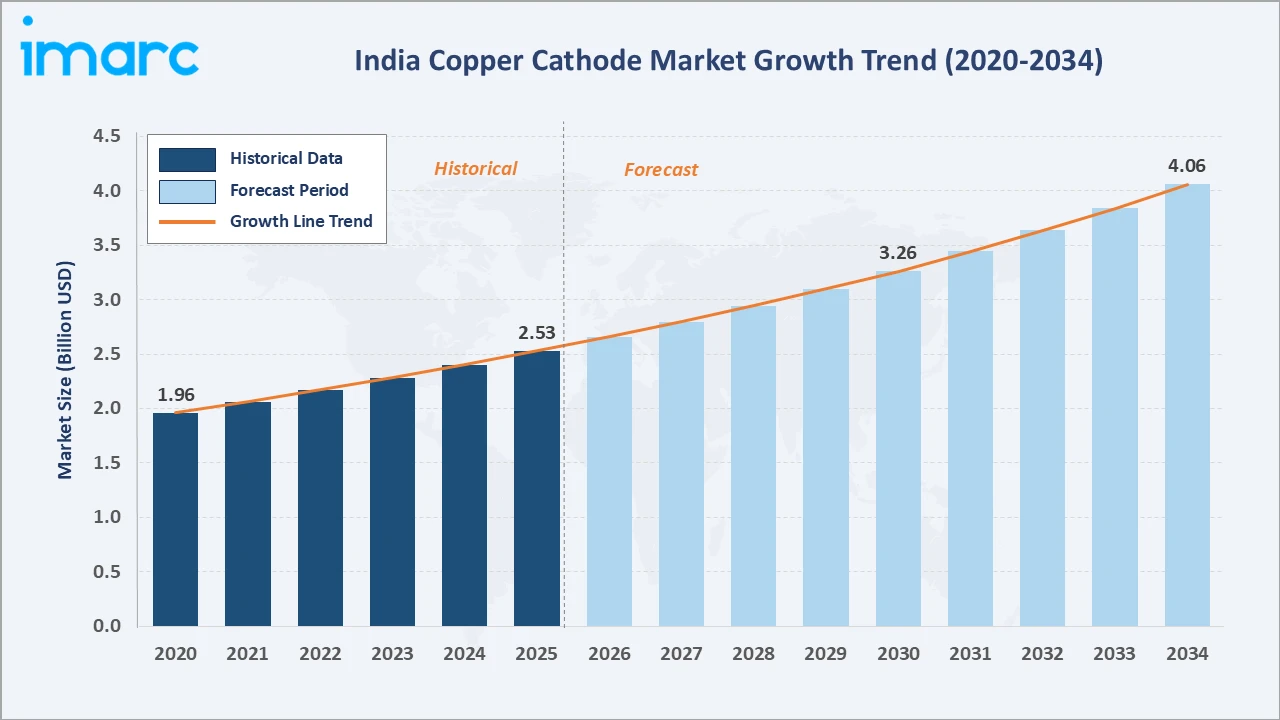
The India copper cathode market size increased from USD 2.53 Billion in 2025 to USD 2.66 Billion in 2026 and is projected to reach USD 4.06 Billion by 2034, growing at a CAGR of 5.24% during 2026-2034, driven by rising electrical and electronics demand, EV adoption, infrastructure growth, and government-backed domestic production initiatives.
Electro-Refining leads processing at 62.8% share. Conductor applications dominate end-use at 56.4%. West India leads regionally at 34.8% share.
Market Snapshot
|
Metric |
Value |
|
Base Year Market Size (2025) |
USD 2.53 Billion |
|
Market Size (2026) |
USD 2.66 Billion |
|
Forecast Market Size (2034) |
USD 4.06 Billion |
|
CAGR (2026-2034) |
5.24% |
|
Base Year |
2025 |
|
Historical Period |
2020-2025 |
|
Forecast Period |
2026-2034 |
|
Dominant Refining Process |
Electro-Refining (62.8%, 2025) |
|
Dominant Application |
Conductor (56.4%, 2025) |
|
Leading Region |
West India (34.8%, 2025) |
The India copper cathode market grew from USD 1.96 Billion in 2020 to USD 2.53 Billion in 2025, and an estimated USD 2.66 Billion in 2026. anchored at USD 3.26 Billion in 2030, and forecast to reach USD 4.06 Billion by 2034, supported by the Copper Quality Control Order, Kutch Copper's refinery ramp-up, and sustained downstream conductor demand. Year-on-year output has climbed steadily across the historical period, and the forecast trajectory shows an equally consistent upward slope as new refining capacity is progressively commissioned and utilised.
To get more information on this market, Request Sample
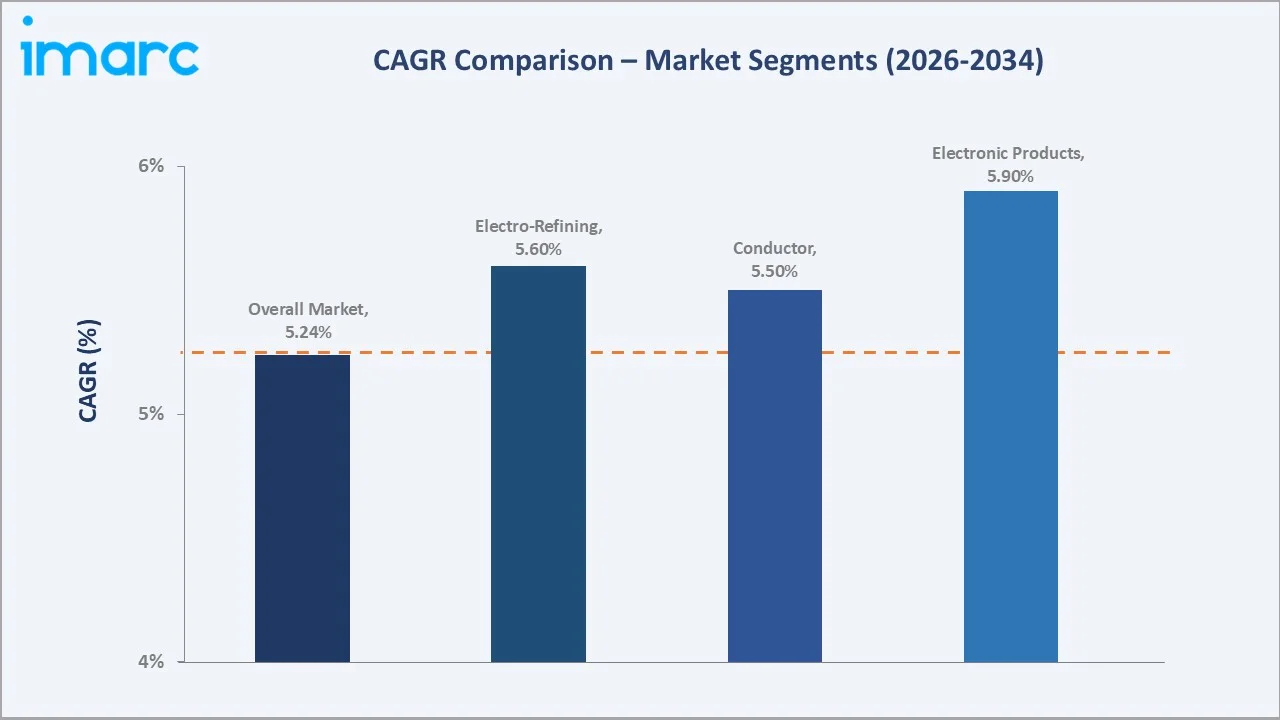
Electro-Refining and the Conductor application grow above the market average as domestic smelting capacity additions and grid electrification programs sustain premium-grade cathode offtake, while the Others application segment lags on limited niche industrial demand. The historical-to-forecast transition around 2025-2026 marks the point at which Kutch Copper's greenfield output begins contributing meaningfully to national cathode supply.
Executive Summary
The India copper cathode market expanded from USD 2.53 Billion in 2025, to an estimated USD 2.66 Billion in 2026 underpinned by copper's role as the primary conductor material for India's expanding electrical, electronics, and renewable energy infrastructure. Copper cathodes, refined to 99.99% purity through smelting and electro-refining routes, feed downstream rod, wire, and alloy manufacturing serving power transmission, construction, and automotive sectors. The market is projected to reach USD 4.06 Billion by 2034, reflecting a 5.24% CAGR over 2026-2034.
Electro-Refining leads processing at 62.8% share through superior purity output, Conductor applications dominate end-use at 56.4% via grid and wiring demand, and West India leads regionally at 34.8% share, anchored by Gujarat's smelter concentration.
Key Market Insights
|
Insight |
Data |
|
Dominant Refining Process |
Electro-Refining - 62.8% share (2025) |
|
Dominant Application |
Conductor - 56.4% share (2025) |
|
Leading Region |
West India - 34.8% share (2025) |
|
Market Opportunity |
Secondary/recycled cathode capacity; Kutch Copper scale-up; EV and renewable-grade conductor demand |
Key Analytical Observations Supporting The Above Data:
- Electro-Refining at 62.8%: Electro-refining dominates as it delivers LME Grade-A, 99.99% pure cathodes required for high-conductivity applications, with Hindalco's Dahej complex and Vedanta's Silvassa plant anchoring domestic electro-refining capacity ahead of conventional smelting-only routes.
- Conductor at 56.4%: The conductor segment leads through sustained demand for power transmission cables, grid modernization wiring, and electrical infrastructure, reinforced by government smart grid investment and rising per-capita electricity consumption across India.
- West India at 34.8%: West India leads through Gujarat's concentration of large-scale smelting and refining assets, including Hindalco's Dahej complex and Adani's Kutch Copper refinery at Mundra, supported by port-based concentrate import access.
India Copper Cathode Market Overview
The India copper cathode market encompasses the smelting and electro-refining of copper concentrate and scrap into 99.99% pure cathodes, the base input for rods, wires, tubes, and alloys used across power, construction, electronics, and automotive industries. The ecosystem integrates copper ore miners, custom smelters, electro-refining plants, downstream rod and wire manufacturers, and regulatory bodies such as the Bureau of Indian Standards enforcing the Copper Quality Control Order. Macroeconomic drivers include industrialization, renewable energy expansion, EV adoption, and 'Make in India' manufacturing incentives.
India's copper cathode industry sits at a structural inflection point as legacy capacity constraints, exemplified by the closure of the Thoothukudi smelter, are being offset by large greenfield investments such as Kutch Copper and planned expansions by JSW Group. This capacity build-out, combined with rising per-capita electricity consumption and a national push toward domestic mineral processing self-reliance, is reshaping the competitive and geographic contours of the market through the forecast period.
Market Dynamics
To evaluate market opportunities, Request Sample
Market Drivers
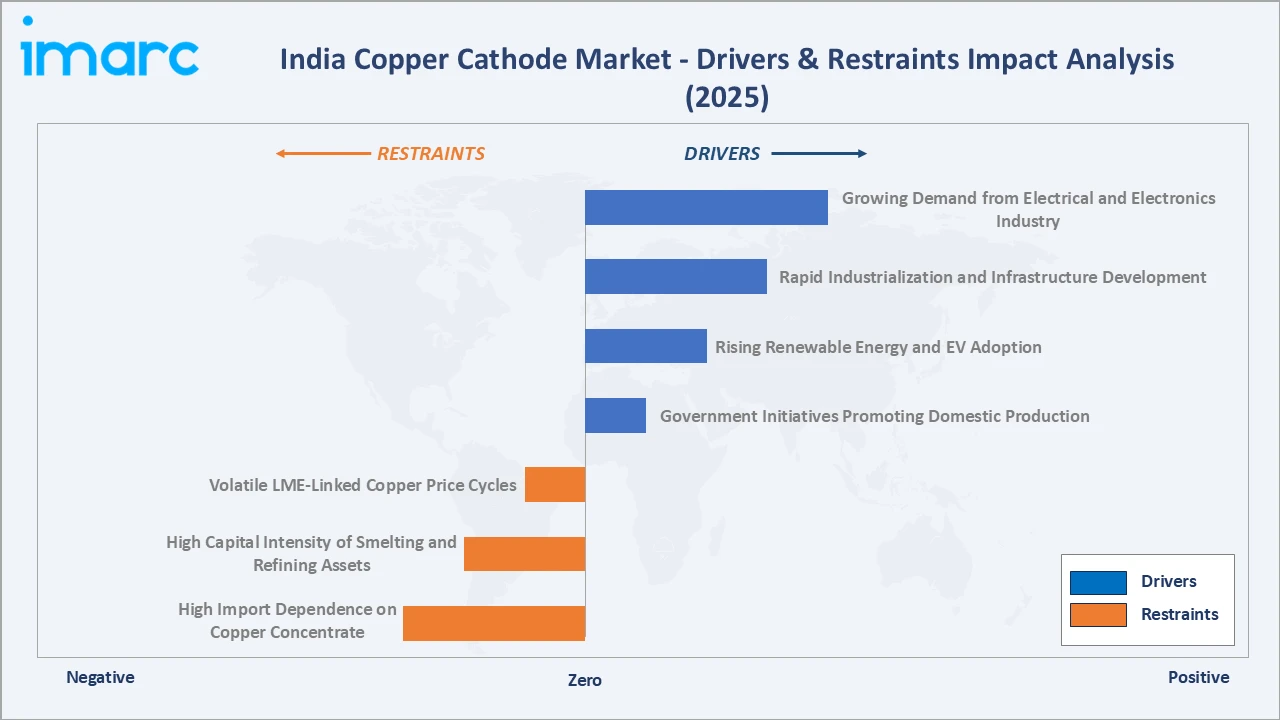
- Growing Demand from Electrical and Electronics Industry: Copper cathodes remain the essential feedstock for wiring, circuit boards, and power transmission equipment. India's urbanization, renewable energy build-out, and EV infrastructure expansion are steadily lifting cathode consumption, reinforced by smart grid investments and 'Make in India' manufacturing incentives across the electrical and electronics sector.
- Rapid Industrialization and Infrastructure Development: India's expanding construction, power, and manufacturing base is driving sustained copper cathode offtake for cabling, transformers, and industrial machinery. Large-scale infrastructure programs, including grid modernization and metro rail electrification, are generating consistent demand for high purity refined copper nationwide.
- Rising Renewable Energy and EV Adoption: Renewable energy projects and electric vehicles are copper-intensive, requiring cathodes for solar cabling, wind turbine generators, EV motors, and charging infrastructure. India's renewable capacity additions and accelerating EV sales are creating a structurally growing demand pool for domestically refined cathode.
- Government Initiatives Promoting Domestic Production: The Copper Quality Control Order and the Vision Document on the Copper Sector target expanded domestic refining capacity and reduced import dependence. Production-linked incentives and public-private partnerships, such as Hindustan Copper's concentrate supply arrangement with Hindalco, are strengthening India's domestic cathode base.
Market Restraints
- High Import Dependence on Copper Concentrate: India's smelters and refiners rely heavily on imported copper concentrate due to limited domestic mine output, exposing producers to global supply disruptions, freight costs, and currency fluctuations that can affect cathode production economics and margins.
- High Capital Intensity of Smelting and Refining Assets: Establishing or expanding copper smelting and electro-refining capacity, such as Kutch Copper's greenfield facility, requires high investments, creating high entry barriers, long payback periods, and financing constraints that can limit new capacity additions.
- Volatile LME-Linked Copper Price Cycles: Domestic cathode prices track London Metal Exchange benchmarks, exposing producers and downstream buyers to global price volatility driven by macroeconomic cycles, mining supply shocks, and speculative trading, which can compress margins and complicate procurement planning.
Market Opportunities
- Secondary and Recycled Copper Cathode Capacity: Rising scrap availability and circular economy policy support are opening opportunities for secondary refining capacity that reduces import dependence and lowers the carbon footprint of cathode production for construction, automotive, and power sector recyclers.
- EV and Renewable-Grade Conductor Demand Scale-Up: Expanding EV motor, battery foil, and renewable transmission cabling requirements are creating opportunities for cathode producers to supply higher-value, high-conductivity grades, supporting margin expansion beyond conventional rod and wire feedstock supply.
Market Challenges
- Domestic Ore Grade Depletion and Limited Exploration: India's operating copper mines face declining ore grades and insufficient exploration converting resources into reserves, constraining domestic concentrate supply growth and keeping refiner’s dependent on imported feedstock despite expanding refining capacity.
- Underutilized Mid-Stream Processing Capacity: Only about half of India's smelting and refining capacity is currently utilized, reflecting working capital constraints, concentrate procurement complexity, and past plant closures, which limits the sector's ability to fully capture rising domestic cathode demand.
Emerging Market Trends
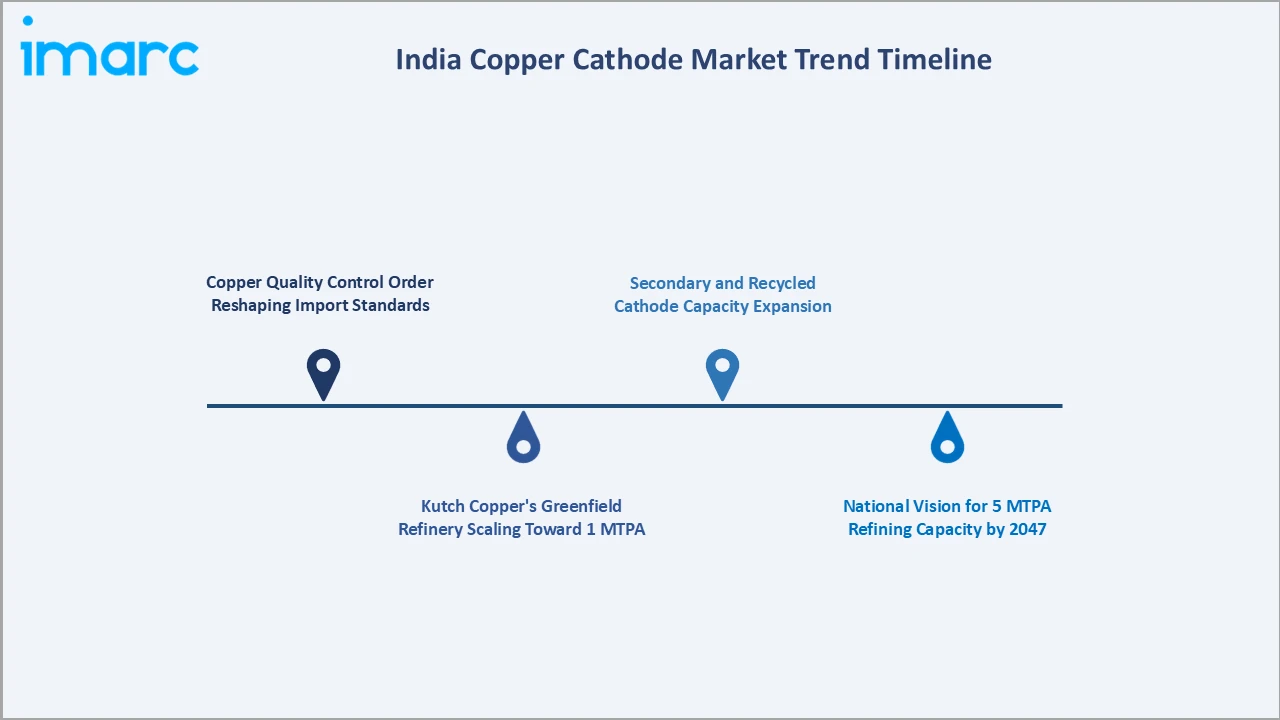
1. Copper Quality Control Order Reshaping Import Standards
The BIS-enforced Copper Quality Control Order, mandates certification for domestic and imported copper suppliers, improving quality control and supply reliability across the non-ferrous metals industry while gradually formalizing cathode trade channels.
2. Kutch Copper's Greenfield Refinery Scaling Toward 1 MTPA
Large-scale investments in greenfield copper refining facilities are expanding domestic refining capacity to meet rising demand from infrastructure, renewable energy, automotive, and electronics sectors. These projects are expected to strengthen supply security, improve production efficiency, and enhance the country's position in the global copper value chain.
3. Secondary and Recycled Cathode Capacity Expansion
Producers are increasingly investing in secondary copper refining from scrap to reduce reliance on mined concentrate, supported by circular economy policy initiatives and sustainability commitments across construction, automotive, and power industry consumers.
4. National Vision for 5 MTPA Refining Capacity by 2047
Long-term policy initiatives focused on strengthening the domestic copper industry are encouraging investments in mining, refining, and downstream manufacturing. Supportive government measures aimed at improving supply chain resilience, promoting value addition, and expanding domestic production capacity are expected to drive sustained growth across the copper value chain.
Industry Value Chain Analysis
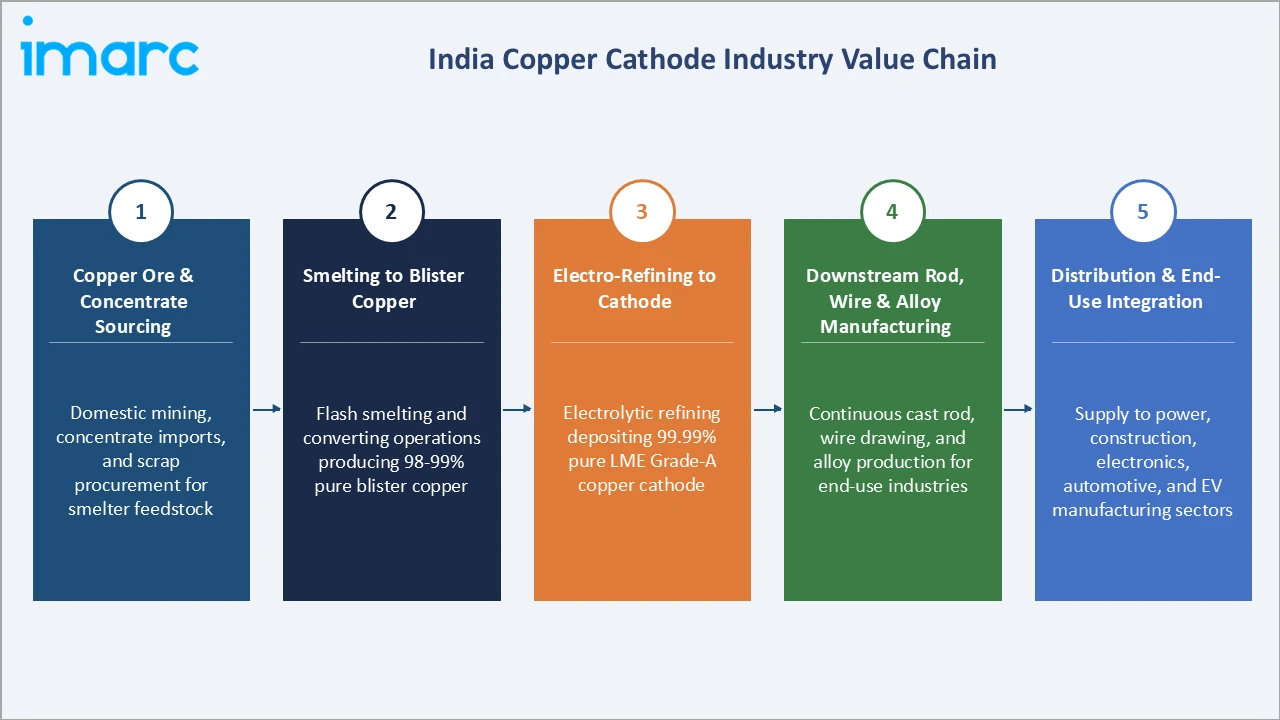
The India copper cathode value chain integrates concentrate mining and import, smelting to blister copper, electro-refining to LME Grade-A cathode, and downstream conversion into rods, wires, and alloys. The smelting and refining tier is the value chain's most capital-intensive and consolidating stage as custom smelters expand toward port-based, import-fed operating models.
|
Stage |
Key Participants |
|
Copper Ore & Concentrate Sourcing |
Domestic mining, concentrate imports, and scrap procurement for smelter feedstock |
|
Smelting to Blister Copper |
Flash smelting and converting operations producing 98-99% pure blister copper |
|
Electro-Refining to Cathode |
Electrolytic refining depositing 99.99% pure LME Grade-A copper cathode |
|
Downstream Rod, Wire & Alloy Manufacturing |
Continuous cast rod, wire drawing, and alloy production for end-use industries |
|
Distribution & End-Use Integration |
Supply to power, construction, electronics, automotive, and EV manufacturing sectors |
Upstream, Hindustan Copper Limited remains India's sole significant domestic concentrate producer, meaning the vast majority of feedstock volume growth over the forecast period will continue to depend on imported concentrate sourced through long-term offtake agreements and spot purchases.
Technology Landscape in the India Copper Cathode Industry
Flash Smelting and Converting Technology
Modern flash smelting technology, employed at facilities such as Kutch Copper's Mundra plant, reacts dried concentrate with oxygen-enriched air to produce high-grade matte efficiently, improving throughput and reducing energy intensity compared to conventional reverberatory smelting methods. Continuous converting of matte to blister copper further reduces processing time and emissions per tonne of output, supporting large-scale, cost-competitive operations.
Electrolytic Refining Technology
Electrolytic refining using copper sulphate electrolyte deposits 99.99% pure cathode while recovering gold, silver, and other precious by-products from anode slime, a process central to Hindalco's Dahej complex and Vedanta's Silvassa operations. Precise current density and electrolyte purity control determine cathode surface quality and directly influence LME Grade-A certification eligibility.
Secondary and Scrap-Based Refining Technology
Secondary refining technologies process copper scrap into refined cathode, supporting circular economy goals and reducing concentrate import dependence, with growing investment interest as sustainability regulations and recycled-content targets gain traction across downstream industries. Scrap-based routes typically carry lower energy intensity per tonne than primary concentrate smelting, improving their appeal amid rising environmental compliance costs.
Market Segmentation Analysis
The report covers the following segments:
|
Segment Category |
Leading Segment |
Market Share |
Year |
|
Refining Process Type |
Electro-Refining |
62.8% |
2025 |
|
Application |
Conductor |
56.4% |
2025 |
|
Region |
West India |
34.8% |
2025 |

By Refining Process Type
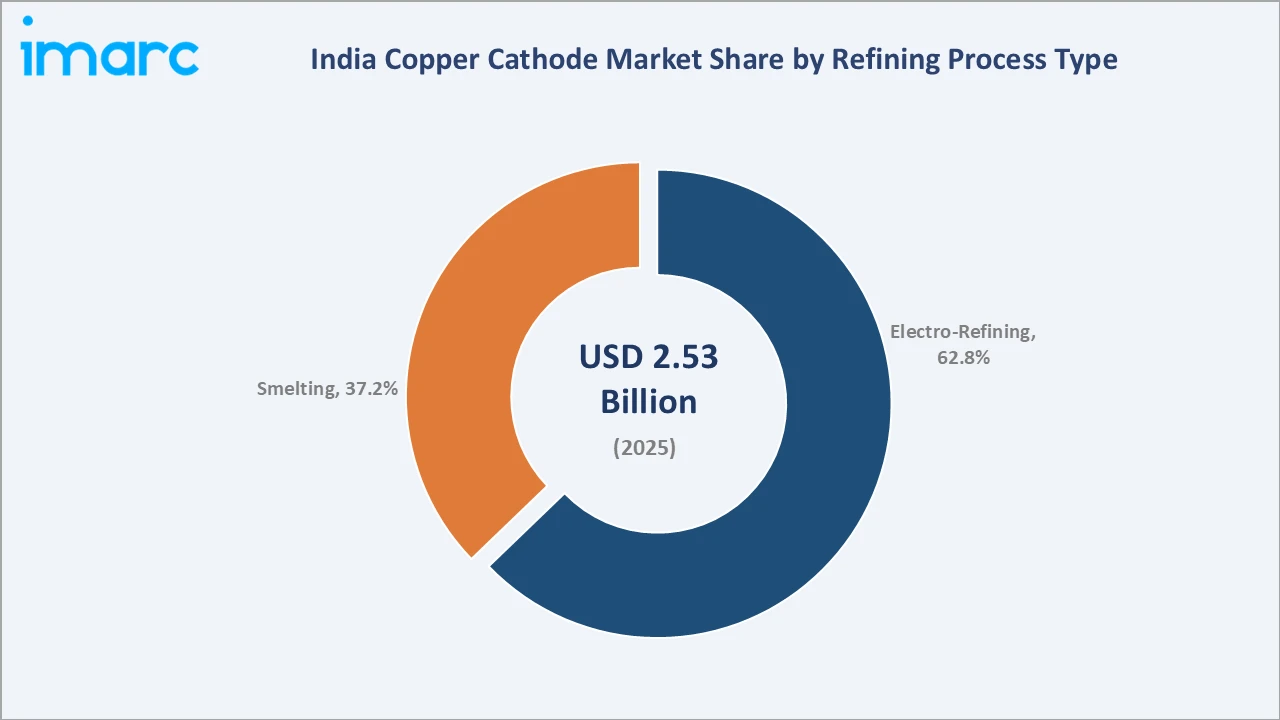
Electro-Refining leads at 62.8% in 2025, reflecting its ability to deliver LME Grade-A, 99.99% pure cathode required for premium conductor and electronics applications. This segment's lead is reinforced by the fact that India's two largest producers, Hindalco and Vedanta, both operate primarily through electrolytic refining routes.
To access detailed market analysis, Request Sample
Smelting-linked cathode output, at 37.2% share, supports bulk industrial and construction-grade copper demand. Electro-refining's share is expected to widen further as Kutch Copper and Hindalco expand integrated smelting-refining capacity, favoring higher-purity, higher-value cathode output over standalone smelting-stage product.
By Application
Conductor applications lead at 56.4% in 2025 through grid transmission, wiring, and cabling demand, a share expected to remain resilient as India's electricity transmission and distribution network continues to expand under national grid modernization programs.
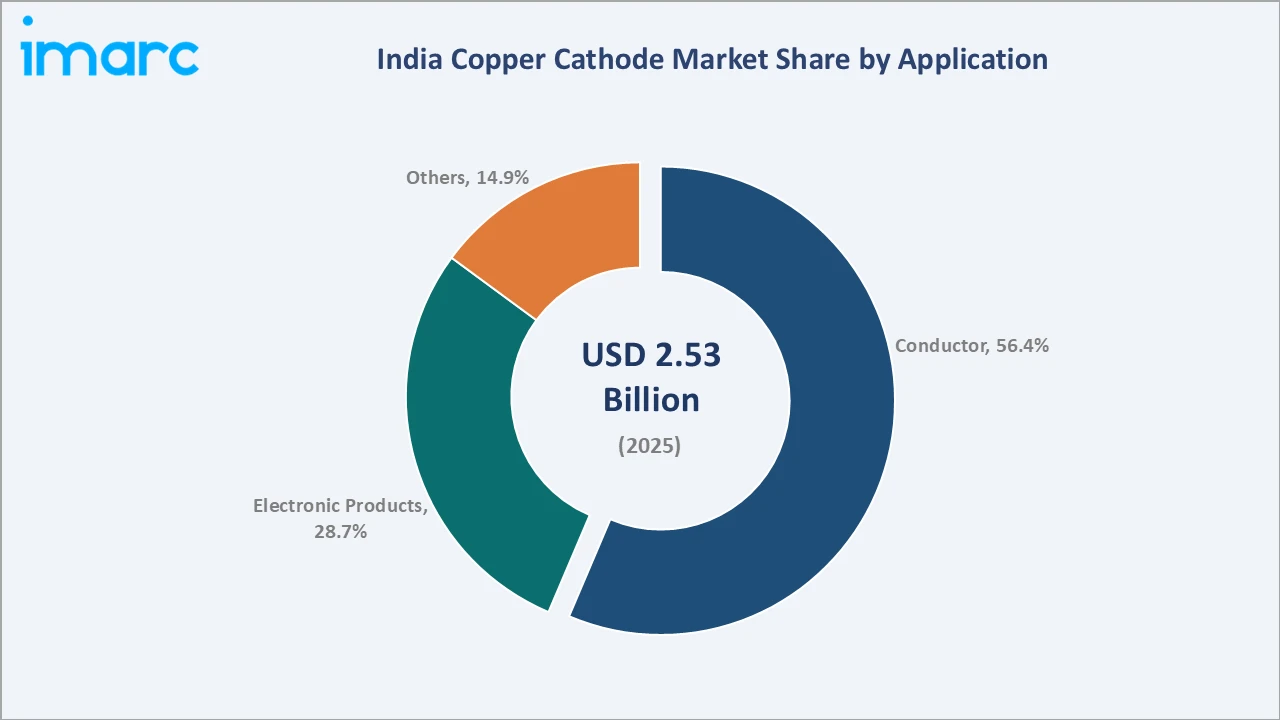
Electronic Products at 28.7% reflect rising consumption in circuit boards, semiconductors, and consumer electronics manufacturing, while Others at 14.9% covers construction hardware, alloys, and industrial components with steadier, lower-growth demand patterns across diversified end-use industries.
Regional Market Insights
|
Region |
Share (2025) |
Key Market Drivers & Characteristics |
|
West India |
34.8% |
Driven by Gujarat's concentration of large-scale smelting and refining assets, including Hindalco's Dahej complex and Adani's Kutch Copper refinery, supported by port-based concentrate imports |
|
South India |
29.6% |
Supported by electronics manufacturing clusters, automotive production hubs, and expanding renewable energy installations across Tamil Nadu, Karnataka, and Andhra Pradesh |
|
North India |
21.7% |
Driven by power infrastructure expansion, construction activity, and industrial wiring demand across Delhi-NCR and surrounding states |
|
East India |
13.9% |
Reflects early-stage industrial and infrastructure development, with growth supported by mining sector linkages in Jharkhand and West Bengal |
West India, at 34.8%, leads through Gujarat's smelter and refinery concentration and port-based import access. South India, at 29.6%, benefits from electronics and automotive manufacturing clusters, while North India, at 21.7%, and East India, at 13.9%, reflect steady infrastructure-linked and mining-linked demand growth respectively.
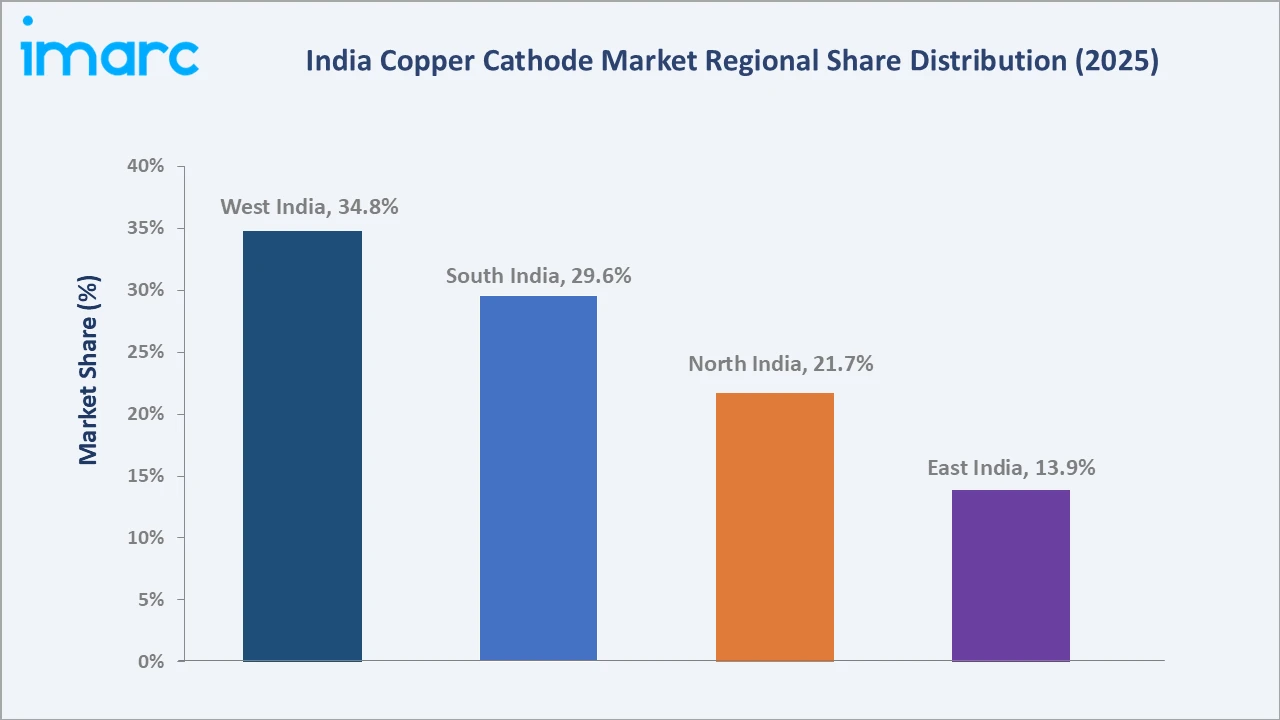
The regional hierarchy is expected to remain broadly stable through 2034, though East India's share may gradually rise as mining-linked concentrate feedstock development in Jharkhand and West Bengal supports incremental downstream refining and fabrication investment closer to the resource base.
Competitive Landscape
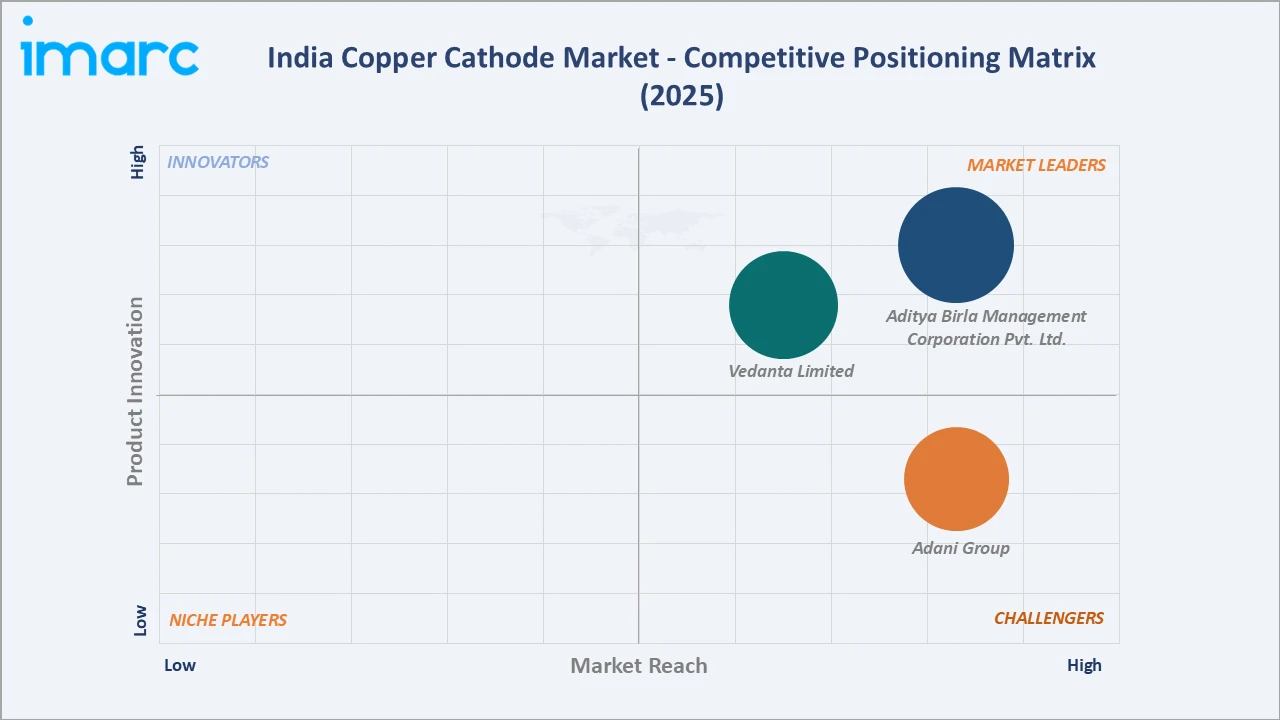
The India copper cathode market competitive landscape spans established integrated smelter-refiners, a rapidly scaling greenfield entrant, upstream concentrate suppliers, and niche regional refiners.
|
Company Name |
Key Products |
Market Position |
Core Strength |
|
Aditya Birla Management Corporation Pvt. Ltd. |
Copper Cathode |
Market Leader |
Operates the copper complex through Hindalco Industries Limited, among the world's largest single-location smelters |
|
Vedanta Limited |
Copper Cathode |
Market Leader |
Operates Sterlite Copper's Silvassa electro-refining plant with a proposed Thoothukudi restart |
|
Adani Group |
Refined Copper Cathode |
Strong Challenger |
Commissioned Kutch Copper's greenfield Mundra refinery |
Key players include Aditya Birla Management Corporation Pvt. Ltd., Vedanta Limited, Adani Group, and others.
Key Company Profiles
Vedanta Limited
Vedanta Limited is a diversified natural resources company operating Sterlite Copper, one of India's principal copper refining businesses.
- Key Products: Copper Cathode
- Strategic Focus: Reviving domestic refining capacity and expanding international copper operations, including the Konkola Copper Mine in Zambia, to strengthen integrated feedstock supply.
Adani Group
Adani Group operating through Adani Enterprises Limited entered the copper sector through its subsidiary Kutch Copper, operating a greenfield refinery at Mundra, Gujarat.
- Key Products: Refined Copper Cathode.
- Recent Developments: In July 2026, Adani Enterprises' subsidiary, Kutch Copper Limited, received London Metal Exchange (LME) brand registration for its 'Adani Copper' Grade A copper cathodes. The certification confirms that the company's cathodes meet the LME's quality and responsible sourcing standards, making them eligible for delivery against LME copper futures contracts. This milestone enhances the international acceptance of Adani's copper products, strengthens India's presence in the global refined copper market, and improves the tradability and financing flexibility of its copper cathodes.
- Strategic Focus: Rapid capacity expansion to reduce India's copper import dependence and establish port-based, large-scale integrated smelting-refining operations.
Market Concentration Analysis
The India copper cathode market is moderately concentrated, with a few large integrated producers accounting for a significant share of domestic refined copper production. Market participants compete based on production capacity, integrated smelting and refining operations, product quality, and distribution networks. Ongoing investments in capacity expansion, modernization of refining facilities, and the development of new production units are gradually increasing competitive intensity across the market.
At the same time, smaller and regional manufacturers continue to serve niche downstream applications through specialized products and localized customer relationships rather than competing on large-scale cathode production. As additional refining capacity becomes operational over the forecast period, the market is expected to become more diversified, reducing concentration while strengthening overall domestic supply capabilities.
Investment & Growth Opportunities
Highest Growth Segments
Electro-Refining capacity expansion (~5.6% CAGR), Conductor-grade cathode supply for grid electrification (~5.5% CAGR), Electronic Products-linked high-purity cathode demand (~5.9% CAGR), and secondary/recycled cathode refining from a smaller base represent the highest-growth investment vectors through 2034, collectively outpacing the market's overall 5.24% CAGR.
Emerging Investment Opportunities
Greenfield smelting and refining capacity, following the Kutch Copper model, represents the market's highest-value emerging opportunity, with port-based, import-fed operating models offering superior scale economics versus legacy inland smelters. JSW Group's planned Odisha facility and continued Hindalco and Vedanta debottlenecking further extend this capacity-led growth pathway, supported by a structurally under-utilised domestic processing base.
Investment Themes
- Port-Based Greenfield Smelter-Refinery Integration: Large port-based custom smelter-refinery complexes, such as Kutch Copper and Hindalco's Dahej facility, secure a durable feedstock-logistics cost advantage over inland or non-integrated operations by minimising concentrate transport costs and enabling economies of scale that smaller domestic refiners cannot easily replicate.
- Secondary Refining and Circular Copper Supply Chains: Rising scrap availability, sustainability regulation, and recycled-content targets are creating an investable secondary refining opportunity that reduces exposure to imported concentrate and LME price volatility, positioning early movers to capture a growing share of India's copper cathode supply mix through 2034.
Future Market Outlook (2026-2034)
The India copper cathode market is projected to grow from USD 2.53 Billion in 2025 to USD 2.66 Billion in 2026, reaching USD 4.06 Billion by 2034, delivering a 5.24% CAGR over the forecast period. Growth will be anchored by Kutch Copper's capacity ramp-up toward 1 million tonnes per annum, Hindalco and Vedanta's sustained electro-refining output, and expanding secondary refining capacity. Electro-Refining and Conductor applications are expected to maintain leadership as grid electrification, renewable energy, and EV infrastructure programs sustain high-purity cathode demand. West India will likely retain regional leadership as Gujarat's smelting and refining base continues to expand toward the government's 2047 domestic capacity vision.
Research Methodology
Primary Research
Primary research comprised structured interviews with industry stakeholders, including smelter and refinery operations heads, copper trading executives, downstream rod and wire manufacturers, and regulatory and policy experts across India's copper value chain.
Secondary Research
Secondary research encompassed company annual reports, Ministry of Mines publications, Bureau of Indian Standards notifications, Copper Quality Control Order documentation, industry association data, and IMARC Group's proprietary market databases and forecasting models.
Forecasting Models
Market revenue forecasts were developed using a bottom-up model incorporating domestic smelting and refining capacity utilization, concentrate import volumes, refining-process-type and application-wise consumption patterns, and regional demand multipliers, cross-validated against top-down macroeconomic and industrial production indicators.
India Copper Cathode Market Report Coverage:
| Report Features | Details |
|---|---|
| Base Year of the Analysis | 2025 |
| Historical Period | 2020-2025 |
| Forecast Period | 2026-2034 |
| Units | Billion USD |
| Scope of the Report |
Exploration of Historical Trends and Market Outlook, Industry Catalysts and Challenges, Segment-Wise Historical and Future Market Assessment:
|
| Refining Process Types Covered | Smelting, Electro-Refining |
| Applications Covered | Conductor, Electronic Products, Others |
| Regions Covered | North India, South India, East India, West India |
| Companies Covered | Aditya Birla Management Corporation Pvt. Ltd., Vedanta Limited, Adani Group, etc. |
| Customization Scope | 10% Free Customization |
| Post-Sale Analyst Support | 10-12 Weeks |
| Delivery Format | PDF and Excel through Email (We can also provide the editable version of the report in PPT/Word format on special request) |
Key Benefits for Stakeholders:
- IMARC’s industry report offers a comprehensive quantitative analysis of various market segments, historical and current market trends, market forecasts, and dynamics of the India copper cathode market from 2020-2034.
- The research report provides the latest information on the market drivers, challenges, and opportunities in the India copper cathode market.
- Porter's five forces analysis assist stakeholders in assessing the impact of new entrants, competitive rivalry, supplier power, buyer power, and the threat of substitution. It helps stakeholders to analyze the level of competition within the India copper cathode industry and its attractiveness.
- Competitive landscape allows stakeholders to understand their competitive environment and provides an insight into the current positions of key players in the market.
Frequently Asked Questions About the India Copper Cathode Market Report
The India copper cathode market size increased from USD 2.53 Billion in 2025 and USD 2.66 Billion in 2026 driven by Electro-Refining's 62.8% process share, Conductor applications leading at 56.4%, and West India commanding 34.8% regional share through Gujarat's smelting and refining concentration. It is expected to nearly double by 2034.
The market is projected to grow at a 5.24% CAGR during 2026-2034, reaching USD 4.06 Billion by 2034, supported by Kutch Copper's capacity ramp-up, grid electrification, expanding secondary refining capacity, and rising EV and renewable energy-linked conductor demand across India.
Electro-Refining leads at 62.8% share in 2025, delivering LME Grade-A, 99.99% pure cathode required for premium conductor and electronics applications, ahead of standalone smelting-stage output at 37.2% share.
Conductor applications lead at 56.4% share, driven by power transmission, grid modernization, and wiring demand, followed by Electronic Products at 28.7% and Others, including construction and alloy uses, at 14.9%.
West India leads at 34.8% share through Gujarat's concentration of large-scale smelting and refining assets, including Hindalco's Dahej complex and Adani's Kutch Copper refinery, followed by South India at 29.6%.
Leading companies include Aditya Birla Management Corporation Pvt. Ltd., Vedanta Limited, Adani Group, and others.
The market is projected to reach approximately USD 4.06 Billion by 2034, supported by expanding secondary refining, and sustained conductor and electronics-linked cathode demand growth across power, construction, and industrial end-use sectors.
Priority opportunities include electro-refining capacity expansion, secondary and recycled cathode refining, and high-conductivity cathode supply for EV and renewable energy applications, alongside greenfield capacity investment aligned with India's 2047 domestic refining vision and import-substitution goals.
The Copper Quality Control Order mandates BIS certification for domestic and imported copper products, improving quality assurance, curbing substandard imports, and gradually formalizing trade channels across the India copper cathode value chain.
Need more help?
- Speak to our experienced analysts for insights on the current market scenarios.
- Include additional segments and countries to customize the report as per your requirement.
- Gain an unparalleled competitive advantage in your domain by understanding how to utilize the report and positively impacting your operations and revenue.
- For further assistance, please connect with our analysts.
 Request Customization
 Speak to an Analyst
 Request Brochure
 Inquire Before Buying
Benefits of Customization
- Personalize this research
- Triangulate with your data
- Get data as per your format and definition
- Gain a deeper dive into a specific application, geography, customer, or competitor
- Any level of personalization
Get in Touch With Us
UNITED STATES
Phone: +1-201-971-6302
INDIA
Phone: +91-120-433-0800
UNITED KINGDOM
Phone: +44-753-714-6104
Email: [email protected]
Client Testimonials




.webp)




.webp)













Related Reports

Choose your plan
*Please note that the prices mentioned below are starting prices for each bundle type. Kindly contact our team for further details.*
Single User License
- 1 User License, Access on 2 Devices
- PDF Report + Excel Dataset (Password Protected)
- Lifetime Access
- No Printing Rights
- 10% Free Report Customization
- 10–12 Weeks of Analyst Support
Five User License
- Access for 5 Users, 2 Devices per User
- PDF Report + Excel Dataset (Password Protected)
- Lifetime Access
- Dedicated Account Manager
- 12–14 Weeks of Analyst Support
- No Printing Rights
- 15% Free Report Customization
- 25% Discount on Your Next Purchase
Corporate User License
- Unlimited User Access (Within Your Organization)
- PDF Report + Excel Dataset
- Lifetime Access
- Dedicated Account Manager
- 14–20 Weeks of Analyst Support
- No Printing Rights
- 20% Free Report Customization
- 30% Discount on Your Next Purchase
Essential Insights
What's included:
3 reports
- Lifetime Access
- PDF Reports
- Excel Datasets
- 2 Weeks of Free Analyst Support
- 2 User Licenses
- Access on 2 Devices
- Printing Rights
- Complimentary PowerPoint (PPT) Version
- Complimentary License Upgrade
Professional Access
What's included:
5 reports
- Lifetime Access
- PDF Reports
- Excel Datasets
- 8 Weeks of Free Analyst Support
- 2 User Licenses
- Access on 2 Devices
- Printing Rights
- Complimentary PowerPoint (PPT) Version
- Complimentary License Upgrade
Business Advantage
What's included:
8 reports
- Lifetime Access
- PDF Reports
- Excel Datasets
- 14 Weeks of Free Analyst Support
- 2 User Licenses
- Access on 2 Devices
- Printing Rights
- Complimentary PowerPoint (PPT) Version
- Complimentary License Upgrade
Enterprise Intelligence
What's included:
10 reports
- Lifetime Access
- PDF Reports
- Excel Datasets
- 20 Weeks of Free Analyst Support
- 2 User Licenses
- Access on 2 Devices
- Printing Rights
- Complimentary PowerPoint (PPT) Version
- Complimentary License Upgrade