
India Cotton Seed Market Size, Share, Trends and Forecast by Type, Application, and Region, 2026-2034
India Cotton Seed Market Summary:
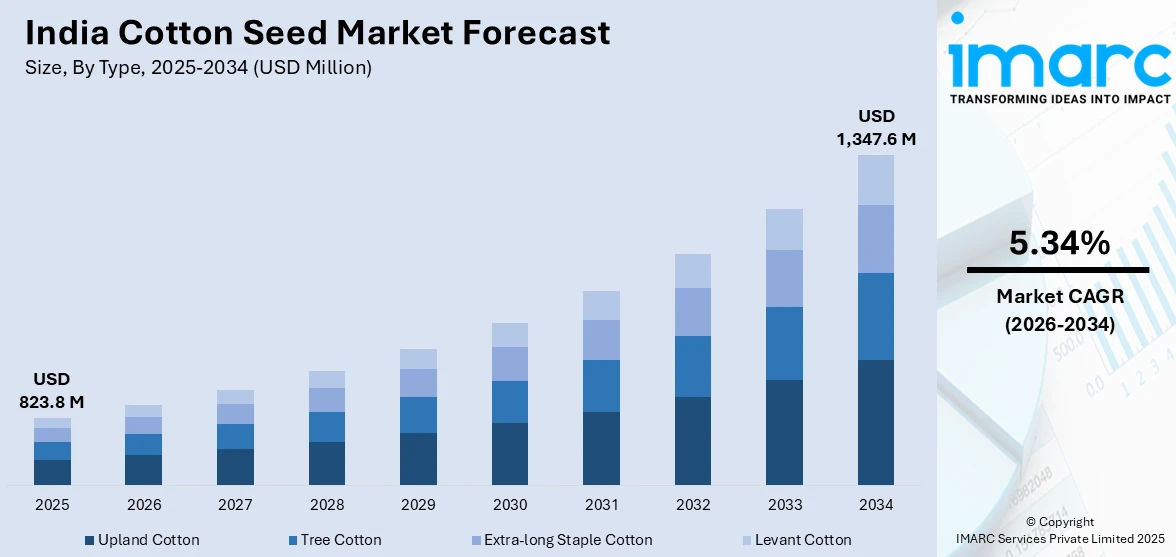
The India cotton seed market size was valued at USD 823.8 Million in 2025 and is projected to reach USD 1,347.6 Million by 2034, growing at a compound annual growth rate of 5.34% from 2026-2034.
The India cotton seed market is experiencing sustained growth, driven by the widespread adoption of hybrid and transgenic seed varieties among farmers seeking higher yields and improved pest resistance. The expanding cotton cultivation area, coupled with government initiatives promoting advanced agricultural technologies and sustainable farming practices, continues to strengthen the market. Rising demand from the textile industry further supports cotton seed consumption nationwide.
Key Takeaways and Insights:
- By Type: Upland cotton dominates the market with a share of 72.4% in 2025, owing to its superior fiber quality, higher productivity potential, and widespread adaptability across diverse agro-climatic zones. The strong preference for Bacillus Thuringiensi (Bt) cotton hybrids drives sustained demand.
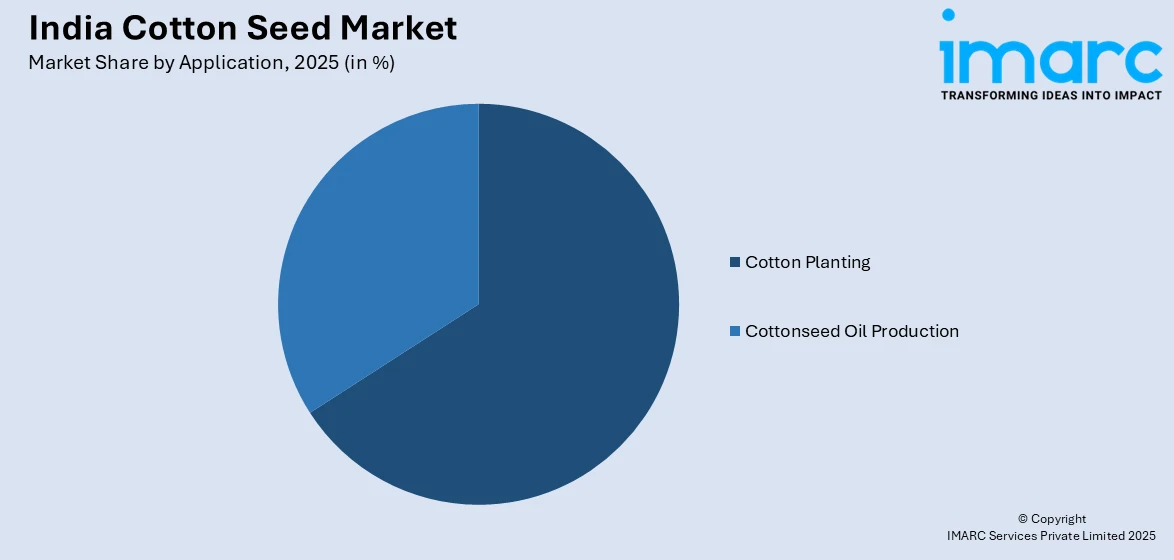
- By Application: Cotton planting leads the market with a share of 65.7% in 2025. This dominance is driven by the primary agricultural purpose of cotton seed procurement, where farmers prioritize high-yielding varieties to maximize fiber production and farm income.
- By Region: West India represents the largest region with 41.2% share in 2025, driven by the concentration of cotton cultivation in Gujarat and Maharashtra, favorable black soil conditions, established irrigation infrastructure, and strong farmer adoption of advanced seed technologies.
- Key Players: Key players drive the India cotton seed market by expanding research capabilities, developing pest-resistant and drought-tolerant hybrid varieties, and strengthening distribution networks across cotton-growing regions. Their investments in biotechnology, farmer education programs, and strategic partnerships with agricultural institutions boost awareness, accelerate adoption, and ensure consistent product availability across diverse agro-climatic zones.
To get more information on this market Request Sample
The India cotton seed market continues to evolve through the integration of advanced breeding technologies and sustainable agricultural practices. The sector benefits from a robust framework of research institutions and seed companies working collaboratively to develop location-specific varieties that address regional challenges. The government's commitment to agricultural development, evidenced by the announcement of the five-year Mission for Cotton Productivity in the 2025-26 Union Budget, provides strategic support for enhancing productivity and promoting extra-long staple cotton varieties. Farmers across major cotton-growing states increasingly recognize the value of certified hybrid seeds in achieving optimal yields and maintaining fiber quality standards demanded by the textile industry. The market structure accommodates diverse farming needs through a mix of transgenic and non-transgenic hybrid options.
India Cotton Seed Market Trends:
Adoption of Climate-Resilient Seed Varieties
Indian cotton farmers are increasingly shifting towards drought-resistant and pest-tolerant cotton seed varieties to address unpredictable weather patterns and evolving pest challenges. This transition reflects heightened awareness about sustainable farming practices and the need for crop resilience against climate variability. In India, seed developers are responding by introducing varieties with enhanced stress tolerance traits that maintain productivity under adverse conditions while reducing dependence on chemical inputs and irrigation resources.
Integration of Digital Agricultural Technologies
The India cotton seed sector is witnessing growing integration of digital platforms and precision agriculture tools that connect farmers with seed suppliers, agronomic advisories, and market information. As per IMARC Group, the India precision agriculture market size reached USD 334.2 Million in 2025. Mobile-based applications are enabling farmers to access weather forecasts, pest alerts, and cultivation guidance in regional languages. These digital interventions bridge information gaps between research institutions and farming communities, facilitating informed decision-making regarding seed selection and crop management throughout the growing season.
Emphasis on High-Density Planting Systems
A gradual shift towards high-density planting systems is emerging as farmers seek to maximize per-acre productivity through optimized plant populations. This cultivation approach requires specifically developed seed varieties adapted to closer spacing and mechanical harvesting. Research institutions are collaborating with seed companies to develop compact plant architectures suitable for high-density cultivation, promoting efficient resource utilization and reduced production costs while maintaining fiber quality standards. These systems also support uniform crop growth and improved yield consistency, strengthening their long-term adoption potential.
Market Outlook 2026-2034:
The India cotton seed market demonstrates promising growth prospects, supported by expanding cotton cultivation areas, technological advancements in seed development, and strengthening government support for agricultural modernization. The market generated a revenue of USD 823.8 Million in 2025 and is projected to reach a revenue of USD 1,347.6 Million by 2034, growing at a compound annual growth rate of 5.34% from 2026-2034. Strategic initiatives are expected to accelerate adoption of improved seed varieties. The textile industry's sustained demand for quality cotton fiber continues to drive farmer investments in premium hybrid seeds. Progressive development of climate-resilient varieties, broadening of micro-irrigation systems in cotton-growing regions, and enhanced extension services are anticipated to contribute positively to market expansion.
India Cotton Seed Market Report Segmentation:
|
Segment Category |
Leading Segment |
Market Share |
|
Type |
Upland Cotton |
72.4% |
|
Application |
Cotton Planting |
65.7% |
|
Region |
West India |
41.2% |
Type Insights:
- Upland Cotton
- Tree Cotton
- Extra-long Staple Cotton
- Levant Cotton
Upland cotton dominates with a market share of 72.4% of the total India cotton seed market in 2025.
Upland cotton, scientifically known as Gossypium hirsutum, represents the predominant cotton species cultivated across India's major cotton-growing states. Upland cotton offers medium to long staple fiber characteristics that meet the quality requirements of domestic textile mills. The widespread adoption of Bt technology in upland cotton hybrids has significantly enhanced pest resistance and reduced insecticide applications, making it the preferred choice for commercial cotton cultivation throughout the central and western growing zones.
The dominance of upland cotton in the India cotton seed market stems from decades of breeding improvements that have enhanced yield potential and fiber quality characteristics. Research institutions continue to develop location-specific upland varieties addressing regional challenges, such as moisture stress and soil-borne diseases. The ongoing development of improved germplasm ensures sustained farmer preference for this highly productive and versatile cotton type across traditional and emerging cultivation areas.
Application Insights:
Access the comprehensive market breakdown Request Sample
- Cotton Planting
- Cottonseed Oil Production
Cotton planting leads with a share of 65.7% of the total India cotton seed market in 2025.
Cotton planting represents the primary application driving seed demand, as six Million cotton farmers across India cultivated this cash crop on average holdings of 1.5 hectares, as of 2023. Strong farmer preference for certified hybrid seeds, which outperform farm-saved alternatives in terms of yields and fiber quality, helps the application segment growth. The Cotton Corporation of India's procurement activities guarantee steady returns, motivating farmers to spend money on high-quality planting materials that maximize their production results and preserve their competitive posture in both domestic and international markets.
Each kharif season, farmers purchase new certified seeds to preserve genetic purity and production potential, resulting in a steady renewal of demand in the cotton planting segment. The advantages of certified hybrid seeds are being promoted more by extension services and farmer education initiatives, hastening the switch from conventional cultivars to better planting material in both rainfed and irrigated systems. Long-term growth for seed producers is supported by this regular seasonal replacement cycle, which guarantees stable seed market volumes.
Regional Insights:
- North India
- South India
- East India
- West India
West India exhibits a clear dominance with a 41.2% share of the total India cotton seed market in 2025.
West India emerges as the leading cotton seed market region, driven by its large cotton acreage, favorable agro-climatic conditions, and high adoption of hybrid and Bt cotton seeds across Maharashtra, Gujarat, and Rajasthan. Gujarat's cotton production was 87.95 Lakh bales in 2022-23 and rose to 90.57 Lakh bales in 2023-24. The region benefits from favorable black soil conditions, established irrigation infrastructure, and strong farmer networks that facilitate rapid adoption of improved seed technologies and modern cultivation practices.
West India's market dominance is further reinforced by Maharashtra's vast cotton cultivation areas in the districts of Vidarbha, Marathwada, and Khandesh. Jalgaon, Yavatmal, and Aurangabad are among the major cotton-producing districts that benefit from focused government initiatives, micro-irrigation subsidies, and strong seed delivery networks that guarantee farmers in the area have timely access to high-quality planting material. Farmers' access to newly released hybrid varieties is further enhanced by the high penetration of private seed businesses and active dealer networks.

Market Dynamics:
Growth Drivers:
Why is the India Cotton Seed Market Growing?
Government Support and Policy Initiatives
The government's sustained commitment to agricultural development significantly propels the India cotton seed market through comprehensive policy frameworks and strategic initiatives. Minimum support price mechanisms provide price floor protection for cotton farmers, encouraging continued cultivation and investment in quality seeds. In addition, schemes promoting certified seed usage, soil health management, and micro-irrigation adoption are improving on-farm productivity and reducing cultivation risks. Public sector research institutions and state agricultural universities play a key role in developing high-yielding, pest-resistant hybrids suited to diverse agro-climatic zones. Extension programs, subsidy-backed input distribution, and digital advisory platforms further strengthen farmer confidence, accelerating the adoption of improved cotton seed varieties across major producing regions. Together, these policy-led interventions ensure long-term market stability and sustained demand growth for cotton seeds.
Rising Demand from Textile Industry
The robust growth of India's textile and apparel sector creates sustained pull-through demand for quality cotton seeds as manufacturers require consistent fiber supply meeting stringent quality parameters. India's textile industry consumption maintains strong levels with mill utilization remaining high despite global economic fluctuations. As per IMARC Group, the India textile market size was valued at USD 152.40 Billion in 2025. The expanding export market for cotton yarn, fabric, and made-up products generates additional demand for domestically produced cotton, encouraging farmers to invest in premium seed varieties that deliver superior fiber characteristics. The government's emphasis on extra-long staple cotton varieties opens opportunities for value-added textile production that commands premium pricing in international markets. Growing domestic consumption, driven by rising disposable incomes and changing fashion preferences, further supports cotton seed demand.
Technological Advancements in Seed Development
Continuous innovations in cotton seed breeding technologies drive market expansion by delivering varieties with enhanced yield potential and superior agronomic characteristics. Seed companies maintain extensive research and development (R&D) facilities across different agro-climatic zones, focusing on developing region-specific varieties addressing local pest pressures, soil conditions, and water availability constraints. Advanced breeding techniques including marker-assisted selection enable faster development of new hybrids with targeted trait combinations. The adoption of genetic male sterility technology for hybrid seed production reduces manufacturing costs while improving efficiency. Modern genomic tools facilitate identification and incorporation of beneficial traits from diverse germplasm sources. Research collaborations between private seed companies and public agricultural universities accelerate variety development timelines and expand the genetic base available for breeding programs. These technological advances ensure continuous improvements in seed performance characteristics, maintaining farmer confidence in hybrid seed investments and driving replacement purchases that sustain market volumes throughout each planting season.
Market Restraints:
What Challenges the India Cotton Seed Market is Facing?
Regulatory Uncertainties and Delayed Approvals
The complex regulatory framework governing genetically modified cotton seeds creates significant market uncertainties. Lengthy approval processes for new seed technologies extend commercialization timelines, limiting introduction of innovative varieties needed to address emerging pest resistance and environmental challenges. Inconsistent policy implementation across states and ongoing debates regarding biotechnology approvals discourage research investments and restrict the availability of advanced trait platforms that could enhance farmer productivity and profitability.
Climate Variability and Weather-Related Risks
Unpredictable weather patterns pose considerable challenges to the cotton seed market as cultivation success remains highly sensitive to rainfall timing and distribution. Irregular monsoons, drought conditions, and unseasonal rainfall events negatively impact seed germination rates and crop establishment, reducing farmer confidence in premium seed investments. The predominance of rainfed cotton cultivation makes the sector vulnerable to climate-induced production fluctuations that affect seed demand and farmer purchasing decisions.
Pest Resistance and Productivity Stagnation
The emergence of pest resistance, particularly pink bollworm resistance to existing Bt gene technologies, diminishes the value proposition of current transgenic hybrids. This resistance development necessitates additional insecticide applications, eroding the economic benefits that initially drove widespread Bt cotton adoption. Stagnant productivity levels compared to global averages indicate underlying challenges in translating genetic improvements into consistent field-level yield gains across diverse cultivation conditions.
Competitive Landscape:
The India cotton seed market exhibits a fragmented competitive structure, characterized by the presence of numerous national and regional players operating across different agro-climatic zones. Market participants compete primarily through product differentiation, emphasizing yield performance, pest resistance traits, and adaptability to local growing conditions. R&D capabilities represent critical competitive advantages, as companies invest substantially in breeding programs to develop superior hybrid varieties. Strategic licensing agreements for biotechnology traits enable market participants to offer transgenic options within their product portfolios. Distribution network strength determines market reach, with established players leveraging extensive farmer relationships and dealer networks across cotton-growing states.
Recent Developments:
- In July 2025, the Indian government intended to approve the contentious herbicide-tolerant (Ht) Bt cotton (HtBt cotton), as part of a significant agricultural overhaul to increase cotton output in the nation. The specialist committee on HtBt cotton seeds provided a favorable recommendation for its commercial farming to the primary biosafety regulatory authority, the Genetic Engineering Appraisal Committee (GEAC), after evaluating three years of biosafety information.
India Cotton Seed Market Report Coverage:
|
Report Features |
Details |
|
Base Year of the Analysis |
2025 |
|
Historical Period |
2020-2025 |
|
Forecast Period |
2026-2034 |
|
Units |
USD Million |
|
Scope of the Report |
Exploration of Historical Trends and Market Outlook, Industry Catalysts and Challenges, Segment-Wise Historical and Future Market Assessment:
|
|
Types Covered |
Upland Cotton, Tree Cotton, Extra-long Staple Cotton, Levant Cotton |
|
Applications Covered |
Cotton Planting, Cottonseed Oil Production |
|
Regions Covered |
North India, South India, East India, West India |
|
Customization Scope |
10% Free Customization |
|
Post-Sale Analyst Support |
10-12 Weeks |
|
Delivery Format |
PDF and Excel through Email (We can also provide the editable version of the report in PPT/Word format on special request) |
Frequently Asked Questions About the India Cotton Seed Market Report
The India cotton seed market size was valued at USD 823.8 Million in 2025.
The India cotton seed market is expected to grow at a compound annual growth rate of 5.34% from 2026-2034 to reach USD 1,347.6 Million by 2034.
Upland cotton dominated the market with a share of 72.4%, owing to its superior fiber quality, high productivity potential, and widespread adaptability across diverse agro-climatic zones in the country.
Key factors driving the India cotton seed market include government policy support through productivity missions, rising textile industry demand, technological advancements in hybrid seed development, and expanding cotton cultivation areas.
Major challenges include regulatory uncertainties delaying new technology approvals, climate variability affecting crop establishment, pest resistance reducing Bt cotton effectiveness, stagnant productivity compared to global averages, and limited availability of advanced trait platforms.
Need more help?
- Speak to our experienced analysts for insights on the current market scenarios.
- Include additional segments and countries to customize the report as per your requirement.
- Gain an unparalleled competitive advantage in your domain by understanding how to utilize the report and positively impacting your operations and revenue.
- For further assistance, please connect with our analysts.
 Request Customization
 Speak to an Analyst
 Request Brochure
 Inquire Before Buying
Benefits of Customization
- Personalize this research
- Triangulate with your data
- Get data as per your format and definition
- Gain a deeper dive into a specific application, geography, customer, or competitor
- Any level of personalization
Get in Touch With Us
UNITED STATES
Phone: +1-201-971-6302
INDIA
Phone: +91-120-433-0800
UNITED KINGDOM
Phone: +44-753-714-6104
Email: [email protected]
Client Testimonials




.webp)




.webp)













Related Reports

Choose your plan
*Please note that the prices mentioned below are starting prices for each bundle type. Kindly contact our team for further details.*
Single User License
- 1 User License, Access on 2 Devices
- PDF Report + Excel Dataset (Password Protected)
- Lifetime Access
- No Printing Rights
- 10% Free Report Customization
- 10–12 Weeks of Analyst Support
Five User License
- Access for 5 Users, 2 Devices per User
- PDF Report + Excel Dataset (Password Protected)
- Lifetime Access
- Dedicated Account Manager
- 12–14 Weeks of Analyst Support
- No Printing Rights
- 15% Free Report Customization
- 25% Discount on Your Next Purchase
Corporate User License
- Unlimited User Access (Within Your Organization)
- PDF Report + Excel Dataset
- Lifetime Access
- Dedicated Account Manager
- 14–20 Weeks of Analyst Support
- No Printing Rights
- 20% Free Report Customization
- 30% Discount on Your Next Purchase
Essential Insights
What's included:
3 reports
- Lifetime Access
- PDF Reports
- Excel Datasets
- 2 Weeks of Free Analyst Support
- 2 User Licenses
- Access on 2 Devices
- Printing Rights
- Complimentary PowerPoint (PPT) Version
- Complimentary License Upgrade
Professional Access
What's included:
5 reports
- Lifetime Access
- PDF Reports
- Excel Datasets
- 8 Weeks of Free Analyst Support
- 2 User Licenses
- Access on 2 Devices
- Printing Rights
- Complimentary PowerPoint (PPT) Version
- Complimentary License Upgrade
Business Advantage
What's included:
8 reports
- Lifetime Access
- PDF Reports
- Excel Datasets
- 14 Weeks of Free Analyst Support
- 2 User Licenses
- Access on 2 Devices
- Printing Rights
- Complimentary PowerPoint (PPT) Version
- Complimentary License Upgrade
Enterprise Intelligence
What's included:
10 reports
- Lifetime Access
- PDF Reports
- Excel Datasets
- 20 Weeks of Free Analyst Support
- 2 User Licenses
- Access on 2 Devices
- Printing Rights
- Complimentary PowerPoint (PPT) Version
- Complimentary License Upgrade