
India E-Cigarette Market Size, Share, Trends and Forecast by Product, Flavor, Mode of Operation, Distribution Channel, and Region, 2026-2034
India E-Cigarette Market Summary:
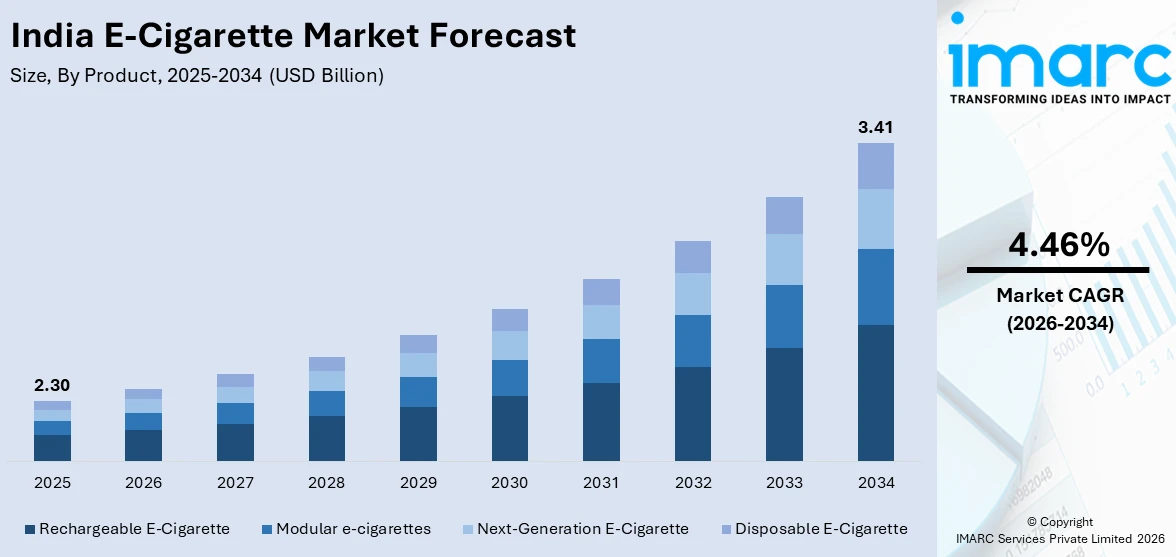
The India e-cigarette market grew from USD 2.30 Billion in 2025 to USD 2.41 Billion in 2026 and is projected to reach USD 3.41 Billion by 2034, growing at a compound annual growth rate of 4.46% from 2026-2034.
The market is experiencing transformation driven by evolving consumer preferences toward smoke-free alternatives, increasing urban developments, and growing awareness about the harmful effects of traditional tobacco products. Apart from this, the market continues to exhibit resilience through underground channels and emerging consumption patterns in metropolitan areas. The shifting perception of e-cigarettes as viable smoking cessation tools, coupled with the appeal of customizable nicotine strengths and diverse flavor options, is reshaping the India e-cigarette market share dynamics across various consumer segments.
Key Takeaways and Insights:
- By Product: Rechargeable e-cigarette segment leads the market with 28% share in 2025, driven by cost-effectiveness and flexibility in refilling cartridges with various e-liquid flavors.
- By Flavor: Tobacco dominates with 35% share in 2025, appealing to consumers transitioning from conventional smoking who seek familiar taste profiles without harsh withdrawal symptoms.
- By Mode of Operation: Automatic e-cigarette holds the largest share at 60% in 2025, owing to its user-friendly activation mechanism that requires only inhalation without manual button operation.
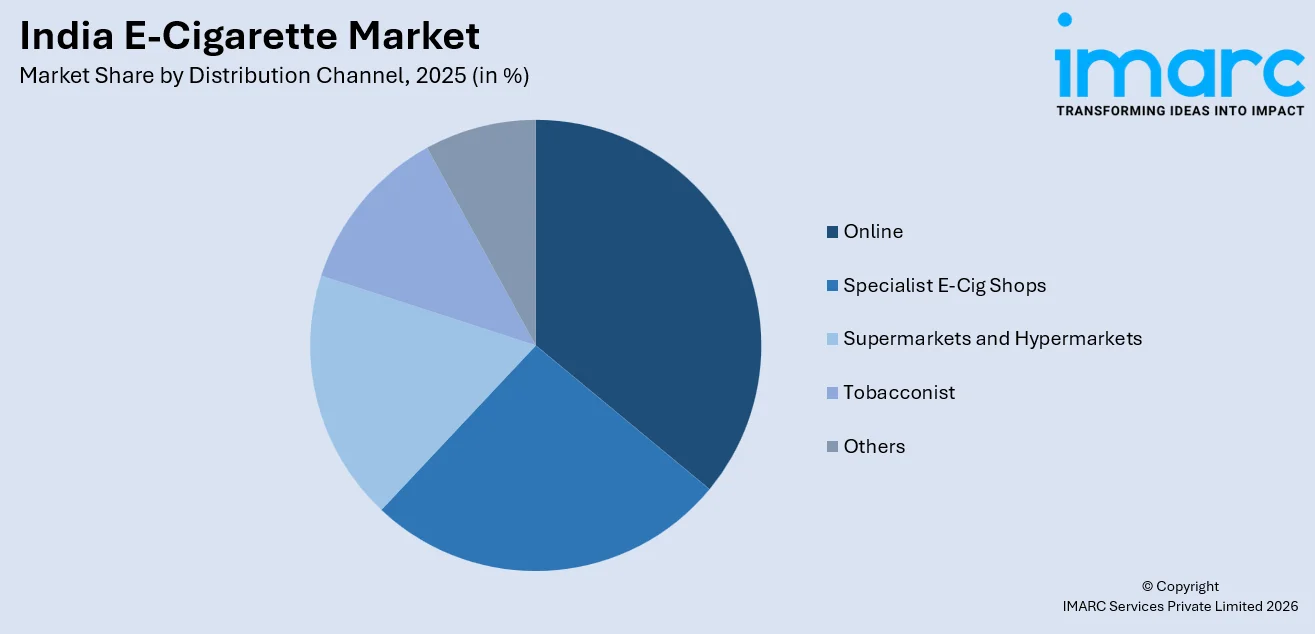
- By Distribution Channel: Online accounts for 36% market share in 2025, benefiting from convenient purchasing options, discreet delivery, and promotional discounts despite regulatory restrictions.
- By Region: North India leads with 30% market share in 2025, propelled by metropolitan lifestyles, pub culture prevalence, and higher disposable incomes in urban centers.
- Key Players: The India e-cigarette market exhibits moderate competitive intensity, with international brands and domestic manufacturers competing across price segments despite regulatory constraints that have reshaped market dynamics.
To get more information on this market Request Sample
The market environment, therefore, displays an intricate balance between the demand for alternatives through consumer groups and stringent government measures focused on controlling vape possession among young consumers globally. Therefore, although it has been difficult for conventional channels to participate, there has been no let-up in underground activity that reiterates the market demand for e-cigarette products as alternatives to traditional smoking habits. The prevalence of vape culture in metropolitan cities, especially among young and educated groups, has acted as a catalyst for the market environment to evolve further despite restrictive market headwinds. India Today’s Open-Source Intelligence (OSINT) team assesses the magnitude of the rapidly developing and prohibited vape product market environment. During this investigation, it was ascertained that there were at least 157 domains associated with the keyword term "vape," of which there have been 40 websites selling this product currently in India. The development of vape culture as an electronic cigarette associated with smoking cessation has catalyzed market trends, especially with growing levels of awareness relating to e-cigarettes as alternatives to traditional smoking habits in anxious consumers desirous of reducing exposures to tar and combustion-related phenomena with smoking habits involving conventional cigarettes.
India E-Cigarette Market Trends:
Expansion of Flavor Diversity Beyond Traditional Options
The e-cigarette market is witnessing significant diversification in flavor offerings, moving beyond traditional tobacco and menthol profiles to encompass fruit-based, dessert-inspired, and beverage-themed options. This trend caters to consumer preferences for personalized vaping experiences that mask the harshness of nicotine while providing enjoyable sensory profiles. The availability of flavors ranging from mango and berry to vanilla and chocolate has become a key differentiator in product positioning, particularly among millennials and younger adult consumers who view flavored vaping as a lifestyle choice supported by sleek, portable devices. Furthermore, 83 online stores (49 Indian and 34 international) were found to be selling e-cigarettes in India.
Rising Recognition as Smoking Cessation Tool
E-cigarettes are increasingly being perceived as effective aids for smoking cessation and harm reduction, driven by growing public health awareness and scientific research highlighting their relative safety compared to conventional cigarettes. Smokers are adopting e-cigarettes as transitional devices that help manage nicotine dependence without the severe withdrawal symptoms associated with abrupt cessation. This trend is particularly prevalent among working professionals who prioritize healthier lifestyle choices while maintaining their nicotine consumption patterns. The availability of variable nicotine strength options enables users to gradually reduce their dependence, positioning e-cigarettes as viable alternatives within smoking reduction strategies. India is at the heart of what the United Nations describes as an unavoidable and historically unique demographic shift as urban areas become the main destination for the majority of people. As per the World Urbanization Prospects 2025: Summary of Results released by the United Nations Department of Economic and Social Affairs, Population Division (UN DESA) in 2025, India is set to be the leading contributor to global urban population growth from 2025 to 2050. As urban populations increase, the smoking patterns among the masses keep changing. The increasing acceptability of vaping as a harm reduction approach has contributed to mainstream adoption patterns across urban demographics seeking to mitigate the health risks associated with traditional tobacco combustion.
Technological Innovation in Device Functionality
The e-cigarette industry is experiencing rapid technological advancement with the introduction of smart features that enhance user experience and device performance. Next-generation products now incorporate Bluetooth connectivity, customizable settings, improved battery longevity, temperature control mechanisms, and digital displays that provide real-time information on battery levels and e-liquid consumption. These innovations cater to tech-savvy consumers who value precision and control over their vaping experience. The integration of advanced atomizer technology, enhanced airflow systems, and modular component designs has elevated product sophistication, enabling users to optimize vapor density, throat hit intensity, and nicotine delivery according to personal preferences. The evolution toward rechargeable systems with USB charging capabilities addresses convenience needs while reducing environmental impact compared to single-use disposable alternatives, aligning with broader sustainability considerations in consumer product design.
Market Outlook 2026-2034:
The India e-cigarette market is poised for steady expansion throughout the forecast period, driven by persistent consumer demand for harm reduction alternatives and potential regulatory evolution. The market generated a revenue of USD 2.30 Billion in 2025, which is expected to reach USD 2.41 Billion in 2026 and further grow to USD 3.41 Billion by 2034, at a compound annual growth rate of 4.46% from 2026-2034. The underground distribution networks and digital commerce channels are expected to maintain market accessibility while formal policy frameworks undergo reassessment. Urban centers will continue driving consumption patterns as metropolitan lifestyles and increasing health consciousness sustain adoption rates. The emergence of technologically advanced devices with enhanced safety features and user controls may influence future regulatory considerations, potentially paving the way for structured market frameworks that balance public health objectives with consumer choice principles.
India E-Cigarette Market Report Segmentation:
|
Segment Category |
Leading Segment |
Market Share |
|
Product |
Rechargeable E-Cigarette |
28% |
|
Flavor |
Tobacco |
35% |
|
Mode of Operation |
Automatic E-Cigarette |
60% |
|
Distribution Channel |
Online |
36% |
|
Region |
North India |
30% |
Product Insights:
- Modular e-cigarettes
- Rechargeable E-Cigarette
- Next-Generation E-Cigarette
- Disposable E-Cigarette
Rechargeable e-cigarette dominates with a market share of 28% of the total India e-cigarette market in 2025.
The rechargeable e-cigarette segment commands significant market presence due to its cost-effectiveness and operational flexibility. These devices feature refillable cartridges that accommodate diverse e-liquid formulations, enabling users to customize their vaping experience through flavor selection and nicotine concentration adjustment. The economic advantage becomes apparent over extended usage periods, as consumers avoid the recurring costs associated with disposable alternatives while maintaining consistent device performance through battery recharging capabilities. The segment appeals particularly to experienced vapers who appreciate the ability to experiment with various e-liquid brands and flavor combinations, creating personalized consumption patterns that align with individual preferences.
The USB charging functionality enhances convenience by enabling power replenishment through standard computer ports and mobile charging adapters, eliminating dependency on specialized charging equipment. The durability and sustainability attributes of rechargeable systems resonate with environmentally conscious consumers seeking to minimize waste generation associated with single-use products. The compatibility with diverse atomizer configurations and adjustable power settings provides advanced users with granular control over vapor production, throat hit intensity, and flavor delivery characteristics, positioning rechargeable e-cigarettes as the preferred choice among discerning enthusiasts who prioritize performance optimization and operational economy.
Flavor Insights:
- Tobacco
- Botanical
- Fruit
- Sweet
- Beverage
- Others
Tobacco leads with a share of 35% of the total India e-cigarette market in 2025.
The tobacco flavor segment maintains market leadership by providing familiar taste profiles that facilitate smoother transitions for users migrating from conventional cigarettes to electronic alternatives. This flavor category addresses the psychological and sensory expectations of former smokers who associate tobacco taste with nicotine consumption, enabling them to maintain familiar consumption patterns while reducing exposure to combustion byproducts. The segment's dominance reflects its effectiveness in minimizing withdrawal discomfort experienced during smoking cessation attempts, as the recognizable flavor signature provides continuity that helps sustain behavioral substitution during the adaptation phase.
Tobacco-flavored e-liquids are formulated to replicate the nuanced taste characteristics of various cigarette brands, ranging from robust full-bodied profiles to lighter, milder variants that accommodate diverse consumer preferences cultivated through years of traditional smoking. The availability of blended formulations that combine tobacco essence with complementary notes such as vanilla, caramel, or honey expands the segment's appeal by introducing subtle variations that enhance palatability without departing fundamentally from the core tobacco experience. Market data indicates that tobacco remained the most preferred flavor among Indian consumers as it helps vapers quit conventional smoking without having to experience sudden tobacco withdrawal symptoms. The psychological comfort derived from tobacco flavor consistency cannot be understated in supporting long-term substitution success, as the sensory similarity reduces cognitive dissonance associated with product switching and reinforces positive associations with the harm reduction choice.
Mode of Operation Insights:
- Automatic E-Cigarette
- Manual E-Cigarette
Automatic e-cigarette exhibits a clear dominance with a 60% share of the total India e-cigarette market in 2025.
The automatic e-cigarette segment commands substantial market share due to its intuitive operation mechanism that activates vapor production through inhalation pressure detection, eliminating the need for manual button manipulation. This draw-activated functionality closely replicates the natural smoking behavior associated with conventional cigarettes, providing seamless user experience transitions for individuals accustomed to traditional tobacco consumption patterns. The segment's dominance reflects consumer preferences for hassle-free operation that minimizes learning curves and reduces operational complexities inherent in manually controlled devices. Automatic systems incorporate pressure-sensitive sensors that detect airflow changes initiated by user inhalation, triggering instantaneous heating element activation that vaporizes e-liquid without requiring conscious device engagement beyond the fundamental drawing action.
This straightforward interaction model appeals particularly to older demographic segments and novice vapers who prioritize simplicity over advanced functionality, as the absence of buttons and settings reduces intimidation factors that might otherwise discourage adoption. The convenience advantage extends beyond operational ease to encompass reliability considerations, as automatic devices eliminate potential user errors associated with improper button timing or inadvertent activation during storage and transport. Market research indicates that automatic e-cigarettes account for approximately 60 percent of consumption patterns, driven by their ability to deliver consistent performance without demanding technical proficiency or active operational management from users.
Distribution Channel Insights:
Access the comprehensive market breakdown Request Sample
- Specialist E-Cig Shops
- Online
- Supermarkets and Hypermarkets
- Tobacconist
- Others
Online leads with a share of 36% of the total India e-cigarette market in 2025.
The online distribution segment has emerged as a significant market channel despite regulatory restrictions, capitalizing on digital commerce advantages including convenience, privacy, and competitive pricing structures. E-commerce platforms enable consumers to browse extensive product catalogs from the privacy of their homes, compare specifications and prices across multiple brands, and access detailed product information that supports informed purchasing decisions. The segment benefits from promotional strategies including discount offers, bundle deals, and loyalty programs that enhance value propositions compared to traditional retail alternatives. Online vendors employ various operational tactics to maintain market presence within restrictive regulatory environments, including cash-on-delivery payment systems that circumvent financial transaction monitoring, strategic shipping partnerships that navigate enforcement mechanisms, and customer database management approaches that facilitate repeat purchases through established relationships.
One retail account for a major portion of sales of e-cigarettes, reflecting widespread consumer acceptance of digital purchasing channels for vaping products. The convenience factor extends beyond transaction completion to encompass discreet packaging and direct delivery services that address privacy concerns particularly relevant given the social sensitivities surrounding e-cigarette consumption in certain contexts. The online channel's resilience demonstrates the powerful intersection of consumer demand and digital commerce capabilities that persist despite legal obstacles, as marketplace platforms and independent vendor websites continue facilitating product availability through adaptive business models.
Regional Insights:
- North India
- South India
- East India
- West India
North India exhibits a clear dominance with a 30% share of the total India e-cigarette market in 2025.
The North India region dominates market revenue generation with approximately 30 percent share, driven by concentrated urban populations, higher disposable income levels, and prevalent social cultures that normalize alternative consumption patterns. Metropolitan centers including Delhi, Gurgaon, Noida, and Chandigarh exhibit particularly robust demand dynamics influenced by cosmopolitan lifestyles, corporate work environments, and active nightlife scenes where vaping has gained social acceptance. The region's demographic profile features substantial representation of young professionals, IT sector employees, and educated middle-class segments who demonstrate openness to innovative products and health-conscious consumption choices.
The concentration of international corporate offices and multinational presence in North Indian cities facilitates cultural exchange and exposure to global trends, accelerating adoption of lifestyle products including e-cigarettes that align with contemporary urban sensibilities. The prevalence of pub culture and social gathering venues in major cities creates visible consumption contexts where vaping serves as both functional nicotine delivery and social signaling mechanism, reinforcing product normalization within peer networks. Market data indicates that the northern region accounted for the largest share in total e-cigarette revenue in India, driven by surging numbers of consumers switching from traditional tobacco cigarettes to e-cigarettes. However, regulatory heterogeneity within the region presents challenges, as states including Punjab, Himachal Pradesh, Uttar Pradesh, and Rajasthan have implemented local bans on e-cigarette sales that fragment market accessibility and compliance landscapes.

Market Dynamics:
Growth Drivers:
Why is the India E-Cigarette Market Growing?
Heightened Awareness of Traditional Tobacco Health Risks
The expansion of the India e-cigarette market is fundamentally driven by escalating public consciousness regarding the severe health consequences associated with conventional tobacco smoking, including cardiovascular diseases, respiratory complications, and various cancer forms. Medical research dissemination through public health campaigns, academic institutions, and healthcare provider recommendations has substantially elevated consumer understanding of combustible tobacco's carcinogenic properties and systemic physiological damage. This knowledge proliferation motivates smokers to actively seek alternatives that maintain nicotine delivery while eliminating the tar, carbon monoxide, and thousands of toxic compounds generated through tobacco combustion processes. Cigarette brands show considerable differences in nicotine levels, but typically, an individual ingests 1–1.5 milligrams (mg) of nicotine from one cigarette. E-cigarettes present a harm reduction option that addresses nicotine dependence without subjecting users to the full spectrum of health hazards inherent in traditional smoking behavior.
Economic Advantages Compared to Conventional Cigarettes
The financial attractiveness of e-cigarette adoption constitutes a significant market growth catalyst, as long-term cost analysis reveals substantial savings compared to ongoing cigarette purchases despite higher initial device investment requirements. Rechargeable e-cigarette systems typically range from twenty-five to one hundred fifty dollars for starter kits, while refill e-liquids cost approximately fifty to seventy-five dollars monthly, representing considerable economic advantages relative to traditional cigarette consumption expenses that accumulate rapidly through daily pack purchases. The durable nature of quality vaping devices enables extended usage periods spanning years with proper maintenance, distributing capital costs across thousands of usage sessions while variable operational expenses remain constrained to e-liquid replenishment and occasional component replacement. Budget-conscious consumers recognize the cumulative savings potential inherent in rechargeable systems that eliminate recurring disposable product purchases, particularly relevant in economic contexts where tobacco taxation policies continually escalate cigarette prices. Medium-length cigarettes will incur a tax of approximately Rs 4 each, while longer cigarettes will be taxed at about Rs 5.40 each. The availability of various price points spanning entry-level to premium device categories ensures market accessibility across diverse socioeconomic segments, democratizing access to harm reduction alternatives regardless of income constraints. Cost transparency in e-cigarette consumption patterns enables predictable budgeting and expenditure control, contrasting with the incremental, often unconscious spending associated with frequent cigarette purchases throughout daily routines. The economic value proposition extends beyond direct product costs to encompass potential healthcare savings derived from reduced smoking-related medical complications, though these longer-term benefits require extended timeframes to materialize and verify through longitudinal health outcomes research.
Technological Sophistication and User Experience Enhancement
The continuous evolution of e-cigarette device technology drives market growth through improved performance characteristics, enhanced safety features, and expanded functionality that addresses sophisticated consumer expectations regarding product quality and user experience. Contemporary devices incorporate advanced battery management systems that optimize power delivery, extend operational duration between charging cycles, and implement multiple safety mechanisms including overcharge protection, short circuit prevention, and temperature regulation to ensure reliable, secure operation. The integration of precision engineering in atomizer design enables efficient e-liquid vaporization with minimal waste, consistent flavor delivery, and adjustable vapor density to accommodate individual preference variations spanning discreet usage to cloud production emphasis. The emergence of smart connectivity features enabling smartphone integration for usage tracking, device diagnostics, and firmware updates positions modern e-cigarettes as sophisticated consumer electronics rather than mere nicotine delivery mechanisms, elevating product category perception and expanding market appeal beyond traditional smoker demographics.
Market Restraints:
What Challenges the India E-Cigarette Market is Facing?
Comprehensive Regulatory Prohibition and Legal Uncertainties
The India e-cigarette market confronts substantial obstacles stemming from the Prohibition of Electronic Cigarettes Act of 2019, which instituted comprehensive bans on production, manufacture, import, export, transport, sale, distribution, storage, and advertisement of e-cigarette products throughout the country. This legislative framework imposes severe penalties including imprisonment up to one year and fines reaching one hundred thousand rupees for first-time offenders, with escalated consequences for repeat violations encompassing three-year imprisonment terms and five hundred thousand rupee fines. The regulatory environment creates operational uncertainties for legitimate business interests while driving market activities underground into unregulated channels characterized by quality control deficiencies, counterfeit product proliferation, and consumer safety risks. The absence of structured regulatory frameworks governing product standards, age restrictions, and distribution controls paradoxically undermines policy objectives by eliminating oversight mechanisms that could otherwise ensure product safety and prevent youth access. The enforcement challenges inherent in prohibition approaches have resulted in persistent market availability through informal networks, while simultaneously denying consumers access to quality-assured products from reputable manufacturers subject to international safety standards.
Youth Vaping Concerns and Gateway Effect Perceptions
Growing apprehension regarding adolescent e-cigarette experimentation and potential pathway effects toward traditional tobacco consumption represents a significant market headwind that influences regulatory attitudes and public opinion dynamics. The availability of appealing flavor profiles, sleek device designs, and social media marketing visibility raises legitimate concerns about youth attraction to vaping products, particularly given neurological vulnerability periods during adolescent development when nicotine exposure can establish lasting dependence patterns and potentially influence subsequent substance use trajectories. The perception that e-cigarettes may normalize smoking behaviors or serve as gateway products introducing nicotine consumption to previously non-smoking youth populations generates substantial political pressure for restrictive policies despite limited empirical evidence supporting definitive causal relationships. Educational institutions, parental advocacy groups, and public health organizations prioritize youth protection considerations that often override harm reduction perspectives emphasizing adult smoker transition benefits. The challenge of implementing effective age verification mechanisms in both retail and digital distribution contexts complicates efforts to balance adult access rights with youth prevention imperatives.
Black Market Emergence and Quality Control Deficiencies
The prohibition framework has inadvertently catalyzed underground market development characterized by unregulated product sourcing, inconsistent quality standards, and elevated health risks stemming from counterfeit merchandise and adulterated e-liquids containing unknown chemical compositions. The absence of legitimate distribution channels drives consumers toward informal networks including online vendors operating through cash-on-delivery systems that circumvent regulatory oversight, tobacconists maintaining covert inventory, and social network-based distribution leveraging personal relationships to facilitate transactions. The quality assurance vacuum created by prohibition eliminates manufacturer accountability mechanisms and product testing requirements that would otherwise ensure chemical safety, nicotine concentration accuracy, and contamination prevention. Consumers purchasing through black market channels assume significant health risks associated with potentially harmful additives, incorrect nicotine dosing, and battery safety deficiencies in counterfeit devices manufactured without adherence to engineering standards. The proliferation of illicit trade networks undermines taxation revenue potential while generating enforcement costs that strain government resources without demonstrably reducing overall consumption levels.
Competitive Landscape:
The India e-cigarette market exhibits fragmented competitive dynamics influenced fundamentally by regulatory prohibition that has eliminated formal market operations by major multinational corporations while creating space for underground distribution networks and gray market operators. The competitive landscape reflects operational sophistication in navigating enforcement mechanisms rather than traditional market competition based on product innovation, brand building, and customer service excellence. The absence of formal market data complicates competitive analysis, as sales volumes, market shares, and brand performance metrics remain largely opaque given underground nature of distribution activities. The potential for future regulatory reform introducing structured frameworks governing product standards, licensing requirements, and distribution controls could dramatically reshape competitive dynamics by enabling legitimate business operations while establishing barriers to entry through compliance requirements.
India E-Cigarette Market Report Coverage:
| Report Features | Details |
|---|---|
| Base Year of the Analysis | 2025 |
| Historical Period | 2020-2025 |
| Forecast Period | 2026-2034 |
| Units | Billion USD |
| Scope of the Report |
Exploration of Historical Trends and Market Outlook, Industry Catalysts and Challenges, Segment-Wise Historical and Future Market Assessment:
|
| Products Covered | Modular E -Cigarette, Rechargeable E-Cigarette, Next-Generation E-Cigarette, Disposable E-Cigarette |
| Flavors Covered | Tobacco, Botanical, Fruit, Sweet, Beverage, Others |
| Modes of Operation Covered | Automatic E-Cigarette, Manual E-Cigarette |
| Distribution Channels Covered | Specialist E-Cig Shops, Online, Supermarkets and Hypermarkets, Tobacconist, Others |
| Regions Covered | North India, South India, East India, West India |
| Customization Scope | 10% Free Customization |
| Post-Sale Analyst Support | 10-12 Weeks |
| Delivery Format | PDF and Excel through Email (We can also provide the editable version of the report in PPT/Word format on special request) |
Frequently Asked Questions About the India E-Cigarette Market Report
The India e-cigarette market size increased from USD 2.30 Billion in 2025 to USD 2.41 Billion in 2026.
The India e-cigarette market is expected to grow at a compound annual growth rate of 4.46% from 2026-2034 to reach USD 3.41 Billion by 2034.
Rechargeable e-cigarettes dominate the product segment with approximately 28% market share in 2025, driven by cost-effectiveness, flexibility in refilling cartridges with various e-liquid flavors, and USB charging convenience that eliminates the recurring costs associated with disposable alternatives while providing experienced vapers with customization capabilities.
Key factors driving the India e-cigarette market include heightened awareness of traditional tobacco health risks, economic advantages compared to conventional cigarettes with rechargeable systems offering long-term cost savings, and technological sophistication in device features including improved battery management, precision engineering, and smart connectivity capabilities.
Major challenges include comprehensive regulatory prohibition through the 2019 Electronic Cigarettes Act imposing severe penalties, youth vaping concerns and gateway effect perceptions that influence policy attitudes, black market emergence with quality control deficiencies stemming from unregulated underground distribution, enforcement difficulties in preventing illicit sales, and consumer safety risks associated with counterfeit products.
Need more help?
- Speak to our experienced analysts for insights on the current market scenarios.
- Include additional segments and countries to customize the report as per your requirement.
- Gain an unparalleled competitive advantage in your domain by understanding how to utilize the report and positively impacting your operations and revenue.
- For further assistance, please connect with our analysts.
 Request Customization
 Speak to an Analyst
 Request Brochure
 Inquire Before Buying
Benefits of Customization
- Personalize this research
- Triangulate with your data
- Get data as per your format and definition
- Gain a deeper dive into a specific application, geography, customer, or competitor
- Any level of personalization
Get in Touch With Us
UNITED STATES
Phone: +1-201-971-6302
INDIA
Phone: +91-120-433-0800
UNITED KINGDOM
Phone: +44-753-714-6104
Email: [email protected]
Client Testimonials




.webp)




.webp)













Related Reports

Choose your plan
*Please note that the prices mentioned below are starting prices for each bundle type. Kindly contact our team for further details.*
Single User License
- 1 User License, Access on 2 Devices
- PDF Report + Excel Dataset (Password Protected)
- Lifetime Access
- No Printing Rights
- 10% Free Report Customization
- 10–12 Weeks of Analyst Support
Five User License
- Access for 5 Users, 2 Devices per User
- PDF Report + Excel Dataset (Password Protected)
- Lifetime Access
- Dedicated Account Manager
- 12–14 Weeks of Analyst Support
- No Printing Rights
- 15% Free Report Customization
- 25% Discount on Your Next Purchase
Corporate User License
- Unlimited User Access (Within Your Organization)
- PDF Report + Excel Dataset
- Lifetime Access
- Dedicated Account Manager
- 14–20 Weeks of Analyst Support
- No Printing Rights
- 20% Free Report Customization
- 30% Discount on Your Next Purchase
Essential Insights
What's included:
3 reports
- Lifetime Access
- PDF Reports
- Excel Datasets
- 2 Weeks of Free Analyst Support
- 2 User Licenses
- Access on 2 Devices
- Printing Rights
- Complimentary PowerPoint (PPT) Version
- Complimentary License Upgrade
Professional Access
What's included:
5 reports
- Lifetime Access
- PDF Reports
- Excel Datasets
- 8 Weeks of Free Analyst Support
- 2 User Licenses
- Access on 2 Devices
- Printing Rights
- Complimentary PowerPoint (PPT) Version
- Complimentary License Upgrade
Business Advantage
What's included:
8 reports
- Lifetime Access
- PDF Reports
- Excel Datasets
- 14 Weeks of Free Analyst Support
- 2 User Licenses
- Access on 2 Devices
- Printing Rights
- Complimentary PowerPoint (PPT) Version
- Complimentary License Upgrade
Enterprise Intelligence
What's included:
10 reports
- Lifetime Access
- PDF Reports
- Excel Datasets
- 20 Weeks of Free Analyst Support
- 2 User Licenses
- Access on 2 Devices
- Printing Rights
- Complimentary PowerPoint (PPT) Version
- Complimentary License Upgrade