
India E-Learning Market Size, Share, Trends and Forecast by Technology, Provider, Application, and Region, 2026-2034
India E-Learning Market Summary:
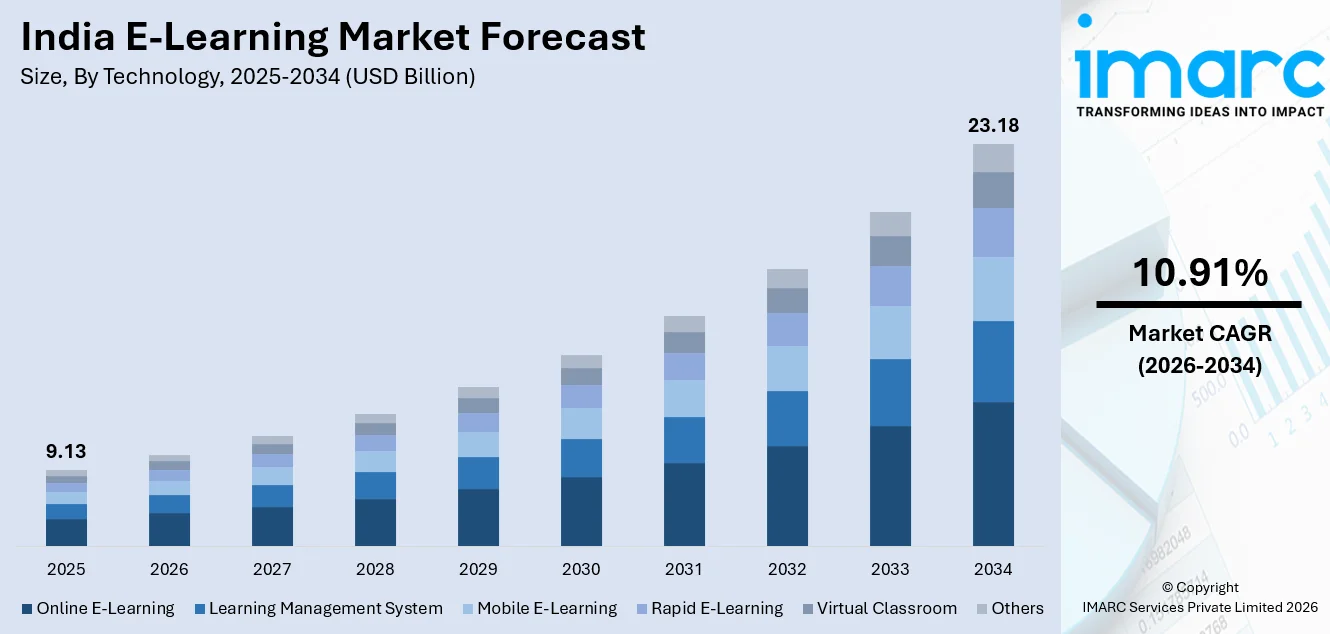
The India e-learning market size was valued at USD 9.13 Billion in 2025 and is projected to reach USD 23.18 Billion by 2034, growing at a compound annual growth rate of 10.91% from 2026-2034.
The India e-learning market is growing at a very rapid pace, driven by the fast development of digital infrastructure and the changing learning paradigms. The increasing internet penetration rate, the growing use of smartphones, and the rising need for flexible skill-based learning solutions are propelling the transition to digital learning. The government-initiated digital literacy initiatives, the growing corporate training needs, and the adoption of new technologies like artificial intelligence and gamification in learning platforms are also bolstering the India e-learning market share.
Key Takeaways and Insights:
-
By Technology: Online E-learning dominates the market with a share of 32% in 2025, driven by widespread internet accessibility and the growing preference for self-paced, browser-based learning platforms.
- By Provider: Content leads the market with a share of 60% in 2025, reflecting the rising demand for diverse, high-quality digital educational materials across academic and professional domains.
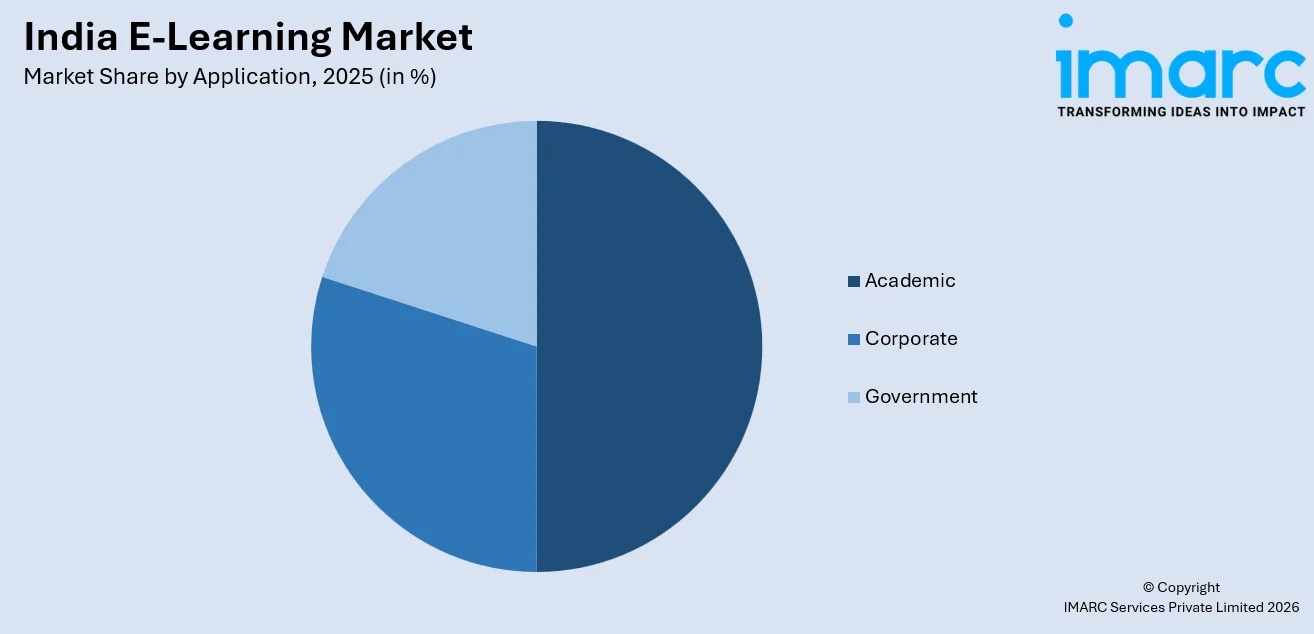
- By Application: Academic represents the largest segment with a market share of 49% in 2025, owing to the massive student population and increasing integration of digital tools in schools and universities.
- By Region: North India holds the largest market share of 30% in 2025, supported by a high concentration of educational institutions and strong digital infrastructure in key states.
- Key Players: The India e-learning market features intense competition among established edtech companies, global platform operators, and emerging startups, all focusing on content diversification, technology-driven personalization, regional language expansion, and strategic partnerships to strengthen their market positioning.
To get more information on this market Request Sample
The India e-learning market is advancing rapidly as the convergence of technology, policy support, and shifting learner expectations reshapes the educational landscape. The country possesses one of the largest student populations globally, presenting an unparalleled addressable market for digital education solutions. In November 2025, Indian edtech firm PhysicsWallah made a notable stock market debut with its shares jumping nearly 49%, valuing the company at around $5.2 billion, reflecting strong investor confidence in digital learning platforms. Government initiatives promoting digital education and national education reforms are facilitating widespread adoption across urban and rural regions. The growing emphasis on outcome-based learning, vocational training, and professional upskilling is further broadening the scope and reach of e-learning platforms. Additionally, the rising penetration of affordable smartphones and high-speed internet is enabling platforms to reach previously underserved demographics, thereby democratizing access to quality education across all socioeconomic segments of society.
India E-Learning Market Trends:
Integration of Artificial Intelligence in Personalized Learning
Artificial intelligence is fundamentally reshaping India’s e-learning landscape by enabling hyper-personalized learning experiences tailored to individual student needs and progress. AI-powered platforms are analyzing learner behavior patterns, adapting content delivery in real time, and providing intelligent feedback to improve learning outcomes. In January 2026, Google launched AI‑powered JEE Main practice tests on its Gemini platform in India, offering dynamic, personalized study guides and quizzes for competitive exam aspirants, and committed significant funding toward integrating AI tools in Indian classrooms. The deployment of AI-driven tutoring systems, automated assessment tools, and adaptive course recommendation engines is enhancing both student engagement and operational efficiency for education providers across the country.
Expansion of Vernacular and Regional Language Content
The growing demand for education content in regional Indian languages is emerging as a defining trend in the e-learning market. Platforms are increasingly investing in content localization to reach learners in Tier-2 and Tier-3 cities who prefer learning in their native languages. This trend is driven by the recognition that language barriers significantly limit educational access, prompting providers to develop courses in Hindi, Tamil, Telugu, Bengali, and other regional languages to maximize inclusivity and learner participation. Additionally, major institutions like IGNOU and IIT Bombay launched AI‑driven translation collaborations (Project Udaan) in 2025 to convert academic content into multiple Indian languages, further supporting multilingual e‑learning adoption.
Rise of Mobile-First Learning Solutions
Mobile devices have become the primary gateway for accessing e-learning content in India, driven by affordable smartphone availability and widespread mobile internet connectivity. Platforms are designing mobile-optimized interfaces, offline-capable content, and bite-sized microlearning modules that cater to learners on the move. In 2025, edtech unicorn PhysicsWallah’s mobile learning app continued to attract millions of users ahead of its IPO, reinforcing how mobile‑first engagement is central to user growth and adoption for Indian e‑learning companies. This shift toward mobile-first delivery models is expanding the addressable market by reaching students and professionals who rely exclusively on smartphones for their educational needs.
Market Outlook 2026-2034:
The Indian e-learning market is expected to grow significantly during the forecast period, driven by continued investments in digital infrastructure, growing demand for professional skill enhancement, and the increasing adoption of AI-powered adaptive learning solutions. The Indian e-learning market is expected to benefit from the growing number of government initiatives supporting digital learning, increasing adoption of online training modules by corporates, and the growing adoption of mobile learning platforms among underserved communities. Advances in gamification, virtual classrooms, and outcome-based learning solutions are also expected to improve engagement and retention rates. The market generated a revenue of USD 9.13 Billion in 2025 and is projected to reach a revenue of USD 23.18 Billion by 2034, growing at a compound annual growth rate of 10.91% from 2026-2034.
India E-Learning Market Report Segmentation:
|
Segment Category |
Leading Segment |
Market Share |
|
Technology |
Online E-Learning |
32% |
|
Provider |
Content |
60% |
|
Application |
Academic |
49% |
|
Region |
North India |
30% |
Technology Insights:
- Online E-Learning
- Learning Management System
- Mobile E-Learning
- Rapid E-Learning
- Virtual Classroom
- Others
The online e-learning dominates with a market share of 32% of the total India e-learning market in 2025.
Online e-learning dominates the market, driven by the widespread availability of internet connectivity and the growing preference for self-paced, browser-based learning platforms. This technology segment enables learners to access a vast repository of academic courses, professional certifications, and skill development programs through internet-connected devices. In 2025, India celebrated its first‑ever Online Education Day on October 25, underscoring the country’s recognition of digital learning’s pivotal role in education and training. The convenience of anytime-anywhere learning, broad subject availability, and cost-effective delivery models continue to make online e-learning the preferred choice for students and working professionals across the country.
The steady adoption of online e-learning is further fueled by the development of broadband infrastructure and the rise of affordable data plans, which have reduced the barriers of access to online learning. Online platforms are increasingly integrating multimedia, instructor-led, and AI-driven recommendation systems to improve learner engagement and retention. The growing need for industry-recognized certifications and degree programs through online platforms is further solidifying the leadership position of the segment in the overall technology ecosystem.
Provider Insights:
- Services
- Content
The content leads with a share of 60% of the total India e-learning market in 2025.
The content leads the market owing to the strong demand for diverse, high-quality digital educational materials across academic and professional domains. Content providers are leveraging advanced authoring tools, multimedia production capabilities, and deep subject-matter expertise to deliver engaging courseware that addresses the evolving requirements of learners and institutions. The massive scale of India's educational ecosystem, encompassing millions of students and professionals, creates sustained and growing demand for fresh, relevant, and curriculum-aligned content.
Content providers are increasingly differentiating themselves through localization in regional Indian languages, gamified learning experiences, and AI-curated learning pathways that adapt to individual learner needs. The growing emphasis on developing industry-aligned, technology-focused educational materials for sectors such as information technology, healthcare, and financial services is further strengthening the segment. Additionally, the rising adoption of micro-credentialing and modular course structures is enabling content providers to cater to diverse learner preferences, ranging from short-duration skill modules to comprehensive degree programs.
Application Insights:
Access the comprehensive market breakdown Request Sample
- Academic
- K-12
- Higher Education
- Vocational Training
- Corporate
- Small and Medium Enterprises
- Large Enterprises
- Government
The academic dominates with a market share of 49% of the total India e-learning market in 2025.
The academic dominates the market, propelled by the country's vast student population and the accelerating digitization of educational institutions at all levels. K-12 education, higher education, and vocational training collectively benefit from the increasing adoption of learning management systems, digital classrooms, and online assessment tools. In January 2026, Chaudhary Charan Singh University in Meerut launched India’s first pilot AI‑enabled university in collaboration with Google Cloud, integrating AI tools across academics and administration to personalize learning and improve academic delivery. National education reforms emphasizing technology integration in pedagogical frameworks are encouraging schools, colleges, and universities to adopt blended and fully digital learning models across the country.
The academic segment continues to attract significant innovation as stakeholders seek to improve educational outcomes and expand access to quality learning resources. The growing network of educational institutions across India is increasingly relying on digital infrastructure to supplement traditional teaching methodologies and bridge geographical access gaps. The rising emphasis on vocational training and skill-based education within academic curricula is further amplifying the segment's contribution to the overall market, as institutions integrate practical, employment-oriented learning modules alongside conventional academic programs to enhance student employability.
Region Insights:
- North India
- West and Central India
- South India
- East India
North India exhibits a clear dominance with a 30% share of the total India e-learning market in 2025.
The market share is dominated by North India, which has a strong digital infrastructure, a large number of premier educational institutions, and a substantial student base. The key states in North India are major ed-tech innovation and content development hubs, with a large number of platforms that contribute to technological advancements in the education sector. The region has strong internet connectivity, high smartphone penetration, and a strong institutional demand for digital education solutions, making it a leader in the market in the country as a whole.
The leadership position of the region is also supported by the strong backing of the government for digital education and skill development initiatives in both urban and semi-urban areas. The region has a strong presence of universities, technical institutions, and coaching centers, making it an ideal place for the adoption of e-learning technologies in academic and professional training applications. The rising demand for competitive exam preparation, professional certification, and corporate training solutions in the region continues to fuel platform engagement and content consumption volumes.

Market Dynamics:
Growth Drivers:
Why is the India E-Learning Market Growing?
Expanding Digital Infrastructure and Internet Penetration
India’s rapidly expanding digital infrastructure serves as a foundational growth driver for the e-learning market, enabling seamless access to educational content across diverse geographies. The progressive rollout of high-speed broadband networks, affordable mobile data plans, and increasing smartphone penetration have collectively lowered barriers to digital education adoption. By December 2025, over 2.18 lakh gram panchayats across India were connected with high‑speed broadband under the BharatNet initiative, significantly expanding rural internet access and paving the way for digital services like e‑learning to reach remote communities. Rural and semi-urban areas, previously underserved by traditional educational infrastructure, are now gaining access to quality learning resources through mobile-first platforms and government-supported digital initiatives. This infrastructure expansion is creating a robust foundation for sustained e-learning market growth, allowing platforms to scale their reach beyond metropolitan centers into smaller towns and villages across the nation.
Growing Demand for Professional Upskilling and Corporate Training
The escalating need for continuous professional development and workforce upskilling represents a critical driver of the India e-learning market. Rapid technological advancements, particularly in areas such as artificial intelligence, cloud computing, and data analytics, are compelling organizations to invest in scalable online training solutions for employee development. In January 2025, major Indian corporations such as HUL, PwC India, Mahindra Group, Capgemini, and Infosys significantly expanded their corporate learning and development programmes, upgrading employee capabilities in GenAI, data analytics, cloud computing, and cybersecurity through internal digital learning platforms and partnerships with specialised training providers. The rise of remote and hybrid work models has further amplified corporate reliance on e-learning platforms for onboarding, compliance training, and skills enhancement. The growing recognition that digital skills are essential for career advancement is driving both employer-sponsored and self-directed learning, making professional upskilling a cornerstone of the expanding e-learning ecosystem across India’s diverse industrial sectors.
Supportive Government Policies and National Education Reforms
Government policies and education reforms are playing a pivotal role in accelerating e-learning adoption across India. National education frameworks emphasize technology integration in education, promoting digital learning tools, online assessments, and credit transfer mechanisms through dedicated government portals and platforms. Under the National Education Policy’s implementation, programs such as SWAYAM and SAMARTH have enabled over 5 crore cumulative enrolments and more than 16,530 online courses, while 401 universities have adopted SWAYAM regulations to allow credit transfers of up to 40% from online learning, significantly boosting accessibility and institutional recognition of digital education. These policy frameworks are creating an enabling environment for edtech innovation and institutional digital transformation. Government-backed modernization schemes targeting vocational institutes and skill development centers are further expanding the reach of digital education to economically weaker sections. Additionally, partnerships facilitated between edtech firms and educational institutions ensure that quality digital learning resources are accessible to learners across all socioeconomic backgrounds.
Market Restraints:
What Challenges the India E-Learning Market is Facing?
Persistent Digital Divide and Infrastructure Gaps
Despite significant progress in digital infrastructure development, substantial disparities remain between urban and rural areas in terms of internet quality, device availability, and digital literacy. Many learners in remote regions face unreliable connectivity and limited access to compatible devices, hindering their ability to fully participate in online learning experiences. This digital divide constrains market penetration in underserved geographies and limits the potential for truly inclusive digital education across the country.
Quality Assurance and Content Standardization Concerns
The rapid proliferation of e-learning platforms has raised concerns about inconsistent content quality and the absence of uniform accreditation standards. Learners often struggle to differentiate between credible and substandard offerings, leading to trust deficits. The lack of standardized frameworks for evaluating course quality, instructor credentials, and learning outcomes poses a challenge to sustaining long-term consumer confidence in digital education and limits the overall credibility of the market.
Learner Engagement and Completion Rate Challenges
Maintaining sustained learner engagement in virtual environments remains a significant challenge for e-learning providers. High dropout rates, screen fatigue, and the absence of in-person interaction can diminish learning effectiveness. Despite advances in gamification and AI-driven personalization, achieving consistent learner motivation and course completion rates comparable to traditional education models continues to be a structural constraint for the market, requiring ongoing innovation in pedagogical approaches.
Competitive Landscape:
The India e-learning market has a very dynamic and competitive environment, with a wide range of ed-tech players, global platform owners, and new-age startups competing in various segments and geographies. The players are differentiating themselves by investing in AI-driven personalization, vernacular content development, mobile-friendly platforms, and strategic partnerships with educational institutions and corporations. The competition is further fueled by price optimization initiatives, Tier-2 and Tier-3 market penetration, and the development of learning models that focus on learning outcomes and employability skills. The new entrants in the form of creator-driven education platforms and learning communities are also introducing a new dimension of competition in the market, which is disrupting the traditional platform-based model of education. The competitive landscape of the India e-learning market is also undergoing continuous changes as the players are optimizing their solutions to meet the diverse and growing needs of the Indian education sector.
Recent Developments:
- In November 2025, Vedantu rolled out Ved, an AI‑driven academic companion offering personalised guidance, adaptive learning paths, doubt resolution and performance analytics to support students’ unique learning needs across India. The platform blends teacher insights with student data to deliver tailored study support.
India E-Learning Market Report Coverage:
| Report Features | Details |
|---|---|
| Base Year of the Analysis | 2025 |
| Historical Period | 2020-2025 |
| Forecast Period | 2026-2034 |
| Units | Billion USD |
| Scope of the Report |
Exploration of Historical Trends and Market Outlook, Industry Catalysts and Challenges, Segment-Wise Historical and Future Market Assessment:Technology
|
| Technologies Covered | Online E-Learning, Learning Management System, Mobile E-Learning, Rapid E-Learning, Virtual Classroom, Others |
| Providers Covered | Services, Content |
| Providers Covered |
|
| Region Covered | North India, West and Central India, South India, East India |
| Customization Scope | 10% Free Customization |
| Post-Sale Analyst Support | 10-12 Weeks |
| Delivery Format | PDF and Excel through Email (We can also provide the editable version of the report in PPT/Word format on special request) |
Frequently Asked Questions About the India E-Learning Market Report
The India e-learning market size was valued at USD 9.13 Billion in 2025.
The India e-learning market is expected to grow at a compound annual growth rate of 10.91% from 2026-2034 to reach USD 23.18 Billion by 2034.
Online e-learning held the largest market share of 32%, driven by widespread internet accessibility, the convenience of self-paced learning, and the growing availability of diverse course offerings through browser-based and app-based platforms.
Key factors driving the India e-learning market include expanding digital infrastructure and internet penetration, growing demand for professional upskilling and corporate training, supportive government policies, increasing smartphone adoption, and the rising integration of AI-driven personalized learning technologies.
Major challenges include the persistent digital divide between urban and rural areas, inconsistent content quality and lack of standardized accreditation, high learner dropout rates, screen fatigue in virtual environments, and limited awareness of credible e-learning offerings among certain demographics.
Need more help?
- Speak to our experienced analysts for insights on the current market scenarios.
- Include additional segments and countries to customize the report as per your requirement.
- Gain an unparalleled competitive advantage in your domain by understanding how to utilize the report and positively impacting your operations and revenue.
- For further assistance, please connect with our analysts.
 Request Customization
 Speak to an Analyst
 Request Brochure
 Inquire Before Buying
Benefits of Customization
- Personalize this research
- Triangulate with your data
- Get data as per your format and definition
- Gain a deeper dive into a specific application, geography, customer, or competitor
- Any level of personalization
Get in Touch With Us
UNITED STATES
Phone: +1-201-971-6302
INDIA
Phone: +91-120-433-0800
UNITED KINGDOM
Phone: +44-753-714-6104
Email: [email protected]
Client Testimonials




.webp)




.webp)













Related Reports

Choose your plan
*Please note that the prices mentioned below are starting prices for each bundle type. Kindly contact our team for further details.*
Single User License
- 1 User License, Access on 2 Devices
- PDF Report + Excel Dataset (Password Protected)
- Lifetime Access
- No Printing Rights
- 10% Free Report Customization
- 10–12 Weeks of Analyst Support
Five User License
- Access for 5 Users, 2 Devices per User
- PDF Report + Excel Dataset (Password Protected)
- Lifetime Access
- Dedicated Account Manager
- 12–14 Weeks of Analyst Support
- No Printing Rights
- 15% Free Report Customization
- 25% Discount on Your Next Purchase
Corporate User License
- Unlimited User Access (Within Your Organization)
- PDF Report + Excel Dataset
- Lifetime Access
- Dedicated Account Manager
- 14–20 Weeks of Analyst Support
- No Printing Rights
- 20% Free Report Customization
- 30% Discount on Your Next Purchase
Essential Insights
What's included:
3 reports
- Lifetime Access
- PDF Reports
- Excel Datasets
- 2 Weeks of Free Analyst Support
- 2 User Licenses
- Access on 2 Devices
- Printing Rights
- Complimentary PowerPoint (PPT) Version
- Complimentary License Upgrade
Professional Access
What's included:
5 reports
- Lifetime Access
- PDF Reports
- Excel Datasets
- 8 Weeks of Free Analyst Support
- 2 User Licenses
- Access on 2 Devices
- Printing Rights
- Complimentary PowerPoint (PPT) Version
- Complimentary License Upgrade
Business Advantage
What's included:
8 reports
- Lifetime Access
- PDF Reports
- Excel Datasets
- 14 Weeks of Free Analyst Support
- 2 User Licenses
- Access on 2 Devices
- Printing Rights
- Complimentary PowerPoint (PPT) Version
- Complimentary License Upgrade
Enterprise Intelligence
What's included:
10 reports
- Lifetime Access
- PDF Reports
- Excel Datasets
- 20 Weeks of Free Analyst Support
- 2 User Licenses
- Access on 2 Devices
- Printing Rights
- Complimentary PowerPoint (PPT) Version
- Complimentary License Upgrade