
India Elderly Care Products Market Size, Share, Trends and Forecast by Product, Usage, End User, and Region, 2026-2034
India Elderly Care Products Market Summary:
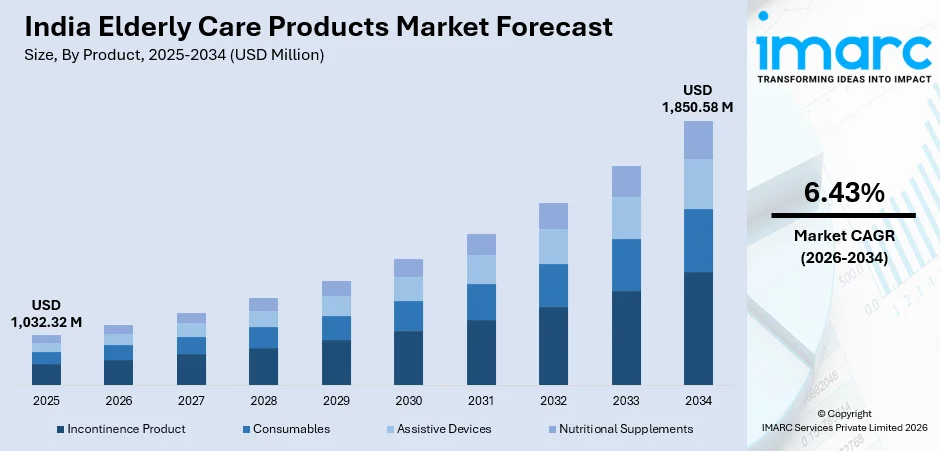
The India elderly care products market size was valued at USD 1,032.32 Million in 2025 and is projected to reach USD 1,850.58 Million by 2034, growing at a compound annual growth rate of 6.43% from 2026-2034.
India's rapidly aging population, increasing prevalence of chronic conditions, and growing preference for home-based care are reshaping the elderly care products landscape. Rising awareness of geriatric health needs, coupled with government schemes such as Ayushman Bharat and the Rashtriya Vayoshri Yojana, is broadening access to assistive devices, incontinence products, and nutritional supplements, collectively strengthening the India elderly care products market share.
Key Takeaways and Insights:
- By Product: Incontinence product dominates the market with a share of 32.5% in 2025, owing to the rising prevalence of urinary incontinence among the aging population, growing acceptance of hygiene products, and increased availability across institutional and home care settings.
- By Usage: Home care leads the market with a share of 46.2% in 2025, driven by the strong cultural preference for aging in familiar surroundings, cost efficiency compared to institutional care, and the expanding availability of home-delivered eldercare solutions.
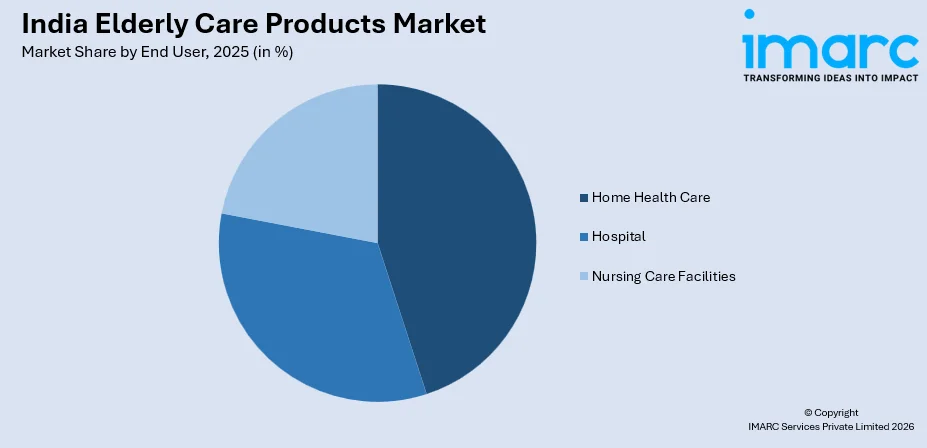
- By End User: Home health care holds the leading segment with a share of 35.5% in 2025, reflecting growing demand for in-home medical assistance, post-discharge recovery support, and chronic disease management without institutional dependency.
- By Region: West India represents the largest region with a share of 29.2% in 2025, supported by urbanization, high concentration of elderly individuals, and greater penetration of organized healthcare and retail distribution networks in states such as Maharashtra and Gujarat.
- Key Players: Key players in the India elderly care products market drive growth by expanding product portfolios, adopting digital health technologies, and strengthening nationwide distribution channels. Strategic investments in research, innovation, and partnerships with healthcare providers and home care agencies enhance product reach, improve affordability, and increase awareness among caregivers and elderly consumers across urban and rural regions.
To get more information on this market Request Sample
The India elderly care products market is experiencing sustained growth, underpinned by one of the world's most significant demographic transitions. India's elderly population, those aged 60 years and above, is projected to reach approximately 230 million by 2036, according to data from India's Ministry of Social Justice and Empowerment. This sharp demographic rise is catalyzing demand for mobility aids, incontinence products, assistive devices, and nutritional supplements across both institutional and home settings. Supportive government healthcare policies and expanding welfare frameworks have significantly broadened access to elderly care solutions, reducing financial barriers and encouraging wider product adoption across diverse income groups. Simultaneously, technology adoption is reshaping care delivery, with AI-powered monitoring devices, wearable health trackers, and telemedicine platforms enabling personalized, real-time care for senior citizens. As the sector matures, rising disposable incomes, evolving caregiver awareness, and deepening healthcare infrastructure continue to drive the India elderly care products market share upward.
India Elderly Care Products Market Trends:
Rise of Technology-Driven Elderly Care Solutions
The integration of artificial intelligence, IoT, and wearable health monitoring technologies into elderly care is transforming how seniors in India manage their health. AI-powered fall detection systems, remote patient monitoring devices, smart pill dispensers, and telemedicine platforms are enabling proactive, real-time care delivery at home and in institutions alike. As digital health ecosystems expand across urban and semi-urban geographies, the convergence of connectivity, data analytics, and assistive innovation is deepening the sector's technological transformation and elevating the overall standard of elderly care product offerings available to India's growing senior population.
Expansion of Senior Living and Home-Based Care Ecosystems
India is witnessing rapid growth in senior living infrastructure and organized home healthcare service networks, fundamentally transforming how elderly care products are distributed and accessed. New senior living facilities and integrated care retail platforms are creating structured demand channels for diverse product categories. In March 2025, Antara Senior Care launched its first AGEasy Store in Gurugram, providing an integrated physical platform of senior-focused products and personalized geriatric assistance. This expanding ecosystem of physical and digital care channels, home delivery services, and professional caregiver networks is accelerating elderly care product adoption across urban and semi-urban areas nationwide.
Growing Government Support and Holistic Wellness Focus
Government-led welfare initiatives and a broader cultural shift toward holistic senior wellness are together reshaping the India elderly care products landscape. India's silver economy, valued at approximately ₹73,000 crore in 2024, is expanding rapidly, supported by schemes such as the Atal Vayo Abhyuday Yojana (AVYAY), the SAGE portal for elderly care start-ups, and the Senior Citizen Scheme 2025, which extends healthcare coverage and preventive health provisions. Alongside these programs, rising consumer interest in nutritional supplements, ergonomic aids, and preventive wellness products reflects a broader societal push toward quality-of-life-centered, proactive aging strategies.
Market Outlook 2026-2034:
The India elderly care products market is poised for consistent long-term expansion across the forecast period, driven by the compounding effects of demographic aging, rising chronic disease burden, advancing healthcare technologies, and strengthening institutional frameworks. As India's elderly population grows rapidly — nearing an estimated 230 million by 2036 — demand for mobility aids, incontinence products, consumables, and nutritional supplements is expected to broaden significantly across both urban and rural geographies. The proliferation of home-based care models, reinforced by expanded government health insurance coverage and digital health infrastructure, is catalyzing adoption in historically underserved segments. Innovation in product design, including ergonomically optimized devices, skin-friendly hygiene materials, and smart monitoring wearables, is expected to enhance product appeal and widen the consumer base. Strategic collaborations between healthcare providers, technology firms, and device manufacturers are anticipated to further strengthen distribution, quality, and market accessibility throughout the forecast horizon. The market generated a revenue of USD 1,032.32 Million in 2025 and is projected to reach a revenue of USD 1,850.58 Million by 2034, growing at a compound annual growth rate of 6.43% from 2026-2034.
India Elderly Care Products Market Report Segmentation:
| Segment Category | Leading Segment | Market Share |
|---|---|---|
|
Product |
Incontinence Product |
32.5% |
|
Usage |
Home Care |
46.2% |
|
End User |
Home Health Care |
35.5% |
|
Region |
West India |
29.2% |
Product Insights:
- Incontinence Product
- Consumables
- Assistive Devices
- Nutritional Supplements
Incontinence product dominates with a market share of 32.5% of the total India elderly care products market in 2025.
Incontinence products command the largest share of the India elderly care products market, anchored by the widespread and growing prevalence of urinary and bowel dysfunction among the aging population. Adult diapers, absorbent pads, protective underwear, and bed protectors represent the core offerings in this category, available across a broad range of absorbency levels, sizes, and price points. The shift from institutional settings to home-based care has notably expanded the consumer base, as family caregivers increasingly rely on incontinence supplies to manage elderly relatives at home. Rising awareness, improved product discretion, odor-control innovations, and skin-friendly materials have also helped reduce the historical stigma surrounding adult incontinence, encouraging broader market participation across diverse demographic segments throughout India.
Product manufacturers are responding to evolving consumer demands by developing breathable and eco-conscious incontinence solutions tailored to India's tropical climate and diverse skin types. Retailers and e-commerce platforms have emerged as critical distribution channels, enabling discreet purchasing and home delivery that remove access barriers for urban and rural consumers alike. Ongoing innovation in absorbent materials, odor-control technologies, and ergonomic product designs is continuously broadening the scope of incontinence management beyond conventional disposable formats, encouraging greater consumer confidence and repeat purchasing behavior that collectively strengthens the segment's long-term growth trajectory.
Usage Insights:
- Home Care
- Chronic Illness Care
Home care leads with a share of 46.2% of the total India elderly care products market in 2025.
Home care accounts for the largest usage segment within the India elderly care products market, reflecting the strong cultural and economic preferences that favor aging within familiar domestic environments. Nuclear family structures, rising disposable incomes, and the growing availability of home-delivered care solutions have collectively reinforced demand for products used in at-home settings. Categories such as mobility aids, incontinence supplies, health monitoring devices, and consumables are routinely purchased for domestic use, enabling seniors to maintain independence and manage chronic conditions without institutional dependency. Government programs promoting home-based healthcare have further validated and expanded this segment, creating a structured demand base that supports consistent product replenishment cycles across urban and semi-urban households nationwide.
The proliferation of organized home healthcare service providers and digital health platforms has created an enabling ecosystem for home care product adoption across India. Growing collaboration between insurance providers, care agencies, and product manufacturers is substantially broadening access to home-based elderly care, accelerating the consumption of associated products spanning wound care consumables, blood pressure monitors, and incontinence supplies. As integrated service-driven demand models become more prevalent, regular product usage and replenishment cycles are being reinforced, further solidifying home care's dominant position within the usage segmentation of the India elderly care products market.
End User Insights:
Access the comprehensive market breakdown Request Sample
- Hospital
- Nursing Care Facilities
- Home Health Care
Home health care represents the leading segment with a share of 35.5% of the total India elderly care products market in 2025.
Home health care stands as the largest end user segment in the India elderly care products market, reflecting the growing preference for receiving medical and supportive care within familiar residential settings. Elderly individuals managing chronic conditions such as hypertension, diabetes, arthritis, and cardiovascular disorders increasingly rely on home health care professionals, caregivers, and home-delivery services to fulfill their daily healthcare needs. The rising participation of trained home health aides and registered nurses in domiciliary settings is driving consistent demand for incontinence products, consumables, mobility aids, and health monitoring devices used within structured home care protocols.
The expansion of organized home health care service providers has created scalable and structured demand channels for elderly care products across India. Growing integration of clinical care pathways with home-based product consumption is ensuring regular replenishment cycles, reducing hospital readmission rates, and empowering elderly patients to maintain quality of life outside institutional settings. The deepening collaboration between home health care agencies, insurance providers, and product manufacturers is expected to further strengthen this segment's leading position throughout the forecast period.
Regional Insights:
- North India
- South India
- East India
- West India
West India represents the largest region with a share of 29.2% of the total India elderly care products market in 2025.
West India has the largest regional contribution to the India elderly care products market, owing to the high elderly population density in the densely populated states of Maharashtra and Gujarat. Additionally, the region has well-established healthcare infrastructure, a high number of private healthcare facilities, and home care services. High urbanization levels, high disposable incomes, and high awareness about healthcare among the population of densely populated states such as Mumbai, Pune, and Ahmedabad are also responsible for the high contribution of the region to the India elderly care products market.
The high contribution of the West India region to the India elderly care products market is also attributable to the presence of a well-established pharmaceutical and medical devices manufacturing sector, which is also responsible for the affordability and availability of products. In addition, increasing awareness among caregivers, high elderly care infrastructure, and penetration of health insurance among the elderly population are responsible for the high contribution of the region to the India elderly care products market. Increasing investments by both the government and private players in elderly care infrastructure and healthcare digitization are also expected to contribute to the high contribution of the region to the India elderly care products market.
Market Dynamics:
Growth Drivers:
Why is the India Elderly Care Products Market Growing?
Rapidly Expanding Aging Population Across India
India is undergoing one of the most consequential demographic transitions in its history. The country's elderly population, comprising those aged 60 years and above, is expanding at a significant pace, driven by declining fertility rates and rising life expectancy. This sustained demographic shift is generating escalating demand across all categories of elderly care products, including assistive devices, incontinence supplies, consumables, and nutritional supplements, as a growing proportion of the population enters the senior age bracket requiring dedicated care and support solutions. The aging population is also presenting with a higher burden of chronic conditions such as arthritis, osteoporosis, and cardiovascular disease, each necessitating specialized, long-term product use. India's silver economy, valued at approximately ₹73,000 crore in 2024, reflects the scale and commercial relevance of this demographic shift, making geriatric wellness one of the country's most high-potential growth sectors over the coming decade.
Government Healthcare Initiatives Strengthening Market Access
India's government has significantly expanded its welfare programs for senior citizens, creating a more enabling environment for elderly care product adoption nationwide. Landmark policy initiatives such as the Ayushman Bharat–Pradhan Mantri Jan Arogya Yojana (AB-PMJAY) have materially lowered financial barriers for elderly healthcare access by extending coverage to a broader base of senior citizens. The National Programme for Health Care of the Elderly (NPHCE) strengthens geriatric care delivery by providing outpatient care, physiotherapy services, and dedicated geriatric wards across districts nationwide. Additionally, the Rashtriya Vayoshri Yojana distributes free assistive devices, including wheelchairs, walkers, and hearing aids, to economically disadvantaged elderly individuals. The SAGE portal catalyzes innovation by supporting start-ups developing elderly care products, while the eSanjeevani telemedicine platform extends healthcare access to elderly populations in remote and underserved regions, collectively reinforcing a robust policy ecosystem that sustains long-term market growth.
Growing Adoption of Assistive Technologies and Smart Healthcare Devices
Rapid advancements in healthcare technology are transforming the quality, reach, and effectiveness of elderly care products in India. AI-powered diagnostic tools, wearable health trackers, remote patient monitoring systems, and fall detection sensors are increasingly being integrated into both home and institutional eldercare environments. A growing domestic innovation pipeline for assistive technology is yielding sophisticated product categories, from electric mobility aids to IoT-enabled health devices, that address the diverse and complex needs of India's aging population. These technological innovations are not only improving health outcomes for elderly users but are also expanding the overall addressable market by introducing advanced offerings that attract higher consumer interest and willingness to invest in quality geriatric care.
Market Restraints:
What Challenges the India Elderly Care Products Market is Facing?
Limited Awareness and Social Stigma in Rural Markets
A significant portion of India's elderly population resides in rural and semi-urban areas, where awareness of specialized care products remains limited. Social stigma associated with incontinence products, mobility aids, and home health devices discourages open purchasing and consistent product use. Low digital literacy further restricts access to e-commerce channels and online health information resources, creating structural barriers to market penetration. Without targeted outreach programs, community-level education, and caregiver training initiatives, a large segment of the addressable market continues to remain underserved, constraining the market's full growth potential.
High Product Costs and Low Insurance Penetration
Premium elderly care products, including advanced assistive devices, smart health monitors, and specialized nutritional supplements, carry price points that are beyond the reach of a significant share of India's elderly population. Insurance penetration for long-term and geriatric care products remains limited, and out-of-pocket expenditure continues to represent the primary mode of payment for most households managing elderly care. This financial constraint limits adoption of technologically advanced offerings and reduces product replacement frequency among cost-sensitive consumers, creating a persistent affordability gap that hinders broader market expansion across lower-income demographic segments.
Shortage of Trained Caregivers and Geriatric Specialists
India's rapidly growing elderly population is outpacing the availability of adequately trained caregivers and geriatric healthcare professionals, constraining the effective utilization of elderly care products. Unskilled or inadequately trained caregivers are less equipped to correctly use, maintain, and recommend specialized care devices, reducing product efficacy and user safety. While government-sponsored training programs under the National Institute of Social Defence have made meaningful progress in expanding the caregiver workforce, the demand-supply gap remains substantial, particularly in smaller cities and rural districts, limiting consistent product adoption and quality care delivery across underserved segments of the market.
Competitive Landscape:
India's elderly care products market is found to be moderately competitive, with both local manufacturers and multinational healthcare companies and specialty geriatric care products operating in the market. Companies are using differentiated strategies such as innovation, extension of distribution networks, engaging caregivers, and digital strategies. Competitive priorities for companies are to innovate products such as skin-friendly incontinence products, mobility aids, and nutritional supplements suitable for different segments of the population. E-commerce penetration and home delivery are also emerging as important differentiators for companies, and strategic partnerships with insurance companies, hospitals, and home care agencies are also becoming important differentiators for companies.
India Elderly Care Products Market Report Coverage:
| Report Features | Details |
|---|---|
| Base Year of the Analysis | 2025 |
| Historical Period | 2020-2025 |
| Forecast Period | 2026-2034 |
| Units | Million USD |
| Scope of the Report |
Exploration of Historical Trends and Market Outlook, Industry Catalysts and Challenges, Segment-Wise Historical and Future Market Assessment:
|
| Products Covered | Incontinence Product, Consumables, Assistive devices, Nutritional Supplements |
| Usages Covered | Home Care, Chronic Illness Care |
| End Users Covered | Hospital, Nursing Care Facilities, Home Health Care |
| Regions Covered | North India, South India, East India, West India |
| Customization Scope | 10% Free Customization |
| Post-Sale Analyst Support | 10-12 Weeks |
| Delivery Format | PDF and Excel through Email (We can also provide the editable version of the report in PPT/Word format on special request) |
Frequently Asked Questions About the India Elderly Care Products Market Report
The India elderly care products market size was valued at USD 1,032.32 Million in 2025.
The India elderly care products market is expected to grow at a compound annual growth rate of 6.43% from 2026-2034 to reach USD 1,850.58 Million by 2034.
Incontinence product dominated the market with a share of 32.5%, driven by the high prevalence of urinary dysfunction among the aging population, growing product acceptance, and expanding availability across home care and institutional settings.
Key factors driving the India elderly care products market include a rapidly aging population, rising prevalence of chronic conditions, government healthcare initiatives, growing home care adoption, and increasing integration of assistive and digital health technologies.
Major challenges include limited product awareness in rural areas, social stigma around specialized elder care items, high costs of premium products, insufficient insurance coverage for geriatric care, and a significant shortage of trained caregivers and geriatric healthcare specialists.
Need more help?
- Speak to our experienced analysts for insights on the current market scenarios.
- Include additional segments and countries to customize the report as per your requirement.
- Gain an unparalleled competitive advantage in your domain by understanding how to utilize the report and positively impacting your operations and revenue.
- For further assistance, please connect with our analysts.
 Request Customization
 Speak to an Analyst
 Request Brochure
 Inquire Before Buying
Benefits of Customization
- Personalize this research
- Triangulate with your data
- Get data as per your format and definition
- Gain a deeper dive into a specific application, geography, customer, or competitor
- Any level of personalization
Get in Touch With Us
UNITED STATES
Phone: +1-201-971-6302
INDIA
Phone: +91-120-433-0800
UNITED KINGDOM
Phone: +44-753-714-6104
Email: [email protected]
Client Testimonials




.webp)




.webp)













Related Reports

Choose your plan
*Please note that the prices mentioned below are starting prices for each bundle type. Kindly contact our team for further details.*
Single User License
- 1 User License, Access on 2 Devices
- PDF Report + Excel Dataset (Password Protected)
- Lifetime Access
- No Printing Rights
- 10% Free Report Customization
- 10–12 Weeks of Analyst Support
Five User License
- Access for 5 Users, 2 Devices per User
- PDF Report + Excel Dataset (Password Protected)
- Lifetime Access
- Dedicated Account Manager
- 12–14 Weeks of Analyst Support
- No Printing Rights
- 15% Free Report Customization
- 25% Discount on Your Next Purchase
Corporate User License
- Unlimited User Access (Within Your Organization)
- PDF Report + Excel Dataset
- Lifetime Access
- Dedicated Account Manager
- 14–20 Weeks of Analyst Support
- No Printing Rights
- 20% Free Report Customization
- 30% Discount on Your Next Purchase
Essential Insights
What's included:
3 reports
- Lifetime Access
- PDF Reports
- Excel Datasets
- 2 Weeks of Free Analyst Support
- 2 User Licenses
- Access on 2 Devices
- Printing Rights
- Complimentary PowerPoint (PPT) Version
- Complimentary License Upgrade
Professional Access
What's included:
5 reports
- Lifetime Access
- PDF Reports
- Excel Datasets
- 8 Weeks of Free Analyst Support
- 2 User Licenses
- Access on 2 Devices
- Printing Rights
- Complimentary PowerPoint (PPT) Version
- Complimentary License Upgrade
Business Advantage
What's included:
8 reports
- Lifetime Access
- PDF Reports
- Excel Datasets
- 14 Weeks of Free Analyst Support
- 2 User Licenses
- Access on 2 Devices
- Printing Rights
- Complimentary PowerPoint (PPT) Version
- Complimentary License Upgrade
Enterprise Intelligence
What's included:
10 reports
- Lifetime Access
- PDF Reports
- Excel Datasets
- 20 Weeks of Free Analyst Support
- 2 User Licenses
- Access on 2 Devices
- Printing Rights
- Complimentary PowerPoint (PPT) Version
- Complimentary License Upgrade