
India Electric Rice Cooker Market Size, Share, Trends and Forecast by Type, Capacity, Distribution Channel, End User, and Region, 2026-2034
India Electric Rice Cooker Market Summary:
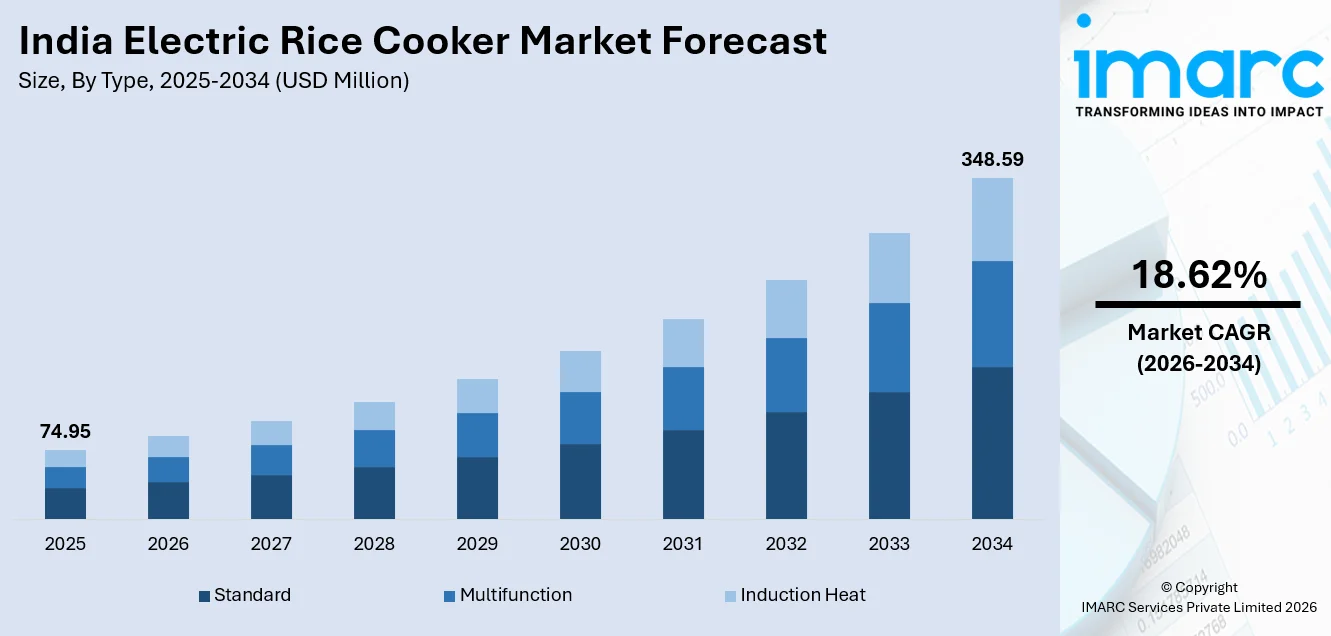
The India electric rice cooker market grew from USD 74.95 Million in 2025 to USD 88.93 Million in 2026 and is projected to reach USD 348.59 Million by 2034, growing at a compound annual growth rate of 18.62% from 2026-2034.
The India electric rice cooker market is experiencing robust expansion driven by rapid urbanization, rising disposable incomes, and the growing prevalence of nuclear family households across the country. As lifestyles become increasingly fast-paced, particularly in metropolitan and tier-two cities, consumers are gravitating toward convenient, energy-efficient cooking appliances that simplify daily meal preparation. The cultural significance of rice as a dietary staple across southern, eastern, and northeastern states further underpins sustained demand for dedicated rice cooking solutions. Manufacturers are responding with innovative product offerings that combine multifunctional capabilities, smart connectivity, and compact designs to cater to modern kitchen requirements. The proliferation of e-commerce platforms has significantly expanded product accessibility, enabling consumers in semi-urban and rural areas to explore diverse product options with competitive pricing and convenient delivery. According to the India Union Budget data, the daily per capita availability of rice reached approximately 226 grams across India in fiscal year 2023, underscoring the grain’s central role in household nutrition. Government electrification initiatives are extending market reach into previously underserved regions, broadening the consumer base for the India electric rice cooker market share.
Key Takeaways and Insights:
- By Type: Standard dominates the market with a share of 38% in 2025, owing to its affordability, ease of use, and widespread availability across diverse retail channels. These cookers remain the preferred choice among price-conscious consumers seeking reliable, single-function rice cooking solutions for everyday household use.
- By Capacity: 2 liter–4 liter leads the market with a share of 49% in 2025, driven by its suitability for medium-sized nuclear families that constitute a growing proportion of Indian households. This capacity range balances portion adequacy with compact kitchen footprints.
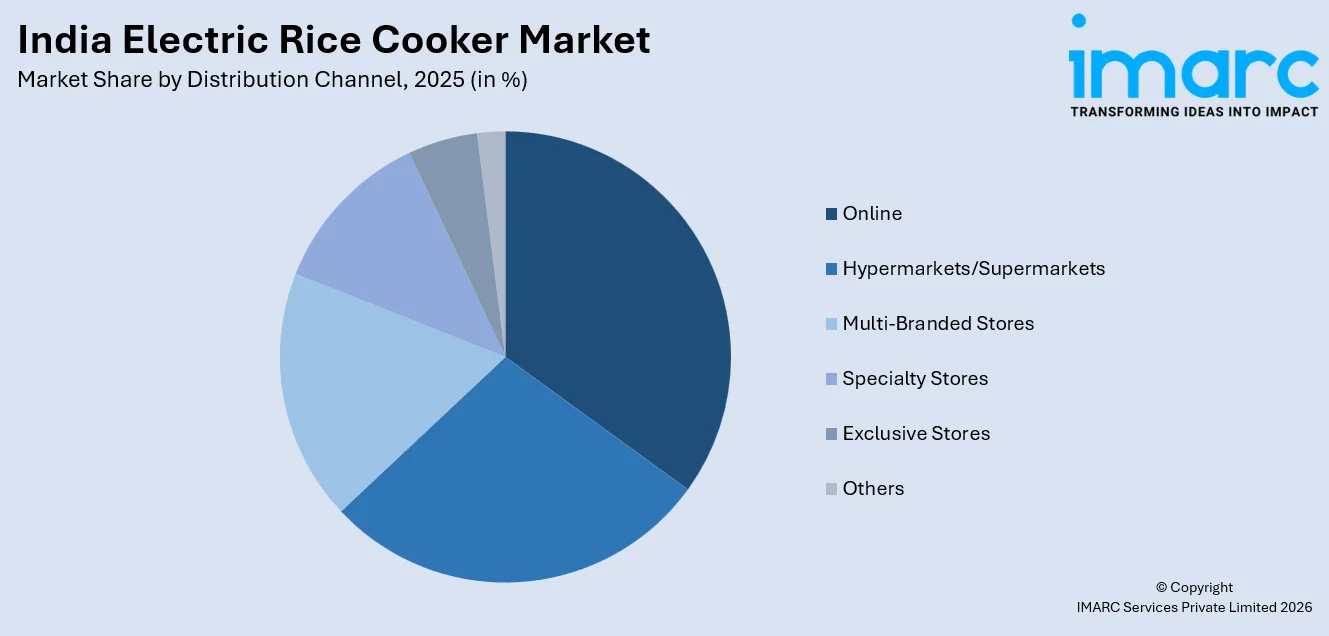
- By Distribution Channel: Online represents the biggest segment with a market share of 30% in 2025, reflecting the accelerating shift toward digital commerce fueled by competitive pricing, extensive product comparison capabilities, and the convenience of doorstep delivery across urban and rural markets.
- By End User: Residential exhibits a clear dominance in the market with 66% share in 2025, driven by the growing preference among urban households for automated, time-saving cooking appliances that align with contemporary dual-income lifestyles and smaller family sizes.
- Key Players: Key players drive the India electric rice cooker market by expanding product portfolios, improving cooking technology and safety features, and strengthening distribution through both online and offline channels. Their investments in affordability, innovation, and regional partnerships enhance product accessibility and consumer adoption across diverse market segments.
India Electric Rice Cooker Market Trends:
Rising demand for multifunctional and smart rice cookers
Indian consumers are increasingly favoring electric rice cookers equipped with multifunctional capabilities such as steaming, slow cooking, and sautéing, moving beyond basic rice preparation. Smart models featuring mobile app connectivity, programmable timers, and automatic warming functions are gaining traction among tech-savvy urban households. This trend reflects a broader shift toward integrated kitchen solutions that maximize convenience while minimizing cooking effort. Manufacturers are responding by introducing feature-rich variants that combine multiple cooking modes with intelligent controls, catering to the evolving needs of modern kitchens where space efficiency and time management are paramount considerations driving the India electric rice cooker market growth.
Expansion of e-commerce as a primary distribution channel
Online retail platforms are rapidly emerging as the preferred purchasing channel for electric rice cookers in India, driven by competitive pricing, extensive product variety, and accessible financing options. Festival-driven flash deals, zero-cost equated monthly installment plans, and doorstep delivery services offered by major e-commerce platforms are accelerating adoption across diverse consumer segments. This shift is enabling manufacturers to reach consumers in tier-two and tier-three cities where physical retail penetration remains limited, thereby broadening the addressable market considerably. Growing internet connectivity and smartphone usage in semi-urban and rural regions further reinforce this channel's expanding role in market distribution.
Growing preference for compact, energy-efficient designs
The proliferation of nuclear families and compact urban living spaces is driving demand for energy-efficient and space-saving rice cooker designs. Consumers increasingly prioritize appliances that offer optimal performance while consuming minimal electricity and fitting into smaller kitchens. Manufacturers are responding by developing lightweight, portable models with advanced thermal insulation and improved energy utilization. The Bureau of Energy Efficiency mandates star labels on multiple kitchen-related product categories, compelling consumers to consider energy ratings when selecting appliances. These regulatory and market forces are converging to reshape product design, encouraging innovation toward sustainable, compact cooking solutions.
Market Outlook 2026-2034:
The India electric rice cooker market is poised for sustained expansion as urbanization accelerates, disposable incomes rise, and consumer lifestyles evolve toward convenience-oriented cooking solutions. The growing penetration of e-commerce platforms, coupled with increasing rural electrification and expanding awareness about modern kitchen appliances, is expected to broaden the addressable consumer base significantly. The market generated a revenue of USD 74.95 Million in 2025, which is expected to reach USD 88.93 Million in 2026 and further grow to USD 348.59 Million by 2034, at a compound annual growth rate (CAGR) of 18.62% during 2026-2034. Manufacturers are expected to intensify product innovation, introducing smart features, multifunctional capabilities, and energy-efficient designs to capture the growing demand from both residential and commercial segments. Strategic collaborations, regional distribution expansion, and the introduction of affordable product variants for price-sensitive markets are anticipated to further drive adoption across urban and rural households alike.
India Electric Rice Cooker Market Report Segmentation:
|
Segment Category |
Leading Segment |
Market Share |
|
Type |
Standard |
38% |
|
Capacity |
2 Liter–4 Liter |
49% |
|
Distribution Channel |
Online |
30% |
|
End User |
Residential |
66% |
Type Insights:
- Standard
- Multifunction
- Induction Heat
Standard dominates with a market share of 38% of the total India electric rice cooker market in 2025.
Standard electric rice cookers maintain their market leadership owing to their straightforward functionality, competitive pricing, and strong consumer familiarity across both urban and rural markets. These appliances cater to the fundamental cooking needs of Indian households where rice remains a daily dietary staple, providing reliable automatic cooking and keep-warm functions. The affordability of standard models makes them accessible to a wide consumer base, including first-time buyers and budget-conscious families seeking dependable kitchen solutions without advanced features or premium price points.
The continued dominance of standard rice cookers is further supported by their extensive availability through diverse retail channels, including multi-branded stores, hypermarkets, and online platforms. Leading manufacturers continue to invest in this segment with improved quality, durable construction, and enhanced safety features tailored to Indian cooking requirements. Their widespread distribution networks and established brand recognition strengthen consumer trust and drive repeat purchases across diverse regional markets, reinforcing the segment's position as the foundational product category in the India electric rice cooker market.
Capacity Insights:
- Less Than 2 Liter
- 2 Liter–4 Liter
- More Than 4 Liter
2 liter–4 liter leads with a share of 49% of the total India electric rice cooker market in 2025.
The 2 liter–4 liter capacity segment commands the largest market share owing to its optimal suitability for nuclear families, which represent a growing share of Indian households. This capacity range adequately serves families of three to five members, aligning with the average household size in urban and semi-urban areas where electric rice cooker adoption is highest. The practical balance between sufficient cooking volume and compact design makes these models particularly appealing for modern kitchens with limited counter space and storage capacity.
Manufacturers are concentrating product development efforts within this capacity range, introducing models with enhanced features including non-stick inner pots, cool-touch handles, and automatic shut-off mechanisms. The expanding prevalence of nuclear family structures across Indian cities reinforces demand for medium-capacity cooking appliances that balance adequate portion preparation with space efficiency. This demographic trend, coupled with growing consumer preference for versatile mid-sized appliances suited to everyday cooking requirements, supports continued expansion of the mid-capacity segment across residential applications nationwide.
Distribution Channel Insights:
Access the comprehensive market breakdown Request Sample
- Hypermarkets/Supermarkets
- Multi-Branded Stores
- Online
- Specialty Stores
- Exclusive Stores
- Others
Online dominates the largest segment with 30% share of the total India electric rice cooker market in 2025.
Due to the growth of e-commerce marketplaces, aggressive pricing tactics, the ease of product comparison, and home delivery services, the online distribution channel has become the most popular platform for sales of electric rice cookers in India. Large platforms enable customers to make well-informed shopping decisions by providing comprehensive product catalogs, user evaluations, and simple return procedures. Festival-driven marketing initiatives and free equivalent monthly installment plans encourage online sales from a variety of customer demographics looking for feature-rich and reasonably priced kitchen appliances.
The channel's growth is accelerating as internet penetration and smartphone usage expand into tier-two and tier-three cities, enabling manufacturers to reach previously underserved markets without significant physical retail investments. In August 2023, Wonderchef opened its 26th exclusive store in Mumbai, India, and announced plans to expand to 50 exclusive outlets across the country, reflecting the broader industry strategy of combining digital and physical retail presence. This omnichannel approach is strengthening product accessibility and driving consumer adoption across India's geographically diverse market landscape. Rising consumer confidence in online transactions, supported by secure payment gateways and reliable logistics networks, continues to reinforce the channel's expanding role in market distribution.
End User Insights:
- Residential
- Commercial
Residential represents the leading segment with 66% share of the total India electric rice cooker market in 2025.
The market for electric rice cookers in India is dominated by the residential sector, which reflects the high demand from households for automated, convenient cooking solutions that cut down on daily meal preparation time. Appliances that provide hassle-free cooking with less supervision are becoming more and more popular in metropolitan areas due to the rising percentage of single-person households, working professionals, and dual-income families. Residential demand across a range of economic levels is also supported by growing understanding of energy-efficient cooking techniques and the health advantages of steaming food preparation.
India's urban population continues to expand as rural-to-urban migration accelerates in pursuit of employment opportunities and improved living standards. This demographic shift is increasing demand for compact, user-friendly kitchen appliances among newly urbanized households seeking modern cooking conveniences. The declining prevalence of traditional bulk-cooking practices in smaller family units reinforces the appeal of electric rice cookers as essential kitchen tools for modern Indian residences. Improving electricity access and growing exposure to branded appliances through digital media further strengthen the residential segment's growth trajectory.
Regional Insights:
- North India
- South India
- East India
- West India
Due to rising urbanization in major cities like Delhi, Chandigarh, and Lucknow, the market for electric rice cookers is expanding in North India. Wheat has historically dominated regional dietary preferences, but growing migrant populations from rice-consuming states and more exposure to other cuisines are progressively increasing demand. Product accessibility in northern urban and semi-urban homes is being improved by the growth of contemporary retail stores and e-commerce platforms.
Owing to rice's deep cultural significance as the main nutritional staple in Tamil Nadu, Andhra Pradesh, Telangana, Karnataka, and Kerala, South India holds the greatest regional share of the electric rice cooker market. The need for effective rice cooking appliances is continuously high in both urban and rural homes throughout the southern states, where per capita rice consumption is significantly higher than the national average.
Because of the region's strong rice-centric dietary culture in states like West Bengal, Odisha, Bihar, and Jharkhand, East India represents a sizable market for electric rice cookers. Because rice is a staple food in the area, there is a strong need for specialized cooking equipment among households. Market penetration in eastern states is steadily increasing because to the expansion of electrification coverage and the increasing availability of reasonably priced models through internet channels.
The market for electric rice cookers is expected to increase in West India due to the region's fast urbanization, growing cosmopolitan population, and rising adoption of various culinary techniques in Maharashtra, Gujarat, and Rajasthan. Although there are many different traditional dietary patterns in western nations, the market for electric rice cookers is steadily developing due to the growing influence of multicultural cuisine tastes and the growing need for convenient cooking solutions among working professionals.

Market Dynamics:
Growth Drivers:
Why is the India Electric Rice Cooker Market Growing?
Rapid urbanization and expanding nuclear family households
Convenient, automated kitchen gadgets, such as electric rice cookers, are in high demand due to India's rapidly increasing urbanization, which is radically changing home cooking habits. Compact, time-saving cooking solutions that fit urban lives and smaller kitchen areas are becoming more popular among young professionals and families who move to cities in search of better work prospects and higher living standards. The demand for properly sized cooking appliances that accommodate smaller meal amounts without sacrificing efficiency is further increased by the shift from joint family structures to nuclear families. Electric rice cookers are necessary kitchen equipment since dual-income households' hectic schedules allow little time for conventional cooking techniques. The automatic warming and cooking features that allow for less supervision during meal preparation are especially valued by urban consumers. The electric rice cooker is positioned as a workable solution in line with the changing lifestyle requirements of Indian households due to the ongoing growth of urban areas, better residential infrastructure, and growing desires for contemporary kitchen comforts.
Government electrification initiatives expanding market reach
By providing dependable energy access to previously underserved areas of India, government-led rural electrification initiatives are greatly expanding the potential customer base for electric rice cookers. Millions of rural and semi-urban homes have been effectively connected to the electricity grid through national programs aimed at universal household electrification, resulting in nearly universal coverage throughout the nation. Customers in remote and underserved locations are now able to use electrical kitchen equipment for the first time thanks to this improved electrical infrastructure, opening up new growth prospects for the industry. Ongoing government initiatives continue to bridge any gaps in household electrification and enhance the quality and dependability of the supply after initial grid connectivity. In areas where rice is a main food but traditional cooking methods have historically predominated due to a lack of dependable power infrastructure, the addressable market for electric rice cookers grows significantly as energy access becomes more consistent and widespread.
Rising disposable incomes and evolving consumer preferences
India's steady economic expansion and growing disposable incomes are allowing people to purchase contemporary kitchen appliances that improve the efficiency and convenience of cooking. The burgeoning middle class shows a growing propensity to switch from time-consuming and energy-intensive conventional cooking methods to mechanized ones, especially in metropolitan and semi-urban areas. Spending by urban households on consumer durables is still rising, which is indicative of rising purchasing power and rising demand for contemporary home appliances across a range of income brackets. Since electric rice cookers allow for steaming and nutrient-preserving preparation methods that are in line with growing health consciousness, this increased affordability is matched by shifting customer preferences toward healthier cooking methods. The availability of easy financing options, including zero-cost equated monthly installments and credit-based purchasing through e-commerce platforms, further lowers adoption barriers for aspirational buyers. As income levels continue to rise across demographic segments, consumers increasingly view electric rice cookers as practical household investments rather than discretionary purchases.
Market Restraints:
What Challenges the India Electric Rice Cooker Market is Facing?
Strong preference for traditional cooking methods
Traditional rice cooking techniques with pressure cookers and stovetop pots are still preferred by a sizable portion of Indian households, especially those in rural and semi-urban areas. Resistance to electric alternatives stems from ingrained eating habits, family cooking customs, and the belief that rice made by hand has a better flavor and texture. Particularly in areas where traditional cooking methods are deeply ingrained in daily routines and the transmission of knowledge between generations, this cultural inertia delays market penetration.
Price sensitivity among rural and lower-income consumers
Price-sensitive consumer categories are less likely to embrace electric rice cookers because they are still more expensive than traditional cooking vessels, especially multifunctional and induction-heat types. Essential kitchen goods are frequently given precedence over specialist cooking gadgets in rural families, where average selling prices must continue to be significantly lower than in metropolitan areas. Purchase power is further limited by the scarcity of reasonably priced financing options in smaller towns and villages, which limits market expansion among the sizable rural consumer base.
Limited consumer awareness in emerging markets
Many Indian semi-urban and rural markets still lack sufficient consumer understanding of the practical advantages, energy efficiency, and adaptability of electric rice cookers. Low awareness levels in these areas are a result of insufficient marketing efforts and insufficient opportunities for product demonstrations. Consumer confidence is further undermined in rural locations by the lack of well-established after-sales service networks, as prospective purchasers are hesitant to purchase electrical goods without guaranteed maintenance and repair assistance.
Competitive Landscape:
Established domestic and foreign producers coexist with up-and-coming domestic names in the fiercely competitive Indian electric rice cooker market. In order to appeal to contemporary consumers, businesses are differentiating themselves through product innovation, increasing multifunctional capabilities, improving safety features, and offering visually pleasing designs. As businesses want for wider geographic coverage, strategic investments in bolstering distribution networks across online and offline channels are escalating competition. Partnerships with e-commerce platforms, advertising campaigns, and pricing tactics are becoming crucial competitive levers. In an effort to save expenses and lessen their reliance on imports, manufacturers are also investing in local production capacities, putting them in a position to meet the rising demand from consumers for reasonably priced, superior electric rice cookers.
India Electric Rice Cooker Market Report Scope:
| Report Features | Details |
|---|---|
| Base Year of the Analysis | 2025 |
| Historical Period | 2020-2025 |
| Forecast Period | 2026-2034 |
| Units | Million USD |
| Scope of the Report |
Exploration of Historical Trends and Market Outlook, Industry Catalysts and Challenges, Segment-Wise Historical and Future Market Assessment:
|
| Types Covered | Standard, Multifunction, Induction Heat |
| Capacities Covered | Less Than 2 Liter, 2 Liter-4 Liter, More Than 4 Liter |
| Distribution Channels Covered | Hypermarket/Supermarket, Multi-Branded Stores, Online, Specialty Stores, Exclusive Stores, Others |
| End Users Covered | Residential, Commercial |
| Regions Covered | North India, South India, East India, West India |
| Customization Scope | 10% Free Customization |
| Post-Sale Analyst Support | 10-12 Weeks |
| Delivery Format | PDF and Excel through Email (We can also provide the editable version of the report in PPT/Word format on special request) |
Frequently Asked Questions About the India Electric Rice Cooker Market Report
The India electric rice cooker market size increased from USD 74.95 Million in 2025 to USD 88.93 Million in 2026.
The India electric rice cooker market is expected to grow at a compound annual growth rate of 18.62% from 2026-2034 to reach USD 348.59 Million by 2034.
Standard dominated the market with a share of 38%, driven by its affordability, ease of operation, widespread retail availability, and strong consumer familiarity across urban and rural Indian households.
Key factors driving the India electric rice cooker market include rapid urbanization, expanding nuclear family households, rising disposable incomes, government rural electrification initiatives, and growing e-commerce penetration.
Major challenges include strong consumer preference for traditional cooking methods, price sensitivity in rural markets, limited awareness in semi-urban areas, inadequate after-sales networks, and competition from alternative cooking appliances.
Need more help?
- Speak to our experienced analysts for insights on the current market scenarios.
- Include additional segments and countries to customize the report as per your requirement.
- Gain an unparalleled competitive advantage in your domain by understanding how to utilize the report and positively impacting your operations and revenue.
- For further assistance, please connect with our analysts.
 Request Customization
 Speak to an Analyst
 Request Brochure
 Inquire Before Buying
Benefits of Customization
- Personalize this research
- Triangulate with your data
- Get data as per your format and definition
- Gain a deeper dive into a specific application, geography, customer, or competitor
- Any level of personalization
Get in Touch With Us
UNITED STATES
Phone: +1-201-971-6302
INDIA
Phone: +91-120-433-0800
UNITED KINGDOM
Phone: +44-753-714-6104
Email: [email protected]
Client Testimonials




.webp)




.webp)













Related Reports

Choose your plan
*Please note that the prices mentioned below are starting prices for each bundle type. Kindly contact our team for further details.*
Single User License
- 1 User License, Access on 2 Devices
- PDF Report + Excel Dataset (Password Protected)
- Lifetime Access
- No Printing Rights
- 10% Free Report Customization
- 10–12 Weeks of Analyst Support
Five User License
- Access for 5 Users, 2 Devices per User
- PDF Report + Excel Dataset (Password Protected)
- Lifetime Access
- Dedicated Account Manager
- 12–14 Weeks of Analyst Support
- No Printing Rights
- 15% Free Report Customization
- 25% Discount on Your Next Purchase
Corporate User License
- Unlimited User Access (Within Your Organization)
- PDF Report + Excel Dataset
- Lifetime Access
- Dedicated Account Manager
- 14–20 Weeks of Analyst Support
- No Printing Rights
- 20% Free Report Customization
- 30% Discount on Your Next Purchase
Essential Insights
What's included:
3 reports
- Lifetime Access
- PDF Reports
- Excel Datasets
- 2 Weeks of Free Analyst Support
- 2 User Licenses
- Access on 2 Devices
- Printing Rights
- Complimentary PowerPoint (PPT) Version
- Complimentary License Upgrade
Professional Access
What's included:
5 reports
- Lifetime Access
- PDF Reports
- Excel Datasets
- 8 Weeks of Free Analyst Support
- 2 User Licenses
- Access on 2 Devices
- Printing Rights
- Complimentary PowerPoint (PPT) Version
- Complimentary License Upgrade
Business Advantage
What's included:
8 reports
- Lifetime Access
- PDF Reports
- Excel Datasets
- 14 Weeks of Free Analyst Support
- 2 User Licenses
- Access on 2 Devices
- Printing Rights
- Complimentary PowerPoint (PPT) Version
- Complimentary License Upgrade
Enterprise Intelligence
What's included:
10 reports
- Lifetime Access
- PDF Reports
- Excel Datasets
- 20 Weeks of Free Analyst Support
- 2 User Licenses
- Access on 2 Devices
- Printing Rights
- Complimentary PowerPoint (PPT) Version
- Complimentary License Upgrade